
Massmart reinstate retrenched employees

south_africa

Employee action taken after competition ruling

Following the March 2012 merger between Wal-Mart and Massmart, the Competition Appeal Court (“CAC”) ordered, as one of the merger conditions, that Massmart re-employ 503 former staff members who were retrenched in 2009 and 2010 as a result of the then proposed merger.

However, it would now appear as though Massmart has failed to comply with the condition. Reportedly, former employees of Massmart have lodged a complaint with Competition Commission (“the Commission”) relating to concerns over Massmart’s non-compliance of this condition.

Following the complaint, the Commission conducted a series of meetings with the South African Commercial Catering and Allied Workers Union (“SACCAWU”) and Massmart. The Commission concluded that Massmart had not complied with the condition imposed by the CAC and found that approximately 217 of the former employees had not been reinstated.

Following negotiations between the Commission, SACCAWU and Massmart, it was found that although Massmart had allegedly sent initial reinstatement offer letters out to former employees, many former employees, allegedly, did not receive the letter.

It was agreed that Massmart would re-employ 61 former employees, who had not received the letter, with 6 months back pay. In addition, Massmart would also re-employ at least 94 former employees, who had received the letter and had not responded to the letter, with 3 months back pay, if such employees accepted the offer by 30 September 2014.

Massmart is required to provide feedback relating to the progress of the implementation of the plan to the Commission over the coming months.
Patel not mincing words, diluting competition-law factors in mergers

south_africa

Economic Development Minister of South Africa, Ebrahim Patel, recently stated that the Competition Commission (“Commission”), South Africa’s key competition authority, will be asked to focus on jobs, industrialisation and small business development in lieu of ‘pure’ antitrust-law issues.

Patel stated that government would require the Industrial Development Corporation to focus on supporting black industrialists, and on the competition authorities to promote economic transformation “not as a by-product of but an explicit objective of competition policy.” According to Patel, competition bodies are in a position to contribute directly to the state’s objective of creating a more equal economy, where workers shared in the benefits of growth. His department is allegedly already in talks with the construction industry on a restitution package to redress collusion and price fixing. The end result, he stated, would be that larger companies will provide funds to support small producers and local suppliers.

Patel’s controversial views have already influenced Commission merger decisions and can clearly be seen in the recent Afgri/AgriGoupe case, where the authority entered into an agreement with the foreign buyer of the local grain and poultry company Afgri, requiring the new owners to contribute R90 million ($9m) to a fund to support small-hold farmers with training and loans.

Based on Mr. Patel’s latest pronouncements, South Africa is on a path to politicizing antitrust law and making pure competition considerations a secondary objective to public-interest considerations.

How the bourgeoisie hijacks antitrust: Justice Minister’s dubitable remarks

south_africa

“Bourgeoisie” in the people’s interest?

South African justice ministry’s highest-ranking member calls for strengthened competition enforcement against “monopoly pricing” and creation of “black bourgeoisie”

In an apparently rambling discourse, covering a vast swathe of subject-matter, South Africa‘s Justice Minister Jeff Radebe has been quoted as calling not only for the dismantling of the “over-concentrated” economy “in the hands of a few large companies,” but also for the creation of a “black bourgeoisie,” purportedly to counter-act the remaining racial imbalance in the country’s economic structure, according to an article in the South African Times Live:

On promoting competition in the economy, Radebe said the Competition Act would be strengthened to prevent monopoly pricing of goods such as steel and heavy chemicals.

This would make local manufacturing more competitive, and support infrastructure investment.

“The competition authorities will be further developed to act against cartels and ensure public interests are adequately protected in mergers and acquisitions.”

… Radebe was heckled from opposition benches when he said the emphasis would be on “creating black industrialists in productive sectors of the economy, and developing a patriotic black bourgeoisie”.

He broke from his prepared speech and asked, to laughter: “Why should it only be white bourgeoisie?

Is a “bourgeoisie” reconcilable with populist politics (and competition law)?

One cannot help but wonder what the connection between the elimination of the so-called “white bourgeoisie” and the reduction of “over-concentration” in the economy may be, if any.

Moreover, AAT respectfully expresses its doubt whether creating a “bourgeoisie” — any bourgeoisie (wholly regardless of its race) — is in the general population’s interests, as the Minister seems to think (“It is a people’s plan which has been adopted by the majority of our people and stakeholders. We are therefore calling on all South Africans to rally behind the implementation of the plan, including labour, business and civil society”).  As another article on the topic points out,

In Marxist philosophy, the term bourgeoisie denotes the social class who owns the means of production and whose societal concerns are the value of property and the preservation of capital, in order to ensure the perpetuation of their economic supremacy in society.

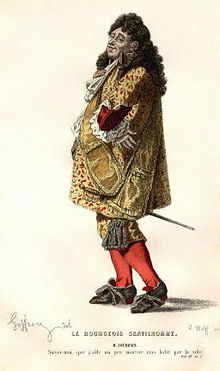
The prototypical bourgeois: Molière’s Monsieur Jourdain, the protagonist of the play Le Bourgeois gentilhomme (1670)
Radebe’s vision of a better & more competitive society? Replace Monsieur Jourdain with a new version of Sandton’s bourgeoisie?
Antitrust plan unclear

How the SA antitrust watchdogs (the Competition Commission and the Competition Tribunal) were going to be “further developed” – structurally, scope/jurisdictionally, personnel-based or otherwise – was not immediately clear.

The remarks were part of the minister’s statement in the parliamentary opening debate on the president’s state-of-the-nation address.

Justice Minister Jeff Radebe (Image via Times Live, by: SYDNEY SESHIBEDI)

Namibian merger control: 1st deal of 2014 gets conditions

namibia

Namibian Competition Commission Imposes Conditions on Mining Deal

The Namibian Competition Commission has given its first conditional approval of the year in a gold-mine transaction, imposing employment conditions that require the purchaser not to lay off any employees for a minimum of two years from the date of sale.

Unemployment concerns drive antitrust ruling

The Commission stated, per reporting on AllAfrica.com, that there were no reasons to block the deal on a lessening-of-competition grounds under section 47 of the Competition Act, but that it was “concerned about the effect of the sale on employment, hence the imposition of the above condition.”

AAT reported last year on the revision of the Namibian competition law to include consumer-protection provisions, which would allegedly bar M&A deals not only on pure antitrust grounds but also on a more broadly defined “unfairness” basis.

In the current deal, buyer Guinea Fowl Investments Twenty Six will acquire the Navachab gold mine from AngloGold Ashanti Namibia, which since last year has had gold-mining competition from one other player (B2Gold) in the domestic market.

First 2014 deal with conditions

We note that no other cleared transaction has had conditions imposed since the beginning of the calendar year, as shown by the agency’s May M&A update 2014:

Namibian NaCC approved deals as of May 2014


New Competition Commissioner not so new: Bonakele retains top job

south_africa

Interim South African Acting Competition Commissioner Tembinkosi Bonakele confirmed in permanent post by minister who unceremoniously fired predecessor Ramburuth

Plus ça change, plus c’est la même chose…

This morning, economic-development minister Ebrahim Patel announced the retention of the 38 year-old Mr. Bonakele as the top antitrust enforcer in the South African republic, making permanent for a five-year term the interim appointment of the man who said the following in an interview regarding the independence of the competition authorities in South Africa:

While competition authorities should not be beholden to the government neither can they be loose cannons who claim independence without accountability.”

In prolonging Mr. Bonakele’s interim appointment for another five years, Minister Patel thus assured that the important position of Competition Commissioner did not go to a “loose cannon”…

Legislative basis

The appointment is made pursuant to Part A, Art. 22 of the South African Competition Act of 1999, as amended, which also provides (in sub section 4) for the flexible salary and benefits determination to be made by the minister himself: “The Minister must, in consultation with the Minister of Finance, determine the Commissioner’s remuneration, allowances, benefits, and other terms and conditions of employment

Minister Patel
Commissioner Bonakele
Public announcement and emphasis on enforcement

In the duo’s official tweets announcing the decision (see graphic extract below), Patel congratulated Mr. Bonakele, reaffirming his and the SA cabinet’s support of the “eminently suitable” candidate, and emphasizing the importance of (1) the Competition Commission‘s ongoing and hotly debated private health-care inquiry as well as (2) the “social-justice” elements of merger conditions imposed by the SACC on mergers in the past 5 years, purportedly “protecting” 4,900 jobs.

The agency had come under considerable flak in the past year due to its high staff and executive-level turnover and a work environment that has been described as “toxic” by insiders.

The official release by the Ministry of Economic Development quotes Patel as follows:

“I am pleased to have someone of Bonakele’s calibre at the helm of the Competition Commission. He is taking leadership of the Commission at a time when the South African economy needs to become more competitive and create many more decent work opportunities by combatting market abuse such as cartels and pervasive monopolies and ensure competitive pricing of products. In particular, the key jobs drivers identified in our policy frameworks require coordinated and concerted efforts improve economic performance and development outcomes.
“The Competition Commission has been one of a number of successful economic agencies and regulators that are together beginning to transform the South African economy. Mr Bonakele possesses the skills and experience to build on the successes of the Competition Commission.”

The agency’s official “Structure” page had not yet been updated as of the day of the announcement, listing Mr. Bonakele as “Acting” head and still showing the long-departed Ms. Makhaya as a Commission official.

Official S.A. government tweets announcing SACC personnel decision of permanent Bonakele appointment

S. African antitrust watchdog described as “toxic” by insider

south_africa

Trade union NEHAWU’s influence over agency staff cited as reason for departure

According to an excellent piece in the ZA Financial Mail – written by Andile Makholwa* and entitled “Competition Commission Bleeds Staff” – departing Acting Deputy Commissioner Trudi Makhaya has explained in detail her recent decision to leave the antitrust authority, describing a “toxic” work environment there since at least October 2013.  On the staffing front, Acting Commissioner Bonakele is quoted as regretting her departure, saying that “one of his priorities is to repair the fractured relations with senior managers and contain the staff exodus.” In the article, Makhaya is cited as bemoaning the increasing influence of NEHAWU (a powerful trade union) over the agency and its staff.

Ms. Makhaya (photo credit: Financial Mail)

While Ms. Makhaya has had her fair share of agit-prop P.R. published under her name (see, eg., her piece published this piece in the Daily Maverick, entitledThe temptations of neo-volkskapitalisme), her insider revelations of NEHAWU’s unduly high influence over the Commission are particularly interesting.

Many ZA commentators have lamented the increasingly pervasive sway that trade unions have in merger-control talks with the enforcer.  This is especially important in light of South Africa’s merger-control regime having express “public interest criteria” embedded in its legislation.

Two ZA antitrust lessons

  1. The legislation’s social agenda element, combined with the now confirmed unions’ influence over agency staff, may have resulted (and will likely result in the future, if unchecked) in extensive so-called “public-interest” conditions imposed on otherwise unproblematic transactions that pose no pure antitrust issues.
  2. The ZA Competition Commission has received extensive bad press of late.  Now, even insiders speak out about the (personnel, rather than structural) problems that have befallen the agency.  Specialist publications (such as Global Competition Review, which publishes a dedicated review and ranking of government antitrust enforcement agencies, in which the Commission used to fare rather well), as well as practitioners and the courts, may perceive these developments as significant steps backward for an institution that once was lauded as a shining example of developing competition-law authorities.  Even Acting Commissioner Bonakele admits that the authority is “in a rebuilding phase. All I can say is that the commission is losing a key staff member. It’s a setback. When you’re rebuilding an institution you need all hands on deck,” and the minister in chage (Patel) believes the Commission too independent.


* The author also wrote an interesting piece on the Competition Commission‘s sectoral health-care inquiry (we reported here and elsewhere) in last week’s FM.