Game On for Regional Merger Control: EACCA to Start Receiving Merger Notifications from November 2025

By Megan Armstrong

In a long-anticipated move towards deeper regional integration and harmonised competition oversight, the East African Community Competition Authority (“EACCA”) has formally announced that it will begin receiving and reviewing merger and acquisition notifications with cross-border effects as of 1 November 2025

This marks a significant implementation milestone under the East African Community Competition Act, 2006, which established the EACCA as the supranational body responsible for enforcing competition policy among the eight EAC Partner States. These Partner States are the Republic of Burundi, the Democratic Republic of Congo, the Federal Republic of Somalia, the Republic of Kenya, the Republic of Rwanda, the Republic of South Sudan, the Republic of Uganda and the United Republic of Tanzania. 

Notably, on 10 June 2025, the COMESA Competition Commission (“CCC”) and the EACCA signed a Memorandum of Understanding (“MOU”) aimed at strengthening collaboration between the two agencies. With six of the eight East African Community (“EAC”) Partner States also being members of COMESA, the MOU seeks to minimise potential duplication in enforcement, while promoting joint advocacy efforts and an enhanced legal certainty and predictability for businesses operating across the region. 

Under the newly effective merger control framework, a transaction must be notified to the EACCA if the combined turnover or assets (whichever is higher) of the merging entities in the EAC equals or exceeds USD 35 million, and at least two of the undertakings have a combined turnover or assets of USD 20 million in the EAC, unless each achieves at least two-thirds of its aggregate turnover or assets in the same Partner State. 

Importantly, once a qualifying transaction is notified to the EACCA, there is no requirement to file with national competition authorities, thereby streamlining the merger review process for regional transactions. Merger notifications will be subject to fees ranging from USD 45 000 to USD 100 000, based on the size of the transaction. 

While the EACCA’s enforcement powers have been active in areas such as restrictive business practices, the operationalisation of merger control fills a long-standing gap in this regional competition regime. It also brings the EAC in line with other regional economic communities like the CCC and ECOWAS Regional Competition Authority (“ERCA”), which already exercise merger control functions. 

Firms with pending or planned transactions in the region should prepare to engage with the Authority under this new regime, ensuring timely filings and compliance from November onwards.

The ECOWAS Merger Control Regime: A New Chapter in Regional Competition Law

By Matthew Freer 

Introduction

The Economic Community of West African States (“ECOWAS”) marked a significant step toward deeper regional integration and market regulation with the formal activation of its merger control regime on 1 October 2024. This regime, now operational under the ECOWAS Regional Competition Authority (“ERCA”), brings a unified, supranational dimension to competition enforcement across the 15 ECOWAS member states. These member states are Benin, Burkina Faso, Cabo Verde, Cote d’Ivoire, The Gambia, Ghana, Guinea, Guinea-Bissau, Liberia, Mali, Niger, Nigeria, Senegal, Sierra Leone, and Togo.[1] This new framework aims to safeguard the regional market against anti-competitive mergers and acquisitions, foster economic development, and ensure fair competition. It also positions ECOWAS among the growing number of African regional economic communities introducing comprehensive competition oversight mechanisms.

Established on 28 May 1975 through the Treaty of Lagos, ECOWAS was conceived to promote economic integration across the West African sub-region. Its initial vision was to foster a large economic and trading bloc through cooperation in industry, transport, telecommunications, energy, agriculture, commerce, monetary and financial policy. Over time, ECOWAS has evolved to address broader governance issues, including political stability, security, and economic justice, making its merger control regime a natural extension of its mandate to build a fair and efficient regional economy.

Legal Foundations and Institutional Framework

The legal foundations and institutional framework for the ECOWAS merger control regime are built on a series of key legal instruments that establish the rules for competition within the region. The key foundational document is the Supplementary Act A/SA.1/12/08, adopted in 2008, which introduced the ECOWAS Competition Rules and established ERCA as the institutional mechanism to implement them.[2] This Act was followed by Regulation C/REG.23/12/21, which laid down the procedural rules for merger notification and review within the region.[3] In early 2024, Implementing Regulation No. 1/01/24 was promulgated to clarify notification thresholds, filing requirements, and review timelines.[4] These instruments collectively define the substantive and procedural contours of the regime and signal a shift toward rules-based governance of regional competition policy. 

Scope and Jurisdiction

The scope of the ECOWAS merger control regime is broad and designed to capture transactions with cross-border implications within the Community. The regime is both mandatory and suspensory in nature, meaning that parties must notify qualifying transactions and obtain clearance before implementation. Specifically, a merger must be notified if the parties involved operate in at least two ECOWAS member states and meet certain financial thresholds. The primary thresholds relate to turnover or asset value within the region: the combined turnover or relevant balance sheet total of the merging parties must exceed 20 million West African Units of Account (“WAUA”), roughly equivalent to $26.8 million, and at least two of the parties must individually exceed 5 million WAUA, or approximately $6.7 million.[5] Importantly, these thresholds are based on regional economic activity, rather than global figures, ensuring that the rules are directly tailored to the regional market context in which the member states operate. Still, companies operating primarily in a single large ECOWAS economy, such as Nigeria, may wonder whether regional thresholds fairly reflect domestic realities. 

Definition of Mergers and Control

Under the ECOWAS rules, the term “merger” includes a range of transactions such as acquisitions of control, the creation of joint ventures, or other forms of consolidation between entities.[6] “Control” is broadly defined to include not just the legal ownership of a majority of shares or voting rights but also de facto control—meaning the capacity to exert decisive influence over an enterprise’s strategic commercial behaviour.[7] In simpler terms, this means the ability to influence or decide a company’s major decisions and actions, even without owning it outright. This broad interpretation of control is similar to that used by both the Common Market for Eastern and Southern Africa (“COMESA”) and South Africa, which consider influence beyond shareholding, including through management or policy direction.[8]This mirrors a growing understanding across Africa that control can be exerted in subtle but decisive ways, not unlike influence in boardrooms or state-linked enterprises.

Procedural Review Timelines

Once a notification is submitted, ERCA’s Executive Director is tasked with the initial review of the merger, which must be concluded within 60 working days. If further information is required, the Director may extend this deadline by another 30 working days. After the completion of the initial review, the ERCA Council is granted an additional 30 working days to make a final decision on the transaction. This period may be extended by a further 15 days where necessary. Therefore, the total possible days for a final decision from the date of the initial notification is 135 working days. Although the legislation provides these timelines, it does not clarify the frequency of Council meetings, raising possible questions about potential procedural delays and administrative backlog. 

Understandably, given the novelty of the regime, there is a risk that administrative capacity may initially lag behind its procedural ambitions—though this is a challenge that is likely to diminish as institutional experience and capacity builds over time.

Notification Fees and Enforcement Penalties

The financial obligations imposed on notifying parties also deserve attention. A notification fee is payable and may amount to 0.1% of the combined annual turnover or asset value—whichever is higher—of the companies involved within ECOWAS. This fee structure, notably, has no statutory ceiling, which could render compliance particularly costly for large-scale mergers. Such uncapped fees introduce a level of uncertainty into the merger planning process and may discourage investment or create disparities between firms of different sizes. Given this, it might be worth considering a sliding scale or a cap to ensure that start-ups and small and medium enterprises (“SMEs”) are not unfairly burdened by compliance costs. Nevertheless, this mechanism reflects a growing trend among African competition authorities to align filing fees with the potential market impact of a transaction. 

If parties fail to notify a qualifying merger, or proceed with implementation before clearance is granted, ERCA may impose fines of up to 500,000 WAUA per day. These penalties, which equate to approximately $660,000 daily, are designed to ensure compliance and deter strategic non-disclosure.[9] This is notably harsher than COMESA’s flat $500,000 fine.[10] Such a stringent approach is consistent with the practices of more established jurisdictions and signals ERCA’s intent to enforce its mandate robustly. However, in a region where the ability to enforce regulations and the private sector’s understanding of competition law are still developing, this tough enforcement model could cause problems and require ongoing efforts to build capacity.

Substantive Assessment and Public Interest Considerations

In terms of substantive assessment, ERCA is empowered to block a merger that substantially lessens or is likely to substantially lessen competition within the ECOWAS common market. However, the authority also retains the discretion to approve otherwise anti-competitive mergers if they are deemed to serve a compelling public interest. This approach being similar to other African jurisdictions, particularly South Africa. Factors that may justify such exceptions include the promotion of socio-economic development, the protection of SMEs, and broader regional development goals.[11] This public interest override introduces a layer of flexibility to the competition assessment, but also demands careful balancing to ensure that economic efficiency is not sacrificed in pursuit of political or social objectives. Used wisely, this discretion can empower regional development—but overuse however could compromise the credibility of competition law as a neutral economic tool.

Appeals Mechanism and Judicial Review

The possibility of judicial review also reflects ECOWAS’s commitment to transparency and the rule of law. Parties aggrieved by ERCA’s decisions may appeal to the ECOWAS Court of Justice. This appeals mechanism is essential in safeguarding procedural fairness and offers a vital check on the Authority’s exercise of power.[12] However, the ECOWAS Court’s experience and ability to handle competition law cases are still developing, and it’s unclear how actively and effectively it will deal with these disputes. Building a body of jurisprudence will take time, but even a few early decisions could establish helpful precedent for future cases.

Emerging Challenges

Despite its promise, the implementation of the ECOWAS regime is not without its challenges. First among these is the potential for jurisdictional overlap with national competition authorities and with the West African Economic and Monetary Union (“UEMOA”), which also exercises competition law functions within several ECOWAS states. This duplication may result in regulatory uncertainty, forum shopping, and increased compliance costs for businesses operating in the region. In the East, COMESA faced similar early coordination challenges, and ECOWAS would do well to draw lessons from that experience in harmonising efforts with UEMOA. Moreover, the regime enters into force at a time of political uncertainty in West Africa, with three ECOWAS member states—Burkina Faso, Mali, and Niger—currently suspended or in the process of exiting the Community. The regional political context may complicate the regime’s uniform application and threaten its credibility as a pan-West African legal instrument.

Conclusion

Notwithstanding these concerns, the ECOWAS merger control framework represents a landmark moment in the evolution of African competition policy. It brings the region into alignment with global and continental trends, offering a platform for increased regulatory convergence and cross-border cooperation. For legal practitioners and multinational corporations operating in the region, the message is clear: compliance with ECOWAS merger rules is no longer optional, and legal due diligence must include early engagement with ERCA’s requirements. While aspects of the regime may still require some clarification and refinement, particularly in relation to thresholds, procedures, and enforcement modalities, the overall architecture provides a strong foundation for fostering competitive regional markets.

The operationalisation of the ECOWAS merger control regime is a welcome development for those advocating deeper economic integration and regulatory harmonisation in West Africa. As the Authority gains experience and jurisprudence begins to develop, ERCA is likely to become a central actor in shaping the competitive landscape of the region. For this to succeed, continued engagement between regional institutions, national authorities, and the private sector will be essential. The challenge ahead lies not only in enforcing the rules but in embedding a culture of compliance and competition across ECOWAS’s diverse and dynamic member states. In time, perhaps ECOWAS could even serve as a model for other African regions where economic integration is still at a conceptual stage.


[2] Economic Community of West African States (ECOWAS), Regulation C/REG.23/12/21 on the Implementation of the ECOWAS Competition Rules by the ECOWAS Regional Competition Authority (ERCA), December 2021

[3] Regulation C/REG 23/12/21 on the Rules of Procedure for Mergers and Acquisitions in ECOWAS

[4] Regulation C/REG.1/01/24 on the Procedural Manuals on Thresholds for Mergers and Acquisitions in ECOWAS. 

[5] Manual of Threshold for Mergers and Acquisitions and Threshold Indicating a Dominant and Monopolistic Position.

[6] Manual of Threshold for Mergers and Acquisitions and Threshold Indicating a Dominant and Monopolistic PositionAt page 3.

[7] Supplementary Act A/AS.1/12/08 Adopting Community Competition Rules and the Modalities of their Application within ECOWAS.

[8] COMESA Merger Guidelines (2014), sec. 2.3.


[10] COMESA Competition Rules, Art. 24.

[11] Economic Community of West African States (ECOWAS), Regulation C/REG.23/12/21 on the Implementation of the ECOWAS Competition Rules by the ECOWAS Regional Competition Authority (ERCA), December 2021.

[12] ECOWAS Regional Competition Authority (ERCA), Welcome to ECOWAS Regional Competition Authority, available at: https://www.arcc-erca.org/ (accessed 25 April 2025).
New Book Alert: “Regulating for Rivalry: The Development of Competition Regimes in Africa”

Book Launch Monday: CCRED’s latest covers AAT’s bread and butter, namely the rise of regulatory antitrust frameworks across the African continent.

The Centre for Competition, Regulation and Economic Development (“CCRED”) has announced the launch of its latest publication: “Regulating for Rivalry: The Development of Competition Regimes in Africa”. Co-edited by Reena das Nair, Simon Roberts, and Jonathan Klaaren, this book looks to be a comprehensive compilation of cutting-edge research and analyses, bringing together the key papers presented at previous ACER Week (Annual Competition and Economic Regulation) conferences. It also includes contributions from CCRED’s ongoing work, reflecting a rich exchange of ideas aimed at fostering competitive markets and effective regulation across the African continent. 

One of the notable contributions in the book is a paper written by Primerio’s John Oxenham, Michael-James Currie, and Joshua Eveleigh, titled “Buyer Power in Emerging Markets: Assessing the Effectiveness of Regulatory Enforcement Developments in South Africa and Kenya”. This paper delves into the complex dynamics of buyer power, particularly in emerging markets, and evaluates the impact of recent regulatory enforcement efforts in South Africa and Kenya. Their research provides critical insights into the challenges and successes of regulatory buyer power within these key African economies, offering valuable lessons for policymakers and regulators across the continent. 

“Regulating for Rivalry” will be available in both digital and print formats towards the end of 2024. The book is expected to be an essential resource for academics, regulators, legal practitioners, and policymakers engaged in the development and enforcement of competition law in Africa. It showcases the growing maturity and innovation of competition regimes across the continent, highlighting the critical role of effective regulation in promoting economic development and inclusive growth. 

More Regional Antitrust: Competition law in West Africa at the hands of ECOWAS

After the successful launch (and by now, first decade) of its Eastern regional counterpart, the COMESA Competition Commission, as of today, West Africa’s ECOWAS body likewise boasts a supra-national antitrust enforcement regime. AAT will be following its path closely.

By Jannes van der Merwe

The Economic Community of West Africa States (“ECOWAS”) was established by fifteen West Africa countries (“member states”) in 1975 when the member states signed the ECOWAS Treaty, with the aim and objectives to maintain and enhance economic stability and development in Africa.[1] The member states signed the revised treaty in 1975, currently governing the member states.

The current member states are Benin, Burkhina Faso, Cabo Verde, Côte d’Ivoire, The Gambia, Ghana, Guinea, Guinea Bissau, Liberia, Mali, Niger, Nigeria, Senegal, Sieera Leone and Togo.

Authority Established in 2008

In 2008 ECOWAS implemented two pieces of legislation through the authority of the treaty to steer the competition framework within the member states. The first was the Supplementary Act A/SA.1/12/08, and the second Supplementary Act A/SA.2/12/ 08.

Supplementary Act A/SA.1/12/08:

The purpose of this piece of legislation (known as the Community Competition Rules) nutshell is to promote competition, enhance economic efficiency, prohibit anti-competitive conduct that restricts or distorts competition, ensure consumer welfare and to expand opportunities for domestic enterprises of the member states. [2]

Supplementary Act A/SA.2/12/ 08:

The purpose of this piece of legislation was to establish a regional body to be known as the ‘ECOWAS Regional Competition Authority’ (“the Commission”) to govern, oversee and implement the Community Competition Rules.

The Commission

The formal launching of the Commission took place in May 2019. In December 2021, together with further enactment of legislation, the Council of Ministers of ECOWAS amended Supplementary Act A/SA.2/12/ 08 to, inter alia, enhance article 2, governing the bodies of the ERCA[3].

The amendment established two formal bodies of the ERCA, being the Council and the Executive Board of the ERCA, together with the Executive Directorate who is the administrative, investigative and implementing body of the Council’s decisions[4].

On 2 October 2024 the newly elected Council of the Commission will be sworn in at Banjul, the capital of the Republic of Gambia. See photo below.

This event will mark the dawn of a new day for competition in West Africa, whereby the Commission, through the Council, will become fully functional in order to administrate and give effect to the Competition Rules to member states.

Legal Framework

The Commission, through the Council, will be able to give effect to the preamble of the Treaty and align a vitally important piece that was missing from the practical application of the treaty.

The Community Competition Rules will be the governing legislation providing the umbrella under which the Commission will operate.

During December 2021, the Council of Ministers for ECOWAS further enacted regulations to govern the rules and procedures to give effect to the articles of the Community Competition Rules established in 2008.

A brief description of all the relevant legal framework will be discussed below.

 The Competition Community Rules

The Competition Community Rules will regulate, inter alia, Agreements and Concerted Practices in Restraint of Trade; Abuse of Dominant Position; Mergers and Acquisitions; State Aid; Public Enterprises; Compensation for Victims of Anti-Competitive Practices; Authorisation and Exemptions; Agreements Concluded by Member States and the Application and Implementation of the Community Competition Rules[5].

ERCA’s Rules of Procedure in Competition Matters

Regulation C/REG.24/12/21[6] was established to set out the rules and procedures of the ECRA in competition matters and by doing so, harmonising competition laws, procedures, cooperations, investigations, exchange of information, decision making, enforcement, sanctions and compensation[7].

Supplementary Act A/SA.3/12/21

The amended act’s new article 3 provides a positive duty on the Commission to represent ECOWAS wherever necessary in matters of competition and consumer protection[8].

Mergers and Acquisitions in ECOWAS

Regulation C/Reg. 23/12/21[9] was established to set out the rules and procedures for mergers and acquisitions.

This regulation requires that merging parties of member states that meets the threshold will have to obtain prior approval before implementing. The merger threshold is governed by enabling Rule PC/REX.1/01/2024[10]

Leniency and Immunity Proceedings in Competition within ECOWAS

Regulation C/REG.22/12/21[11] was established to set out the rules, conditions and procedures of leniency and immunity applications to the Commission. Simultaneously, this regulation is a guide to the Commission in the exercise of its investigative and prosecutorial discretion in illegal cartels who, through their cooperation, help to reveal Cartel conduct[12].

Regulation C/REG.22/12/21 is accompanied with enabling Rule PC/REX.1/01/24[13] containing the manual for leniency and immunity applications and what leniency and immunity the Commission may grant for enterprises of member states which are engaged in anti-competitive behavior and who voluntarily disclose information to facilitate the Community Competition Rules.

Final Word

The operational ECOWAS Regional Competition Authority and the implementation of a functioning Council for the ECOWAS Regional Competition Authority is a leap forward in the West Africa competition sphere and will protect enterprises and enhance competition within the West Africa markets, providing benefits for entrepreneurs, enterprises and consumers.


[1] Article 3, ECOWAS Revise Treaty, 24 July 1993 (‘the treaty;’).

[2] Supplementary Act A/SA.1/12/08, Article 3.

[3] Supplementary Act A/SA.3/12/21 Relating to the Amendments of Supplementary Act A/SA.2/12/08.

[4] Article 2(new), Supplementary Act A/SA.3/12/21 Relating to the Amendments of Supplementary Act A/SA.2/12/08.

[5] Article 5-13, Supplementary Act A/SA.1/12/08.

[6] Regulation C/REG.24/12/21 on the ERCA’s Rules and Procedures in Competition Matters.

[7] Article 3, Regulation C/REG.24/12/21 on the ERCA’s Rules and Procedures in Competition Matters.

[8] Article 3(new), Supplementary Act A/SA.3/12/21 Relating to the Amendments of Supplementary Act A/SA.2/12/08.

[9] Regulation C/Reg.23/12/21 on the Rules of Procedure for Mergers and Acquisitions in ECOWAS.

[10] Enabling Rule PC/REX.1/01/24 on Manuals of the Procedures of the ECOWAS Regional Competition Authority.

[11] C/REG.22/12/21 on the Rules on Leniency and Immunity Procedures in Competition within ECOWAS.

[12] Article 1, C/REG.22/12/21 on the Rules on Leniency and Immunity Procedures in Competition within ECOWAS.

[13]  Enabling Rule PC/REX.1/01/24 on Manuals of the Procedures of the ECOWAS Regional Competition Authority.

In Conversation with African Antitrust Agencies: Nigeria

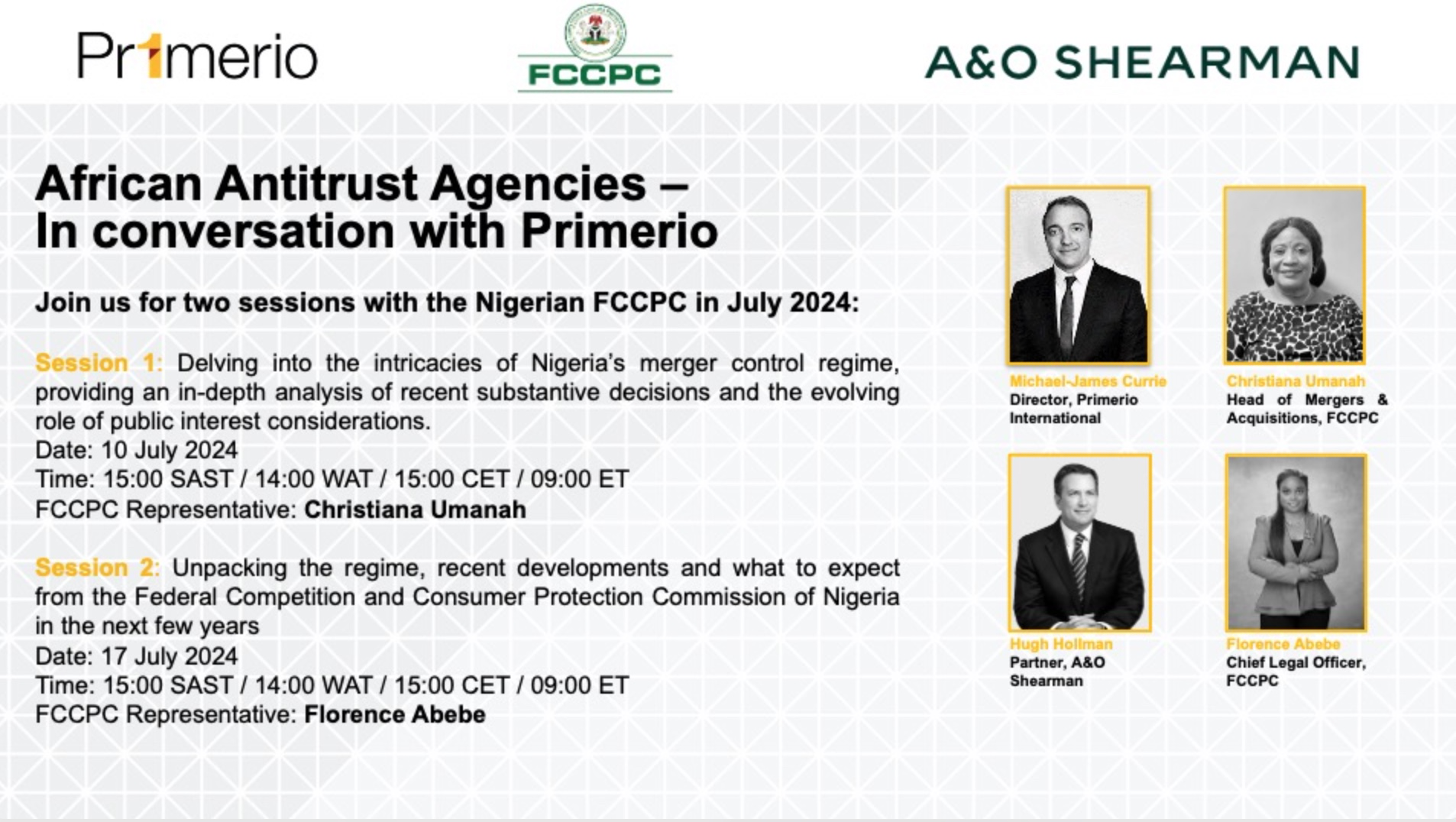
A Primerio-sponsored webinar recently put the spotlight on Nigeria’s burgeoning FCCPC

On 10 July 2024, advisors from pan-African law firm Primerio continued their “African Antitrust Agencies – in Conversation with Primerio” series with the Nigerian Federal Competition and Consumer Protection Commission (“FCCPC”) in the first of two sessions aimed at a quick snapshot of the most noteworthy enforcement, legislative, and policy developments. 

This first session focused on merger control. 

Primerio’s Michael-James Currie, Competition Law Partner at Primerio (Johannesburg) was joined by Hugh Hollman, Competition Law Partner at A&O Shearman (Washington & Brussels) and had the pleasure of speaking with Christiana Umanah, the Head of the FCCPC’s Merger Control Department

This recent webinar featured insights from Hugh Hollman, an experienced international antitrust partner at A&O Shearman, and Christiana Umanah, head of FCCPC’s merger division. Christiana Umanah elaborated on the rapid development of the FCCPC since the Federal Competition and Consumer Protection Act (“FCCPA”) was enacted in 2018. She outlined the structure and growth of the FCCPC, noting its establishment in 2019 with an active team of eight in the mergers department, along with offices in all 36 states of Nigeria, and 6 regional offices. Christiana emphasized the regular training received by FCCPC staff both locally and internationally, with recent sessions in Mauritius and Barcelona. The FCCPC maintains collaborative relationships with international agencies such as the FTC, and the DOJ, especially for capacity building and training. She detailed the timelines for merger reviews in Nigeria, which usually take 60 business days, extendable to 120 business days for complex antitrust cases, while harmonizing multi-jurisdictional reviews and offering a fast-track option to reduce the timeline by 40 business days. 

Addressing foreign-to-foreign mergers, Christiana explained that the FCCPC assesses these based on local turnover, focusing on the specific business presence in Nigeria. She also discussed the penalties for gun-jumping, which are commonly based on 2% turnover for the last financial year, considering factors like knowledge, cooperation, and company size. The FCCPC is open to pre-merger consultations on a no-name basis, ensuring confidentiality while guiding parties through the process. Christiana shared examples of conditions imposed on transactions, such as divestments and board member exit to prevent market concentration. Public interest considerations are also a key focus for the FCCPC, particularly regarding employment and market impact, as demonstrated in a case involving a failing firm where job preservation was prioritized. Looking ahead, the FCCPC is developing regulations for digital transactions and e-market platforms to address emerging issues in the digital market. The webinar concluded with a note on the importance of ongoing dialogues and the FCCPC’s willingness to assist with information and support. 

The transcript for this session is available here, and the recording of this session is available on Primerio’s YouTube page, accessible here

Our next session of Primerio‘s “in conversation with…” series remains focused on Nigeria, as we will discuss recent enforcement activity and legislative & policy developments. Join Hugh Hollman, the FCCPC’s senior officer, Florence Abebe and Primerio partners for another concise but very useful session as Nigeria’s FCCPC Nigeria gains prominence across the Continent.

Register for this upcoming session here.

Malawi Revamps its Antitrust Laws: Suspensory Merger Control and More

Not only did the Malawian government revise its 26 year-old competition law, but it effectively repealed the old statutory regime under the “Competition and Fair Trading Act”, and it has now enacted its replacement, the so-called “Competition and Fair Trading Act of 2024.”

Says Andreas Stargard, who practices competition law with Primerio Intl., “the new regime had been in the works for several years, with input from the broader international and pan-African competition communities, both private and academic, as well as from fellow antitrust enforcers across the globe. We are pleased to see this revision effort come to fruition in the form of the CFTA 2024, which notably introduces a suspensory merger-control provision — meaning companies that meet the Malawian thresholds for notifying their M&A activity must put on hold the closing of their deal until it is cleared by the authority, the CFTC.”

Parties considering entering into transactions affecting the Malawian market should note, Stargard observes, that Malawi is part of the COMESA competition-law area, “which would require firms to consider whether or not there is a COMESA community dimension to their transaction, thereby possibly negating one or more domestic filings with [National Competition Authorities], and instead making a ‘one-stop-shop’ notification to the CCC.” Coincidentally, the COMESA Competition Commission is also headquartered in the Malawian capital, Lilongwe, so “parties can expect there to be extensive collaboration between the supra-national CCC enforcement teams and the CFTC’s domestic-focussed antitrust lawyers,” Mr. Stargard surmises.

The in-depth text of the Malawian press release is as follows:

 ENTERING INTO FORCE OF THE NEW COMPETITION AND FAIR TRADING ACT 

You will recall that the Competition and Fair Trading Commission (CFTC) has been reviewing the Competition and Fair Trading Act (CFTA) of 1998 in order to fill the existing gaps and enhance its effective enforcement. The CFTC is pleased to announce that the process of repealing the CFTA of 1998 was completed and it has been replaced with a new legislation, the Competition and Fair Trading Act of 2024. 

The new legislation was passed by Parliament on 5th April, 2024, and was assented to by the State President, His Excellency, Dr Lazarus Chakwera on 19th May 2024. In accordance to Section 1 of CFTA of 2024, The new Act shall come into force on a date to be appointed by the Minister, by notice published in the Gazette. The Competition and Fair Trading Act of 2024, therefore, comes into force today, 1st July, 2024, following the gazetting of the notice, signed by the Minister of Trade and Industry, Hon. Sosten Gwengwe, MP, which appoints this date. 

CFTC is extremely pleased with this development as it signals an end to some of the enforcement challenges the institution was facing with regard to the enforcement of the old Act due to the gaps in some of the key provisions in the law. In addition, the CFTA needed to be aligned with the recent developments in the enforcement of competition 

and consumer protection law, reflective of the current market dynamics in the economy. Furthermore, the CFTA required to be aligned with international best practices in the enforcement of competition and consumer protection. 

In order to address these gaps, there are several changes that have been made to the CFTA of 2024. Below is a highlight of some of the key changes: 

i. Competition Regulation 

The major change that has been brought in is on Suspensory Merger Notification. The 1998 CFTA provided for voluntary notification of mergers and acquisitions; which meant that mergers having potential harm to competition process and consumer welfare could be effected without seeking authorisation from the CFTC. The new CFTA has made notification of mergers and acquisitions mandatory, based on determined thresholds. 

The new Act has also expanded on the provisions on anticompetitive business practices, to make it very encompassing but also effective to regulate and enforce. These areas include: restrictive business practices; collusive conducts (cartels); abuse of market power; but also mergers and acquisitions. 

ii. Consumer Protection 

The CFTA of 1998 narrowly defined the term “Consumer”. The definition under the old Act left out some stakeholders that are equally affected by unfair trading practices, which include: consumers of technology, consumers of digital products, beneficiary consumers, but also other users of goods or services for purposes of production of other goods or services. For this reason, various vulnerable groups that did not fall within that narrow definition were not effectively protected from unfair trading practices 

The CFTA of 2024 has also brought in several types of unfair trading practices that were not included in the CFTA of 1998. Among others, these include the following: 

 failure to give warranty or guarantee on goods for long term use; 

 improper or insufficient labelling of products; 

 failure to disclose material information about the products supplied; 

 engaging in excessive or exploitative pricing of the products. 

 imposition and implementation of unfair terms in consumer contracts. 

iii. Abuse of Buyer Power 

The CFTC of 1998 focused on abuse of supplier (seller) power and not the abuse that may arise from powerful or dominant buyers. This made it difficult to deal with malpractices by buyers, including those involved in buying farm produce from farmers. 

The CFTA of 2024 has included various provisions to redress malpractices resulting from abuse of buyer power. The Act has expressly prohibited the powerful and dominant companies that purchase agriculture produce from the farmers not to engage in any anticompetitive and exploitative conducts. For example, the Act prohibits, among others, the following conducts: 

 delays in payment of suppliers, without justifiable reason, in breach of agreed terms of payment; 

 unilateral termination or threats of termination of a commercial relationship, without notice or on an unreasonably short notice period, and without an objectively justifiable reason; 

 refusal to receive or return any goods or part thereof without justifiable reason, in breach of the agreed contractual terms; 

 transfer of commercial risks meant to be borne by the buyer to the suppliers; 

 demands for preferential terms unfavourable to the suppliers; 

 demanding limitations on supplies to other buyers; 

 reducing prices by a small, but significant, amount where there is difficulty in substitutability of alternative buyers or reducing prices below competitive levels; or 

 bidding up prices of inputs by a buyer enterprise with the aim of excluding competitors from the market. 

iv. Penalties for Violations 

Under the CFTA of 1998, when the Commission found a business enterprise in breach, it had been imposing fines, which were provided for under Section 51. However, in 2023, in the matter of CFTC v Airtel Malawi Plc, the Court ruled that the said provision does not empower the CFTC to impose fines, on the grounds that the violations were designated as being criminal in nature. Specifically, under section 51 of the CFTA of 1998, the provision for imposing the fines was combined with sanctioning of an imprisonment sentence of up to 5 years. The ruling in the CFTC v Airtel Malawi Plc case, thus weakened the regulatory mandate of the CFTC. In addition, the 1998 CFTA did not provide for aggravating and mitigation factors for the Commission to consider in coming up with fines and/or orders. 

The CFTA of 2024 gives express powers to the CFTC to issue Administrative Orders, which include imposing fines on errant enterprises. Under the new Act, the fines to be imposed will be (i) up to 5% of annual turnover if it is an individual; or (ii) up to 10% of annual turnover if it is a company. The determination of the fines will depend on the applicable aggravating and mitigating factors. There are also various Orders that the CFTC can impose which are meant to redress the malpractices. These include orders to: give refunds, return or exchange defective products, withdraw false advertisements, supply the advertised/promised goods and services, and cancel unfair and exploitative contracts. 

v. Suitability and Independence of Commissioners for the CFTC 

As adjudicators of cases, the Commissioners of the CFTC are required to be sufficiently scrutinized for their qualification and suitability for their functions, but also guarantee utmost independence. Under the provisions of the CFTA of 1998, the Commissioners were not thoroughly subjected to scrutiny of Parliament once appointed, to determine their qualification and suitability for their office. Similarly, the Commissioners independence as adjudicators was not guaranteed under the old law. The CFTA of 2024 has provided that, as a way of ascertaining the Commissioners’ suitability and ensuring independence, their appointment and removal from office will be subjected to the scrutiny of the Public Appointments Committee of Parliament. 

In view of the foregoing, the CFTC would like to call upon business enterprises, consumers and the general public to take notice of the new legislation, and particularly take consideration of the provisions that have been brought into the CFTA of 2024. Furthermore, the CFTC would like to advise the business enterprises to adopt voluntary compliance with competition and fair trading laws at all times, so as not to be found in breach of the law. 

For media enquiries on this statement, contact Innocent Helema on 0880725075 or email innocent.helema@cftc.mw. 

LLOYDS VINCENT NKHOMA 

CHIEF EXECUTIVE OFFICER 

A New Dawn for African Antitrust in Uganda

By Guest Author, Simon M. Mutungi, Ph.D.

Competition law first emerged in 19th century North America where it was known as antitrust law. Back then, large companies entered legal arrangements where they formed a trust that would hold and consolidate their property. They would then cooperate as a single group in various ways to maximize their profits at the expense of customers. To better understand the impact of such an arrangement, imagine you are a kid again back in kindergarten, preparing for a tag-of-war match and you have chosen the biggest and strongest colleagues as your teammates to compete with other students. That team is going to win that competition before the whistle even blows.

Enter John D. Rockefeller, one of modern history’s richest men, who formed a trust that consolidated a large number of petroleum companies under a single board of trustees. Through this trust called Standard Oil, he controlled about 90 percent of America’s oil refining capacity at its peak. Consequently, he could price the oil as he wished, and he did not need to produce quality petroleum products as there was no strong competition against his trust. Seeing the negative effect of such an arrangement on consumers and the economy at large, neighbouring Canada would pass the world’s first competition law in 1889 followed by the U.S in 1890 to break up such trusts hence the name ‘Antitrust’ law.

Now, 134 years later, Uganda has finally caught up following this month’s presidential assent of the Competition Act 2023, a very late yet equally very welcome endeavour. Till then we had mostly relied on sectoral laws such as Uganda Communications Act and regional laws like COMESA’s Competition Protocol. More recently, the Africa Continental Free Trade Area Competition Protocol was also promulgated. Competition law is basically a policy designed to promote fair market competition by regulating anti-competitive conduct by companies. Uganda’s introduction of a Competition Act marks a significant stride in its economic legislative framework, aiming to create a fair business environment and improve consumer welfare. This editorial highlights the ABCs of competition law tailored for businesses and individuals who might be unfamiliar with the concept, in the context of Uganda’s new law.

Levelling the playing field

Imagine a marketplace in Uganda where only one seller has maize to sell. Without competition, this seller can charge high prices, and buyers have no choice but to pay up if they need maize. That seller would also have no incentive to produce good quality maize products since there would be no other alternatives to his products. Competition law levels the playing field by preventing such monopolies and ensuring that no single company can dominate a market to the detriment of consumers and competitors. It encourages innovation, fair pricing, and quality through healthy competition. By regulating anti-competitive practices, such as price-fixing and market sharing, competition law keeps markets open and accessible, allowing new entrants and fostering an environment where businesses of all sizes can thrive. This ensures consumers benefit from a wider choice of products and services, improved quality, and better prices.

 The Ugandan Competition Act 2023

President Museveni signed this law into effect on 2nd February 2024.and it addresses various practices as explained below:

 Prohibition of anti-competitive agreements.

The Act in effect, for instance prevents MTN and Airtel from agreeing on a deal to fix airtime or data prices at a certain level. It prevents Nile Breweries and Uganda Breweries from agreeing on a deal to limit the production of beers to cause a shortage and increase the price of Nile Special or Tusker Lite respectively. Under the Act, NTV cannot coordinate with NBS TV to divide the tele-broadcasting market by region, where one channel exclusively airs content in one area while the other operates in a different region, thereby avoiding direct competition. These are all examples of a horizontal agreement between competitors. The Act also prevents vertical arrangements such as tying arrangements where for example City Tyres would contract with Cafe Javas to only serve food to clients that used services of the former. Another example of vertical arrangements prohibited under the Act is resale price maintenance agreements where Unilever Uganda Limited for example would enter a contract with Akiki’s Retailer Shop to sell Geisha soap at a specific price, preventing her from offering discounts or altering the price. A deal forcing Akiki’s retail shop to only sell Unilever products under an exclusive supply/distribution agreement is also illegal under the new law. This position was earlier provided by the commercial court in Ezee Money v. MTN Uganda, where court found that MTN’s use of illegal exclusivity agreements on mobile money agents and intimidation tactics in the market; restricted competitors from rendering beneficial services to the public and thus constituted unfair competition in violation of the Communications (Fair Competition) Regulations, 2005.

However, the Act’s limitation lies in the genius nature of companies, which typically avoid explicit collusion agreements, opting instead for subtle coordination through mutual adjustments in their actions without documented interactions. For instance, Mogas and CityOil may observe each other’s pricing and adjust their own prices accordingly without any direct communication. If one station raises its prices and the others follow suit, maintaining higher prices collectively, they are indirectly coordinating to benefit from higher profits at the expense of consumers, despite not having an explicit agreement to do so. While the law addresses this issue in price fixing and tendering exercises, it leaves other media open and as such it ought to address not just overt but also covert forms of collusion, ensuring it encompasses both explicit and implicit conspiracies to ensure market fairness.

Abuse of dominant position

Dominant position is defined under the Act as a firm commanding 30 percent of the market or where a group of three or more has a 60 percent market share. Such a firm(s) are not allowed to use this position to the detriment of their competition or consumers for instance through predatory pricing. This is a concept where, hypothetically, Kinyara significantly lowers sugar prices below cost to outcompete and drive Kakira out of the sugar market and once the latter has left the market, the former raises prices again, taking advantage of its now dominant market position.

Another example of abuse of dominant position is the refusal of access to an essential facility.  The Act does not define what an essential facility is but it is basically a facility/asset/infrastructure that is owned and controlled by a dominant firm or monopolist which facility a third party needs access to, to offer its own product or service. This doctrine is applied when the facility in question is something competitors cannot feasibly replicate due to legal, economic, or technical barriers, and where denying access to this facility would hinder competition.

Essentially, it ensures that no company can use control over a crucial resource to lock out competition and maintain its dominance, thereby promoting a more competitive marketplace. This doctrine has proved controversial and Ugandan courts have dealt with this issue before and will likely deal with it again. For example, can MTN commanding a dominant position in the mobile money market deny any third-party fintech aggregators access to its mobile money platform? This issue was at play again in the 2013 Ezee Money v MTN matter where the court determined that MTN had unjustly prevented Ezee Money from connecting with the aggregator, Yo! Uganda Limited, to its network. As a result, Ezee argued that it incurred substantial financial losses.

The court rejected MTN’s flimsy response that the law only protected licensed persons and held that its activities unfairly prevented, restricted or distorted competition in the communications sector contrary to the Uganda Communications Act and the Communications (Fair Competition) Regulations, 2005. MTN was ordered to pay general damages of USD 235,000 as well as punitive damages to the tune of USD 441,000, though this was appealed. This verdict, in my opinion, was the catalyst for the emergence of the hundreds of Ugandan fintech start-ups that have leveraged the essential infrastructure provided by MTN and Airtel. This development has led to the creation of a robust national payment system, ultimately and significantly benefiting us, the consumers. This will also be critical as Uganda ventures into the open banking sphere.

Mergers, acquisitions and joint ventures

The Act requires that for all mergers, acquisitions and joint ventures to be consummated, there must be authorization from the Minister of Trade. Firstly, the Minister should immediately prescribe a threshold for the kind of mergers and acquisition that will require ministerial approval lest Frank’s Auto Shop acquisition of Amara’s Garage in downtown Kisenyi require clearance which can cause a mountain load of paperwork headache for both the minister and these SMEs. Only acquisitions that can alter competition on a large scale should require ministerial approval. For example, MTN can never be allowed to acquire Airtel in this current market under the new law.

Another type of arrangement the Act indirectly prohibits is “killer acquisitions” This refers to a strategy where a dominant firm acquires a potential competitor, not necessarily for the value of its existing operations, but to prevent future competition. Imagine a large pharmaceutical company, like Quality Chemicals Ltd that dominates the market for a specific class of HIV/AIDS medication “ARVx,”. Now imagine a small start-up, Ankole Pharma Ltd, develops a promising new HIV/AIDS drug “AnXX” that could potentially revolutionize treatment in this category, posing a competitive threat to Quality Chemical’s ARVx. Before Ankole Pharma can bring AnXX to the market, Quality Chemicals Ltd acquires Ankole Pharma.

However instead of further developing and marketing Ankole Pharma’s ground-breaking drug AnXX, Quality Chem shelves or kills the project altogether. This move effectively eliminates a potential competitor, ensuring Quality Chemical’s market dominance remains unchallenged, preventing the innovative drug from reaching patients who could benefit from it. This scenario exemplifies a “killer acquisition” in the pharmaceutical industry, where the primary motive is to stifle competition and innovation rather than enhance the acquirer’s product portfolio.

Such are the practices that competition law seeks to prevent. In a free capitalistic market, parties tend to place profits ahead of the consumer welfare and government intervention is welcome to this extent. This intervention is however a costly venture as the government would need to train/hire economists and lawyers to add some bite to its bark. Noting that there is also no competition authority despite the law being passed, the country still has challenges ahead in this regard.

The author, Dr. Mutungi

(c) Dr. Simon Mutungi

Gun-jumping in Morocco, Switzerland-style

In a relatively rare northwestern excursion on the continent, we are reporting today that the Moroccan competition authority (the Competition Council, or “CC”) based in Fez, which has operated only since late 2018, issued its first-ever gun-jumping fine to Swiss construction/chemicals firm Sika Aktiengesellschaft. Sika will have to pay (unless it exercises its right to a judicial appeal of this inaugural MCC decision, which it appears the company has waived and agreed to pay the) approx. $1m in fines, per the recent Article 19 fining decision made on April 28, 2022.

The underlying conduct consisted of Sika’s May 2019 acquisition of 100% of the capital and voting rights of its French competitor, Financière Dry Mix Solutions SAS, with business activities in and economic ties to Morocco, via its “Sodap” in-country subsidiary. Sika – the largest construction chemicals firm worldwide, according to its own marketing materials – likewise conducts business in Morocco, in addition to 100 other countries globally.

According to the MCC, the parties purportedly failed to notify the transaction pursuant to the mandatory provisions in Arts. 12-14 of the Moroccan competition act (Loi no. 104-12 of 2014) and thus caused the MCC to open its first gun-jumping investigation, leading to this — not insignificant — fine that has now been issued by the Council. The original liability finding was made previously, in MCC decision n°134/D/2021 (dated 6th December 2021).

Under the domestic merger-control regime, a notifiable transactions exists when:

  1. two or more previously independent undertakings merge;
  2. one or more persons, already controlling at least one undertaking, acquire, directly or indirectly, whether by purchase of securities or assets, by contract or by any other means, control of the whole or parts of one or more undertakings; and
  3. one or more undertakings acquire, directly or indirectly, whether by purchase of securities or assets, by contract or by any other means, control of the whole or parts of one or more other undertakings.

To avoid similar mishaps from happening in the future, the MCC — in collaboration with the General Confederation of Moroccan Enterprises (CGEM) — held a conference and issued a legal compliance guide for businesses active in Morocco in January 2022. The MCC’s president, Ahmed Rahhou, expressed his hope that the Guidebook would “allow companies to avoid being in breach of the law and to know their rights and duties especially in terms of competition law.”

Nigerian competition authorities finally established

The Federal Government of Nigeria inaugurates the Federal Competition & Consumer Protection Commission (“FCCPC”) and the Competition & Consumer Protection Commission Tribunal (“CCPT”) 

By Gina Lodolo

The Federal Government inaugurated the governing board of the FCCPC together with that of the CCPT, in order to ensure that consumer protection is placed at the forefront in giving effect to Nigeria’s developmental goals.  The board was inaugurated by the Minister of Industry Trade and Investment, Otunba Adeniyi Adebayo on the 4th of March 2021.

Section 4 of the Federal Competition and Consumer Protection Act, 2018 (“Act”) provides that in the establishment of a Governing Board charged with the administration of affairs of the Federal Competition and Consumer Protection Commission, the Board shall “consist of 8 Commissioners made up of a Chairman, a Chief Executive who shall also be the Executive Vice Chairman, two executive Commissioners and four non-executive commissioners”.

According to Section 5 of the Act, the Board members are appointed by the President from the six geo-political zones in the country, subject to confirmation by the Senate. Each Commissioner shall serve for a term of 4 years. The term may only be renewed by the President for a further term of 4 years.

The responsibilities of the FCCPC will be, inter alia, to monitor staff performance, financial reporting and to ensure accountability.  The FCCPC has been established as a policy-making body as gleaned from Minister Adebayo who stated that the agency “as the highest policy-making body, [… is] expected to ensure that the Federal Government’s mandate is achieved”.  Mr. Emeka Nwankpa, Chairman of FCCPC’s board, said that “the board was the first of its kind in the commission [and] appealed to the government to give the team the necessary support in order to function effectively”. Hajia Sharatu Shafi, Chairman of the CCPT board, said “the tribunal would ensure thorough and timely adjudication to ensure that Nigerians get value for their money and enjoy all privileges and protection”.

Minister Adebayo stated that the “present administration has zero tolerance for any form of corruption and this stance must not be compromised in any way”.  Further, “government will punish any corrupt practices perpetrated  by any board members as well as the management team.”

Chief enforcer departs CCC, Mwemba takes on role

February 17th, 2021: TODAY, the COMESA Competition Commission (“Commission”) released the following statement, wishing “to inform the general public that the tenure of office of Dr George Lipimile who was the Director and Chief Executive Officer of the Commission for the past ten years, came to an end on 31st January 2021.

Dr Lipimile was appointed by the COMESA Council of Ministers as the first Director and Chief Executive Officer of the Commission in February 2011. He served in this capacity at the Commission for ten years during which time he played a pivotal role in the establishment of the Commission as the first fully operational regional competition authority in Africa and the second fully functional regional competition authority in the world after the European Commission. Dr Lipimile tirelessly worked towards the enforcement of the COMESA Competition Regulations and Rules. He dedicated his time at the Commission in strengthening the institution with but not limited to:

  • Growth in its staff compliment;
  • Creating sound legal framework;
  • Processes and Procedures for enforcement of the Regulations;
  • Advocacy and technical assistance to COMESA Member States; and
  • Setting up the necessary corporate governance systems.

Further, the Commission wishes to announce to the general public that Dr Willard Mwemba has been appointed as the Acting Director and Chief Executive Officer of the Commission from 1st February 2021 until such time the substantive Director of the Commission is recruited. The Commission wishes to congratulate Dr Mwemba on his appointment as the Acting Director and Chief Executive Officer of the Commission.

Incoming Mwemba & outgoing Lipimile

Andreas Stargard, a Primerio competition lawyer who knows both men from having notified transactions to the CCC as well as socially, says that “an era is now concluded — namely the ‘Genesis Era’ of the CCC, as George was its very first, and thus formative, leader. That said, I am deeply assured by the appointment of Dr. Mwemba to his post as acting Director, as he is of utmost competence and I have no doubt will guide the Commission in the right direction in this new ‘CCC 2.0 Era’ after Dr. Lipimile’s departure.”