

UNCTAD report evaluates antitrust efforts in Namibia

namibia


Extensive UNCTAD report highlights state of Namibian competition enforcement, comes at right time when Namibia ponders inclusion of “unfairness” standard in merger control

A.S.

Following the release of the final UNCTAD report (entitled “Voluntary Peer Review of Competition Law and Policy: Namibia“), the report’s sponsors organised a gathering of interested parties in mid-February in Windhoek, the Namibian capital, for a “dissemination event” of the report.

The event included a session on “various elements of knowledge management systems,” for which the the South African Competition Commission was selected to serve as an exemplary agency.  The Namibia Competition Commission presented a plan for implementing the Report’s recommendations.  This plan will form part of the agency’s overall strategic planning framework “Smart enforcement, smart advocacy and smart research” that is to be launched by June 2015.

In attendace was, among others, the country’s Deputy Minister of Trade and Industry, Tjekero Tweya.  Participants were invited to attend two round tables discussions on the intersection and complementarities of competition policy and consumer protection; and strengthening cooperation between different government bodies to improve competition enforcement in Namibia.

Can Report avert devolution of merger-control regime into extrajudicial “fairness” criteria?
Substantively, AAT welcomes further and deeper discussion of true antitrust/competition law issues in Namibia wholeheartedly.  We reported last year that a crucial revision of the Namibian competition law includes consumer-protection provisions that would potentially bar M&A deals not only on pure antitrust grounds but also on a more broadly defined “unfairness” basis.
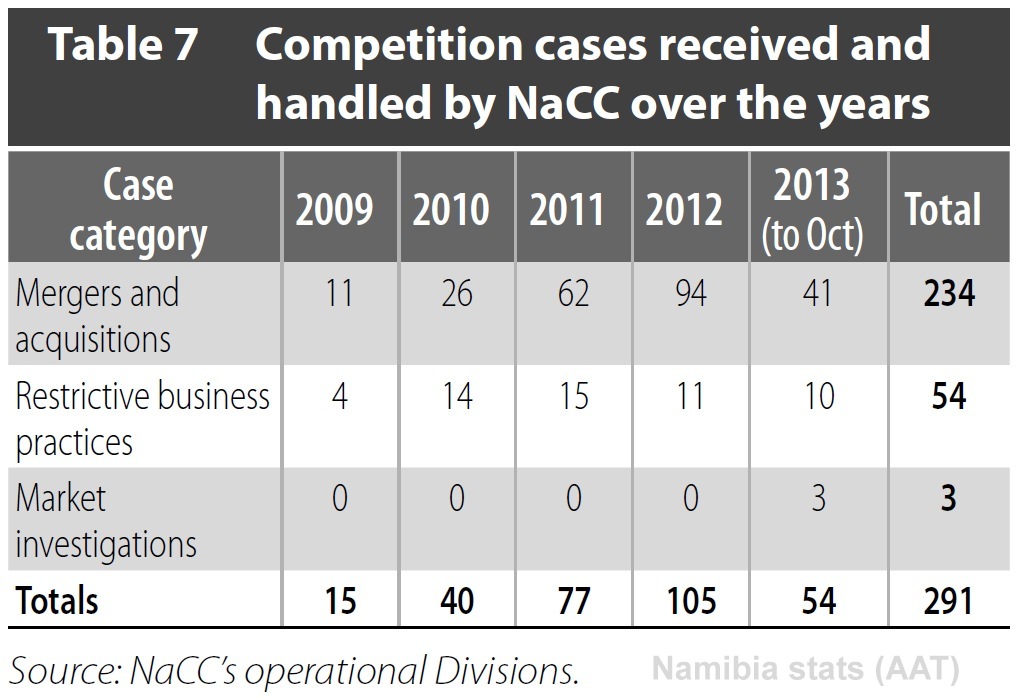
The cited Report contains two relevant statistics, showing the relatively young enforcement agency’s workload in absolute terms as well as in relative (merger vs. other enforcement work) numbers:

Namibia stats

Namibia stats comparison


Government-mandated sharing of trade secrets: anticompetitive interference

south_africa

Ms. Zulu proposes foreign competitors share trade secrets with SA counterparts

Perhaps it is time for increased advocacy initiatives within the South African government, or at a minimum a basic educational program in competition law for all its sitting ministers.
In what can only be described as startling (and likely positively anticompetitive), Lindiwe Zulu, the S.A. Minister of Small Business, has demanded foreign business owners to reveal their trade secrets to their smaller rivals.
The South African Competition Commission, and perhaps one of the Minister’s own fellow Cabinet members, minister Ebrahim Patel, who is de facto in charge of the competition authorities, can see fit to remind Ms. Zulu that fundamental antitrust law principles (and in particular section 4 of the South African Competition Act), preclude firms in a horizontal relationship from sharing trade secrets that are competitively sensitive – i.e., precisely those types of information Ms. Zulu now proposes to be shared mandatorily amongst competitors.
While SACC has utilized this provision with much success against big business in South Africa, it would be remiss not enforce the provisions of the Act without fear or favor should the traders act out on the instruction of the Minister.  It is also time that the Cabinet seeks to enforce business practices which comply with South African legislation.
BDLive‘s Khulekani Magubane reports in today’s edition (“Reveal trade secrets, minister tells foreigners“) that “foreign business owners in SA’s townships cannot expect to co-exist peacefully with local business owners unless they share their trade secrets, says Small Business Development Minister Lindiwe Zulu.”

Lindiwe Zulu. Picture: PUXLEY MAKGATHO

Lindiwe Zulu. Picture: PUXLEY MAKGATHO

“In an interview on Monday she said foreign business owners had an advantage over South African business owners in townships. This was because local business owners had been marginalised and been offered poor education and a lack of opportunities under apartheid.

“Foreigners need to understand that they are here as a courtesy and our priority is to the people of this country first and foremost. A platform is needed for business owners to communicate and share ideas. They cannot barricade themselves in and not share their practices with local business owners,” Ms Zulu said.”

Research fellow at the SA Institute for International Affairs Peter Draper said Ms Zulu’s remarks, underscored government’s mistrust of foreign investors which was also reflected in business regulations. “If you connect this to the broader picture, essentially this is part of a thrust to single out foreign business, which is contrary to the political message President Jacob Zuma went to portray in Davos. We are at a tipping point and we are going beyond it. You can only push foreign business so far before they disengage,” he said.Mr Draper agreed with Ms Zulu’s remarks on the effect of apartheid on local business owners in townships but said foreign business owners had to confront their own challenges with little state support.

“Apartheid did disadvantage black people and over generations it inhibited social capital. Many foreigners have trading entrenched in their blood. Wherever they go they bring social capital, networks and extended family. Is that unfair? I don’t think so. That’s life,” he said.

Ms Zulu’s comments show the about-turn in the African National Congress’ (ANC’s) ideology of Pan Africanism and in line with remarks by party leaders.

After a week of looting in Soweto last week, ANC secretary-general Gwede Mantashe told residents in Doornkop that immigration laws needed to be strengthened to protect the country from terror.

Unfair competitors or clever innovators? Lessons from the sharing economy.

new multi-part seriesInnovators face unfair competition claims

Our AAT multi-part series on innovation & antitrust is being continued by Professor Sofia Ranchordás. The AAT author just published a new paper on the ubiquitous “Sharing Economy” we are witnessing not only in the United States and Europe but also on the African continent (UBER has seen significant successes in Johannesburg and Cape Town, for instance).

Below is the abstract — for the full 45-page PDF article, to be published in the Minnesota Journal of Law, Science and Technology please go to SSRN here.

Sharing economy practices have become increasingly popular in the past years. From swapping systems, network transportation to private kitchens, sharing with strangers appears to be the new urban trend. Although Uber, Airbnb, and other online platforms have democratized the access to a number of services and facilities, multiple concerns have been raised as to the public safety, health and limited liability of these sharing economy practices. In addition, these innovative activities have been contested by professionals offering similar services that claim that sharing economy is opening the door to unfair competition. Regulators are at crossroads: on the one hand, innovation in sharing economy should not be stifled by excessive and outdated regulation; on the other, there is a real need to protect the users of these services from fraud, liability and unskilled service providers. This dilemma is far more complex than it seems since regulators are confronted here with an array of challenging questions: firstly, can these sharing economy practices be qualified as “innovations” worth protecting and encouraging? Secondly, should the regulation of these practices serve the same goals as the existing rules for the equivalent commercial services (e.g. taxi regulations)? Thirdly, how can regulation keep up with the evolving nature of these innovative practices? All these questions, come down to one simple problem: too little is known about the most socially effective ways of consistently regulating and promoting innovation. The solution of these problems implies analyzing two fields of study which still seem to be at an embryonic stage in the legal literature: the study of sharing economy practices and the relationship between innovation and law in this area. In this article, I analyze the challenges of regulating sharing economy from an ‘innovation law perspective’, i.e., I qualify these practices as innovations that should not be stifled by regulations but should not be left unregulated either. I start at an abstract level by defining the concept of innovation and explaining it characteristics. The “innovation law” perspective adopted in this article to analyze sharing economy implies an overreaching study of the relationship between law and innovation. This perspective elects innovation as the ultimate policy and regulatory goal and defends that law should be shaped according to this goal. In this context, I examine the multiple features of the innovation process in the specific case of sharing economy and the role played by different fields of law. Electing innovation as the ultimate policy target may however be devoid of meaning in a world where law is expected to pursue many other — and often conflicting — values. In this article, I examine the challenges of regulating innovation from the lens of sharing economy. This field offers us a solid case study to explore the concept of “innovation”, think about how regulators should look at the innovation process, how inadequate rules may have a negative impact on innovation, and how regulators should fine tune regulations to ensure that the advancement of innovation is balanced with other values such as public health or safety. I argue that the regulation of innovative sharing economy practices requires regulatory “openness”: less, but broader rules that do not stifle innovation while imposing a minimum of legal requirements that take into account the characteristics of innovative sharing economy practices, but that are open for future developments.