
South Africa Healthcare panel- a swing to the left?

While it certainly appears that the newly appointed panel to the first ever market inquiry into the South African private healthcare sector consists of a number of members who have a strong medical background, there is a concern, however, that this is significantly skewed in favour of those who have more of a public healthcare background.

This brings into question the degree to which the inquiry will be focused more on the question of accessibility of healthcare to all citizens (An aspect for which South African government has the main responsibility) on the one hand, and the perceived inefficiencies within the private healthcare sector where members/patients pay a premium for access to the latter.

The only economist on the panel is, interestingly, not from South Africa which may bring to question his ability to effectively understand the South African private healthcare sector, how it has evolved in the last two decades, particularly given the changes observed in regulations governing the different levels of the value chain.

A clear concern will be how well the panel will appreciate any commercial arguments, which would undoubtedly be brought forward by the industry, particularly providers.  At the end of the day these are private entities which rely on investors who seek certain levels of return, often irrespective of where those returns come from.

The Competition Commission should  be able to provide some assistance, however, given the level of attrition experienced at the Commission in the last 18 months the quality of those resources remains an issue.

A second aspect is the apparent exclusion of an assessment of the public sector.  Since government is ultimately tasked with providing healthcare services to the vast majority of unemployed in South Africa, these would be the very same majority which could never afford private healthcare today.  Ignoring the public sector is tantamount to ignoring the real issue.

The panel comprises of former Chief Justice Sandile Ngcobo, Professor Sharon Fonn, Dr Ntuthuko Bhengu, Dr Lungiswa Nkonki and Cornelis van Gent.  A brief overview of panel members is as follows:

  • Former Chief Justice Sandile Ngcobo served as the Chief Justice of the Constitutional Court from 2009 to 2011.
  • Professor Sharon Fonn is a medical doctor and registered public health specialist and she is currently the acting dean of the Faculty of Health Sciences at the University of the Witwatersrand.
  • Dr Nthuthuko Bhengu holds an MBChB and his most recent executive appointments have been with Metropolitan Health, Clinix Health Group and Biotech Laboratories.
  • Dr. Lungiswa Nkonki holds a PhD in health economics and is currently a senior lecturer at the University of Stellenbosch.
  • Cornelis van Gent is an economist with experience in competition economics, economic regulation and competition in healthcare markets.

S. African antitrust watchdog described as “toxic” by insider

south_africa

Trade union NEHAWU’s influence over agency staff cited as reason for departure

According to an excellent piece in the ZA Financial Mail – written by Andile Makholwa* and entitled “Competition Commission Bleeds Staff” – departing Acting Deputy Commissioner Trudi Makhaya has explained in detail her recent decision to leave the antitrust authority, describing a “toxic” work environment there since at least October 2013.  On the staffing front, Acting Commissioner Bonakele is quoted as regretting her departure, saying that “one of his priorities is to repair the fractured relations with senior managers and contain the staff exodus.” In the article, Makhaya is cited as bemoaning the increasing influence of NEHAWU (a powerful trade union) over the agency and its staff.

Ms. Makhaya (photo credit: Financial Mail)

While Ms. Makhaya has had her fair share of agit-prop P.R. published under her name (see, eg., her piece published this piece in the Daily Maverick, entitledThe temptations of neo-volkskapitalisme), her insider revelations of NEHAWU’s unduly high influence over the Commission are particularly interesting.

Many ZA commentators have lamented the increasingly pervasive sway that trade unions have in merger-control talks with the enforcer.  This is especially important in light of South Africa’s merger-control regime having express “public interest criteria” embedded in its legislation.

Two ZA antitrust lessons

  1. The legislation’s social agenda element, combined with the now confirmed unions’ influence over agency staff, may have resulted (and will likely result in the future, if unchecked) in extensive so-called “public-interest” conditions imposed on otherwise unproblematic transactions that pose no pure antitrust issues.
  2. The ZA Competition Commission has received extensive bad press of late.  Now, even insiders speak out about the (personnel, rather than structural) problems that have befallen the agency.  Specialist publications (such as Global Competition Review, which publishes a dedicated review and ranking of government antitrust enforcement agencies, in which the Commission used to fare rather well), as well as practitioners and the courts, may perceive these developments as significant steps backward for an institution that once was lauded as a shining example of developing competition-law authorities.  Even Acting Commissioner Bonakele admits that the authority is “in a rebuilding phase. All I can say is that the commission is losing a key staff member. It’s a setback. When you’re rebuilding an institution you need all hands on deck,” and the minister in chage (Patel) believes the Commission too independent.


* The author also wrote an interesting piece on the Competition Commission‘s sectoral health-care inquiry (we reported here and elsewhere) in last week’s FM.

South Africa: another senior Commission member resigns

south_africa

It has recently been reported that Ms Trudi Makhaya, the Deputy Competition Commissioner, has resigned. There has been no indication yet on a replacement but it signals a continuation of the worrying trend of senior experienced Commission staff departing the authority.

For further information see the attached link.  Her twitter and LinkedIn accounts remain unaffected by her resignation as of Feb. 11, as both still show her job title as Competition Commission executive.  She is likewise still listed on the Commission’s web site as active.  We previously reported on one of her opinion pieces here.  She also recently published this piece in the Daily Maverick, entitled “The temptations of neo-volkskapitalisme“.

Competition Commission releases latest newsletter

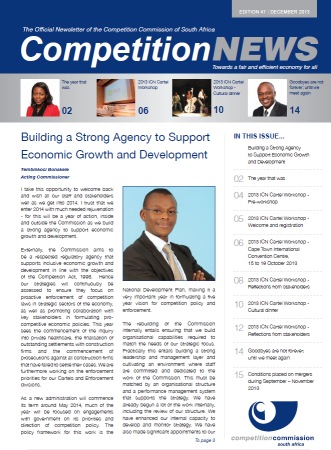
A couple of months after its official release date, the SACC’s latest newsletter, “CompetitionNEWS (December 2013 ed. no. 47), is finally out.

For those interested, the South African Competition Commission has published a piece largely consisting of the agency’s internal personnel news and photographs of “cultural dinners” & the like (even screenshots of related tweets?)…  One of the only substantive sections appears to be the half-pager on p.15 summarising “conditions placed on mergers during September-November 2013.”  Other than that, it’s picture time and a recapitulation of the ICN Cape Town event.

compnewspictureTime

Readers of AfricanAntitrust.com have full access to the PDF here.

Competition Commission fails to find conclusive evidence of supermarket violations

south_africa

Competition Commission concludes exclusive-lease investigation without taking action

John Oxenham, Nortons Inc.

The South African Competition Commission (“Commission”) has recently announced that it has concluded its investigation into the major retail grocery stores, namely Shoprite Holdings Ltd, Woolworths Holdings Ltd, the Spar Group Ltd and Pick ‘n Pay Stores Ltd, as well as wholesale retailers, Massmart Holding Ltd and Metcash Trading Africa (Pty) Ltd for alleged contraventions of the Competition Act in relation to exclusive lease agreements.

By way of factual background, the Commission initiated an investigation in 2009 against Shoprite, Woolworths, Spar, Massmart, Metcash and Pick ‘n Pay in which the Commission  examined various competition concerns including buyer power, category management, information exchange and long-term exclusive lease agreements. The Commission’s initial investigation uncovered no evidence of competition contraventions, yet subsequently the Commission decided to focus its investigation on the long-term exclusive lease agreements, evaluating whether they could potentially give rise to contraventions of abuse of dominance and restrictive vertical practices.

The Commission’s investigation failed to find sufficient evidence to meet the tests set out in the Competition Act to proceed with the investigation. As a result, the Commission has decided not to refer the matter to the Competition Tribunal, concluding that “on the basis of the evidence before the commission, the anti-competitive effects of the conduct could not be demonstrated conclusively.

Image Credit: SA Sunday Times

More or less competition in African mobile payments sector?

south_africakenyanigeria

More countries may enter the mix of players – but at the platform level, competition may have stagnated

As we reported last month, the mobile payments sector is going gangbusters on the African continent.  Kenya is ahead of the game, but other countries are closing in.

Kenya itself is considered by many to be at the forefront of the African mobile-payments universe, with its M-Pesa mobile-currency system often touted as the most developed mobile-payment system in the world.  The Economist asked rhetorically: “Why does Kenya lead the world in mobile money?”, pointing out that roughly 25% of Kenya’s GDP flows through the mobile service, with over 17 million users in Kenya alone.  The WorldBank has commented that “Mobile payments go viral [with] M-PESA in Kenya.”

Earlier this week, South African media outlet Business Tech published an interesting comparative piece on the issue, entitled “Africa leads in mobile banking“.  The article shows (also graphically, see below) how  and South Africa are close rivals to the Kenyan leadership in the mobile payments industry:

Image credit: Business Tech

What triggered the article is the release of the MEF-Africa report on mobile payments on the continent, which provides much of the content of the Business Tech piece.

One of the key developments highlighted is that M-Pesa’s platform may soon see a major upgrade in South Africa (where it is run by Vocadom and Nedbank), according to the article, linking the system directly with the brick-and-mortar banks’ platforms.  This may either (1) cement the relative market dominance of M-Pesa or (2) spur further innovation and enhance the overall competitiveness of the still rather young industry.

The Commission Doth Protest Too Much?

south_africa

The defensive justification for the Commission’s healthcare inquiry by its acting chief has widely caused eyebrows to be raised…

As reported, the South African Competition Commission (“Commission”) has launched its first-ever market inquiry into the South African private healthcare sector.

The sector has recently been the subject of significant attention from the Commission, the South African health minister in particular, and the S.A. government in general. In spite of the perilous state of South Africa’s public health system, the government appears to have invested more time in deflecting from the obvious problems in the public branch by subjecting the private sector to a costly investigation.  From a procedural-history point of view, it is interesting to note that the market inquiry provision was brought into effect by way of Section 6 of the amended South African Competition Act. Although there were other areas of the legislation to be amended, it is noteworthy that only the market inquiry provision was brought into effect.

Many have suspected that the motivation behind the private healthcare inquiry was based on aspirations from outside the ambit of the Commission, particularly since the launch of the South African government’s National Health Insurance policy scheme (designed to achieve the noble aim of universal health insurance coverage, not entirely unlike the United States’ “Obamacare” effort) may ultimately cause the demise of a robust private healthcare sector.

Independence of Commission questioned

With this in mind, what is perhaps most interesting is a recent public submission made by the newly appointed 37-year old Acting Competition Commissioner Tembinkosi Bonakele in the South African media.  In an article co-authored with Ms. Paremoer, the Commission principal responsible for the healthcare inquiry, entitled Market inquiries an important advocacy tool (also published in the Sunday Times), Bonakele attempts to deflect any suggestions of government involvement in (or other ministerial influence over the pursuit of) the market inquiry. This approach seems at odds with Mr Bonakele’s predecessor, Shan Ramburuth – who was unceremoniously let go by the same government in a public display of shaming last year – in seeking to justify the motivation behind the private healthcare inquiry.  (We note that the present government has an apparent history of “letting go” unruly cabinet members in unusual and rather bombastic fashion, see here and here.)

Ramburuth’s Commission had previously stated expressly, for instance, that the inquiry was intended at least in part to review the sector for collusive behaviour, while Mr. Bonakele now disavows this rationale and claims that any such findings would merely be a side effect of the inquiry (“[o]f course, during such an inquiry, we may come across anti-competitive practices that need to be rooted out”).

In his piece, the Acting Commissioner seeks to reassure those who “remain confused about the […] intended market inquiry,” and states that the “inquiry is not a stalking horse“:

“we are simply seeking to understand how to improve efficiency and competition” in what he calls the “complicated web” of the healthcare industry.

Is this a case of Shakespearean “the [man] doth protest too much”, especially when keeping in mind that the private healthcare sector has previously been acknowledged to be competitive and efficient.  Mr. Bonakele has previously emphasised his independence, despite being referred to in the press as Minister “Patel’s man”:

“I haven’t responded to the media debate out there because I don’t think one has to stand on a mountain and say ‘I’m independent’. Actions speak louder than words.” [Source: BDLive]

Acting Commissioner Bonakele

The aim of the inquiry, according to the Acting Commissioner, is to improve competition and efficiency in the sector to such a degree that the ordinary man on the street will have full access. A very noble goal indeed, but when juxtaposed with the fundamental function and intention of the NHI,it is highly contradictory: the private healthcare sector is, by definition, not in the business of providing access to everybody. The public NHI body’s own slogan, on the other hand, shows that the national insurance programme fulfills precisely that role: “NHI is premised on the ideology that all South Africans are entitled to access quality healthcare services.”

What is perhaps of greater concern (with a wider applicability than just the healthcare sector, public or private) to competition-law enforcement in South Africa as a whole, is the confluence of the government’s industrial policy ambitions with otherwise supposedly independent Commission investigations and its competition adjudication based in the pure law & economics of antitrust. As previously reported in our piece on political interventionism in South African competition law, the Commission should seek to demonstrate its complete independence from the cabinet and executive branch as a whole, and avoid falling into the trap FTC Chairwoman Edith Ramirez warned against: the “proper goals” of competition law are best solved when a competition authority is focused on competitive effects and on consumer welfare and its analysis is not “interrupted to meet social and political goals.”

In sum, one must hope that Mr. Bonakele can be taken at his word when he says that, while “[m]aybe people think the minister will use the commission as a tool, but it’s just not possible. This is a legal process we are talking about.

SA telecoms firm implements antitrust settlement terms

south_africa

According to a report by ITweb Business, the South African incumbent R16 billion telecommunications giant Telkom Limited (no stranger to this blog) has now taken steps to implement its landmark June 2013 settlement in a margin-squeeze and monopolization case brought by the South African Competition Commission (the “Commission”).

The settlement was finalized by the Competition Tribual on 18 July 2013.  Its terms include, importantly for the latest job-related and divisional developments at Telkom, the functional separation between the company’s retail and wholesale divisions, in addition to other pricing commitments, a fine, and ongoing monitoring obligations under the guidance of the Commission.  As reported today, the company has now also issued and implemented a new antitrust/competition compliance policy, its so-called “Competition Settlement Code of Conduct Policy,” reportedly a whopping 25-page document.

In this latest round of compliance efforts, Telkom’s CEO Sipho Maseko is said to have sent out communications to all staff, attempting to alleviate media reports about potential large-scale job cuts.  He is cited as follows: “While I can’t predict the future, I can unhesitatingly say the 12 months that lie ahead will be demanding. Challenges await, of this we can be certain. We will have to be on top of our game and tackle the issues that influence our business with focus and purpose if we are to unlock our full potential.”

Telkom’s CEO

Antitrust & “extreme economic inequality” – new OXFAM paper out

Arguably, most if not all of today’s antitrust enforcers would agree that the world’s competition regimes (African or Asian, American or European, established or recently budding) are fundamentally designed to achieve very few, but important, goals.  Among these goals are the following: (1) economically, to enhance the market’s allocative efficiency & stimulate growth of production and (2) individually, consistent with Bob Bork‘s key insight, to increase consumer welfare (even if the latter may not be a formally stated aim of some regimes).

Today’s release of the OXFAM briefing paper on “Political Capture and Economic Inequality,” tantalizingly entitled “WORKING FOR THE FEW,” brings the second of the two above-stated goals to the fore:

Is the world today better for the [working] consumer than it was 123 years ago, when Senator Sherman and the majority of the U.S. legislature decried the unjust and ill-gotten riches of that era’s robber barons and enacted the Sherman Act?

Robber Baron
Robber Baron, circa 1890

The paper is interesting but too short to be of real academic or legal value in and of itself, in our view.  The infamous photo of the super-yacht on the authors’ blog represents the easy part of what they set out to accomplish – politicizing the issue and driving popular opinion (much akin to the period newspaper cartoon above).

Robber Baron, circa 2014

That said, authors Ricardo Fuentes and Nick Galasso go somewhat beyond the, by now, usual egalitarian quotes (Brandeis’s Depression-era statement: “We may have democracy, or we may have wealth concentrated in the hands of the few, but we cannot have both“) and the well-known head-turner statistics of inequality (e.g., “almost half [of the world’s wealth is] going to the richest one percent; the other half to the remaining 99 percent“), many of which are also found on their blog.

Yet, while they do go a bit deeper than merely scratching the surface with populist platitudes and photos of jetsetter playtoys, they fail to do so on the specific issue of how antitrust fits into the question of global economic inequality.  One need not attempt to un-seat Bork from the academic and judicial pedestals he has reigned over for 4 decades, but one could try a bit harder here…  The OXFAM study simply does not provide any new insights.  To its credit, it does identify the issue – but it does not develop the overall impact of competition law any further than highlighting the one (very particularized) example of the allegedly monopolistic Mexican telecoms sector:

Anti-competition and regulatory failure: the richest man in the world
Weak regulatory environments are ideal settings for anti-competitive business practices. Without competition, firms are free to charge exorbitant prices, which cause consumers to lose out and ultimately increase economic inequality. When elites exploit weak or incompetent anti-trust authorities, price gauging follows as a form of government to big business. By not acting when dominant firms crowd out competition, government tacitly permits big business to capture unearned profits, thereby transferring income from the less well-off sections of society to the rich. Consumer goods become more expensive, and if incomes do not rise, inequality worsens.

Mexico’s privatization of its telecommunications sector 20 years ago provides a clear example of the nexus between monopolistic behavior, weak and insufficient regulatory and legal institutions, and resulting economic inequality.

Mexico’s Carlos Slim moves in and out of the world’s richest person spot, possessing a net worth estimated at $73bn. The enormity of his wealth derives from establishing an almost complete monopoly over fixed line, mobile, and broadband communications services in Mexico. Slim is the CEO and Chairman of América Móvil, which controls nearly 80 percent of fixed line services and 70 percent of mobile services in the country. A recent OECD review on telecommunications policy and regulation in Mexico concluded that the monopoly over the sector has had a significant negative effect on the economy, and a sustained welfare cost to citizens who have had to pay inflated prices for telecommunications.

As the OECD report argues, América Móvil’s ‘incessant’ monopolistic behavior is facilitated by a ‘dysfunctional legal system’, which has replaced the elected government’s right and responsibility to develop economic policy and execute regulation of markets. This system has stunted the emergence of a dynamic and competitive telecommunications market. In fact, many of the regulatory instruments present in most OECD countries are absent in Mexico.

The costs of government failure to curb such monopolistic behavior are large. Mexico has a high level of inequality and has the lowest GDP of all OECD countries. As other OECD countries demonstrate, a more efficient telecommunications (especially broadband) sector can play an important role in driving economic growth and reducing poverty, especially among a large rural population, as in Mexico’s case. The OECD calculates that the market dysfunctions stemming from the telecommunications sector have generated a welfare loss of $129.2bn between 2005 and 2009, or 1.8 percent of GDP per year.

In the end, no matter how deeply or superficially the paper treats its subject, it will likely be of great interest to several of the African competition enforcers that preside over antitrust regimes in which the “public interest” criterion is present (e.g., COMESA, South Africa, and several others).  This means in practice: We at AfricanAntitrust.com expect the paper to be cited in the near future by a competition authority near you.  So get acquainted with it before it’s too late.

Ph.D. student elevated to Chief Economist position

south_africa

High-level appointments made by acting Competition Commissioner

According to statements made by the interim South African Competition Commissioner, Tembinkosi Bonakele, and based on several news reports (here and here, for instance), the SACC has filled several of its recently (or not-so-recently) emptied ranks:

  1. Chief Economist and Manager of the Policy and Research division: Liberty Mncube
  2. Divisional Manager of Enforcement and Exemptions: Junior Khumalo
  3. Chief Financial Officer: Thomas Kgokolo

The appointments were made effective as of the first of the year.  The SACC had been criticised for lack of stability in its leadership and overall staff, given a fairly high turnover rate among its employees and officers.  Perhaps to counter this impression, Mr. Bonakele said in the official SACC statement that the “new appointees will provide the necessary leadership to their very important divisions. It is important that we have a very strong and stable senior management team and I have full confidence that this team will take the Commission to higher levels. We are privileged as an institution that we are able to find most candidates internally and thereby ensure continuity.”  (Emphasis added).

Focusing on the first new appointment to the Chief Economist role – a position that has sat empty for over a year, according to our recollection – it not only provides for a catchy title but is indeed a noteworthy fact that Mr. Mncube is a graduate student at the moment We do not know of any other competition enforcement agency that has filled the job of chief economist with someone who is currently pursuing a degree in economics.  This comment is not to diminish Mr. Mncube’s accomplishments, nor to take away from his potential to fill the role adequately.  It simply states a fact.  His past professional biography includes the following, according to a 2011 ICN The Hague conference web site:

[Note: information as of 2011] “Liberty Mncube is a Senior Analyst in the Policy and Research Division of the Competition Commission of South Africa. At the Commission, his responsibilities include managing and coordinating research and policy development; managing and coordinating case analysis; contributing in building capacity for research and knowledge of competition policy; and undertaking analysis related to competition matters with regard to policy and regulation. Prior to joining the Commission, he was a Researcher at the Development Policy Research Unit at the University of Cape Town. Liberty holds an MSc in Economics from the University of York.”

Mr. Mncube’s own LinkedIn profile is updated to reflect his current position:

I am the Chief Economist at the Competition Commission South Africa. I hold a MSc in Economics from the University of York and am currently completing a PhD in Economics at the University of KwaZulu-Natal. I have been a visiting PhD graduate student at the Barcelona Graduate School of Economics.

For the economists among our readership, here are a few selected publications by Mr. Mncube (note that his LinkedIn profile lists several additional articles and book chapters): “On merger simulation and its potential role in South African merger control“; “Strategic Entry Deterrence: Pioneer Foods And The Bread Cartel“; and “Designing Appropriate Remedies For Competition Law Enforcement: The Pioneer Foods Settlement Agreement