As other attendees of the 17 July 2015 regional sensitisation workshop have done, the Zimbabwean daily NewsDayhas reported on the Livingstone, Zambia event — a session that has yielded a plethora of rather interesting pronouncements from COMESA Competition Commission (“CCC”) officials, including on non-merger enforcement by the CCC, as we have noted elsewhere.
In light of the additional comments made by CCC officials — in particular George Lipimile, the agency’s CEO, and Willard Mwemba, its head of mergers — we decided to select a few and publish the “AAT Highlights: COMESA Officials’ Statements” that should be of interest to competition-law practitioners active in the region (in no particular order):
M&A: CCC claims approval of 72 deals since 2014
Willard Mwemba is quoted as saying: “The commission has updated more than 72 mergers and the transaction represented more than $20 million. This money has been invested in the common market through mergers and acquisition.”
We do not know what it means to “update” a merger in this context. We presume it implies “cleared.”
This figure does not conform to the published statistics on the CCC’s web site, which show the following numbers, based on our latest internal tally, amounting to a total of 30 published notifications since 2013 versus a claimed 72 approved deals since only 2014:
Number of merger notifications based on CCC-published notices
This discrepancy opens up the topic of transparency and proper documentation on the part of the CCC on its web site. The (undated, as we have observed) PDF notices of merger filings simply do not reflect this claimed number of actual merger approvals made by Mr. Mwemba. We hope that the CCC will enhance and better organise its online documentation of M&A activity. (Even the very first link to the “Explanatory Note” of mergers remains broken after months, as noted previously, simply leading to a blank page comically headlined “What is Merger?”).
We also wonder about the reference in Mr. Mwemba’s statement to “the transaction” valued at “more than $20m.” It may be unclear reporting on the part of NewsDay, or perhaps Mr. Mwemba was referring to a specific but unnamed transaction, presumptively in the mining industry. In any case, Mwemba highlighted the following sectors as key for COMESA M&A transactions: mining, pharmaceuticals, agriculture and energy.
Finally, the claimed CCC’s reduction of the the merger filing fees from half a million dollars “to $200,000” is a topic we shall discuss in a separate post.
Non-Merger Enforcement by COMESA
As we noted in yesterday’s post, the CCC’s head, executive director George Lipimile, foreshadowed non-merger enforcement by the agency, including an inquiry into the “shopping mall sector,” as well as cartel enforcement. On the latter topic, Mr. Lipimile highlighted cartels in the fertiliser, bread and construction industries as potential targets for the CCC — all of which, of course, would constitute a type of “follow-on enforcement” by the CCC, versus an actual uncovering by the agency itself of novel, collusive conduct within its jurisdictional borders, as John Oxenham, a director at Africa consultancy Pr1merio, notes.
“Here, in particular, the three examples given by Mr. Lipimile merely constitute existing cartel investigations that we know well from the South African experience — indeed, the SA Competition Commission has already launched, and in large part completed, its prosecutions of the three alleged cartels,” says Oxenham.
As AAT has reported since the 2013 inception of the CCC, antitrust practitioners have been of two minds when it comes to the CCC: on the one hand, they have criticised the COMESA merger notification regime, its unclear thresholds and exorbitant fees, in the past. On the other hand, while perhaps belittling the CCC’s merger experience, the competition community has been anxious to see what non-merger enforcement within COMESA would look like, as this (especially cartel investigations and concomitant fines under the COMESA Regulations) has a potentially significantly larger impact on doing business within the 19-member COMESA jurisdiction than merely making a mandatory, but simple, filing with an otherwise “paper tiger” agency. Says Andreas Stargard, also with Pr1merio:
“If the CCC steps up its enforcement game in the non-transactional arena, it could become a true force to reckon with in the West. I can envision a scenario where the CCC becomes capable of launching its own cartel matters and oversees a full-on leniency regime, not having to rely on the ‘follow-on enforcement’ experience from other agencies abroad. The CCC has great potential, but it must ensure that it fulfills it by showing principled deliberation and full transparency in all of its actions — otherwise it risks continued doubt from outsiders.”
COMESA Judge Proposes Judicial Enhancements
Justice Samuel Rugege, the former principal judge of the COMESA Court of Justice, is quoted as arguing against the COMESA Treaty’s requirement for exhaustion of local remedies prior to bringing a matter before the Court of Justice:
“I think that the rule ought to be removed and members should have access to the courts like the Ecowas Court of Justice. The matter has been raised by the president of the Court and the matter needs to be pursued. It is an obstacle to those who want to come and cannot especially on matters that are likely to be matters of trade and commercial interest. Commercial matters must be resolved in the shortest possible time as economies depend on trade,” Rugege said.
Justice Rugege also highlighted the potential for jurisdictional infighting in the COMESA region (see our prior reporting on this topic here), observing that said COMESA currently lacks any framework for coordinating matters involving countries that are part of both SADC and the COMESA bloc.
Retail antitrust: “mushrooming” shopping malls vs. SMEs, and possible cartel follow-on enforcement on the horizon for CCC
As reported in the Swazi Observer and other news outlets, the COMESA Competition Commission (“CCC”) recently expressed an interest in investigating the effect that larger shopping malls have had on competition in the common market’s retail sector.
This is one of the first non-M&A investigations undertaken by the CCC, according to a review of public sources. While observers in the competition-law community have witnessed several merger notifications (and clearances) under COMESA jurisdiction, there has been no conduct enforcement by the young CCC to speak of. Indeed, CCC executive director George Lipimilestated at a conference in November 2014: “Since we commenced operations in January, 2013 the most active provisions of the Regulations has been the merger control provisions.” Andreas Stargard, an attorney with the boutique Africa consultancy Pr1merio, notes:
“Looking at the relative absence of enforcement against non-merger conduct (such as monopolisation, unilateral exclusionary practices, cartels, information exchanges among competitors or other conduct investigations), this new ‘shopping mall sectoral inquiry‘ may thus mark the first time the CCC has become active in the non-merger arena — a development worth following closely. Moreover, the head of the CCC also announced future enforcement action against cartels, albeit only those previously uncovered in other jurisdictions such as South Africa, it appears from his prepared remarks.”
The CCC’s interest in the mall sector was revealed during one of the agency’s “regional sensitisation workshops” for business journalists (AAT previously reported on one of them here). At the event, Lipimile is quoted as follows:
“The little shops in the locations seem to be slowly disappearing because everybody is going into shopping malls. And these shopping malls and the shops in them are mostly owned by foreigners.”
The investigation will take a sampling from the economies of several of the 19 COMESA member states and attempt to determine whether the “mushrooming” growth of shopping malls negatively affects local small and medium enterprises in the whole common market.
Rajeev Hasnah, a Pr1merioconsultant, former Commissioner of the CCC and previously Chief Economist & Deputy Executive Director of the Competition Commission of Mauritius, commented that,
“Conducting market studies is one of the functions of the CCC and it is indeed commendable that the institution would contemplate on conducting such a study in the development of shopping malls across the COMESA region. I believe that this will then enable the institution to correctly identify and appreciate the competition dynamics in the operations of shopping malls and the impact they have on the economy in general. The study should also identify whether there are areas of concerns where the CCC could initiate investigations to enable competition to flourish to the benefit of businesses, consumers and the economy in general. We look forward to the undertaking of such a study and its findings.”
AAT agrees with this view and welcomes the notion of the CCC commencing substantive non-merger investigations. We observe, however, that the initial reported statements on the part of the CCC tend to show that there is the potential for dangerous local protectionist motives to enter into the legal competition analysis. As Mr. Lipimile stated at the conference:
“Though [the building of malls] might be seen as a good thing, it may negatively impact on our local entrepreneurship and might lead to poverty. Before shopping malls were built, local entrepreneurs realised sales from their products. Now malls are taking over. … [A] strong competition policy can be an effective tool to promote social inclusion and reduce inequalities as it tends to open up more affordable options for consumers, acting as an automatic stabiliser for prices”
That said, Mr. Lipimile also stated at the same event, quite astutely, that a “solid competition framework provides a catalyst to increase productivity as it generates the right incentives to attract the most efficient firms.” In the rational view of antitrust law & economics, if — after an objective review such as the study announced by the CCC — the “most efficient” firm happens to be a larger shopping mall that does not otherwise foreclose equally effective competition, then the Darwinian survival of the fittest in a market economy must not be impeded by regulatory intervention.
George Lipimile, CEO, COMESA Competition Commission
Mr. Lipimile himself seemed to agree in November 2014, when he said that the 19-member COMESA jurisdiction must have regard to “its trading partners [which] go beyond the Common Market hence, it requires consensus building and a balancing act.” At this time, “when regional integration is occupying the centre stage as one of the key economic strategies and a rallying point for the development of the African continent,” domestic protectionist strategies have no place in antitrust & competition law. Said Mr. Lipimile: “[R]egional integration can only be realized by supporting a strong competition culture in the Common Market,” which would not support a more reactionary, closed tactic of a regulatory propping-up of “domestic champions” versus more efficient foreign competition. As the CCC head recognised, “[t]he purpose of competition law is to facilitate competitive markets, so as to promote economic efficiency, thereby generate lower prices, increase choice and economic growth and thus enhance the welfare of the general community.”
Extensive UNCTAD report highlights state of Namibian competition enforcement, comes at right time when Namibia ponders inclusion of “unfairness” standard in merger control
A.S.
Following the release of the final UNCTAD report (entitled “Voluntary Peer Review of Competition Law and Policy: Namibia“), the report’s sponsors organised a gathering of interested parties in mid-February in Windhoek, the Namibian capital, for a “dissemination event” of the report.
The event included a session on “various elements of knowledge management systems,” for which the the South African Competition Commission was selected to serve as an exemplary agency. The Namibia Competition Commission presented a plan for implementing the Report’s recommendations. This plan will form part of the agency’s overall strategic planning framework “Smart enforcement, smart advocacy and smart research” that is to be launched by June 2015.
In attendace was, among others, the country’s Deputy Minister of Trade and Industry, Tjekero Tweya. Participants were invited to attend two round tables discussions on the intersection and complementarities of competition policy and consumer protection; and strengthening cooperation between different government bodies to improve competition enforcement in Namibia.
Can Report avert devolution of merger-control regime into extrajudicial “fairness” criteria?
Substantively, AAT welcomes further and deeper discussion of true antitrust/competition law issues in Namibia wholeheartedly. We reported last year that a crucial revision of the Namibian competition law includes consumer-protection provisions that would potentially bar M&A deals not only on pure antitrust grounds but also on a more broadly defined “unfairness” basis.
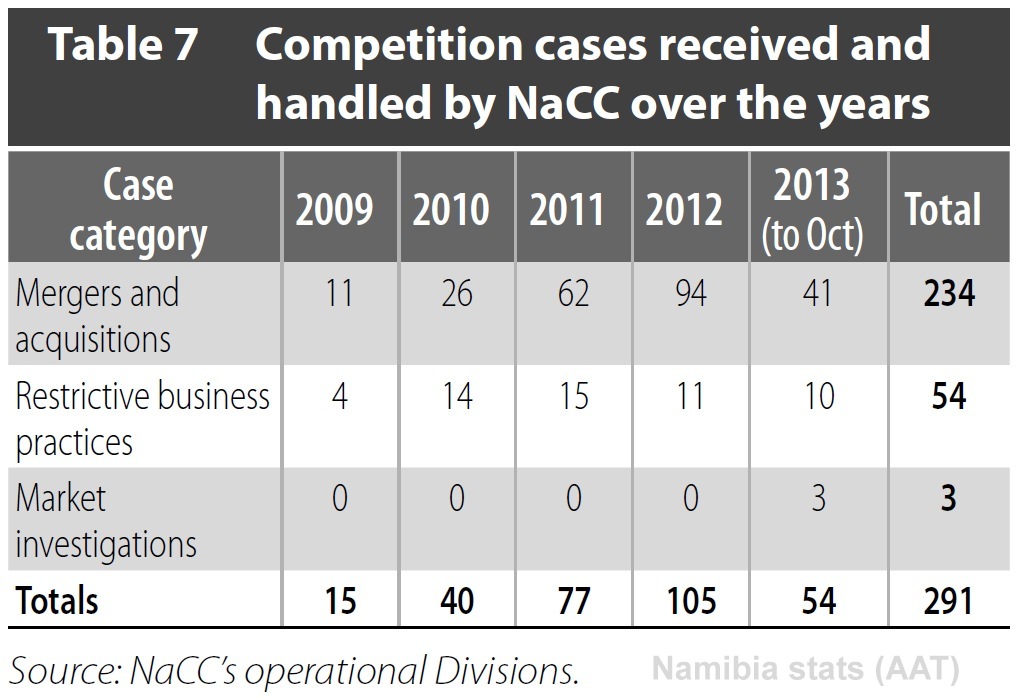
The cited Report contains two relevant statistics, showing the relatively young enforcement agency’s workload in absolute terms as well as in relative (merger vs. other enforcement work) numbers:
“Highly regulated” liquefied petroleum gas at center of second sectoral Commission inquiry
According to the South African Competition Commission, the agency has issued “Terms of Reference for the market inquiry into the Liquefied Petroleum Gas sector”:
The Commission has today issued the Terms of Reference (ToR) for the LPG market inquiry. The ToR formally launches and outlines the scope of the inquiry.
The Commission is initiating the inquiry because it has reason to believe that there may be features of the sector that prevent, distort or restrict competition. The Commission hopes that the inquiry will assist in understanding the state of competition in the LPG sector.
It comes on the heels of the first market inquiry into private healthcare, on which AAT has reported extensively.
According to the Terms of Reference, the objectives of the market inquiry include:
Analyzing the current regulatory pricing framework with the aim of determining whether regulation could be improved in order to limit the exercise of substantial market power by market participants;
Examining whether the supply bottlenecks in the liquefied petroleum gas industry may serve to create circumstances or incentives that serve to distort, prevent or lessen competition;
Determining whether features currently prevalent in the market increase costs of switching to a prohibitive level when customers seek to switch between resellers of liquefied petroleum gas;
Assessing the extent of the barriers to entry and general competition dynamics at various levels of the supply chain within the industry; and
Making recommendations that may serve to improve the state of competition.
The Commission has identified the participants in the market inquiry process as including business enterprises within the liquefied petroleum gas chain, such as manufacturers, wholesalers, distributors and retailers, other related enterprises, end-users, government departments, public entities, regulatory authorities, industry associations and any other stakeholders that may be able to provide information relevant to the market inquiry.
BDLive reports that approximately “300,000 tons of LPG is manufactured in SA annually, generating turnover of about R1.5bn. Six refineries, Sapref, Sasol Synfuels, PetroSA Synfuels, Enref, Chevref and Natref produce and supply LPG.
Major resellers such as Afrox, Easigas, BPSA and Total Gas distribute it bulk or in a repackaged form. Afrox, Easigas and Sapref also imported at least 6,100 tons of LPG through facilities in Richards Bay, Port Elizabeth and Durban.”
In its Strategic Plan over the next 3 years, the GCCPC indicates that it purposefully did not identify any priority sectors, to allow it to commit to investigating prohibited practices regardless of the market or its size. The Minister endorsed this approach given the need for independent agencies like the GCCPC to ensure that the competition playing field is leveled, that barriers to entry are low and that “the rules of the game” are reasonable. The Minister continued that simply having competition regime cannot produce or ensure competition in the market unless this is facilitated by government policies and enforcement.
Sectoral Market Inquiries: As in South Africa, whose Competition Commission has launched its first-ever market inquiry into the state of competition in the healthcare sector in terms of the Competition Amendment Act of 2009, the GCCPC is also empowered to launch “market studies” under section 15(k) of the Gambian Competition Act. A market study enables the GCCPC to consider both policies and enforcement simultaneously, thereby promoting competition in the economy, according to the Minister. The Minister explained that the aim of the market study was to assess competition in a particular area and recommend ways of improving it to the benefit of the economy and consumers in general.
As noted in our prior reporting, the Minister spoke at the opening of a workshop on the “Tourism Market Study” and to bring the concept of competition law closer to home, he placed emphasis on the increasing awareness about competition law within the tourism fraternity, forums such as the workshop will contribute substantially to the spread of competition culture and improving levels of compliance of the Competition Act, which would be beneficial both for the economy as well as individual businesses.





 African Antitrust & Competition Law