AAT Wishes Its Readers a Happy World Competition Law Day

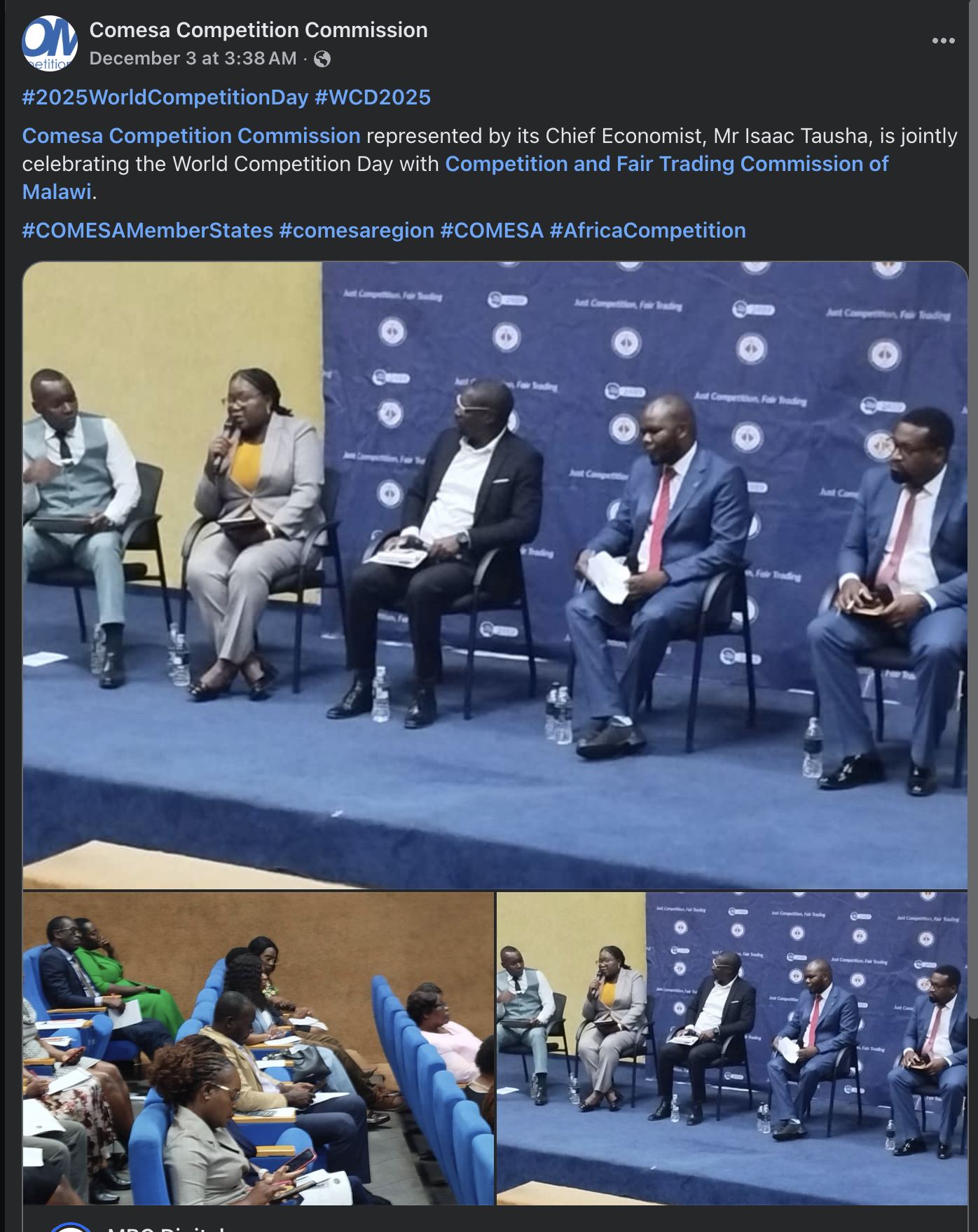
Marking the adoption of the United Nations’ “Multilaterally Agreed Equitable Principles and Rules for the Control of Restrictive Business Practices” 45 years ago on Dec. 5th, today’s International World Competition Day is celebrated around the Globe and particularly in Africa, where leading agencies like the COMESA Competition Commission have observed the commemorative event for years, including this year by meeting with the Malawian CFTC leadership.

On this occasion, AAT wishes everyone a safe and happy holiday season…

Malawi: More than CCCC HQ. A short Retrospective on Mergers in Malawi.

Updated Malawi Merger Control Thresholds

By Michael Williams

Malawi’s new Competition and Fair Trading Act came into effect in 2024 (“2024 Act”).[1]  While this lags behind one of the best-known competition authorities in Malawi, namely COMESA’s Competition and Consumer Protection Commission (“CCCC”) headquartered in Lilongwe to the tune of over a decade, the domestic antitrust regime is being reinforced, as this legislative update shows. And with this latest edition, it is firmly in place when it comes to those national merger-control matters that escape the one-stop-shop of the CCCC. The Competition and Fair Trading Commission of Malawi (“CFTC”) stated that the goal of the 2024 Act is to:

  1. supplement certain areas that the previous Act lacked; and
  2. improving effective enforcement.

Several notable changes were included in the 2024 Act, particularly in respect of the introduction of a suspensory merger control regime. 

The 2024 Act also introduces a public interest test that the CFTC must apply when evaluating whether a proposed merger can or cannot be justified. This public interest test includes several factors including the effect of the potential transaction on:

  • specific industrial sectors or regions; 
  • employment levels; and 
  • the saving of a failing firm.

The CFTC has also been granted the power to impose administrative orders on parties who violate the 2024 Act, which include administrative penalties of up to 10% of a firm’s annual turnover or 5% of an individual’s income. 

The CFTC can also levy orders to redress wrongdoing, such as instructing refunds, exchange or return of defective products, and termination of unfair and exploitative contracts.

These increased powers come after the High Court of Malawi Civil Division ruled in the 2023 case of CFTC v Airtel Malawi that the CFTC lacked the authority to impose fines under the 1998 Act.[2]

To supplement the 2024 Act, the Minister recently published a Government Notice[3] that provides for the financial thresholds for mandatory merger notifications as well as an overview of other fees payable to the CFTC.

THE FINANCIAL THRESHOLDS FOR MANDATORY MERGER NOTIFICATIONS

Any transaction exceeding the following financial threshold will require prior approval from the CFTC before implementing:

  1. The combined annual turnover or combined value of assets whichever is higher, in, into, or from Malawi, equals to or exceeds MWK 10 billion (approximately USD 5 800 000); or
  2. The annual turnover of a target undertaking, in, into, or from Malawi, equals to or exceeds MWK 5 billion (approximately USD 3 000 000).

FEES PAYABLE TO CFTC FOR COMPETITION FILINGS 

The Government Notice sets the merger application fee payable at 0.5% of the combined annual turnover or total assets whichever is higher of the merging parties derived from Malawi. It is important to note that the Government Notice does not specify a maximum fee payable.

OTHER FEES PAYABLE TO THE CFTC

  1. Application for an Authorization of an Agreement at MWK 10 million (approximately USD 5 800) an agreement, a class of agreements under section 24(1) of the 2024 Act or an agreement which, any person who proposes to enter into, or carry out an agreement which, in that person’s opinion, is an agreement affected or prohibited by the 2024 Act. Importantly, an ‘agreement’ is defined in the 2024 Act, being: “any agreement, arrangement or understanding, whether oral or in writing, or whether or not the agreement is legally enforceable or is intended to be legally enforceable”
  2. Application for Negative Clearance at MWK 10 million (approximately USD 5 749,49) for any party to a merger transaction seeking clarification as to whether the proposed merger requires the formal approval of the CFTC or whose proposed merger is subject to review by the CFTC.
  3. Training on Competition & Consumer Protection at MWK 5 million per training package (approximately USD 3 000);
  4. Non-Binding Advisory Opinions for SMEs: MWK 200 000,00 (approximately USD 115); Micro-enterprises: MWK 100 000,00 (approximately USD 58); Other businesses: MWK 500 000,00 (approximately USD 300).

CONCLUSION

This supplementation by the Government Notice to the 2024 Act is of utmost importance for businesses and competition law practitioners operating within the jurisdiction of Malawi to ensure smooth transactions and to avoid statutory sanctions.


[1] Competition and Fair Trading Act No. 20 of 2024

[2] Competition and Fair Trading Commission v Airtel Malawi Ltd. & Anor. (MSCA Civil Appeal 23 of 2014) [2018] MWSC 3

[3] Government Notices No. 76 and No. 77 of 2024

CCC Celebrates ’10’ — a Decade of COMESA Competition Law

Anniversary of CCC’s 2013 Creation to be Celebrated, Developments Discussed

Next week, African heads of state, ministers of trade and commerce, the secretary general of the 21-member state COMESA organization, Commissioners, and several heads of various competition agencies across the region, from Egypt to Eswatini & from Mauritius to Malawi, will join antitrust practitioners, legal experts, business people, and journalists in celebrating the occasion of the 10-year anniversary of the COMESA Competition Commission in Lilongwe, where the agency is headquartered.

Of course, AAT will be there to cover it.

As leaders of this august publication will know by now, our authors have followed the development of the CCC since its very beginning: from the nascent stages of having only a rudimentary staff and foundational rule documents, lacking sufficient guidance for practitioners and businesses alike, to the significant developmental stage under its first chief executive officer, Dr. Lipimile, who built out his enforcement team to coincide with the stellar growth of the CCC’s “one-stop-shop” merger notification statistics and attendant agency reviews (hiring economists and lawyers alike from across COMESA member nations) — and culminating, so far at least, in what we have come to call “CCC 2.0”: the latest iteration of the vastly successful multi-jurisdictional antitrust body, now led by its long-term member Dr. Willard Mwemba.

Under Mwemba’s aegis, the Commission has advanced well beyond a mere ‘rubber-stamping’ merger review body, as some had perceived the fledgling agency in its very early years (approx. 2013-15). The triple-C has since then begun to launch serious investigations into price-fixing, monopolization, attempted monopolization, gun-jumping, as well as market allocation schemes and secretly implemented transactions that parties had failed to notify.

While ‘antitrust is on our minds’, we note here for the record that, beyond its “competition” ambit that mostly remains in our focus at AAT, the CCC’s enforcement mission also includes a fairly large “consumer protection” brief, and the agency’s dedicated unit has investigated areas of consumer concern as broad as airline practices, imported faulty American baby powder, online ‘dark’ practices, pay-TV, and agricultural product quality disputes (milk and sugar come to mind) between Uganda and Kenya, to name only a few…

Our publication, together with several of the business journals and newspapers across the southeastern region of Africa, will report in great detail on the events, and possible news, to take place next week. Says Andreas Stargard, a competition practitioner with Primerio International:

“I look forward to hearing from these leaders themselves what they have accomplished in 10 years, and more importantly what they wish to accomplish in the near to mid-term future. In addition, I have a feeling that we may be treated to some truly newsworthy developments: I could imagine there being either confirmation or denials of the circulating rumour that the COMESA merger regime will soon become not only mandatory, but also suspensory. As most attorneys practicing in this arena know by now, the current Competition Regulations are not suspensory, which may be deemed too restrictive by the group’s Secretariat and its agency leadership in terms of its enforcement powers. After all, it is much more difficult to unscramble the egg than to never let it drop in the pan from the get-go!

Also, the CCC may reveal its plans in relation to a leniency programme for cartel conduct, which is plainly in order!”

Beyond that, Stargard surmises, participants at the almost week-long event may be treated to news about the CCC’s thoughts on digital markets, sectoral investigations, and the Commission’s upcoming “beyond-mere-merger” enforcement activities.
First set of Merger Assessment Guidelines made available by CFTC

Malawi Releases 2015 ‘Merger Assessment Guidelines’

By Michael J. Currie

A number of African jurisdictions have recently published guidelines relating to merger control (which we have reported here on Africanantitrust). During 2015, Malawi’s Competition and Fair Trading Commission (“CFTC”whose web site appears to be down at the time of publication (http://www.cftc.mw), followed suit and published Merger Assessment Guidelines in 2015 (“Guidelines”) in order to provide some guidance as to how the CFTC will evaluate mergers in terms of the Competition and Fair Trading Act (“Act”).

malawi

Most significantly, the Guidelines have not catered for mandatorily notifiable merger thresholds which is unfortunate as most competition agencies as well as advocacy groups have recognised that financial thresholds is an important requirement to ensure that merger control regimes are not overly burdensome on merging parties.

Furthermore, the COMESA Competition Commission, to which Malawi is a member, published merger notification thresholds in 2015 in line with international best practice. It would be encouraged that the CFTC considers likewise publishing thresholds.

Other than the absence of any thresholds, the Guidelines contain substantively similar content to most merger control guidelines insofar as they set out the broad and general approach that the CFTC will take when evaluating a merger. We have, however, identified the following interesting aspects which emerge from the Guidelines which our readers may want to take note of:

  • The CFTC is entitled to issue a “letter of comfort” to merging parties. A letter of comfort is not formal approval, but allows the merging parties to engage conduct their activities as if approval has been obtained. Therefore, once a letter of comfort has been obtained, the parties may implement the merger. In terms of the Guidelines, a letter of comfort will only be issued once the CTFC is satisfied that any should their investigation reveal any potential competition law concerns, that those concerns will be able to be sufficiently addressed by merger related conditions. It is not clear whether a letter of comfort will be issued before the merger has been made public and therefore it is also unclear what the role of an intervening third party will be once a letter of comfort has been issued.
  • The merger filing fee is 0.05% of the combined turnover or assets of the enterprises’ turnover. The Guidelines do not specify that the turnover must be derived from, in, or into Malawi, although it is likely that this is indeed what was intended.
  • The Act and Guidelines make provision for what is becoming a common feature of developing countries competition laws, namely the introduction of so-called “public interest” provisions in merger control. The Guidelines, however, indicate that the CFTC does not consider these public interest provisions in quite as robust manner as the authorities do other countries including, inter alia, South Africa, Namibia, Zambia and Swaziland. In terms of the Guidelines, any public interest advantages or disadvantages is just one of the factors that the CFTC will consider, together with the traditional merger control factors. It is thus unlikely that a pro-competitive merger would be blocked purely on public interest grounds although this is notionally possible.
  • The Guidelines set out the following factors, combined with figures that are likely to be utilised when evaluating market concentration, which if exceeded, may increase the likelihood of the merger leading to a substantial lessening of competition:
  1. Market Shares: 40% for horizontal mergers and 30% for non-horizontal mergers;
  2. Number of firms in the market;
  3. Concentration Ratios: CR3- 65%; or
  4. The Herfindahl-Hirschman Index (“HHI”): HHI between 1000-2000 with delta 259; or HHI above 200 with delta 150. For non-horizontal mergers a merger is unlikely to raise competition concerns if the HHI is below 2000 post-merger.