COMESA foreshadows first substantive sector study, potential cartel enforcement

Retail antitrust: “mushrooming” shopping malls vs. SMEs, and possible cartel follow-on enforcement on the horizon for CCC

As reported in the Swazi Observer and other news outlets, the COMESA Competition Commission (“CCC”) recently expressed an interest in investigating the effect that larger shopping malls have had on competition in the common market’s retail sector.

This is one of the first non-M&A investigations undertaken by the CCC, according to a review of public sources.  While observers in the competition-law community have witnessed several merger notifications (and clearances) under COMESA jurisdiction, there has been no conduct enforcement by the young CCC to speak of.  Indeed, CCC executive director George Lipimile stated at a conference in November 2014: “Since we commenced operations in January, 2013 the most active provisions of the Regulations has been the merger control provisions.”  Andreas Stargard, an attorney with the boutique Africa consultancy Pr1merio, notes:

“Looking at the relative absence of enforcement against non-merger conduct (such as monopolisation, unilateral exclusionary practices, cartels, information exchanges among competitors or other conduct investigations), this new ‘shopping mall sectoral inquiry‘ may thus mark the first time the CCC has become active in the non-merger arena — a development worth following closely.  Moreover, the head of the CCC also announced future enforcement action against cartels, albeit only those previously uncovered in other jurisdictions such as South Africa, it appears from his prepared remarks.”

The CCC’s interest in the mall sector was revealed during one of the agency’s “regional sensitisation workshops” for business journalists (AAT previously reported on one of them here).  At the event, Lipimile is quoted as follows:

“The little shops in the locations seem to be slowly disappearing because everybody is going into shopping malls. And these shopping malls and the shops in them are mostly owned by foreigners.”

The investigation will take a sampling from the economies of several of the 19 COMESA member states and attempt to determine whether the “mushrooming” growth of shopping malls negatively affects local small and medium enterprises in the whole common market.

Rajeev Hasnah, a Pr1merio consultant, former Commissioner of the CCC and previously Chief Economist & Deputy Executive Director of the Competition Commission of Mauritius, commented that,

“Conducting market studies is one of the functions of the CCC and it is indeed commendable that the institution would contemplate on conducting such a study in the development of shopping malls across the COMESA region.  I believe that this will then enable the institution to correctly identify and appreciate the competition dynamics in the operations of shopping malls and the impact they have on the economy in general.  The study should also identify whether there are areas of concerns where the CCC could initiate investigations to enable competition to flourish to the benefit of businesses, consumers and the economy in general.  We look forward to the undertaking of such a study and its findings.”

AAT agrees with this view and welcomes the notion of the CCC commencing substantive non-merger investigations.  We observe, however, that the initial reported statements on the part of the CCC tend to show that there is the potential for dangerous local protectionist motives to enter into the legal competition analysis.  As Mr. Lipimile stated at the conference:

“Though [the building of malls] might be seen as a good thing, it may negatively impact on our local entrepreneurship and might lead to poverty. Before shopping malls were built, local entrepreneurs realised sales from their products.  Now malls are taking over. … [A] strong competition policy can be an effective tool to promote social inclusion and reduce inequalities as it tends to open up more affordable options for consumers, acting as an automatic stabiliser for prices”

That said, Mr. Lipimile also stated at the same event, quite astutely, that a “solid competition framework provides a catalyst to increase productivity as it generates the right incentives to attract the most efficient firms.”  In the rational view of antitrust law & economics, if — after an objective review such as the study announced by the CCC — the “most efficient” firm happens to be a larger shopping mall that does not otherwise foreclose equally effective competition, then the Darwinian survival of the fittest in a market economy must not be impeded by regulatory intervention.

George Lipimile, CEO, COMESA Competition Commission

Mr. Lipimile himself seemed to agree in November 2014, when he said that the 19-member COMESA jurisdiction must have regard to “its trading partners [which] go beyond the Common Market hence, it requires consensus building and a balancing act.”  At this time, “when regional integration is occupying the centre stage as one of the key economic strategies and a rallying point for the development of the African continent,” domestic protectionist strategies have no place in antitrust & competition law.  Said Mr. Lipimile: “[R]egional integration can only be realized by supporting a strong competition culture in the Common Market,” which would not support a more reactionary, closed tactic of a regulatory propping-up of “domestic champions” versus more efficient foreign competition.  As the CCC head recognised, “[t]he purpose of competition law is to facilitate competitive markets, so as to promote economic efficiency, thereby generate lower prices, increase choice and economic growth and thus enhance the welfare of the general community.”

Second domino falls in SA liner-shipping cartel investigation

The M/V Thalatta, a WWL High Efficiency RoRo vessel
The M/V Thalatta, a WWL High Efficiency RoRo vessel (image (c) WWL)

WWL settles collusion allegations in South Africa for US $7,500,000

As we reported on 2 July 2015 (see “Shipping Cartel Update: NYK settles in South Africa“), the South African competition-law enforcers have had success in bringing members of the acknowledged international liner-shipping cartel to the settlement table, extracting R104 million (approximately $8,600,000) from NYK.

Now, Wallenius Wilhelmsen Logistics (“WWL”) has become the second investigated party to enter into a settlement agreement with the South African Competition Commission (“SACC”) — presumptively for a decent discount off the maximum possible fine, as outlined in greater detail below.

south_africa

On 30 July 2015, it was announced that WWL settled the SACC’s charges stemming from the investigation into the seven shipping companies for fixing prices, allocating markets and collusive tendering.

SACC found that WWL colluded on 11 tenders with its competitors in the transportation of motor vehicles by sea issued by several automotive manufacturers to and from South Africa.

WWL — a 50/50 Swedish/Norwegian liner-shipping conglomerate, which has had a representative office in South Africa since 2013 and previously had “a major Turn Key Project for a copper mine in Zambia, … creating a sub-Saharan hub for moving Breakbulk into and out of Africa” — settled for an amount of R95 million.  As Andreas Stargard, an attorney with the Africa advisory boutique Pr1merio, notes:

“This amount — in today’s dollar terms only about $7,500,000 — is a mere 0.25% of WWL’s global turnover of about $2.9 billion.  In other words, the company got away with only a tiny fraction [namely 2.5%] of the potential maximum fine, which under South African law would have been capped at $290 million or 10% of total group revenue.”

The SACC found that NYK colluded on 14 tenders with its competitors for the transportation of motor vehicles by sea issued by several automotive manufacturers to and from South Africa, including BMW, Toyota Motor Corporation, Nissan, and Honda among others.

The agency filed the WWL settlement agreement with the South African Competition Tribunal on 30 July 2015 for confirmation as an order of the Tribunal.

WWL’s Africa Ties

What is of particular note in the WWL matter is the company’s business commitment to the African continent.  As Mr. Stargard points out, WWL recently published a document entitled, “West Africa – The frontier of opportunity?” in which it states:

The outlook for Africa has long been seen as one of great promise, but with major challenges attached. It certainly is a place of great dimensions and great opportunities, but with immense development needs and complexities to be tackled. According to African Economic Outlook, a recent report published jointly by the OECD, the African Development Bank and the UN Development Program, Africa’s economic growth will gain momentum and reach 4.5 per cent in 2015 and 5 per cent in 2016.  

The world’s attention to Africa has largely been directed towards West Africa in the last few years, as some of the fastest growing economies were to be found there, as well as some of the world’s richest resource bases from oil to rare earth minerals. As of late, the shine has come off a little bit, with West African economies struggling with lower oil income, weakening currencies as well as a lack of economical and societal reform. The Ebola epidemic on top of this effectively served to slow the West African growth somewhat. The region is nevertheless expected to stage a recovery from the Ebola epidemic with 5 per cent growth in 2015.

West African growth is largely driven by the development in Nigeria, Africa’s most populous country and largest economy. Despite the large oil revenue dependency (which naturally is hurting from the recent decline in oil prices), the country has started diversifying its economic base. In the automotive industry, several OEMs have opened assembly plants for complete knock-downs, boosted by the increased import tax for finished vehicles. The slow process towards building more advanced manufacturing capabilities continues, but still remains some way off. 

Other economies in the region are smaller and even more dependent on resource exports. A few have been seeing quite positive development, like Ghana, but we still find some of Africa’s poorest countries in this region, highlighting the large contrasts to be found there. 

Trade patterns for vehicles and heavy equipment are, not surprisingly, dominated by imports, with Europe and Asia being the largest regional trade partners. 

In 2014, the single largest country exporting vehicles and heavy equipment to West Africa was the US followed by China, Japan and Germany. This illustrates the diverse geographical trade interests in the region. Trade has been developing strongly after the crisis, but has weakened over the past couple of years.

Long term, given its population and resource base, West Africa remains sure to be on everyone’s target list when it comes to capturing African opportunities.

THE SWAZILAND COMPETITION COMMISSION POWER TO IMPOSE ADMINISTRATIVE FINES UNDER SPOTLIGHT

swaziland

By Julie Tirtiaux

On Tuesday 14 July 2015, the Swaziland Competition Commission (the “SCC”) Board heard the substantive issues related to the anticompetitive behavior of Eagles Nest and Usuthu Poultry Farm (the “Parties”). The hearing followed the decisions of the Swaziland High Court and Supreme Court respectively regarding the procedure. The hearing deserves attention as it triggered questions about the SCC’s power to impose administrative fines.

The penalties that were imposed on the Parties

In November 2010, the Parties entered into a supply agreement whereby they agreed to restrict output and allocate customers. Following a complaint raised by the Minister for Commerce, Industry and Trade, the SCC Secretariat, which is the investigative and administrative arm of the Commission, initiated an investigation into this alleged anticompetitive conduct.

In 2013, the SCC Secretariat required the imposition of a fine on the Parties. The SCC Secretariat recommended a fine fixed at 10 percent of Eagles Nest’s affected turnover, while Usuthu Poultry Farm would be fined five percent of its affected turnover. The affected turnover for each company would amount to the total turnover of the companies for the three years that the Parties had allegedly contravened the Swaziland Competition Act, 8 of 2007 (the “Competition Act”).

On 15 July 2013, an appeal was launched by the Parties before the High Court based on procedural grounds as they were denied access to the full record of the SCC Secretariat’s investigations and the hearing suffered from procedural fairness problems.[1] This dispute carried on before the Supreme Court which confirmed the High Court decision by dismissing the appeal. The Supreme Court held that the SCC Board “had not taken real decision on the substantive matter of anticompetitive conduct”.[2]

Consequently, during the hearing on 14 July 2015 the substantive matters were before the SCC Board for determination. Surprisingly, however, the SCC Secretariat, chaired by Nkonzo Hlatjwayo, introduced new issues which were not raised in the first place by requesting the imposition of one of two proposed sanctions;

  1. either both of the egg producers would be required to pay 10 percent of their annual turnover for the period whereby the anti-competitive behavior was occurring; or
  2. alternatively they would be liable to a fine of E250 000 or to five years imprisonment.

In addition, the SCC referred the matter to the director of public prosecution.

What does the Swaziland Competition Act state?

The SCC is empowered to impose the fine of E250 000 or five years imprisonment since Section 42(1)(a) of the Competition Act states that “Any person who contravenes or fails to comply with any provision of this Act (…) commits an offence and shall, on conviction, be liable to a fine not exceeding two hundred and fifty thousand Emalangeni or to imprisonment to a term not exceeding 5 years or to both”.

The first option imposing a fine of 10 percent of the Parties turnover, however, is problematic since in terms of Sections 11(2)(a) and 40 of the Competition Act, the SCC has the power “to issue orders or directives it deems necessary to secure compliance with this Act” (our emphasis). There is therefore no specific provision which empowers the SCC to impose administrative fines or to refer the matter for prosecution.

How should the Swaziland Competition Act be interpreted?

Different interpretations are given to these public enforcement provisions of the Competition Act.

From the SCC’s perspective, Section 11(2)(a) read with Section 40 of the Competition Act provides the SCC with a wide range of powers in so far as the enforcement of the provisions of the Competition Act was concerned. Thus, the Secretariat of the SCC deduces from a teleological approach, based on the effective enforcement of the Competition Act, that the Board has the power to impose administrative fines.

As far as the Parties are concerned, if regard has had to the text of the Competition Act, none of the provisions confer the SCC with the authority to impose administrative penalties.

Why can’t the SCC grant itself a power which was not given by the legislator?

Imposing administrative fines without having the power triggers two main concerns.

Firstly, it leads to unpredictability as to how the factors which determine how the penalties are calculated are to be considered. Accordingly, the silence of the Competition Act and the lack of guidelines in that respect undermine the rights of companies who cannot accurately contest a fine. You cannot contest a fine if you don’t know how it was determined. The lack of clarity would make it challenging for companies to contest the imposition of a fine, if there is no guarantee as to how the fine was calculated.

Secondly, allowing the SCC the power to impose administrative penalties while the Competition Act only empowers the SCC to issue orders or directives to ensure compliance leaves the door open to the SCC to assume other powers, which they would not be entitled to do so without overstepping its bounds defined by the legislature.

We will continue to monitor this matter and eagerly await the decision of the SCC Board expected for the first week of September.

[1] Eagles Nest (Pty) and 5 others v Swaziland Competition Commission & Another (1/2014) [2014] SZSC 39 (30 May 2014, see pages 15-16.

[2] Ibid, see page 60 paragraph 8.

CEO Calls for Introduction of Nigerian Competition Law


“Too huge to be monopolised”? — Orkeh cites business need for Nigerian competition law

The Managing Director and Chief Executive Officer of African Cable Television, Mr. Godfrey Orkeh, was interviewed recently in Lagos, Nigeria, and discussed a topic we at AAT have previously addressed: The need for Africa’s largest economy to enact antitrust laws.  ACTV (pronounced “active”) began its service in December 2014 and has faced an uphill battle in entering the pay-TV marketplace.

As John Oxenham, a founding director of Pr1merio, the Africa-focussed legal advisory firm and business consultancy, points out: “In April of 2014, Nigeria surpassed South Africa as the continent’s largest economy, yet it still lacks any enforceable antitrust provision in its statutes.” (See Economist Apr. 12, 2014: “Africa’s New Number One“).

nigeria

Even prior to Nigeria’s rise to become the continent’s premier economy in terms of GDP, we published several calls for a Nigerian competition law. For example, in our article “Another call for Competition Law in Nigeria: Privatization of Electricity,” AAT contributor Chinwe Chiwete wrote:

The way forward still remains for Nigeria to have a Competition Law as the basic legal framework upon which other sector regulations can build upon.

Chilufya Sampa, a former COMESA Competition Commissioner and currently the Executive Director of the Zambian Competition & Consumer Protection Commission, said that antitrust law in Africa’s largest economy “would be great indeed,” noting the “many benefits in having a competition law.”

Pr1merio director Andreas Stargard likewise promoted the idea of establishing an antitrust regime in West Africa’s dominant economy. He wrote in an article aptly entitled “Nigerian antitrust?“:

Today, AfricanAntitrust adds its voice to the steady, though infrequent, discussion surrounding the possibility of a Nigerian competition-law regime.  In our opinion, it is not a question of “if” but “when”, and perhaps more importantly, “how“?

“If”: it is a virtual certainty that sooner or later, the drivers of growth in the Nigerian economy (innovators, IPR owners and applicants, upstarts, and foreign investment) will succeed in their demands for an antitrust law to be enacted.

“When”: it’s been debated in Nigeria since at least 1988; there was another push in the right direction in 2002; and, since then, at least a steady trickle of intermittent calls for a central antitrust regulator, often coming loudest from the outside (as does this post). This general time line coincides with that of other developing or now emerging competition-law jurisdictions, and we believe it is now a question of years, not decades, until a Nigerian Sherman Act will see the legislative light of day. Our (admittedly unscientific) prediction is that Nigeria will have a competition-law regime prior to 2020. (Note: the latest of up to six bills introduced to date, the Competition and Consumer Protection Bill, has been languishing in the Nigerian Senate since 2009).

“How”: this is the kicker — the most interesting bit of the Groundhog Day story this would otherwise be and remain. The intriguing part about reigniting the discussion surrounding Nigerian antitrust law is that we now live in the age of COMESA and more importantly here, the COMESA CCC (Competition Commission).

This opens up new opportunities that may not have been envisaged by others in the 1990s or 2000s. For example: will the economies of West Africa band together and create a similar organisation, notably with “legal teeth”, which might include provisions for a centralised enforcement of antitrust? Will it be under the auspices of ECOWAS or UEMOA? A monetary union has been known to be an effective driver of ever-increasing competition-law enforcement elsewhere in the world (hint: Brussels)…

If the answer to these crucial questions is “no”, what are the consequences to the Nigerian economy? Will Nigeria continue on its path to outsider status when it comes to healthy economic regulation — despite its powerhouse status in sub-Saharan Africa? Will this add to the disincentive against increased foreign investment, akin to the prevalent oil and diesel-stealing that occurs ’round-the-clock and in the open? Will businesses — other than former state monopolies, now privatised and firmly in the hands of oligarchs, or cartelists — continue to accept being deprived of the economic fruit of their labour, without protection from certifiably anti-competitive behaviour? Will other state agencies continue to step in and act as quasi-enforcers of antitrust, as they have done in the past (the Air Cargo cartel is an example), filling the void of a central competition commission?

Godfrey-Orkeh
Chief Executive Officer of African Cable Television, Mr. Godfrey Orkeh

Below, we excerpt a few of Mr. Orkeh’s pertinent comments on the issue, in which he discusses the lack of any monopolisation offence under Nigerian law and the high barriers of entry in the television and media sector he and his company have faced while challenging the incumbent domestic TV provider.

The number one challenge in the industry is that there is no regulation, NBC is doing its best but there is no act of law that backs the activities up. Before the last government handed over, there was a bill that was being pushed, [competition-law] bill like what we find in Europe that nobody can own 100 per cent of an industry, if you grow beyond a particular size, for instance when Microsoft, Google among others grew beyond a certain size, they were stopped to allow room for other players. There is no such law right now in Nigeria so it is a big barrier; it is only legislature that can change that. … This is good for the economy and the customers.

We knew there is a monopolistic tendency in the market, the existing structure in the legislature of Nigeria allows a dominant player to take advantage of the environment, before we came to the market. There was no pay TV offering PVR for the middle class and for you to get decoder with PVR you have to cough out about N70, 000 but we are saying with N15, 000 you can have a PVR. And content-wise there was a lot of exclusivity which is going to be difficult for one person to break. Beyond this, we will develop the market for our self, develop a niche for our self because right now the tendency is also thriving in the industry, Nigeria with a population of about 170 million, 26 million households with television, but the market is so huge. There is still a huge market that is not being addressed, we are here to capture that niche market and grow it. … [] Nigerians are the only ones that can take a stand as far as monopoly is concerned, and we have started seeing that in recent social media reactions about what is happening in the industry.  If we don’t have a choice there will always be a monopoly even if it is only a player that is that market, but you’ve created an avenue for two to three players to play in the market, there would be options like what we see in the telecoms sector, where I can port my number, which I believe has  taken efficiency to another level. So we are getting to a point where with digitisation every Nigerian would be exposed to as many channels as possible.  But the fact remains that the market is a huge segment. It is too huge to be monopolised.

Outside of AAT’s own resources on the prospect of a future Nigerian antitrust law, we refer our readers to the following resources for further reading on this topic:

  1. http://www.globalcompetitionforum.org/regions/africa/Nigeria/antitrust%20article.pdf
  2. http://afro-ip.blogspot.be/2011/11/iprs-and-competition-law-nigerian.html
  3. http://www.cuts-ccier.org/7up4/NTW-Nigeria_media.htm

South African Competition Commission’s Guidelines for the Determination of Administrative Penalties for Prohibited Practices (the “Guidelines”)

On 17 April 2015, the new Guidelines were published in the Government Gazette (No. 38693). The Guidelines will come into effect on 1 May 2015.

The Guidelines have been adopted in response to criticism that there is a lack of transparency, certainty and consistency when imposing administrative penalties on firms for prohibited conduct.

Notably the Guidelines are virtually identical  to the guidelines which were published in November 2014 for comment (“draft guidelines”). Despite a number of individuals and entities submitting proactive and substantive comments to the South African Competition Commission (“SACC”) in relation to the draft guidelines, it is somewhat remarkable that the only material change effected by the SACC is to be found in the Guidelines is in 5.19.4., which deals with repeated conduct in terms of Section 59(3)(g) of the Competition Act, 89 of 1998 (the “Act”). The Guidelines now requires that a firm must have engaged in conduct which is substantially a repeat, of conduct previously found by the Competition Tribunal to be a prohibited practice. Previously, the word “substantially” was omitted from the draft guidelines. Beyond this the Guidelines mirror the draft guidelines of 2014.

The Guidelines set out a six step process to be used by the SACC  to calculate administrative penalties. The six steps are summarised below:

  1. An affected turnover in the base year is calculated;
  2. the base amount is a proportion of the affected turnover ranging from 0-30% depending on the type of infringement (the higher end of the scale being reserved for the more serious types of prohibited conduct such as collusion or price fixing);
  3. the amount obtained in step 2 is then multiplied by the number of years that the contravention took place;
  4. the amount in step 3 is then rounded off in terms of Section 59(20 of the Act which is limited to 10% of the firms turnover derived from or within South Africa;
  5. the amount in step 4 can be adjusted upwards or downwards depending on mitigating or aggravating circumstances; and
  6. the amount should again be rounded down in accordance with Section 59(2) of the Act if the sum exceeds the statutory limit.

It is important to note in the case of bid-rigging or collusive tendering, the affected turnover will be determined by calculating the value of the tender awarded. Thus, even where a firm deliberately ‘loses’ a tender, the firm will be subjected to an administrative penalty which calculates the value of the tender in the hands of the firm who ‘won’ the tender.

The Guidelines are not, however, clear as to how the affected turnover will be calculated when the value of the tender is not readily ascertainable.

Part of the objectives of the Guidelines is to encourage settlement proposals and outcomes. The SACC may at its sole discretion, offer a discount of between 10-50% of a potential administrative penalty as calculated in terms of the six steps identified. There are a number of factors that will determine what discount percentage will apply, including the timing, pro activeness and co-operation of the firm, during the settlement discussions.

Importantly, in terms of the Guidelines, a holding company (parent company) may be held liable for an administrative penalty imposed on one of the holding company’s subsidiaries (the proviso is that the holding company must directly control the subsidiary company). This is a noteworthy development and certainly raises constitutional concerns. The disregard of separate juristic personality, which is a well established principle in South African law, is problematic. These concerns, which were initially addressed by various parties with the SACC, have seemingly been ignored.

While the Guidelines are binding on the SACC, the Guidelines also afford the SACC the use of its discretion to impose administrative penalties on a case-by-case basis. Furthermore, the Guidelines are not binding on the Competition Tribunal or the Competition Appeal Court, who may also use their discretion to impose administrative penalties on a case-by-case basis.

SA guidelines for administrative penalties

South Africa-Dawn Raids in Gauteng in Relation to Suppliers of Fire Control and Protection Systems

south_africa

The South African Competition Commission (SACC) launched a dawn raid, in terms of Section 48 of the Competition Act, 89 of 1998, on the offices of six companies in Gauteng, who supply fire control and protection systems on 20 March 2015. The companies subjected to the dawn raid include:

  •  Belfa Fire (Pty) Ltd;
  • Cross Fire Management (Pty) Ltd;
  • Fire Control Systems (Pty) Ltd;
  • QD Air (Pty) Ltd;
  • Technological Fire Innovations (Pty) Ltd; and
  • Fireco (Pty) Ltd

According to the SACC’s spokesperson, the SACC has reasonable grounds to believe that these companies have been involved in collusion when bidding for tenders in respect to the provision of fire control and protection systems.  The dawn raid forms part of an on-going investigation into this alleged anti-competitive conduct. This is the first dawn raid conducted in 2015.  The SACC  conducted 3 dawn raids in 2014, after a substantial period of no activity signalling that the trend in 2014 may well continue in 2015.  Some of the dawn raids conducted in 2014 include:

  •  Investchem Pty Ltd (Investchem) and Akulu Marchon Pty Ltd (Akulu Marchon), in Kempton Park, Gauteng (December 2014);
  • Unilever in Durban and Sime Darby Hudson & Knight in Boksburg (April 2014);
  • Precision and Sons, Eldan Auto Body in Pretoria West and the Vehicle Accident Assessment Centre in Centurion (July 2014).

The SACC appears content to increasingly uitilise dawn raids as an investigative tool during its investigations into anti-competitive conduct. The increase in the use of dawn raids coincides with a change of senior management at the SACC.

UNCTAD report evaluates antitrust efforts in Namibia

namibia


Extensive UNCTAD report highlights state of Namibian competition enforcement, comes at right time when Namibia ponders inclusion of “unfairness” standard in merger control

A.S.

Following the release of the final UNCTAD report (entitled “Voluntary Peer Review of Competition Law and Policy: Namibia“), the report’s sponsors organised a gathering of interested parties in mid-February in Windhoek, the Namibian capital, for a “dissemination event” of the report.

The event included a session on “various elements of knowledge management systems,” for which the the South African Competition Commission was selected to serve as an exemplary agency.  The Namibia Competition Commission presented a plan for implementing the Report’s recommendations.  This plan will form part of the agency’s overall strategic planning framework “Smart enforcement, smart advocacy and smart research” that is to be launched by June 2015.

In attendace was, among others, the country’s Deputy Minister of Trade and Industry, Tjekero Tweya.  Participants were invited to attend two round tables discussions on the intersection and complementarities of competition policy and consumer protection; and strengthening cooperation between different government bodies to improve competition enforcement in Namibia.

Can Report avert devolution of merger-control regime into extrajudicial “fairness” criteria?
Substantively, AAT welcomes further and deeper discussion of true antitrust/competition law issues in Namibia wholeheartedly.  We reported last year that a crucial revision of the Namibian competition law includes consumer-protection provisions that would potentially bar M&A deals not only on pure antitrust grounds but also on a more broadly defined “unfairness” basis.
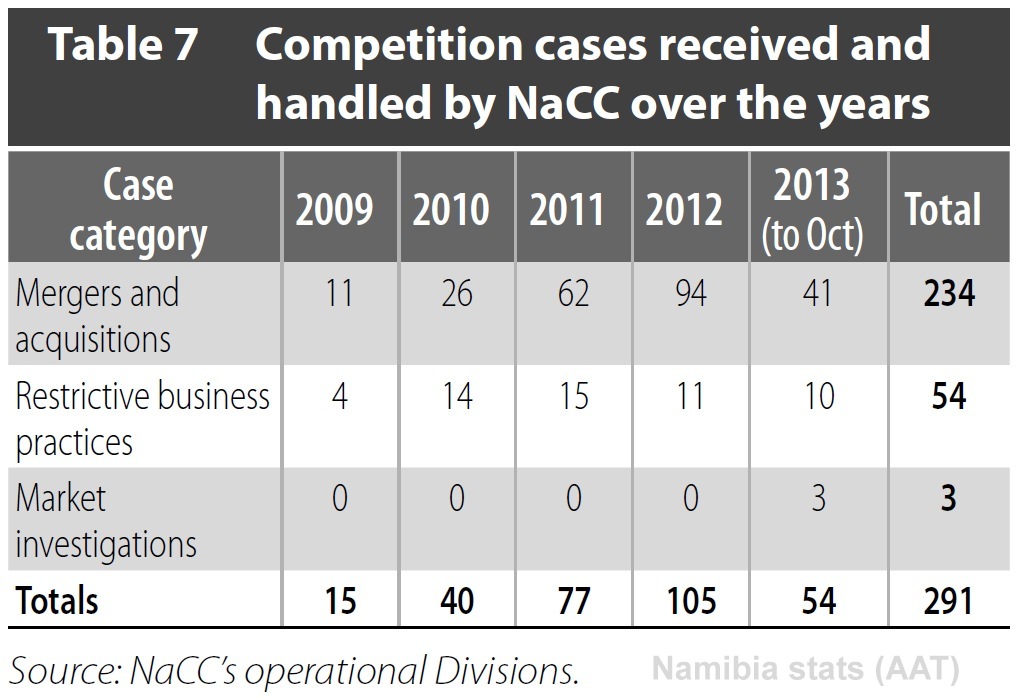
The cited Report contains two relevant statistics, showing the relatively young enforcement agency’s workload in absolute terms as well as in relative (merger vs. other enforcement work) numbers:

Namibia stats

Namibia stats comparison


Video: Oxenham on government interventionism in African antitrust

AAT the big picture

AAT’s own editor John Oxenham has been featured in a video discussion of government interventionism in African competition law.  See the talk on Competition Law Observatory (subscription required)

The topic at issue is successfully negotiating the ever-increasing rise of government interventionism in South African and regional merger control.  Not only does interventionism have the potential to undermine the independence of the agencies, but given the increasing trend of government intervention over the past decade, there are concomitant negative effects on merger control in terms of timing and costs.

John Oxenham, editor

The number of countries in Sub-Saharan Africa, and indeed Africa as a whole, which require mandatory merger notification, has increased dramatically in recent times. South Africa, which has the largest economy in Africa and has had a merger control regime in place for some time now, has made significant contributions to merger jurisprudence in Sub-Saharan Africa already. Accordingly, as many regional countries adopt competition law legislation or specific merger control regimes, they will look increasingly towards South Africa’s Competition Authorities to assist in interpreting and enforcing competition law policies.

In addition with this growth in regimes there are significant challenges for companies (and advisors on their behalf) engaging in multi-jurisdictional mergers principally due to the lack of uniformity across the respective jurisdictions. In particular, when one considers the unique merger review considerations that the South African authorities take into account, it becomes clear that navigating through the field of merger control in South Africa and indeed many African countries requires great skill and care.

Kowlessur appointed as head of Mauritian Competition Commission

New head of CCM announced

Amid some controversy over other past (and some other pending) political appointments and potential nepotism, Mr. Deshmuk Kowlessur has been appointed as new head of the Competition Commission in Mauritius.

An article in Le Mauricien states (French skills required) that the rules have “followed to a T” in Mr. Kowlessur’s case, thereby alleviating readers’ concerns that the Competition Commission’s recent appointment may have been similarly tainted:

Les nominations de proches du MSM continuent conformément à l’engagement donné par Pravind Jugnauth. Et c’est d’ailleurs un proche, Deshmuk Kowlessur, qui décroche le poste de directeur de la Competition Commission en attendant que d’autres affidés du Sun Trust soient casés.

Deshmuk Kowlessur, un professionnel de la gestion qui a occupé divers postes dans le management de quelque grandes compagnies dont Rogers ou Emtel, est le beau-frère du beau-frère du leader du MSM et il avait déjà occupé le poste de président de la SIC lorsque Pravind Jugnauth était vice-Premier ministre et ministre des Finances entre 2003 et 2005. Week-End a toutefois appris que, contrairement à l’ICAC, les procédures et les consultations d’usage ont été respectées à la lettre pour la nomination de M. Kowlessur.

EU gives Kenya until October 1 to sign Partnership Agreement

kenya

Kenya is currently at risk of losing preferential access to European markets

As of next year, this risk will expose the country’s exporters of flowers, fish, fruits and vegetables to high tariffs and logistical problems.

Lodewijk Briët, the European Union Ambassador has indicated that the bloc would remove Kenya from the preferential list again, if the East African Community fails to ratify the new Economic Partnership Agreements by October 2015. The removal of Kenya from the list would result in Kenya accessing the European Union market under the Generalised System of Preferences which results in tariffs of up to 15 per cent.  The deadline is apparently not a “must-beat” time limit, according to a quote from the Daily Nation article on the topic:

Negotiations between EU and EAC started in 2002, culminating in the two trading blocs signing an interim EPA in 2007 that ensured duty-free, quota-free access for its products under the Market Access Regulation that will end in October.

Kenya exports flowers to the European Union worth Ksh46.3 billion and vegetables worth Ksh26.5 billion annually resulting in the horticulture sector being one of the most important contributors of foreign exchange. The European Union takes about 40 per cent of Kenya’s fresh produce exports. The horticulture industry has also created job opportunities for about 90 000 Kenyans.

In October 2014, the European Union removed Kenya from its list of duty-free exporters after the East African Community failed to meet the Economic Partnership Agreements deadline which subjected fresh produce to levies of Ksh100 million per week.