The Commission Doth Protest Too Much?

south_africa

The defensive justification for the Commission’s healthcare inquiry by its acting chief has widely caused eyebrows to be raised…

As reported, the South African Competition Commission (“Commission”) has launched its first-ever market inquiry into the South African private healthcare sector.

The sector has recently been the subject of significant attention from the Commission, the South African health minister in particular, and the S.A. government in general. In spite of the perilous state of South Africa’s public health system, the government appears to have invested more time in deflecting from the obvious problems in the public branch by subjecting the private sector to a costly investigation.  From a procedural-history point of view, it is interesting to note that the market inquiry provision was brought into effect by way of Section 6 of the amended South African Competition Act. Although there were other areas of the legislation to be amended, it is noteworthy that only the market inquiry provision was brought into effect.

Many have suspected that the motivation behind the private healthcare inquiry was based on aspirations from outside the ambit of the Commission, particularly since the launch of the South African government’s National Health Insurance policy scheme (designed to achieve the noble aim of universal health insurance coverage, not entirely unlike the United States’ “Obamacare” effort) may ultimately cause the demise of a robust private healthcare sector.

Independence of Commission questioned

With this in mind, what is perhaps most interesting is a recent public submission made by the newly appointed 37-year old Acting Competition Commissioner Tembinkosi Bonakele in the South African media.  In an article co-authored with Ms. Paremoer, the Commission principal responsible for the healthcare inquiry, entitled Market inquiries an important advocacy tool (also published in the Sunday Times), Bonakele attempts to deflect any suggestions of government involvement in (or other ministerial influence over the pursuit of) the market inquiry. This approach seems at odds with Mr Bonakele’s predecessor, Shan Ramburuth – who was unceremoniously let go by the same government in a public display of shaming last year – in seeking to justify the motivation behind the private healthcare inquiry.  (We note that the present government has an apparent history of “letting go” unruly cabinet members in unusual and rather bombastic fashion, see here and here.)

Ramburuth’s Commission had previously stated expressly, for instance, that the inquiry was intended at least in part to review the sector for collusive behaviour, while Mr. Bonakele now disavows this rationale and claims that any such findings would merely be a side effect of the inquiry (“[o]f course, during such an inquiry, we may come across anti-competitive practices that need to be rooted out”).

In his piece, the Acting Commissioner seeks to reassure those who “remain confused about the […] intended market inquiry,” and states that the “inquiry is not a stalking horse“:

“we are simply seeking to understand how to improve efficiency and competition” in what he calls the “complicated web” of the healthcare industry.

Is this a case of Shakespearean “the [man] doth protest too much”, especially when keeping in mind that the private healthcare sector has previously been acknowledged to be competitive and efficient.  Mr. Bonakele has previously emphasised his independence, despite being referred to in the press as Minister “Patel’s man”:

“I haven’t responded to the media debate out there because I don’t think one has to stand on a mountain and say ‘I’m independent’. Actions speak louder than words.” [Source: BDLive]

Acting Commissioner Bonakele

The aim of the inquiry, according to the Acting Commissioner, is to improve competition and efficiency in the sector to such a degree that the ordinary man on the street will have full access. A very noble goal indeed, but when juxtaposed with the fundamental function and intention of the NHI,it is highly contradictory: the private healthcare sector is, by definition, not in the business of providing access to everybody. The public NHI body’s own slogan, on the other hand, shows that the national insurance programme fulfills precisely that role: “NHI is premised on the ideology that all South Africans are entitled to access quality healthcare services.”

What is perhaps of greater concern (with a wider applicability than just the healthcare sector, public or private) to competition-law enforcement in South Africa as a whole, is the confluence of the government’s industrial policy ambitions with otherwise supposedly independent Commission investigations and its competition adjudication based in the pure law & economics of antitrust. As previously reported in our piece on political interventionism in South African competition law, the Commission should seek to demonstrate its complete independence from the cabinet and executive branch as a whole, and avoid falling into the trap FTC Chairwoman Edith Ramirez warned against: the “proper goals” of competition law are best solved when a competition authority is focused on competitive effects and on consumer welfare and its analysis is not “interrupted to meet social and political goals.”

In sum, one must hope that Mr. Bonakele can be taken at his word when he says that, while “[m]aybe people think the minister will use the commission as a tool, but it’s just not possible. This is a legal process we are talking about.

Competition policy: economic necessity vs. budgetary constraint

Prof. Flavien TCHAPGA (Versailles)

Competition policy: economic necessity vs. budgetary constraint

Professor Flavien TCHAPGA (Economics, University of Versailles, France) published an intriguing paper on developing effective competition policies in Africa and on the inherent tension this effort faces: their economic necessity on one hand vs. the realpolitik of budgetary constraints on the other hand.  His analysis — available in full PDF to our valued [francophone] readers here — focuses on the member countries of CEMAC and WAEMU.

Abstract:

Because of the promises of efficient markets (protection of consumer interests, reduction of poverty, innovation and economic dynamism), competition policy is an attractive issue for Central African Economic and Monetary Community (CEMAC) and West African Economic and Monetary Union (WAEMU) countries. However, appropriate financial resources are essential for its effectiveness. This paper assesses the competition policy implementation in these two regions. In particular, it focuses on the balance between the issues at stake and dedicated financial resources since this could signal governments’ commitment to ensure effective implementation of competition legislation for better market outcomes.

NOTE: This article was originally published in HORIZONS / Concurrences Law Journal (vol. 01-2013) Institute of Competition Law, re-published here under author’s licence.  Original title (in French): “La politique de la concurrence dans la CEMAC et l’UEMOA  : Entre urgences économiques et contraintes budgétaires

Due process arguments come to the fore as the Botswana Competition Authority gears itself for enforcement

By Mark Griffiths (@markgjhb) and Wiri Gumbie

image

In September and October, the Botswana Competition Commission (Commission) took its first two rulings on cartel enforcement. Both rulings have a keen (if not almost exhaustive) focus on due process. Given that due process arguments have tended to be prominent only after a wave of cartel enforcement in more established jurisdictions, the cases demonstrate how developing competition jurisdictions are setting their own learning curves by absorbing the lessons from elsewhere.

Having been set up in 2011, the Botswana Competition Authority (Authority) has been primarily active in merger control and has taken a number of prominent decisions, in particular, on the issue of the relevance and scope of public interest considerations in merger control decisions. Unlike other young authorities across the Africa continent, the Authority has also been keen to pursue cartel enforcement as a priority area. While it has undertaken a number of dawn raids in a range of sectors and is in the final stages of adopting a leniency programme, the Authority is only now taken its first steps to establish a clear enforcement record with alleged cartels in the public procurement of food rations and also the panel beating sector.

The first ruling concerns alleged bid-rigging in relation to the supply of food rations to the Botswana government. Super Trading, a food supplier, provided the Authority with details of how one of its directors allegedly provided its competitor,Ya Raheem, with commercially sensitive information which enabled Ya Raheem to win tenders during a sustained period. Following a raid by the Authority, Ya Raheem opted to settle with the Authority and admitted to bid rigging as well as providing details of its involvement.

Notwithstanding Ya Raheem’s admission, on 17 September 2013, the Commission refused to confirm the settlement on the basis that it considered that the Authority had failed to provide any evidence of Ya Raheem’s involvement in the alleged bid rigging. Evidence of payments allegedly received by Super Trading’s director from Ya Raheem did not, in the Commission’s opinion, substantiate any finding of an agreement between competitors. To put it mildly, the Commission was scathing of the Authority’s approach regarding the lack of evidential or material information. Moreover, the Commission dismissed the significance of the joint undertaking between the Authority and Ya Raheem, labeling it “as simply a report that did little to cure the defects in the main application…”

The key question arising from the Commission’s ruling is whether or not due process requires additional evidence (over and above an admission) to support a settlement in a cartel case? Given that Ya Raheem’s involvement in bid rigging was not in dispute, was it necessary for the Commission to insist on further evidence? Moreover, given that Ya Raheemadmitted to and gave details of its involvement in the alleged bid rigging as part of its settlement with the Authority, it is not clear what additional evidence the Commission required to satisfy itself that alleged bid rigging had taken place.

One would expect that an undertaking with a clear statement of the facts and nature of the offence would have satisfied the procedural requirements of the South African settlement procedure, a pertinent observation given the Commission’s reliance on South African precedent on the treatment of evidence in this case.

It could be questioned whether the Commission’s implicitly categorized the settlement as a ‘contested’ proceeding (as opposed to an ‘uncontested’ consent order), which would have inevitably led them to require the Authority to provide sufficient evidence of Ya Raheem’s involvement in bid rigging. Should the significance of this ruling be dismissed asa teething problem regarding the first settlement procedure or does it reflect a fundamental difference in how settlement proceedings will be treated in Botswana? If the latter, it may hamper the Authority’s ability to expeditiously conclude settlement proceedings, a tool that has proved spectacularly successful in South Africa.

The second ruling relates to an alleged concerted practice between panel beaters. Following the referral of the matter to the Commission, the alleged cartelists raised a number of due process issues prior to the substantive hearing of the facts. In particular, it was argued that the Commission was incompetent to rule in the matter as, given its role as both referee and player in the dispute, the parties under investigation were not guaranteed a fair hearing. The parties sought the relief that the matter be stayed pending the establishment of an independent and impartial body.

In sharp contrast to the tone and substance of its previous cartel ruling, on 30 October 2013, the Commission dismissed the procedural challenges in their entirety. Irrespective of the fact that the Commission is formally located within the Authority and also functions as a governing Board for the Authority, the Commission stressed that the roles and functions are clearly delineated in the Competition Act, with the Authority authorized to carry out investigations and then refer matters for adjudication to the Commission.

The Commission emphasized that due process was furtherguaranteed by the jurisdiction of the High Court over rulings of the Commission whereby it can remit matters back to theCommission, revoke, increase or reduce any financial penalty, give any direction of its own in substitution for that of the Commission and make any decision as it sees fit.

Underpinning the Commission’s ruling is an implicit acknowledgement of the fact that the institutional design of a competition regime is a policy decision relative to the best fit for a given jurisdiction (taking into account international best practice). Acknowledging that the Botswana model is a hybrid between the integrated (e.g. European Commission) and bifurcated model (e.g. South Africa), the Commission appeared uncomfortable with second-guessing the legislature’s view as to what model was most suitable for Botswana’s current circumstances.

The ruling demonstrates a welcomed openness to international precedence. The Commission makes explicit reference to ICN guidelines on institutional design, while there is implicit reference to the “full jurisdiction” jurisprudence of the European Court of Human Rights relating to the application of due process to administrative proceedings when the Commission emphasizes the full extent of the High Court’s review of the Commission’s rulings. This review process will be further probed in this case given that the parties have appealed the ruling.

These two recent rulings illustrate how in the relatively short period since their inception, both the Authority and the Commission have absorbed the lessons from more established jurisdictions and are forging their own path in the enforcement of the Competition Act. Both the Authority and the Commission are already grappling with complex issues of due process on par with those confronting their more established counterparts. For example, by contrast, it has taken decades to obtain an arguably definitive ruling on the application of Article 6 of the European Convention of Human Rights to the competition proceedings before the European Commission.

9 months make a baby – but no antitrust authority!

mozambique

Almost nine months later… and still no signs of the Mozambique Competition Authority

By Sofia Ranchordas, Tilburg University (Law School)

On April 11, 2013, the Mozambique Competition Act was passed.  We wrote a piece on the potential advent of competition law in Mozambique here, brusquely entitled: Antitrust in Mozambique? …could have stayed in COMESA.

The law constitutes an important milestone for the country’s economy since it establishes an independent competition regulatory authority (‘CRA’), is applicable to most economic activities, and introduces a legal framework for competition in Mozambique. The Mozambique Competition Act addresses anti-competitive practices and merger control. This act came into force on July 10 and should have been implemented by October 8, 2013. It ‘should have’ but its thorough implementation, including the approval of the Statute of the CRA, leniency program and the definition of exact thresholds for the notification of mergers to the CRA, is still out of sight.

In 2007, the Mozambique Competition Policy (Resolution n.º 37/2007, 12.11) was approved. The adoption of this policy document was a step towards the modernization of this country’s framework for business conduct and improvement of competition conditions. It was also an attempt to tackle existing anticompetitive practices taking place in different economic sectors, including predatory pricing, refusals to deal, and horizontal agreements. In 2007, the Council of Ministers acknowledged the need for stricter competition rules and the establishment of an independent competition authority. At the time, Mozambique already knew multiple sectoral dispositions prohibiting anti-competitive practices that were (and still are) enforced by sectoral regulators. However, an all-embracing competition act was still missing. In 2009, the endorsement of the Southern African Development Community (SADC) Declaration on Regional Cooperation in Competition and Consumer Policies increased the pressure for the enactment of a competition act. Mozambique was seriously lagging behind the other members of this regional community, where some countries had effective competition laws and operating competition authorities for years. This was the case of South Africa, Zimbabwe, Tanzania and Malawi.

On April 11, 2013 the long-awaited Mozambique Competition Act (‘MzCA’) was adopted. An attentive reader shall rapidly find the similarities between this act and the 2003 Portuguese Competition Act (replaced in 2012). The MzCA has a comprehensive scope and is applicable to both private and State-owned undertakings, including most economic activities (see the exceptions listed in article 4). This act prohibits both horizontal and vertical agreements and practices susceptible of substantially impeding, distorting or restricting competition (articles 15-18). This act provides however that the mentioned prohibited practices may notably be justified if they generate economic efficiencies, promote the competitiveness of small and medium enterprises, promote innovation, exportations, or result in other pro-competitive gains (article 21 and 22). Although the text of the MzCA is unclear, it appears that the drafting of a leniency policy is one of the elements which shall be regulated in the context of the implementation process of this act.

The prohibition of abuse of dominant position, as defined in article 20, appears to be one of the priorities of this law. Mozambique is characterized by a highly concentrated market and the dominance of previously state-owned companies, which have been recently liberalized.

The MzCA introduces merger control rules in Mozambique, defining mergers as ‘an acquisition of shareholdings, an acquisition of ownerships or the right of use of assets, IP rights, or any agreements granting a decisive influence on the composition or resolution of corporate bodies. Mergers that meet certain thresholds must notify the operation to the CRA within seven working days after the agreement. These thresholds remain until now unknown since their definition has been left to the further regulations which should have been adopted in October this year.

As far as sanctions are concerned, the violation of the prohibitions contained in the MzCA may result in the application of fines up to 5% of a company’s turnover in the previous year. Additional sanctions such as the exclusion of participation in public tenders for a period of up to five years may equally be applied.

The implementation of the MzCA is expected to be gradual and to take into account the characteristics of the Mozambican economy. Considering the dispositions of the MzCA and particularly the extensive powers vested in the CRA, this act, if correctly implemented, may produce a strong impact on most Mozambican economic sectors and compel companies to rethink some of their practices. There is only one small detail: almost nine months have passed and it is still unknown when and how the implementation process of the MzCA will start.  If experience from other new competition jurisdictions can be used as a guideline, one may expect the MZ government to hire a law firm or other experts to draft the implementation rules that are still missing, but this – as much else – remains to be seen.

Balancing Public Interest Merger Considerations with the Quest for Certainty

AAT editor John Oxenham‘s paper on “Balancing Public Interest Merger Considerations with the Quest for Multi-Jurisdictional Merger Control Certainty” in the “US-China Law Review.

Our readers have free access to the full PDF.

Abstract:

The growing importance of public interest considerations, and the uncertainty that it creates, in South Africa and other sub-Saharan jurisdictions, including Zambia, Namibia and Botswana, pose an additional challenge for merging entities attempting to coordinate multi-jurisdictional merger notifications. These difficulties were, most recently, brought to the fore during the much publicized and highly opposed proceedings involving Wal-Mart’s takeover of the South African listed retailer Massmart. While the growing importance of public considerations increases the complexity and cost of multi-jurisdictional merger filings, the author suggests that these challenges can be countered by addressing public interest considerations as an integral part of submissions in support of merger filings in the sub-Saharan African region

Quo vadis? Political interventionism in South African competition law

There has been a somewhat startling demonstration of diverging views regarding interventionism in competition matters between emerging and established jurisdictions.

During the recent BRICS international competition conference, held in New Delhi over the last few days, FTC chairwoman Edith Ramirez had sought to steer emerging economies away from mixing industrial policy with antitrust law. She indicated that “proper goals of competition law were best solved when a competition authority is focused on competition effects and consumer welfare, and when its analysis is not “interrupted to meet social and political goals.” (Ramirez cited the well-known case of the Wal-Mart / Massmart merger during which a number of South African government departments had intervened and extracted significant non-competition centric conditions from the merging parties as an example of permitting non-competition factors to intervene in the merger-review process to an undue degree).

Juxtapose this with the comments made at the very same conference, by the newly appointed interim South African Competition Commissioner, Tembinkosi Bonakele. Bonakele had the following to say during an interview regarding the independence of the competition authorities in South Africa:

“In a country which suffers from 35 per cent unemployment, there are increasingly calls for the authority to consider job creation and the development of local industries in its investigation and merger reviews. This is not an unreasonable call. While competition authorities should not be beholden to the government neither can they be loose cannons who claim independence without accountability. Competition policy cannot exist in isolation and each BRICS enforcer faces the need to balance competition law with its government’s political and economic policies. Competition authorities cannot afford to shy away from the debate.”

ppt

A number of practitioners have keenly been awaiting Bonekele’s views on the independence of the Competition Commission in the light of the untimely and suspicious departure of the previous commissioner, Shan Ramburuth (in what many commentators have described as evidence of pure uninterrupted interventionism by the Department of Economic Development). It is, particularly, in light of the cloud surrounding (and possible political element involved in) his predecessor’s removal, that these comments of the South African competition commissioner are all the most startling. It is worrying that the prevalent view in developing economies (after all, the venue at issue here was a BRICS conference) appears to open the door for greater non-antitrust intervention rather than less government meddling.

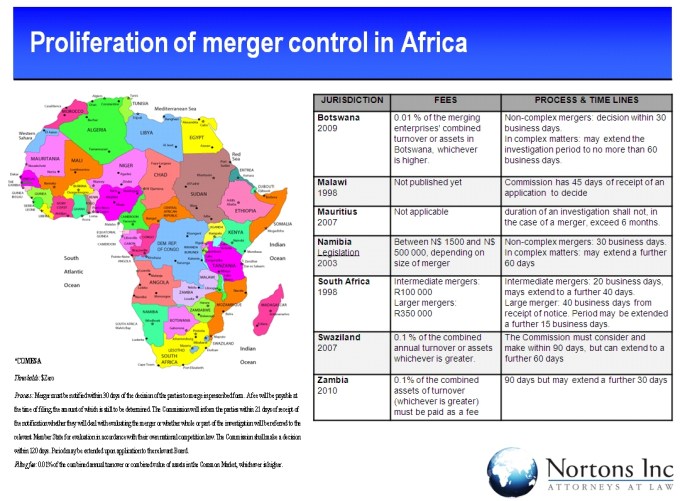
It is certainly the view of the author of this piece — a presentation given this fall at the Inaugural Global Mergers Conference in Paris (Concurrences/Paul Hastings) — that the South African competition authority should rather seek to assert its independence rather than tolerate what appears to be an ever increasing amount of political interventionism.