African antitrust authority fines META quarter-billion dollars — WhatsApp (with that?)

Nigeria’s FCCPC has imposed a U.S. $220m fine on WhatsApp’s parent company Meta for violating data privacy laws, continuing the FCCPC’s consumer-protection streak

When it rains, it pours. And when the nascent FCCPC (on whose relatively youthful existence we have reported extensively) issues a fine on a global mega corporation like META (or BAT to the tune of $110m), then it really reaches deep into its pockets: Mr. Zuckerberg’s conglomerate will have to pay $220m to resolve an extensively-documented violation abusing its dominant position, exploiting Nigerian WhatsApp users’ personal data, which it had stored in Singapore, Europe and the U.S. The proceedings were brought approximately 3 years ago, culminating in a particularly in-depth Report issued by the FCCPC and the resulting fining decision last week, pursuant to both the Federal Competition and Consumer Protection Act, 2018 (FCCPA), and the Nigerian Data Protection Regulation, 2019 (NDPR).

At the heart of the allegations lies Meta’s undisclosed, apparent dual-use of WhatsApp user information and metadata (no pun), across virtually all of its conglomerate digital platform companies — i.e., data-sharing conduct squarely in violation of the NDPR and, so says the FCCPC, without consumer knowledge and in many cases against WhatsApp users’ wishes.

Andreas Stargard, a competition lawyer at Primerio Ltd., with a focus on African antitrust cases, comments as follows on this latest record-setting West African case:

“This latest foray by the FCCPC against Meta is notable for multiple reasons: First, it spans both the inaugural aegis of the FCCPC under internationally lauded former FCCPC chief, Babatunde Irukera, and that of his recent successor, Tunji Bello.

Secondly, it represents a new record, and quite literally a doubling of the last record fine, namely the $110m agreed-upon antitrust settlement against British American Tobacco less than 2 years ago.

Third, it shows a trend we have recently noticed in the African government enforcement world: namely, the intertwined nature of competition law and consumer-protection issues, which the detailed Report issued by Commission staff highlights in a significant way. Other agencies on the continent will surely take notice and (we hope) issue similarly-documented case reports going forward.

Fourth, and finally, setting aside the amount of the fine, this matter shows how African jurisdictions may well be ahead of some European and other peer institutions. This is a milestone development for the future regulation of digital behemoths across Africa. The detailed report and analysis provided publicly by the Nigerian agency shows that its nascent competition-law regime continues to be eager to comply with global best practices and appears well situated to keep earning the respect of its Western and other African peer authorities, akin to the journey that the COMESA Competition Commission has undertaken in its first 10 years of existence. Both agencies have gone from non-existent to generally and globally respected African antitrust and consumer-protection powerhouses.”

The Commission’s release noted that “[t]he totality of the investigation has concluded that Meta over the protracted period of time has engaged in conduct that constituted multiple and repeated, as well as continuing infringements… particularly, but not limited to abusive, and invasive practices against data subjects in Nigeria. Being satisfied with the significant evidence on the record, and that Meta has been provided every opportunity to articulate any position, representations, refutations, explanations or defences of their conduct, the Commission have now entered a final order and issued a penalty against Meta.”

In Conversation with African Antitrust Agencies: Nigeria

A Primerio-sponsored webinar recently put the spotlight on Nigeria’s burgeoning FCCPC

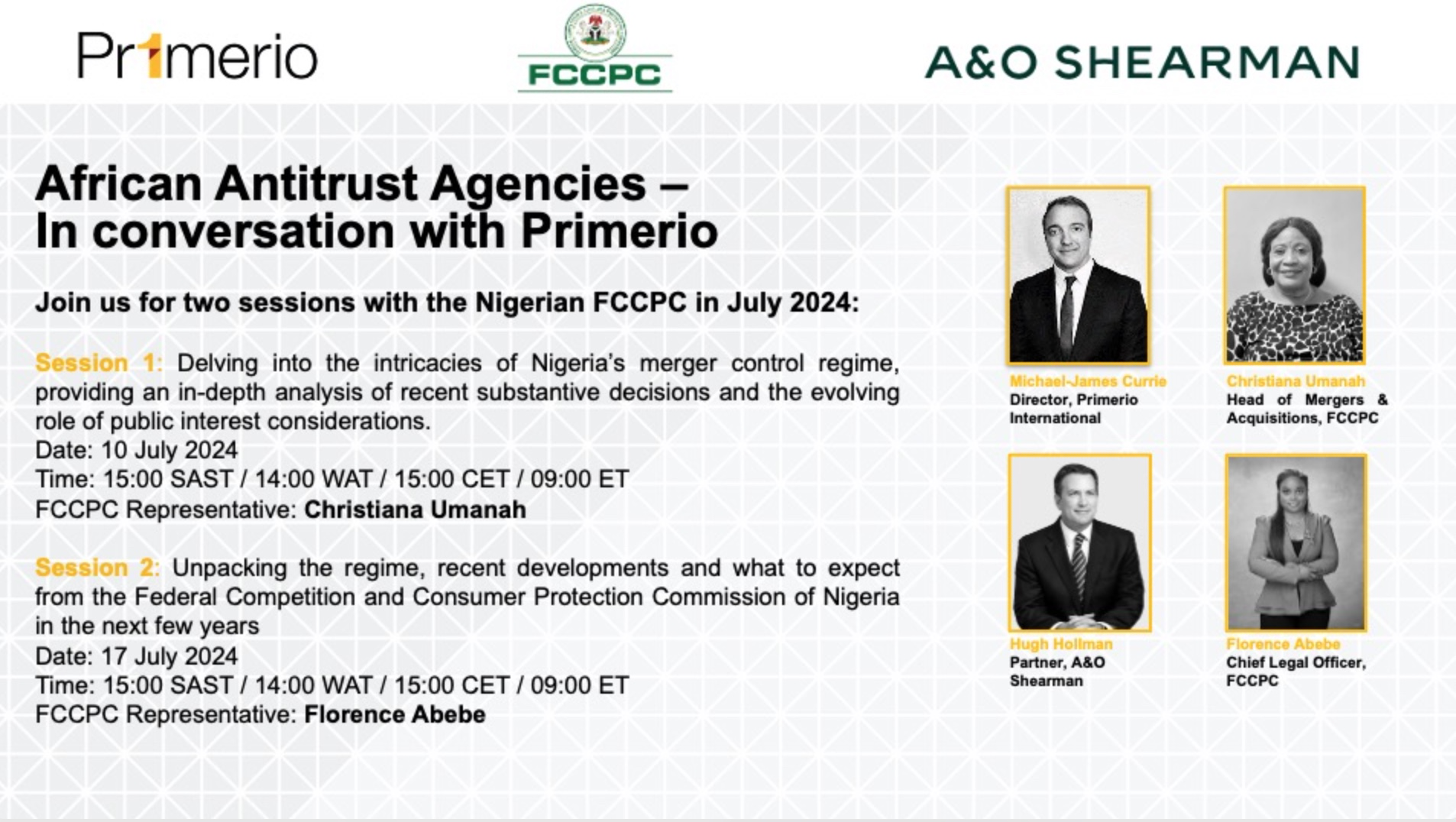
On 10 July 2024, advisors from pan-African law firm Primerio continued their “African Antitrust Agencies – in Conversation with Primerio” series with the Nigerian Federal Competition and Consumer Protection Commission (“FCCPC”) in the first of two sessions aimed at a quick snapshot of the most noteworthy enforcement, legislative, and policy developments. 

This first session focused on merger control. 

Primerio’s Michael-James Currie, Competition Law Partner at Primerio (Johannesburg) was joined by Hugh Hollman, Competition Law Partner at A&O Shearman (Washington & Brussels) and had the pleasure of speaking with Christiana Umanah, the Head of the FCCPC’s Merger Control Department

This recent webinar featured insights from Hugh Hollman, an experienced international antitrust partner at A&O Shearman, and Christiana Umanah, head of FCCPC’s merger division. Christiana Umanah elaborated on the rapid development of the FCCPC since the Federal Competition and Consumer Protection Act (“FCCPA”) was enacted in 2018. She outlined the structure and growth of the FCCPC, noting its establishment in 2019 with an active team of eight in the mergers department, along with offices in all 36 states of Nigeria, and 6 regional offices. Christiana emphasized the regular training received by FCCPC staff both locally and internationally, with recent sessions in Mauritius and Barcelona. The FCCPC maintains collaborative relationships with international agencies such as the FTC, and the DOJ, especially for capacity building and training. She detailed the timelines for merger reviews in Nigeria, which usually take 60 business days, extendable to 120 business days for complex antitrust cases, while harmonizing multi-jurisdictional reviews and offering a fast-track option to reduce the timeline by 40 business days. 

Addressing foreign-to-foreign mergers, Christiana explained that the FCCPC assesses these based on local turnover, focusing on the specific business presence in Nigeria. She also discussed the penalties for gun-jumping, which are commonly based on 2% turnover for the last financial year, considering factors like knowledge, cooperation, and company size. The FCCPC is open to pre-merger consultations on a no-name basis, ensuring confidentiality while guiding parties through the process. Christiana shared examples of conditions imposed on transactions, such as divestments and board member exit to prevent market concentration. Public interest considerations are also a key focus for the FCCPC, particularly regarding employment and market impact, as demonstrated in a case involving a failing firm where job preservation was prioritized. Looking ahead, the FCCPC is developing regulations for digital transactions and e-market platforms to address emerging issues in the digital market. The webinar concluded with a note on the importance of ongoing dialogues and the FCCPC’s willingness to assist with information and support. 

The transcript for this session is available here, and the recording of this session is available on Primerio’s YouTube page, accessible here

Our next session of Primerio‘s “in conversation with…” series remains focused on Nigeria, as we will discuss recent enforcement activity and legislative & policy developments. Join Hugh Hollman, the FCCPC’s senior officer, Florence Abebe and Primerio partners for another concise but very useful session as Nigeria’s FCCPC Nigeria gains prominence across the Continent.

Register for this upcoming session here.

Malawi Revamps its Antitrust Laws: Suspensory Merger Control and More

Not only did the Malawian government revise its 26 year-old competition law, but it effectively repealed the old statutory regime under the “Competition and Fair Trading Act”, and it has now enacted its replacement, the so-called “Competition and Fair Trading Act of 2024.”

Says Andreas Stargard, who practices competition law with Primerio Intl., “the new regime had been in the works for several years, with input from the broader international and pan-African competition communities, both private and academic, as well as from fellow antitrust enforcers across the globe. We are pleased to see this revision effort come to fruition in the form of the CFTA 2024, which notably introduces a suspensory merger-control provision — meaning companies that meet the Malawian thresholds for notifying their M&A activity must put on hold the closing of their deal until it is cleared by the authority, the CFTC.”

Parties considering entering into transactions affecting the Malawian market should note, Stargard observes, that Malawi is part of the COMESA competition-law area, “which would require firms to consider whether or not there is a COMESA community dimension to their transaction, thereby possibly negating one or more domestic filings with [National Competition Authorities], and instead making a ‘one-stop-shop’ notification to the CCC.” Coincidentally, the COMESA Competition Commission is also headquartered in the Malawian capital, Lilongwe, so “parties can expect there to be extensive collaboration between the supra-national CCC enforcement teams and the CFTC’s domestic-focussed antitrust lawyers,” Mr. Stargard surmises.

The in-depth text of the Malawian press release is as follows:

 ENTERING INTO FORCE OF THE NEW COMPETITION AND FAIR TRADING ACT 

You will recall that the Competition and Fair Trading Commission (CFTC) has been reviewing the Competition and Fair Trading Act (CFTA) of 1998 in order to fill the existing gaps and enhance its effective enforcement. The CFTC is pleased to announce that the process of repealing the CFTA of 1998 was completed and it has been replaced with a new legislation, the Competition and Fair Trading Act of 2024. 

The new legislation was passed by Parliament on 5th April, 2024, and was assented to by the State President, His Excellency, Dr Lazarus Chakwera on 19th May 2024. In accordance to Section 1 of CFTA of 2024, The new Act shall come into force on a date to be appointed by the Minister, by notice published in the Gazette. The Competition and Fair Trading Act of 2024, therefore, comes into force today, 1st July, 2024, following the gazetting of the notice, signed by the Minister of Trade and Industry, Hon. Sosten Gwengwe, MP, which appoints this date. 

CFTC is extremely pleased with this development as it signals an end to some of the enforcement challenges the institution was facing with regard to the enforcement of the old Act due to the gaps in some of the key provisions in the law. In addition, the CFTA needed to be aligned with the recent developments in the enforcement of competition 

and consumer protection law, reflective of the current market dynamics in the economy. Furthermore, the CFTA required to be aligned with international best practices in the enforcement of competition and consumer protection. 

In order to address these gaps, there are several changes that have been made to the CFTA of 2024. Below is a highlight of some of the key changes: 

i. Competition Regulation 

The major change that has been brought in is on Suspensory Merger Notification. The 1998 CFTA provided for voluntary notification of mergers and acquisitions; which meant that mergers having potential harm to competition process and consumer welfare could be effected without seeking authorisation from the CFTC. The new CFTA has made notification of mergers and acquisitions mandatory, based on determined thresholds. 

The new Act has also expanded on the provisions on anticompetitive business practices, to make it very encompassing but also effective to regulate and enforce. These areas include: restrictive business practices; collusive conducts (cartels); abuse of market power; but also mergers and acquisitions. 

ii. Consumer Protection 

The CFTA of 1998 narrowly defined the term “Consumer”. The definition under the old Act left out some stakeholders that are equally affected by unfair trading practices, which include: consumers of technology, consumers of digital products, beneficiary consumers, but also other users of goods or services for purposes of production of other goods or services. For this reason, various vulnerable groups that did not fall within that narrow definition were not effectively protected from unfair trading practices 

The CFTA of 2024 has also brought in several types of unfair trading practices that were not included in the CFTA of 1998. Among others, these include the following: 

 failure to give warranty or guarantee on goods for long term use; 

 improper or insufficient labelling of products; 

 failure to disclose material information about the products supplied; 

 engaging in excessive or exploitative pricing of the products. 

 imposition and implementation of unfair terms in consumer contracts. 

iii. Abuse of Buyer Power 

The CFTC of 1998 focused on abuse of supplier (seller) power and not the abuse that may arise from powerful or dominant buyers. This made it difficult to deal with malpractices by buyers, including those involved in buying farm produce from farmers. 

The CFTA of 2024 has included various provisions to redress malpractices resulting from abuse of buyer power. The Act has expressly prohibited the powerful and dominant companies that purchase agriculture produce from the farmers not to engage in any anticompetitive and exploitative conducts. For example, the Act prohibits, among others, the following conducts: 

 delays in payment of suppliers, without justifiable reason, in breach of agreed terms of payment; 

 unilateral termination or threats of termination of a commercial relationship, without notice or on an unreasonably short notice period, and without an objectively justifiable reason; 

 refusal to receive or return any goods or part thereof without justifiable reason, in breach of the agreed contractual terms; 

 transfer of commercial risks meant to be borne by the buyer to the suppliers; 

 demands for preferential terms unfavourable to the suppliers; 

 demanding limitations on supplies to other buyers; 

 reducing prices by a small, but significant, amount where there is difficulty in substitutability of alternative buyers or reducing prices below competitive levels; or 

 bidding up prices of inputs by a buyer enterprise with the aim of excluding competitors from the market. 

iv. Penalties for Violations 

Under the CFTA of 1998, when the Commission found a business enterprise in breach, it had been imposing fines, which were provided for under Section 51. However, in 2023, in the matter of CFTC v Airtel Malawi Plc, the Court ruled that the said provision does not empower the CFTC to impose fines, on the grounds that the violations were designated as being criminal in nature. Specifically, under section 51 of the CFTA of 1998, the provision for imposing the fines was combined with sanctioning of an imprisonment sentence of up to 5 years. The ruling in the CFTC v Airtel Malawi Plc case, thus weakened the regulatory mandate of the CFTC. In addition, the 1998 CFTA did not provide for aggravating and mitigation factors for the Commission to consider in coming up with fines and/or orders. 

The CFTA of 2024 gives express powers to the CFTC to issue Administrative Orders, which include imposing fines on errant enterprises. Under the new Act, the fines to be imposed will be (i) up to 5% of annual turnover if it is an individual; or (ii) up to 10% of annual turnover if it is a company. The determination of the fines will depend on the applicable aggravating and mitigating factors. There are also various Orders that the CFTC can impose which are meant to redress the malpractices. These include orders to: give refunds, return or exchange defective products, withdraw false advertisements, supply the advertised/promised goods and services, and cancel unfair and exploitative contracts. 

v. Suitability and Independence of Commissioners for the CFTC 

As adjudicators of cases, the Commissioners of the CFTC are required to be sufficiently scrutinized for their qualification and suitability for their functions, but also guarantee utmost independence. Under the provisions of the CFTA of 1998, the Commissioners were not thoroughly subjected to scrutiny of Parliament once appointed, to determine their qualification and suitability for their office. Similarly, the Commissioners independence as adjudicators was not guaranteed under the old law. The CFTA of 2024 has provided that, as a way of ascertaining the Commissioners’ suitability and ensuring independence, their appointment and removal from office will be subjected to the scrutiny of the Public Appointments Committee of Parliament. 

In view of the foregoing, the CFTC would like to call upon business enterprises, consumers and the general public to take notice of the new legislation, and particularly take consideration of the provisions that have been brought into the CFTA of 2024. Furthermore, the CFTC would like to advise the business enterprises to adopt voluntary compliance with competition and fair trading laws at all times, so as not to be found in breach of the law. 

For media enquiries on this statement, contact Innocent Helema on 0880725075 or email innocent.helema@cftc.mw. 

LLOYDS VINCENT NKHOMA 

CHIEF EXECUTIVE OFFICER 

South Africa’s New Cabinet Under the GNU: A Shift Towards Business-Friendly Policies?

By Megan Friday

On Sunday, 30 June 2024, President of South Africa, Cyril Ramaphosa announced South Africa’s new cabinet under the newly-formed Government of National Unity (‘GNU’).  The Government of National Unity is “a government that brings together a number of rival leaders and political parties in order to promote national unity and political stability” (Cheeseman, N., Bertrand, E., and Husaini, S. (2019). A Dictionary of African Politics, Oxford University Press). The Democratic Alliance, South Africa’s main opposition party, is generally considered to be more business friendly than other, rival parties.

From the new cabinet announcement, it has been revealed that Parks Tau is the new Minister of the Department of Trade, Industry, and Competition (‘DTIC’), with Zuko Godlimpi and Andrew Whitfield serving as Deputy Ministers. Mr. Tau, the former Mayor of Johannesburg, is seen as a more business-friendly appointment than his predecessor, Ebrahim Patel.

We anticipate that the aggressive approach taken by the South African Competition Commission in driving an industrial policy agenda will be moderated in favour of a more business-friendly approach. A more balanced implementation of public interest objectives is expected, aiming to stimulate economic growth, business development, job creation, and more.

Any potential changes to the structure and mandate of the Commission remain to be seen.

Nigeria appoints new chief antitrust enforcer: is it a pure consumer-protection play?

Nigerian president, Bola Tinubu, yesterday appointed Mr. Tunji Bello to become the new Chief Executive Officer and Executive Vice-Chairman of the Federal Competition and Consumer Protection Commission (“FCCPC”), subject to review and a vote by the Senate, which is expected to pass without issue.

Observers are noting the relative lack of competition-law / antitrust experience of Mr. Bello (whose prior credentials include State Secretary and Environment Commissioner, both in Lagos State). Mr. Bello, a former journalist, is an unknown to most, if not all, competition-law practitioners. His Wikipedia entry describes him primarily in terms of his career as a journalist, which included international stints as “a Staff Writer with [the] St. Petersburg Times, Florida, US, and also [] US News & World Report, Washington DC in 1992.”

The formal press release (see below) seems to support this sentiment of a purely political appointment without any regard to prior competition-law or economics experience, as it appears to focus solely on “consumer protection” and the “safety of goods and services,” while failing to mention competition or antitrust even once.

We note that some commentators have pointed out, at the cynical end of the spectrum, that this appointment may be due to the FCCPC’s past successes in garnering massive fines (e.g., the $110 million fine imposed against BAT), under recently-dismissed predecessor Babatunde Irukera. Such financial windfalls for the government coffers have, these observers believe, turned the agency’s CEO job, into a highly coveted executive post, which had been temporarily held in an interim capacity by Dr. Adamu Abdullahi between January and Mr. Bello’s appointment yesterday.

AAT is hopeful that this is not the case, and that Mr. Bello will not turn the young and so-far highly-regarded FCCPC into a mere means to an end of generating revenue for the Nigerian government. We trust that the Commission will continue to uphold its mandate of competition-law enforcement and its high standard of excellence, thanks in large part to the leadership of Mr. Bello’s predecessor and the quality of the senior team members he had assembled to run the agency.

Press release:

Draft Vertical Restraints Regulations: what is an SPLC for purposes of section 5(1)?

By Joshua Eveleigh

On 03 June 2024, the Department of Trade, Industry and Competition (“DTIC”) published the draft Vertical Restraints Regulations (“Draft Regulations”) with the intention of providing a non-exhaustive list of factors to assist in determining whether a restrictive vertical practice, contravenes section 5 of the Competition Act, 89 of 1998 (“Competition Act”).

The current framing of section 5(1) of the Competition Act is broadly framed in that:

“An agreement between parties in a vertical relationship is prohibited if it has the effect of substantially preventing or lessening competition in a market, unless a party to the agreement can prove that any technological, efficiency or other pro-competitive, gain resulting from that agreement outweighs that effect.” (own emphasis)

In this regard, the non-exhaustive list contained in Draft Regulations look to provide clarity in respect of which arrangements may result in a substantial prevention or lessening of competition (“SPLC”) within a particular market, including:

  • The nature of any restraint and the exclusivity (if any) of such restraint;
  • the duration of the restraint and any rights of renewal;
  • practical implementation of the agreement;
  • the nature of the good or service subject to the restraint, including the level in the supply chain and the maturity of that particular market;
  • the individual market shares of the contracting parties;
  • whether one (or more) of the parties is an important competitor within one level of the value chain;
  • barriers to entry and the likelihood of entry;
  • the strength and importance of inter/intra-brand competition and both levels of the supply chain;
  • the extent of participation of SMEs and/or HDPs firms in market;
  • whether there are parallel networks of similar vertical restraints amongst competing buyers or supplers, and whether the agreement contributes to the cumulative effect of this network of agreements; and
  • whether the vertical relationship is a franchise arrangement.

The Draft Regulations go further as to provide a list of instances which would be regarded as resulting in a “strong likelihood” of a SPLC. These include, inter alia, restrictions on:

  • active and passive sales, particularly within the context of distribution agreements;
  • the ability of a buyer to manufacture, purchase, sell or resell goods and services after termination of the agreement; and
  • buyers of online intermediation platforms being, directly or indirectly obliged, not to offer, sell or resell goods or services to end-users under more favourable conditions via competition online intermediation services, otherwise known as ‘wide’ most favoured nation (“MFN”) clauses.

As section 5(1) of the Competition Act exists as a rule-of-reason prohibition, firms may justify any vertical agreement which results in a SPLC on the fact that the anticompetitive effect is outweighed by other technological, efficiency or pro-efficiency gains. One aspect where firms typically fall short is that they fail to provide any objective quantification of such gains and why/how these outweigh the perceived anticompetitive effect. In this regard, the Draft Regulations also provide a list of non-exhaustive factors to assist in the rule-of-reason aspect of section 5(1), these include:

  • if the alleged gains have been quantified;
  • if it can be shown the customers or end-consumers benefit from the alleged gains; and
  • whether the agreement promotes the participation of SMEs and/or HDPs in the market.

Interestingly, the Draft Regulations was also accompanied with a memorandum, elaborating on certain aspects or factors contained in the Draft Regulations. Notably, the accompany memorandum states:

Dominance by one of the firms to the vertical agreement or practice is not required for the agreement to be assessed under section 5. Where one of the firms to the agreement or practice is dominant in a relevant market, the conduct may also be assessed under both sections 5 and 8 of the [Competition Act]”

While ‘dominance’ is not strictly required for a contravention of section 5 of the Competition Act, it is commonly accepted that an SPLC, as required by section 5(1), is unlikely to occur unless one or more parties to the vertical agreement have market power (i.e., the ability to act independently of their competitors, suppliers and/or customers). Where it can be established that a firm to the vertical agreement has market power, the conduct is more likely to be considered under the abuse of dominance provisions of the SA Competition Act.[1]

Accordingly, the SACC should be careful to assume that there has been an SPLC just because the nature of a vertical arrangement aligns with one of the ‘non-exhaustive factors’ identified in the Draft Regulations. This would clearly have unfair effects on firms investigated or prosecuted against.

Interestingly, the SACC has included wide MFN clauses into the ambit of the Draft Regulations, most likely pursuant to its findings in the Online Intermediation Platform Market Inquiry which found that these clauses prevented competition. The SACC imposed remedial action on several platforms to remove wide MFN clauses from their agreements with other firms. While the SACC’s position to date is that wide MFN clauses are anticompetitive, these arrangements would still be subject to a rule-of-reason analysis – however, given the SACC’s explanation in the accompanying memorandum (explained above) platforms should be concerned that they will be prevented from implementing MFN clauses despite them having no significant market share or market power.

In sum, while the Draft Regulations are welcomed in certain respects it appears that the non-exhaustive factors look to forego the SACC’s obligation to establish that a vertical arrangement has, in fact, resulted in an SPLC by conducting the necessary economic assessments. If successful, the section 5(1) net will be cast significantly wider than what it is currently.


[1]             Luke Kelly et al ‘Principles of Competition Law in South Africa’ at 113.

“So Much Abuse”: Overhaul of Competition Law Shifts from ‘Buyer Power’ to ‘Superior Bargaining Position’ Abuse

AAT discusses how the Kenyan antitrust watchdog, CAK, is seeking input on its recently released draft amendments

By Joshua Eveleigh

On 28 May 2024, the Competition Authority of Kenya (“CAK”) published a request for public comment on its ‘Draft Competition (Amendment) Bill, 2024’ (the “Amendment Bill”). The Amendment Bill seeks, most notably, to broaden the scope of the Competition Act to include ‘digital activities’ and to replace the recently included ‘abuse of buyer power’ prohibition with an ‘abuse of superior bargaining position.

Digital Activities

The Amendment Bill defines ‘digital activities’ as:

the provision of a service by means of the internet, or provision of digital content, for the benefit of business consumers or other consumers (whether paid for or otherwise and whether or not such activity is multisided), and may include —

  • online intermediation services, including online marketplaces and app stores;
  • online search engines;
  • online social networking services;
  • video-sharing platform services;
  • independent interpersonal communication services;
  • operating systems;
  • cloud computing services; and
  • online advertising services”

Moreover, the new law would broaden the assessment for effects on competition or a firm’s dominance provided for in the Competition Act to include the following:

  • in the context of digital activities, where dominance can be established even with market shares below forty percent, the Authority shall consider factors that typically grant significant market position, whether they arise from the digital activity being performed in one or multiple markets;
  • direct and indirect network effects and the entry barriers arising in connection with those network effects;
  • economies of scale and scope enjoyed by the undertaking, including with regard to the undertaking’s access to data relevant for competition;
  • switching costs for users and the ability and propensity for users to multihome; and
  • competitive pressure driven by innovation;
  • the importance of the intermediary services provided by the undertaking for accessing supply and sales market, including with reference to the size of the undertaking and the number of business and individual users it has and the period over which that level of importance has been held.

Says Andreas Stargard, a partner in Primerio’s competition-law group, “[e]vidently, the CAK is joining the global trend in regulating online marketplaces and firms. Our Kenyan colleagues expect more enforcement against firms that are active within the digital space – particularly given the CAK’s focus on the online sector in its past market studies and investigations.”

The inquiries mentioned include:

Abuse of Superior Bargaining Position

The Amendment Bill also seeks to remove the ‘abuse of buyer power’ prohibition, despite it only being included subsequent to recent amendments to the Competition Act in 2019. Interestingly, this change also comes after the CAK’s recent success in enforcing the newly-implemented buyer power provision, including:

  • the CAK’s announcement that it was able to recover reneged payments worth KES38 million from twenty motor vehicle repairers and five motor vehicle assessors in favour of 1, 000 Kenyans;[1]
  • its settlement with Unilever Kenya Limited resulting in the revision of payment terms for a number of its suppliers; and
  • the High Court of Kenya’s recent finding that Majid Al Futtaim Hypermarkets Limited had abused its buyer power in respect of its commercial relationship with Orchards Limited, confirming the finding of Kenya’s Competition Tribunal.

Now, in lieu of the perhaps more narrowly perceived Buyer-Power clause, the Amendment Bill seeks to include an entirely new section 40A to the Competition Act, prohibiting the abuse of a ‘superior bargaining position’, defining it as:

“the ability of an undertaking to control, direct, define or determine the conditions of business operations with counterparties which are favourable to itself without reference to the undertaking’s dominant market position or market power in the relevant market;” (our emphasis)

While the proposed definition is clear in that a firm need not be dominant or have market power to have a ‘superior bargaining position’, the Amendment Bill provides that the CAK must consider the following factors in determining whether a superior bargaining position in fact exists:

  • the degree of dependence by the affected undertaking or undertakings on transactions with the party under investigation;
  • the position of the undertaking in the market;
  • the possibility of the affected undertaking to change its business counterpart; and
  • whether the party under investigation is an unavoidable trading partner or a critical business partner in the relevant market.

Additionally, the Amendment Bill looks to broaden the conduct which would trigger an abuse of a superior bargaining position from what is already included in what may trigger an abuse of buyer power. These additional categories include, inter alia:

  • unilateral variation of contractual terms, conditions, or other rules associated with the transaction or service without prior notification to the counterparties;
  • unreasonable collection and/or processing of data of the counterparty;
  • imposing unduly difficult conditions for the termination of service; and
  • obstruction of business activities or interference in the counterpart’s management of its business.

Notably, an abuse of superior bargaining position attracts the same penalties as the current abuse of buyer power provision, that being a period of imprisonment not exceeding five years or a fine not exceeding KES 10 million shillings, or both.

Looking Ahead

“It is clear that the CAK is looking to broaden the ambit of its enforcement initiatives. In this regard, we note that the ‘abuse of superior bargaining position’ is largely identical to the current abuse of buyer power framework. It is likely, therefore, that the CAK is looking to translate its recent success against ‘buyers’ to firms at all levels of the supply chain, irrespective of whether they in a position of supplier or purchaser,” says Mr. Stargard.

Following this approach, it appears to us that the abuse of dominance provisions in the Competition Act have been given something of a ‘downgrade’. Specifically, it is not apparent to the author why a disgruntled firm (or the investigating CAK) would rely on the existing abuse of dominance provisions (and thereby needing to actually establish a firm’s dominance) when the would-be plaintiff could rely solely on the incredibly broad superior bargaining position provision — which notably does not require a showing of dominance or market power.

We are also interested to see whether the proposed superior bargaining provision will have an ‘opening the floodgates’ type effect if and when implemented. In this regard, it appears that an economic dependence argument would be relevant in determining whether a firm has a superior bargaining position. Absent a dominance requirement, the CAK may well be inundated with complaints from disgruntled contracting parties. 


[1] CAK, Newsletter Issue No.9 (2022), at 3. Available at: https://cak.go.ke/sites/default/files/2022-06/CAK%20Newsletter%20Issue%209.pdf

“But did you really comply…?” Insights into Post-Merger Conditions

Lessons drawn from the Constitutional Court in the Coca-Cola Appeal

By Brandon Cole

In a pivotal decision issued on April 17, 2024 by the Constitutional Court of South Africa, the case of Coca-Cola Beverages Africa (Pty) Ltd against the Competition Commission has reshaped our understanding and enforcement of post-merger conditions in business transactions.  Stemming from a 2016 merger that led to the creation of “Coca-Cola Beverages South Africa” (out of four separate entities), the case underlines the complexity of adhering to merger conditions imposed to safeguard fair competition and operational continuity.

The merger was initially green-lit with certain conditions focused on preventing job losses (“retrenchments”) and on harmonizing employment terms across the new entity.  Despite these protective measures, certain challenging economic conditions, including a sugar tax and rising input costs, compelled Coca-Cola to undertake some retrenchments. This action sparked a legal challenge from the Food and Allied Workers Union (FAWU), asserting a breach of the stipulated merger conditions that underlay the transaction’s approval by the antitrust authorities.

Central to the dispute was the interpretation of how merger conditions are enforced and reviewed under the South African Competition Act.  The crux was whether Coca-Cola’s retrenchments violated the merger-specific conditions or were justified by external economic pressures. The Competition Tribunal, tasked with adjudicating the challenge, initially ruled in favour of Coca-Cola, recognizing the broader economic factors at play. However, this decision was overturned by the Competition Appeal Court, which led to Coca-Cola’s subsequent appeal to the Republic’s Constitutional Court.

The Constitutional Court’s decision clarified several crucial aspects regarding the enforcement of merger conditions:

Nature of review: The Court differentiated this review from ordinary administrative actions, focusing on whether Coca-Cola substantially complied with the merger conditions rather than strictly adhering to them without regard for external circumstances.

Causal connection: The Court criticized the narrow focus of the Appeal Court on the direct causality between the merger and retrenchments. Instead, it supported a more holistic approach that must consider all relevant factors impacting business decisions post-merger.

Implications for business strategy: The judgment emphasized the importance for businesses to thoroughly plan and document their strategies when complying with merger conditions. This is essential to demonstrate substantial compliance, especially when external economic factors might compel deviations from the expected course.

This landmark judgment highlights the dynamic nature of post-merger conditions and their enforcement, illustrating that adherence to these conditions must consider both the intended protective measures and the practical realities faced by businesses. For companies undergoing mergers, this case serves as a critical reminder of the need to balance merger obligations with agile business responses to external challenges.

The insights derived from the Coca-Cola Beverages Africa case provide valuable lessons for businesses and legal practitioners involved in mergers and acquisitions, especially in terms of planning, executing, and justifying actions taken in relation to merger conditions.

Combating inflationary pressure while avoiding price regulation: Nigeria’s FCCPC seeks consumer collaboration

By Editor

Under the aegies of its recently appointed acting Vice Chairman and CEO, Dr. Adamu Abdullahi, the Nigerian Federal Competition and Consumer Protection Commission (FCCPC) today published a statement condemning the continuing consumer price increases in the country, despite the recent strengthening of the Naira currency.

The agency was, wisely, quick to point out that “the FCCPC cannot directly regulate prices.” Yet, it promised to “utilise its existing legal framework to enforce fair competition and consumer protection provisions. This includes monitoring and investigating unusual price hikes, addressing complaints filed by consumers, and taking action against any businesses found to be engaging in anti-competitive practices such as price-fixing, price gouging or cartel formation.”

In an interesting twist, the FCCPC also said that it had appointed so-called “operatives” (whom we imagine to be akin to contracted on-the-ground shadow buyers of goods and services) to report back to the Commission in their apparently ongoing “monitoring of both formal and informal markets.”

To support these ‘operatives,’ the FCCPC called upon regular consumers, trade associations, and farmer groups “to identify and remove unnecessary barriers to entry in various sectors, combat price-fixing, and dismantle cartels,” in the hopes of subsquent consumer-protection enforcement actions and, ultimately, lower prices for consumers.

A New Dawn for African Antitrust in Uganda

By Guest Author, Simon M. Mutungi, Ph.D.

Competition law first emerged in 19th century North America where it was known as antitrust law. Back then, large companies entered legal arrangements where they formed a trust that would hold and consolidate their property. They would then cooperate as a single group in various ways to maximize their profits at the expense of customers. To better understand the impact of such an arrangement, imagine you are a kid again back in kindergarten, preparing for a tag-of-war match and you have chosen the biggest and strongest colleagues as your teammates to compete with other students. That team is going to win that competition before the whistle even blows.

Enter John D. Rockefeller, one of modern history’s richest men, who formed a trust that consolidated a large number of petroleum companies under a single board of trustees. Through this trust called Standard Oil, he controlled about 90 percent of America’s oil refining capacity at its peak. Consequently, he could price the oil as he wished, and he did not need to produce quality petroleum products as there was no strong competition against his trust. Seeing the negative effect of such an arrangement on consumers and the economy at large, neighbouring Canada would pass the world’s first competition law in 1889 followed by the U.S in 1890 to break up such trusts hence the name ‘Antitrust’ law.

Now, 134 years later, Uganda has finally caught up following this month’s presidential assent of the Competition Act 2023, a very late yet equally very welcome endeavour. Till then we had mostly relied on sectoral laws such as Uganda Communications Act and regional laws like COMESA’s Competition Protocol. More recently, the Africa Continental Free Trade Area Competition Protocol was also promulgated. Competition law is basically a policy designed to promote fair market competition by regulating anti-competitive conduct by companies. Uganda’s introduction of a Competition Act marks a significant stride in its economic legislative framework, aiming to create a fair business environment and improve consumer welfare. This editorial highlights the ABCs of competition law tailored for businesses and individuals who might be unfamiliar with the concept, in the context of Uganda’s new law.

Levelling the playing field

Imagine a marketplace in Uganda where only one seller has maize to sell. Without competition, this seller can charge high prices, and buyers have no choice but to pay up if they need maize. That seller would also have no incentive to produce good quality maize products since there would be no other alternatives to his products. Competition law levels the playing field by preventing such monopolies and ensuring that no single company can dominate a market to the detriment of consumers and competitors. It encourages innovation, fair pricing, and quality through healthy competition. By regulating anti-competitive practices, such as price-fixing and market sharing, competition law keeps markets open and accessible, allowing new entrants and fostering an environment where businesses of all sizes can thrive. This ensures consumers benefit from a wider choice of products and services, improved quality, and better prices.

 The Ugandan Competition Act 2023

President Museveni signed this law into effect on 2nd February 2024.and it addresses various practices as explained below:

 Prohibition of anti-competitive agreements.

The Act in effect, for instance prevents MTN and Airtel from agreeing on a deal to fix airtime or data prices at a certain level. It prevents Nile Breweries and Uganda Breweries from agreeing on a deal to limit the production of beers to cause a shortage and increase the price of Nile Special or Tusker Lite respectively. Under the Act, NTV cannot coordinate with NBS TV to divide the tele-broadcasting market by region, where one channel exclusively airs content in one area while the other operates in a different region, thereby avoiding direct competition. These are all examples of a horizontal agreement between competitors. The Act also prevents vertical arrangements such as tying arrangements where for example City Tyres would contract with Cafe Javas to only serve food to clients that used services of the former. Another example of vertical arrangements prohibited under the Act is resale price maintenance agreements where Unilever Uganda Limited for example would enter a contract with Akiki’s Retailer Shop to sell Geisha soap at a specific price, preventing her from offering discounts or altering the price. A deal forcing Akiki’s retail shop to only sell Unilever products under an exclusive supply/distribution agreement is also illegal under the new law. This position was earlier provided by the commercial court in Ezee Money v. MTN Uganda, where court found that MTN’s use of illegal exclusivity agreements on mobile money agents and intimidation tactics in the market; restricted competitors from rendering beneficial services to the public and thus constituted unfair competition in violation of the Communications (Fair Competition) Regulations, 2005.

However, the Act’s limitation lies in the genius nature of companies, which typically avoid explicit collusion agreements, opting instead for subtle coordination through mutual adjustments in their actions without documented interactions. For instance, Mogas and CityOil may observe each other’s pricing and adjust their own prices accordingly without any direct communication. If one station raises its prices and the others follow suit, maintaining higher prices collectively, they are indirectly coordinating to benefit from higher profits at the expense of consumers, despite not having an explicit agreement to do so. While the law addresses this issue in price fixing and tendering exercises, it leaves other media open and as such it ought to address not just overt but also covert forms of collusion, ensuring it encompasses both explicit and implicit conspiracies to ensure market fairness.

Abuse of dominant position

Dominant position is defined under the Act as a firm commanding 30 percent of the market or where a group of three or more has a 60 percent market share. Such a firm(s) are not allowed to use this position to the detriment of their competition or consumers for instance through predatory pricing. This is a concept where, hypothetically, Kinyara significantly lowers sugar prices below cost to outcompete and drive Kakira out of the sugar market and once the latter has left the market, the former raises prices again, taking advantage of its now dominant market position.

Another example of abuse of dominant position is the refusal of access to an essential facility.  The Act does not define what an essential facility is but it is basically a facility/asset/infrastructure that is owned and controlled by a dominant firm or monopolist which facility a third party needs access to, to offer its own product or service. This doctrine is applied when the facility in question is something competitors cannot feasibly replicate due to legal, economic, or technical barriers, and where denying access to this facility would hinder competition.

Essentially, it ensures that no company can use control over a crucial resource to lock out competition and maintain its dominance, thereby promoting a more competitive marketplace. This doctrine has proved controversial and Ugandan courts have dealt with this issue before and will likely deal with it again. For example, can MTN commanding a dominant position in the mobile money market deny any third-party fintech aggregators access to its mobile money platform? This issue was at play again in the 2013 Ezee Money v MTN matter where the court determined that MTN had unjustly prevented Ezee Money from connecting with the aggregator, Yo! Uganda Limited, to its network. As a result, Ezee argued that it incurred substantial financial losses.

The court rejected MTN’s flimsy response that the law only protected licensed persons and held that its activities unfairly prevented, restricted or distorted competition in the communications sector contrary to the Uganda Communications Act and the Communications (Fair Competition) Regulations, 2005. MTN was ordered to pay general damages of USD 235,000 as well as punitive damages to the tune of USD 441,000, though this was appealed. This verdict, in my opinion, was the catalyst for the emergence of the hundreds of Ugandan fintech start-ups that have leveraged the essential infrastructure provided by MTN and Airtel. This development has led to the creation of a robust national payment system, ultimately and significantly benefiting us, the consumers. This will also be critical as Uganda ventures into the open banking sphere.

Mergers, acquisitions and joint ventures

The Act requires that for all mergers, acquisitions and joint ventures to be consummated, there must be authorization from the Minister of Trade. Firstly, the Minister should immediately prescribe a threshold for the kind of mergers and acquisition that will require ministerial approval lest Frank’s Auto Shop acquisition of Amara’s Garage in downtown Kisenyi require clearance which can cause a mountain load of paperwork headache for both the minister and these SMEs. Only acquisitions that can alter competition on a large scale should require ministerial approval. For example, MTN can never be allowed to acquire Airtel in this current market under the new law.

Another type of arrangement the Act indirectly prohibits is “killer acquisitions” This refers to a strategy where a dominant firm acquires a potential competitor, not necessarily for the value of its existing operations, but to prevent future competition. Imagine a large pharmaceutical company, like Quality Chemicals Ltd that dominates the market for a specific class of HIV/AIDS medication “ARVx,”. Now imagine a small start-up, Ankole Pharma Ltd, develops a promising new HIV/AIDS drug “AnXX” that could potentially revolutionize treatment in this category, posing a competitive threat to Quality Chemical’s ARVx. Before Ankole Pharma can bring AnXX to the market, Quality Chemicals Ltd acquires Ankole Pharma.

However instead of further developing and marketing Ankole Pharma’s ground-breaking drug AnXX, Quality Chem shelves or kills the project altogether. This move effectively eliminates a potential competitor, ensuring Quality Chemical’s market dominance remains unchallenged, preventing the innovative drug from reaching patients who could benefit from it. This scenario exemplifies a “killer acquisition” in the pharmaceutical industry, where the primary motive is to stifle competition and innovation rather than enhance the acquirer’s product portfolio.

Such are the practices that competition law seeks to prevent. In a free capitalistic market, parties tend to place profits ahead of the consumer welfare and government intervention is welcome to this extent. This intervention is however a costly venture as the government would need to train/hire economists and lawyers to add some bite to its bark. Noting that there is also no competition authority despite the law being passed, the country still has challenges ahead in this regard.

The author, Dr. Mutungi

(c) Dr. Simon Mutungi