In a long-anticipated move towards deeper regional integration and harmonised competition oversight, the East African Community Competition Authority (“EACCA”) has formally announced that it will begin receiving and reviewing merger and acquisition notifications with cross-border effects as of 1 November 2025.
This marks a significant implementation milestone under the East African Community Competition Act, 2006, which established the EACCA as the supranational body responsible for enforcing competition policy among the eight EAC Partner States. These Partner States are the Republic of Burundi, the Democratic Republic of Congo, the Federal Republic of Somalia, the Republic of Kenya, the Republic of Rwanda, the Republic of South Sudan, the Republic of Uganda and the United Republic of Tanzania.
Notably, on 10 June 2025, the COMESA Competition Commission (“CCC”) and the EACCA signed a Memorandum of Understanding (“MOU”) aimed at strengthening collaboration between the two agencies. With six of the eight East African Community (“EAC”) Partner States also being members of COMESA, the MOU seeks to minimise potential duplication in enforcement, while promoting joint advocacy efforts and an enhanced legal certainty and predictability for businesses operating across the region.
Under the newly effective merger control framework, a transaction must be notified to the EACCA if the combined turnover or assets (whichever is higher) of the merging entities in the EAC equals or exceeds USD 35 million, and at least two of the undertakings have a combined turnover or assets of USD 20 million in the EAC, unless each achieves at least two-thirds of its aggregate turnover or assets in the same Partner State.
Importantly, once a qualifying transaction is notified to the EACCA, there is no requirement to file with national competition authorities, thereby streamlining the merger review process for regional transactions. Merger notifications will be subject to fees ranging from USD 45 000 to USD 100 000, based on the size of the transaction.
While the EACCA’s enforcement powers have been active in areas such as restrictive business practices, the operationalisation of merger control fills a long-standing gap in this regional competition regime. It also brings the EAC in line with other regional economic communities like the CCC and ECOWAS Regional Competition Authority (“ERCA”), which already exercise merger control functions.
Firms with pending or planned transactions in the region should prepare to engage with the Authority under this new regime, ensuring timely filings and compliance from November onwards.
The COMESA Competition Commission (“CCC”), released its 2024 Annual Report on 23 July 2025, outlining a narrative of both increased institutional maturity and a growing assertiveness in market regulation. This, against a backdrop of economic turbulence such as regional inflationary pressures, tightened global credit conditions and slowing GDP growth in Member States, the CCC pressed forward, making notable strides in their enforcement, policy advocacy and institutional development.
M&A Activity and a shift in sectoral dynamics
Dr. Willard Mwemba, COMESA Competition Commission Chief Executive
A notable metric from the year under review is the number of merger notifications, the CCC recorded receiving 56 transactions, a 47.4% increase from the previous year (2023). This spike may, in part, be a response to post-COVID19 economic restructurings and macroeconomic volatility prompting consolidation across various sectors. It is also likely that it points to a growing awareness among firms of their obligations to notify under the COMESA Competition Regulations, alongside the CCC’s increasing presence in regulatory enforcement within the region.
A large portion of these notified mergers in 2024 came from the banking and financial services sector, at 7 notified mergers, followed by energy and petroleum with 6 notified mergers, and ICT and agricultural sectors having 4 notified mergers each. Notably, each of these sectors can be linked to economic resilience and infrastructure development across the Member States. Countries like Kenya and Zambia showed the highest levels of enforcement with respect to mergers, affirming their roles as key economic nodes within the COMESA region.
The CCC continued to apply the subsidiarity principle in their merger assessments, deferring to national authorities where appropriate. With this, there were still 43 determinations finalised within stipulated time frames, unconditionally cleared with no mergers being blocked or subject to conditions. This contrasts with 2023, where four such interventions occurred. This unblemished record may suggest procedural compliance and benign effects, it does raise the question of whether these competitive harms are being sufficiently interrogated or whether transactions are being proactively structured to avoid scrutiny.
Restrictive Practices: Building a Hard Enforcement Reputation
Here, the CCC pursued 12 investigations in 2024, increased from 9 in 2023. These investigations touched sectors ranging from beverages, to wholesale and retail, ICT, pharmaceuticals and transport and logistics. The CCC’s increasing use of ex officio powers, particularly in the transport and non-alcoholic beverages sectors is noteworthy, reflecting a strategic pivot from a reactive enforcement regime to a more intelligence-led and proactive regime.
The CCC bolsters this enforcement strategy with an acknowledgement that behavioural change often requires more than deterrence. It maintains research and advocacy at its core focus for market engagements. The CCC’s involvement in collaboration with the African Market Observatory project in the food and agricultural sector highlights the market and policy failures that arise in these areas. This research has spurred dialogue at both national and international levels, including involvement from the OECD and International Competition Network.
Reform and Capacity Building
The CCC has initiated a long-overdue review of its legal framework, seeking to modernise its 2004 Regulations and Rules. These revised instruments, once adopted, are expected to cover emerging regulatory concerns, which includes climate change, and digital markets. These are areas where the intersection between competition and broader public policy goals are becoming more pronounced.
The CCC has scaled up technical assistance across the region, including providing support to legal reform processes in jurisdictions such as Eswatini, Egypt and Djibouti. The CCC also presented training for competition authority officials in Member States such as Comoros, Zimbabwe and Zambia. These capacity building efforts are critical for the CCC to realise its vision of a harmonised and integrated regional competition regime.
The Year Ahead: A Cartel Crackdown and Consumer-Centric Focus
Looking ahead to 2025, the CCC has signalled a decisive focus on cartel enforcement. There has been a growing recognition that undetected and entrenched cartel operations remain one of the most damaging forms of anti-competitive conduct in the Common Market, resulting in raised priced, limitations to innovation and a stifling of regional integration. The CCC intends to ramp up their detection tools, build cross-border enforcement partnerships, and enhance leniency and whistleblower frameworks. This is a complex undertaking, but does provide the potential to yield transformative results should it be executed effectively.
Alongside this, the CCC intends to intensify its efforts on the consumer protection front, particularly in those sectors that have been flagged through its market intelligence efforts. The digital economy is one such priority sector, the CCC has received anecdotal evidence of exploitative practices in this sector and is positioned to clarify its understanding of the competitive dynamics at play in this sector. Similarly, product safety in the fast-moving consumer goods sector is expected to receive closer scrutiny.
Conclusion
If 2024 was the year of consolidation, 2025 promises to be the year of forward momentum. The CCC has shifted its weight towards deeper enforcement, increased research and the implementation of a regulatory framework that has the ability to meet and address modern market realities. From cartel detection to digital market fairness and food sector resilience, the CCC has an ambitious agenda for the year ahead.
As regional integration efforts gather pace under the AfCFTA, the CCC’s role as a guardian of market fairness and consumer protection within Member States will only become more central. With this groundwork having been laid, it is time for the harder, but more rewarding task: “building markets that work for everyone”.
On 5 June 2025, Primerio hosted the latest instalment of its African Antitrust Agencies – in Conversation series. This session featured Primerio’s Managing Associate, Joshua Eveleigh, alongside Carole Bamu, Primerio’s in-country lead partner for Zimbabwe, and Calistar Dzenga, Head of Mergers at the Zimbabwe Competition and Tariff Commission (“CTC”). Their wide-ranging conversation offered a rare window into Zimbabwe’s merger control regime, recent enforcement developments, and anticipated legislative reforms, thus providing valuable insight into how the regulator is intensifying oversight and sharpening enforcement.
Calistar Dzenga explained that any transaction meeting the combined turnover or asset threshold of USD 1.2 million in Zimbabwe is notifiable under the Competition Act [Chapter 14:28]. Notably, this includes foreign-to-foreign mergers, the activities of which have an appreciable effect within Zimbabwe’s market, a critical point as Zimbabwe becomes an increasingly active jurisdiction in African dealmaking. The CTC’s review process starts with notification and payment of fees capped at USD 40,000, followed by detailed engagement including market research and stakeholder consultations.
Mergers are classified as either “small” or “big,” with smaller transactions typically decided within 30 days, while larger or complex deals taking up to 90 to 120 days.
While the CTC uses indicators like the Herfindahl-Hirschman Index (HHI) as screening tools, the CTC confirmed that market shares are not determinative on whether a transaction will have anticompetitive effects. Instead, the CTC focuses on, and considers, barriers to entry, countervailing buyer power, and the historical context of collusion. Zimbabwe’s framework embeds public interest considerations within competition analysis, differing from South Africa’s dual-stream approach.
Public interest concerns, particularly employment protection and local industry support, are increasingly central to merger decisions. These conditions often require maintaining junior-level employment for at least 24 months post-merger and increasing local procurement. Industrial development goals also shape decisions, including mandates for mineral beneficiation in sectors such as lithium processing.
One of the most significant recent cases involved CBZ Holdings’ attempt to acquire a controlling stake in ZB Financial Holdings. The proposed merger raised alarms over market concentration in banking, reinsurance, and property, as well as risks to consumer choice. After extensive engagement, the Commission proposed strict conditions, from divestitures in related markets to commitments to maintain separate brands. Ultimately, the merging parties walked away, demonstrating that Zimbabwe’s regulator has the resolve to stand firm even on high-profile deals.
Joshua and Carole explored how Zimbabwe’s CTC collaborates with other African authorities. Calistar highlighted the strong relationships the CTC has with theCOMESA Competition Commission, the South African Competition Commission, as well as the relevant competition authorities in Zambia and Botswana. Such cross-border collaboration plays a crucial role in ensuring that mergers do not slip through regulatory gaps and that decisions are coordinated across the region. The CTC also uses memoranda of understanding with other national regulators, such as the Zimbabwe Stock Exchange and the Reserve Bank, to detect transactions which have not been notified to the CTC.
A major theme of the conversation was the long-awaited Competition Amendment Bill, which is set to overhaul Zimbabwe’s 1996 Act. As Calistar explained, the Amendment Bill will:
(i) give the CTC powers to impose harsher administrative penalties for restrictive practices and cartels;
(ii) introduce clearer rules on public interest considerations;
(iii) allow the CTC to conduct proactive market inquiries rather than just reactive investigations;
(iv) enable anticipatory decisions for failing firms to speed up urgent cases; and
(v) provide leniency frameworks for companies disclosing collusion.
The reforms are expected to give the CTC more enforcement capability and help align Zimbabwe with international practices. Joshua mentioned that these changes would give the CTC “more teeth to bite,” a phrase Calistar repeated, showing how the regulator wants to align with global standards.
Right now, Zimbabwe is seeing more merger activity, especially in the financial services and manufacturing sectors. This is predominantly due to consolidation pressures, along with large infrastructure projects. With regulatory scrutiny picking up speed, companies really have to stay on the front foot when it comes to managing clearance risks and be ready for stricter enforcement.
Joshua also pointed out that it’s an exciting period for competition law in Zimbabwe. He believes businesses should start preparing now for the significant changes that are on the horizon. For Primerio’s African antitrust team, this conversation really highlights how important it is to guide clients through an evolving and complex enforcement landscape.
To view the recording of this session, please see the link here.
Zimbabwe’s Supreme Court hears competition matter between CTC & Innscor
By Jannes van der Merwe & Joshua Eveleigh
On 3 October 2024, the Supreme Court of Zimbabwe (“SCZ”) delivered a judgment in the matter of the Competition Tariff Commission v. Ashram Investments (Private) Limited, and Others, setting aside the order of the Administrative Court (“Court a quo”), which had previously set aside the order of the Competition Tariff Commission (“CTC”) (the appellant before the SCZ).
The decision by the CTC dates back to 2014, when the CTC rejected a merger application where Ashram Investments would obtain control of Profeeds and Produtrade. The CTC rejected the merger on the grounds that Profeeds and Ashram, which is wholly owned by Innscor, had shares in National Foods and Irvines (collectively referred to as “the Respondents”). The proposed merger was likely to give Profeeds and National Foods a monopoly in the stock feeds market. Subsequently, in 2015, the Respondents agreed to merge the entities and obtained 49% of the shares of the target entities, in an attempt to circumvent the regulatory framework.
By doing so, the Respondents obtained an increasing stake in the stock feeds market, where the vertically integrated Respondents operated together. Inscorr, through its subsidiary Irvines[1] and National Foods[2], operates in the stock feed market, spanning their activities over eggs, day old chicks and stock feed manufacturing. Profeeds is also in the market of manufacturing stock feed and poultry feed. [3]
The Respondents were advised to notify the CTC about the implemented mergers, which they did in 2019. The CTC investigated the matter and informed the Respondents, in terms of Section 31(5) of the Competition Act [Chapter 14:28] (“the Act”), that Ashram should divest from Profeeds and that the CTC would impose a penalty for the Respondents’ contraventions of the Act. The Respondents were given an opportunity to make representations regarding the CTC’s broad terms order.
The CTC held that the merger was not in the public interest and was likely to create a monopoly within the market, and that the Respondents failed to notify the CTC of the proposed merger as the Respondents surpassed the notifiable monetary threshold; accordingly, the CTC prohibited the merger. The Respondents appealed to the Court a quo, which upheld the appeal.
The CTC appealed the decision of the Court a quo to the SCZ on the principal grounds that the Court a quo’s findings were grossly unreasonable or irrational, and that it failed to determine that the merger was contrary to the public interest, resulting in a monopoly.
The SCZ opined that the Court a quo erred in allowing the merger. Further, the SCZ held that in terms of the Act, competition must be in the interest of the public and that parties must adhere to the provisions set out in the Act.
The SCZ considered the evidence indicating that, despite the short-term benefits that the Respondents might rely on, the Court a quo failed to consider the long-term effects of the proposed merger and the consequences that arise from a monopolistic enterprise.
The SCZ held that:
“Monopolistic tendencies must be carefully assessed because they may initially appear favorable, but in the long run, they may, when the monopolists get to the point where the market has no other option but to buy their goods, turn around and control even the economy of a country by producing highly priced goods or substandard goods sold at high prices.”
The SCZ relied on the Akzo matter where the COMESA Competition Commission had prohibited a monopolistic merger in Zimbabwe, where it was found that the merger of two strong paint brands would result in there being no effective competition in the market. The SCZ stated that:
“In the present case the court a quo ought to have upheld the prohibition of the merger taking into consideration the merging of Profeeds and National Foods which resulted in the concentration of industrial power in the two biggest companies in the stock feed industry. There are striking similarities between this case and the Akzo case”
This judgment has set a new precedent in Zimbabwe, reaffirming the sound principles set out in the Act and the consequences for parties who wish to jump the gun to circumvent legislation and regulatory authorities.
A Primerio-sponsored webinar recently put the spotlight on Nigeria’s burgeoning FCCPC
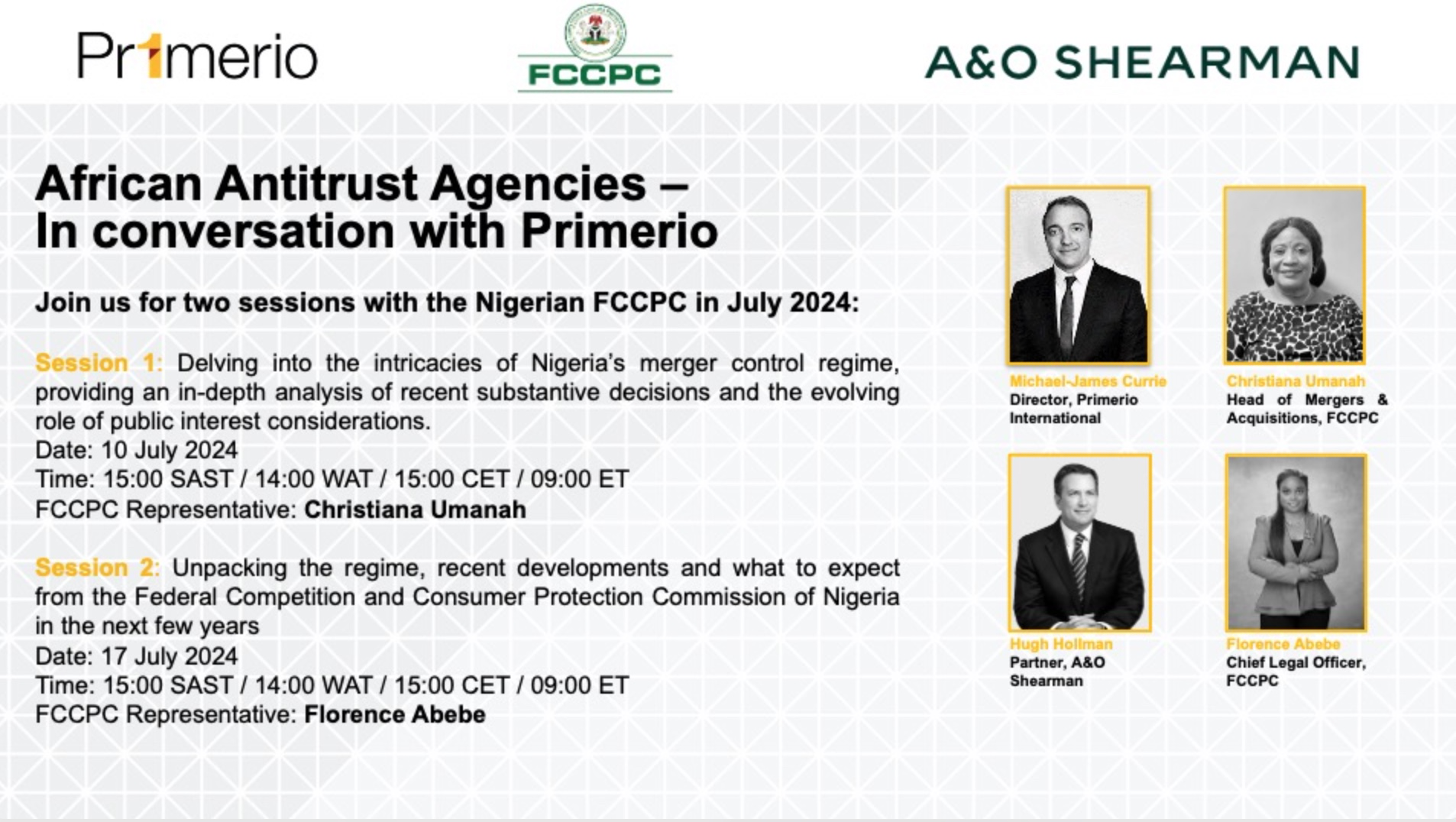
On 10 July 2024, advisors from pan-African law firm Primerio continued their “African Antitrust Agencies – in Conversation with Primerio” series with the Nigerian Federal Competition and Consumer Protection Commission (“FCCPC”) in the first of two sessions aimed at a quick snapshot of the most noteworthy enforcement, legislative, and policy developments.
This first session focused on merger control.
Primerio’s Michael-James Currie, Competition Law Partner at Primerio (Johannesburg) was joined by Hugh Hollman, Competition Law Partner at A&O Shearman (Washington & Brussels) and had the pleasure of speaking with Christiana Umanah, the Head of the FCCPC’s Merger Control Department.
This recent webinar featured insights from Hugh Hollman, an experienced international antitrust partner at A&O Shearman, and Christiana Umanah, head of FCCPC’s merger division. Christiana Umanah elaborated on the rapid development of the FCCPC since the Federal Competition and Consumer Protection Act (“FCCPA”) was enacted in 2018. She outlined the structure and growth of the FCCPC, noting its establishment in 2019 with an active team of eight in the mergers department, along with offices in all 36 states of Nigeria, and 6 regional offices. Christiana emphasized the regular training received by FCCPC staff both locally and internationally, with recent sessions in Mauritius and Barcelona. The FCCPC maintains collaborative relationships with international agencies such as the FTC, and the DOJ, especially for capacity building and training. She detailed the timelines for merger reviews in Nigeria, which usually take 60 business days, extendable to 120 business days for complex antitrust cases, while harmonizing multi-jurisdictional reviews and offering a fast-track option to reduce the timeline by 40 business days.
Addressing foreign-to-foreign mergers, Christiana explained that the FCCPC assesses these based on local turnover, focusing on the specific business presence in Nigeria. She also discussed the penalties for gun-jumping, which are commonly based on 2% turnover for the last financial year, considering factors like knowledge, cooperation, and company size. The FCCPC is open to pre-merger consultations on a no-name basis, ensuring confidentiality while guiding parties through the process. Christiana shared examples of conditions imposed on transactions, such as divestments and board member exit to prevent market concentration. Public interest considerations are also a key focus for the FCCPC, particularly regarding employment and market impact, as demonstrated in a case involving a failing firm where job preservation was prioritized. Looking ahead, the FCCPC is developing regulations for digital transactions and e-market platforms to address emerging issues in the digital market. The webinar concluded with a note on the importance of ongoing dialogues and the FCCPC’s willingness to assist with information and support.
The transcript for this session is available here, and the recording of this session is available on Primerio’s YouTube page, accessible here.
Our next session of Primerio‘s “in conversation with…” series remains focused on Nigeria, as we will discuss recent enforcement activity and legislative & policy developments. Join Hugh Hollman, the FCCPC’s senior officer, Florence Abebe and Primerio partners for another concise but very useful session as Nigeria’s FCCPC Nigeria gains prominence across the Continent.
Lessons drawn from the Constitutional Court in the Coca-Cola Appeal
By Brandon Cole
In a pivotal decision issued on April 17, 2024 by the Constitutional Court of South Africa, the case of Coca-Cola Beverages Africa (Pty) Ltd against the Competition Commission has reshaped our understanding and enforcement of post-merger conditions in business transactions. Stemming from a 2016 merger that led to the creation of “Coca-Cola Beverages South Africa” (out of four separate entities), the case underlines the complexity of adhering to merger conditions imposed to safeguard fair competition and operational continuity.
The merger was initially green-lit with certain conditions focused on preventing job losses (“retrenchments”) and on harmonizing employment terms across the new entity. Despite these protective measures, certain challenging economic conditions, including a sugar tax and rising input costs, compelled Coca-Cola to undertake some retrenchments. This action sparked a legal challenge from the Food and Allied Workers Union (FAWU), asserting a breach of the stipulated merger conditions that underlay the transaction’s approval by the antitrust authorities.
Central to the dispute was the interpretation of how merger conditions are enforced and reviewed under the South African Competition Act. The crux was whether Coca-Cola’s retrenchments violated the merger-specific conditions or were justified by external economic pressures. The Competition Tribunal, tasked with adjudicating the challenge, initially ruled in favour of Coca-Cola, recognizing the broader economic factors at play. However, this decision was overturned by the Competition Appeal Court, which led to Coca-Cola’s subsequent appeal to the Republic’s Constitutional Court.
The Constitutional Court’s decision clarified several crucial aspects regarding the enforcement of merger conditions:
Nature of review: The Court differentiated this review from ordinary administrative actions, focusing on whether Coca-Cola substantially complied with the merger conditions rather than strictly adhering to them without regard for external circumstances.
Causal connection: The Court criticized the narrow focus of the Appeal Court on the direct causality between the merger and retrenchments. Instead, it supported a more holistic approach that must consider all relevant factors impacting business decisions post-merger.
Implications for business strategy: The judgment emphasized the importance for businesses to thoroughly plan and document their strategies when complying with merger conditions. This is essential to demonstrate substantial compliance, especially when external economic factors might compel deviations from the expected course.
This landmark judgment highlights the dynamic nature of post-merger conditions and their enforcement, illustrating that adherence to these conditions must consider both the intended protective measures and the practical realities faced by businesses. For companies undergoing mergers, this case serves as a critical reminder of the need to balance merger obligations with agile business responses to external challenges.
The insights derived from the Coca-Cola Beverages Africa case provide valuable lessons for businesses and legal practitioners involved in mergers and acquisitions, especially in terms of planning, executing, and justifying actions taken in relation to merger conditions.
Competition Authority of Kenya emphasises the role of public interest in M&A reviews
By Joshua Eveleigh
On 05 January 2024, the Competition Authority of Kenya (“CAK”) approved Nava Apparels L.L.C-FZ acquisition of the assets of Mombasa Apparel (EPZ) and Ashton Apparel (EPZ) on the condition that Nava retains all of EPZ’s 7019 employees on terms that are no less favourable than their current terms of employment.
Notably, post-transaction the merged entity would have an insignificant market share of only 3.83% in the market for the manufacture of clothing apparel for export. Accordingly, the merged entity would still face significant competitive restraint from various other market players post-transaction and, against this, the CAK found that the transaction would not result in any substantial lessening or prevention of competition in the relevant market.
Similar to South Africa’s merger control regime, the CAK is mandated to conduct a public interest assessment, in addition to the conventional competition assessment, during its merger review process. As part of its public interest assessment, the CAK has particular regard to the enhancement and sustainment of employment; the ability of SMEs to enter into and compete into a particular market; and the ability of national industries to compete in international markets. Where the CAK has a credible basis to conclude that a notified transaction will result in a public interest concern, it may prevent that particular transaction.
What is interesting in this instance, however, is that the merger decisions do not appear to include any particular period within which the retrenchment moratorium must be adhered to. Without guidance, the acquirer may find itself in the invidious position of not being able to retrench any of the 7019 employees for an extended period of time.
The CAK’s recent decision emphasises the agencies’ commitment to preventing merger specific retrenchments. Parties intending to conclude mergers in Kenya must proactively consider the effect of the proposed transaction on the public interest, as is the case in other African jurisdictions such as South Africa and be able to meaningfully engage with the CAK to proffer public interest commitments.
Fidel Mwaki, Kenyan lead partner of Primerio International, says: “An interesting decision by the CAK that highlights the need for businesses to seek legal and regulatory guidance on public interest factors that may affect their workforce retrenchment timelines when looking to conclude mergers.”
A perspective from private practice — the real cost of doing business in South Africa: Merger Control Disincentivizing Investment into the South African Economy
By Gina Lodolo, Joshua Eveleigh, and Nicola Taljaard
A Look Back:
South Africa has been trying to find the delicate balance between the promotion of public interest initiatives, attracting foreign investment and promoting the competitiveness of South Africa’s markets. In recent years, however, the South African Competition Commission (“Commission”) appears to have taken a more rigid approach towards requiring the promotion of public interest initiatives as an outcome of merger control investigations.
At the outset, it is important to note that the Competition Act 89 of 1998 (“Act”) allows the Commission to impose conditions on mergers and acquisitions that are deemed to result in a substantial lessening of competition or detrimental to the public interest.
In 2019, the Act also underwent a significant amendment regarding the public interest provisions. In accordance with the transformative values under the Act’s preamble, the amendment aimed to ensure that competition authorities have regard to public interest factors when assessing mergers and acquisitions and, in particular, section 12A(3)(e) makes provision for the promotion of a greater spread of ownership with a view to increasing the levels of ownership by historically disadvantaged persons and employees.
While the Commission was not so emphatic on the promotion of HDP and/or employee ownership immediately after the 2019 amendments, the Commission has been taking an increasingly robust approach to the imposition of these public interest criteria. Most notably, this can be seen from the widely publicised Burger King decision where a merger that raised no competition concerns was prohibited for the first time, based solely on public interest concerns (namely a decreased HDP shareholding from 68% to 0%). While the decision was ultimately settled before being heard on request for consideration before the Tribunal, it certainly indicated the trajectory of the Commission’s approach. Since the Burger King decision, the Commission has increasingly taken a hard-line regarding transactions that are benign both from a competition and public interest perspective.
While the amendments to the Act symbolize a benevolent effort toward the transformative objectives that the competition authorities are mandated to develop, a great deal of uncertainty stemmed as a result. In practice, the Commission’s interpretation of section 12A(3)(e) of the amended Act has been to place a positive obligation on the merging parties, post transaction, to increase the merging parties’ HDP and/or employee shareholding, often times utilising a benchmark of 5%. This is irrespective of whether a transaction is benign from both a competition and public interest perspective.
Merging parties, legal representatives and regulatory authorities have also substantially debated the interpretation and effect of the amended public interest provisions. The primary argument that contrasts the Commission’s interpretation of the amended public interest provisions, however, provides that section 12A(3)(e) is only one factor for consideration in determining whether a transaction that would otherwise have an adverse effect on competition or other public interest grounds, should be allowed. Premised on this interpretation, the Commission would not be authorised to refuse a transaction if it cannot show an adverse effect on competition based on a holistic assessment of the public interest grounds delineated in section 12A(3).
The Commission’s application of the public interest provision has increasingly lacked clarity and predictability, thereby creating uncertainty in the merger review process, and making it challenging for businesses to plan and execute transactions with confidence. This is particularly so when transactions are subject to long-stop dates where protracted engagements and negotiations with the Commission risk the termination of the entire agreement. To circumvent the incurrence of frictional costs and risks of breaching any long-stop dates, private practitioners are experiencing an increased amount of global mergers carving-out (or at least considering to) the South African legs of those transactions.
Firms are often concerned about the potential dilution of existing shareholders’ equity, regardless of the size of the firm. Foreign investors may be concerned about the impact of the allocation of new shares to employees on their current ownership stakes, potentially reducing their control and influence over the merged entity.
Further uncertainty surrounded how the application of what appears to be a 5% public interest divestiture approach will apply in all circumstances. For example, it is unclear whether this would apply to all merging parties even if the two merging entities are wholly owned BBBEE entities. Furthermore, how should firms divest a 5% stake in the merged entity where the underlying transaction involves land and no employees? These are some examples of the difficult questions the Commission has yet to consider if it is to continue with the outright application of its interpretation of the Act.
In addition, by insisting on ownership-related commitments from merging parties, the Commission’s policy undermines the efficacy of the BEE framework, as parties are likely to take the view that any efforts to improve their BEE profiles outside of the ambit of the transaction may, on the Commission’s approach and assessment, carry very little weight. Accordingly, firms may start to favour an approach of decreasing their BEE efforts prior to transactions in preparation of having conditions imposed on them. Firms may also start to undervalue the target to account for additional public interest spend or carve out the South African part of the transaction to circumvent this cumbersome condition.
Over an extended period, the outcome becomes evident for South Africa – increased uncertainty and an impractical application of the Act will result in decreased in investment; potential prohibition of competitively benign mergers and increased transaction costs.
While the Commission’s approach is prima facie laudable, the unintended consequences may result in a counterintuitive outcome and cause greater long-term prejudice to the public interest and growth of the South African economy. This is particularly true in light of the much-needed foreign direct investment South Africa requires following the effects of Covid-19, greylisting and economic instability.
Introduction of Public Interest Guidelines
On 28 September 2023, the Commission released their ‘Draft Amended Public Interest Guidelines relating to Merger Control’ for public comment accessible here (“Public Interest Guidelines”).
On the same day, at the Commission’s 17th Annual Conference, the Minister of Trade, Industry and Competition (“DTIC”), Minister Ebrahim Patel, lauded the amendments to the Act and stated that the increasing imposition of public interest conditions on mergers has resulted:
in a contribution of R67 billion towards the local economy;
the saving of at least 236 000 jobs over a period of five years;
the creation of at least 22 000 jobs;
and 143 000 workers now being shareholders in companies.
While there have certainly been commendable strides towards the achievement of promoting the transformation of the local economy, the above statistics do not paint a full picture. While many firms will continue to consent to the public interest commitments suggested by the Commission, for fear of an outright merger prohibition, a number of firms would rather carve-out the South African leg of multi-jurisdictional deals. This, in itself, would stifle economic growth and adversely effect the public interest in the long-term (as consumers do not stand to enjoy the benefits of pro-competitive mergers).
The Public Interest Guidelines are intended to formalise the Commission’s policy approach discussed above when evaluating public interest factors.
We outline the pertinent aspects of the Public Interest Guidelines below:
Commission’s approach to public interest factors in merger control
Section 12A of the Competition Act provides that both the competition and public interest assessments carry equal weight in merger considerations.
Regardless of whether a merger is found to result in a substantial prevention or lessening of competition (“SPLC”), the Public Interest Guidelines provide that the Commission must still determine whether the merger is “justifiable on Public Interest grounds”. In this regard, the Commission will determine the effect of the merger on each of the public interest elements arising from the merger to determine the net effect of the merger on the public interest.
General approach to assessing public interest provisions
The Commission considers that a merger assessment requires a quantitative and qualitative determination into the merger’s likely effect on:
a particular industrial sector or region;
employment;
the ability of small and medium businesses, or firms controlled or owned by historically disadvantaged persons, to effectively enter into, participate in or expand within the market;
the ability of national industries to compete in international markets; and
the promotion of a greater spread of ownership, in particular to increase the levels of ownership by historically disadvantaged persons and workers in firms in the market.
Where the Commission concludes that the merger will have a positive effect on one of the above factors, there will be no further assessment into that factor. Where, however, the Commission finds that one of the above factors is substantially negatively impacted by the merger, the Commission will consider remedies to address these adverse impacts.
Importantly, the Public Interest Guidelines provide that where a negative impact on a public interest factor cannot be remedied, the Commission may consider “equally weighty countervailing Public Interest factors that outweigh the negative impact identified” on a case-by-case basis.
Where a merger is found to positively impact a majority of the above public interest factors, these may be outweighed countervailed by a substantial negative effects from a single public interest factor.
Approach to induvial public interest factors
The Public Interest Guidelines provide guidance on how the Commission will assess each of the public interest factors. For purposes of this summary, we focus primarily on “the promotion of a greater spread of ownership…by [HDPs] and workers…” factor which has caused the greatest degree of uncertainty, transaction costs and protracted negotiations with the Commission. This factor stands out from the rest of the public interest factors as the Public Interest Guidelines make it clear that the Commission considers section 12A(3)(e) of the Competition Act to confer a “positive obligation on merging parties to promote or increase a greater spread of ownership, in particular by HDPs and/or Workers in the economy.” In this regard, the Commission regards every merger having an effect in South Africa as having to promote HDP and/or worker ownership and therefore assumes no neutral effect.
In light of the above, where a merger does not promote HDP and/or worker ownership, it will be regarded as having an adverse impact on that particular public interest factor and, if considered substantial enough, may render the merger unjustifiable on public interest grounds.
The Public Interest Guidelines go further so as to state that where a merger promotes HDP ownership, this would not preclude the Commission’s obligation to consider an increase of ownership by workers.
Where the Commission considers there to be a substantial negative effect on the promotion of HDP and/or workers, the following remedies may be imposed:
concluding alternative ownership agreements with HDPs/Workers in either the acquiring, target or merged firm; and
divestitures to HDP shareholders which would create a greater spread of ownership in another part of the business. Importantly, the Commission will generally require that these HDPs and/or workers are actively involved in the operations (ideally control should be conferred) of the divested business and are not merely passive or financial investors.
Where the Commission proposes that an ESOP be implemented, the following guidance is provided:
where a merger results in a dilution of HDP and/or workers, the ESOP should remedy the full extent of the dilution;
where the merger does not result in a dilution, the ESOP should “hold no less than 5% of the value/shares of the merged entity but may be required to hold a higher shareholding based on the facts of the case”.
Where the Commission proposed that an HDP transaction be concluded, it provided the following guidance of the principles that ought to apply:
the HDP transaction should be no less than 25% +1 share and “should ideally confer control on the HDPs”;
the merging parties will have discretion to choose the HDPs; and
the merging parties must inform the SACC of the proposed HDP transaction prior to its implementation to assess compliance with imposed conditions.
Importantly, while the Public Interest Guidelines are not binding on the Commission, the Competition Tribunal or the Competition Appeal Court, they provide clarity on how the Commission intends on assessing mergers notified to it.
Despite an increase in certainty, the Public Interest Guidelines remain a cause for concern amongst the local and international private sectors as they have merely confirmed the policy approach that the Commission has increasingly been adopting in practice. In this regard, even where a foreign-to-foreign merger is notified to the Commission, it ought to consider how it can actively promote HDP and/or worker ownership and may become susceptible to ESOPs and/or HDP transactions in achievement of the Competition Act’s transformational objectives.
The Public Interest Guidelines are open for public comment until 28 October 2023 and are likely to be subject to extensive submissions.
The COMESA Competition Commission Issues Its First Partial Refusal to Grant Merging Parties Permission to Consummate Merger
By Tyla Lee Coertzen
On 2 September 2023, the COMESA Competition Commission released its decision to prohibit the proposed acquisition by Akzo Nobel N.V (“AkzoNobel”) of Kansai Plascon East Africa Proprietary Limited (“KPEA”) and Kansai Plascon Africa Limited (“KPAL”) (the “Target Firms”). The CCC’s decision in this merger represents the first merger prohibition it has issued since its inception in 2013.
In terms of the proposed acquisition, AkzoNobel was set to acquire 83.31% of the issued share capital of KPAL and 100% of the issued share capital of KPEA from Kansai Paint Co. Ltd.
AkzoNobel is a Dutch multinational company active in the manufacture and sale of paints and coatings, with a presence in Egypt, Mauritius, Tunisia and Zambia and Zambia. In addition, AkzoNobel supplies paints to the Democratic Republic of the Congo, Eswatini, Ethiopia, Kenya, Libya, Madagascar, Rwanda, Sudan and Zimbabwe.
The Target Firms are also active in the manufacture and supply of coating products. KPEA maintains a presence in Burundi, Kenya, Tanzania, Uganda and Zanzibar and operates five manufacturing plants, four of which are located within the Common Market (namely in Burundi, the Democratic Republic of the Congo, Malawi, Rwanda and Zambia). KPAL also has manufacturing plants in the Common Market, namely in Malawi, Zambia and Zimbabwe and derives turnover in Eswatini.
This would-be transaction has a somewhat convoluted history and was, by some observers’ interpretations, many years in the making. As Andreas Stargard notes regarding our prior reporting, “this very publication has analysed the COMESA competition troubles of the merging paints makers of the recent past. These have included failure-to-file mandatory notifications (and also here), as well as a paints cartel-conduct inquiry by the CCC, after Akzo and Kansai’s acquisitive hunger had initially begun in 2013 with disputes over use of the Sadolin brand in Uganda and elsewhere — coincidentally the same year the CCC became functional.”
In addition, notably, the same transaction was prohibited by the South African Competition Commission in late 2022 (which decision is currently being determined by the South African Competition Tribunal). The merger is also currently being assessed by the Namibian Competition Commission.
In its assessment of the market for the manufacture and supply of decorative paints, the CCC identified several competition concerns arising from the proposed merger. Specifically, it identified that the merger would result in a combination of two strong paint brands (namely Plascon and Dulux) and that there were no effective competitors present who would pose a real ability to counter the undue market power and unilateral conduct arising thereof.
While the merging parties proffered a number of commitments, the CCC found that such commitments would not sufficiently remedy the decrease in competition in the market (particularly in Eswatini, Zambia and Zimbabwe). The CCC thus outright prohibited the merger in these three Member States.
The CCC approved the merger in certain other jurisdictions subject to conditions proffered by the parties. Specifically, the parties are obliged to divest the Sadolin brand owned by AzkoNobel to an independent third-party competitor in Uganda within 6 months of the date of the CCC’s decision. In Malawi, the CCC approved the merger subject to a condition that the merging parties continue productions in the Malawi manufacturing plant for a period of three years after the CCC’s decision, in order to remedy the plant’s potential closure and job losses resulting thereof.
The CCC’s decision over this merger is a clear indication of the approach it will take to mergers which it believes will pose significant anti-competitive harm and competitive loss within the Common Market. Thus, the decision is an indication of CCC’s powers, adjudicative authority as well as its willingness to enforce its powers.
Competition Authority adds exemptions to boost economic activity
By Joshua Eveleigh and Katia Lopes
In a recent speech by Kenya’s Minister of Finance, Professor Njuguna Ndung’u, it is clear that the Competition Authority of Kenya (“CAK”) will take active steps in promoting micro, small and medium-sized enterprises (“MSMEs”) in the local economy.
Firstly, to facilitate their growth and contribution, Professor Ndung’u, noted that government plans to ease the cost of doing business and to minimize compliance costs for MSMEs. Specifically, the CAK will exempt MSMEs from having to notify otherwise mandatorily notifiable mergers to the CAK. By removing the significant regulatory hurdle of obtaining prior merger approval, and its associated costs, it is hoped that Kenya will see a promotion of start-up and digital businesses. This development is particularly important considering that Kenyan startups ranked second, in Africa, in terms of funding raised but fell behind other African jurisdictions when it came to acquisitions of MSMEs. Fidel Mwaki, legal practitioner based in Nairobi, observes that “this is a positive move from the CAK that should hopefully bode well for MSME’s, many of whom are battling under the strain of increased taxation, inflation, and licensing requirements and will certainly benefit from the proposed waiver on merger notification fees.” His Primerio colleague, attorney Diana Wariara, adds that “regulating buyer power remains a challenge for the agency. A greater emphasis on audits and investigations may help strengthen the CAK’s enforcement mandate and ensure a level playing field and fair competitive practices within these sectors.”
In addition to merger exemptions and emphasising the CAK’s position as Eastern Africa’s lodestar in the enforcement of abuses of buyer power, the CAK will monitor and conduct surveillance audits, specifically in the manufacturing and agro-processing sectors, to further protect MSMEs from incidences of abuses of buyer power. Professor Ndung’u also noted that the CAK will implement codes of practice to ensure MSMEs in the retail and insurance sectors are protected from powerful buyers.
Lastly, Professor Ndung’u highlighted that the CAK will take measures to address the issues of price fixing by professional services, ensuring that fees and the quality of professional services remain competitive.
Given the pivotal role that MSMEs play in the Kenyan economy, comprising 98% of all local business entities and contributing approximately 24% of Kenya’s GDP, their promotion will be a welcome development among the local business community. In this respect, Professor Ndung’u’s speech demonstrates the CAK’s commitment towards ensuring a competitive marketplace that is free from abuses of dominance.






 African Antitrust & Competition Law