Nigeria Flexes Regulatory Muscle: Tribunal Upholds $220 million fine against WhatsApp and Meta over data discrimination practices  

By Nicole Araujo

On 25 April 2025, almost a year after the Federal Competition and Consumer Protection Commission (“FCCPC”) imposed a hefty $220 million fine on WhatsApp and its parent company, Meta, the Competition and Consumer Protection Tribunal (“Tribunal”) delivered its landmark decision, upholding the fine and ordering a further – almost negligible, when compared to the substantive fine – $35,000 administrative penalty against the social media giants for fact-finding costs incurred during the 38-month long investigation. This regulatory win for Nigeria’s digital rights landscape has contributed to reinforcing Nigeria’s growing resolve to regulate big tech.

The decision stemmed from findings that the companies engaged in discriminatory data practices and violated Nigerian data protection laws, affecting more than 51 million users.  As Andreas Stargard, a competition-law practitioner with Primerio, notes, “not only did the FCCPC’s investigation uncover WhatsApp’s unauthorised sharing of user data and a lack of meaningful consent mechanisms, but it also revealed discriminatory practices compared to other regions – I believe this is where the differentiation in the FCCPC’s consumer-protection jurisdiction (as opposed to that of the domestic data protection authority) comes in meaningfully.  It remains to be seen what an independent, judicial review of the Tribunal decision will yield in this regard, but the FCCPC has had a comparatively strong track record so far in terms of having its novel, forceful, and ‘creative’ enforcement strategies upheld, with the B.A.T. matter perhaps being the most powerful example.  The recent Dangote matter, involving the shocking fact pattern of a lack of refining capabilities in oil-rich Nigeria, is an interesting counter-point, though, as the FCCPC lost an attempt to intervene in that matter in Abuja’s Federal High Court.”

So far, the appellate-level Tribunal has sided with the Commission, dismissing an appellate request for review by WhatsApp and Meta, which challenged the fine on 22 grounds, ranging from procedural errors to allegations of vagueness and technical impossibility in respect of the timeframe given by the FCCPC. Meta’s legal team relied on the grounds that the FCCPC’s orders were unclear, unsupported by Nigerian law, and financially impractical to comply with. However, the FCCPC argued that the penalties were not financially punitive but rather corrective and aimed at rectifying the tech giant’s alleged discriminatory practices.

In its decision, the Tribunal emphasised that the FCCPC acted within its lawful mandate and that WhatsApp and Meta were afforded a fair hearing. It further upheld that the reliance on foreign legal standards, while not binding, was appropriately persuasive in determining issues of data protection and consumer rights.

The Tribunal ordered WhatsApp and Meta to inter alia, reinstate Nigerian users’ rights to control their personal data, revert to their 2016 data-sharing policy, and immediately cease unauthorised data sharing with Facebook and other third parties without obtaining the necessary consent from users. In this regard, compliance letters must be submitted by July 1, 2025, and a revised data policy must be proposed and published. 

This case marks a significant moment in the Nigerian Authority’s forceful use of the regulatory tools available to it — as well as overall for Africa’s evolving digital economy, highlighting the demand for global corporations to acknowledge local presence and effects and adapt to robust local compliance expectations. While Big Tech companies such as Amazon, Google and Meta have been subject to significant penalties under the European Union’s General Data Protection Regulation, as one of Africa’s digital technology pioneers, Nigeria’s move could inspire similar enforcement actions across the African continent. This decision can be seen as a “gentle” reminder for multinational digital and tech firms that compliance with local data protection laws is no longer optional, it is imperative.

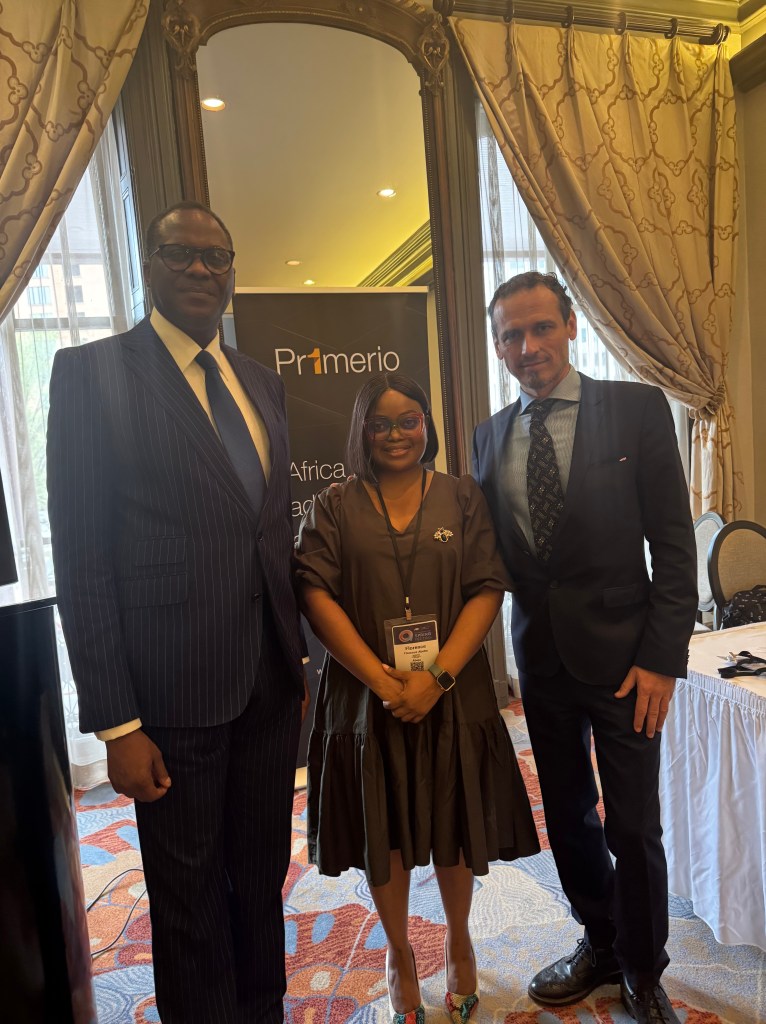
Babatunde Irukera, Florence Abebe, Andreas Stargard at the African Antitrust Salon hosted by Primerio

While more African countries are pushing back against big tech companies and are focusing on unchecked data exploitation within their borders, there is a need, however, for the continent to build towards a larger, sustainable strategy to manage the presence and power of big tech.  Says Andreas Stargard, “the quarter-billion dollar Meta fine, if upheld, would firmly cement Nigeria’s antitrust global relevance in the minds of international lawyers and businesses.  This comes as a surprise in some ways, as the FCCPC was first put on the map only fairly recently, by its inaugural Chief enforcer, Tunde Irukera: his vision for creative enforcement tools and encouragement of the agency’s staff to employ heretofore unused investigatory mechanisms and strategies – often seen only in U.S.-style civil litigation, and certainly not in many government agencies worldwide, much less among other African jurisdictions – show that the Commission potentially has the necessary intellectual capacity and investigatory stamina to pursue cases of equal or greater dimensions in the future.  It will depend on its leadership where the FCCPC’s path is charted next…”

Of course, there needs to be a balance struck between the value of personal data and that of innovation and tech adoption, which calls for a coordinated regulation policy that will strive to balance economic and non-economic features of the continent. 

As observed by Leonard Ugbajah, a competition law consultant, a balanced and pragmatic approach is essential when opting to address the regulatory landscape around big tech: 

“A common approach would harness the capabilities of countries, moderate opportunism by state and non-state actors in pursuing enforcement, recognise the economic importance of big tech, properly calibrate the various pain points (economic and non-economic) and safeguard the interests of the not-so-capable African countries.” 

The social media giants have 60 days, starting from 30 April 2025, to comply with the $220 million fine ordered by the Tribunal. Notably, following the decision, WhatsApp has indicated that it intends to seek a stay of the Tribunal’s decision and pursue an appeal. 

African antitrust authority fines META quarter-billion dollars — WhatsApp (with that?)

Nigeria’s FCCPC has imposed a U.S. $220m fine on WhatsApp’s parent company Meta for violating data privacy laws, continuing the FCCPC’s consumer-protection streak

When it rains, it pours. And when the nascent FCCPC (on whose relatively youthful existence we have reported extensively) issues a fine on a global mega corporation like META (or BAT to the tune of $110m), then it really reaches deep into its pockets: Mr. Zuckerberg’s conglomerate will have to pay $220m to resolve an extensively-documented violation abusing its dominant position, exploiting Nigerian WhatsApp users’ personal data, which it had stored in Singapore, Europe and the U.S. The proceedings were brought approximately 3 years ago, culminating in a particularly in-depth Report issued by the FCCPC and the resulting fining decision last week, pursuant to both the Federal Competition and Consumer Protection Act, 2018 (FCCPA), and the Nigerian Data Protection Regulation, 2019 (NDPR).

At the heart of the allegations lies Meta’s undisclosed, apparent dual-use of WhatsApp user information and metadata (no pun), across virtually all of its conglomerate digital platform companies — i.e., data-sharing conduct squarely in violation of the NDPR and, so says the FCCPC, without consumer knowledge and in many cases against WhatsApp users’ wishes.

Andreas Stargard, a competition lawyer at Primerio Ltd., with a focus on African antitrust cases, comments as follows on this latest record-setting West African case:

“This latest foray by the FCCPC against Meta is notable for multiple reasons: First, it spans both the inaugural aegis of the FCCPC under internationally lauded former FCCPC chief, Babatunde Irukera, and that of his recent successor, Tunji Bello.

Secondly, it represents a new record, and quite literally a doubling of the last record fine, namely the $110m agreed-upon antitrust settlement against British American Tobacco less than 2 years ago.

Third, it shows a trend we have recently noticed in the African government enforcement world: namely, the intertwined nature of competition law and consumer-protection issues, which the detailed Report issued by Commission staff highlights in a significant way. Other agencies on the continent will surely take notice and (we hope) issue similarly-documented case reports going forward.

Fourth, and finally, setting aside the amount of the fine, this matter shows how African jurisdictions may well be ahead of some European and other peer institutions. This is a milestone development for the future regulation of digital behemoths across Africa. The detailed report and analysis provided publicly by the Nigerian agency shows that its nascent competition-law regime continues to be eager to comply with global best practices and appears well situated to keep earning the respect of its Western and other African peer authorities, akin to the journey that the COMESA Competition Commission has undertaken in its first 10 years of existence. Both agencies have gone from non-existent to generally and globally respected African antitrust and consumer-protection powerhouses.”

The Commission’s release noted that “[t]he totality of the investigation has concluded that Meta over the protracted period of time has engaged in conduct that constituted multiple and repeated, as well as continuing infringements… particularly, but not limited to abusive, and invasive practices against data subjects in Nigeria. Being satisfied with the significant evidence on the record, and that Meta has been provided every opportunity to articulate any position, representations, refutations, explanations or defences of their conduct, the Commission have now entered a final order and issued a penalty against Meta.”

In Conversation with African Antitrust Agencies: Nigeria

A Primerio-sponsored webinar recently put the spotlight on Nigeria’s burgeoning FCCPC

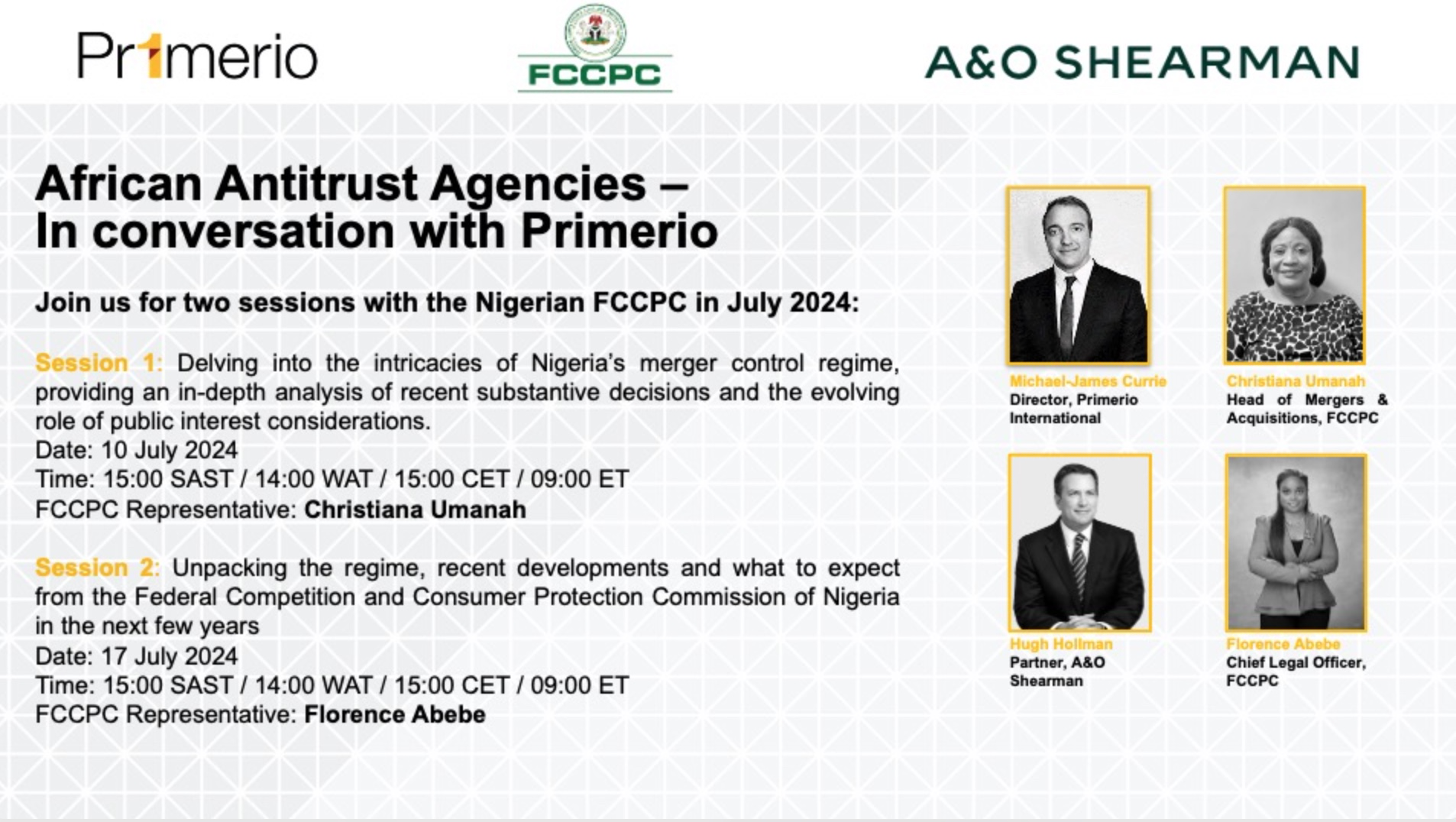
On 10 July 2024, advisors from pan-African law firm Primerio continued their “African Antitrust Agencies – in Conversation with Primerio” series with the Nigerian Federal Competition and Consumer Protection Commission (“FCCPC”) in the first of two sessions aimed at a quick snapshot of the most noteworthy enforcement, legislative, and policy developments. 

This first session focused on merger control. 

Primerio’s Michael-James Currie, Competition Law Partner at Primerio (Johannesburg) was joined by Hugh Hollman, Competition Law Partner at A&O Shearman (Washington & Brussels) and had the pleasure of speaking with Christiana Umanah, the Head of the FCCPC’s Merger Control Department

This recent webinar featured insights from Hugh Hollman, an experienced international antitrust partner at A&O Shearman, and Christiana Umanah, head of FCCPC’s merger division. Christiana Umanah elaborated on the rapid development of the FCCPC since the Federal Competition and Consumer Protection Act (“FCCPA”) was enacted in 2018. She outlined the structure and growth of the FCCPC, noting its establishment in 2019 with an active team of eight in the mergers department, along with offices in all 36 states of Nigeria, and 6 regional offices. Christiana emphasized the regular training received by FCCPC staff both locally and internationally, with recent sessions in Mauritius and Barcelona. The FCCPC maintains collaborative relationships with international agencies such as the FTC, and the DOJ, especially for capacity building and training. She detailed the timelines for merger reviews in Nigeria, which usually take 60 business days, extendable to 120 business days for complex antitrust cases, while harmonizing multi-jurisdictional reviews and offering a fast-track option to reduce the timeline by 40 business days. 

Addressing foreign-to-foreign mergers, Christiana explained that the FCCPC assesses these based on local turnover, focusing on the specific business presence in Nigeria. She also discussed the penalties for gun-jumping, which are commonly based on 2% turnover for the last financial year, considering factors like knowledge, cooperation, and company size. The FCCPC is open to pre-merger consultations on a no-name basis, ensuring confidentiality while guiding parties through the process. Christiana shared examples of conditions imposed on transactions, such as divestments and board member exit to prevent market concentration. Public interest considerations are also a key focus for the FCCPC, particularly regarding employment and market impact, as demonstrated in a case involving a failing firm where job preservation was prioritized. Looking ahead, the FCCPC is developing regulations for digital transactions and e-market platforms to address emerging issues in the digital market. The webinar concluded with a note on the importance of ongoing dialogues and the FCCPC’s willingness to assist with information and support. 

The transcript for this session is available here, and the recording of this session is available on Primerio’s YouTube page, accessible here

Our next session of Primerio‘s “in conversation with…” series remains focused on Nigeria, as we will discuss recent enforcement activity and legislative & policy developments. Join Hugh Hollman, the FCCPC’s senior officer, Florence Abebe and Primerio partners for another concise but very useful session as Nigeria’s FCCPC Nigeria gains prominence across the Continent.

Register for this upcoming session here.

Nigeria appoints new chief antitrust enforcer: is it a pure consumer-protection play?

Nigerian president, Bola Tinubu, yesterday appointed Mr. Tunji Bello to become the new Chief Executive Officer and Executive Vice-Chairman of the Federal Competition and Consumer Protection Commission (“FCCPC”), subject to review and a vote by the Senate, which is expected to pass without issue.

Observers are noting the relative lack of competition-law / antitrust experience of Mr. Bello (whose prior credentials include State Secretary and Environment Commissioner, both in Lagos State). Mr. Bello, a former journalist, is an unknown to most, if not all, competition-law practitioners. His Wikipedia entry describes him primarily in terms of his career as a journalist, which included international stints as “a Staff Writer with [the] St. Petersburg Times, Florida, US, and also [] US News & World Report, Washington DC in 1992.”

The formal press release (see below) seems to support this sentiment of a purely political appointment without any regard to prior competition-law or economics experience, as it appears to focus solely on “consumer protection” and the “safety of goods and services,” while failing to mention competition or antitrust even once.

We note that some commentators have pointed out, at the cynical end of the spectrum, that this appointment may be due to the FCCPC’s past successes in garnering massive fines (e.g., the $110 million fine imposed against BAT), under recently-dismissed predecessor Babatunde Irukera. Such financial windfalls for the government coffers have, these observers believe, turned the agency’s CEO job, into a highly coveted executive post, which had been temporarily held in an interim capacity by Dr. Adamu Abdullahi between January and Mr. Bello’s appointment yesterday.

AAT is hopeful that this is not the case, and that Mr. Bello will not turn the young and so-far highly-regarded FCCPC into a mere means to an end of generating revenue for the Nigerian government. We trust that the Commission will continue to uphold its mandate of competition-law enforcement and its high standard of excellence, thanks in large part to the leadership of Mr. Bello’s predecessor and the quality of the senior team members he had assembled to run the agency.

Press release:

Combating inflationary pressure while avoiding price regulation: Nigeria’s FCCPC seeks consumer collaboration

By Editor

Under the aegies of its recently appointed acting Vice Chairman and CEO, Dr. Adamu Abdullahi, the Nigerian Federal Competition and Consumer Protection Commission (FCCPC) today published a statement condemning the continuing consumer price increases in the country, despite the recent strengthening of the Naira currency.

The agency was, wisely, quick to point out that “the FCCPC cannot directly regulate prices.” Yet, it promised to “utilise its existing legal framework to enforce fair competition and consumer protection provisions. This includes monitoring and investigating unusual price hikes, addressing complaints filed by consumers, and taking action against any businesses found to be engaging in anti-competitive practices such as price-fixing, price gouging or cartel formation.”

In an interesting twist, the FCCPC also said that it had appointed so-called “operatives” (whom we imagine to be akin to contracted on-the-ground shadow buyers of goods and services) to report back to the Commission in their apparently ongoing “monitoring of both formal and informal markets.”

To support these ‘operatives,’ the FCCPC called upon regular consumers, trade associations, and farmer groups “to identify and remove unnecessary barriers to entry in various sectors, combat price-fixing, and dismantle cartels,” in the hopes of subsquent consumer-protection enforcement actions and, ultimately, lower prices for consumers.

FCCPC leadership shake-up: Farewell to a Nigerian antitrust legend

AAT is sad (but not surprised) to report that the new Nigerian government under President Bola Tinubu has sacked the legendary head of its competition-law enforcer, the Federal Competition and Consumer Protection Commission (FCCPC), Babatunde Irukera. His termination is with immediate effect. His pro tempore replacement at the agency will be Dr. Adamu Ahmed Abdullahi, as the next-in-command Executive Commissioner of Operations.

While it is certainly not a shocking revelation that incoming administrations frequently shake up their senior agency leadership, it is nonetheless an objective loss to the burgeoning FCCPC, which — under Irukera’s leadership — invariably gained international respect and, indeed, won an award for Nigeria’s most effective government institution.

The reactions of those with personal knowledge of the outgoing FCCPC CEO were almost invariably gloomy. Says Andreas Stargard, a partner with competition firm Primerio Ltd.: “This is a real loss to the Commission, which was literally brought into existence under the aegis of Babatunde. The antitrust community views his departure with dejection and a real concern for the future trajectory of the otherwise blossoming young agency, with which we had nothing but positive experiences so far. Babatunde is a real leader, and I wish him well in his future endeavours — I have a feeling that this is not the last we have seen of him in Nigerian antitrust.

Messrs. Babatunde Irukera (outgoing FCCPC CEO) and Ali Kamanga (COMESA Competition Commission, CCC) at the first IBA competition-law conference in Lagos, Nigeria (photo: A. Stargard, November 2023)

Other industry voices echoed similar sentiments, with academic Vellah Kigwiru opining that Irukera “had so much to offer for the continent,” while the FCCPC’s Chief Legal Officer, Florence Abebe, stated poignantly:

He is such an icon. FCCPC cannot be the same. The sadness is real. He took the then-CPC from a T-shirt and face cap wearing council with disgruntled incapacitated staff to what it is today on the continent and globally. Staff welfare was paramount, he prioritised capacity development like no other, he demanded excellence and professionalism from staff; he folded his sleeves and did the work, he wasn’t just directing operations, he was handling himself. While we were preparing, this guy was thinking on his feet. He is a genius, unpredictable, humble, compassionate, patient to the core, and didn’t accept failure. He is an institution!”

Mr. Irukera’s departure comes on the heels of the FCCPC’s record-setting multi-million dollar single-firm conduct settlement with British American Tobacco, on which AAT reported previously.

10 January 2023 update:

After widespread criticism and backlash against the manner in which Mr. Irukera’s departure from the Commission was announced by the new(ish) Nigerian government, the administration revised its statements to the effect of having “relieved [him] of his duties,” as opposed to “dismissed” the CEO. From a tweet: “I have followed the concerns in the media on the report that President Bola Ahmed Tinubu dismissed Babatunde Irukera EVC/CEO, Federal Competition and Consumer Protection Commission (FCCPC) and Alexander Ayoola Okoh — Director-General/CEO, Bureau of Public Enterprises (BPE). The President’s directive did not intend a dismissal. The two men who have served our country were relieved of their duties by the President, as he scouts for their successors. The connotations implied in using the word dismissal were clearly not intended in the statement issued. President Tinubu thanks the two men for their services and wishes them well in their future endeavours.”

Nigeria & Single-Firm Conduct: FCCPC Smokes Monopolist with Largest-Ever Fine

British American Tobacco faces $110 million fine for abuse of dominance in Nigeria, after settlement with up-and-coming antitrust enforcement agency

By Nicola Taljaard and Nicole Araujo 

About three years ago, in the summer of 2020, British American Tobacco Nigeria Limited and associated companies (collectively “BAT”) became the subject of an investigation by Nigeria’s then-brand-new Federal Competition and Consumer Protection Commission (“FCCPC”). The FCCPC was looking into the potential violation of the Federal Competition and Consumer Protection Act (“FCCPA”) and Administrative Penalties Regulations, 2020 (“Regulations”). After three years of investigating BAT’s business practices (including “dawn raids” on the company’s various office locations), the FCCPC found BAT guilty of having engaged in unfair business practices under section 155 of the Act by abusing its market dominance in Nigeria and violating public health regulations.  For the former, notably, BAT had penalized retailers for fostering an equitable and competitive market for its rival’s products in-store.

As a result of the finding, the FCCPC and BAT entered a consent order in December 2023. As part of this settlement pact, BAT agreed to engage in tobacco health advocacy, provide written assurances to the FCCPC and to be monitored by the FCCPC for the ensuing two years to ensure that BAT modified its behavioral and business practices to accord with relevant antitrust and tobacco control laws and efforts. BAT also agreed to pay a hefty fine of $110 million to the FCCPC in accordance with Clause 11 of the Regulations.  Notes Andreas Stargard, competition partner at specialist firm Primerio Ltd., “[t]he penalty agreed upon by the parties constitutes the largest fine imposed by the FCCPC thus far. It is also the first known instance in which the Regulations — which were intended to clarify the methodology for calculating administrative penalties — were applied and where the FCCPC has used the discretion conferred on it under Clause 11 to ‘consider administrative penalties on a case-by-case basis as the circumstances require’. Notably, BAT cannot appeal this fine, as it is part of a mutually agreed ‘consent order’ between the parties.”

In accordance with the terms and nature of the consent agreement, respectively, the FCCPCwithdrew the pending criminal charges against BAT and the agreement is not subject to appeal. Moreover, in compliance with applicable legislation, BAT and the relevant associated companies must advocate for both tobacco control and public health. 

The investigation and consent agreement have certainly come at a precarious time for BAT, which recently published that the value of its cigarette brands had diminished considerably in the past year and is known to have entered into a separate agreement with the US authorities surrounding investigations into the violation of a prohibition on tobacco sales to North Korea. 

The fine agreed to between the FCCPC and BAT follows the fairly recent publication of the FCCPC’s Regulations which delineate the legislative framework for the administration and imposition of administrative penalties according to the Act. The FCCPC reiterated its commitment to enforcing the law, making sure companies follow the relevant regulations, fair markets are fostered by all, and the protection of consumer interests are at the core of competitive actions and regulations. Ultimately, a fine to this extent sends a clear signal to other companies about the importance of fair, competitive behaviour and antitrust compliance. 

Nigerian antitrust regulator takes up digital money lenders

FCCPC Resumes its Digital Money Lender Registration Process 

By Nicola Taljaard 

On 26 June 2023, the Federal Competition and Consumer Protection Commission (“FCCPC”) announced the resumption of registration of Digital Money Lenders (“DMLs”) under the Joint Regulatory and Enforcement Task Force’s Limited Interim Regulatory/Registration Framework and Guidelines for Digital Lending 2022 (“Guidelines”).

In a statement signed by CEO and Executive Vice-Chairman Babatunde Irukera, the FCCPC stated that the decision to resume registration was in response to requests from both existing platforms that missed the earlier registration deadline set by the FCCPC and new businesses planning to enter the market. He explained that as part of the Joint Regulatory and Enforcement Task Force (“JRETF”), the FCCPC introduced the Guidelines to protect consumers’ rights and ensure responsible practices by digital money lenders, particularly in light of the increasing number of loan sharks and the like flooding Nigeria’s digital money market. The associated registration process/platform was also established.

The Guidelines initially required completion of the registration process by November 14, 2022, to continue operations and enjoy privileges such as access to Google Playstore and payment systems/gateways. The FCCPC, however, extended the deadline to January 31, 2023, and subsequently to March 27 of the same year.

Irukera further noted that, while the JRETF continues to work toward developing a more comprehensive and durable digital lending regulatory framework, the FCCPC remains inundated with applications for registration and thus, it will resume in accepting and approving eligible DML applications, from both businesses those that previously failed to register themselves on the basis of the initial Guidelines as well as new businesses seeking to enter the market. 

Nevertheless, Irukera cautioned that businesses that were removed from Google Playstore or halted transaction processing would only be registered after providing a statement that justifies their failure to complete the registration before the previous deadline. In addition,any late applications would be subjected to a late processing fee. 

Says Andreas Stargard, a partner with Primerio Ltd.: “This development shows that the FCCPC is not only a capable and multi-faceted (albeit young) agency, but also that it is highly attuned and quick to adapt to — in real life, and with real action taken — some of the digital-markets issues that seem to be the du jour topic of antitrust in 2023.” It shows the FCCPC’s commitment to continuously monitor the digital market and safeguard the rights of consumers against privacy violations, harassment, unconventional loan repayment strategies, and disclosed charges associated with loans.”

For the full list of DMLs that have received conditional and full approval, see here: https://fccpc.gov.ng/registration-status-for-digital-money-lenders-apps/

Podcast explores latest developments across Africa

The latest episode #122 of Sheppard Mullin’s popular NOTA BENE podcast features Primerio’s Andreas Stargard, exploring “Africa Q2 Check In: Economic Growth and Relevance.”

Africa continues to strive for economic growth through various trade partnerships and foreign investments, but long-standing challenges remain an impediment in certain respects. Is Twitter’s decision to open an African base in #Ghana any indication of the continent’s economic potential? We’re joined by #Africa competition and markets expert, Andreas Stargard, a co-founding senior member of Primerio Ltd., as he shares insights on Africa’s economic outlook in Q2 of 2021.

You can listen to it for free on all major ‘podcatchers,’ including here:

Nigerian competition authorities finally established

The Federal Government of Nigeria inaugurates the Federal Competition & Consumer Protection Commission (“FCCPC”) and the Competition & Consumer Protection Commission Tribunal (“CCPT”) 

By Gina Lodolo

The Federal Government inaugurated the governing board of the FCCPC together with that of the CCPT, in order to ensure that consumer protection is placed at the forefront in giving effect to Nigeria’s developmental goals.  The board was inaugurated by the Minister of Industry Trade and Investment, Otunba Adeniyi Adebayo on the 4th of March 2021.

Section 4 of the Federal Competition and Consumer Protection Act, 2018 (“Act”) provides that in the establishment of a Governing Board charged with the administration of affairs of the Federal Competition and Consumer Protection Commission, the Board shall “consist of 8 Commissioners made up of a Chairman, a Chief Executive who shall also be the Executive Vice Chairman, two executive Commissioners and four non-executive commissioners”.

According to Section 5 of the Act, the Board members are appointed by the President from the six geo-political zones in the country, subject to confirmation by the Senate. Each Commissioner shall serve for a term of 4 years. The term may only be renewed by the President for a further term of 4 years.

The responsibilities of the FCCPC will be, inter alia, to monitor staff performance, financial reporting and to ensure accountability.  The FCCPC has been established as a policy-making body as gleaned from Minister Adebayo who stated that the agency “as the highest policy-making body, [… is] expected to ensure that the Federal Government’s mandate is achieved”.  Mr. Emeka Nwankpa, Chairman of FCCPC’s board, said that “the board was the first of its kind in the commission [and] appealed to the government to give the team the necessary support in order to function effectively”. Hajia Sharatu Shafi, Chairman of the CCPT board, said “the tribunal would ensure thorough and timely adjudication to ensure that Nigerians get value for their money and enjoy all privileges and protection”.

Minister Adebayo stated that the “present administration has zero tolerance for any form of corruption and this stance must not be compromised in any way”.  Further, “government will punish any corrupt practices perpetrated  by any board members as well as the management team.”