Podcast explores latest developments across Africa

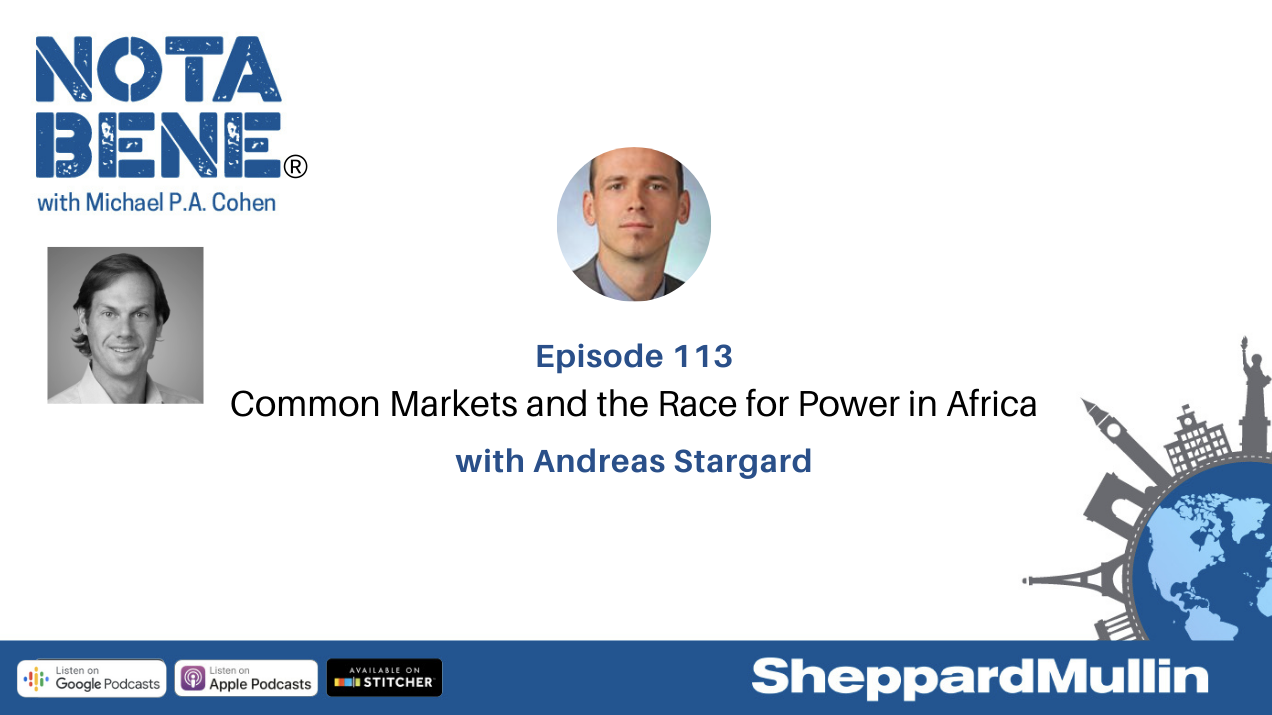
The latest episode #122 of Sheppard Mullin’s popular NOTA BENE podcast features Primerio’s Andreas Stargard, exploring “Africa Q2 Check In: Economic Growth and Relevance.”

Africa continues to strive for economic growth through various trade partnerships and foreign investments, but long-standing challenges remain an impediment in certain respects. Is Twitter’s decision to open an African base in #Ghana any indication of the continent’s economic potential? We’re joined by #Africa competition and markets expert, Andreas Stargard, a co-founding senior member of Primerio Ltd., as he shares insights on Africa’s economic outlook in Q2 of 2021.

You can listen to it for free on all major ‘podcatchers,’ including here:

The price might be right, but simmer down: a “Yup” is still required from competition authorities in Mr. Price’s strategic Yuppiechef acquisition

By Gina Lodolo and Estelle Naude


South Africans have been left with dropped jaws at the news that Mr Price Group has entered into an agreement to acquire the local Yuppiechef, known for their quirky, luxury kitchenware.


The owners of Yuppiechef are certainly pleased with their agreement with Mr Price Group to have 100% of their issued share capital acquired in cash for around R470 million and stated that “the timing is right for Yuppiechef to move forward with its growth ambitions with a partner who has a shared vision and the resources to help achieve this. I am excited about our future as a part of the Mr Price Group. They are a business which prides themselves on innovation and growth and we are strategically aligned in our plans. We share similar cultures and values which will make this an easy fit for both parties.”

According to Mr Price Group, the acquisition will provide the opportunity for Mr Price Group to expand their market share by reaching a high-end customer base in the kitchen appliance department, as well as expand their product variety from that which is already part of the Mr Price Group offering. Yuppiechef has a larger online presence than Mr Price Group, as such, Mr Price Group will reap competitive benefits from the online presence of Yuppiechef, which will enable them to become a more effective competitor with the likes of inter alia, Takealot.


According to the voluntary announcement from Mr Price Group regarding the acquisition of Yuppiechef, “the targeted effective date is subject to the fulfilment of both regulatory and commercial suspensive conditions which includes competition authority approval.” As such, it is important to note that section 13(3) of the Competition Act 89 of 1998 (“Act”) states that “the parties to an intermediate or large merger may not implement that merger until it has been approved, with or without conditions, by the Competition Commission.” Thereafter, according to section 12A(2) of the Competition Amendment Act 18 of 2018 (“Amendment Act”), a proposed merger must be evaluated on both competition and public interest grounds.


Accordingly, although South Africans are excited about the success story of the local Yuppiechef start-up, it is important to note that the proposed acquisition is still subject to scrutiny from the competition authorities before implementation of the merger can take effect.


Further, Yuppiechef is not the only home-grown retail store that Mr Price Group has sunk it’s teeth into as they seem untouched by the COVID-19 pandemic in their acquisition of Power Fashion, which was approved by the Competition Tribunal in March 2021. The acquisition of Power Fashion, with 170 retail stores, places Mr Price Group in an even stronger competitive position against the likes of Pep and JAM Clothing. According to the South African Primerio team, this acquisition places Mr Price Group in a strategic position to compete more vehemently with the lower end market, while Mr Price Group’s proposed acquisition of Yuppiechef places Mr Price Group in a position to access the higher end market. It seems that Mr Price Group intends to diversify its market share to such an extent that they are able to access the entire market, being both the lower end and the higher end consumer through the acquisition of Power Fashion and proposed acquisition of Yuppiechef respectively. The large scope of retail outlets provided by Power Fashion allows Mr Price Group to expand their physical store offering, while the online retail side will soon be catered for by the acquisition of YuppieChef.


According to Moneyweb the Mr Price Group’s JSE listing is “around 64% up on a year ago when South Africa went into its first Covid-19 lockdown”. Accordingly, Mr Price Group’s diversification and broader acquisition of market share may be one of the reasons that Mr Price Group finds itself at a stock high, unfettered by effects of the COVID-19 pandemic.

S.A. considers non-binding advisory opinions (again)

The South African Competition Act and the re-emergence of non-binding advisory opinions: Draft regulations published for comment

By Jemma Muller and Estelle Naude

After the suspension of the Competition Commission’s (“Commission”) advisory service in 2018, following the Constitutional Court’s decision in Hosken Consolidated Investments Limited v The Competition Commission, the regulation of non-binding advisory opinions is once again on the Commission’s agenda.

On the 23rd of March 2021, the Proposed Regulations on Non-Binding Advisory Opinions (“Proposed Regulations”) were published for comment by the Department of Trade, Industry and Competition (“DTIC”) in Gazette 44310 GoN 248. The public have been afforded until 23 April 2021 to provide their comment on the Proposed Regulations.

These Draft Regulations are centered around three important aspects of non-binding advisory opinions, namely:

  • How one can request a non-binding advisory opinion from the Commission;
  • The legal status of a non-binding advisory opinion; and
  • The fees payable if one requests a non-binding advisory opinion.

When requesting a non-binding advisory opinion, the requesting party will have to provide the Commission with a fairly comprehensive set of information, including, inter alia, the requesting party’s name, the market(s) in which it operates, the reasons for seeking a non-binding advisory opinion, the nature of the legal advice requested, appropriate information to allow the Commission to determine whether the requesting party falls within one of the entities exempt from paying a fee, and any other facts, information and documents which would enable to the Commission to provide a non-binding advisory opinion.

The Proposed Regulations serve as a vital tool for parties to receive guidance from the Commission pertaining to their compliance with the Competition Act No. 89 of 1998, as amended (the “Act”). Obtaining guidance from the Commission, for example on whether a proposed merger is notifiable, could not only prevent the party concerned from facing penalties for contravening the Act, but also save time and resources and negate the need for paying a filing fee (although requesting a non-binding advisory opinion does attract a fee in certain circumstances, which is discussed more fully below).

Notwithstanding the above, the information that the requesting party is required to disclose to the Commission may have the unintended consequence of discouraging parties from utilizing the advisory function for fear of confidentiality concerns. In this respect, section 44 of the Act is relevant and states the following:

1(a) A person, when submitting information to the Competition Commission or the Competition Tribunal, may identity information that the person claims to be confidential information.

(2) The Competition Commission is bound by that a claim contemplated in subsection (1), but may at any time during its proceedings refer the claim to the Competition Tribunal to determine whether or not the information is confidential information(our emphasis)

On the 23rd of March 2021, the DTIC also published for comment amendments to forms, rules and regulations of the Commission in Gazette 44309 GoN 247 (available at https://www.gov.za/sites/default/files/gcis_document/202103/44309gon247.pdf) which deals with, inter alia, an amended Rule 15A which pertains to access to confidential information submitted to the Commission. Rule 15A states:

“(1) Before the Commission makes the determination contemplated in section 44(3) of the Act in respect of information submitted to the Commission under a confidentiality claim, the Commission must:

(a) issue a Notice of intention to make a determination in Form CC 23 to the claimant and the Respondent; and

(b) allow the claimant and the Respondent 5 business days to make representations to the Commission.

(2) Within 5 business days after the Commission makes its determination in terms of section 44(3), an aggrieved person may refer the Commission’s decision to the Tribunal in accordance with the Tribunal’s rules.” (our emphasis)

According to the Proposed Regulations, the Commission is permitted, upon receipt of a request for a non-binding advisory opinion, to determine whether the issues subject to the request should be dealt with in an investigation or any other process under the Act. Additionally, a non-binding advisory opinion cannot fetter the discretion of the Commission while it exercises its functions in terms of the Act. As with the information the requesting party is required to disclose to the Commission, this provision may serve to deter businesses from utilizing this advisory function for fear that information disclosed may later be used by the Commission in an investigation. In this regard, section 45A of the Act states:

1(a) When making any decision in terms of this Act, the Competition Commission, subject to paragraph (b), may take confidential information into account in making its decision.”

This also raises the question on the status of confidential information submitted to the Commission pursuant to a non-binding advisory opinion, which the Commission later declines to issue an opinion on. According to the Proposed Regulations, if the Commission declines to issue an opinion, it must refund the fee paid by the requesting party if it appears the issues underpinning the advisory opinion will undermine the objectives of the Act.

Importantly, a request by medium enterprises and other market participants for a non-binding advisory opinion must be accompanied by a fee of R20 000 and R50 000 respectively. This is a notable increase from the fees the Commission previously charged under Rule 10.4 of the Conduct of Proceeding in the Competition Commission, which was a fee of R2500 payable by the requesting party.

While the proposed fee structure is a noticeable increase from the fees previously payable under Rule 10.4, the penalties for contravening the Act as well as merger filing fees prescribed by the Act can be far more costly than the cost of requesting a non-binding advisory opinion. It is also noteworthy that the Proposed Regulations expressly exclude certain entities from paying a fee, namely:

  • Constitutional institutions;
  • Departments;
  • Major public entities;
  • Micro enterprises;
  • Non-profit organizations;
  • Other public entities; and
  • Small enterprises.

It could be argued that the exclusion of the abovementioned entities from paying a fee may open the floodgates for requests for non-binding advisory opinions to the Commission, which could overburden an already inundated Commission.

In terms of the legal status of non-binding advisory opinions, the Proposed Regulations make it clear that the opinion has no binding legal effect on the Commission, the Competition Tribunal or the Competition Appeal Court.

The Proposed Regulations, while still in draft form, represent an important competition law development in South Africa and provide parties with much needed guidance, particularly in light of the complexities and legal nuances brought about by the recent amendments to the Act. Furthermore, the Proposed Regulations are largely in line with recent trends in promoting competition law compliance through competition advocacy as opposed to enforcement mechanisms.
Nigerian competition authorities finally established

The Federal Government of Nigeria inaugurates the Federal Competition & Consumer Protection Commission (“FCCPC”) and the Competition & Consumer Protection Commission Tribunal (“CCPT”) 

By Gina Lodolo

The Federal Government inaugurated the governing board of the FCCPC together with that of the CCPT, in order to ensure that consumer protection is placed at the forefront in giving effect to Nigeria’s developmental goals.  The board was inaugurated by the Minister of Industry Trade and Investment, Otunba Adeniyi Adebayo on the 4th of March 2021.

Section 4 of the Federal Competition and Consumer Protection Act, 2018 (“Act”) provides that in the establishment of a Governing Board charged with the administration of affairs of the Federal Competition and Consumer Protection Commission, the Board shall “consist of 8 Commissioners made up of a Chairman, a Chief Executive who shall also be the Executive Vice Chairman, two executive Commissioners and four non-executive commissioners”.

According to Section 5 of the Act, the Board members are appointed by the President from the six geo-political zones in the country, subject to confirmation by the Senate. Each Commissioner shall serve for a term of 4 years. The term may only be renewed by the President for a further term of 4 years.

The responsibilities of the FCCPC will be, inter alia, to monitor staff performance, financial reporting and to ensure accountability.  The FCCPC has been established as a policy-making body as gleaned from Minister Adebayo who stated that the agency “as the highest policy-making body, [… is] expected to ensure that the Federal Government’s mandate is achieved”.  Mr. Emeka Nwankpa, Chairman of FCCPC’s board, said that “the board was the first of its kind in the commission [and] appealed to the government to give the team the necessary support in order to function effectively”. Hajia Sharatu Shafi, Chairman of the CCPT board, said “the tribunal would ensure thorough and timely adjudication to ensure that Nigerians get value for their money and enjoy all privileges and protection”.

Minister Adebayo stated that the “present administration has zero tolerance for any form of corruption and this stance must not be compromised in any way”.  Further, “government will punish any corrupt practices perpetrated  by any board members as well as the management team.”

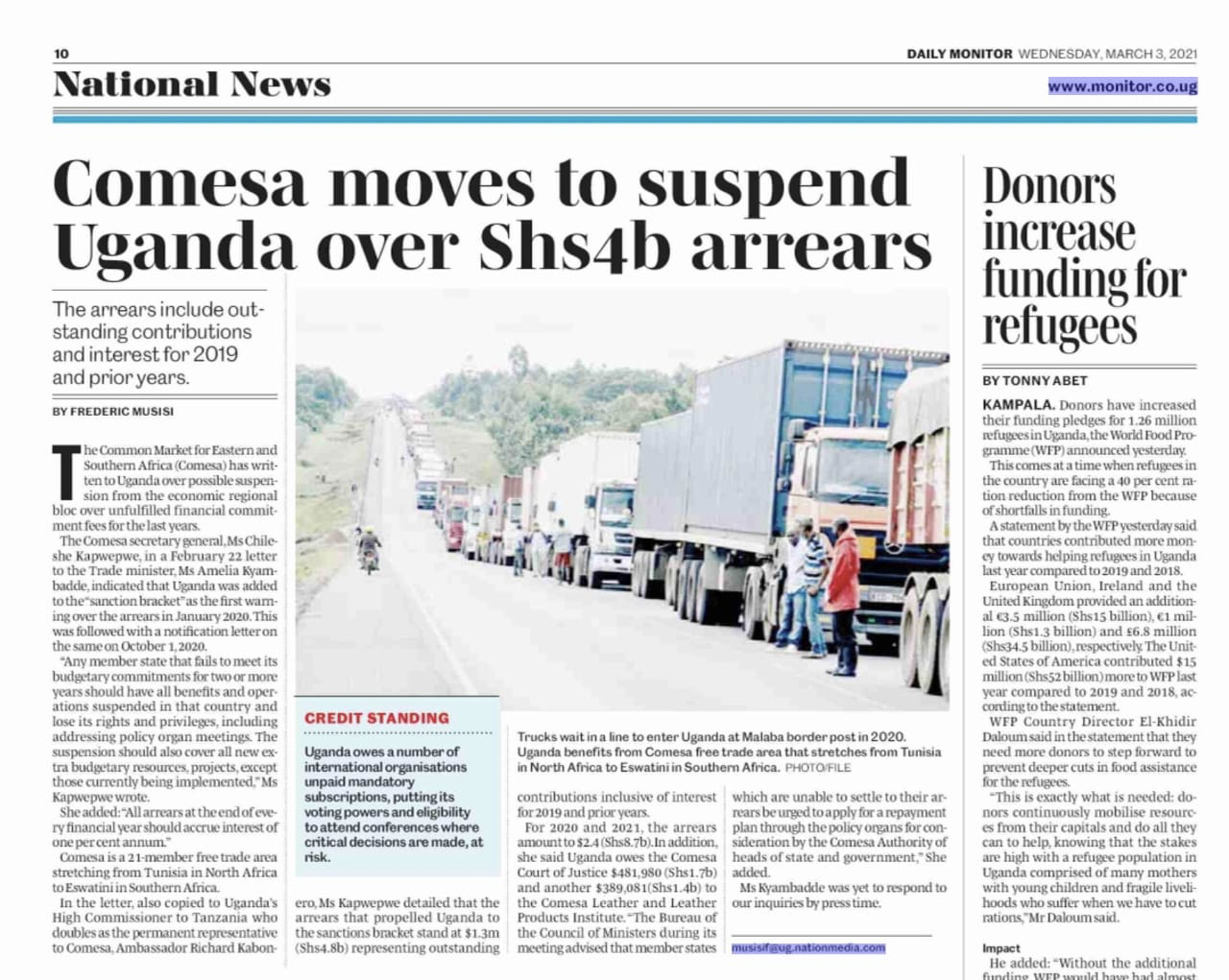
Uganda misses $5m Common Market payments, gets “suspension”

As the local Daily Monitor reports, landlocked COMESA member state Uganda — ruled since January 1986 by authoritarian president Museveni — has failed to make requisite payments under the COMESA Treaty to the supra-national regional organization. Its arrears date back over two years, according to sources, and amount to roughly U.S. $4 to 5 million. Arrears carry with them a 1% per annum interest rate.

COMESA’s Secretary General has officially reprimanded the Ugandan government and placed the nation on the organization’s “sanction bracket.” Andreas Stargard, an attorney with Africa boutique law firm Primerio Ltd., notes that being sanctioned carries with it the nation-state’s loss of all privileges of COMESA membership, including its key free-trading benefits, during the duration of the sanctions being imposed. “It also means that Ugandan officials are not permitted to address official COMESA bodies, nor are Ugandan citizens permitted to be appointed to, or hired by, COMESA organs. It remains to be seen whether this suspension of Uganda will impact competition-law enforcement in any direct, appreciable way — what comes to mind is merger notification and the impact that Uganda’s being sanctioned may have on cooperation between the CCC and Ugandan authorities.”

The outstanding debt is all the more concerning as Museveni’s administration, in an attempt to cling to power after 35 years, recently reportedly spent large sums out of the state’s coffers on military-grade weaponry to prepare for the chaos precipitated by the recent hotly-disputed elections.

Antitrust writing awards – call for nominations

Our partner publication Concurrences is happy to announce that submissions are now open for the 2021 Antitrust Writing Awards.

Now in their 10th year, the Antitrust Writing Awards are given for excellent written thoughts in the field. Participation in the Awards process, whether as an author, jury member, or reader, helps highlight the best antitrust ideas of the past year.

The present Call for Nominations concerns 3 types of publications:

  • Best Articles: Articles published or accepted for publication in 2020, in both academic journals and professional magazines.
  • Best Soft Laws: Most innovative non-enforcement tools issued by competition agencies in 2020, such as guidelines, market studies, white books, etc.
  • Best Student Papers: Articles written or published in 2020 by current students of law or economics.

Deadline for submissions is Monday, April 5, 2021. You can submit your article here: https://awards.concurrences.com/

Winners will be announced at the online Awards Ceremony on Wednesday, June 30, 2021, and accept their Awards in the presence of the Board and Steering Committee Members. To see the full list of Jury members, click here.

The Antitrust Writing Awards is a joint initiative between Concurrences and the George Washington University Law School.

Single Brush Stroke Stops Paints Cartel in its Tracks

Three years after an intricate East-African antitrust saga involving global European and Asian paint manufacturers, the industry is in the region’s competition-law news again.

By Andreas Stargard

Upon receiving allegations, in 2018, of cartel-like practices among paint manufacturers and undisclosed distributors, the Competition Authority of Kenya (CAK) launched an investigation into the companies suspected of breaching competition rules. These investigations later uncovered that four firms, namely: Crown Paints, Basco Products Limited, Kansai Plascon and Galaxy Paints were deemed guilty of collusion and price-fixing, subjecting the purchasers to unreasonably high prices for various paint brands. The CAK has since revealed its findings to the Kenyan Parliament.

Crown Paints has a flagship brand called DuraCoat, which includes paint products for both interior and exterior finishing (painting and waterproofing). Dura Brands’ exposed collusion with the other three companies sparked fears that consumers had been buying these products at artificially inflated prices. This is particularly significant given that Crown Paints is listed on the Nairobi Securities Exchange and is a heavyweight in the local Kenyan paints market, with further regional subsidiaries in Uganda and Tanzania (all COMESA member states).

Ruth Mosoti, Primerio Ltd.’s Kenyan competition practitioner, notes that the “CAK ultimately found that all four companies were in direct contravention of section 31 of the Competition Act, which addresses restrictive trade practices that prohibit companies from colluding with one another in order to determine product prices, as well as control when and to whom they will offer pricing discounts. The CAK alleges that these are all anti-competitive behaviors that are to the detriment of the consumer as well as other, outside competitors.”

In its Annual Report to Parliament, the CAK noted: “The investigations with respect to three other paint manufacturers and distributors were concluded in July 2019 with the Authority making a preliminary finding that the parties were involved in an anti-competitive agreement on prices, discount structure and transport charges.”

In line with section 36(c) and (d) of the Act, the CAK is entitled to impose financial penalties “to remedy or reverse the infringement or the effects thereof” which may span “up to ten percent of the immediately preceding year’s gross annual turnover in Kenya of the undertaking or undertakings in question”.

Of the four Companies, Basco Products Limited was the only company that did not challenge the CAK’s preliminary ruling and paid a penalty amount of Sh20.799 million. The company further agreed to abstain from committing any similar breaches in the future. While the other subject companies initially appealed the decision handed down by the CAK, AfricanAntitrust.com editorial staff have now learned that up to 3 of the accused firms have opted to settle, having withdrawn their appeals.

COMESA

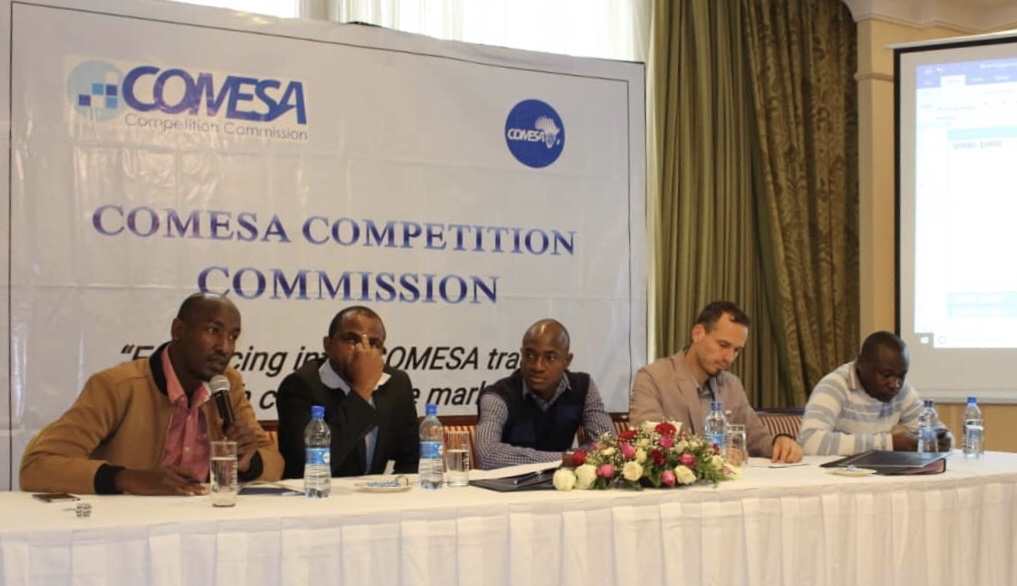
It is also pivotal to note that on the 25th of February 2021, the COMESA Competition Commission (CCC) issued a cautionary note specifically pertaining to the consequences of forming artificial barriers to free trade, such as collusive practices and other horizontal agreements hindering competition.

The CCC — in its recent bid to become a fully-fledged competition enforcement agency that investigates not only merger activity (as it had done primarily so far) but also pursues hard-core antitrust offences such as cartels — made reference to Article 16 of the Regulations, prohibiting “all agreements between undertakings, decisions by associations of undertakings and concerted practices which: (a) may affect trade between Member States; and (b) have as their object or effect the prevention, restriction or distortion of competition within the Common Market”.

The Kansai paint allegations described above would fit the bill, but we shall see what cartel matters the CCC will pursue going forward, and in which industry segments… The CCC has stated that it “…will work closely with the national competition authorities in the Member States to ensure that offenders are detected, investigated and punished”. Furthermore, there is particular focus on “hard enforcement through screening, detection, investigation and punishment of offenders”.

Online Intermediation Platforms Market Inquiry: Call for Comments

By Jemma Muller & Gina Lodolo / edits by Charl van der Merwe

The South African Competition Commission (SACC) indicated its intent to formally initiate a market inquiry in the Online Intermediation Platforms Market (Inquiry), in terms of section 43B(1)(a) of the Competition Act 89 of 1998 (as amended) (Competition Act).

In terms of the amended Competition Act, the SACC has the power to conduct a market inquiry at any time, “if it has reason to believe that any feature or combination of features of a market or any goods or services impedes, distorts or restricts competition within that market.

The SACC published its draft Terms of Reference (ToR), allowing members of the public until 12 March 2021 to submit their comments on the scope of the Inquiry.

The ToR envisage a limited scope of assessment, to include only online intermediation services and, in particular, eCommerce marketplaces; online classifieds; travel and accommodation aggregators; short term accommodation intermediation; food delivery; app stores (with the notable exclusion of ‘fintech’).

The Inquiry will be focused on both competition and public interest factors and will aim to consider:

  • market features that may hinder competition amongst the platforms themselves;
  • market features that give rise to discriminatory or exploitative treatment of business users; and
  • market features that may negatively impact on the participation of SMEs and/or HDI owned firms

According to the SACC in the ToR, these platforms have been flagged as they have the potential to self-preference and distort markets through algorithms, which is harmful to businesses who rely on these platforms to reach consumers.

The Inquiry follows shortly on the back of the SACC’s “Competition in the Digital Economy” report (Report), which was published for public comment in the final quarter of 2020. In the Report, the SACC specifically identified market inquiries are an effective tool to address market barriers (especially for Small Medium Enterprises (SME) and historically disadvantaged individuals (HDP)) and to address market feature concerns which may lead to reduced competition.

Allied to this, the ToR goes on to state, in support of the Inquiry, that the use of intermediation services can provide a manner of entry into a market for SMEs/ HDPs, but due to the potential distortions of the market, may also discriminate against them. As a result of the COVID-19 pandemic, domestic online business opportunities are vital in ensuring economic recovery as well as inclusive growth of SMEs and HDPs.

The Inquiry will be the first inquiry in terms of the Competition Act as amended. In this regard, the amended Competition Act empowers the SACC to “take action to remedy, mitigate or prevent the adverse effect on competition”.  This includes imposing structural or behavioural remedies.

It is also notable that the standard of assessment for market inquiries is a lower standard that that required in complaint proceedings. The SACC need only find that certain elements of the market may have “adverse effect on competition” (as opposed a substantial lessening of competition).

In light of these facts, firms in the relevant market cannot afford to remain passive participants in market inquiries and, instead, must consider and respond to the inquiry, as a respondent.

Chief enforcer departs CCC, Mwemba takes on role

February 17th, 2021: TODAY, the COMESA Competition Commission (“Commission”) released the following statement, wishing “to inform the general public that the tenure of office of Dr George Lipimile who was the Director and Chief Executive Officer of the Commission for the past ten years, came to an end on 31st January 2021.

Dr Lipimile was appointed by the COMESA Council of Ministers as the first Director and Chief Executive Officer of the Commission in February 2011. He served in this capacity at the Commission for ten years during which time he played a pivotal role in the establishment of the Commission as the first fully operational regional competition authority in Africa and the second fully functional regional competition authority in the world after the European Commission. Dr Lipimile tirelessly worked towards the enforcement of the COMESA Competition Regulations and Rules. He dedicated his time at the Commission in strengthening the institution with but not limited to:

  • Growth in its staff compliment;
  • Creating sound legal framework;
  • Processes and Procedures for enforcement of the Regulations;
  • Advocacy and technical assistance to COMESA Member States; and
  • Setting up the necessary corporate governance systems.

Further, the Commission wishes to announce to the general public that Dr Willard Mwemba has been appointed as the Acting Director and Chief Executive Officer of the Commission from 1st February 2021 until such time the substantive Director of the Commission is recruited. The Commission wishes to congratulate Dr Mwemba on his appointment as the Acting Director and Chief Executive Officer of the Commission.

Incoming Mwemba & outgoing Lipimile

Andreas Stargard, a Primerio competition lawyer who knows both men from having notified transactions to the CCC as well as socially, says that “an era is now concluded — namely the ‘Genesis Era’ of the CCC, as George was its very first, and thus formative, leader. That said, I am deeply assured by the appointment of Dr. Mwemba to his post as acting Director, as he is of utmost competence and I have no doubt will guide the Commission in the right direction in this new ‘CCC 2.0 Era’ after Dr. Lipimile’s departure.”

Common Markets & the Race for Power in Africa: a Podcast Interview

Africa is a continent of 1.2 billion people.  From a consumer potential standpoint it matches China or India.  Yet historically, it has suffered from the lingering shadows of its colonial past, in addition to its current fractures, hostility, and ever-present corruption.

The continent is emerging fast, however, and is quickly accelerating into the 21st Century marketplace both from an investment and growth opportunity. From the digital revolution and increased free trade, to innovation in various industries, Africa may be the next market frontier to unfold into accelerated multinational presence.

In this podcast episode (available gratis on Apple, Spotify, and Sheppard Mullin‘s web site), Michael P.A. Cohen is joined by Africa competition and markets expert, Andreas Stargard, as he shares his insight to help multinationals navigate the African landscape.

What we discuss in this Podcast episode:

  • What do the Africa markets look like from a multinational business opportunity perspective?
  • Which countries in Africa have established markets? Which ones have growth potential?
  • How and why has China’s investment and influence across Africa intensified over the last couple of decades?
  • What type of digital revolution is taking place in Africa?
  • Is there a huge opportunity for mobile money on the continent?
  • How is free trade shaping up across the African continent? How do the AfCFTA’s goals tie in?
  • What Free Trade cooperation agreements exist among the East, West and South African nations? Will they succeed?
  • Where is Africa leading innovations?
  • How will African wars and corruption impact its ability to grow a multinational marketplace?

Who’s speaking:

Michael Cohen is the creator of the Nota Bene podcast. He began his career as an Assistant Special Prosecutor, investigating and prosecuting organized crime involvement with the failure of local financial institutions in the early 1990s, and has since practiced globally at several top law firms. In 2015, Michael joined Sheppard Mullin’s storied antitrust practice with a goal of putting his 25 years experience to work to complement the firm’s longstanding antitrust litigation group, helping to bridge government antitrust enforcement in Washington, D.C. to the firm’s strengths in Brussels, San Francisco and Los Angeles.

A co-founding senior member of Primerio, a business advisory firm helping companies do business within Africa from a global perspective, Andreas Stargard is legal, strategic, and business advisor to companies and individuals across the globe.  He focuses on antitrust and competition advice, white-collar counseling, contract dispute and negotiation, and resolution of global business disputes, including cartel work, corruption allegations and internal investigations, intellectual property, and distribution matters.  He has written and spoken extensively on these topics and many others.  Andreas also advises clients on corporate compliance programmes that conform to local as well as global government standards, and has handled key strategic merger-notification questions, including evaluation of filing requirements, avoidance strategies, cross-jurisdictional cooperation, and the like.