
Having reported on the promise and challenges of the African Continental Free Trade Area (“AfCFTA”) and its regulatory ambitions previously here, our Editor was fortunate to attend the inaugural AfCFTA conference of competition-law experts this week. Reporting from Lomé, Togo, he relayed an excellently-planned and executed meeting — cleverly scheduled adjacent to the massive annual Biashara Afrika 2026 convention taking place in the Togolese capital this year, drawing thousands of attendees from the trade and commerce world. Together, under the broader umbrella of “Powering Africa’s Economic Transformation through the AfCFTA,” the two events convened policy-makers and business leaders to push for a single market and boosting Africa’s trading position on the global stage.

Over 200 participants attended the antitrust conference, with its theme of “Harnessing Competition as a Catalyst for African Market Integration,” assembled by the leadership of Malick Diallo, Head of AfCFTA’s Competition Division and his Ghana-based team of organizers. The competition-focused meetings at the five-star Hôtel 2 Février were well attended throughout both days, covering topics ranging from the tricky subject of multi-jurisdictional mergers with regional overlaps to digital-market regulation and, importantly, listening to the private bar for their input.
In total, the meeting comprised 5 sessions and 3 keynotes over the course of two days, including speeches by NYU’s Prof. Eleanor Fox, the FCCPC legend Babatunde Irukera, Leonard Ugbajah of ERCA, and the European Commission’s DG COMP as well as OECD. Participants notably took in lessons learned from other regional enforcers (Dr. Willard Mwemba and Alexia Waweru from COMESA, Simeon Koffi, and Mor Backhoum from ECOWAS, the EAC, WAEMU and the AU) as well as National Competition Authorities. The latter ranged from Kenya, Egypt, Tanzania, Nigeria, Mauritius, South Africa, Tunisia, and others to the European Union and delegates from Switzerland and the World Bank. While David Kemei (CAK) and Florence Abebe (FCCPC) spoke on behalf of their agencies, notably absent from the discussion were representatives from the United States enforcement agencies, belying a further retrenchment of the DOJ and FTC’s prior capacity-building activities and international involvement under the current administration.
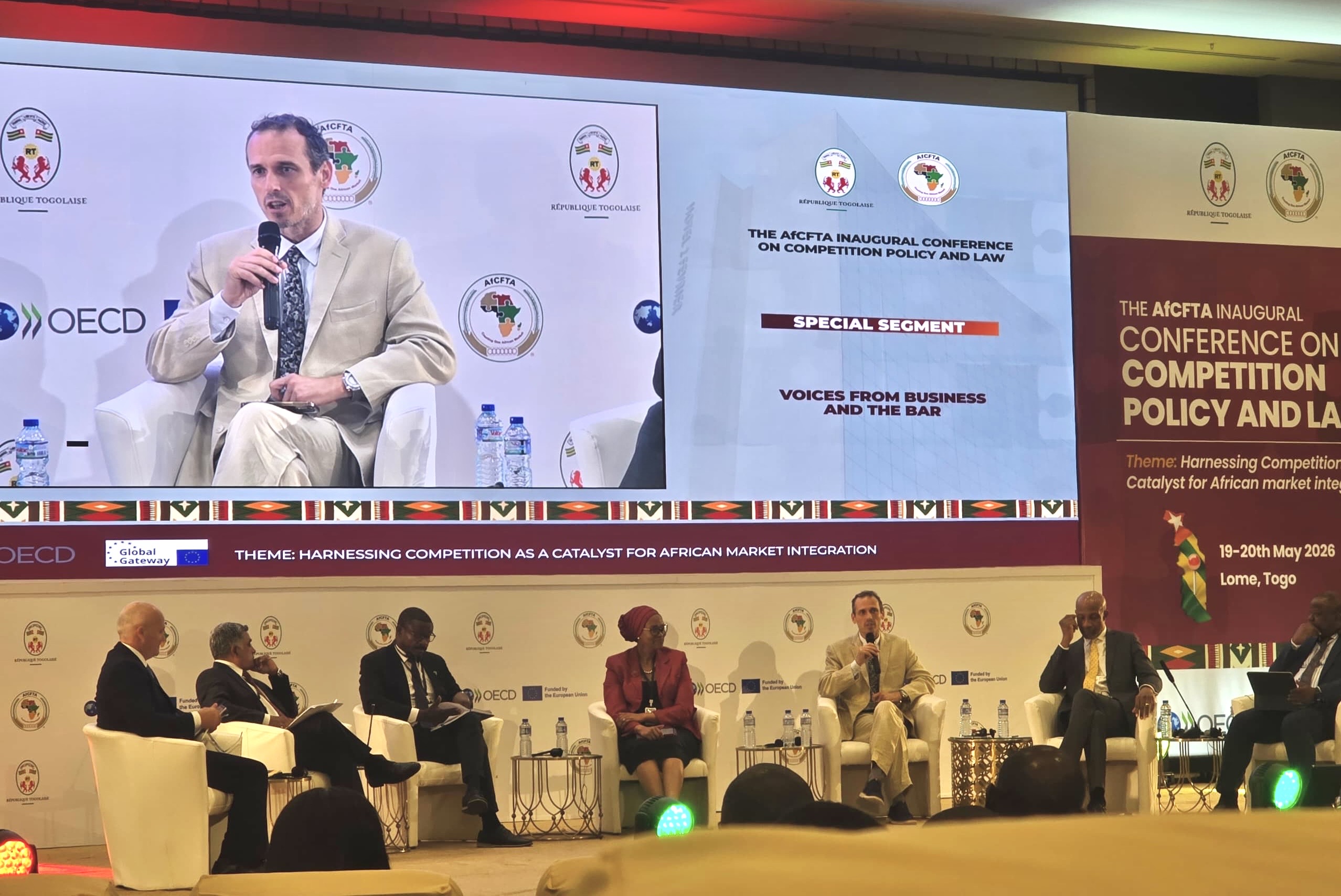
“I see the AfCFTA as perhaps the single most important building block for a truly cohesive, pan-African trade and commerce community so far,” says AAT’s Editor, Andreas Stargard, who attended the conference in his capacity as a practitioner with Primerio International. “Coming from quite a bit of EU and COMESA multi-national experience, I believe that managing those clearly unavoidable jurisdictional conflicts in a regional body from the get-go will be crucial to its success, lending credence to the ‘Competition as Catalyst’ theme of the conference…”.
Below is the AfCFTA’s Concept Note, outlining further details surrounding the event:
THE AfCFTA INAUGURAL CONFERENCE ON COMPETITION POLICY AND LAW

A joint initiative of the AfCFTA Secretariat, the Organisation for Economic Co-operation and Development (OECD) and the European Union (EU)
Theme:
“Harnessing Competition as a Catalyst for African market integration”
Lome, Togo 19-20th May 2026
Introduction
- Africa is entering a new phase of its economic integration journey. The African Continental Free Trade Area (AfCFTA) — the largest free trade area in the world by number of participating countries — has set in motion a transformation of the continent’s economic architecture. With a combined market of over 1.4 billion people and a GDP approaching USD 3.4 trillion, the AfCFTA offers an unprecedented opportunity to deepen intra-African trade, accelerate industrialisation, and position Africa as a global economic force. Realising that opportunity, however, requires more than the removal of tariffs and border barriers. It requires markets that are genuinely open, contestable, and fair — markets where competition determines outcomes, not the power of incumbents or the distortions of anti-competitive conduct.
- That is where competition policy comes in. A dynamic, well-enforced competition framework is not a regulatory luxury; it is a foundational condition for the AfCFTA to deliver. It ensures that the gains of trade liberalisation are not captured by dominant incumbents, cartels, or anti-competitive mergers. It creates the conditions for new entrants, innovative businesses, and African SMEs to compete on merit. It underpins consumer welfare, productive investment, and the structural transformation that Africa’s integration agenda demands.
- To support this vision, the Assembly of Heads of State and Government of the African Union, at its 36th Ordinary Session held in Addis Ababa, Ethiopia, on 18–19 February 2023, adopted the Protocol to the Agreement Establishing the African Continental Free Trade Area on Competition Policy (the “AfCFTA Competition Protocol”). The Protocol establishes a continental competition regime aimed at enhancing competition within the AfCFTA for improved market efficiency, inclusive growth, and the structural transformation of the African economies.
- At the same time, African competition authorities and policymakers are being asked to grapple with increasingly complex issues: how to manage overlapping national, regional, and continental competition regimes; how to align competition, trade, and industrial policy objectives; how to tackle long‑standing competition problems in transport and logistics; and how to respond to the rapid rise of powerful digital platforms and new forms of market power in the digital economy. Despite significant progress, important gaps remain. A recent survey of competition frameworks conducted by the AfCFTA Secretariat and the OECD found that while 76.2% of surveyed African jurisdictions have a competition law framework in place, significant disparities persist in enforcement capacity, institutional design, and coherence between national, regional, and continental regimes.
- The AfCFTA Conference on Competition Policy and Law 2026 is conceived as a practical, forward‑looking response to these challenges. Jointly convened by the AfCFTA Secretariat, the Organisation for Economic Co‑operation and Development (OECD) and the European Union, it provides a continental platform where competition authorities, trade and industrial policymakers, sector regulators, business leaders, legal practitioners, academics and development partners can think together about how competition policy can best support Africa’s integration and development ambitions.
- The inaugural edition focuses on four interconnected themes that are shaping the continent’s competition agenda today, namely:
- the emerging architecture of an integrated African competition regime which discusses the interplay between national, regional, and continental competition frameworks;
- the interaction between competition, trade and industrial policies;
- competition in the transport and logistics sector as a cornerstone of trade facilitation; and
- competition and regulation in digital markets.
The Conference is designed not only to exchange experiences, but to generate concrete ideas on how to make these frameworks work in practice for a dynamic and integrated African market.
Conference Theme
- The theme of the inaugural Africa Competition Conference is “Harnessing Competition as a Catalyst for African market integration”.
- The theme captures a core belief of the Conference: that competition policy is not simply a compliance obligation, but a powerful driver of economic integration, productive investment, consumer welfare and sustainable development. It challenges participants to reflect on how competition law and enforcement can be shaped, implemented and coordinated across Africa to unlock the full integration gains of the AfCFTA.
Objectives and target audience
- The overall objective of the Conference is to foster high-level, practical dialogue among competition authorities, regulators, policymakers, business practitioners, academics, and international experts on the key challenges and opportunities in African competition policy; and to generate concrete ideas that can inform future work under the AfCFTA.
- More specifically, the Conference aims to:
- Build a shared understanding of how the AfCFTA continental competition framework interacts with existing national and regional regimes, and how overlapping jurisdictions and enforcement responsibilities can be managed effectively;
- Examine the interaction between competition, trade, and industrial policy under the AfCFTA, with a focus on practical approaches for ensuring coherence and managing tensions in key sectors;
- Identify priority enforcement and regulatory actions to improve competition in Africa’s transport and logistics sector, with a view to reducing trade costs and facilitating intra-African trade;
- Advance the understanding and implementation of Article 11 of the AfCFTA Competition Protocol in digital markets, including approaches to economic dependence, gatekeeper designation, and the interpretation of gatekeeper obligations;
- Solicit practical perspectives from business leaders, legal practitioners, and in-house counsel on how African competition frameworks operate and how they can be strengthened; and
- Lay the groundwork for a programme of future cooperation, technical work, and capacity-building under the AfCFTA, in partnership with the OECD, EU, regional economic communities, and other partners.
Conference Sessions: Background, Key Issues and Structure
Session 1: The triangle of policies – Competition, trade and industrial policy in Africa
- Africa’s development strategy relies on an active industrial policy to build productive capacity and accelerate structural transformation, trade policy to manage market access across borders, and competition policy to discipline anti-competitive conduct. These three policy strands share the overarching goal of improving economic performance but can generate significant tensions, particularly at the sectoral level. The way in which these policies interact depends both on their underlying objectives as well as on the way in which they are designed and implemented.
- Industrial policy instruments such as state aid, sector-specific incentives, special economic zones, and strategic procurement can create market distortions when poorly designed or captured by incumbents. Trade measures such as anti-dumping duties may protect domestic industries at the cost of consumer welfare. Conversely, aggressive competition enforcement, if not carefully attuned to development context, can undermine legitimate scale‑building and coordination efforts that industrial policy seeks to foster. Getting the balance right is one of the defining policy challenges for African integration.
- This session draws on case studies from Africa and comparative experiences from other regions to explore practical approaches workable within the AfCFTA framework. It will examine:
- Where competition, trade, and industrial policy are consistent and reinforce each other — and where tensions arise in practice;
- The role of competition authorities as institutional voices supporting a pro-competitive design or implementation of industrial and trade policy processes;How State Parties, RECs and the AfCFTA can promote policy convergence across the three domains; and
- Lessons from jurisdictions that have successfully balanced competition and industrial policy goals.
- Critical issues: Can African industrial policy ambitions be pursued without sacrificing the competitive market structures that drive long-term productivity? What role should competition authorities play in designing and reviewing industrial policy measures and what policy instruments should be considered to ensure industrial policies are pro-competitive? What level of convergence in competition, trade and industrial policy is realistic and desirable under the AfCFTA, and how can State Parties, RECs and AfCFTA institutions sequence this convergence over time? Which concrete experiences from other regions in aligning industrial strategy with competition rules are most transferable to African conditions, and what adaptations are required to make them fit the AfCFTA context?
Session 2: Towards an integrated African continental competition regime – The interplay between national, regional, and continental competition frameworks
- Africa’s competition landscape is being reshaped by the AfCFTA Competition Protocol, which adds a continental layer to existing national laws and regional regimes such as those of COMESA, ECOWAS, the EAC and WAEMU. This deepens the integration architecture but also raises practical questions about overlapping jurisdictions, potentially conflicting obligations and greater regulatory complexity for businesses operating across borders. A central concern for practitioners, authorities and policymakers is how these interlocking regimes will function day to day.
- This session will explore the emerging architecture of an integrated African competition regime. Discussions will cover:
- The distinct features of existing supranational frameworks and their interaction with national laws and the AfCFTA regime;
- The opportunities and challenges of cross-border enforcement, including coordinated investigations, merger control, and cooperation between national and regional bodies;
- How businesses can navigate an evolving multi-level regulatory landscape;
- Lessons from comparable supranational architectures, including the EU; and
- The status of AfCFTA competition regulations and the roadmap to operationalisation.
- Critical issues: How can concurrent jurisdiction be managed to minimise conflict and duplication, while fostering consistent outcomes? What institutional and procedural mechanisms are needed to coordinate enforcement between national authorities, REC bodies, and the future AfCFTA Competition Authority? How can the continental regime support, rather than burden, smaller jurisdictions with nascent competition frameworks?
Session 3: Levelling the playing field – Competition in Africa’s transport and logistics sector
- The transport and logistics sector constitutes a cornerstone for the development of an integrated internal market in Africa. However, transport and logistics costs are among the highest globally, operating as a de facto tariff on intra‑African trade. Regulatory shortcomings and anti‑competitive conduct in this sector are a major part of the problem: restrictive and onerous licensing and access regimes, fragmented multi‑modal regulation across borders, cartels in road freight, concentrated control over ports and terminals and gaps in essential infrastructure access all depress trade, push up prices and undermine the competitiveness of African producers.
- As the AfCFTA deepens tariff liberalisation, the relative importance of logistics costs as a constraint on trade increases. Sector-specific regulatory assessment and reform, complemented by robust competition enforcement, is therefore a necessary companion to trade liberalisation. This session brings together competition authorities, transport regulators, corridor agencies, and industry representatives to identify the main sources of competitive harm, share enforcement and regulatory experience, and discuss targeted reforms.
- The session will address:
- How existing regulatory frameworks (licensing, concessions, access rules, corridor agreements) shape market structure and entry, and where they unintentionally hinder access, increase discretionary powers and entrench monopolies or cartels;
- The main patterns of anti‑competitive conduct in key transport and logistics markets (road freight, ports and terminals, aviation, multimodal logistics), and how they affect prices, service quality and reliability;
- The Yamoussoukro Decision and Single African Air Transport Market (SAATM) from a competition perspective;
- Practical cooperation models between competition authorities, transport regulators and corridor institutions for investigating and remedying harmful practices;
- The role of competition assessments and market studies in informing transport and logistics reform under the AfCFTA; and
- How to incorporate competition objectives into ongoing regional infrastructure initiatives and corridor development programmes.
- Critical issues: How can competition authorities and transport regulators coordinate to address practices that span their respective mandates? Which regulatory reforms would most effectively improve contestability in key transport markets? How can the AfCFTA regime support an effective and coordinated approach to removing competition barriers in logistics?
Session 4: Competing in the digital age – Digital trade, platform markets, and Article 11 of the AfCFTA Competition Protocol
- Digital trade is reshaping African markets and will increasingly determine whether African businesses and consumers participate competitively in the broader global economy. Africa’s digital economy is characterised by fast-growing platform markets, expanding mobile and fintech ecosystems, and the rapid penetration of digital intermediaries into commerce, payments, logistics, and communications. This creates new opportunities but also new forms of market power and dependence.
- Article 11 of the AfCFTA Competition Protocol is the continent’s primary legal tool for tackling competition concerns in digital markets. It introduces the notion of “economic dependence”, prohibits abuses of that dependence that significantly harm competition in the AfCFTA market, sets out a detailed list of forbidden practices for core platforms (such as self‑preferencing, certain parity and anti‑steering arrangements, tying, and unjustified limits on data portability and interoperability), and mandates the development of a Regulation to identify and subject “gatekeeper” platforms to these obligations.
- At the same time, the AfCFTA Digital Trade Protocol, adopted in February 2024, sets harmonised rules on e‑commerce, data flows and digital identities, making coherence between competition and digital trade rules an important implementation challenge.
- The session will explore:
- Defining and assessing economic dependence in African digital markets in practice; what indicators and evidence are relevant, and how this differs from standard dominance analysis;
- The specific prohibited practices in Article 11; how they should be interpreted, which are most relevant to African market realities, and what enforcement challenges they present;
- Options for a gatekeeper designation framework under Article 11(5), drawing on the EU Digital Markets Act and other international experience while calibrating criteria and thresholds to African conditions;
- The enforcement capacity and institutional tools that authorities need to investigate digital platform conduct under Article 11; and
- The interface between Article 11 and the Digital Trade Protocol on data portability, interoperability, and access to data.
- Critical issues: How should economic dependence be assessed where multi-homing is possible but switching costs are high? What designation criteria would be both rigorous and proportionate for African digital markets? How can authorities with limited resources build capacity to investigate platform conduct? How can coherence between Article 11 and the Digital Trade Protocol be ensured?
Special Segment: The Lome Roundtable: Voices from business and the bar
- This special segment departs from the formal panel format to provide an open forum where business leaders, legal practitioners, and in-house counsel engage directly with competition authorities and policymakers. The Lome Roundtable is designed to bring out the day‑to‑day concerns and realities of dealing with African competition regimes: compliance costs, merger clearance timelines, enforcement unpredictability, market access barriers, and the challenges of navigating multi-level competition regimes, that may not be fully visible from a purely institutional perspective.
- The Roundtable reflects the Conference’s commitment to ensuring that competition law serves not only as an enforcement instrument but as a framework that enables businesses to operate, grow, and trade across African borders with confidence. Open and structured dialogue between enforcers and the business community is a hallmark of mature competition systems, and the Lome Roundtable is designed to institutionalise this practice at the AfCFTA level.
- It will address:
- Practical experience with African competition regimes: what works, what creates uncertainty, and what imposes disproportionate compliance costs;
- How authorities can improve transparency, predictability, and responsiveness including in merger review, guidelines, and stakeholder engagement;
- The specific challenges of operating across multiple overlapping competition jurisdictions; and
- Practical suggestions for how the relevant stakeholder can improve competition frameworks from a business perspective.
- Critical issues: What are the most significant compliance and enforcement challenges for businesses operating across African borders? How can merger review be made more streamlined and predictable? What kinds of guidance, tools or platforms would most help businesses navigate overlapping competition regimes?
Expected Outcomes
- The expected outcomes of the Conference include:
- A shared, practical understanding of how the AfCFTA continental competition framework interacts with regional and national regimes and the roadmap for its operationalisation;
- Concrete insights and practical approaches for managing the interaction between competition, trade, and industrial policies at the national, regional, and continental levels;
- A set of regulatory actions and priority enforcement to identify and address regulatory barriers and anti-competitive practices in Africa’s transport and logistics sector, with concrete suggestions for cooperation between competition authorities and sector regulators;
- Key questions, indicators, and options for implementing Article 11 of the AfCFTA Competition Protocol in digital markets — including ideas for a gatekeeper designation framework and priority areas for guidance and capacity-building; and
- Practical suggestions from business leaders and legal practitioners on improving the clarity, predictability, and accessibility of African competition frameworks.
 African Antitrust & Competition Law