“The WRAP” — our monthly summary of antitrust developments across the continent

AAT Header square

Competition-Law Developments: a WRAP from the Comp-Corner

Issue 2 – August 2016

The editors and authors at AAT welcome you to the second edition of “The WRAP.”

We look at the most recent developments and updates in respect of competition law and enforcement which has taken place across the African continent in recent months.

As always, thank you for reading the WRAP, and remember to visit us at AAT for up-to-date competition-law news from the African continent.

         –Ed. (we wish to thank our contributors, especially Michael James Currie, for their support)

Cooperation, handshakes & MoUs: all the rage in African antitrust?

AAT the big picture

Significant Strides made to Promote Harmonisation across African Competition Agencies

By AAT Senior Contributor, Michael-James Currie.

In the past 12 months there has been a steady drive by competition law agencies in Africa to promote harmonisation between the respective jurisdictions.

The African regional competition authority, the COMESA Competition Commission (CCC), has entered into memorandum of understandings with a number of its nineteen member states. On 5 June 2016, it was announced that the CCC has further concluded MoU’s with the Swaziland Competition Commission as well as the Fair Trade Commission of the Seychelles.

On 7 May 2016, it was announced that nine members of the Southern African Development Community (SADC) have also entered into and MoU. These member states include South Africa, Malawi, Botswana, Swaziland, Seychelles, Mozambique, Namibia, Tanzania and Zambia.

The SADC MoU was based on the 2009 SADC Declaration on Regional Cooperation and Consumer Policies.

SADC MoUAccording to the South African Competition Commissioner, Mr Tembinkosi Bonakele, the MoU creates a framework for cooperation enforcement within the SADC region.  “The MoU provides a framework for cooperation in competition enforcement within the SADC region and we are delighted to be part of this historic initiative,” said Bonakele.

Interestingly, although a number of the signatories to SADC MoU are not member states of COMESA (that is, South Africa and Namibia, who in turn, have a MoU between their respective competition authorities), Swaziland, Malawi and the Seychelles have existing MoU’s with the COMESA Competition Commission. Says Andreas Stargard, a competition practitioner with Primerio Ltd., “it will be interesting to see, first, whether there may be conflicts that arise out of the divergent patchwork of cooperation MoUs, and second, to what extent the South African Competition Authorities, for example, could indirectly benefit from the broader cooperation amongst the various jurisdiction and regional authorities.”

Part of the objectives of the MoUs to date has largely been to facilitate an advocacy role. However, from a practical perspective, the SADC MoU envisages broader information exchanges and coordination of investigations.

While the MoU’s are a positive stride in achieving cross-border harmonisation, it remains to be seen to what extent the collaboration will assist the respective antitrust agencies in detecting and prosecuting cross border anticompetitive conduct.

There may be a number of practical and legal hurdles which may provide challenges to the effective collaboration envisaged. The introduction of criminal liability for cartel conduct in South Africa, for example, may provide challenges as to how various agencies obtain and share evidence.

Namibia: NaCC issues Guidelines on Restrictive Practices

By Michael-James Currie

In April 2016, the Namibian Competition Commission (NaCC) finalised its guidelines on restrictive practices (Guidelines) in terms of chapter three of the Namibian Competition Act. The Guidelines focus in particular on the investigatory powers and procedures to be utilised by the NaCC during its investigations into restrictive practices.

The Namibian Competition Act contains most of the traditional antitrust prohibitions in relation to restrictive conduct. These include ‘agreements’ or ‘concerted practices’ between firms in a horizontal or vertical relationship which have the “object” or “effect” of substantially lessening competition in the market.

The Competition Act does not, from a plain reading of the language, impose a per se prohibition for ‘hardcore’ cartel conduct. The Guidelines, however, confirm that certain practices such as ‘hardcore cartel conduct’ and ‘minimum resale price maintenance’ will be considered per se to be anticompetitive. It is unclear, however, whether this per se contravention should rather serve as a presumption that the conduct is anti-competitive which may affect the onus of proof, rather, as in the South African context where the Act makes it clear that the effect of hardcore cartel conduct is irrelevant.

Furthermore, there is no express provision which deals with ‘rule of reason’ defences, however, the Guidelines confirm that efficiency or pro-competitive features of the alleged anti-competitive conduct, may outweigh any anti-competitive effect. It should be noted, however, that even if there was no anti-competitive effect, if the objective of the conduct was to engage in an anti-competitive agreement or concerted practice, a respondent may still be liable. Accordingly, conduct must not only be shown not to have an anti-competitive effect, but must also be properly ‘characterised’ as not being anti-competitive, in order to avoid liability.

The Namibian Competition Act also prohibits abuse of dominance conduct. The Act does not contain thresholds or criteria for deterring when a firm would be considered ‘dominant’, however, in term of the Competition Commission’s Rules, a firm:

  • will be considered dominant if it has above a 45% market share;
  • will be presumed dominant if it has between 35-45% market share (unless it can show it does not have market power); or
  • has a market share of less than 35%, but has market power.

Although the abuse of dominant provision is intended to prohibit a broad range of potential anti-competitive conduct, the Act in particular, notes the following conduct which, if a firm is dominant, is restricted:

  • directly or indirectly imposing unfair purchase or selling prices or other unfair trading conditions;
  • limiting or restricting production, market outlets or market access, investment, technical development or technological progress;
  • applying dissimilar conditions to equivalent transactions with other trading parties; and
  • making the conclusion of contracts subject to acceptance by other parties of supplementary conditions which by their nature or according to commercial usage have no connection with the subject-matter of the contracts.”

Importantly, the Namibian Competition Act does not state that the conduct identified above must lead to a substantial-lessening of competition in the market. Furthermore, in terms of the Guidelines, the NaCC not only considers the conduct of and individual firm, but also considers the conduct of a “number of connected undertakings acting collectively” for purposes of considering whether there has been an “abuse of dominance”.

It should be noted that the Namibian Competition Act does cater for exemptions from the application of Chapter 3 (i.e. restrictive practices) and sets out in some detail the requirements and terms upon which an exemption may be granted.

As noted above, however, the most elements contained in the Guidelines relate to the NaCC’s investigatory powers.

In terms of the Namibian Competition Act, the NaCC may initiate a complaint or may elect to investigate a third party complaint.

The NaCC‘s investigatory powers include the power to conduct search and seizure operations. Importantly, the NaCC may take into possession any evidence which, in its opinion, will assist in the investigation. This is so even if such evidence would not be admissible as evidence in a court of law. For purposes of obtaining witness statements, however, a witness has the same rights and privileges as a witness before a court of law.

The Guidelines also confirm that the NaCC is not entitled to peruse or seize “legally privileged” documents unless privilege is waived. Interestingly, the Guidelines do not appear to protect communication between in-house legal and the firm and refers to legally privileged communication as that between “lawyer and client” only.

Search and seizure operations must be conducted in terms of a valid search warrant.

The Guidelines also contains further guidance on various topics and caters for a number of procedural aspects which must be adhered to (as well as the prescribed forms which should be utilised in certain circumstances) in relation to, inter alia the following:

  • initiating complaint;
  • applying for an exemption;
  • requesting an advisory opinion;
  • handling and the use of ‘confidential information’;

The Guidelines is no doubt a stern indication that the NaCC is preparing to heighten its intensity in terms of investigating and prosecuting restrictive practices. Since inception, the NaCC has dealt with over 450 merger cases, but has only handled approximately 40 restrictive practice complaints.

Furthermore, and in line with the NaCC’s newly adopted 5 year ‘Strategic Plan (2015-2020), the NaCC is growing in confidence and competence and firms should be aware that the NaCC will look to utilise the dawn raids provisions when necessary.

Namibian Competition Act to be Amended

By Michael-James Currie

The Namibian Competition Commission (“NaCC”) has recently confirmed that the NaCC has submitted proposals to the Ministry of Industrialisation, Trade and SME Development (“Ministry”) relating to possible amendments to the Namibian Competition Act.

namibiaAAT does not yet know exactly what the nature and scope of the proposed amendments are, although the NaCC has indicated that the current Act, which was promulgated in 2003, is out of date and does not sufficiently cater for Namibia’s context (relating both to Namibia’s economic and socio-economic environment).

Furthermore, the NaCC has indicated that the amendments are aimed at increasing the NaCC’s enforcement capabilities and address ‘loopholes’ in the current Act.

In this regard, Minister Calle Schlettwein under whose portfolio the NaCC falls, stated that: “I am made to understand that in the years ahead, the Commission will focus on moving forward as a highly competent and equipped market regulator, especially in addressing market distortions on monopolistic and collusive behaviour and inefficiencies on price formation processes in the country that impact on the consumer welfare and the broader structure of the economy.  To this end, its activities are to be driven by the adoption of a National Competition Policy as well as revisions to the Competition Act.

As Andreas Stargard notes, ‘[i]t would not be surprising if the proposed amendments related to “complex monopolies” and the introduction of criminal sanctions for cartel conduct,’ as this would be in line with the amendments made to the South African Competition Act (although not yet in force).  “Moreover, the Namibian commission will also likely cater for so-called ‘public interest’ elements in its enforcement strategy, as we have seen in several African jurisdictions.”  Stargard’s law partner at Pr1merio, John Oxenham, likewise emphasises “the strong ties between the two respective competition authorities” in southern Africa:

“The NaCC has often taken the lead from the South African competition authorities in respect of the interpretation and enforcement of competition law matters. The Namibian Competition Act is also largely moulded around the South African Competition Act.”

The strong links between the two respective authorities culminated in the signing of a Memorandum of Understanding under the heading, “In the field of competition law, enforcement and policy”MOU-COMPETITION-COMMISSION-SOUTH-AFRICA-and-NAMIBIAN-COMPETITION-COMMISSION

The spokesperson for the NaCC has said that “the aim of the review is to strengthen the enforcement capabilities and machinery of the commission and to close loopholes that exist within the current law.  Our Competition Act is similar, in many ways, to that of South Africa and the amendment thereof will only raise our standards to international best practices but within the context of Namibia.”

Schlettwein is on record as saying: “I am made to understand that in the years ahead, the Commission will focus on moving forward as a highly competent and equipped market regulator, especially in addressing market distortions on monopolistic and collusive behaviour and inefficiencies on price formation processes in the country that impact on the consumer welfare and the broader structure of the economy.

“To this end, its activities are to be driven by the adoption of a National Competition Policy as well as revisions to the Competition Act.”

In sum, given that the proposed introduction of a “complex monopolies” offence and criminal sanctions in South Africa has led a number of practioners in that country questioning the constitutionality or the practicality of the these amendments, it will be interesting to see whether the NaCC takes these concerns into consideration assuming we at AAT are indeed correct that these are the amendments which the NaCC is also proposing to introduce.

Raising merger notification thresholds

Namibia fine-tunes its M&A review

By AAT guest author Anne Brigot-Laperrousaz

Under the Namibian Competition Act (the “Act”), which came into law in April 2003, the term “merger” covers all three common types of M&A activity, as well as joint ventures; above certain thresholds, a merger becomes compulsorily notifiable.  On December 21, 2015, the Namibian Ministry of Industrialisation, Trade and SME Development, in accordance with the powers conferred upon it under s43(1) and (2) of the Act, published a notice containing remarkable changes to the thresholds triggering the application of the merger regulations under the Act and thereby a compulsory notification.

Former thresholds

The previously applicable government notice on the determination of those thresholds, dated December 24, 2012, had established the following triggering values:

  • The combined assets, or combined annual turnover in, into or from Namibia of the acquiring and target undertakings exceed N$20 million (US$1.578 million, based on the Bank of Namibia 2015 average exchange rate)

or

  • The annual turnover of one of the undertaking plus the assets of the other undertaking exceed N$20 million

or

  • The asset value or the annual turnover in, into or from Namibia of the target undertaking exceeds N$10 million (US$ 789,000)

Revised thresholds

John Oxenham, an Africa practitioner with advisory firm Pr1merio, notes that  “[t]he December 2015 Government notice raised those thresholds by 50%, i.e. N$30 million and N$15 million respectively (US$ 2.367 and 1.1835 million). Furthermore, the revised notice sets out a two-tier calculation of the triggering thresholds, with two cumulative values to be considered,” as follows:

  • First, the combined assets, on the one hand, or annual turnover, on the other hand of the involved entities;
  • or, the cumulated value of the assets of one entity, and of the annual turnover of the other.
  • Yet even if one of those values exceeds N$30 million, the operation need not be notified if either the asset value of the annual turnover of the transferred undertaking is equal to or valued below N$15 million.

In other words, M&A targeting relatively small firms will not need to be notified, no matter how large the acquiring entity may be.

Yet the new notice maintains the possibility for the enforcement agency, the Namibian Competition Commission (the “Commission”), which came into operation in December 2008, to demand notification of a merger falling below those thresholds, if it considers it necessary to deal with the merger in terms of the Act.

namibiaAlthough the rationale of this provision is relatively clear, its phrasing raises questions as to the way it should be implemented. It is reasonable to believe that this regulation simply aims at allowing the Commission to investigate in all cases it deems useful. Indeed, the purpose of the thresholds is to sort out the potentially hazardous operations, as a form of “pre-selection” so as to avoid obstructing the Commission. But those thresholds should not bear the adverse consequence of preventing the Commission to exercise its control when it has reasonable grounds to consider that a “smaller” operation may cause harm to competition.

The notice lacks explicitly stated and pre-determined factors that could lead the Commission to such a finding, a loophole that arguably leaves way for arbitrary decisions. This goes against international best practices, as reaffirmed once again in a 2005 OECD report, considering that the criteria to determine whether a merger must be notified should be clear and objective.

Furthermore, it is unclear how the Commission could determine that a “small” merger needs to be notified, prior to any investigation. If this regulation simply requires the firms to provide the Commission with the information that would be asked in case of a mandatory notification, it is regrettable to make this unnecessary detour instead of recognising the Commission’s powers to request relevant documents and information as part of its general investigatory function.

As for the modification of the thresholds themselves, recent commentaries have praised the initiative, describing it as a “positive development”.

The explanatory note accompanying the Government notice referred, in particular, to the Recommended Practices of the International Competition Network (the “ICN”), together with comparative studies and analysis of the past efficiency of the thresholds’ level, as the basis for this reform.

Indeed, one of the first recommendations of the ICN is that “merger notification thresholds should incorporate appropriate standards of materiality as to the level of ‘local nexus’ required for merger notification”. The first comment of the ICN working group on this recommendation states that “each jurisdiction should seek to screen out transactions that are unlikely to result in appreciable competitive effects within its territory”. In particular, the material sales or assets level within the territory shall be important enough to justify the additional transaction costs entailed by the obligation to notify the operation.

In the case of Namibia in particular, a UNCTAD peer review conducted in 2014, while acknowledging the “fairly good competition law as enshrined in the Competition Act”, recommended a revision of the Namibian merger control. In particular, the UNCTAD report advocated for a review upwards of merger notification thresholds. In that regards, the Commission’s initiative is much welcome. Indeed, the UNCTAD report praised the Act for taking into account special requirements of the country’s economy, characterised by small undertakings. Arguably, the revised thresholds go a step further in this positive direction.

Conclusion

The public statistics on the Commission’s achievements show that since its setting up in 2009, the Commission’s M&A division has handled over 200 mergers. In November 2015, the Commission announced that it received a total of 60 merger notifications, of which 48 were approved during the current financial year of 2015/2016. The announced total value or purchase consideration for these merger notifications was about N$23,2 billion, and N$19,2 billion for the 48 approved mergers. Yet since “about 99%” of the total purchase consideration paid during the first quarter was one transaction, the relevance of the revised thresholds appears clearly.
Landmark bilateral competition agreement takes effect

namibiasouth_africa

South Africa and Namibia sign landmark memorandum of understanding

On 11 November 2015, the Competition Commission of South Africa and theNamibian Competition Commission signed an historic memorandum of understanding (MoU) on cooperation on competition matters both in terms of policy and enforcement.

Andreas Stargard, a director with African competition-law and anti-corruption advisors Pr1merio, points out, that collaboration of the two relatively mature agencies is not new per se:

Having cooperated in prior years on multiple merger investigations (see, e.g., the Wal*Mart / Massmart transaction), the time had come for a formalised agreement in principle between these two key southern-African jurisdictions.  Antitrust practitioners in the region should anticipate a hopefully streamlined process across national borders, especially in terms of merger reviews & clearance, as well as quite likely conduct investigations in the cartel or dominance areas.

Says the SACC’s press release:

“We thank the Namibian Competition Commission for their cooperation. I’m grateful we’re able to formalise our relations. Our laws tend to be similar which makes cooperation easier,” said South African Competition Commissioner Tembinkosi Bonakele.

Namibian Competition Commission Chief Executive Officer, Mr Mihe Gaomab said that the signing of the MoU is a historic moment for them, and that this will improve cooperation between the authorities, especially on multi-jurisdiction projects, such as mergers.

UNCTAD report evaluates antitrust efforts in Namibia

namibia


Extensive UNCTAD report highlights state of Namibian competition enforcement, comes at right time when Namibia ponders inclusion of “unfairness” standard in merger control

A.S.

Following the release of the final UNCTAD report (entitled “Voluntary Peer Review of Competition Law and Policy: Namibia“), the report’s sponsors organised a gathering of interested parties in mid-February in Windhoek, the Namibian capital, for a “dissemination event” of the report.

The event included a session on “various elements of knowledge management systems,” for which the the South African Competition Commission was selected to serve as an exemplary agency.  The Namibia Competition Commission presented a plan for implementing the Report’s recommendations.  This plan will form part of the agency’s overall strategic planning framework “Smart enforcement, smart advocacy and smart research” that is to be launched by June 2015.

In attendace was, among others, the country’s Deputy Minister of Trade and Industry, Tjekero Tweya.  Participants were invited to attend two round tables discussions on the intersection and complementarities of competition policy and consumer protection; and strengthening cooperation between different government bodies to improve competition enforcement in Namibia.

Can Report avert devolution of merger-control regime into extrajudicial “fairness” criteria?
Substantively, AAT welcomes further and deeper discussion of true antitrust/competition law issues in Namibia wholeheartedly.  We reported last year that a crucial revision of the Namibian competition law includes consumer-protection provisions that would potentially bar M&A deals not only on pure antitrust grounds but also on a more broadly defined “unfairness” basis.
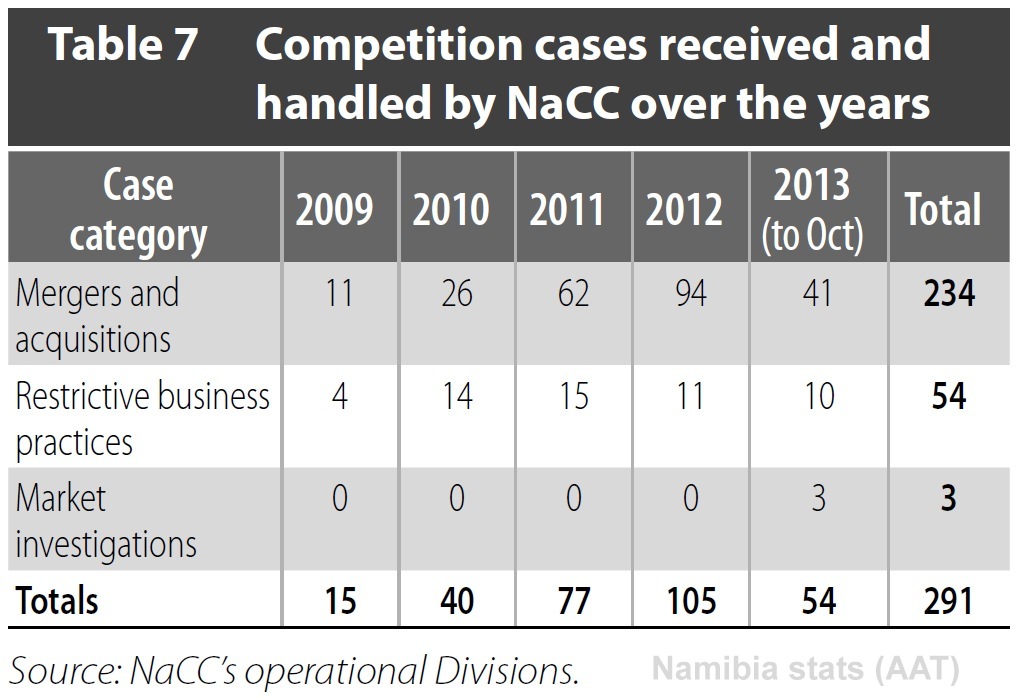
The cited Report contains two relevant statistics, showing the relatively young enforcement agency’s workload in absolute terms as well as in relative (merger vs. other enforcement work) numbers:

Namibia stats

Namibia stats comparison


Namibian merger control: 1st deal of 2014 gets conditions

namibia

Namibian Competition Commission Imposes Conditions on Mining Deal

The Namibian Competition Commission has given its first conditional approval of the year in a gold-mine transaction, imposing employment conditions that require the purchaser not to lay off any employees for a minimum of two years from the date of sale.

Unemployment concerns drive antitrust ruling

The Commission stated, per reporting on AllAfrica.com, that there were no reasons to block the deal on a lessening-of-competition grounds under section 47 of the Competition Act, but that it was “concerned about the effect of the sale on employment, hence the imposition of the above condition.”

AAT reported last year on the revision of the Namibian competition law to include consumer-protection provisions, which would allegedly bar M&A deals not only on pure antitrust grounds but also on a more broadly defined “unfairness” basis.

In the current deal, buyer Guinea Fowl Investments Twenty Six will acquire the Navachab gold mine from AngloGold Ashanti Namibia, which since last year has had gold-mining competition from one other player (B2Gold) in the domestic market.

First 2014 deal with conditions

We note that no other cleared transaction has had conditions imposed since the beginning of the calendar year, as shown by the agency’s May M&A update 2014:

Namibian NaCC approved deals as of May 2014


The Big Picture: AAT History – Maturing competition-law regimes in Africa

AAT the big picture

Below, AfricanAntitrust.com provides a brief overview of maturing antitrust jurisdictions in Africa

In the past two decades, 26 African countries implemented domestic competition law regimes, and that number continues to grow.

Many competition authorities who were previously deemed as being rather ineffective in their teething stages, have now begun to actively enforce their respective competition law provisions by launching market inquiries, prohibiting anti-competitive mergers, conducting dawn raids and becoming tough on cartel activity.

Below, we provide a short summary of some of the maturing jurisdictions on the continent (notably excluding matured ones (South Africa) as well as young regimes, including supra-national ones such as COMESA, as they arguably fall outside this definition.)

Botswana

The Competition Authority in Botswana was launched in 2011, and with 33 staff members, of which nearly half comprises economists, and the authority has already conducted more than 20 dawn raids and launched market inquiries launched into various “priority sectors” such as retail, poultry and cement. The competition authority has blocked mergers which impede the empowerment of Botswana’s citizens on the basis of public interest concerns in maintaining sufficient local shareholding in certain key markets such as health care.

Kenya

In 2011, Kenya implemented its Competition Act and now, given the new, and higher, merger filing fees, the budgetary constraints within the Competition Authority of Kenya (“CAK”) will be addressed and alleviated. The Competition Authority of Kenya announced its intention to launch investigations into claims of powerful cartels in the lucrative coffee industry in Kenya. The Competition Authority of Kenya plans to probe abuse of dominance by coffee firms, particularly in relation to marketing. In addition, the Competition Authority of Kenya has initiated an investigation into allegations of abuse of dominance by Lafarge in Kenya, which may result in Lafarge being forced to sell its stake in the East African Portland Cement Company.

Following the dawn raid conducted by the South African Competition Commission on Unilever and Sime Darby in April 2014 in relation to the edible oils industry, the CAK has launched an investigation into the edible oils market, in which local prices have been unresponsive to reductions in the cost of imported feedstock.

Namibia, Zambia & Mauritius

Both the Namibian and Mauritian competition authorities have announced their respective plans to introduce a formal corporate leniency policy to improve their cartel enforcement. In addition, the Mauritian Competition Commission will investigate whether Stage Beverages, of the Castle Group, and Phoenix Beverages Ltd have agreed to divide markets in Mauritius and Madagascar, given that the Mauritian Competition Commission has reason to believe that Stage Beverages and Phoenix Beverages have agreed that Stage Beverages will cease the manufacture and supply of beer in Mauritius, while Phoenix Beverages will do the same in Madagascar.

The Zambian competition authority has recently imposed significant penalties for price-fixing in the vehicle-repair industry. Furthermore, it has conducted dawn raids on two fertiliser companies.

AAT will continue its summaries (which we hope you find helpful in navigating the competition-law map of Africa) in its “Big Picture” series.

Namibian antitrust law revision will include consumer protection measures

namibia

As the Namibia Economist reports (via online journal AllAfrica), the revised Namibian Competition Act will include consumer protection legislation, in addition to the existing antitrust laws.

The current legislation dates back a decade to 2003 and is being overhauled (whether by the Namibian parliament or by the Commission is not entirely clear to us from the information provided).

The Namibian Competition Commission‘s head (their “CEO”, as the agency’s lead job title is formally called), Mihe Gaomab II, has reportedly stated in an interview with the publication of the country’s chamber of commerce that the revised law will contain new “enabling provisions on consumer rights“, e.g., regarding affordable pricing, fair promotion or advertising, contractual arrangements, and “shelving the right goods at the right place” (whatever that may mean in practice).  He is quoted as emphasizing the “enforcement of competition policy and law” not only with respect to “market failures associated with a substantial reduction of competition”, but also “addressing certain aspects … which are consumer protection related such as unfair deals and lack of information disclosures on consumers.”

We at AfricanAntitrust.com are keen to see the proposed revisions in writing, as much as we are eager to learn how “unfair deals” for consumers are going to be defined in the NCC’s enforcement practice.