On 28 September 2016, the South African Competition Commission (SACC) conducted a further set of dawn raids. This time, on various cargo shipping liners based in the provinces of Kwa-Zulu Natal and the Western Cape.
The SACC indicated that “Hamburg Sud South Africa (Pty) Ltd, Maersk South Africa (Pty) Ltd, Safmarine (Pty) Ltd, Mediterranean Shipping Company (Pty) Ltd, Pacific International Line South Africa (Pty) Ltd and CMA CGM Shipping Agencies South Africa (Pty) Ltd have engaged in collusive practices to, inter alia, fix the incremental rates for the shipment of cargo from Asia to South Africa in contravention of the Competition Act”.
The investigation is allegedly a result of a complaint received from a member of public.
The SACC has not provided an indication of the period over which conduct took place and whether this investigation relates to historical or on-going conduct. This is an important consideration in light of the introduction of criminalisation of cartel conduct, which came into effect as of 1 May 2016. In terms of the Section 73A of the Competition Amendment Act, any director or person with management authority may be held criminally liable for ‘causing’ or ‘knowingly acquiescing’ in cartel conduct.
Since the notion of criminal liability was put raised as far back as 2008, there have been substantial concerns raised about the effectiveness of the SACC’s corporate leniency policy which in effect, offers immunity to a company who whistle blows, from an administrative penalty only. The CLP does not offer immunity to any individual from criminal prosecution, as the discretion to prosecute an individual under Section 73A, rests solely with the National Prosecuting Authority.
The interplay between the introduction of criminal liability and dawn raids will, in our view, be quite significant as there have been a number of respondents who have thought to approach the SACC for leniency, off the back of a dawn raid. A decision which a company may think twice about if its directors may potentially be held criminally liable.
Regardless of the impact which the criminalisation of cartel conduct may have on the whistleblowing regime, the SACC remains committed to utilising dawn raids as one of its most powerful investigative tools.
The SACC has been strong proponent of dawn raids and despite having conducted its first dawn raids in the early 2000’s, the past 18 months has seen a marked spike in the number of dawn raids conducted across a broad range of sectors.
The shipping industry in particular has been the subject of significant attention from the South African Competition Authorities and last year saw substantial administrative penalties, of over R95 million, levied by way of a settlement agreement on WWL and NYK Shipping Liners respectively for having engaged cartel conduct in relation to certain shipping routes. This investigation, however, remains on-going.
The Competition Commission and South African steel producer, ArcelorMittal South Africa Limited (ArcelorMittal), have agreed to settle six complaints against ArcelorMittal for R1.5 billion (approximately US$ 112 million), in what is the largest (agreed) administrative penalty imposed in South Africa.
The penalty (by consent order) represents just under 5% of ArcelorMittal total turnover (including chemicals) for 2015.
The allegations which were brought against ArcelorMittal included allegations of price fixing and market allocation in what was termed by the Competition Commission the “steel cartel”.
In terms of the settlement agreement, ArcelorMittal admitted to contravening section 4(1)(b) of the Competition Act and will pay not less than R300 million per annum for five years from 2017. Furthermore, ArcelorMittal has undertaken to invest approximately R4.6 million into the South African economy for the next 5 years (provided the prevailing economic conditions render such investment feasible). Interest will be charged on the outstanding amount, interest starting to run 17 months after the finalisation of the settlement agreement.
In addition to the cartel conduct, the Commission had also instituted a complaint alleging the dominant steel manufacturer had engaged in excessive pricing. Although ArcelorMittal did not admit to wrongdoing in relation to the abuse of dominance allegation, the parties nevertheless agree that ArcelorMittal would not generate earnings before interest and tax of over 10% for the next 5 years (subject to certain exceptions).
The Competition Commission’s press release states the following:
ArcelorMittal admits that it engaged in collusion with CISCO, Scaw and Cape Gate by fixing prices and discounts, allocating customers and sharing commercially sensitive information in the market for the manufacture of long steel products, in contravention of the Competition Act. ArcelorMittal also admits that it fixed the purchased price of scrap metal with Columbus Steel, Cape Gate and Scaw. In respect of the flat steel complaint and the Barnes Fencing complaints, ArcelorMittal admits the conduct as alleged by the Commission but does not admit that this conduct constituted a contravention of the Competition Act. In relation to the pricing complaint, ArcelorMittal does not admit that it acted in contravention of the Competition Act.
The investigation and settlement agreement follows a leniency application brought by another respondent, Scaw Metals. There is little doubt that the Competition Commission’s corporate leniency policy has permitted the Commission to uncover and successfully prosecute a number of cartels. As previously reported on AAT, the risk remains that the recent introduction of criminal liability (on directors or persons having management authority) for engaging in cartel conduct, may dampen the use of the whistle-blower regime (absent any formal immunity from criminal prosecutions).
The settlement agreement does, however, bring finality to all six cases against ArcelorMittal.
In light of the very recent civil damages awarded in favour of Nationwide Airlines against South African Airways for abuse of dominance which led to loss of profits, it will be interesting to see whether any civil party elects to prosecute ArcelorMittal for the excessive pricing complaint. In terms of the South African Competition Act and a recent judgment by the Supreme Court of Appeal, it appears as if the door is closed on a civil litigant brining a civil damages claim against a respondent, based on a breach of the competition Act, if there has been no adverse finding made against such a respondent by the Competition Tribunal (or Competition Appeal Court) as per section 65 of the Competition Act.
The admission to having engaged in cartel conduct, may, however, expose ArcelorMittal to civil liability over and above the settlement agreement.
The Kenyan antitrust authority, CAK, recently closed its investigation into a classic price-fixing cartel involving the Outdoor Advertisers Association, resulting in a fine of Sh11.64 million (approx. $120,000) imposed on domestic advertising firms for fixing minimum prices of billboard space, reports the Kenya Gazette. The affected companies include Magnate Ventures Limited (Sh5 million), A1 Outdoor Limited (Sh114,000), Live Ad Limited (Sh2.5 million) and Adsite Limited (Sh2.39 million), while four others had already settled with CAK previously (Consumer Link (Sh1.2 million), Look Media (Sh136,000), Firm Bridge Limited (Sh246,400) and Spellman Walkers Limited (Sh45,180)). The remaining four trade association members will be fined forthwith.
Notes Andreas Stargard, a competition practitioner with Primerio Ltd., “[i]n this case — which really represents a classic minimum-price fixing arrangement among trade association members — the billboard owners agreed during a period of less than one year to set a minimum monthly price of Sh160,000 in large Kenyan markets, such as Nairobi. Interestingly, they price-discriminated geographically within their cartel arrangement and fixed the corresponding fees in smaller markets at a slightly lower amount.”
The head of the CAK, Director-GeneralWang’ombe Kariuki, lamented that a trade group was being used to manipulate an otherwise competitive process of market forces yielding market prices, which he believed are approximately 20 to 25% lower than the fixed rates, based on post-investigation pricing. Says Stargard:
“It is interesting to see that the CAK has already followed up on this matter and has noticed an arguably direct empirical result, yielding a beneficial effect of a not insignificant price reduction in advertising costs in Nairobi.”
Zambia: New Penalty Guidelines may Incentivise Firms to Apply for Leniency
By AAT Senior Contributor, Michael-James Currie.
At the recent International Competition Network conference held in Singapore, the International Competition Network (ICN), in conjunction with the World Bank, named the Zambian Competition and Consumer Protection Commission (CCPC) as one of the best Competition Authorities in advocating competition in key domestic markets.
The CCPC, as a competition agency, is making significant strides to ensure that the Zambian market is competitive to ensure greater consumer benefit.
In particular, the CCPC has, in recent years, strengthened its efforts to detect cartel conduct. This includes carrying out search and seizure operations, initiating investigations and introducing a corporate leniency policy (Zambian CLP) for whistle-blowers.
The Zambian CLP affords a firm who has engaged in cartel conduct, who is ‘first through the door’ in disclosing the cartel and who provides the CCPC with sufficient evidence to prosecute the cartel total immunity from an administrative penalty.
Unlike its South African counter-part, the Zambian CLP also caters for a ‘leniency plus’ whereby the ‘second through the door’ may qualify for up to a 50% reduction in respect of a potential administrative penalty.
In spite of leniency policies being regarded as arguably the most effective tool by which competition agencies detect and prosecute cartel conduct, we are not aware of the CCPC having yet received an application in terms of its CLP (as at March the CPCC had confirmed that it had not yet received such an application).
The reluctance by firms to come forward and expose cartel conduct in Zambia may be due to the fact that the Zambian CLP only extends immunity in respect of administrative liability and does not protect a whistle-blower from potential criminal or civil liability.
Despite the lack of success which the Zambian CLP has achieved thus far, the policy has only been in effect for just over a year. Furthermore, the CCPC has strengthened its efforts in initiating and concluding investigations in various sectors (which includes the stockbroker, frozen fish and milling industries, the latter of which is still on-going).
Accordingly, and in light of the recently published Draft Guidelines for the Issuance of Fines (Guidelines) (now for public comment), there may well be more activity in so far as the CLP is concerned.
The Guidelines are clear in that administrative penalties should be punitive and should have a sufficient deterrent effect. The CCPC has expressly stated that it does not want administrative penalties to merely be considered as a ‘cost of doing business’ in Zambia.
Unsurprisingly, the Guidelines confirm that in respect of cartel conduct, “the fines to be imposed will be the highest due to the seriousness of the conduct”. Furthermore, the Guidelines state that “preceding such fines may be conviction for criminal culpability by a Court of Competent jurisdiction”.
In terms of the Competition and Consumer Protection Act (the “Act”), a firm’s potential liability is capped at 10% of its turnover derived within or from Zambia (similar to the EU’s 10% turnover cap), although the implementation of this cap is uncertain as we indicate below.
The Guidelines state that the 10% cap should be based on the latest audited financial years. While the CCPC will accept management accounts in certain circumstances, it should be noted that the CCPC will add 5% to the total as reflected in the management accounts.
Importantly, while the Guidelines recognise that an administrative penalty may be adjusted depending on aggravating or mitigating circumstances, the Guidelines provide, as a starting point, a ‘base fine’ which will be calculated in accordance with the nature of the contravention. We set these out below.
Base (%)
Conduct
7
Cartels
4
Resale Price Maintenance
4
Abuse of Dominance
3
Mergers
5
Restrictive Business Practices
John Oxenham, an African competition law practitioner, notes that the ‘base fine’ is “calculated utilising a firm’s aggregated turnover generated in or from Zambia, irrespective of the relevant market. In other words, the CCPC considers a firm’s total turnover in Zambia as the affected turnover, which can cause fines to mushroom in the case of diversified conglomerates with large revenues even where the affected, cartelised product market is de minimis.”
Importantly, in relation to prohibited horizontal or vertical conduct, the CCPC will impose a fine based on each year in which the parties contravened the Act, up to a maximum of five years. While the Guidelines as noted above, expressly state that the total penalty will be capped at the statutory cap of 10%. In light of the fact that the base fines start at 4% (which would in any evet exceed the statutory cap after only 2.5 years) it seems that the CCPC is of the view that each year in which a firm engaged in cartel conduct should be viewed as a separate contravention (i.e. that the statutory cap only applies per contravention). This will need to be clarified as a firm who is found to have engaged in anti-competitive conduct (including vertical restrictive practices) may be subjected to an exorbitant administrative fine.
It remains to be seen whether the significant administrative liabilities which is contemplated in terms of the Guidelines is indeed permissible and in accordance with the Act, and secondly, whether it will incentivise firms to take advantage of the CLP.
Price-fixing in Kenya is prohibited under the Competition Act No. 12 of 2010 under Section 21 (3) (a) which provides that any agreements, decisions or concerted practices which directly or indirectly fix purchase or selling prices or any other trading condition is prohibited under the Act, unless they are exempt in accordance with the provisions of Section D of Part III.
Part III B further prohibits price-fixing by trade associations under Section 22 (b) (i) which provides that the making, indirectly or directly, of a recommendation by a trade association to its members or to any class of its members which relates to the prices charged, or to be charged by such members, or to any class of members, or to the margins included in the prices, or to the pricing formula used in the calculation of those prices, constitutes a restrictive trade practice under the Act.
Section 29 (1) of the Act further outlines the rules for exemptions in respect of professional associations. It provides that a professional association whose rules contain a restriction that has the effect of preventing, distorting or lessening competition in a market must apply in writing or in the prescribed manner to the Competition Authority for an exemption. Sub-section (2) goes on to explain what factors the Authority considers in order to grant an exemption for a specified period. These include:
Maintenance of professional standards
Maintenance of the ordinary functioning of the profession
Internationally applied norms
Section 29 (5) further gives discretion to the Authority to revoke an exemption in respect of such rules or the relevant part of the rules, at any time, if the Authority considers that any rules, either wholly or in part, should no longer be exempt under this section. For instance, if they no longer promote consumer welfare or do not enhance standards in the profession.
Price setting concerns by Law Society of Kenya, LSK
Professional fees for advocates in Kenya are set by the Chief Justice under the Advocates Act Chapter 16 of the Laws of Kenya. Part IX Section 44 provides that the Chief Justice may by order prescribe and regulate in such manner as he/she thinks fit the remuneration of advocates in respect of all professional business, whether contentious or non-contentious. Sub-section (2) also provides that the Chief Justice may prescribe a scale of rates of commission or percentage in respect of non-contentious business.
However, Section 45 provides that agreements in respect of remuneration may be made between the advocate and the client subject to permissible professional rules under section 46 of the Act. Therefore, as much as the Chief Justice may set professional fees under the Act, there is an opportunity for the advocate and the client to agree on professional fees subject to the Act. Moreover, a client has redress to apply to the courts under Section 45 (2) to set aside or vary such an agreement on grounds that it is harsh, unconscionable, exorbitant or unreasonable according to professional practice. The decision of the court on this matter is final.
The Chief Justice periodically revises the Advocates Remuneration Order which sets out the scale of professional legal fees. In doing so the Chief Justice considers factors such as inflation and the costs of providing legal fees. The Kenyan Advocates Remuneration Order was last revised upwards in 2014, increasing professional fees by 50%. The Order was last revised in 1997. Advocates had petitioned the Chief Justice to do so in order to enable them cope with tough economic conditions. Recently there was a public discourse on whether advocates should have set fees. Stakeholders argue that the Chief Justice’s decision to adjust fees may not be entirely objective because since he or she has qualifications in law, and could revert to the profession upon retirement from office.
LSK on the other had contends that the minimum fees help protect consumers from poor services, and it reduces the price wars that would occur without the scale of fees. Under the Advocates Act, charging below the set scale of fees amounts to undercutting. This is a professional offense that could result in the concerned advocate being suspended or struck off the roll. Moreover, any agreements or instruments prepared by the concerned advocate are liable to be invalidated by the courts.
The question arose among legal stakeholders as to whether the Authority could intervene in relation to the scale of professional fees under the provisions on price-fixing. The LSK chairperson recently commented that it is beyond the jurisdiction of the Authority, as the Remuneration Order seeks to set minimum fees and not a fixed rate. However, it is clear from the provisions of Section 29 that any professional body whose rules, having regard to internationally applied standards, contain any restrictions which have the effect of preventing or substantially lessening competition in a market, must apply to the Competition Authority for an exemption of the said rules.
Price Setting Concerns by Association of Kenya Reinsurers, AKR
The Association of Kenya Reinsurers is regulated by the Kenya Reinsurance Corporation Limited Act, Cap 487A of the Laws of Kenya. The Association consists of the following companies: Kenya Reinsurance Corporation Limited, Africa Reinsurance Corporation Limited, East Africa Reinsurance Company, Zep – Re and Continental Reinsurance Limited. The Authority recently investigated this association for price fixing following a complaint lodged from the National Intelligence Service (NIS). The association, through a circular dated 2, October 2013, had advised its members on the minimum applicable premiums upon renewal of NIS Group Life Scheme for 2013/2014. Insurance companies are required by their regulator Insurance Regulatory Authority (IRA) to use an independent actuary to come up with their own individual premium rates, which they file with the IRA for approval.
The association is required under the Competition Act Section 29 (1) to apply in the prescribed manner to the Authority for an exemption in relation to any anti-competitive rules. Section 22 (2) (b) also prohibits the making, directly or indirectly, of a recommendation by a trade association to its members, or to any class of its members which relates to the prices charged, or to be charged by such members, or any such class of members, or to the margins included in the prices, or to the prices, or to the pricing formula used in the calculation of those prices. Therefore, the Association is legally bound to seek the approval of the Authority in order to set a minimum fee for any particular group of consumers. Moreover, the association may be in violation of Section 21 (f) of the Competition Act which prohibits any decisions by associations of undertakings which applies dissimilar conditions to equivalent transactions with other trading parties, thereby placing them at a competitive disadvantage, unless they are exempt in accordance with the provisions of Section D of Part III.
Conclusion
In conclusion, professional associations in Kenya should take advantage of the provisions of Section 29 of the Competition Act which allow professional associations to apply rules whose effect is the lessening of competition in the market, provided they are applied to enhance professional standards, the ordinary functioning of the profession or internationally applied norms for the benefit of consumers.
Price-fixers face up to 10 years prison time, starting May 1st
Prison time for executives is now firmly on the not-so-distant horizon in South Africa: As reported in some media outlets, the criminalisation of certain hard-core (and possibly lesser) antitrust offences is finally being implemented in the Republic — notably after more than 8 years of the relevant legislation technically being on the books.
We are referring to the “phased” implementation of the 2009 Competition Amendment Act. The legislation technically criminalised hard-core antitrust offences such as bid-rigging or price-fixing cartels. However, President Zuma has, until now, not yet implemented or effectively signed the criminal provision of the Act (section 73A) into law.
Enter his Economic Development Minister,Ebrahim Patel:
According to news reports, Mr. Patel announced today (Thursday), that the criminalisation of the price-fixing cartel offence would henceforth be enforced. Section 73A will be gazetted tomorrow, 22 April 2016, and hold the force of law from 1 May 2016. BDLive also reports that even the lesser “abuse of dominance” (or more commonly “monopolisation”) offence would be subject to the criminal penalties, but AAT is awaiting independent confirmation on this subject. As Andreas Stargard, a U.S.-based Pr1merioantitrust practitioner with a focus on Africa and experience counseling clients in criminal competition matters, explains:
“If Mr. Patel indeed made this statement, and I doubt this, it would signal a departure from the rest of the world’s antitrust regimes: It is highly uncommon to have the monopolisation offence constitute a criminal act — indeed I am aware of no jurisdiction where this is the case.
In the United States, the only conduct constituting a Sherman Act offence pursued by the DOJ as a potential felony involve so-called ‘hard-core’ violations. This would include horizontal price-fixing among competitors; territorial allocations; output allocations; and bid-rigging. The same holds true in the UK. That said, monopolisation or abuse of dominance is simply not among the criminalised antitrust violations elsewhere, and I’d be surprised if South Africa took this unusual path.“
We have since been able to confirm that the BDLive report incorrectly refers to abuse of dominance as being criminalised. AAT has obtained a copy of Mr Patel’s speech which provides clearly only for cartel conduct to be subjected to imprisonment:
“We are confident that because our work on cartels over the past five years has given clarity in the market on what collusion entails and what kind of acts falls within prohibited practices, we can now step up our efforts to the next level in our endeavor to combat corruption, cartels and anti-competitive conduct that raise prices and keep businesses and new entrants out of local markets.
Accordingly, government will tomorrow gazette a Presidential Proclamation that brings into effect certain sections of the Competition Amendment Act, with effect from 1 May 2016, which make it a criminal offence for directors or managers of a firm to collude with their competitors to fix prices, divide markets among themselves or collude in tenders or to acquiesce in collusion and they expose themselves to time in jail if convicted.”
The Patel announcements come ahead of his upcoming budget vote speech, and as he has shown in recent months, Mr. Patel is a proud advocate for tougher competition enforcement in the country. “We want to make sure that it just does not make sense to collude,” he is reported as saying today. This follows the Minister’s speech during the Parliament debate in February, where he announced that, “we will now introduce measures shortly to make it a criminal offence in any industry to collude and fix-prices. It will send a message to everyone that we mean business on stamping out corruption and collusion. We must build competitive strengths through innovation, not through sitting in rooms somewhere fixing tenders, prices and contracts.”
White-collar crime: it pays, but is getting riskier
We live in the era of the PanamaPapers, where the notion of white-collar business people going to jail is not an entirely unlikely outcome for some. Antitrust offences, however, have historically not been enforced worldwide as stringently as public corruption or tax-evasion matters, for instance. Key jurisdictions with criminalisation of competition offences remain few, notably the U.S. and the UK.
In South Africa, since at least 2014, both Competition Commissioner Tembinkosi Bonakele and Minister Patel have been engaging in discussions on how and when to implement the Act “to ensure that the necessary institutional capacity is available to apply the [criminal] amendments.” While some provisions (relating to the agency’s market-inquiry powers) went into effect in 2013, the criminalisation provisions remain unimplemented to date — but this is about to change.
During these negotiations, as reported on AAT, the minister and SACC admitted in a remarkable self-assessment that the Commission then lacked “the institutional capacity needed to comply with the higher burden of proof in criminal cases.” One notable aspect of potential discord lies in not only in the different standard of proof in civil vs. criminal matters (“more probable than not” vs. “beyond a reasonable doubt”), but perhaps more importantly can be found on the procedural side, preventing rapid implementation of the law: There has been historic friction between various elements of the RSA’s police forces and (special) prosecutorial services, and the power to prosecute crimes notably remains within the hands of the National Prosecuting Authority, supported in its investigations by the South African Police Service.
History & Legislative Background – and a bit of Advice from the U.S.
Starting in the spring and summer of 2008, the rumoured legislative clamp-down on corrupt & anti-competitive business practices by the government made the RSA business papers’ headlines.
During a presentation Mr. Stargard gave at a Johannesburg conference in September that year (“Criminalising Competition Law: A New Era of ‘Antitrust with Teeth’ in South Africa? Lessons Learned from the U.S. Perspective“), he quoted a few highlights among them, such as “Competition Bill to Pave Way for Criminal Liability”, “Tough on directors”, “Criminalisation of directors by far most controversial”, “Bosses Must Pay Fines Themselves”, “Likely to give rise to constitutional challenges”, and “Disqualification from directorships … very career limiting”.
Stargard, whose practice includes criminal and civil antitrust work, having represented South African Airways in the global “Air Cargo Cartel” investigations, also notes that international best-practice recommendations all highlight the positive effect of criminal antitrust penalties. For example, the OECD’s Hard-Core Cartel Report recommended that governments consider the introduction and imposition of criminal antitrust sanctions against individuals to enhance deterrence and incentives to cooperate through leniency programmes. Then-DOJ antitrust chief Tom Barnett said in 2008, the year South Africa introduced its legislation: “Jail time creates the most effective, necessary deterrent. … [N]othing in our enforcement arsenal has as great a deterrent as the threat of substantial jail time in a United States prison, either as a result of a criminal trial or a guilty plea.”
Mr. Stargard points out the following recommendations to serve as guide-posts for the Commission going forward in its “new era” of criminal enforcement:
Cornerstones of a successful criminal antitrust regime
Crystal-clear demarcation of criminal vs. civil conduct
Highly effective leniency policy also applies to individuals
Standard of proof must be met beyond a reasonable doubt
No blanket liability for negligent directors – only actors liable
Plea bargaining to be used as an effective tool to reduce sentence
Clear pronouncements by enforcement agency to help counsel predict outcomes
What lies ahead?
After 1 May, the penalties for violating Section 73A of the Competition Amendment Act will range from a period of up to 10 years in prison and/or a fine of up to R500 000.00. It appears that the introduction of criminal provisions will not have a retrospective effect, but will only apply prospectively from 1 May 2016 onward.
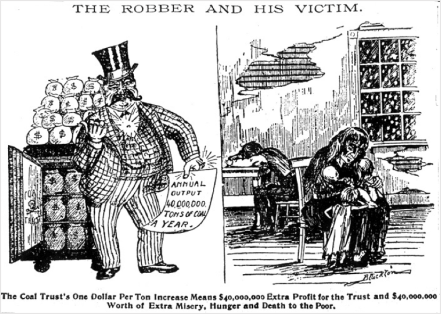
Robber barons…
The introduction of criminal sanctions for cartel conduct raise several constitutional concerns. It is likely that, in the event of the imposition of criminal sanctions, the constitutional validity of the relevant Competition Amendment Act provisions will be challenged. In particular, section 73A(5) of the Amendment Act, introduces a reverse onus on the accused, in that the onus for rebutting the Competition Tribunal of Competition Appeal Court’s conclusion rests with the accused in criminal proceedings. The reverse onus’ constitutional validity is questionable given the constitutional right to a fair trial and the right to be presumed innocent.
John Oxenham, also with Pr1merio, notes that the “criminalisation of cartel conduct is a development which needs to be carefully considered and well planned before its official introduction due to the imminent effects it will have on current South African competition law.” The successful prosecution of cartel conduct rests heavily on the efficiency of corporate leniency policies. The introduction of criminal sanctions and in turn the National Prosecuting Authority will undoubtedly have an effect on the current corporate leniency policies. It is important to consider granting the staff of a company applying for corporate leniency in relation to cartel activity ‘full immunity’ from criminal prosecution in order to encourage companies to come forward and not debilitate the very purpose of corporate leniency policies. The careful integration of criminal sanctions is therefore vital in ensuring that the very purpose of its introduction, namely to deter corruption and anti-competitive conduct, is achieved.
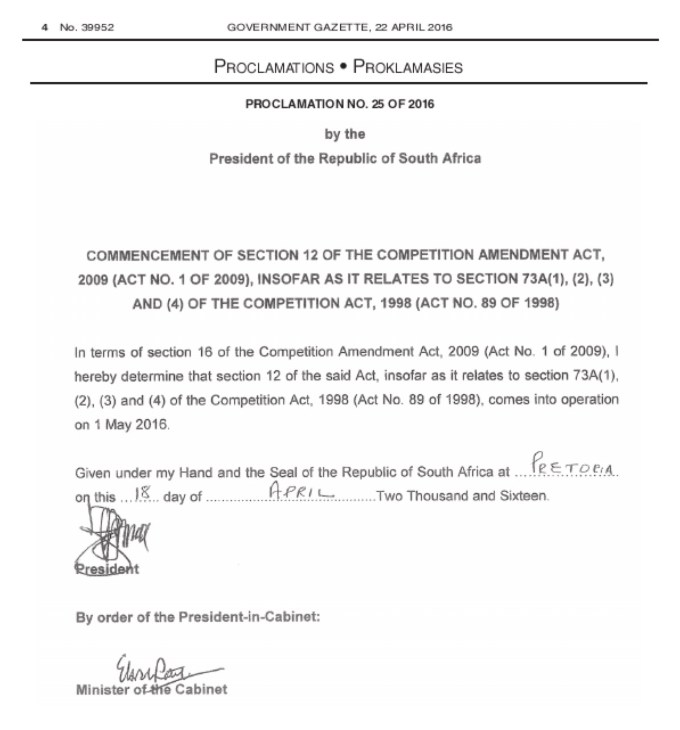
Update [22 April 2016]: As anticipated, the South African government gazetted [published] the official document starting the era of criminal antitrust enforcement under section 73A as of today, signed 18 April 2016:
March 2016 has been a busy month for the competition agencies of South Africa and Kenya respectively. Both agencies carried out search and seizure operations as a result of alleged collusion within various sectors of the economy. While the March dawn raids are not connected, the South African Competition Authority, as part of its advocacy outreach, provided training to the Competition Authority of Kenya relating to inter alia, search and seizure operations.
South Africa
On 23 March 2016, the South African Competition Commission carried out search and seizure operations in the automotive glass fitment industry, as part of its continued investigation into alleged collusion within this sector.
Accordingy to the SACC, the raid was carried out “at the Gauteng premises of PG Glass, Glasfit, Shatterprufe and Digicall as part of its investigation of alleged collusion. PG Glass and Glasfit are automotive glass fitment and repair service providers; Shatterprufe supplies PG Glass and Glasfit with automotive glass while Digicall processes and administers automotive glass related insurance claims on behalf of PG Glass and Glasfit.”
John Oxenham, founding director of Pr1merio, notes that “[t]his most recent dawn raid follows on from those carried out towards the latter part of 2014 and 2015 and confirms that the SACC has adopted a more robust approach to investigating alleged anti-competitive practices.” In this regard, Commissioner, Tembinkosi Bonakele, confirmed at the 9th Annual Competition, Law, Economics and Policy Conference in November last year that the Competition Commission has in the past two years, “conducted more dawn raids than those conducted in preceding years since the Competition Commission came into existence” (nearly 16 years ago).
For an overview of dawn raids and cartel investigations in South Africa, please see the following GCR Article.
Kenya
This month the Competition Authority of Kenya (“CAK”) conducted its first dawn raid. The search and seizure operations were carried out in respect of two fertiliser firms, Mea Limited and the Yara East Africa, based on the CAK’s suspicion of price fixing occurring between these two firms, who together control approximately 60% of the fertiliser market. The CAK conducted the raid in accordance with Section 32 of the Competition Act, 2011 which provides for the Authority to enter any premises in which persons are believed to be in possession of relevant information and documents and inspect the premises and any goods, documents and records situated thereon. This follows an inquiry which was launched last year by Kenyan competition authorities into what the CAK termed “powerful trade associations exhibiting cartel-like behaviour specifically targeting banks, microfinance institutions, forex bureaus, capital markets as well as the agricultural and insurance lobbies”. The fact that the CAK has carried out its first dawn raid demonstrates its growing stature.
The fertiliser industry appears to be a priority sector for a number of African jurisdictions as the CAK’s investigation into this sector follows the South African Competition Commission’s investigation into the fertiliser industry (which resulted in a referral before to the South African Competition Tribunal for adjudication some years back). In this regard,the South African Competition Commission’s spokesperson stated that the “fertiliser sector is viewed as a priority sector, due to the its importance as an input in the agricultural sector” (as reported here on African antitrust)
Zambia
Interestingly, the Zambian Competition and Consumer Protection Commission (“CCPC”) had, in 2012, conducted dawn raids at the premises of two fertiliser companies, as a result of alleged collusion within the industry.
On a Path to Harmonisation?
While there are a number of practical and legislative hurdles to effectively carrying out cross border search and seizure operations, it appears that cross border investigations may not be too far off. This is particularly so as the various agencies within the Southern African Region have identified similar priority sectors (as evidenced by both the investigations into the fertiliser sectors as well as the various market inquiries into the grocery retail sector).
Uber Africa: Increased competitiveness not a boon for entrenched monopolies
Continuing our AAT multi-part series on innovation & antitrust we turn once again to the ubiquitous “Sharing Economy” we are witnessing not only in the United States and Europe but also on the African continent…
“The taxi industry is in the midst of a crisis. Once protected by a regulated monopoly of the commercial passenger motor vehicle transportation market, the industry now faces increasing competition from a new type of transportation service—ride-sharing. The emergence of companies like Uber, the most successful ride-sharing company, threatens to eliminate the taxi industry’s stronghold on the ground transportation market and possibly the industry itself.” (Erica Taschler, Institute for Consumer Antitrust Studies, in “A Crumbling Monopoly: The Rise of Uber and the Taxi Industry’s Struggle to Survive“)
Today, the Taxi Cab Association of Kenya announced protests against the “unfair competition” its members face from ride-sharing giant Uber, according to the organisation’s chairman, Josphat Olila. This is no news for folks in London, Brussels, Hamburg, or Washington — places where the taxi-medallion-capped brethren of Nairobi’s cabbies have all long ago gone through the protest phase against the rising tide of the “new economy’s” novel way of hailing cars. Examples abound, and all involve more or less refined antitrust arguments.
Andreas Stargard, an attorney with Africa competition advisors Primerio, sums it up as follows: “The pro-competitive notion of innovation-plus-price competition is perhaps best understood by looking at the views of two leading antitrust agencies, the FTC and the European Commission. Both have articulated simple and sound arguments for striking the right balance between regulatory limits for the protection of passengers, as well as allowing innovative technologies to enhance the competitive landscape and thereby increasing transportation options for riders. In antitrust law, more options usually equal better outcomes.”
U.S.
Here is what the U.S. Federal Trade Commission had to say in 2013 about the D.C. taxi commission’s ‘unfair competition’ argument against ride-sharing services:
“The staff comments recommend that DCTC avoid unwarranted regulatory restrictions on competition, and that any regulations should be no broader than necessary to address legitimate public safety and consumer protection concerns. … [T]he comments recommend that DCTC allow for flexibility and experimentation and avoid unnecessarily limiting how consumers can obtain taxis.”
Crucially, the Kenyan cabbies’ argument that Uber should be banned is based on price competition from Uber’s lower fares. One of the main tenets of competition law is: lower prices are good for consumers (in general), as long as service quality remains the same. With Uber in the mix, quality arguably increases beyond the sad status quo of smelly and difficult-to-hail cabs: for one, users now are able to know when and where their car arrives, quality control via Uber’s policies and check-ups is available, convenient electronic billing & dispute resolution exists, etc.
Let’s go back to the FTC’s public comments and see their take:
“Competition and consumer protection naturally complement and mutually reinforce each other, to the benefit of consumers. Consumers benefit from market competition, which creates incentives for producers to be innovative and responsive to consumer preferences with respect to price, quality, and other product and service characteristics. As the U.S. Supreme Court has recognized, the benefits of competition go beyond lower prices: ‘The assumption that competition is the best method of allocating resources in a free market recognizes that all elements of a bargain – quality, service, safety, and durability – and not just the immediate cost, are favorably affected by the free opportunity to select among alternative offers’.”
EU DG COMP
Former Competition Commissioner Neelie Kroes would agree wholeheartedly with the above, and indeed said in 2014 that she was “outraged at the decision by a Brussels court to ban Uber.” In her personal op-ed piece, published on the EU Commission’s web site under the catchy title “Crazy court decision to ban Uber in Brussels“, she poignantly had this to tell the Belgian Mobility Minister who signed off on the Uber ban:
“This decision is not about protecting or helping passengers – it’s about protecting a taxi cartel. The relevant Brussels Regional Minister is Brigitte Grouwels. Her title is “Mobility Minister”. Maybe it should be “anti-Mobility Minister”. She is even proud of the fact that she is stopping this innovation. It isn’t protecting jobs Madame, it is just annoying people!”
We wonder what would happen if Neelie Kroes were Kenyan government minister…
Kenya: Keep prices high and ‘foreign’ competition out?
The Kenyan Taxi Association does not see it that way, just like its D.C. counterpart did not some 3 years ago. However, D.C.’s streets are still full of old-fashioned cabs, and Uber — while popular — is still far from blowing out the light shone by the once-prized cabbie medallions…
Still, the Kenyan association claims that between 4,000 and up to 15,000 taxi drivers face job extinction due to lower prices charged by Uber, which has been active in Nairobi since the beginning of 2015. Again, the “lower price” argument is a red herring under even the most basic application of competition economics, which shows that innovation-based price competition is ultimately pro-competitive and good not only for the end consumer but also the industry’s development as a whole.
The Kenyan taxi-cab organisation not only claims that the livelihoods of its members are at stake, but also “questioned the protocols followed by the foreign investors behind Uber, saying they were not consulted before the service provider entered the market,” according to an article in the Kenyan Daily Nation. The association’s spokesman is quoted as saying: “We have loans to service, families to feed, children to educate and other responsibilities to cater for and we are not ready to leave the transport industry to a foreigner and render [ourselves] jobless while we are in a democratic republic.”
So in the end, the ‘unfair taxi competition’ argument devolves into xenophobia and mistrust. Sadder yet, Kenya’s Uber fight has now taken a violent turn: Yesterday, an Interior Ministry spokesman said that there had been reports of attacks on Uber drivers, which are being investigated.
AAT of course deplores the resort to violence and trusts that neither it nor the upcoming protests will impede the progress of competitiveness in Kenya, a country that otherwise prides itself on encouraging competition (see CNBC Africa video on “East African competitiveness”). The sole glimmer of hope we see consists of the closing line of the Daily Nation piece, which notes that “[t]he drivers have also promised to come up with their own version of Uber to connect taxi drivers in the country.” That is what innovation is all about: Uber innovates, others copy (be it Lyft or the Kenyan cabbies), and everyone is better off in the final analysis.
South Africa is in the midst of one of the worst droughts in decades. The droughts impact stretches far broader than simply grass roots levels. Maize prices have recently reached a record high due to shortage of supply over the past 12 months, which, being a staple food source for the majority of the population..
It comes as no surprise that the drought has sparked interest of the competition authorities or those wanting to use competition law as a means to promote and protect socio-economic goals.
The recent matter involving alleged price-fixing and collusion between a number of fertiliser companies (including the H Pistorius and Co. company which has strong family ties to convicted former Para-Olympian champion, Oscar Pistorius – previously reported by AAT) will be heard before the Tribunal in a month’s time. Despite the matter laying dormant for some time, the Commission appears intent on prosecuting the respondents. The Commission’s spokesperson stated that the fertiliser sector is viewed as a priority sector, due to the its importance as an input in the agricultural sector. The case will undoubtedly receive additional media attention due to the heightened focus on the agricultural industry brought about by the drought, as well of course from an atmospheric perspective given the Oscar Pistorius link.
Unrelated to the fertiliser case, the Congress of South African Trade Unions (COSATU) has recently called on the Commission to investigate the maize sector for collusion. This call follows an investigation which was already carried out during 2006-2007 which saw a number of maize milling companies referred to the Tribunal for adjudication. A date for these complaint hearings has not yet been set. The complaint brought by COSATU, which must be investigated by the Commission, relates to traders who are allegedly “buying and selling maize unlawfully and manipulating the price of maize taking advantage of the shortage of supply of maize as a result of the drought”. The allegations have, however, been denied by AgriSA who insists that the price of maize has consistently being increasing from 2015 to over 50%.
Flying somewhat under the radar during the Christmas and year-end holiday season (but not under AAT’s radar), the South African Petroleum Industry Association (made up of BP, Shell, Chevron and other oil heavyweights) have sought a five-year renewal of their currently temporary holdover exemption from certain competition laws, which will expire in June 2016. The application was made on Christmas Eve 2015 under section 10(6)(a) of the Competition Act. SAPIA has not posted any news item or press release about its application on its web site to date.
SAPIA is seeking permission to allow its members to “cooperate and co-ordinate” on common industry logistics issues, as Andreas Stargard, a director with African competition-law and anti-corruption advisors Pr1merio notes.
“These include areas such as Single Buoy Mooring, port facilities, shipping, mooring, and interestingly also distribution as well as less well-defined ‘production and manufacturing plant shutdowns.'”
As Stargard observes, from an antitrust perspective, this could be of significant interest: production limitations would necessarily decrease available supply and thereby have the potential to drive up price, he notes. Under the terms of SAPIA’s application, the plant shutdowns are both scheduled and unscheduled and supposedly relate to upgrades and safety measures only, according to the application. In practice, however, such an exemption could give possibly provide the oil industry with carte blanche on competition issues and market manipulation.
In order to assuage concerns, the SAPIA members agree, in return for the exemption, that:
Competing participants in exempt agreements and practices may not share competitively sensitive information, except for the purposes described in the exemption application.
SAPIA and its members may not share information relating to setting of margins, imposition of levies and or approval of tariffs, unless required to do so by the DOE or NERSA.
The employees of any operating party who receive such information shall ensure that the information is held, maintained and used separately, confidentially and on need- to-know basis only.
The full text of the request for exemption is located here. Interested parties and the public have 20 business days to comment on the application.
 The SACC has not provided an indication of the period over which conduct took place and whether this investigation relates to historical or on-going conduct. This is an important consideration in light of the introduction of criminalisation of cartel conduct, which came into effect as of 1 May 2016. In terms of the Section 73A of the Competition Amendment Act, any director or person with management authority may be held criminally liable for ‘causing’ or ‘knowingly acquiescing’ in cartel conduct.
 Notes Andreas Stargard, a competition practitioner with
  At the recent International Competition Network conference held in Singapore, the International Competition Network (ICN), in conjunction with the World Bank, named the
  The Guidelines are clear in that administrative penalties should be punitive and should have a sufficient deterrent effect. The CCPC has expressly stated that it does not want administrative penalties to merely be considered as a ‘cost of doing business’ in Zambia.
 Professional fees for advocates in Kenya are set by the Chief Justice under the Advocates Act Chapter 16 of the Laws of Kenya. Part IX Section 44 provides that the Chief Justice may by order prescribe and regulate in such manner as he/she thinks fit the remuneration of advocates in respect of all professional business, whether contentious or non-contentious. Sub-section (2) also provides that the Chief Justice may prescribe a scale of rates of commission or percentage in respect of non-contentious business.
 We are referring to the “phased” implementation of the 2009
  According to news reports, Mr. Patel announced today (Thursday), that the criminalisation of the price-fixing cartel offence would henceforth be enforced. Section 73A will be gazetted tomorrow, 22 April 2016, and hold the force of law from 1 May 2016. BDLive also
  We live in the era of the




 Strategic Timing of Exemption Application?
 African Antitrust & Competition Law