The South African National Consumer Commission (“NCC”) recently confirmed its investigation into Shein and Temu regarding certain of the e-commerce giants’ operations in the nation. The NCC’s inquiry will assess whether Temu and Shein are complying with the Consumer Protection Act (“CPA”), with a specific focus on their marketing practices; the safety and quality of products sold; and the accuracy and fairness of their digital-market representations.
Prudence Moilwa, the NCC’s executive head, emphasised that the NCC will undertake a rigorous assessment of their compliance with the CPA, sending a clear message to the e-commerce industry that the NCC will enforce accountability.
The CPA is a strong legislative framework; however, it is increasingly tested by the rapid technological developments that shape e-commerce business models. As innovation progresses faster than regulation, the CPA’s effectiveness is limited in addressing modern consumer protection concerns. The NCC’s intention is not to discourage innovation; however, notes that innovation is expected to take place within the lawful framework.
Additionally, the NCC has expressed growing concern about Temu’s and Shein’s use of algorithms to drive consumer engagement, particularly in relation to South Africa’s Protection of Personal Information Act. The key issue is the extent to which users are adequately informed about how their data is processed and whether they meaningfully consent to such use. These concerns also relate to the platforms’ data-mining practices and the use of automated systems to determine what consumers see, interact with, and ultimately purchase. In effect, the algorithms employed by these platforms enable highly targeted marketing, which may undermine consumer choice and preference.
Overall, the investigation is a call from the NCC for the e-commerce world to practice basic transparency.
This latest action by the NCC follows closely on the South African Competition Commission (“SACC)’s separate enforcement measures related to tax compliance by Temu and Shein, which focused on alleged under-declaration of customs duties and improper import-tax structures. Together, the two investigations suggest a coordinated tightening of oversight over foreign e-commerce operators entering the South African market at scale.
The Competition Commission of South Africa (“the Commission”) released a Cost-of-Living Report (“The Report”) on 4 September 2025, setting out a structured, data-driven assessment of affordability pressures faced by South African households, with particular focus on those low-income consumers predominantly impacted by consistently high inflation rates. Its aim is to provide insights into the affordability of basic goods and services so that individuals, households, businesses, and policymakers can assess financial capacity and understand how price movements affect living standards. This is in alignment with the Presidency’s Strategic Plan that identifies tackling the high cost of living as a priority.
The current cost-of-living crisis is framed against entrenched domestic challenges, rising food, fuel and electricity prices against the backdrop of an ongoing energy crisis and interest rate increases that have lifted debt servicing costs in an environment where growth in household income has maintained the same pace.
Background and Goal of the COL Report
The COL Report stems from the Commission’s earlier Essential Food Price Monitoring(“EFPM”) programme, first published in July 2020 to track the prices of staple foods across the value chain, from farm to retail, and to analyse price transmission between producers, processors and retailers. Recognising shifting expenditure patterns and growing inequality, the Commission has expanded the scope of the EFPM, rebranding it as the COL Report. The new format retains essential food price monitoring while including those key non-food items that have a significant impact on lower income households.
As James Hodge, the chief economist at the Commission said:
“This analysis plays a crucial role in identifying the economic pressures various socio-economic groups, particularly low-income households, experience in a time of fluctuating prices and growing inequality.”[1]
The COL Report’s overarching intent is to highlight the affordability of basic goods and services in South Africa and to identify the underlying drivers of the cost-of-living crisis.
The COL Report tracks non-food necessities (e.g., electricity, water, rentals, healthcare, minibus taxi fares and petrol, funeral policies, public school fees, and internet usage costs) alongside essential food items such as pilchards, eggs, IQF chicken, brown bread, sunflower oil, maize meal. It further illustrates interest-rate effects by comparing owner’s rent as an equivalent to bond repayments on a standard mortgage. This structured monitoring enables the Commission to highlight where inflation is concentrated, where pricing appears sticky during cost reductions, and where spreads are widening.
COL Report and South African competition law
While the COL Report does not draw conclusions in respect of anticompetitive conduct, it does have notable implications for competition oversight by continuing to apply the Consumer’s International Early-Warning System (“Early-Warning System”) and evidentiary baseline for price transmission across essential value chains.[2] Several features are salient for competition law practice and policy, as drawn directly from the Report’s findings and methodology:
A broadened monitoring mandate across non-food essentials, expands the EFPM’s food focus to include electricity, water, rentals, transport, primary healthcare, funeral policies, education, and internet costs, the Commission positions itself to trackpersistent inflation drivers where administered pricing or sectoral structures may entrench affordability constraints. Assisting in the prioritisation and policy engagement across markets that shape consumer welfare, even where formal competition enforcement is not immediately implicated.
It presents clear analytical boundaries that respect competition law standards. It expressly cautions that the analysis of spreads (aggregate spread between retail and producer prices) is not an inference of anticompetitive conduct. Instead, spreads are diagnostic of price transmission and places in the chain where margins are expanding. The Commission’s reliance on the Early-Warning System underscores that the COL Report is an intelligence and monitoring tool, useful for triage and prioritisation, rather than a determinative finding of collusion or abuse. This delineation aligns with competition law’s evidentiary requirements while still highlighting areas that may merit closer scrutiny.
The Report identifies pricing patterns relevant to oversight, documenting patterns in essential staples where input costs fell or stabilised, but retail prices remained elevated. An example of this is, for instance, the discussion of eggs, sunflower oil, and maize meal, where price stickiness and widening retail margins are observed at various points. In brown bread, producer-level margins rose as wheat prices declined, and retail margins fluctuated as retailers alternated between absorbing and passing through cost movements. Such documented patterns inform areas where the Commission may, in being consistent with its mandate, monitor for potential strategic pricing behaviour over time.
The contextualisation of administered prices as structural inflation drivers, by the Report identifies evidence that electricity prices rose 68% and water prices rose 50% over the last 5 years. This is well above headline inflation and provides a policy context for sustained consumer-facing cost pressure. Although administered tariffs are not set through ordinary market dynamics, persistent increases affect downstream markets and household welfare, which are central concerns of the Commission’s broader public-interest and competition policy ecosystem.
The Report recalls that, following the Commission’s Data Services Market Inquiry in 2019, mobile data prices fell significantly in 2020 and 2021 and have remained comparatively stable. This illustrates how evidence-based monitoring and market inquiries can produce effective outcomes, a tool that the Commission may use in other sectors flagged by the COL Report.
The Report uses an interest rate lens to complement the Consumer Price Index (“CPI”) measures of housing costs, by comparing bond repayments (up 28% over the period 2022 to March 2025) with owner’s equivalent rent, shows how debt-servicing costs meaningfully diverge from CPI’s treatment of owner-occupied housing. This perspective assists competition authorities and policymakers to understand consumer budget constraints that can interact with the market.
Collectively, these features show that the COL Report is intended to guide monitoring and policy dialogue, highlight potential risk zones, without asserting contraventions and maintain an evidentiary base for any future work within the Commission’s statutory toolkit such as market inquiries.
Key Findings Highlighted in the Report
To ground the above effects in the Report’s data, the COL Report records the following notable movements over the past 5 years for the period of 2020 to March 2025:
Key non-food items:
Administered prices: Electricity up 68% and water up 50%, both outpacing headline inflation.[3]
Rentals: Actual rentals for houses and flats up 12%, well below headline inflation (28%).[4]
Primary healthcare (General Practitioners): Cumulative increase 33%, with the latest 6.6% annual rise noted against slowing general inflation.[5]
Transport: Minibus taxi fares increased sharply in mid-2022 following the petrol price spike; fares have been “sticky downwards”, though subsequent increases have trailed CPI, narrowing the gap.[6]
Funeral policies: Up 9% over the period, significantly below headline inflation.
Public education: Primary +37% and secondary +42%, both above headline inflation. [7]
Internet usage costs: Wireless +1%; wired +14%, with a notable step-up in 2022 linked to certain higher priced fibre offerings.[8]
Interest rates vs CPI housing proxy: Bond repayments +28% versus more moderate owner’s equivalent rent growth, illustrating the load from higher interest rates on household budgets.[9]
Essential foods:
Pilchards: Retail margins declined over time; early 2025 spreads narrowed to 15% as retailers showed restraint amid rising producer prices.[10]
Eggs: Producer prices fell into early 2025 but retail prices were slow to normalise; later producer-price increases reduced retail margins, with the Report monitoring recovery trajectories post-avian flu.[11]
IQF chicken: Producer prices stable and retail margins held under 40% in 2025 after earlier pressure. [12]
Brown bread: Farm-to-producer spread 77% in 2025 (above historic highs); retail margins fell to 15%, as retailers absorbed later producer increases.[13]
Sunflower oil: Producer margins settled around 25% since late 2023; retail margins elevated (40–45%) due to slow pass-through of producer-price declines.[14]
Maize meal: Producer margins rose rapidly in late 2023 after white maize price drops; retail prices increased in 2025 despite relatively stable producer prices, pushing retail margins to the high end of historic levels.
These findings supply concrete price-formation signals, where margins compress, where they expand, and how quickly costs are transmitted, which are central to the Commission’s ongoing monitoring orientation.
In Conclusion, the COL Report documents a pronounced squeeze on South African households, especially the poorest, driven by elevated inflation in essential services and persistent cost pressures. It demonstrates that while certain categories (e.g., rentals, funeral policies) have increased less than headline inflation, others (e.g., electricity, water, education, and several staple foods) are coming down hard on budgets. In parallel, the COL Report records instances of sticky pricing and widening spreads, and it maintains a clear line between diagnostic monitoring and legal inference.
For competition law and policy, the COL Report delivers three practical gains, by widening the scope to include key essentials beyond food, showing the spreads and pass through clearly, and a continuation of the Early-Warning System. Furthermore, it assists the Commission in fulfilling its mandate by flagging areas which may need attention, guiding debate on administered prices, and grounding future market work in carefully, publicly sourced data.
The COMESA Competition Commission (“CCC”), released its 2024 Annual Report on 23 July 2025, outlining a narrative of both increased institutional maturity and a growing assertiveness in market regulation. This, against a backdrop of economic turbulence such as regional inflationary pressures, tightened global credit conditions and slowing GDP growth in Member States, the CCC pressed forward, making notable strides in their enforcement, policy advocacy and institutional development.
M&A Activity and a shift in sectoral dynamics
Dr. Willard Mwemba, COMESA Competition Commission Chief Executive
A notable metric from the year under review is the number of merger notifications, the CCC recorded receiving 56 transactions, a 47.4% increase from the previous year (2023). This spike may, in part, be a response to post-COVID19 economic restructurings and macroeconomic volatility prompting consolidation across various sectors. It is also likely that it points to a growing awareness among firms of their obligations to notify under the COMESA Competition Regulations, alongside the CCC’s increasing presence in regulatory enforcement within the region.
A large portion of these notified mergers in 2024 came from the banking and financial services sector, at 7 notified mergers, followed by energy and petroleum with 6 notified mergers, and ICT and agricultural sectors having 4 notified mergers each. Notably, each of these sectors can be linked to economic resilience and infrastructure development across the Member States. Countries like Kenya and Zambia showed the highest levels of enforcement with respect to mergers, affirming their roles as key economic nodes within the COMESA region.
The CCC continued to apply the subsidiarity principle in their merger assessments, deferring to national authorities where appropriate. With this, there were still 43 determinations finalised within stipulated time frames, unconditionally cleared with no mergers being blocked or subject to conditions. This contrasts with 2023, where four such interventions occurred. This unblemished record may suggest procedural compliance and benign effects, it does raise the question of whether these competitive harms are being sufficiently interrogated or whether transactions are being proactively structured to avoid scrutiny.
Restrictive Practices: Building a Hard Enforcement Reputation
Here, the CCC pursued 12 investigations in 2024, increased from 9 in 2023. These investigations touched sectors ranging from beverages, to wholesale and retail, ICT, pharmaceuticals and transport and logistics. The CCC’s increasing use of ex officio powers, particularly in the transport and non-alcoholic beverages sectors is noteworthy, reflecting a strategic pivot from a reactive enforcement regime to a more intelligence-led and proactive regime.
The CCC bolsters this enforcement strategy with an acknowledgement that behavioural change often requires more than deterrence. It maintains research and advocacy at its core focus for market engagements. The CCC’s involvement in collaboration with the African Market Observatory project in the food and agricultural sector highlights the market and policy failures that arise in these areas. This research has spurred dialogue at both national and international levels, including involvement from the OECD and International Competition Network.
Reform and Capacity Building
The CCC has initiated a long-overdue review of its legal framework, seeking to modernise its 2004 Regulations and Rules. These revised instruments, once adopted, are expected to cover emerging regulatory concerns, which includes climate change, and digital markets. These are areas where the intersection between competition and broader public policy goals are becoming more pronounced.
The CCC has scaled up technical assistance across the region, including providing support to legal reform processes in jurisdictions such as Eswatini, Egypt and Djibouti. The CCC also presented training for competition authority officials in Member States such as Comoros, Zimbabwe and Zambia. These capacity building efforts are critical for the CCC to realise its vision of a harmonised and integrated regional competition regime.
The Year Ahead: A Cartel Crackdown and Consumer-Centric Focus
Looking ahead to 2025, the CCC has signalled a decisive focus on cartel enforcement. There has been a growing recognition that undetected and entrenched cartel operations remain one of the most damaging forms of anti-competitive conduct in the Common Market, resulting in raised priced, limitations to innovation and a stifling of regional integration. The CCC intends to ramp up their detection tools, build cross-border enforcement partnerships, and enhance leniency and whistleblower frameworks. This is a complex undertaking, but does provide the potential to yield transformative results should it be executed effectively.
Alongside this, the CCC intends to intensify its efforts on the consumer protection front, particularly in those sectors that have been flagged through its market intelligence efforts. The digital economy is one such priority sector, the CCC has received anecdotal evidence of exploitative practices in this sector and is positioned to clarify its understanding of the competitive dynamics at play in this sector. Similarly, product safety in the fast-moving consumer goods sector is expected to receive closer scrutiny.
Conclusion
If 2024 was the year of consolidation, 2025 promises to be the year of forward momentum. The CCC has shifted its weight towards deeper enforcement, increased research and the implementation of a regulatory framework that has the ability to meet and address modern market realities. From cartel detection to digital market fairness and food sector resilience, the CCC has an ambitious agenda for the year ahead.
As regional integration efforts gather pace under the AfCFTA, the CCC’s role as a guardian of market fairness and consumer protection within Member States will only become more central. With this groundwork having been laid, it is time for the harder, but more rewarding task: “building markets that work for everyone”.
On 25 April 2025, almost a year after the Federal Competition and Consumer Protection Commission (“FCCPC”) imposed a hefty $220 million fine on WhatsApp and its parent company, Meta, the Competition and Consumer Protection Tribunal (“Tribunal”) delivered its landmark decision, upholding the fine and ordering a further – almost negligible, when compared to the substantive fine – $35,000 administrative penalty against the social media giants for fact-finding costs incurred during the 38-month long investigation. This regulatory win for Nigeria’s digital rights landscape has contributed to reinforcing Nigeria’s growing resolve to regulate big tech.
The decision stemmed from findings that the companies engaged in discriminatory data practices and violated Nigerian data protection laws, affecting more than 51 million users. As Andreas Stargard, a competition-law practitioner with Primerio, notes, “not only did the FCCPC’s investigation uncover WhatsApp’s unauthorised sharing of user data and a lack of meaningful consent mechanisms, but it also revealed discriminatory practices compared to other regions – I believe this is where the differentiation in the FCCPC’s consumer-protection jurisdiction (as opposed to that of the domestic data protection authority) comes in meaningfully. It remains to be seen what an independent, judicial review of the Tribunal decision will yield in this regard, but the FCCPC has had a comparatively strong track record so far in terms of having its novel, forceful, and ‘creative’ enforcement strategies upheld, with the B.A.T. matter perhaps being the most powerful example. The recent Dangote matter, involving the shocking fact pattern of a lack of refining capabilities in oil-rich Nigeria, is an interesting counter-point, though, as the FCCPC lost an attempt to intervene in that matter in Abuja’s Federal High Court.”
So far, the appellate-level Tribunal has sided with the Commission, dismissing an appellate request for review by WhatsApp and Meta, which challenged the fine on 22 grounds, ranging from procedural errors to allegations of vagueness and technical impossibility in respect of the timeframe given by the FCCPC. Meta’s legal team relied on the grounds that the FCCPC’s orders were unclear, unsupported by Nigerian law, and financially impractical to comply with. However, the FCCPC argued that the penalties were not financially punitive but rather corrective and aimed at rectifying the tech giant’s alleged discriminatory practices.
In its decision, the Tribunal emphasised that the FCCPC acted within its lawful mandate and that WhatsApp and Meta were afforded a fair hearing. It further upheld that the reliance on foreign legal standards, while not binding, was appropriately persuasive in determining issues of data protection and consumer rights.
The Tribunal ordered WhatsApp and Meta to inter alia, reinstate Nigerian users’ rights to control their personal data, revert to their 2016 data-sharing policy, and immediately cease unauthorised data sharing with Facebook and other third parties without obtaining the necessary consent from users. In this regard, compliance letters must be submitted by July 1, 2025, and a revised data policy must be proposed and published.
This case marks a significant moment in the Nigerian Authority’s forceful use of the regulatory tools available to it — as well as overall for Africa’s evolving digital economy, highlighting the demand for global corporations to acknowledge local presence and effects and adapt to robust local compliance expectations. While Big Tech companies such as Amazon, Google and Meta have been subject to significant penalties under the European Union’s General Data Protection Regulation, as one of Africa’s digital technology pioneers, Nigeria’s move could inspire similar enforcement actions across the African continent. This decision can be seen as a “gentle” reminder for multinational digital and tech firms that compliance with local data protection laws is no longer optional, it is imperative.
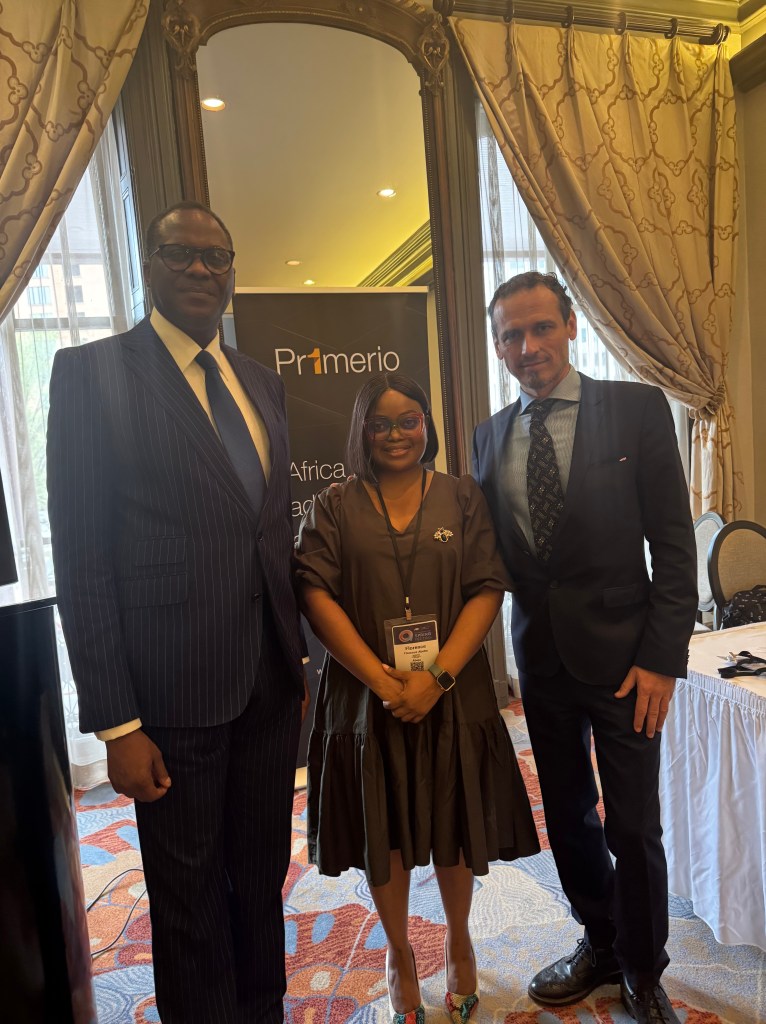
Babatunde Irukera, Florence Abebe, Andreas Stargard at the African Antitrust Salon hosted by Primerio
While more African countries are pushing back against big tech companies and are focusing on unchecked data exploitation within their borders, there is a need, however, for the continent to build towards a larger, sustainable strategy to manage the presence and power of big tech. Says Andreas Stargard, “the quarter-billion dollar Meta fine, if upheld, would firmly cement Nigeria’s antitrust global relevance in the minds of international lawyers and businesses. This comes as a surprise in some ways, as the FCCPC was first put on the map only fairly recently, by its inaugural Chief enforcer, Tunde Irukera: his vision for creative enforcement tools and encouragement of the agency’s staff to employ heretofore unused investigatory mechanisms and strategies – often seen only in U.S.-style civil litigation, and certainly not in many government agencies worldwide, much less among other African jurisdictions – show that the Commission potentially has the necessary intellectual capacity and investigatory stamina to pursue cases of equal or greater dimensions in the future. It will depend on its leadership where the FCCPC’s path is charted next…”
Of course, there needs to be a balance struck between the value of personal data and that of innovation and tech adoption, which calls for a coordinated regulation policy that will strive to balance economic and non-economic features of the continent.
As observed by Leonard Ugbajah, a competition law consultant, a balanced and pragmatic approach is essential when opting to address the regulatory landscape around big tech:
“A common approach would harness the capabilities of countries, moderate opportunism by state and non-state actors in pursuing enforcement, recognise the economic importance of big tech, properly calibrate the various pain points (economic and non-economic) and safeguard the interests of the not-so-capable African countries.”
The social media giants have 60 days, starting from 30 April 2025, to comply with the $220 million fine ordered by the Tribunal. Notably, following the decision, WhatsApp has indicated that it intends to seek a stay of the Tribunal’s decision and pursue an appeal.
Senior diplomats from the COMESA region gathered in Livingstone, Zambia, for the fourth in a series of diplomatic antitrust-focused conferences that began in 2016 but were halted due to the coronavirus pandemic in 2019.
At today’s formal resumption of the recurring event, Dr. Willard Mwemba, CEO of the COMESA Competition Commission, introduced the conference session by calling out the importance of the agricultural sector to the people residing in the region, especially the very poorest of citizens.
He stated in unmistakable terms that his agency would prioritize this and related markets for heightened antitrust enforcement, to ensure the sector operates efficiently and competitively. “Accessibility (and affordability) of food is one of the most fundamental human rights. $2 per day are spent by the poorest people on average, and the majority of those two dollars is spent on food,” noted Mwemba.
Says Andreas Stargard, who attended the session, “it is clear that the view of the Commission is that agricultural markets in COMESA are not functioning as they should, based on studies the agency has undertaken with outside assistance. The massive foodstuffs price inflation levels COMESA residents have suffered in recent years are not merely natural consequences of irreversible climate change but rather represent mostly economic profit to the manufacturers and traders, to the detriment of consumers, based on what Dr. Mwemba presented today.”
COMESA Secretary General, Chileshe Mpundu Kapwepwe, summarized the stark importance of the AG sector to the region, its people, and the economic zone in sobering statistical terms: “The agriculture sector is one of the key sectors for most Member States as it contributes more than 32% to the Gross Domestic Product of COMESA, provides a livelihood to about 80% of the region’s labour force, accounts for about 65% of foreign exchange earnings and contributes more than 50% of raw materials to the industrial sector.”
In light of this crucial importance of the agricultural and food markets, food security is high on the list of action items that COMESA must address practically and effectively, she concluded. COMESA evaluates supply and demand levels across all 21 member states to assist with market assessment and planning.
The Diplomatic Conference’s guest of honour, Zambian Minister of Commerce, Trade and Industry, Hon. Chipoka Mulenga, noted in prepared remarks delivered by his deputy and permanent secretary to COMESA that, while “food production must be profitable for farmers, it must not be exploitative.”
In this regard, the famous Adam Smith quote referenced by Dr. Mwemba at a prior antitrust session comes to mind: “It is not from the benevolence of the butcher, the brewer, or the baker that we expect our dinner, but from their regard to their own self-interest. We address ourselves not to their humanity but to their self-love, and never talk to them of our own necessities, but of their advantages.”
Beyond the immutable wisdom of the Wealth of Nations from two and a half centuries ago, the (1) CCC’s increased competition law enforcement in the agricultural and food sectors, as well as (2) national member states are assisting the effort of ensuring wide and secure availability to all COMESA residents by creating and strengthening cross-border value chains in the food sectors with overlaps across member state borders, the Zambian minister observed.
Nigeria’s FCCPC has imposed a U.S. $220m fine on WhatsApp’s parent company Meta for violating data privacy laws, continuing the FCCPC’s consumer-protection streak
When it rains, it pours. And when the nascent FCCPC (on whose relatively youthful existence we have reported extensively) issues a fine on a global mega corporation like META (or BAT to the tune of $110m), then it really reaches deep into its pockets: Mr. Zuckerberg’s conglomerate will have to pay $220m to resolve an extensively-documented violation abusing its dominant position, exploiting Nigerian WhatsApp users’ personal data, which it had stored in Singapore, Europe and the U.S. The proceedings were brought approximately 3 years ago, culminating in a particularly in-depth Report issued by the FCCPC and the resulting fining decision last week, pursuant to both the Federal Competition and Consumer Protection Act, 2018 (FCCPA), and the Nigerian Data Protection Regulation, 2019 (NDPR).
At the heart of the allegations lies Meta’s undisclosed, apparent dual-use of WhatsApp user information and metadata (no pun), across virtually all of its conglomerate digital platform companies — i.e., data-sharing conduct squarely in violation of the NDPR and, so says the FCCPC, without consumer knowledge and in many cases against WhatsApp users’ wishes.
Andreas Stargard, a competition lawyer at Primerio Ltd., with a focus on African antitrust cases, comments as follows on this latest record-setting West African case:
“This latest foray by the FCCPC against Meta is notable for multiple reasons: First, it spans both the inaugural aegis of the FCCPC under internationally lauded former FCCPC chief, Babatunde Irukera, and that of his recent successor, Tunji Bello.
Secondly, it represents a new record, and quite literally a doubling of the last record fine, namely the $110m agreed-upon antitrust settlement against British American Tobacco less than 2 years ago.
Third, it shows a trend we have recently noticed in the African government enforcement world: namely, the intertwined nature of competition law and consumer-protection issues, which the detailed Report issued by Commission staff highlights in a significant way. Other agencies on the continent will surely take notice and (we hope) issue similarly-documented case reports going forward.
Fourth, and finally, setting aside the amount of the fine, this matter shows how African jurisdictions may well be ahead of some European and other peer institutions. This is a milestone development for the future regulation of digital behemoths across Africa. The detailed report and analysis provided publicly by the Nigerian agency shows that its nascent competition-law regime continues to be eager to comply with global best practices and appears well situated to keep earning the respect of its Western and other African peer authorities, akin to the journey that the COMESA Competition Commission has undertaken in its first 10 years of existence. Both agencies have gone from non-existent to generally and globally respected African antitrust and consumer-protection powerhouses.”
The Commission’s release noted that “[t]he totality of the investigation has concluded that Meta over the protracted period of time has engaged in conduct that constituted multiple and repeated, as well as continuing infringements… particularly, but not limited to abusive, and invasive practices against data subjects in Nigeria. Being satisfied with the significant evidence on the record, and that Meta has been provided every opportunity to articulate any position, representations, refutations, explanations or defences of their conduct, the Commission have now entered a final order and issued a penalty against Meta.”
Nigerian president, Bola Tinubu, yesterday appointed Mr. Tunji Bello to become the new Chief Executive Officer and Executive Vice-Chairman of the Federal Competition and Consumer Protection Commission (“FCCPC”), subject to review and a vote by the Senate, which is expected to pass without issue.
Observers are noting the relative lack of competition-law / antitrust experience of Mr. Bello (whose prior credentials include State Secretary and Environment Commissioner, both in Lagos State). Mr. Bello, a former journalist, is an unknown to most, if not all, competition-law practitioners. His Wikipedia entry describes him primarily in terms of his career as a journalist, which included international stints as “a Staff Writer with [the] St. Petersburg Times, Florida, US, and also [] US News & World Report, Washington DC in 1992.”
The formal press release (see below) seems to support this sentiment of a purely political appointment without any regard to prior competition-law or economics experience, as it appears to focus solely on “consumer protection” and the “safety of goods and services,” while failing to mention competition or antitrust even once.
We note that some commentators have pointed out, at the cynical end of the spectrum, that this appointment may be due to the FCCPC’s past successes in garnering massive fines (e.g., the $110 million fine imposed against BAT), under recently-dismissed predecessor Babatunde Irukera. Such financial windfalls for the government coffers have, these observers believe, turned the agency’s CEO job, into a highly coveted executive post, which had been temporarily held in an interim capacity by Dr. Adamu Abdullahi between January and Mr. Bello’s appointment yesterday.
AAT is hopeful that this is not the case, and that Mr. Bello will not turn the young and so-far highly-regarded FCCPC into a mere means to an end of generating revenue for the Nigerian government. We trust that the Commission will continue to uphold its mandate of competition-law enforcement and its high standard of excellence, thanks in large part to the leadership of Mr. Bello’s predecessor and the quality of the senior team members he had assembled to run the agency.
Press release:
President Bola Tinubu has approved the appointment of Mr. Olatunji Bello as the new Chief Executive Officer/Executive Vice-Chairman of the Federal Competition and Consumer Protection Commission (FCCPC), pending confirmation by the Senate.
Mr. Bello is a lawyer, administrator, and renowned journalist.
He is the former secretary to the Lagos State Government and holds a Master’s degree in International Law and Diplomacy from the University of Lagos. He studied Law at the same university and was called to the Nigerian Bar in 2002.
Mr. Bello began his career in journalism at the Concord Newspapers in 1985 and held the positions of Group Political Editor; Sunday Concord Editor, and Editor, National Concord.
He is a winner of the US Alfred Friendly Press Fellowship and was appointed the Chairman, Editorial Board of THISDAY Newspapers in 2001.
He also served as Commissioner for Environment under various administrations in Lagos State.
The President expects that the new Chief Executive Officer of this important agency will ensure the holistic realization of the Commission’s mandate of protecting and promoting the interest and welfare of Nigerian consumers, and ensuring the adoption of measures to guarantee the safety and quality of goods and services.
Under the aegies of its recently appointed acting Vice Chairman and CEO, Dr. Adamu Abdullahi, the Nigerian Federal Competition and Consumer Protection Commission (FCCPC) today published a statement condemning the continuing consumer price increases in the country, despite the recent strengthening of the Naira currency.
The agency was, wisely, quick to point out that “the FCCPC cannot directly regulate prices.” Yet, it promised to “utilise its existing legal framework to enforce fair competition and consumer protection provisions. This includes monitoring and investigating unusual price hikes, addressing complaints filed by consumers, and taking action against any businesses found to be engaging in anti-competitive practices such as price-fixing, price gouging or cartel formation.”
In an interesting twist, the FCCPC also said that it had appointed so-called “operatives” (whom we imagine to be akin to contracted on-the-ground shadow buyers of goods and services) to report back to the Commission in their apparently ongoing “monitoring of both formal and informal markets.”
To support these ‘operatives,’ the FCCPC called upon regular consumers, trade associations, and farmer groups “to identify and remove unnecessary barriers to entry in various sectors, combat price-fixing, and dismantle cartels,” in the hopes of subsquent consumer-protection enforcement actions and, ultimately, lower prices for consumers.
Anniversary of CCC’s 2013 Creation to be Celebrated, Developments Discussed
Next week, African heads of state, ministers of trade and commerce, the secretary general of the 21-member state COMESA organization, Commissioners, and several heads of various competition agencies across the region, from Egypt to Eswatini & from Mauritius to Malawi, will join antitrust practitioners, legal experts, business people, and journalists in celebrating the occasion of the 10-year anniversary of the COMESA Competition Commission in Lilongwe, where the agency is headquartered.
Of course, AAT will be there to cover it.
As leaders of this august publication will know by now, our authors have followed the development of the CCC since its very beginning: from the nascent stages of having only a rudimentary staff and foundational rule documents, lacking sufficient guidance for practitioners and businesses alike, to the significant developmental stage under its first chief executive officer, Dr. Lipimile, who built out his enforcement team to coincide with the stellar growth of the CCC’s “one-stop-shop” merger notification statistics and attendant agency reviews (hiring economists and lawyers alike from across COMESA member nations) — and culminating, so far at least, in what we have come to call “CCC 2.0”: the latest iteration of the vastly successful multi-jurisdictional antitrust body, now led by its long-term member Dr. Willard Mwemba.
Under Mwemba’s aegis, the Commission has advanced well beyond a mere ‘rubber-stamping’ merger review body, as some had perceived the fledgling agency in its very early years (approx. 2013-15). The triple-C has since then begun to launch serious investigations into price-fixing, monopolization, attempted monopolization, gun-jumping, as well as market allocation schemes and secretly implemented transactions that parties had failed to notify.
While ‘antitrust is on our minds’, we note here for the record that, beyond its “competition” ambit that mostly remains in our focus at AAT, the CCC’s enforcement mission also includes a fairly large “consumer protection” brief, and the agency’s dedicated unit has investigated areas of consumer concern as broad as airline practices, imported faulty American baby powder, online ‘dark’ practices, pay-TV, and agricultural product quality disputes (milk and sugar come to mind) between Uganda and Kenya, to name only a few…
Our publication, together with several of the business journals and newspapers across the southeastern region of Africa, will report in great detail on the events, and possible news, to take place next week. Says Andreas Stargard, a competition practitioner with Primerio International:
“I look forward to hearing from these leaders themselves what they have accomplished in 10 years, and more importantly what they wish to accomplish in the near to mid-term future. In addition, I have a feeling that we may be treated to some truly newsworthy developments: I could imagine there being either confirmation or denials of the circulating rumour that the COMESA merger regime will soon become not only mandatory, but also suspensory. As most attorneys practicing in this arena know by now, the current Competition Regulations are not suspensory, which may be deemed too restrictive by the group’s Secretariat and its agency leadership in terms of its enforcement powers. After all, it is much more difficult to unscramble the egg than to never let it drop in the pan from the get-go!
Also, the CCC may reveal its plans in relation to a leniency programme for cartel conduct, which is plainly in order!”
Beyond that, Stargard surmises, participants at the almost week-long event may be treated to news about the CCC’s thoughts on digital markets, sectoral investigations, and the Commission’s upcoming “beyond-mere-merger” enforcement activities.
USAID AND THE FEDERAL TRADE COMMISSION LAUNCH TRUST AND COMPETITION IN DIGITAL ECONOMIES INITIATIVE TO PROMOTE CONSUMER PROTECTION AND COMPETITION IN AFRICA’S DIGITAL ECONOMY
From the USAID/FTC Press Release dated Oct. 3, 2022:
USAID announced it will partner with the Federal Trade Commission (FTC) to launch a new initiative that will help protect consumers and increase competition in countries across Africa. This initiative will strengthen legal and regulatory frameworks and the institutional capacity to ensure that the benefits of the digital economy are not undermined by anti-competitive, unfair, or deceptive practices.
Robust frameworks for competition and consumer protection are indispensable foundations for partner countries seeking to promote inclusive economic growth, sustain economic competitiveness, promote gender equality and equity, support resilient democratic institutions, and strengthen the rule of law.
Where these foundations are weak or non-existent, a country’s digital economy can become vulnerable to a range of risks and harms, including online fraud, scams, cyber attacks, data misuse, algorithmic bias, gender-based discrimination, corruption, and abuses of market power. While each of these are damaging in their own right, they can collectively contribute to deeper economic and governance concerns if left unchecked, including economic inequality, reduced local and foreign investment, reduced competitiveness, and weakened democratic institutions.
The FTC will use its technical expertise, capacity-building programs, convening power, and relationships across the region to help authorities adopt and implement policy, legal, regulatory, and enforcement frameworks. The FTC will pursue these lines of engagement in concert with other U.S. Government counterparts, regional bodies on the African continent, and country-level counterpart authorities.