Antitrust amnesty: new regime to go online soon

kenya

Kenya to become latest competition jurisdiction with cartel leniency scheme

As Mugambi Mutegi of the Business Daily reports, Kenya is the latest antitrust jurisdiction to embrace a self-reporting leniency programme.
Mr Wang’ombe Kariuki, director of the CAK

Self-reporting of “hard-core” competition-law offences (such as price-fixing cartel conduct, market division, bid rigging, or group boycotts among horizontal competitors) has long been a staple of antitrust enforcement in the most developed jurisdictions, including the United States and the European Union.  In South Africa, cartel-whistleblowing leniency has just passed its 10th anniversary, and in the EU, the European Commission’s “Notice” on the non-imposition of fines in certain cartel cases (i.e., the EU’s leniency regime) recently celebrated its 18th birthday — nowadays, more than 75% of the EC’s cartel matters are uncovered thanks to one or many cartel members “snitching” on their counterparts, in exchange for full or partial amnesty from antitrust prosecution and attendant fines.

The Competition Authority of Kenya (CAK) has recently upped its rhetoric, threatening criminal sanctions against various business sectors’ potential cartel members and disputing jurisdiction of the multi-national, but still feeble, COMESA competition authority in merger cases.

In Africa, Kenya (AAT archive on CAK issues here) is now becoming a new member of the “Leniency Club”, rewarding whistleblowers with eased penalties for volunteering relevant tips and information on the workings of the cartel.  The CAK is acting to implement the provision of the Kenyan Finance Bill 2014, which allows it to terminate cartel investigations with lighter punishment for whistleblowers, all the way to a full pardon.

“The Authority (CAK) may operate a leniency programme where an undertaking that voluntarily discloses the existence of an agreement or practice that is prohibited by the Competition Act and co-operates…in the investigation of the agreement may not be subject to all or part of a fine…”

The agency’s web site — which otherwise (unusually) refers to the Business Daily article quoted here, instead of issuing its own press release — tersely provides as follows:

Cartel firms get amnesty in new CAK regulation

The competition regulator has drafted a law that will see whistleblower companies and their directors get off with lighter punishment for volunteering information that helps to break up cartels.

The Competition Authority of Kenya (CAK) says introduction of this law, which is already in the Finance Bill 2014, will attract informers that can help to bust unlawful business agreements between cartels and other secretive pacts that facilitate anti-competitive behaviour.

Whistleblowers whose evidence leads to the successful termination of such agreements and punishment (fines and jail sentences) of the participants will either get reduced fines or full pardon.

The CAK’s Director General, Francis Wang’ombe Kariuki, is quoted as saying that the authority’s is merely awaiting Parliament’s amendment of the law, and that “[t]he settlement policy we have drafted includes offering leniency to the directors of companies who come forward individually or as a group to report on cartels or unlawful business pacts“.

Criminalisation of antitrust offences: not on short-term horizon

south_africa

Competition Commission not ready to pursue antitrust cases criminally – plus: AAT‘s recommendations

The newly (permanently) appointed Competition Commissioner, Tembinkosi Bonakele, has referred to a “phased” implementation of the 2009 Competition Amendment Act.  The legislation technically criminalised hard-core antitrust offences such as bid-rigging or price-fixing cartels.  However, it has not yet been implemented or effectively signed into law.

According to a MoneyWeb/ZA report, both he and his boss, Economic Development Minister Ebrahim Patel, had discussions on how and when to implement “to ensure that the necessary institutional capacity is available to apply the amendments.”  The initially effective provisions (relating to the SACC’s market-inquiry powers) went into effect last year, while the criminalisation provisions remain unimplemented.

In a somewhat remarkable and prudent self-assessment, the minister and SACC have now admitted that the Commission currently lacks “the institutional capacity needed to comply with the higher burden of proof in criminal cases,” according to the report.

One notable aspect of potential discord lies in not only in the different standard of proof in civil vs. criminal matters (“more probable than not” vs. “beyond a reasonable doubt”), but perhaps more importantly can be found on the procedural side, preventing rapid implementation of the law: There has been historic friction between various elements of the RSA’s police forces and (special) prosecutorial services, and the power to prosecute crimes notably remains within the hands of the National Prosecuting Authority, supported in its investigations by the South African Police Service.

Historical and Legislative Background – and a bit of Advice

Starting in the spring and summer of 2008, the rumoured legislative clamp-down on corrupt & anti-competitive business practices by the government made the RSA business papers’ headlines.

During a presentation I gave at a Johannesburg conference in September that year (“Criminalising Competition Law: A New Era of ‘Antitrust with Teeth’ in South Africa? Lessons Learned from the U.S. Perspective“), I quoted a few highlights among them, asking somewhat rhetorically whether these were the words of fearmongers or oracles?

  • “Competition Bill to Pave Way for Criminal Liability”
  • “Tough on directors”
  • “Criminalisation of directors by far most controversial”
  • “Bosses Must Pay Fines Themselves”
  • “New leniency regime to turn up heat on cartels”
  • “New era in the application of competition policy in SA”
  • “Likely to give rise to constitutional challenges”
  • “New Bill On Cartels is a Step Too Far”
  • “Fork out huge sums or face jail time if found guilty”
  • “Disqualification from directorships … very career limiting”

I also quoted international precedent-setting institutions and enforcers’ recommendations, all of which tended towards the positive effect of criminal antitrust penalties:

OECD, 3rd Hard-Core Cartel Report (2005):

  • Recommends that governments consider the introduction and imposition of criminal antitrust sanctions against individuals to enhance deterrence and incentives to cooperate through leniency programmes.

U.S. Department of Justice, Tom Barnett (2008):

  • “Jail time creates the most effective, necessary deterrent.”
  • “[N]othing in our enforcement arsenal has as great a deterrent as the threat of substantial jail time in a United States prison, either as a result of a criminal trial or a guilty plea.”

While the presentation contained a lot more detail, the key recommendations that I summarised would seem to continue to hold true today, and may serve as guide-posts for Commissioner Bonakele and the EDD ministry:

Cornerstones of a successful criminal antitrust regime
  • Crystal-clear demarcation of criminal vs. civil conduct
  • Highly effective leniency policy also applies to individuals
  • Standard of proof must be met beyond a reasonable doubt
  • No blanket liability for negligent directors – only actors liable
  • Plea bargaining to be used as an effective tool to reduce sentence
  • Clear pronouncements by enforcement agency to help counsel predict outcomes
Demarcation of criminal vs civil antitrust conduct in U.S.

Competition authority issues sectoral warning, threatens criminal sanctions

kenya

Wake-up call to would-be cartelists and monopolists in Kenya

The Standard reports that the Competition Authority of Kenya (“CAK”) (AAT archive on CAK issues here) is threatening cartelists with prison terms of up to 5 years and fines up to 10 million Shilling ($115,000).

According to the report, CAK Director General Francis Wang’ombe Kariuki said that “investigations are already being conducted in [the] transport, insurance, shipping, milling, banking, cement, sugar, health care and tea” sectors, pursuant to purported consumer complaints.

CAK Director General Kariuki

The CAK has actively pursued antitrust matters, using novel approaches of late, as AAT recently reported on a seemingly hybrid unilateral/collusion case (“Kenya: Lafarge faces possible price-fixing penalties due to cross-shareholding“).  The CAK is also the sole COMESA member enforcement authority that has, to our knowledge, challenged the fledgling and issues-plagued COMESA Competition Authority’s jurisdiction in various merger cases.

COMESA old flag color

Investment in Africa: Changing landscape, new hurdles

Questioning African antitrust growth prospects: Slowdown in economic investment (both organic and outside investment) may affect functioning of competition law on the continent

Recent developments in Africa have many scratching their heads and wondering whether the formerly wondrous economic-growth engine of the vastly resource-rich and otherwise economically still undervalued continent will soon experience a slowdown, if not come to a halt altogether.

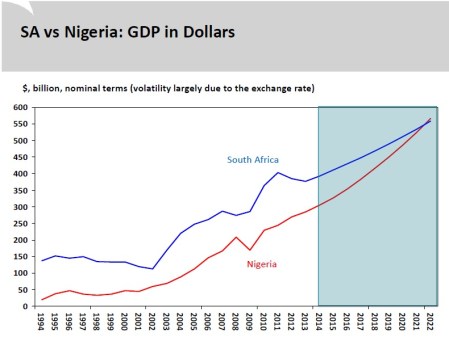
For one, in April 2014, Nigeria surpassed South Africa as the continent’s largest economy (see Economist Apr. 12, 2014: “Africa’s New Number One“).  This is a significant milestone for the former, and a setback for the latter — an economy that was 8 times the size of the Nigerian economy only 20 years ago, yet is now suffering from stagnating GDP, reeling from corruption allegations amongst its current leadership, undergoing a closely-watched presidential election process, and whose ruling ANC party is facing a heretofore unprecedented backlash and torrent of criticism.

Source: The Economist

Not only South Africa has weakened, politically and economically, however.  Events such as the Northern Nigerian wave of violence – with sectarian Boko Haram forcefully displaying the impotence of the central Nigerian government of a weakened president Goodluck Jonathan – fuel the fire of outside investors’ mistrust of African stability and their concomitant reluctance to make good on prior investment promises.  As The Economist notes in the article quoted above: “it is not a place for the faint-hearted” to invest, even though it highlights the successful Nigerian business ventures of outsiders such as Shoprite, SABMiller, and Nestlé.  Bloomberg BusinessWeek quotes Thabo Dloti, chief executive officer of South Africa’s fourth-largest insurer Liberty Holdings Ltd. (LBH), as saying: “It does slow down the plans that we have, it does put out the projections that we have by a year or two.”

http://www.stanlib.com/EconomicFocus/Pages/InterestingChart112SouthAfricaneconomyvsNigerianeconomy.aspx
Nigerian vs. RSA GDP
Source: http://www.stanlib.com

Likewise, multi-national organisations such as COMESA and its competition enforcement body, are undergoing significant changes (such as, currently, an opaque process of raising the heretofore insufficient merger-filing thresholds), shockingly successful web attacks on their data, and a resulting dearth of transactions being notified.  Elsewhere in developing economies, recent political turmoil has likewise led observes to comment on the negative spillover effect from political & social spheres into the economy (e.g., Financial Times, May 8, 2014: “Political crisis further dents prospects for Thai economy“).

Impact on antitrust practice

The upshot for competition-law practitioners and enforcers alike is rather straightforward, AAT predicts: more hesitation around African deals being done means fewer notifications, less enforcement, and overall lower billings for firms.

The flip side of the coin – as is usually the case in the economic sine curve of growth and slowdowns – is the commonly-observed inverse relationship of M&A and criminal antitrust: while we may see fewer transactions in the short term, the incidence of cartel behaviour and commercial bribery & government-contract fraud cases will likely increase.

Price-fixers beware: U.S. DOJ scores first-ever pure antitrust-based extradition from E.U.

From DOJ: First-Ever Pure Antitrust Extradition

In what may well affect African and other international price-fixers going forward, the spectre of U.S. extradition for criminal antitrust charges has been reinforced by the recent successful DOJ extradition request in the “Marine Hose” cartel.  An Italian national was extradited from Germany to face bid-rigging charges.

Ian Norris, then-CEO of Morgan Crucible, sentenced to serve 18 months in federal U.S. prison

“First-ever”?! Some readers may recall the carbon products cartel and a certain Mr. Ian Norris, the then-Morgan Crucible chief executive, who had been extradited from the U.K. to the United States back in 2010.  Yet, that seven-year long procedure was based not a pure antitrust charge — rather, he was extradited on a technicality, if you will, namely the “obstruction of justice” charge, given the lack of reciprocal or dual criminality of the underlying price-fixing offense in the two countries at the time the competition offense had been committed in the early 1990s.  Norris’ 1 1/2 year prison sentence ended in November 2011.

The Marine Hose cartel extradition is different: In this case, the DOJ succeeded, for the first time ever, in securing an extradition solely on a competition-law offense being charged.

Source: BSO / via CBS Miami

What follows is the DOJ press release text (with added links):

WASHINGTON — Romano Pisciotti, an Italian national, was extradited from Germany on a charge of participating in a conspiracy to suppress and eliminate competition by rigging bids, fixing prices and allocating market shares for sales of marine hose sold in the United States and elsewhere, the Department of Justice announced today. This marks the first successfully litigated extradition on an antitrust charge.

Pisciotti, a former executive with Parker ITR Srl, a marine hose manufacturer headquartered in Veniano, Italy, was arrested in Germany on June 17, 2013. He arrived in the Southern District of Florida, in Miami, yesterday and is scheduled to make his initial appearance today in the U.S. District Court for the Southern District of Florida in Ft. Lauderdale, at 11:00 a.m. EDT.

“This first of its kind extradition on an antitrust charge allows the department to bring an alleged price fixer to the United States to face charges of participating in a worldwide conspiracy,” said Assistant Attorney General Bill Baer in charge of the Department of Justice’s Antitrust Division. “This marks a significant step forward in our ongoing efforts to work with our international antitrust colleagues to ensure that those who seek to subvert U.S. law are brought to justice.”

Marine hose is a flexible rubber hose used to transfer oil between tankers and storage facilities. During the conspiracy, the cartel affected prices for hundreds of millions of dollars in sales of marine hose and related products sold worldwide.

According to a one-count felony indictment filed under seal on Aug. 26, 2010, and ordered unsealed on Aug. 5, 2013, in U.S. District Court in the Southern District of Florida, Pisciotti carried out the conspiracy by agreeing during meetings, conversations and communications to allocate shares of the marine hose market among the conspirators; use a price list for marine hose in order to implement the conspiracy; and not compete for customers with other marine hose sellers either by not submitting prices or bids or by submitting intentionally high prices or bids, all in accordance with the agreements reached among the conspiring companies. As part of the conspiracy, Pisciotti and his conspirators provided information received from customers in the United States and elsewhere about upcoming marine hose jobs to a co-conspirator who served as the coordinator of the conspiracy. That coordinator acted as a clearinghouse for bidding information that was shared among the conspirators, and was paid by the manufacturers for coordinating the conspiracy. The department said the conspiracy began at least as early as 1999 and continued until at least May 2007. Pisciotti was charged with joining and participating in the conspiracy from at least as early as 1999 until at least November 2006.

Pisciotti is charged with violating the Sherman Act, which carries a maximum penalty of 10 years in prison and a $1 million criminal fine for individuals. The maximum fine may be increased to twice the gain derived from the crime or twice the loss suffered by the victims of the crime, if either of those amounts is greater than the statutory maximum fine.

As a result of the department’s ongoing marine hose investigation, five companies, including Parker ITR; Bridgestone Corp. of Japan; Manuli SPa of Italy’s Florida subsidiary; Trelleborg of France; and Dunlop Marine and Oil Ltd, of the United Kingdom, and nine individuals have pleaded guilty.

The investigation is being conducted by the Antitrust Division’s Washington Criminal I Section, the Defense Criminal Investigative Service (DCIS) of the Department of Defense’s Office of Inspector General, the U.S. Navy Criminal Investigative Service and the Federal Bureau of Investigation. The U.S. Marshals Service and other law enforcement agencies from multiple foreign jurisdictions are also investigating or assisting in the ongoing matter. The Criminal Division’s Office of International Affairs provided assistance.