The creeping public-interest factor in antitrust: Still creeping or racing yet?

south_africa

Race to bottom: dilution of competition-law factors in South Africa?

As we have reported numerous times, both on the global policy front as well as in individual case reports, the South African competition regulators and their superiors in the economic development ministry have had their sights on placing a stronger emphasis on the “public interest” element inherent in the SA competition legislation — thereby diluting pure competition-law/antitrust analysis, as some might argue.

Recently, Minister Patel commended his “independent” team at the Competition Commission for not only doing a good job overall, but also in particular on the public-interest front, encouraging the systematic consideration of public interest by the Commission and the Tribunal.

His prepared remarks from the 8th Annual Competition, Law, Economics and Policy Conference in Johannesburg are now uploaded here.  In them, he emphasizes that competition policy is “rightly”…:

“… a subset of broader competitive policies, which in turn are part of our industrial policy framework. … Our law provides an opportunity, and indeed an obligation, to align corporate strategy (by which I refer to mergers or takeovers) with public interest considerations. … The increasing use of the public-interest requirements in evaluating mergers has been critical in ensuring that competition policy has a growing developmental impact, saving thousands of jobs and providing millions of rands to support small and emerging enterprises.”

On the independence of the enforcers, Mr. Patel had this to say:

This kind of alignment must in future, as in the past, respect the independence of the regulator. But all our agencies, however independent, work within the framework of national policies.

These remarks are fairly strong, indeed!  We leave it to our AAT readership to infer the consequences of these observations on future merger enforcement and on the true degree of independence of the Commission — you can read between the lines.

In a companion paper, entitled “What is competition good for – weighing the wider benefits of competition and the costs of pursuing non-competition objectives”, AAT’s own John Oxenham (Nortons) and Patrick Smith (RBB Economics) argue as follows:

Over the past five years, the South African competition authorities have increasingly struggled to balance a competition test with defined public interest criteria (Metropolitan, Kansai, Walmart). Other agencies (ICASA, NERSA), and government ministries more generally, have also wrestled with how competition policy might fit into wider government policies and even broader concepts of the “public interest”, including notions of equality, fairness and access. In this paper we discuss some of key events in this ongoing debate, and we anticipate some of the battles that are likely to come. Furthermore, we set out a rigorous framework and provide a review of the available research and literature to discuss the effects of competition (both positive and negative) in multiple dimensions, in order to assess how far a “pure competition” test might go in achieving a broad range of efficiency, growth, and employment objectives. Such a comprehensive and evidence based approach is essential in understanding the costs and benefits of the existing pursuit of multiple (and often apparently conflicting) objectives, and will allow decision makers to more logically assess the trade-offs that they will continue to be confronted with.

Tribunal overrides Commission’s lean toward merger veto

south_africa

Tribunal decides against Commission’s recommendation of prohibition of resin merger

The Competition Commission (“Commission”) recommended to the Competition Tribunal (“Tribunal”) to prohibit the proposed acquisition of resin manufacturer Arkema Resins SA (Pty) Ltd (“Arkema”) by specialised coatings company Ferro Industrial Products (Pty) Ltd (“Ferro”).

The acquiring firm, Ferro, operates in the industrial chemicals sector and its activities comprise powder coatings, plastics, enamels and ceramics, glass colours, spectrum ceramics and resin.

Arkema, the target firm, is a wholly-owned subsidiary of Arkema Afrique SAS, which in turn is wholly-owned by Paris-listed company Arkema. Arkema is also involved in the manufacture of unsaturated polyester resin which is used in the manufacture of swimming pools, truck bodies, baths, etc.

The merging parties argued that the Commission’s recommendation to the Tribunal was fundamentally flawed as it failed to take into account certain key considerations, such as the constraint of imports on domestic suppliers, the fact that post-transaction, there were two alternative domestic suppliers to the merging parties and that the merging parties argued that Arkema was not in fact a competitive constraint to Ferro in certain key market segments.

Following a two-week long hearing, the Tribunal approved the merger subject to conditions which involve a pricing formula to customers in the mining segment, a toll-manufacturing agreement and a two-year moratorium on retrenchments.

Nortons Inc. acted for Ferro in this matter.

Patel not mincing words, diluting competition-law factors in mergers

south_africa

Economic Development Minister of South Africa, Ebrahim Patel, recently stated that the Competition Commission (“Commission”), South Africa’s key competition authority, will be asked to focus on jobs, industrialisation and small business development in lieu of ‘pure’ antitrust-law issues.

Patel stated that government would require the Industrial Development Corporation to focus on supporting black industrialists, and on the competition authorities to promote economic transformation “not as a by-product of but an explicit objective of competition policy.” According to Patel, competition bodies are in a position to contribute directly to the state’s objective of creating a more equal economy, where workers shared in the benefits of growth. His department is allegedly already in talks with the construction industry on a restitution package to redress collusion and price fixing. The end result, he stated, would be that larger companies will provide funds to support small producers and local suppliers.

Patel’s controversial views have already influenced Commission merger decisions and can clearly be seen in the recent Afgri/AgriGoupe case, where the authority entered into an agreement with the foreign buyer of the local grain and poultry company Afgri, requiring the new owners to contribute R90 million ($9m) to a fund to support small-hold farmers with training and loans.

Based on Mr. Patel’s latest pronouncements, South Africa is on a path to politicizing antitrust law and making pure competition considerations a secondary objective to public-interest considerations.

Namibian merger control: 1st deal of 2014 gets conditions

namibia

Namibian Competition Commission Imposes Conditions on Mining Deal

The Namibian Competition Commission has given its first conditional approval of the year in a gold-mine transaction, imposing employment conditions that require the purchaser not to lay off any employees for a minimum of two years from the date of sale.

Unemployment concerns drive antitrust ruling

The Commission stated, per reporting on AllAfrica.com, that there were no reasons to block the deal on a lessening-of-competition grounds under section 47 of the Competition Act, but that it was “concerned about the effect of the sale on employment, hence the imposition of the above condition.”

AAT reported last year on the revision of the Namibian competition law to include consumer-protection provisions, which would allegedly bar M&A deals not only on pure antitrust grounds but also on a more broadly defined “unfairness” basis.

In the current deal, buyer Guinea Fowl Investments Twenty Six will acquire the Navachab gold mine from AngloGold Ashanti Namibia, which since last year has had gold-mining competition from one other player (B2Gold) in the domestic market.

First 2014 deal with conditions

We note that no other cleared transaction has had conditions imposed since the beginning of the calendar year, as shown by the agency’s May M&A update 2014:

Namibian NaCC approved deals as of May 2014


Battle of the Agencies: ICASA vs. CompCom

In dispute over competition-law & merger enforcement in South Africa, Communications agency raises its voice

Jurisdictionally crossed wires and agency disputes in antitrust are no longer the exclusive playground of the FCC and DOJ, of COMESA’s CCC and the Kenyan CAK, or DOJ and FTC.  They have now reached the shores of the Republic of South Africa as well, in the form of the Independent Communication Authority of South Africa (“ICASA”) challenging the country’s Competition Commission’s de facto exclusive right to review merger deals.

Factual Background

ICASA, created in July 2000 by the Independent Communication Authority of South Africa Amendment Act is reported to be in a jurisdictional dispute with the country’s traditional merger watchdog, the South African Competition Commission (“SACC”).  ICASA wants the power to take a closer look at relevant deals such as MTN and Telkom’s network sharing and the announced Vodacom / Neotel deal, on which AAT has reported previously (see Telecom adversaries to remain “principled” in their competing bids for 4G spectrum, Internet & mobile operators at war: merge, acquire, complain, and our prior reports mentioning ICASA here).

ICASA’s specialized “Markets & Competition” division is tasked to deal with promoting “competition, innovation and investment in respect of services and facilities provided in the electronic communications, broadcasting and postal sectors, whilst ensuring account cultural diversity, especially regarding broadcasting content.”  The authority as a whole is “mandated to create competition in the telecommunications, broadcasting and the postal industries. In turn, competition brings about affordable prices for goods and services rendered and provides value for money to consumers.”

Legal Standard – “Public Interest”?

In recent reports by the New Telegraph and HumanIPO, ICASA is said to have voiced discontent with the Competition Commission’s failure to send proposed communications-related M&A deals to the authority.

That said, it is unclear to AAT precisely which legal standard ICASA wishes to impose on any potential future merger review it might undertake.  In the U.S., notably, the FCC’s standard of review is a more flexible public-interest standard, vs. the “classic” antitrust agencies’ (FTC/DOJ) “substantial lessening of competition” standard.

Regardless of (at least our) uncertainty of the legal standard to be applied, ICASA is quoted as saying that deals cleared by the SACC may still require separate approval from the Communications authority, irrespective of any competition-law based decision reached by the Competition Commission:

“While consolidation is a global phenomenon and anticipated in the market, all such deals may require regulatory approval.”

“The authority is aware of what is currently before the Competition Commission; and in accordance with our institutional arrangements with the Competition Commission we will collaborate, however, that in no way negates the regulatory approvals required from ICASA.”

In addition to the previous lack of coordination between the Commission and ICASA on merger reviews, there has also been criticism of the country’s limited allocation of more frequency spectrum to wireless operators.

south_africa


Internet & mobile operators at war: merge, acquire, complain

Deals and accusations rock ZA’s Vodacom

The South African mobile operator landscape can be described as a microcosmic reflection of the larger African experience: Mobile technology is exponentially more developed than what an outside observer would otherwise predict, based on distinct economic predictors.  One of the key reasons for this highly-developed sub-Saharan mobile world is the concomitant lack of hard-wired infrastructure, necessitating that mobile make up for the copper-wire slack.  Other reasons include the hot topic of mobile banking (again: lack of brick-and-mortar banks necessitates mobile banking alternatives, such as M-Pesa’s services, on which AAT has reported extensively).

South Africa, as the continent’s largest (or second-largest, depending on whether you trust the revised Nigerian GDP numbers) economy, is of course at the forefront of the African mobile/internet frontier.

Now, the large South African operator Vodacom has rejoined the antitrust headlines simultaneously in two ways:

First, Vodacom ZA plans to acquire Neotel, a large S.A. internet provider, for 7 billion Rand (circa $650m).  This transaction will, of course, be subject to merger review by the South African Competition Commission (“SACC”).

Second, Vodacom has confirmed the prior reports of its competitor Cell-C’s October 2013 complaint, accusing Vodacom of discriminatory pricing, which is now being taken rather seriously by the SACC, according to TechCentral’s reporting.  On that front, Vodacom’s spokesman Richard Boorman is quoted as using classic competition-law argumentation as a clever shield:

“Cell C is apparently arguing for an increase in the price that Vodacom customers pay to call other Vodacom customers. It’s hard to argue that increasing prices would be a benefit to consumers.”

Vodacom’s official press statement on the Neotel deal follows below:

Vodacom reaches agreement to acquire Neotel

Monday, 19 May 2014

Further to the SENS announcement on 30 September 2013, Vodacom has reached an agreement with the shareholders of Neotel Proprietary Limited (“Neotel” or the “Company”) to acquire 100% of the issued share capital in, and shareholder loans against, Neotel for a total cash consideration equivalent to an enterprise value of R7.0bn.

Principal benefits of the transaction

Leading fixed telecommunications network

Neotel, which started operations in 2007, is the second largest provider of fixed telecommunications services for both businesses (commonly referred to as enterprise services) and consumers in South Africa. The company has access to over 15,000 km of fibre-optic cable, including 8,000 km of metro fibre in Johannesburg, Cape Town and Durban. Neotel also has access to 2 x 12 MHz of 1800 MHz spectrum, 2 x 5 MHz of 800 MHz spectrum and 2 x 28 MHz of 3.5 GHz spectrum.

Acceleration of Vodacom’s unified communications strategy

Neotel will become a subsidiary of Vodacom South Africa and the combination with Vodacom’s South African fixed enterprise business will create a national service provider with annual revenues of more than R5bn.

Vodacom sees a significant opportunity to accelerate growth in unified communications products and services by integrating its extensive distribution and marketing capabilities with Neotel’s fixed network and product capabilities. The combined entity will be able to offer an expanded and enhanced range of converged services (e.g. hosted PBX, OneNet) to enterprise customers. Vodacom estimates revenue synergies with a total net present value of approximately R0.9bn after integration costs.

Enhancement of next generation network capabilities in South Africa

The combination of Neotel’s and Vodacom’s networks will improve overall network availability and reduce the cost to serve customers. The combined business will also be ideally positioned to accelerate broadband connectivity in line with the South African Government’s broadband targets, enabling Vodacom to take a leading position in the fibre to the home and fibre to the enterprise segments of the market.

The combined entity will also be able to use the radio spectrum currently assigned to Neotel more effectively. This spectrum will enable Vodacom to accelerate the roll-out of LTE (commonly referred to as 4G) services, providing high speed, high quality wireless connectivity to a greater proportion of the South African population.

In-market consolidation with substantial cost and capex savings

Vodacom expects to achieve substantial cost and capex synergies with an annual run-rate of approximately R300m before integration costs in the full fifth year post completion, equivalent to a net present value of approximately R1.5bn after integration costs. These savings will primarily be derived from the joint utilisation of Neotel’s extensive fibre network and the elimination of overlapping elements, joint procurement and the combination of overlapping administrative functions. The transaction values Neotel at a multiple of 8.8x annualised 1H2014 OpFCF, adjusted for cost and capex synergies.

Neotel management and employees

Vodacom looks forward to welcoming Neotel’s employees. Their fixed and enterprise skills will enable the combined entity to deliver enhanced and extended service offers.

Additional information on the transaction

Vodacom will fund the acquisition through available cash resources and existing credit facilities.

The transaction remains subject to the fulfilment of a number of conditions precedent including applicable regulatory approvals and is expected to close before the end of the financial year.

Speaking about the transaction, Vodacom Group CEO Shameel Joosub said:

“Through the combination of these two businesses, the provision of a wider range of business services and much needed consumer services like fibre-to-the-business and fibre-to-the-home becomes a concrete reality – it will be good for the consumer, good for business and good for the country.  And for our investors, the transaction fits perfectly within the priorities of Vodacom’s growth strategy focused on continuing our investment in data and our Enterprise business.”


New Competition Commissioner not so new: Bonakele retains top job

south_africa

Interim South African Acting Competition Commissioner Tembinkosi Bonakele confirmed in permanent post by minister who unceremoniously fired predecessor Ramburuth

Plus ça change, plus c’est la même chose…

This morning, economic-development minister Ebrahim Patel announced the retention of the 38 year-old Mr. Bonakele as the top antitrust enforcer in the South African republic, making permanent for a five-year term the interim appointment of the man who said the following in an interview regarding the independence of the competition authorities in South Africa:

While competition authorities should not be beholden to the government neither can they be loose cannons who claim independence without accountability.”

In prolonging Mr. Bonakele’s interim appointment for another five years, Minister Patel thus assured that the important position of Competition Commissioner did not go to a “loose cannon”…

Legislative basis

The appointment is made pursuant to Part A, Art. 22 of the South African Competition Act of 1999, as amended, which also provides (in sub section 4) for the flexible salary and benefits determination to be made by the minister himself: “The Minister must, in consultation with the Minister of Finance, determine the Commissioner’s remuneration, allowances, benefits, and other terms and conditions of employment

Minister Patel
Commissioner Bonakele
Public announcement and emphasis on enforcement

In the duo’s official tweets announcing the decision (see graphic extract below), Patel congratulated Mr. Bonakele, reaffirming his and the SA cabinet’s support of the “eminently suitable” candidate, and emphasizing the importance of (1) the Competition Commission‘s ongoing and hotly debated private health-care inquiry as well as (2) the “social-justice” elements of merger conditions imposed by the SACC on mergers in the past 5 years, purportedly “protecting” 4,900 jobs.

The agency had come under considerable flak in the past year due to its high staff and executive-level turnover and a work environment that has been described as “toxic” by insiders.

The official release by the Ministry of Economic Development quotes Patel as follows:

“I am pleased to have someone of Bonakele’s calibre at the helm of the Competition Commission. He is taking leadership of the Commission at a time when the South African economy needs to become more competitive and create many more decent work opportunities by combatting market abuse such as cartels and pervasive monopolies and ensure competitive pricing of products. In particular, the key jobs drivers identified in our policy frameworks require coordinated and concerted efforts improve economic performance and development outcomes.
“The Competition Commission has been one of a number of successful economic agencies and regulators that are together beginning to transform the South African economy. Mr Bonakele possesses the skills and experience to build on the successes of the Competition Commission.”

The agency’s official “Structure” page had not yet been updated as of the day of the announcement, listing Mr. Bonakele as “Acting” head and still showing the long-departed Ms. Makhaya as a Commission official.

Official S.A. government tweets announcing SACC personnel decision of permanent Bonakele appointment

COMESA news of the day: web site down again; 5 “exemption” letters granted

COMESA Competition Commission logo

Site down – 5 “comfort letters in 5 months – Guidelines revision by June

In an almost farcical repetition of its information-technology woes, the COMESA Competition Commission’s web site (http://www.comesacompetition.org/) is off-line, yet again, after having been successfully hacked multiple times.  Whether the latest outage is due to a similar attack or simply (and hopefully) due to its webmaster’s shoring up the competition enforcer’s IT security measures remains to be seen.  (We have not yet heard back from the agency’s leadership on our request for information on the online data safety of parties’ submissions.)

In more substantive news, IFLR reports that the CCC has issued five so-called “Comfort Letters” since December 2013, exempting otherwise notifiable transactions from the duty to file (as well as the concomitant payment of the (high) filing fees), where the actual nexus to the COMESA region was negligible or non-existent.  This may help explain some of the lackluster filing statistics on which we reported previously.

The report also quotes the CCC’s head of mergers, Mr. Willard Mwemba, as saying that the revision of the Competition Guidelines should be finalised by the end of June 2014.

Malicious COMESA web site attack: Competition Commission hacked 3rd time

For the third time in a month, the fledgling pan-African antitrust enforcer’s web site has been disabled by hackers

As competition-law attorneys counseling clients on the necessity of notifying mergers in the COMESA jurisdiction, we view these developments with – put mildly – shock.  This is especially true as confidential party data and documents would appear to be at risk of involuntary and malicious disclosure to third, unauthorized parties.  As reported at AfricanAntitrust.com, the COMESA enforcement agency’s web site has previously been hacked and later simply disabled.

COMESA leadership non-responsive

On both prior occasions, AAT’s editors wrote to the COMESA Competition Commission‘s webmaster, as well as the agency’s leadership (Messrs. George Lipimile and Willard Mwemba), to seek an explanation of the attacks.  We also asked them about the safety of data and other confidential party information submitted to the CCC via its extranet & online document repository.

Not only have we not received any response to date.  What’s more, in a – perhaps unsurprising, at this stage – turn of events, the Commission has now been subjected to its third hacking attack.

Hackers boast of achieving successful attack

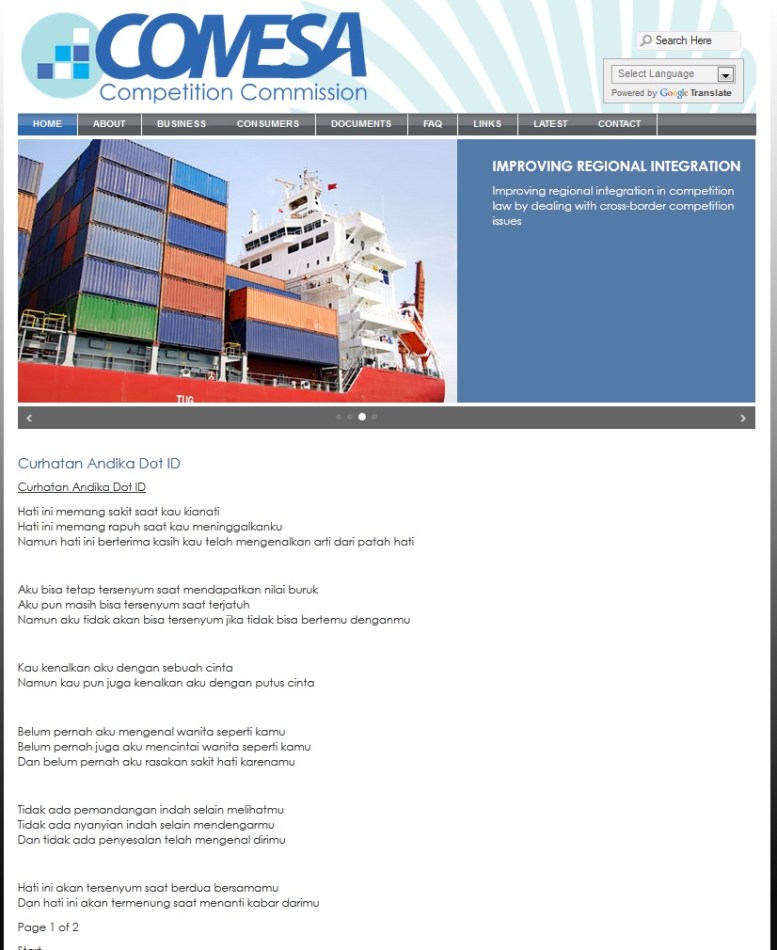
This latest episode also embodies the most disconcerting hack, as it appears visually and substantively more malicious than the prior attacks (one of which featured an Indonesian love poem, whilst the second rendered the CCC’s page simply blank).  A visual example of the latest attack can be found below.  The hackers (identified as “Kinal Undetected” from SerdaduPerangCrew and SPCSO) [note: prior and subsequent links open hacker-related pages] acknowledge – for the first time – that it is an intentional event and not merely an accidental outage or otherwise unintended gaffe of the CCC’s webmaster.  Moreover, the perpetrators even submitted a screenshot of the intrusion to “Zone H“, a clearing-house of hackers, as evidence of the attack on Monday.  This means that the CCC’s site has been disabled for at least two full days (through 14 May — UPDATE: the regular COMESA site is back up and running at 16:00 CET, 14th May).  On the prior occasions, the site likewise remained compromised for several days in a row.

Logo of the successful COMESA hackers displayed on CCC’s web site (May 12-13, 2014)

High risk of data security breach & next steps

We are in the process of sending yet another follow-up e-mail to the CCC’s executives to obtain further information about this unsettling and embarrassing security breach/failure, including: (1) risks to confidential corporate information, (2) the impact on the private deliberative process of the Commission, as well as (3) steps the CCC intends to take to prevent future replication of these embarrassing and dangerous attacks, including (we propose) the retention of a professional data-security firm for advice and potentially management of the web interface.

COMESA hack no3


Call for parties to CCC proceedings to take action

Especially in light of COMESA staff’s unsettling silence in response to alerts to these attacks, and as we have done before, we are notifying our readership (and particularly current or potential future parties to CCC merger reviews) regarding the deficiencies in the competition enforcer’s electronic systems. These may impact the timetable and resulting deadlines of pending merger investigations, and it is advisable that all such interested parties enquire with the Competition Commission about the procedural effect of the outage.

Positive outlook for Ghana M&A activity

ghana
Future of Ghanaian M&A deals promising, according to bankers

The Benso Oil Palm Plantation and FanMilk International deals (both involving foreign investment in the country) over the past year are merely an indication of an upward mergers & acquisitions trend, according to a GhanaWeb report.

Usually, with increased merger activity comes heightened competition scrutiny, of course — not so in Ghana, however, as the West-African country still lacks an antitrust and merger-review law.  AAT noted in December:

[Ret. Ghanaian Supreme Court] Justice Date-Bah, who has held visiting academic positions at Oxford and Yale Law School, deplored the legislature’s previously failed attempts of enacting a comprehensive competition law, calling for the country to do so to ensure proper market dynamics.

The most recent economic report quotes Randolph Rodrigues, sr. investment banker at Stanbic Bank Ghana, as predicting “a rise in M&A activity in the country given the increasing emphasis on local content across sectors in the country.”

“The renewed quest for the institution of local content requirements across industries is expected to drive a wave of M&A activity, with larger foreign-owned enterprises seeking partnership opportunities with indigenous operations to continue to grow within the legal framework of their respective industries. Banks are well placed to lead the way in advisory services.”

In AAT’s view, four factors may contribute to the anticipated deal volume and influx of foreign investment, of which one is competition-law based: (1) the absence of antitrust hurdles, as noted above, (2) the relatively open Ghanaian economy, (3) stable political climate (unlike its distant neighbor at the moment, Nigeria), and (4) high intrinsic growth rate of Ghana’s GDP:

ghana gdp growth
Ghana’s GDP growth (blue line) compared to Kenya and Cameroon