Two new COMESA competition commissioners seated

COMESA grows to 11-member Commission

Numerous in personnel, yet still displaying a dearth of actual case-law development even in merely the one area in which the COMESA Competition Commission has been active — mergers — the agency recently appointed two new (indeed, additional, as the number grew from 9 to 11) Commissioners for the standard term of three years.

Competition practitioner John Oxenham, a director at Africa consultancy Pr1merio, identified them as Trudon Nzembela Kalala from the Democratic Republic of the Congo, and Kowlessur Deshmuk, Executive Director of the Competition Commission of Mauritius.  Oxenham notes that neither country enjoyed representation between the April announcement of 4 new commissioners and December 8 (see also April 15 AAT story on the agency’s prior appointments).

COMESA's 18th Summit in Ethiopia

Name Member State
Ali Mohammed Afkada Djibouti
Trudon Nzembela Kalala DRC
Amira Abdel Ghaffar Egypt
Merkebu Zeleke Sime Ethiopia
Francis Kariuki Kenya
Matthews Chikankheni Malawi
Kowlessur Deshmuk Mauritius
Georges Emmanuel Jude Tirant Seychelles
Thabisile Langa Swaziland
Patrick Okilangole Uganda
Chilufya Sampa Zambia

Protecting competition vs. competitors: Calls for an EAC competition regime

Protecting competition vs. competitors: Calls for an EAC competition regime

In an opinion piece by Elizabeth Sisenda, a competition lawyer at the Centre for International Trade, Economics and Environment, the author calls for region-wide adoption, implementation, and enforcement of competition law, for the greater good of local business in the East African Community.  While generally in favour of increased competition-law recognition in Africa, we at AAT believe that there may be a protectionist undertone in the editorial, however:

Ms. Sisenda notably writes, “The EU has been negotiating a bilateral agreement with the EAC … Local firms stand to lose to foreign firms with greater capacity under the agreement in agriculture, retail, horticulture, fisheries, textile and clothing, dairy, and meat — if adequate safeguards are not established under the agreement.  This brings to light the need to enhance a competitive regional economy within the EAC through the implementation of a regional competition law regime to protect consumers and small enterprises from unfair business practices.

As antitrust attorneys will be quick to point out, pure competition law does not invariably act to protect small companies against so-called “unfair” competition by larger (or foreign) entities.  Granted, certain abuses of dominance or — of course — cartelist conduct is prohibited by proper antitrust legislation.  However, the mere arrival of a more powerful competitor in a local economy does not amount to “unfair competition” per se.  If a larger company can source its products and inputs at a lower cost than a local, established entity (say, Wal Mart compared to a ‘mom-and-pop’ corner store), this may hurt the incumbent but is not necessarily unlawful.

Calls for “African” competition enforcement must be careful not to commingle the notions of protectionism of domestic incumbents with actual competition-law enforcement.

UPDATE: Ms. Sisenda, the author of the original article, wishes to clarify that by “adequate safeguard” her intention was not protectionism but ensuring that dominant firms do not undertake anti-competitive practices such as price-fixing, raising barriers to entry or other illicit conduct.  She is clear in disavowing any notion of protectionism that AAT might have perceived, noting that “By using the term ‘unfair business practices,’ I did not impute any regulatory measures to prop local entities and lock out foreign firms. I simply meant abuse of dominance by more capable foreign firms such as predatory pricing.”

Andreas Stargard, a partner at Africa advisory practice Pr1merio, agrees with Miss Sisenda on two key points, however.  Says Stargard:

The author correctly notes that “there is still a quest for protectionism by the governments of some of the EAC member states.”  Truly anti-competitive practices must be curbed, whereas the inefficient protection of smaller incumbent domestic companies versus more efficient new entrants must not be encouraged.  In the words of one influential court, over 53 years ago, good antitrust laws are designed to protect “competition, not competitors”

Moreover, Ms. Sisenda rightly points to the great need within the EAC (and elsewhere in Africa) for “capacity-building at the national and regional level in support of the … competition regime, which might involve training personnel on competition law and policy and its enforcement.”  Workshops and publications such as AfricanAntitrust.com aid greatly in these efforts, including raising awareness of the need for proper competition-law enforcement, what it can do and also what it cannot accomplish on its own.

The EAC Competition Authority has an interim organisational structure & budget and is expected to start being operational next year.

PS: we note that Ms. Sisenda also raised, in our follow-up conversation with her, some notable questions that we invite our readers or future contributing authors (maybe Ms. Sisenda herself?) to address:

  • In your view, are there any parameters to antitrust such as exemptions granted under legislation for the purpose of promoting economic efficiency (be it allocative or productive) that are justified?
  • Is there a place for economic regulation in antitrust?

Continue reading “Protecting competition vs. competitors: Calls for an EAC competition regime”

Insight into COMESA thinking: CCC executives speak

COMESA old flag color

COMESA officials’ pronouncements: merger enforcement #1, cartel ‘follow-on enforcement’, jurisdictional swamp

As other attendees of the 17 July 2015 regional sensitisation workshop have done, the Zimbabwean daily NewsDay has reported on the Livingstone, Zambia event — a session that has yielded a plethora of rather interesting pronouncements from COMESA Competition Commission (“CCC”) officials, including on non-merger enforcement by the CCC, as we have noted elsewhere.

In light of the additional comments made by CCC officials — in particular George Lipimile, the agency’s CEO, and Willard Mwemba, its head of mergers — we decided to select a few and publish the  “AAT Highlights: COMESA Officials’ Statements” that should be of interest to competition-law practitioners active in the region (in no particular order):

M&A: CCC claims approval of 72 deals since 2014

Non-Merger Enforcement by COMESA

As we noted in yesterday’s post, the CCC’s head, executive director George Lipimile, foreshadowed non-merger enforcement by the agency, including an inquiry into the “shopping mall sector,” as well as cartel enforcement.  On the latter topic, Mr. Lipimile highlighted cartels in the fertiliser, bread and construction industries as potential targets for the CCC — all of which, of course, would constitute a type of “follow-on enforcement” by the CCC, versus an actual uncovering by the agency itself of novel, collusive conduct within its jurisdictional borders, as John Oxenham, a director at Africa consultancy Pr1merio, notes.
“Here, in particular, the three examples given by Mr. Lipimile merely constitute existing cartel investigations that we know well from the South African experience — indeed, the SA Competition Commission has already launched, and in large part completed, its prosecutions of the three alleged cartels,” says Oxenham.
As AAT has reported since the 2013 inception of the CCC, antitrust practitioners have been of two minds when it comes to the CCC: on the one hand, they have criticised the COMESA merger notification regime, its unclear thresholds and exorbitant fees, in the past.  On the other hand, while perhaps belittling the CCC’s merger experience, the competition community has been anxious to see what non-merger enforcement within COMESA would look like, as this (especially cartel investigations and concomitant fines under the COMESA Regulations) has a potentially significantly larger impact on doing business within the 19-member COMESA jurisdiction than merely making a mandatory, but simple, filing with an otherwise “paper tiger” agency.  Says Andreas Stargard, also with Pr1merio:
“If the CCC steps up its enforcement game in the non-transactional arena, it could become a true force to reckon with in the West.  I can envision a scenario where the CCC becomes capable of launching its own cartel matters and oversees a full-on leniency regime, not having to rely on the ‘follow-on enforcement’ experience from other agencies abroad.  The CCC has great potential, but it must ensure that it fulfills it by showing principled deliberation and full transparency in all of its actions — otherwise it risks continued doubt from outsiders.”

COMESA Judge Proposes Judicial Enhancements

Justice Samuel Rugege, the former principal judge of the COMESA Court of Justice, is quoted as arguing against the COMESA Treaty’s requirement for exhaustion of local remedies prior to bringing a matter before the Court of Justice:
“I think that the rule ought to be removed and members should have access to the courts like the Ecowas Court of Justice. The matter has been raised by the president of the Court and the matter needs to be pursued. It is an obstacle to those who want to come and cannot especially on matters that are likely to be matters of trade and commercial interest. Commercial matters must be resolved in the shortest possible time as economies depend on trade,” Rugege said.
Justice Rugege also highlighted the potential for jurisdictional infighting in the COMESA region (see our prior reporting on this topic here), observing that said COMESA currently lacks any framework for coordinating matters involving countries that are part of both SADC and the COMESA bloc.

CEO Calls for Introduction of Nigerian Competition Law


“Too huge to be monopolised”? — Orkeh cites business need for Nigerian competition law

The Managing Director and Chief Executive Officer of African Cable Television, Mr. Godfrey Orkeh, was interviewed recently in Lagos, Nigeria, and discussed a topic we at AAT have previously addressed: The need for Africa’s largest economy to enact antitrust laws.  ACTV (pronounced “active”) began its service in December 2014 and has faced an uphill battle in entering the pay-TV marketplace.

As John Oxenham, a founding director of Pr1merio, the Africa-focussed legal advisory firm and business consultancy, points out: “In April of 2014, Nigeria surpassed South Africa as the continent’s largest economy, yet it still lacks any enforceable antitrust provision in its statutes.” (See Economist Apr. 12, 2014: “Africa’s New Number One“).

nigeria

Even prior to Nigeria’s rise to become the continent’s premier economy in terms of GDP, we published several calls for a Nigerian competition law. For example, in our article “Another call for Competition Law in Nigeria: Privatization of Electricity,” AAT contributor Chinwe Chiwete wrote:

The way forward still remains for Nigeria to have a Competition Law as the basic legal framework upon which other sector regulations can build upon.

Chilufya Sampa, a former COMESA Competition Commissioner and currently the Executive Director of the Zambian Competition & Consumer Protection Commission, said that antitrust law in Africa’s largest economy “would be great indeed,” noting the “many benefits in having a competition law.”

Pr1merio director Andreas Stargard likewise promoted the idea of establishing an antitrust regime in West Africa’s dominant economy. He wrote in an article aptly entitled “Nigerian antitrust?“:

Today, AfricanAntitrust adds its voice to the steady, though infrequent, discussion surrounding the possibility of a Nigerian competition-law regime.  In our opinion, it is not a question of “if” but “when”, and perhaps more importantly, “how“?

“If”: it is a virtual certainty that sooner or later, the drivers of growth in the Nigerian economy (innovators, IPR owners and applicants, upstarts, and foreign investment) will succeed in their demands for an antitrust law to be enacted.

“When”: it’s been debated in Nigeria since at least 1988; there was another push in the right direction in 2002; and, since then, at least a steady trickle of intermittent calls for a central antitrust regulator, often coming loudest from the outside (as does this post). This general time line coincides with that of other developing or now emerging competition-law jurisdictions, and we believe it is now a question of years, not decades, until a Nigerian Sherman Act will see the legislative light of day. Our (admittedly unscientific) prediction is that Nigeria will have a competition-law regime prior to 2020. (Note: the latest of up to six bills introduced to date, the Competition and Consumer Protection Bill, has been languishing in the Nigerian Senate since 2009).

“How”: this is the kicker — the most interesting bit of the Groundhog Day story this would otherwise be and remain. The intriguing part about reigniting the discussion surrounding Nigerian antitrust law is that we now live in the age of COMESA and more importantly here, the COMESA CCC (Competition Commission).

This opens up new opportunities that may not have been envisaged by others in the 1990s or 2000s. For example: will the economies of West Africa band together and create a similar organisation, notably with “legal teeth”, which might include provisions for a centralised enforcement of antitrust? Will it be under the auspices of ECOWAS or UEMOA? A monetary union has been known to be an effective driver of ever-increasing competition-law enforcement elsewhere in the world (hint: Brussels)…

If the answer to these crucial questions is “no”, what are the consequences to the Nigerian economy? Will Nigeria continue on its path to outsider status when it comes to healthy economic regulation — despite its powerhouse status in sub-Saharan Africa? Will this add to the disincentive against increased foreign investment, akin to the prevalent oil and diesel-stealing that occurs ’round-the-clock and in the open? Will businesses — other than former state monopolies, now privatised and firmly in the hands of oligarchs, or cartelists — continue to accept being deprived of the economic fruit of their labour, without protection from certifiably anti-competitive behaviour? Will other state agencies continue to step in and act as quasi-enforcers of antitrust, as they have done in the past (the Air Cargo cartel is an example), filling the void of a central competition commission?

Godfrey-Orkeh
Chief Executive Officer of African Cable Television, Mr. Godfrey Orkeh

Below, we excerpt a few of Mr. Orkeh’s pertinent comments on the issue, in which he discusses the lack of any monopolisation offence under Nigerian law and the high barriers of entry in the television and media sector he and his company have faced while challenging the incumbent domestic TV provider.

The number one challenge in the industry is that there is no regulation, NBC is doing its best but there is no act of law that backs the activities up. Before the last government handed over, there was a bill that was being pushed, [competition-law] bill like what we find in Europe that nobody can own 100 per cent of an industry, if you grow beyond a particular size, for instance when Microsoft, Google among others grew beyond a certain size, they were stopped to allow room for other players. There is no such law right now in Nigeria so it is a big barrier; it is only legislature that can change that. … This is good for the economy and the customers.

We knew there is a monopolistic tendency in the market, the existing structure in the legislature of Nigeria allows a dominant player to take advantage of the environment, before we came to the market. There was no pay TV offering PVR for the middle class and for you to get decoder with PVR you have to cough out about N70, 000 but we are saying with N15, 000 you can have a PVR. And content-wise there was a lot of exclusivity which is going to be difficult for one person to break. Beyond this, we will develop the market for our self, develop a niche for our self because right now the tendency is also thriving in the industry, Nigeria with a population of about 170 million, 26 million households with television, but the market is so huge. There is still a huge market that is not being addressed, we are here to capture that niche market and grow it. … [] Nigerians are the only ones that can take a stand as far as monopoly is concerned, and we have started seeing that in recent social media reactions about what is happening in the industry.  If we don’t have a choice there will always be a monopoly even if it is only a player that is that market, but you’ve created an avenue for two to three players to play in the market, there would be options like what we see in the telecoms sector, where I can port my number, which I believe has  taken efficiency to another level. So we are getting to a point where with digitisation every Nigerian would be exposed to as many channels as possible.  But the fact remains that the market is a huge segment. It is too huge to be monopolised.

Outside of AAT’s own resources on the prospect of a future Nigerian antitrust law, we refer our readers to the following resources for further reading on this topic:

  1. http://www.globalcompetitionforum.org/regions/africa/Nigeria/antitrust%20article.pdf
  2. http://afro-ip.blogspot.be/2011/11/iprs-and-competition-law-nigerian.html
  3. http://www.cuts-ccier.org/7up4/NTW-Nigeria_media.htm

MergerMania: Are CCC notifications picking up pace unnoticed?

COMESA Competition Commission logo

COMESA Merger Mania

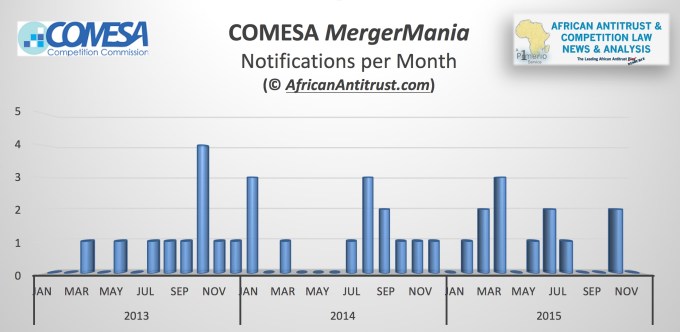
To answer our rhetorical question in the title above: We don’t believe so.  For the merger junkies among our readership, here is AAT’s latest instalment of “COMESA MergerMania” — AfricanAntitrust’s occasional look at merger matters reviewed by the young multi-jurisdictional competition enforcers in south/eastern Africa.  (To see our last post on COMESA merger statistics, click here).

COMESA publishes new Merger Filings, still fails to identify dates thereof

As nobody else seems to be doing this, let us compile the latest news in merger notifications to the COMESA Competition Commission.  Prior to doing so, however, we observe one item of utility and basic house-keeping etiquette, which we hope will be heeded in future official releases by the agency: Please note the dates of (and on the) documents being issued.  Using the date as a ‘case ID’ is insufficient in our view — the CCC’s current PDF pronouncements invariably remain un-dated, a practice which AAT deplores and which simply does not conform to international business (or government) standards.  So: please date your press releases, opinions, decisions, and notifications on the documents themselves.

We observe that the matters below have not yet been assigned final “case numbers” (at least not publicly) in the style typical of the CCC decisions in the past, namely sequential numbers per year, as they are currently under investigation and have not yet been decided.

We also note that one notification in particular appears to have been retroactively made in 2014, even though it is identified as merger no. 3 of 2015 (Gateway), a peculiarity we cannot currently explain.  Likewise, AAT wonders what the “44” stands for in its case ID (“12/44/2014”), we surmise it’s a typo and should be “14” instead.

Internal Case ID Statement of Merger
Holtzbrinck PG/ Springer Science MER/04/06/2015 SOM/6/2015
Eaton Towers/ Kenya, Malawi, Uganda Towers MER/04/05/2015 SOM/5/2015
Coca-Cola BAL/ Coca-Cola SABCO MER/04/07/2015 SOM/4/2015
Gateway/Pan Africa MER/12/44/2014 SOM/3/2015
Old Mutual/UAP MER/03/04/2015 SOM/2/2015
Zamanita /Cargill MER/03/03/2015 SOM/1//2015

Which brings us to the bi-monthly…

AAT COMESA Merger Statistics Roundup

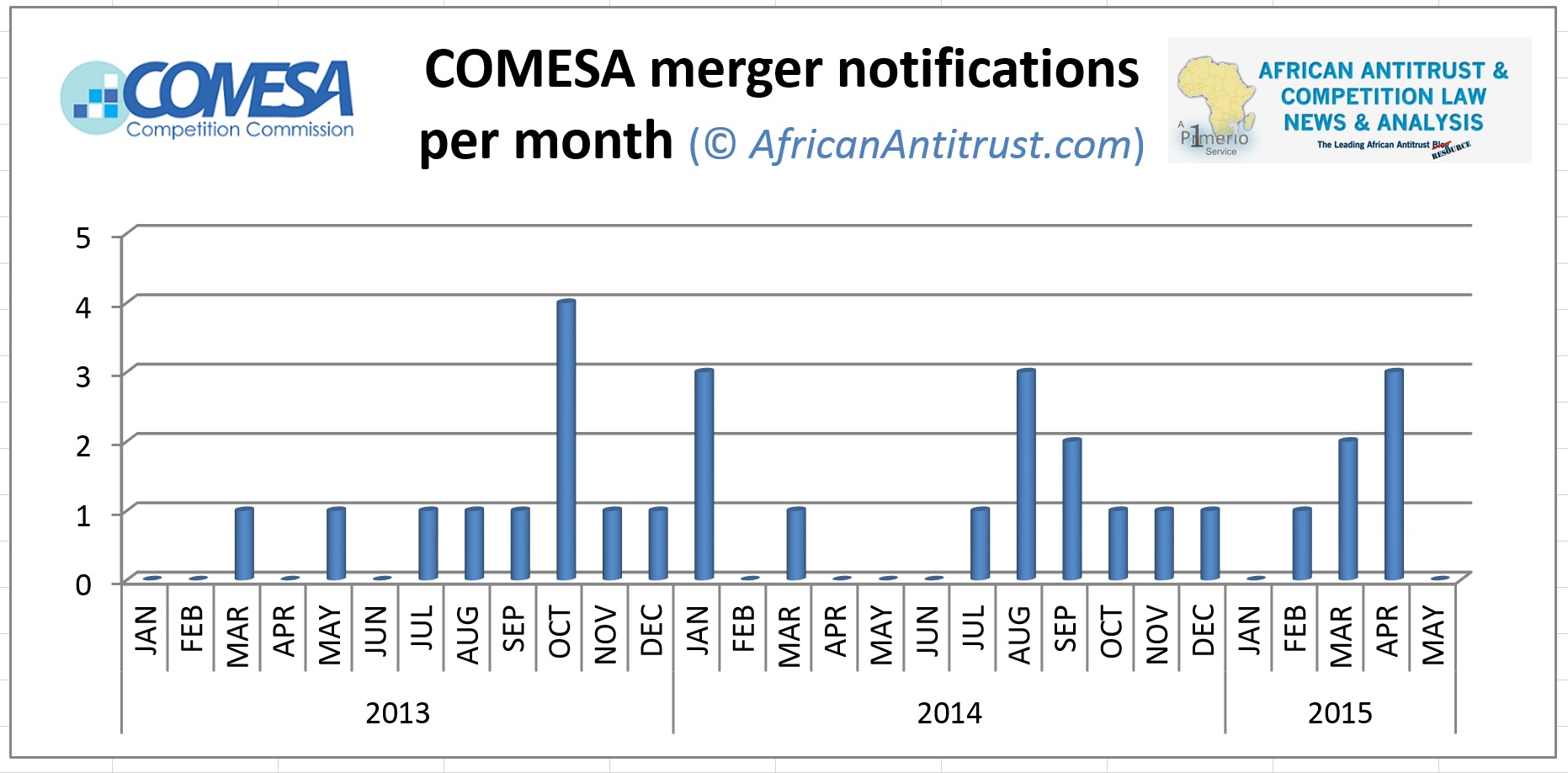
COMESA Merger Statistics as of July 2015
COMESA Merger Statistics as of July 2015 (source: AAT)

Proliferation of active multi-nation competition regimes continues

6-member East African Community (EAC) to finalise competition law amendments

The EAC, a regional intergovernmental organisation comprising Burundi, Kenya, Rwanda, Tanzania, Uganda and South Sudan, is said to be drafting amendments to its thus-far essentially dormant regional fair Competition Act (dating back to 2006, EAC Competition Act 2006, 49 sections) to address antitrust concerns in the region.  The EAC’s legislative body is in the final stages of completing its work on the East African Community Competition (Amendment) Bill (2015).

In a 2010 paper, Alloys Mutabingwa (then Deputy Secretary General of the EAC Community Secretariat) writes:

As the EAC begins the implementation of the Common Market, one is pushed to wonder, which kind of competition do we currently have in the East African Community? Is it the kind of competition that constantly pushes companies to innovate and reduce prices? Does it increase the choice of products and services available to EAC consumers? Or, is it the type of competition that is defined by companies colluding to highjack the market? The answer lies somewhere in the middle but one thing is certain, with the intensification of competition in the EAC there will be frictions between companies across the region as they seek to gain advantage over their competitors.

In this short and worthwhile read, he stresses the importance of having a multi-national competition framework vs. a purely domestic network of independent enforcers.  Mr. Mutabingwa uses the example of the merger case of East African Breweries and South African Breweries, in which the Kenyan and Tanzanian competition authorities were “allowed by law to handle national practices only.”

According to an October 2014 article, “statistics show that the EAC’s total intra-regional trade soared from $2 billion in 2005 to $5.8 billion in 2012, while the total intra-regional exports grew from $500 million to $3.2 billion in the period under review.”  The  piece quotes an EAC competition official as saying that the enforcement agency would be online by December 2014.

In addition to the EAC efforts, a report also states that the head of economic affairs of the Tanzanian Fair Competition Tribunal (FCT), Nzinyangwa Mchany, recently emphasised the importance of member-state level enforcement, such as that of the country’s FCT and FCC, “to increase efficiency in the production, distribution and supply of goods and services to Tanzanians,” especially in economies that were centrally planned until only a few decades ago, and which have had to struggle with the ill after-effects of unregulated trade liberalisation and privatisation of state-owned enterprises.

Finally: One step forward for COMESA merger enforcement? New rules, new commissioners

COMESA old flag color

Clarification or not?

Amended Rules for Merger Notification

Repealing the oft-criticised original 2012 Rules on the Determination of Merger Notification Threshold, the COMESA Board of Commissioners approved on March 26, 2015 the new set of Amended Merger Rules. These are ostensibly meant to permit parties and their legal counsel a more meaningful determination of filing fees, notification thresholds, and calculation of parties’ revenue (and asset) valuation.  Whilst many legal news outlets have reported (uncritically, as we fear) a high-level summary of these Rules, AAT undertook a critical review of them, and finds that many of the previously-identified flaws persist.

Filing Fee

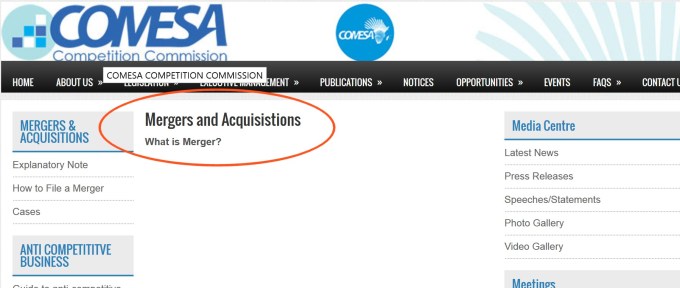
The question of what parties had to pay in administrative fees to be permitted to file a merger notification with the Competition Commission was always in question (see here for AAT summaries of the issue).  We have reported on examples of fees that came dangerously close to the original $500,000 maximum limit.  Since then, the agency’s “Explanatory Note” (which still has a visible link on the Commission’s web site, but which happens to be an essentially “dead” web page, other than its amusing headline: “What is merger?“) attempted to clarify, and indeed informally change, the filing fee from a 0.5% figure to 0.01% of the parties’ annual COMESA-area turnover.

COMESA explanatory note

Where the filing fee stands now is, honestly, not clear to AAT.  While other sources have reiterated the revised fee of 0.1% with a maximum of $200,000, we fail to see any information whatsoever about the filing fee in the (partial set, containing only ANNEX 2 of) the Amended Rules made available by COMESA on its site, despite their title containing the term “fees”.  We have been able to determine, through some internet sleuthing on the COMESA site, that a document marked clearly as “DRAFT” does contain references to 0.1% and $200k maximum fees.

We note that we have now seen three different turnover percentage-based filing fees from COMESA: 0.01%, 0.1%, and 0.5%, as well as several different maxima.  Which shall govern in the end remains to be seen.  We do not envy those parties that have filed with COMESA and have paid the half-million dollar fee within the past 2 years, as we doubt they are entitled to restitution of their evident overpayment.

AAT predicts that this is where things will land, at 0.1% and $200,000, once the good folks at COMESA get around to actually editing the document and finalising their own legislation, so that practitioners and parties alike may have an original, statutory source document on which to rely

Our previous AAT advice has been very clear to companies envisaging a filing with COMESA: wait until the Commission and the Board clarify the regime in its entirety.  Do not file for fear of enforcement, because there is little if any enforcement yet, and the utter lack of clarity – apparently even within the agency itself – on the actual thresholds and other rules provides ample grounds for a legal challenge to the “constitutionality,” if you will, of the entire COMESA merger regime

Combined $50 million revenue threshold

What the 5-page document does show, however, is the new notification threshold embodied in Rule 4, which defines the threshold as follows:

Either (or both) of the acquiring and/or target firms must ‘operate’ [defined elsewhere] in at least two COMESA member states and have (1) combined annual turnover or assets of $50 million or more in the COMESA common market, AND (2) in line with the EU’s “two-thirds” merger rule, each of at least 2 parties to the merger must have at least $10 million revenue or assets within the COMESA zone, unless each of the merging parties achieves 2/3 or more of its aggregate revenue within one and the same member state.

The likewise-revised Form 12, the mandatory filing form, which is available in a scanned format (we hope this will be remedied and provided in more legible and native-electronic format soon by the secretariat) here, reflects the rules changes.  It must be submitted at a minimum within “30 days of the merging parties’ decisions [sic] to merge.”  The Competition Commission mus t make a decision within 120 days of receipt of (a complete) notification.

Interestingly, if the same two firms enter into multiple transactions within a 2-year period are to be treated “as one and the same merger arising on the date of the last transaction.” (See Rule 5, in a likely-misidentified subsection that is confusingly entitled 1.2.). Mimicking the EU Merger Regulation and Consolidated Jurisdictional Notice, the revised COMESA rules likewise contain special provisions for determining the revenues or assets of financial institutions (and their individual member-state branches’ income) as well as insurance companies.

Parents, sisters, subs: included.

Parent, sister and subsidiary entities are included in the revenue determination of the purchaser, to no surprise.  However, unlike what has been reported in the media, again we fail to see the (entirely logical) exclusion of the target parent’s turnover in calculating total revenues, other than in section 3.16 of the August 2014 Guidelines (which provides: “the annual turnover and value of assets of a target undertaking will not, for the purposes of these Guidelines, include the annual turnover or value of assets of its parents and their subsidiaries under Section 3.15)(d)where, after the merger is implemented, such parents are not parents of (i) the target undertaking if it remains after the merger, or (ii) the merged undertaking in the case of an amalgamation or combination“).

We observe the obvious: the Guidelines have no binding legal effect.

The Amended Rules do however provide that state-owned enterprises do not have to include their “parental” governmental revenues; for instance, if a state-owned airline like Air Tanzania were to acquire its counterpart, such as Air Mauritius, in a hypothetical COMESA-reportable transaction, the parties would not be required to report the full tax income or other revenues of the Tanzanian and Mauritian governments, respectively, but only those of the actual state-owned entity and its subsidiaries.

COMESA's 18th Summit in Ethiopia

18th COMESA Summit in Ethiopia

Four New Commissioners

As AAT reported previously, the Addis Ababa COMESA summit also saw the election and confirmation of four new Competition Commissioners.  We now have the full listing of the members, including the 4 new* ones (listed below in italics), whose term is for three years:

New 2015 Commissioners Origin
Ali Mohammed Afkada Djibouti
Amira Abdel Ghaffar* Egypt
Merkebu Zeleke Sime* Ethiopia
Francis Kariuki Kenya
Matthews Chikankheni Malawi
Georges Emmanuel Jude Tirant* Seychelles
Thabisile Langa Swaziland
Patrick Okilangole* Uganda
Chilufya Sampa Zambia

ACF in the spotlight: African Competition Forum promotes policy enhancements

Putting African antitrust enforcement in the spotlight: the work of the African Competition Forum

AAT is often right and sometimes wrong — and we acknowledge the latter whenever that happens.  Today is one such occasion, as we have been entirely remiss in our coverage of the African Competition Forum (“ACF”).

The ACF (FAQ here) is a 3+ year-old organisation comprising several anglophone and francophone countries with and without competition enforcement agencies across the African continent (with apparently ongoing efforts to recruit Portuguese-language entities as well, e.g., Mozambique, Angola).  It undertakes various research, capacity-building, and advocacy/integration projects, all related to competition policy and enforcement.

The ACF notably spans across the entire continent, having a self-reported 41 countries as members, and its membership scope is larger than that of regional bodies, such as COMESA or SADC.

We look forward to providing more in-depth coverage of the ACF in the future, including interviews with the group’s senior leaders.  For the time being, in the organisation’s own words, its history and mission are as follows:

The African Competition Forum (ACF) was formally launched in March 2011 as a network of competition authorities in African countries. The network is comprised of 41 out of 54 African countries. It was tasked with enhancing the adoption of competition laws, building the capacity of new authorities and assisting in advocating for the implementation of competition reforms that benefit African economies. In countries where there is no authority, the network would assist in paving the way for the development of a competition law. An Interim Steering Group (ISG) was initially tasked with overseeing the setting up of the ACF.

A major task the ISG and then SC had to perform, foremost, was the development of a needs assessment which would be used to develop the ACF’s plan of action and would also help prioritise the key issues for which countries who are members of the network would require assistance. In coming up with the needs assessment a broad questionnaire was administered and sent to the four regional competition authorities of Southern African Development Community (SADC), West African Economic Monetary Union (WAEMU), Common Market for East and Southern Africa (COMESA) and Economic Community of West African States (ECOWAS) and to forty-one countries, twenty-seven of which responded.

Overall, the key elements that were identified as priorities for African authorities within the questionnaire fell into three main categories:

1. Capacity building on strategic planning and management, practical aspects of competition law enforcement such as investigative and litigation skills and techniques; and foundational training on the basics of competition law and economics;
2. Technical assistance in drafting and revising competition policy, laws and regulations and in designing agency procedures, guidelines, and operational manuals; and,
3. Support with advocacy and engaging other relevant stakeholders.

The questionnaire incorporated the above elements in five sections, namely:

1. The status of competition policy and law in the responding country
2. The responsible agency’s powers, jurisdiction and functions (if one exists)
3. The resources and workload of the competition agency
4. The capacity building and technical support required by the responding country
5. The nature of relationships with regional and multinational and other competition bodies.

Respondents’ contact details were drawn from the International Development Research Centre (IDRC) databases on competition authorities worldwide; information supplied by Department for International Development (DFID); SADC; United Nations Conference on Trade and Development (UNCTAD); personal contact between the ACF Co-ordinating Team; and, regional and national authorities. A meeting about the needs assessment questionnaire with African countries attending an UNCTAD conference in Geneva in November 2010 also served to provide contacts details of key competition personnel.

The ACF was recently spotlighted in an article in the Tanzanian Daily News, which reported on the ACF’s workshop entitled “Agency Effectiveness.”  The article is worth a read, we believe, as it explains the history of the ACF’s founding as well as some background to African economies’ slower and later adoption of competition regulation, due to previously centrally-planned economics and broadly government-sanctioned monopolies operating lawfully:

Dr Kigoda noted that African economies have co-existed with a number of well-known cartels and anti-competitive conducts such as price fixing, bid-ridding, restrictions of output, allocation of markets and other unwarranted agreements.

Due to that African competition agencies must be vigilant to investigate and prosecute all these in order to ease the burden on their taxpayers.

Deputy Chairman of Fair Competition Commission (FCC) Col. (Rtd) Abihudi Nalingigwa said competition authorities seek to ensure that there are no anti-competitive agreements, abuse of market power and unjustified monopolistic market concentrations are put on check.

“We thought it would be worthwhile this time around concentrating on ‘Agency Effectiveness” because we believed the topic falls directly within the expectations of our stakeholders including the consumer, business community and the government who should see value for financing agency operations.

This can best be realized through translation into more effective competition and regulatory authorities which are capable of quick dispensation of justice that provide relief to their lives. On other hand, investor-confidence through better market regulation will increase investment inflow as investors will be assured that no anti-competitive will go unchecked or unaddressed.

Many African countries introduced their competition law in the mid 1990s prompted by a process of privatization and liberalization of their respective economies that started in late 1980s….


Confusion reigns in COMESA: filing fees misstated, “operation” vs. “threshold”, and new web site

COMESA Competition Commission logo

COMESA Competition Commission makes changes, but observers deplore lack of clarity and persisting mistakes

Visiting the CCC web site will yield a surprise to COMESA followers, as the Commission’s online presence has an updated look.  (Importantly, we express hope that it’s not all cosmetic but also substantive, and that the CCC’s webmaster has improved online security, in light of the numerous hacking attacks to which the agency was subjected in 2014.)

What’s more, the new web site has some new merger-related information, most notably of course the new finalized Merger Assessment Guidelines and an “Explanatory Note” on mergers.

Guidelines subvert Rules threshold under guise of companies’ “operation” within region

The former attempt to infuse some sense into the previous zero-dollar notification threshold regime (by re-defining in the Guidelines what it means to “operate” in COMESA countries as having turnover of >$5 million per annum).  They do so without actually amending or otherwise revoking the underlying Rules, which still do specify to this day that the turnover threshold for notification is “$0” COMESA dollars (which are the fictitious FX equivalent currency of U.S. dollars, so there is effectively no currency conversion required from USD figures).  CNBC/Africa has an 8-minute interview on the topic with a World Bank Group staffer who was part of the working group making the revisions here.

We at AAT respectfully question both the validity and the sensibility of keeping the flawed legislation of the Rules in place, while making agency ex parte interpretive changes via CCC “Guidelines” that notably do not have the force of law in COMESA countries.

“Explanatory Note” and the question of filing fees: 0.01% or 0.5%? Errors continue to persist.

The latter document (reproduced below in full) tries to do the same in a more simplistic fashion — asking, curiously, “What is merger?” [sic!]  However, the Explanatory Note appears fundamentally flawed as it incorrectly includes a reference to the filing fee as being set at 0.01% of the parties’ combined annual revenues.

AAT analysed this statement and believes that the CCC improperly refers to the old Rules (which provided for a 0.01% fee in Rule 55) until they were revised and then subsequently interpreted by CCC guidance in February of 2013: since then, filing a CCC notification incurs a fee of 0.5% of turnover, as we extensively discussed here(Update: The CCC has apparently read our post and, as of 5 Nov. 2014, changed this incorrect statement, deleting all references to filing fees in their entirety.)

Continuing lack of clarity emanates from COMESA’s official statements and publications

AAT deplores the ongoing confusion that reigns with respect to the CCC’s pronouncements on crucially important issues such as thresholds, filing fees, and the like.  It takes more than a new web site design to instill parties’ and attorneys’ trust in the young antitrust regime’s competency, and with it, new filings (which have notably stalled at zero for the past half year).

Mergers and Acquisistions

What is Merger?

Most mergers pose little or no serious threat to competition, and may actually be pro-competitive.  Such benevolent mergers have a number of economic advantages such as resultant economies of scale, reduction in the cost of production and sale, and gains of horizontal integration.  There could also be more convenient and reliable supply of input materials and reduction of overheads.  These advantages could, and should, lead to lower prices to the consumer.

Other mergers, however, may harm competition by increasing the probability of exercise of market power and abuse of dominance.  Mergers can also sometimes produce market structures that are anti-competitive in the sense of making it easier for a group of firms to cartelise a market, or enabling the merged entity to act more like a monopolist.

An increasing number of business firms in the COMESA region are merging, or entering into other forms of strategic alliances, in order to take advantage of the many economic benefits that arise from such transactions.  Undertakings in the COMESA region are relatively small compared with those in other parts of the world.  Mergers in the region, however, would create ‘regional champions’ capable of competing with other international companies on an equal footing.

Companies however need to notify the Commission their proposed mergers to enable the mergers to be thoroughly examined for any anti-competitive features that might reduce or eliminate the transaction’s economic benefits.  Not all mergers are notified to the Commission.  Only those large mergers that exceed a certain prescribed threshold have to be notified.  The fee for notifying mergers is not punitive, but is only meant to defray the costs to the Commission for examining the transactions.  The COMESA Competition Rules provide for a relatively small merger notification fee calculated at 0.01% of the combined annual turnover or combined value of assets in the COMESA region of the merging parties.  (NOTE by editor: The CCC has, as of 5 Nov. 2014, changed this incorrect statement and deleted all references to filing fees entirely.) Failure to notify mergers can however be very costly to the merging parties.  The Regulations provide for a high penalty of up to 1% of the merging parties’ annual turnover in the COMESA region for not notifying eligible mergers

Merger in COMESA Competition Regulations

The word merger in this COMESA Competition Regulation is construed in the context of its definition under Article 23(1) of the Regulations.

Control is used in the context of controlling interest as defined under Article 23(2) of the Regulations. Without prejudice to Article 23(2), control shall be constituted by rights, contracts or any other means which, either separately or in combination with and having regard to the considerations of fact or law involved, confer the possibility of exercising decisive influence on an undertaking. The COMESA Competition Commission (‘the Commission’) shall deem a person or undertaking to exercise control within the meaning of Article 23(2) of the Regulations if the person or undertaking;

  • Beneficially owns more than one half of the issued share capital of the undertaking;
  • Is entitled to cast a majority of the votes that may be cast at a general meeting of the undertaking, or has the ability to control the voting of a majority of those votes that may be cast at a general meeting of the undertaking, or has the ability to control the voting of a majority of those votes, either directly or through a controlled entity of the undertaking;
  • Is able to appoint, or to veto the appointment, of a majority of the directors of the undertakings;
  • Is a holding company, and the undertaking is a subsidiary of that holding company;
  • In the case of the undertaking being a trust, has the ability to control the majority of the votes of the trustees or to appoint or change the majority of the beneficiaries of the trust;
  • In the case of an undertaking being a close corporation, owns the majority of the members’ interest or controls directly, or has the right to control, the majority of the members’ votes in the close corporation; or
  • Has the ability to materially influence the policy of the undertaking in a manner comparable to a person who, in ordinary commercial practice, can exercise an element of control referred to in paragraphs (a) to (f).

The Commission shall assess material influence on a case by case basis, having regard to the overall relationship between the acquiring firm and the target firm in light of the commercial context.

In its assessment of material influence, the Commission shall focus on the acquiring undertaking(s). Minority and other interests shall be examined by the Commission to the extent that they are able to influence the policy of the undertaking(s) concerned.

The Commission shall consider an acquiring firm’s ability to influence policy relevant to the behaviour of the target firm in the market place. This includes the management of the business, in particular in relation to its competitive conduct, and thus includes the strategic direction of a firm and its ability to define and achieve its commercial objectives.

The Commission shall consider an acquiring firm’s ability to block special resolutions by virtue of share ownership or other factors, including:

  • The distribution and holders of the remaining shares, in particular whether the acquiring entity’s shareholding makes it the largest shareholder;
  • Patterns of attendance and voting at recent shareholders’ meetings based on recent shareholder returns, and, in particular, whether voter attendance is such that in practice a minority holder is able to block a special resolution;
  • Any special voting or veto rights attached to the shareholding under consideration; and
  • Any other special provisions in the constitution of the target firm which confer the ability to exercise influence.

Where an acquiring firm is not able to block special resolutions of the target firm, the Commission shall have regard to the status and expertise of the acquiring firm, and its corresponding influence with other shareholders, and shall consider whether, given the identity and corporate policy of the target company, the acquiring firm may be able to exert material influence on policy formulation at an earlier stage.

The Commission shall review the proportion of Board of Directors appointed by the acquiring firm and the corporate/industry expertise of members of the Board appointed by the acquiring firm. The Commission may also assess the identities, relevant expertise and incentives of other Board Members.

Interpretation of Article 23(3) of the COMESA Competition Regulations
Article 23(3) of the COMESA Competition Regulations (‘the Regulations’) provides that:

                        “This Article shall apply where:

  • both the acquiring firm and target firm or either the acquiring firm or target firm operate in two or more Member States; and

  • the threshold of combined annual turnover or assets provided for in paragraph 4 is exceeded”.

The interpretation shall focus on Article 23(3)(a) since Article 23(3)(b) is superfluous due to the non-existent of thresholds currently. Article 23(3)(a) is divided into two parts as follows:

  • both the acquiring firm and the target firm operate in two or more Member States;
  • either the acquiring firm or target firm operate in two or more Member States.

The meaning of the first part above is that for a merger to fall within the dominion of Part IV of the Regulations is that both the acquiring firm and the target firm should operate in two or more Member States. For example if Company A is the acquiring firm and it operates in Zambia and Malawi and Company B is the target company and it equally operates in Zambia and Malawi, then the requirements of the first limb are satisfied and the merger falls within the ambit of Part IV of the Regulations.

Another scenario where the first part is satisfied is where Company A the acquiring firm operates in Zambia and Malawi and Company B the target firm operates in Zambia and Ethiopia. In this example, both Company A and Company B operate in two or more Member States.

The third scenario where the first part is satisfied is where Company A the acquiring firm operates in Zambia and Malawi and Company B the target firm operates in Djibouti and Madagascar. In this example, both Company A and Company B operate in two or more Member States.

As regards the second part, a merger falls within the province of Part IV of the Regulations where for example Company A the acquiring firm operates in Kenya and Seychelles and acquires Company B the target which has no operations in the COMESA Member States.

Another scenario where the second part is satisfied is where Company A the acquiring firm has no operations in any of the COMESA Member States but acquires Company B the target which operates in Rwanda and Burundi.

The foregoing are pursuant to the second limb which uses the words “either or” and therefore presupposes that both the acquiring firm and the target firm do not have to operate in two or more Member States as is the case for the first limb but that where either the target or acquiring is operates in two or more Member States, the merger is captured under Part IV of the Regulations.

It is important to note that where the acquiring firm operates in only one Member State and the target firm operates in another Member State and only that Member State, then such a merger does not satisfy the jurisdictional requirements of Part IV of the Regulations. This is however on the premise that such firms do not control any other firm whether directly or indirectly in a third Member State. Such firms should also not be controlled whether directly or indirectly by any other firm in a third Member State. For example, where Company A the acquiring firm operates in Swaziland only and Company B the target operates in Rwanda only, such a merger does not meet the jurisdictional requirements of Part IV of the Regulations. The situation may be different where Company A has a stake in Company C which operates in Mauritius or Company B has a stake in Company D which operates in the Democratic Republic of Congo.

The word operate is taken to mean that a firm(s) in issue derives turnover in two or more Member States. Therefore does not need to be directly domiciled in a Member State but it can have operations through exports, imports, subsidiaries etc. in a Member State.

COMESA to media reps: “Dr. Livingstone, I presume?”

COMESA Competition Commission logo

Zambia hosts COMESA Competition Commission workshop to sensitize journalists to antitrust

As many African news outlets are reporting, their journalists were recently invited to take part in a competition-law “sensitization workshop” hosted by high-ranking CCC personnel in Livingstone, Zambia.

In light of COMESA’s currently lackluster merger enforcement and virtually non-existing merger notifications (none since 19 March 2014), this “media sensitization” public relations effort on the part of the CCC leadership comes as no surprise.

Here, we quote from the Seychelles Nation:


The Common Market for Eastern and Southern Africa (Comesa) competition commission recently organised a regional sensitisation workshop for business reporters.

The aim of the workshop, held in Livingstone, Zambia, was to enhance the role of the media in exposing anti-competitive business practices and promoting a competition culture in markets. 

The media was explained the role of good reporting on the competition policy within the Comesa, whose prime objective is to promote consumer welfare through encouraging competition among businesses. This objective is achieved by instituting a legal framework aimed at preventing restrictive business practices and other restrictions that deter the efficient operation of the market, thereby enhancing the welfare of consumers in the common market. 

Comesa is a regional economic grouping composed of 19 member states namely; Republic of Burundi, Union of Comoros, Democratic Republic of Congo, Republic of Djibouti, Arab Republic of Egypt, State of Eritrea, Federal Democratic Republic of Ethiopia, Republic of Kenya, Libya, Republic of Madagascar, Republic of Malawi, Republic of Mauritius, Republic of Rwanda, Republic of Seychelles, Republic of Sudan, Kingdom of Swaziland, Republic of Uganda, Republic of Zambia and Republic of Zimbabwe.  The grouping’s objective is for a full free trade area guaranteeing the free movement of goods and services produced within Comesa and the removal of all tariffs and non-tariff barriers.

But only journalists from Kenya, Malawi, Mauritius, Seychelles, Rwanda, Swaziland, Uganda, Zambia and Zimbabwe were present at the workshop. Seychelles was represented by journalist Marylene Julie from the Seychelles NATION newspaper.

The Comesa competition law is, in this regard, a legal framework enforced with the sole aim of enabling the common market attain the full benefits of the regional economic integration agenda by affording a legal platform for promoting fair competition among businesses involved in trade in the common market and protecting consumers from the adverse effects of monopolisation and related business malpractices.

Among the topics discussed at the meeting were the definition and scope of competitive policy;  the relevance of competition policy in ensuring market efficiency and the protection of consumer welfare; overview of the Comesa competition regulations, its legal basis and implementation modalities.

Mergers and acquisitions were also explained and why competition authorities regulate them. 

The media representatives also learned about their role in ensuring businesses notify transactions with competition authorities to avoid the dangers of anti-competitive business.

Hosting the workshop were the director and chief executive of the Comesa competition commission, George K. Lipimile; the manager for enforcement and exemptions Vincent Nkhoma and Willard Mwemba, manager (mergers & acquisitions).

In a message from the secretary general of Comesa Sindiso Ngwenya which was read by Mr Lipimile, Mr Ngwenya welcomed all media guests in Livingstone for the sensitisation workshop.

He said the gathering means that Comesa is reaching out to one of the most important key stakeholders in the region – the media. 

He also said the media plays a great role in advancing the group’s advocacies in the regions and through it Comesa is creating awareness surrounding the current regional trade order and the need for a competition policy for the region.

“Today our specific governments as well as other economic operators and the general public are appreciating that competition policy has a key role to play in creating conditions of governance for the national, regional and global market place,” read the message.

Explaining why the competition policy is an important instrument, Mr Lipimile said it forces companies to run themselves efficiently, ensures a level playing field, forces economic operators to adjust changes and encourages innovation. Competitions lead to lower prices, greater dynamism in industry and most important of all greater job creation.

He added that competitive markets are needed to provide strong incentives for achieving economic efficiency and goods that consumers want in the quantities they want.

Regarding mergers and acquisitions and why competition authorities should regulate mergers, Mr Mwemba said the regulation of mergers is one of the most important components of any competition legislation and policy. 

He explained that sometimes mergers are effected to eliminate competition. 
“Therefore mergers need to be regulated so as not to injure the process of competition and harm consumers,” said Mr Mwemba.

He highlighted that firms merging just to eliminate competition is detrimental to consumers as it results in poor quality goods, high prices, and fewer choices to them.

He also stressed the media’s role in ensuring firms notify their mergers so that they do not merge for ulterior motives. 

The media can also avoid situations where firms  keep the merger a secret as they are mindful competition authority may reject their application. 
“The media should act as watchdog by reporting mergers that have happened in the country,” said Mr Mwemba.

As for Mr Nkhoma, he said there are several ways in which anti-competitive business practices can harm consumer welfare and derail the gains of intra regional trade. 

He said this during his presentation on anti-competitive business practices and the role of the media in enhancing the competition culture. 

He gave examples of two well established firms in a country or region which are engaged in fierce competition with each other. Such competition leads them to independently introduce innovations aimed at outwitting each other on the market such as offering lower prices, discounts, rebates, etc.  The consumer benefits from this rivalry in terms of low prices, high quality, etc. 

He explained the scenario where two firms decide that rather than compete, they agree on what quantities to supply on the market and at what price and quality.  The two firms will end up maximising profits at the expense of consumer welfare. 

“This is what is described as a cartel, a situation where businesses rather than compete, seek to collude to exploit high prices from the market. Markets dominated by cartels will ultimately become complacent in their business decisions and as a result, consumers lose out by way of poor quality products, high prices, etc.,” said Mr Nkhoma.

He also said consumers may also have experienced scenarios where a firm or a collection of firms become so dominant in the market to the extent of behaving without effective constraints from existing competitors or potential competitors. Such dominant firms have an incentive to charge excessive prices knowing that consumers have no alternative of getting similar goods or services anywhere feasible. 

In Seychelles the competition regulator is the Fair Trading Commission (FTC). In a recent press release, FTC said it is setting up a National Competition Policy which comes at a time when Comesa is seeking to harmonise the Comesa competition regulations with domestic competition law. 

The National Competition Policy aims at guiding governments on applying laws, regulations, rules of policies that will allow businesses to compete fairly with one another in order to foster entrepreneurship activity and innovation. 

The policy will also guide the commission in the enforcement of the Fair Competition Act 2009 and will provide a platform upon which national policies can be harmonised with the existing competition law.