More Criminal Anti-Cartel Enforcement in Africa? Some Thoughts on Nigeria

By AAT guest author, Osayomwanbor Bob Enofe, Sutherland School of Law Doctoral Scholar, UCD.

We recently wrote about the landmark enactment of the new South African competition legislation that makes hard-core price-fixing a criminal offence, subjecting cartelists to up to 10 years imprisonment.  Nigeria is usually not on the radar of antitrust practitioners, however, and certainly not in the criminal sense, either.  As regular readers of AAT know, the Republic of Nigeria has featured occasionally in our posts despite not having a functioning antitrust regime, yet.  As editor and Pr1merio director Andreas Stargard wrote in an article entitled “Nigerian antitrust?“, scholars and political activists alike have promoted the idea of establishing an antitrust regime in West Africa’s dominant economy: ‘Today, AfricanAntitrust adds its voice to the steady, though infrequent, discussion surrounding the possibility of a Nigerian competition-law regime.  In our opinion, it is not a question of “if” but “when”, and perhaps more importantly, “how“?’

Today, contributing author Bob Enofe adds his voice to the mix, and we are publishing one of his articles that originally appeared on Robert Connolly’s cartel capers blog.

Criminal Antitrust in Nigeria?

nigeriaThe Federal Republic of Nigeria is currently in the process of enacting a competition law, including to criminalise cartel activity amongst competitors. While such is in line with moves made by various other jurisdictions and theories of ‘rational actor’, sanction and deterrence, on ground realities suggest that criminalisation where transplanted might be seriously flawed.

From the late 1990s, and particularly in the year 2000, the Federal Government of Nigeria commenced moves to enact a Competition Law. Under such law, business cartel activity defined as agreements between competitors, aimed at distorting the process of competition and generating monopolistic rents, would be criminalised. The ‘Federal Competition Bill, 2002’, an executive bill drafted by the Nigerian Bureau of Public Enterprises (BPE), was titled: “a Bill for an Act to provide necessary conditions for market competition and to stimulate creative business activities, protect consumers, and promote the balanced development of the natural economy, by prohibiting restrictive contracts and business practices that substantially lessened competition”. It was also to be a Bill to regulate “possible abuses of dominant positions by businesses, and anti-competitive combines, and to establish the Federal Competition Commission, for effective implementation and enforcement of all the provisions of the bill”.  According to relevant sections of the bill, cartel agreements amongst competitors, including price fixing, bid rigging and market division, were also to be expressly criminalised. Clearly a robust and comprehensive bill, 16 years after introduction to the Nigerian National Assembly, the bill remains to be passed into law. Several amendments have since been presented, together with other bills presented by lawmakers. In every case, such bills have either stalled at first reading stage, or in certain cases disappeared from the legislative process. In one of such instances, an amendment of the above bill (The Federal Trade and Competition Commission Bill, 2006) was “vehemently” objected to by distinguished Senators, prompting governmental withdrawal. Amongst reasons advanced for the reception accorded the bill included that there was no need for a distinct ‘competition commission’, in the face of an already existent consumer protection council in Nigeria; other legislators simply complained about a proliferation of “too many commissions” in the country. Commentators have alluded to overt ignorance and lack of particular inclination for the subject, on the part of Nigerian Senators, as in reality underlining the reception accorded the bill.

In a paper recently presented at the #SLSA2016, ‘Developing Countries, Nigeria, and Cartel Criminalisation: of Transplantation and Desirability’ I had outlined how Nigeria’s attempt to introduce a competition law, and in particular criminalise cartel activity, reveals a (marked) lack of societal inclination towards competition law and prior poor advocacy on the part of government. Social norms are crucial to the effectiveness of law reform. Desirable social norms ensures amongst other things that prohibited conduct will be reported and discovered, even without direct enforcement or investigativeBob Enofe intervention, thereby complementing stretched law enforcement efforts.[1] Such also imply that prosecutors will be willing to enforce and vigorously police provisions of the law where passed, and in the case of the judiciary, stringent sentences will also be applied—or at least not deliberately avoided—so as to facilitate the deterrence potential of the applicable law. Perhaps most crucially for Nigeria, existence of such norms also mean that law makers are incentivised to support reform efforts, while the chances of ‘hijack’ by private interests will be slim. Absent such norms the chances of Nigeria’s competition and cartel criminalisation law, even when passed, could be (remarkably) marginal.

Heightened advocacy, together with a careful selection of test cases once the law is enacted is advanced as capable of remedying the above situation. In the face of sub-par institutions characteristic of the Nigerian context however (including severe limitations in the operation of the rule of law), abilities to so ‘guide’ social norms will be in reality seriously limited. An online petition regarding corruption amongst Nigerian senators, for example, reflect in part difficulties that could frustrate transplantation of cartel criminalisation, absent independent, effective, anti-corruption reforms in the country.

Neoliberal theories of rational actors, sanction and deterrence, imply to large extents a similar existence of contexts as have underlined effectiveness in western societies. In many cases, on the ground realities suggest that theories where transplanted, could be seriously flawed.

As I have argued in another paper currently under review (details to be communicated soon, hopefully!), one size cannot fit all- with developing countries and cartel criminalisation, the point gains extra force. To the extent that fines and other administrative means of enforcement are limited in ability to effectively curtail cartel practices, suggests a need for continuation of relevant research. Criminalisation hardly represents the ‘Golden Fleece’.

Footnote:

[1] See Stephan, Andreas, ‘Cartel laws undermined: Corruption, social norms, and collectivist business cultures’ (2010) Journal of Law and Society 345-367, See Maher, Imelda, The Institutional Structure of Competition Law, in Dowdle, Gillespie and Maher (eds) Asian Capitalism and the Regulation of Competition: Towards a Regulatory Geography of Global Competition Law (Cambridge University Press, 2013) 55, See Gal, Michal  ‘The Ecology of Antitrust: Preconditions for Competition Law Enforcement in Developing Countries.’ (2004) Competition, Competitiveness and Development 20-38.
CEO Calls for Introduction of Nigerian Competition Law


“Too huge to be monopolised”? — Orkeh cites business need for Nigerian competition law

The Managing Director and Chief Executive Officer of African Cable Television, Mr. Godfrey Orkeh, was interviewed recently in Lagos, Nigeria, and discussed a topic we at AAT have previously addressed: The need for Africa’s largest economy to enact antitrust laws.  ACTV (pronounced “active”) began its service in December 2014 and has faced an uphill battle in entering the pay-TV marketplace.

As John Oxenham, a founding director of Pr1merio, the Africa-focussed legal advisory firm and business consultancy, points out: “In April of 2014, Nigeria surpassed South Africa as the continent’s largest economy, yet it still lacks any enforceable antitrust provision in its statutes.” (See Economist Apr. 12, 2014: “Africa’s New Number One“).

nigeria

Even prior to Nigeria’s rise to become the continent’s premier economy in terms of GDP, we published several calls for a Nigerian competition law. For example, in our article “Another call for Competition Law in Nigeria: Privatization of Electricity,” AAT contributor Chinwe Chiwete wrote:

The way forward still remains for Nigeria to have a Competition Law as the basic legal framework upon which other sector regulations can build upon.

Chilufya Sampa, a former COMESA Competition Commissioner and currently the Executive Director of the Zambian Competition & Consumer Protection Commission, said that antitrust law in Africa’s largest economy “would be great indeed,” noting the “many benefits in having a competition law.”

Pr1merio director Andreas Stargard likewise promoted the idea of establishing an antitrust regime in West Africa’s dominant economy. He wrote in an article aptly entitled “Nigerian antitrust?“:

Today, AfricanAntitrust adds its voice to the steady, though infrequent, discussion surrounding the possibility of a Nigerian competition-law regime.  In our opinion, it is not a question of “if” but “when”, and perhaps more importantly, “how“?

“If”: it is a virtual certainty that sooner or later, the drivers of growth in the Nigerian economy (innovators, IPR owners and applicants, upstarts, and foreign investment) will succeed in their demands for an antitrust law to be enacted.

“When”: it’s been debated in Nigeria since at least 1988; there was another push in the right direction in 2002; and, since then, at least a steady trickle of intermittent calls for a central antitrust regulator, often coming loudest from the outside (as does this post). This general time line coincides with that of other developing or now emerging competition-law jurisdictions, and we believe it is now a question of years, not decades, until a Nigerian Sherman Act will see the legislative light of day. Our (admittedly unscientific) prediction is that Nigeria will have a competition-law regime prior to 2020. (Note: the latest of up to six bills introduced to date, the Competition and Consumer Protection Bill, has been languishing in the Nigerian Senate since 2009).

“How”: this is the kicker — the most interesting bit of the Groundhog Day story this would otherwise be and remain. The intriguing part about reigniting the discussion surrounding Nigerian antitrust law is that we now live in the age of COMESA and more importantly here, the COMESA CCC (Competition Commission).

This opens up new opportunities that may not have been envisaged by others in the 1990s or 2000s. For example: will the economies of West Africa band together and create a similar organisation, notably with “legal teeth”, which might include provisions for a centralised enforcement of antitrust? Will it be under the auspices of ECOWAS or UEMOA? A monetary union has been known to be an effective driver of ever-increasing competition-law enforcement elsewhere in the world (hint: Brussels)…

If the answer to these crucial questions is “no”, what are the consequences to the Nigerian economy? Will Nigeria continue on its path to outsider status when it comes to healthy economic regulation — despite its powerhouse status in sub-Saharan Africa? Will this add to the disincentive against increased foreign investment, akin to the prevalent oil and diesel-stealing that occurs ’round-the-clock and in the open? Will businesses — other than former state monopolies, now privatised and firmly in the hands of oligarchs, or cartelists — continue to accept being deprived of the economic fruit of their labour, without protection from certifiably anti-competitive behaviour? Will other state agencies continue to step in and act as quasi-enforcers of antitrust, as they have done in the past (the Air Cargo cartel is an example), filling the void of a central competition commission?

Godfrey-Orkeh
Chief Executive Officer of African Cable Television, Mr. Godfrey Orkeh

Below, we excerpt a few of Mr. Orkeh’s pertinent comments on the issue, in which he discusses the lack of any monopolisation offence under Nigerian law and the high barriers of entry in the television and media sector he and his company have faced while challenging the incumbent domestic TV provider.

The number one challenge in the industry is that there is no regulation, NBC is doing its best but there is no act of law that backs the activities up. Before the last government handed over, there was a bill that was being pushed, [competition-law] bill like what we find in Europe that nobody can own 100 per cent of an industry, if you grow beyond a particular size, for instance when Microsoft, Google among others grew beyond a certain size, they were stopped to allow room for other players. There is no such law right now in Nigeria so it is a big barrier; it is only legislature that can change that. … This is good for the economy and the customers.

We knew there is a monopolistic tendency in the market, the existing structure in the legislature of Nigeria allows a dominant player to take advantage of the environment, before we came to the market. There was no pay TV offering PVR for the middle class and for you to get decoder with PVR you have to cough out about N70, 000 but we are saying with N15, 000 you can have a PVR. And content-wise there was a lot of exclusivity which is going to be difficult for one person to break. Beyond this, we will develop the market for our self, develop a niche for our self because right now the tendency is also thriving in the industry, Nigeria with a population of about 170 million, 26 million households with television, but the market is so huge. There is still a huge market that is not being addressed, we are here to capture that niche market and grow it. … [] Nigerians are the only ones that can take a stand as far as monopoly is concerned, and we have started seeing that in recent social media reactions about what is happening in the industry.  If we don’t have a choice there will always be a monopoly even if it is only a player that is that market, but you’ve created an avenue for two to three players to play in the market, there would be options like what we see in the telecoms sector, where I can port my number, which I believe has  taken efficiency to another level. So we are getting to a point where with digitisation every Nigerian would be exposed to as many channels as possible.  But the fact remains that the market is a huge segment. It is too huge to be monopolised.

Outside of AAT’s own resources on the prospect of a future Nigerian antitrust law, we refer our readers to the following resources for further reading on this topic:

  1. http://www.globalcompetitionforum.org/regions/africa/Nigeria/antitrust%20article.pdf
  2. http://afro-ip.blogspot.be/2011/11/iprs-and-competition-law-nigerian.html
  3. http://www.cuts-ccier.org/7up4/NTW-Nigeria_media.htm

Investment in Africa: Changing landscape, new hurdles

Questioning African antitrust growth prospects: Slowdown in economic investment (both organic and outside investment) may affect functioning of competition law on the continent

Recent developments in Africa have many scratching their heads and wondering whether the formerly wondrous economic-growth engine of the vastly resource-rich and otherwise economically still undervalued continent will soon experience a slowdown, if not come to a halt altogether.

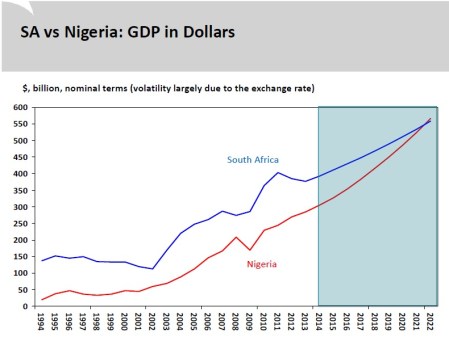
For one, in April 2014, Nigeria surpassed South Africa as the continent’s largest economy (see Economist Apr. 12, 2014: “Africa’s New Number One“).  This is a significant milestone for the former, and a setback for the latter — an economy that was 8 times the size of the Nigerian economy only 20 years ago, yet is now suffering from stagnating GDP, reeling from corruption allegations amongst its current leadership, undergoing a closely-watched presidential election process, and whose ruling ANC party is facing a heretofore unprecedented backlash and torrent of criticism.

Source: The Economist

Not only South Africa has weakened, politically and economically, however.  Events such as the Northern Nigerian wave of violence – with sectarian Boko Haram forcefully displaying the impotence of the central Nigerian government of a weakened president Goodluck Jonathan – fuel the fire of outside investors’ mistrust of African stability and their concomitant reluctance to make good on prior investment promises.  As The Economist notes in the article quoted above: “it is not a place for the faint-hearted” to invest, even though it highlights the successful Nigerian business ventures of outsiders such as Shoprite, SABMiller, and Nestlé.  Bloomberg BusinessWeek quotes Thabo Dloti, chief executive officer of South Africa’s fourth-largest insurer Liberty Holdings Ltd. (LBH), as saying: “It does slow down the plans that we have, it does put out the projections that we have by a year or two.”

http://www.stanlib.com/EconomicFocus/Pages/InterestingChart112SouthAfricaneconomyvsNigerianeconomy.aspx
Nigerian vs. RSA GDP
Source: http://www.stanlib.com

Likewise, multi-national organisations such as COMESA and its competition enforcement body, are undergoing significant changes (such as, currently, an opaque process of raising the heretofore insufficient merger-filing thresholds), shockingly successful web attacks on their data, and a resulting dearth of transactions being notified.  Elsewhere in developing economies, recent political turmoil has likewise led observes to comment on the negative spillover effect from political & social spheres into the economy (e.g., Financial Times, May 8, 2014: “Political crisis further dents prospects for Thai economy“).

Impact on antitrust practice

The upshot for competition-law practitioners and enforcers alike is rather straightforward, AAT predicts: more hesitation around African deals being done means fewer notifications, less enforcement, and overall lower billings for firms.

The flip side of the coin – as is usually the case in the economic sine curve of growth and slowdowns – is the commonly-observed inverse relationship of M&A and criminal antitrust: while we may see fewer transactions in the short term, the incidence of cartel behaviour and commercial bribery & government-contract fraud cases will likely increase.

More or less competition in African mobile payments sector?

south_africakenyanigeria

More countries may enter the mix of players – but at the platform level, competition may have stagnated

As we reported last month, the mobile payments sector is going gangbusters on the African continent.  Kenya is ahead of the game, but other countries are closing in.

Kenya itself is considered by many to be at the forefront of the African mobile-payments universe, with its M-Pesa mobile-currency system often touted as the most developed mobile-payment system in the world.  The Economist asked rhetorically: “Why does Kenya lead the world in mobile money?”, pointing out that roughly 25% of Kenya’s GDP flows through the mobile service, with over 17 million users in Kenya alone.  The WorldBank has commented that “Mobile payments go viral [with] M-PESA in Kenya.”

Earlier this week, South African media outlet Business Tech published an interesting comparative piece on the issue, entitled “Africa leads in mobile banking“.  The article shows (also graphically, see below) how  and South Africa are close rivals to the Kenyan leadership in the mobile payments industry:

Image credit: Business Tech

What triggered the article is the release of the MEF-Africa report on mobile payments on the continent, which provides much of the content of the Business Tech piece.

One of the key developments highlighted is that M-Pesa’s platform may soon see a major upgrade in South Africa (where it is run by Vocadom and Nedbank), according to the article, linking the system directly with the brick-and-mortar banks’ platforms.  This may either (1) cement the relative market dominance of M-Pesa or (2) spur further innovation and enhance the overall competitiveness of the still rather young industry.

Another call for Competition Law in Nigeria: Privatization of Electricity

The Privatization of the Electricity Sector in Nigeria

By Chinwe Chiwete
nigeria
The full implementation of the Electric Power Sector Reform has been a key priority for the administration of President Goodluck Jonathan in Nigeria. As noted in the Roadmap for Power Sector Reform, for over two decades, the stalled expansion of Nigeria’s grid capacity, combined with the high cost of diesel and petrol generation has crippled the growth of the country’s productive and commercial industries. The Federal Government was therefore determined to pursue the fundamental changes to the ownership, control and regulation of the sector as outlined in the National Electric Power Policy (2001) and enshrined in the Electric Power Sector Reform (EPSR) Act of 2005.

The power sector reform was structured into several phases starting with the creation of the Power Holding Company of Nigeria (PHCN) as the holding company of the assets of the defunct NEPA. The PHCN was subsequently unbundled into 18 successor companies which paved the way for the privatization program. On the 30th September 2013, the Federal Government formally handed over the unbundled Power Holdings Company of Nigeria, PHCN, to private organizations that bought it. Licenses and share certificates were handed over to these investors, an event which has ushered in a new beginning for Nigerians.

With the entrance of private players into the power sector, the possibility of market manipulation and other abuses cannot be overruled; consequently, consumers need to be adequately protected from these private sectors who are essentially profit driven. Till date, the Nigerian Competition Bill is yet to be passed into law meaning that competition related issues in the power sector will be regulated by the Nigeria Electricity Regulatory Commission (NERC or Commission) as the regulator of the power sector established under the EPSR Act. The EPSR Act empowered the NERC to monitor the Nigeria electricity supply industry with regards to its potential for additional competition and to monitor electricity businesses and markets to determine whether there is or may be an abuse of market power and where such exist take the appropriate actions which include issuing a cease order and imposing fines.

Clearly Nigeria seems to be adopting more of sector regulation of competition as against speeding up actions on the pending Competition Bill. This can also be seen from other existing laws for example, the Securities and Exchange Commission (SEC) regulates competition in terms of mergers and acquisitions as provided under the Investments and Securities Act 2007 (ISA) while the National Communication Commission (NCC) regulates competition in the telecommunication sector. Even though sector regulation may sometimes be necessary particularly for issues peculiar to that sector, there are disadvantages one of which is that the government may be less inclined to promulgate the pending Competition Bill which will leave many vital sectors unregulated. In addition, one foresees a case of over-regulation for certain sectors in the event that Competition Law finally comes into force. To address the possible conflict and power tussle between these sectoral regulators and the Commission created by the Competition Bill, the Federal Competition Bill at least made a comforting provision to the effect that the Commission created under the Bill will coordinate the activities of sectoral regulators as they relate to, or may impact on, competition with a view to maintaining coherence in policy implementation.

The privatisation exercises no doubt hold many advantages for Nigerians; however, more harm will be done if these private sectors are not well regulated. The way forward still remains for Nigeria to have a Competition Law as the basic legal framework upon which other sector regulations can build upon.

S.A. dominance in the Nigerian mobile telecom market? MTN concerned.

nigeriasouth_africa

AllAfrica.com reports that South African telecom giant MTN is in discussions with Nigeria’s Communications Commission (“NCC”) (again, note that Nigeria doesn’t have a competition law regime) relating to its 44% market share in mobile telephony in the country.

The NCC published its report in PDF format on its web site. The report, entitled “Determination of Dominance in Selected Communications Markets in Nigeria“, states in relevant part:

Nigeria is the fastest growing telecommunications market in Africa, rising from a meagre 500,000 telephone subscribers in 2001 to over 108 million as at December 2012 …

As the news report states, MTN is not accused of any abuse of its market power — that is, the hallmark of a unilateral / dominance case, abuse of dominance, is apparently yet absent from the NCC’s phantom case against the provider. What the NCC is worried about inter alia, however, is the preferential treatment given to MTN’s own customers and calls amongst that group. That’s interesting, because many providers across the world have similar “in-network” call rates (indeed, often even free allowances for in-network calls) without triggering antitrust review. The NCC does not perceive dominance issues in fixed voice or mobile data market segments. Rather than relying on the investigated operators’ submissions (proposing, among other things, to use a simple Herfindahl-Hirschman Index determination to see if the market segments were ‘concerntrated’), the NCC’s report lays out quite nicely how it used a “Structure‐Conduct‐Performance (SCP) model”.

The SCP model postulates that the structure of a market determines to large extent the conduct of the participants in the market, which in turn, influences the performance of the firms within the market with respect to profitability and efficiency.

We’ll see where this one goes. Perhaps it simply serves to reinforce our prior question: Is it not time for Nigeria to have its own, proper competition-law regime?

Nigerian antitrust?

nigeria
Today, AfricanAntitrust adds its voice to the steady, though infrequent, discussion surrounding the possibility of a Nigerian competition-law regime.

In our opinion, it is not a question of “if” but “when”, and perhaps more importantly, “how“?

“If”: it is a virtual certainty that sooner or later, the drivers of growth in the Nigerian economy (innovators, IPR owners and applicants, upstarts, and foreign investment) will succeed in their demands for an antitrust law to be enacted.

“When”: it’s been debated in Nigeria since at least 1988; there was another push in the right direction in 2002; and, since then, at least a steady trickle of intermittent calls for a central antitrust regulator, often coming loudest from the outside (as does this post). This general time line coincides with that of other developing or now emerging competition-law jurisdictions, and we believe it is now a question of years, not decades, until a Nigerian Sherman Act will see the legislative light of day. Our (admittedly unscientific) prediction is that Nigeria will have a competition-law regime prior to 2020. (Note: the latest of up to six bills introduced to date, the Competition and Consumer Protection Bill, has been languishing in the Nigerian Senate since 2009).

“How”: this is the kicker — the most interesting bit of the Groundhog Day story this would otherwise be and remain. The intriguing part about reigniting the discussion surrounding Nigerian antitrust law is that we now live in the age of COMESA and more importantly here, the COMESA CCC (Competition Commission).

This opens up new opportunities that may not have been envisaged by others in the 1990s or 2000s. For example: will the economies of West Africa band together and create a similar organisation, notably with “legal teeth”, which might include provisions for a centralised enforcement of antitrust? Will it be under the auspices of ECOWAS or UEMOA? A monetary union has been known to be an effective driver of ever-increasing competition-law enforcement elsewhere in the world (hint: Brussels)…

If the answer to these crucial questions is “no”, what are the consequences to the Nigerian economy? Will Nigeria continue on its path to outsider status when it comes to healthy economic regulation — despite its powerhouse status in sub-Saharan Africa? Will this add to the disincentive against increased foreign investment, akin to the prevalent oil and diesel-stealing that occurs ’round-the-clock and in the open? Will businesses — other than former state monopolies, now privatised and firmly in the hands of oligarchs, or cartelists — continue to accept being deprived of the economic fruit of their labour, without protection from certifiably anti-competitive behaviour? Will other state agencies continue to step in and act as quasi-enforcers of antitrust, as they have done in the past (the Air Cargo cartel is an example), filling the void of a central competition commission?

We are curious to hear our readers’ opinions.

Comment below or e-mail us directly (a.stargard [AT] primerio.international & j.oxenham [AT] primerio.international)