Gun jumping: Record antitrust fine for failure to notify merger

S.A. Competition Tribunal imposes record fine for missed merger filing in healthcare

By AAT guest author Meghan Eurelle

On 7 April 2016, the South African Competition Tribunal (“Tribunal”) confirmed that merger parties Life Healthcasouth_africare Group Proprietary Limited and Joint Medical Holdings Limited had entered into a consent agreement with record-breaking consequences.  The two hospital groups admitted to not complying with the Competition Act, 1998 (“the Act”) by failing to notify the competition authorities of their merger and to obtain the required approval prior to the merger being implemented; and subsequently agreed to jointly pay an administrative penalty of 10 million Rand, or approximately U.S. $690,000.  (Interestingly, the parties also conceded that they were guilty of fixing the price of services back in 2004 but the Tribunal dropped these charges.)

gunjumpingThe R10-million administrative penalty is a record amount for gun-jumping, or the failure to notify the competition authorities of a merger.  Previously, the highest penalty for a failure to notify was just over R1-million. The new record penalty follows numerous warnings by the Competition Commission (“Commission”) that it intended to materially increase penalties for failure to notify mergers — says Andreas Stargard, an antitrust practitioner with Pr1merio advisors, “South Africa has a suspensory merger-notification system, like most international antitrust regimes do.  And unlike other African countries, such as Senegal or Mauritius, the domestic S.A. competition legislation prohibits transacting parties from effecting the transfer of control or beneficial ownership prior to obtaining clearance from the authorities.”

In terms of the Act, transactions that are defined as “intermediate mergers” and “large mergers” must be notified to the Commission and may only be lawfully implemented if it has been approved, with or without conditions, by the relevant competition authorities. Small mergers do not have to be notified in the ordinary course and may be implemented without approval unless required by the Commission.

Merger notification thresholds in South Africa remain as follows:

Acquiring and Target firm (merger group) Target firm
Large Merger Combined assets and/or turnover of at least R6.6-billion. AND Assets and/or turnover of at least R190-million.
Intermediate Merger Combined assets and/or turnover equals or exceeds R560-million but is less than R6.6-billion. AND Assets and/or turnover equals or exceeds R80-million but is less than R190-million.
Small Merger Combined assets and/or turnover of less than R560-million. OR Assets and/or turnover of less than R80-million.

In light of the above, it serves as an important reminder to parties that they ensure compliance with the competition authorities and the Act so as to avoid costly consequences.

COMESA acknowledges low merger filing stats

2015 figures plummet 66% year-over-year

Going from 44 notifications in 2014 to 15 filings last year, the Competition Commission of the COMESA common-market area has seen a dramatic decline in merger filings.

Says Andreas Stargard, a competition lawyer with Africa advisory firm Pr1merio:

“These statistics are akin to the agency’s inaugural year — a slump that can only be explained by one of two likely underlying rationales:

Andreas Stargard, editor
A. Stargard

(1) Potential filers have begun to follow widespread advice from legal counsel that effectively admonishes would-be notifying parties not to do so until COMESA establishes a more robust enforcement and notification regime; or (2) — and this is the CCC’s preferred official explanation — the increased filing thresholds as of March 2015 caused fewer transactions to be caught in the mandatory filing net of the regulator.”

Of further concern, Stargard notes, is that the supporting merger documents made available by the CCC do not reflect the purported official statistics.  This fact is reflected in the MergerMania article published on AAT last August..  “For each and every one of the 15 filings identified by the Commission in its official statement, we should be able to see the underlying SOM [statement of merger] and the concomitant Decision — ideally published contemporaneously with the occurrence of each relevant event,” he says.  “Unfortunately, on the CCC merger site, two merger filings are missing entirely (numbers 9 and 10), and the others are commonly published many months after the public-comment deadline for the transactions has long expired.”

To date, a parsing of the (available) 2015 statistics shows that 3 of 15 cases actually went into Phase Two review, Stargard observes.  “This would generally imply a more serious concern raised by the authority in terms of the effect on competition post-merger.  Here, however, it is quite unclear what the potential threat to competition in, for example, a purely private-equity deal would be.  The official decision (no. 15, from November 2015) fails to even hint at a possible threat — as one would commonly expect from a PE to PE transaction, which usually raises little to no antitrust eyebrows…”

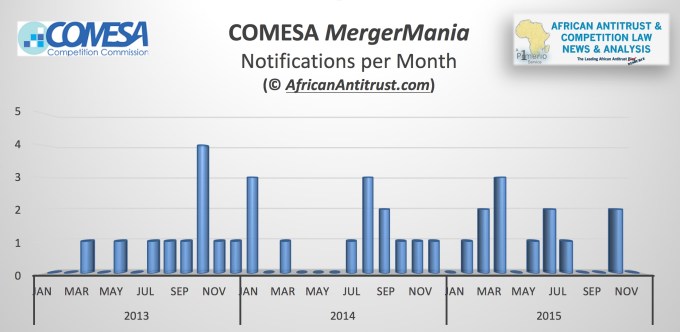
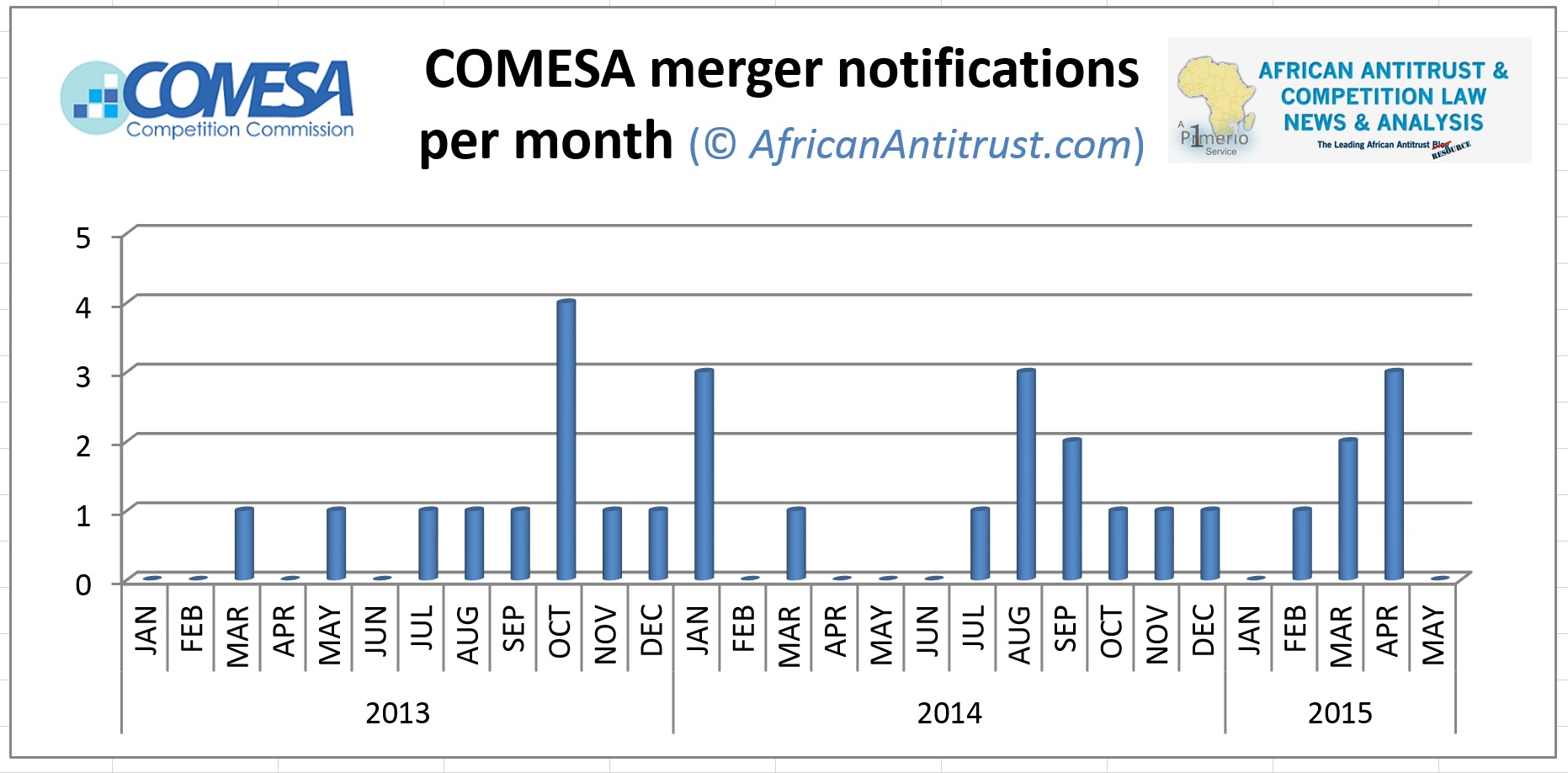
Our updated AAT COMESA MergerMania statistics are therefore as follows (again noting the fact that AAT bases its count on only the official, published and available merger documents, instead of relying on mere press release-based summaries published by the CCC).  We also note that to date, 2016 has seen one “merger inquiry notice,” namely of the Dutch Yara / Zambian Greenbelt fertiliser deal.  The public-comment period for that transaction expires on January 22, 2016.

Number of merger notifications based on CCC-published notices

The full text of the COMESA release follows below:

During the year 2015, the Commission assessed and cleared 15 merger transactions. The transactions involved sectors such as insurance, food additives, water treatment, agro-chemical, banking, telecommunication, non alcohol-ic beverage, publishing, packaging and retail. The Commission handled 12 merger notifications in the year 2013 and 44 merger notifications in the year 2014. The Pie Chart below shows the number of mergers handled by the Commission from inception to date.

COMESA merger statistics (official graphic)

As shown in the pie chart the Commission dealt with more mergers in 2014 as compared to 2013 but this trend has gone down in 2015. This trend may be attributed to the supposition that in 2013, the Commission had just commenced operations and therefore some stakeholders were not immediately aware of its existence and operations. By 2014, most stake-holders had become aware of the Commission and its operations, hence the significant increase in the number of mergers notified. The significant reduction in 2015 can be attributed to the supposition that the merger notification thresholds approved by the Council of Ministers on 26 March 2015 which has resulted in smaller mergers escaping the notification. Before 26 March 2015, the merger notification thresholds were Zero hence all mergers were notifiable regardless of size.

Insight into COMESA thinking: CCC executives speak

COMESA old flag color

COMESA officials’ pronouncements: merger enforcement #1, cartel ‘follow-on enforcement’, jurisdictional swamp

As other attendees of the 17 July 2015 regional sensitisation workshop have done, the Zimbabwean daily NewsDay has reported on the Livingstone, Zambia event — a session that has yielded a plethora of rather interesting pronouncements from COMESA Competition Commission (“CCC”) officials, including on non-merger enforcement by the CCC, as we have noted elsewhere.

In light of the additional comments made by CCC officials — in particular George Lipimile, the agency’s CEO, and Willard Mwemba, its head of mergers — we decided to select a few and publish the  “AAT Highlights: COMESA Officials’ Statements” that should be of interest to competition-law practitioners active in the region (in no particular order):

M&A: CCC claims approval of 72 deals since 2014

Non-Merger Enforcement by COMESA

As we noted in yesterday’s post, the CCC’s head, executive director George Lipimile, foreshadowed non-merger enforcement by the agency, including an inquiry into the “shopping mall sector,” as well as cartel enforcement.  On the latter topic, Mr. Lipimile highlighted cartels in the fertiliser, bread and construction industries as potential targets for the CCC — all of which, of course, would constitute a type of “follow-on enforcement” by the CCC, versus an actual uncovering by the agency itself of novel, collusive conduct within its jurisdictional borders, as John Oxenham, a director at Africa consultancy Pr1merio, notes.
“Here, in particular, the three examples given by Mr. Lipimile merely constitute existing cartel investigations that we know well from the South African experience — indeed, the SA Competition Commission has already launched, and in large part completed, its prosecutions of the three alleged cartels,” says Oxenham.
As AAT has reported since the 2013 inception of the CCC, antitrust practitioners have been of two minds when it comes to the CCC: on the one hand, they have criticised the COMESA merger notification regime, its unclear thresholds and exorbitant fees, in the past.  On the other hand, while perhaps belittling the CCC’s merger experience, the competition community has been anxious to see what non-merger enforcement within COMESA would look like, as this (especially cartel investigations and concomitant fines under the COMESA Regulations) has a potentially significantly larger impact on doing business within the 19-member COMESA jurisdiction than merely making a mandatory, but simple, filing with an otherwise “paper tiger” agency.  Says Andreas Stargard, also with Pr1merio:
“If the CCC steps up its enforcement game in the non-transactional arena, it could become a true force to reckon with in the West.  I can envision a scenario where the CCC becomes capable of launching its own cartel matters and oversees a full-on leniency regime, not having to rely on the ‘follow-on enforcement’ experience from other agencies abroad.  The CCC has great potential, but it must ensure that it fulfills it by showing principled deliberation and full transparency in all of its actions — otherwise it risks continued doubt from outsiders.”

COMESA Judge Proposes Judicial Enhancements

Justice Samuel Rugege, the former principal judge of the COMESA Court of Justice, is quoted as arguing against the COMESA Treaty’s requirement for exhaustion of local remedies prior to bringing a matter before the Court of Justice:
“I think that the rule ought to be removed and members should have access to the courts like the Ecowas Court of Justice. The matter has been raised by the president of the Court and the matter needs to be pursued. It is an obstacle to those who want to come and cannot especially on matters that are likely to be matters of trade and commercial interest. Commercial matters must be resolved in the shortest possible time as economies depend on trade,” Rugege said.
Justice Rugege also highlighted the potential for jurisdictional infighting in the COMESA region (see our prior reporting on this topic here), observing that said COMESA currently lacks any framework for coordinating matters involving countries that are part of both SADC and the COMESA bloc.

MergerMania: Are CCC notifications picking up pace unnoticed?

COMESA Competition Commission logo

COMESA Merger Mania

To answer our rhetorical question in the title above: We don’t believe so.  For the merger junkies among our readership, here is AAT’s latest instalment of “COMESA MergerMania” — AfricanAntitrust’s occasional look at merger matters reviewed by the young multi-jurisdictional competition enforcers in south/eastern Africa.  (To see our last post on COMESA merger statistics, click here).

COMESA publishes new Merger Filings, still fails to identify dates thereof

As nobody else seems to be doing this, let us compile the latest news in merger notifications to the COMESA Competition Commission.  Prior to doing so, however, we observe one item of utility and basic house-keeping etiquette, which we hope will be heeded in future official releases by the agency: Please note the dates of (and on the) documents being issued.  Using the date as a ‘case ID’ is insufficient in our view — the CCC’s current PDF pronouncements invariably remain un-dated, a practice which AAT deplores and which simply does not conform to international business (or government) standards.  So: please date your press releases, opinions, decisions, and notifications on the documents themselves.

We observe that the matters below have not yet been assigned final “case numbers” (at least not publicly) in the style typical of the CCC decisions in the past, namely sequential numbers per year, as they are currently under investigation and have not yet been decided.

We also note that one notification in particular appears to have been retroactively made in 2014, even though it is identified as merger no. 3 of 2015 (Gateway), a peculiarity we cannot currently explain.  Likewise, AAT wonders what the “44” stands for in its case ID (“12/44/2014”), we surmise it’s a typo and should be “14” instead.

Internal Case ID Statement of Merger
Holtzbrinck PG/ Springer Science MER/04/06/2015 SOM/6/2015
Eaton Towers/ Kenya, Malawi, Uganda Towers MER/04/05/2015 SOM/5/2015
Coca-Cola BAL/ Coca-Cola SABCO MER/04/07/2015 SOM/4/2015
Gateway/Pan Africa MER/12/44/2014 SOM/3/2015
Old Mutual/UAP MER/03/04/2015 SOM/2/2015
Zamanita /Cargill MER/03/03/2015 SOM/1//2015

Which brings us to the bi-monthly…

AAT COMESA Merger Statistics Roundup

COMESA Merger Statistics as of July 2015
COMESA Merger Statistics as of July 2015 (source: AAT)

Meet the Enforcers: COMESA’s Rajeev Hasnah, 1st in exclusive AAT interview series

meet the enforcers

New AAT interview series highlights individual African competition enforcers

In the first instalment of our new Meet the Enforcers series, we speak with Rajeev Hasnah, CFA, who is a sitting Commissioner of the COMESA Competition Commission.  In our exclusive interview, we discuss the CCC’s merger review practice, its revised Guidelines, young history and achievements, and seek practitioner guidance.


Rajeev Hasnah, CFA
You are an economist by training and currently a sitting COMESA Competition Commissioner.  As the young agency is about to celebrate its 2nd anniversary, what do you consider to be the CCC’s biggest achievement to date?
According to me, it is the fact that the CCC is effectively enforcing the COMESA Competition Regulations since it started operating in January 2013.  It is indeed a commendable achievement given that the current Board of Commissioners sworn-in in October 2011.  In 2012, the CCC worked on the drafting of the guidelines, in consultation with various stakeholders, and under the advice of other competition experts.
The institution also established a good working relationship with national authorities across COMESA and beyond, and proved its credibility and effectiveness as a regional competition authority within the business and legal communities globally.  The rather high number of merger notifications with a COMESA dimension already adjudicated to-date (around 50) is testimony to the success of the CCC being an effective competition law enforcer in its still early days.
Comparing the CCC merger review in practice with that of other competition enforcement agencies worldwide, where do you see the key differences?
Nowadays it is getting harder to talk about differences in any field of economic activity in this increasingly globalised world.  In my view, the key principles and the application of the Competition Law in the COMESA region do not differ significantly either from that of the national authorities or other major jurisdictions across the globe.  The assessment of “substantial lessening of competition” as the underlying fundamental test in merger reviews is at the core of the evaluation conducted by the CCC as well.
Does the multi-national nature of the CCC (akin to the European Commission) make the substantive work more difficult?
It is definitely not an easy feat to enforce the COMESA Competition Regulations across 19 different countries, each with its own economic, legal and cultural environments.  Yet, under the leadership of the current Chairman, Alex Kububa and Director/CEO of the CCC, George Lipimile, a good working relationship and collaboration has been established with the different national authorities across the COMESA region, which facilitates an effective enforcement of the Competition Regulations.   This also ensures that the CCC has a good perspective of the individual local realities, which is no doubt a key element to assess the impact on competition at the regional level.
What prompted the re-drafting of the CCC Merger Guidelines, and why was the indirect path of an administrative guidelines interpretation of the verb “to operate” chosen to elevate the review thresholds, as opposed to increasing the thresholds in the underlying Rules themselves?
It is not uncommon that an authority reviews its guidelines as it gains experience in enforcing the law.  Any changes or further clarifications are geared toward ensuring that the business and legal communities as well as competition economics experts have a good understanding of how the Regulations are enforced by the CCC.  This indeed shows that the CCC stands ready to ensure an improved clarity of its enforcement of the Competition Regulations among its key stakeholders.
The relevant paragraphs defining the verb “to operate” in the Merger Guidelines, should not be construed as a review of the merger notification thresholds per se.  The latter has its own procedures regarding any likely review.  The definition in the Merger Guidelines is rather to ascertain whether the said undertaking is construed to be effectively operating in a Member State or not.
Do you have advice for African practitioners counselling their clients on whether or not to notify a merger to the CCC?
Taking into consideration the rise in the enactment and enforcement of a competition policy regime across various jurisdictions and at the level of regional trading blocs as well, one can safely say that a competition authority is here to stay and to enforce the law as prescribed.
One of the key considerations in doing business is a proper assessment of the risks the undertaking faces or could potentially face and the implementation of a suitable actionplan to deal with these risks.  I believe that non-notification of a notifiable COMESA dimension merger to the CCC should not be construed as carrying a low probability of being detected by the CCC and certainly not a low impact one for the undertaking.
What is your view about the elevation of non-competition assessments above those of pure competition tests in merger review?  Is it good for the adjudication of competition matters generally?
Some jurisdictions consider public interests as important, while some don’t.  This is normally provided for or not in the respective laws, and whichever is the case, as adjudicators, we need to follow what is prescribed in the Regulations.
It is also important to note that in practice, the enforcement of competition law can be defined as being the conduct of economic analysis within a legal framework.  Both the economic analysis and legal framework evolve accordingly in line with the development of the jurisdiction’s economy.  We can take the examples of more mature competition policy regimes which started with the consideration of non-competition issues in merger review, to then afterwards moving to assessing only competition matters.  As such, each jurisdiction has its own specificities that it needs to take into consideration, though these are bound to evolve with time.
By way of background, how did you get into antitrust/competition law & economics?
I am an economist and a Chartered Financial Analyst (CFA) by training, and prior to joining the antitrust world I was an investment professional.  Four years ago I had the choice between acquiring experience in private equity or joining the nascent competition law enforcement team of the Competition Commission of Mauritius as its Chief Economist/Deputy Executive Director, working with the then Executive Director, John Davies.  I chose the latter for its excellent combination of applied microeconomics and law.
What was the path that took you to working for competition enforcement agencies?
I started as a macroeconomist working in London for an economic consultancy firm in the city, where I was advising traders and asset managers.  I then moved on to financial investing in an investment management firm and to corporate finance in one of the largest conglomerates in Mauritius.  So I came to the antitrust world as a business/investment practitioner with a strong background and experience in applied economic and financial analysis.
Having seen the world from the private sector side, I acquired an edge in the application of competition economics in my previous role as a Chief Economist/Deputy Executive Director and as a current Commissioner at the COMESA Competition Commission.
What skills would you encourage regional African practitioners focus on for purposes of developing antitrust advocacy in the COMESA region?
Having previously led the Competition Culture project for the International Competition Network (ICN) Advocacy Working Group (AWG), I am now one of the strong proponents of the importance of advocacy to develop and maintain a strong competition culture within society.
Ensuring that advocacy activities are properly designed and tailored to meet the requirements of the target group is crucial.  Equally important is to ability to communicate in a very simple and easy to understand language, adapted to meeting the target audience’s expectations.
Thank you, Mr. Hasnah.

Confusion reigns in COMESA: filing fees misstated, “operation” vs. “threshold”, and new web site

COMESA Competition Commission logo

COMESA Competition Commission makes changes, but observers deplore lack of clarity and persisting mistakes

Visiting the CCC web site will yield a surprise to COMESA followers, as the Commission’s online presence has an updated look.  (Importantly, we express hope that it’s not all cosmetic but also substantive, and that the CCC’s webmaster has improved online security, in light of the numerous hacking attacks to which the agency was subjected in 2014.)

What’s more, the new web site has some new merger-related information, most notably of course the new finalized Merger Assessment Guidelines and an “Explanatory Note” on mergers.

Guidelines subvert Rules threshold under guise of companies’ “operation” within region

The former attempt to infuse some sense into the previous zero-dollar notification threshold regime (by re-defining in the Guidelines what it means to “operate” in COMESA countries as having turnover of >$5 million per annum).  They do so without actually amending or otherwise revoking the underlying Rules, which still do specify to this day that the turnover threshold for notification is “$0” COMESA dollars (which are the fictitious FX equivalent currency of U.S. dollars, so there is effectively no currency conversion required from USD figures).  CNBC/Africa has an 8-minute interview on the topic with a World Bank Group staffer who was part of the working group making the revisions here.

We at AAT respectfully question both the validity and the sensibility of keeping the flawed legislation of the Rules in place, while making agency ex parte interpretive changes via CCC “Guidelines” that notably do not have the force of law in COMESA countries.

“Explanatory Note” and the question of filing fees: 0.01% or 0.5%? Errors continue to persist.

The latter document (reproduced below in full) tries to do the same in a more simplistic fashion — asking, curiously, “What is merger?” [sic!]  However, the Explanatory Note appears fundamentally flawed as it incorrectly includes a reference to the filing fee as being set at 0.01% of the parties’ combined annual revenues.

AAT analysed this statement and believes that the CCC improperly refers to the old Rules (which provided for a 0.01% fee in Rule 55) until they were revised and then subsequently interpreted by CCC guidance in February of 2013: since then, filing a CCC notification incurs a fee of 0.5% of turnover, as we extensively discussed here(Update: The CCC has apparently read our post and, as of 5 Nov. 2014, changed this incorrect statement, deleting all references to filing fees in their entirety.)

Continuing lack of clarity emanates from COMESA’s official statements and publications

AAT deplores the ongoing confusion that reigns with respect to the CCC’s pronouncements on crucially important issues such as thresholds, filing fees, and the like.  It takes more than a new web site design to instill parties’ and attorneys’ trust in the young antitrust regime’s competency, and with it, new filings (which have notably stalled at zero for the past half year).

Mergers and Acquisistions

What is Merger?

Most mergers pose little or no serious threat to competition, and may actually be pro-competitive.  Such benevolent mergers have a number of economic advantages such as resultant economies of scale, reduction in the cost of production and sale, and gains of horizontal integration.  There could also be more convenient and reliable supply of input materials and reduction of overheads.  These advantages could, and should, lead to lower prices to the consumer.

Other mergers, however, may harm competition by increasing the probability of exercise of market power and abuse of dominance.  Mergers can also sometimes produce market structures that are anti-competitive in the sense of making it easier for a group of firms to cartelise a market, or enabling the merged entity to act more like a monopolist.

An increasing number of business firms in the COMESA region are merging, or entering into other forms of strategic alliances, in order to take advantage of the many economic benefits that arise from such transactions.  Undertakings in the COMESA region are relatively small compared with those in other parts of the world.  Mergers in the region, however, would create ‘regional champions’ capable of competing with other international companies on an equal footing.

Companies however need to notify the Commission their proposed mergers to enable the mergers to be thoroughly examined for any anti-competitive features that might reduce or eliminate the transaction’s economic benefits.  Not all mergers are notified to the Commission.  Only those large mergers that exceed a certain prescribed threshold have to be notified.  The fee for notifying mergers is not punitive, but is only meant to defray the costs to the Commission for examining the transactions.  The COMESA Competition Rules provide for a relatively small merger notification fee calculated at 0.01% of the combined annual turnover or combined value of assets in the COMESA region of the merging parties.  (NOTE by editor: The CCC has, as of 5 Nov. 2014, changed this incorrect statement and deleted all references to filing fees entirely.) Failure to notify mergers can however be very costly to the merging parties.  The Regulations provide for a high penalty of up to 1% of the merging parties’ annual turnover in the COMESA region for not notifying eligible mergers

Merger in COMESA Competition Regulations

The word merger in this COMESA Competition Regulation is construed in the context of its definition under Article 23(1) of the Regulations.

Control is used in the context of controlling interest as defined under Article 23(2) of the Regulations. Without prejudice to Article 23(2), control shall be constituted by rights, contracts or any other means which, either separately or in combination with and having regard to the considerations of fact or law involved, confer the possibility of exercising decisive influence on an undertaking. The COMESA Competition Commission (‘the Commission’) shall deem a person or undertaking to exercise control within the meaning of Article 23(2) of the Regulations if the person or undertaking;

  • Beneficially owns more than one half of the issued share capital of the undertaking;
  • Is entitled to cast a majority of the votes that may be cast at a general meeting of the undertaking, or has the ability to control the voting of a majority of those votes that may be cast at a general meeting of the undertaking, or has the ability to control the voting of a majority of those votes, either directly or through a controlled entity of the undertaking;
  • Is able to appoint, or to veto the appointment, of a majority of the directors of the undertakings;
  • Is a holding company, and the undertaking is a subsidiary of that holding company;
  • In the case of the undertaking being a trust, has the ability to control the majority of the votes of the trustees or to appoint or change the majority of the beneficiaries of the trust;
  • In the case of an undertaking being a close corporation, owns the majority of the members’ interest or controls directly, or has the right to control, the majority of the members’ votes in the close corporation; or
  • Has the ability to materially influence the policy of the undertaking in a manner comparable to a person who, in ordinary commercial practice, can exercise an element of control referred to in paragraphs (a) to (f).

The Commission shall assess material influence on a case by case basis, having regard to the overall relationship between the acquiring firm and the target firm in light of the commercial context.

In its assessment of material influence, the Commission shall focus on the acquiring undertaking(s). Minority and other interests shall be examined by the Commission to the extent that they are able to influence the policy of the undertaking(s) concerned.

The Commission shall consider an acquiring firm’s ability to influence policy relevant to the behaviour of the target firm in the market place. This includes the management of the business, in particular in relation to its competitive conduct, and thus includes the strategic direction of a firm and its ability to define and achieve its commercial objectives.

The Commission shall consider an acquiring firm’s ability to block special resolutions by virtue of share ownership or other factors, including:

  • The distribution and holders of the remaining shares, in particular whether the acquiring entity’s shareholding makes it the largest shareholder;
  • Patterns of attendance and voting at recent shareholders’ meetings based on recent shareholder returns, and, in particular, whether voter attendance is such that in practice a minority holder is able to block a special resolution;
  • Any special voting or veto rights attached to the shareholding under consideration; and
  • Any other special provisions in the constitution of the target firm which confer the ability to exercise influence.

Where an acquiring firm is not able to block special resolutions of the target firm, the Commission shall have regard to the status and expertise of the acquiring firm, and its corresponding influence with other shareholders, and shall consider whether, given the identity and corporate policy of the target company, the acquiring firm may be able to exert material influence on policy formulation at an earlier stage.

The Commission shall review the proportion of Board of Directors appointed by the acquiring firm and the corporate/industry expertise of members of the Board appointed by the acquiring firm. The Commission may also assess the identities, relevant expertise and incentives of other Board Members.

Interpretation of Article 23(3) of the COMESA Competition Regulations
Article 23(3) of the COMESA Competition Regulations (‘the Regulations’) provides that:

                        “This Article shall apply where:

  • both the acquiring firm and target firm or either the acquiring firm or target firm operate in two or more Member States; and

  • the threshold of combined annual turnover or assets provided for in paragraph 4 is exceeded”.

The interpretation shall focus on Article 23(3)(a) since Article 23(3)(b) is superfluous due to the non-existent of thresholds currently. Article 23(3)(a) is divided into two parts as follows:

  • both the acquiring firm and the target firm operate in two or more Member States;
  • either the acquiring firm or target firm operate in two or more Member States.

The meaning of the first part above is that for a merger to fall within the dominion of Part IV of the Regulations is that both the acquiring firm and the target firm should operate in two or more Member States. For example if Company A is the acquiring firm and it operates in Zambia and Malawi and Company B is the target company and it equally operates in Zambia and Malawi, then the requirements of the first limb are satisfied and the merger falls within the ambit of Part IV of the Regulations.

Another scenario where the first part is satisfied is where Company A the acquiring firm operates in Zambia and Malawi and Company B the target firm operates in Zambia and Ethiopia. In this example, both Company A and Company B operate in two or more Member States.

The third scenario where the first part is satisfied is where Company A the acquiring firm operates in Zambia and Malawi and Company B the target firm operates in Djibouti and Madagascar. In this example, both Company A and Company B operate in two or more Member States.

As regards the second part, a merger falls within the province of Part IV of the Regulations where for example Company A the acquiring firm operates in Kenya and Seychelles and acquires Company B the target which has no operations in the COMESA Member States.

Another scenario where the second part is satisfied is where Company A the acquiring firm has no operations in any of the COMESA Member States but acquires Company B the target which operates in Rwanda and Burundi.

The foregoing are pursuant to the second limb which uses the words “either or” and therefore presupposes that both the acquiring firm and the target firm do not have to operate in two or more Member States as is the case for the first limb but that where either the target or acquiring is operates in two or more Member States, the merger is captured under Part IV of the Regulations.

It is important to note that where the acquiring firm operates in only one Member State and the target firm operates in another Member State and only that Member State, then such a merger does not satisfy the jurisdictional requirements of Part IV of the Regulations. This is however on the premise that such firms do not control any other firm whether directly or indirectly in a third Member State. Such firms should also not be controlled whether directly or indirectly by any other firm in a third Member State. For example, where Company A the acquiring firm operates in Swaziland only and Company B the target operates in Rwanda only, such a merger does not meet the jurisdictional requirements of Part IV of the Regulations. The situation may be different where Company A has a stake in Company C which operates in Mauritius or Company B has a stake in Company D which operates in the Democratic Republic of Congo.

The word operate is taken to mean that a firm(s) in issue derives turnover in two or more Member States. Therefore does not need to be directly domiciled in a Member State but it can have operations through exports, imports, subsidiaries etc. in a Member State.

New Merger Guidelines fail to revise Rules flaw, but adjust notification threshold upwards

COMESA Competition Commission logo

COMESA publishes new Merger Assessment Guidelines, uses back-door defintion to adjust threshold to >$5 million

On Friday, the COMESA Competition Commission published its 2014 Merger Assessment Guidelines, available here in PDF.  They finally replace the prior Draft Guidelines, which the agency’s Willard Mwemba had predicted would be finalised no later than June 2014.  The new final version fails to put a formal end to the technical zero-dollar notification threshold, but — through a back-door definition of what it means to “operate” in the COMESA region — does achieve the practical effect of terminating what AAT has dubbed the “zero-threshold contagion” – i.e., any transaction between parties with any turnover/revenue whatsoever within the common market of COMESA used to be notifiable.

We invite our readers to take a look at the entire document.  Rather than having the COMESA Board meet and re-draft the actual Rule, the CCC appears to have taken the short-cut solution of ex parte “Commission consider[ation]” of what it means for a company to “operate” in the organisation’s jurisdiction.  Section 3.9 re-defines “operat[ion]” of a COMESA company as follows:

3.9 The Commission considers that an undertaking only “operates” in a Member State for purposes of Article 23(3)(a) of the Regulations if its operations in that Member State are substantial enough that a merger involving it can contribute to an appreciable effect on trade between Member States and restriction on competition in the Common Market. For these purposes, the Commission considers that an undertaking “operates” in a Member State if its annual turnover or value of assets in that Member State exceeds US $5 million.

However, it notably maintains all references to the “Rules on Notification Threshold,” which continue to specify a “U.S. $ zero” threshold:

3.4 The Commission’s Board prescribed such threshold with Council approval in the Rules on Notification Threshold, the scope of which is also limited to mergers having a “regional dimension”(Rule 3). According to the Rules on Notification Threshold currently in force, the threshold of combined annual turnover or assets for the purposes of Article 23(4) is exceeded if:
(a) the combined worldwide aggregate annual turnover or the combined worldwide aggregate value of assets, whichever is higher, of all undertakings to the merger in the Common Market equals or exceeds US $ zero; and
(b) the aggregate annual turnover or the aggregate value of assets, whichever is higher, of each or at least two undertakings to the merger in the Common Market equals or exceeds US $ zero.

It is not as though the CCC’s staff were unaware of the critiques levied against their zero-threshold regime.  Mr. Mwemba stated back in February 2014 that the agency had been setting “the wheels in motion for the threshold to be raised.”  The Commission has been eportedly working with the World Bank’s International Finance Corporation to determine what the proper notification thresholds should be.  AAT also understands that other antitrust advisors — including former FTC Commissioner, Chairman, law professor and competition-law conference mainstay Bill Kovacic — were helping the young enforcement agency to design a more workable and internationally respected merger-review regime.

COMESA news of the day: web site down again; 5 “exemption” letters granted

COMESA Competition Commission logo

Site down – 5 “comfort letters in 5 months – Guidelines revision by June

In an almost farcical repetition of its information-technology woes, the COMESA Competition Commission’s web site (http://www.comesacompetition.org/) is off-line, yet again, after having been successfully hacked multiple times.  Whether the latest outage is due to a similar attack or simply (and hopefully) due to its webmaster’s shoring up the competition enforcer’s IT security measures remains to be seen.  (We have not yet heard back from the agency’s leadership on our request for information on the online data safety of parties’ submissions.)

In more substantive news, IFLR reports that the CCC has issued five so-called “Comfort Letters” since December 2013, exempting otherwise notifiable transactions from the duty to file (as well as the concomitant payment of the (high) filing fees), where the actual nexus to the COMESA region was negligible or non-existent.  This may help explain some of the lackluster filing statistics on which we reported previously.

The report also quotes the CCC’s head of mergers, Mr. Willard Mwemba, as saying that the revision of the Competition Guidelines should be finalised by the end of June 2014.

Slow-going M&A statistics in COMESA before anticipated threshold revision

COMESA Competition Commission logo

Strong numbers from early 2014 did not hold up

After posting a record three merger notifications in January, the COMESA Competition Commission has seen its M&A filing statistics decline to zero in February and merely one in March.

As we have reported here (optimistic for 2014) and here (pessimistic on 2013 statistics), COMESA’s notified M&A deals have seen erratic ups & downs.  Not surprising, perhaps, if one considers the exquisite confusion that has reigned since the inception of the young antitrust authority about filing thresholds and fees.

The current ebb in notified deals (despite the record set in January) reflects, in our view, the impending end of the current “zero-threshold” regime in COMESA, which was foreshadowed by The CCC’s head of mergers, Willard Mwemba, back in late February 2014.  Quite understandably, parties to ongoing transactions are willing to risk “flying under the radar” if the agency has de facto admitted that the zero-dollar filing threshold is unworkable in practice.

We are curious to see what impact the vacuum of the pending revision to the COMESA merger rules will have on filing statistics going forward, until a more sensible threshold is set by the agency.  For now, with the latest notification #4/2014 (fertilizer and industrial products acquisition by Yara International ASA of OFD Holdings Inc.*) the stats look like this:

* we note that in the notice, the CCC erroneously set the deadline for public comment prior to the notice date itself, namely as “Friday, 28th February, 2014.”

competition law antitrust Africa
COMESA CCC M&A filing statistics as of March 2014

COMESA Competition Commission: first hacked, now out-of-service

COMESA out of service

The COMESA Competition Commission’s web site (http://www.comesacompetition.org/) has suffered yet another setback, only a month after AAT’s prior investigation into the apparent hacking of its online resources — it has been out of service as of 23-April-2014 (through at least the 25th), showing up as a mere white blank page.

Subordinate pages, such as the extranet page containing sensitive party information from ongoing investigations or merger reviews (http://www.comesacompetition.org/documents/private), are likewise blank.

As before, where we pointed out that the Commission’s hacking event constituted “evidence of a real risk that highly confidential party information (stemming from COMESA merger reviews or other competition investigations) may be vulnerable to accidental or intentional disclosure to unauthorized third parties,” we are alerting current or potential future parties to CCC merger reviews regarding the deficiencies in the competition enforcer’s electronic systems.  These may impact the timetable and resulting deadlines of pending merger investigations, and we advise all such interested parties to enquire with the Competition Commission about the procedural effect of the outage.