By Nicole Araujo
On 25 April 2025, almost a year after the Federal Competition and Consumer Protection Commission (“FCCPC”) imposed a hefty $220 million fine on WhatsApp and its parent company, Meta, the Competition and Consumer Protection Tribunal (“Tribunal”) delivered its landmark decision, upholding the fine and ordering a further – almost negligible, when compared to the substantive fine – $35,000 administrative penalty against the social media giants for fact-finding costs incurred during the 38-month long investigation. This regulatory win for Nigeria’s digital rights landscape has contributed to reinforcing Nigeria’s growing resolve to regulate big tech.

The decision stemmed from findings that the companies engaged in discriminatory data practices and violated Nigerian data protection laws, affecting more than 51 million users. As Andreas Stargard, a competition-law practitioner with Primerio, notes, “not only did the FCCPC’s investigation uncover WhatsApp’s unauthorised sharing of user data and a lack of meaningful consent mechanisms, but it also revealed discriminatory practices compared to other regions – I believe this is where the differentiation in the FCCPC’s consumer-protection jurisdiction (as opposed to that of the domestic data protection authority) comes in meaningfully. It remains to be seen what an independent, judicial review of the Tribunal decision will yield in this regard, but the FCCPC has had a comparatively strong track record so far in terms of having its novel, forceful, and ‘creative’ enforcement strategies upheld, with the B.A.T. matter perhaps being the most powerful example. The recent Dangote matter, involving the shocking fact pattern of a lack of refining capabilities in oil-rich Nigeria, is an interesting counter-point, though, as the FCCPC lost an attempt to intervene in that matter in Abuja’s Federal High Court.”
So far, the appellate-level Tribunal has sided with the Commission, dismissing an appellate request for review by WhatsApp and Meta, which challenged the fine on 22 grounds, ranging from procedural errors to allegations of vagueness and technical impossibility in respect of the timeframe given by the FCCPC. Meta’s legal team relied on the grounds that the FCCPC’s orders were unclear, unsupported by Nigerian law, and financially impractical to comply with. However, the FCCPC argued that the penalties were not financially punitive but rather corrective and aimed at rectifying the tech giant’s alleged discriminatory practices.
In its decision, the Tribunal emphasised that the FCCPC acted within its lawful mandate and that WhatsApp and Meta were afforded a fair hearing. It further upheld that the reliance on foreign legal standards, while not binding, was appropriately persuasive in determining issues of data protection and consumer rights.
The Tribunal ordered WhatsApp and Meta to inter alia, reinstate Nigerian users’ rights to control their personal data, revert to their 2016 data-sharing policy, and immediately cease unauthorised data sharing with Facebook and other third parties without obtaining the necessary consent from users. In this regard, compliance letters must be submitted by July 1, 2025, and a revised data policy must be proposed and published.
This case marks a significant moment in the Nigerian Authority’s forceful use of the regulatory tools available to it — as well as overall for Africa’s evolving digital economy, highlighting the demand for global corporations to acknowledge local presence and effects and adapt to robust local compliance expectations. While Big Tech companies such as Amazon, Google and Meta have been subject to significant penalties under the European Union’s General Data Protection Regulation, as one of Africa’s digital technology pioneers, Nigeria’s move could inspire similar enforcement actions across the African continent. This decision can be seen as a “gentle” reminder for multinational digital and tech firms that compliance with local data protection laws is no longer optional, it is imperative.
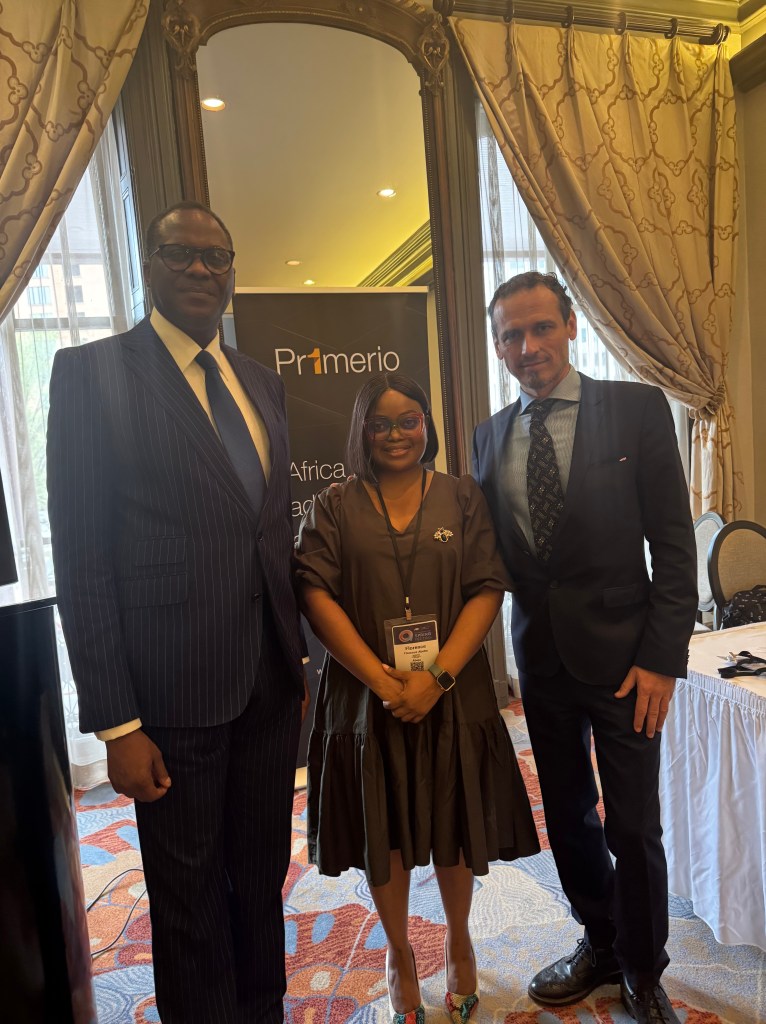
Babatunde Irukera, Florence Abebe, Andreas Stargard at the African Antitrust Salon hosted by Primerio
While more African countries are pushing back against big tech companies and are focusing on unchecked data exploitation within their borders, there is a need, however, for the continent to build towards a larger, sustainable strategy to manage the presence and power of big tech. Says Andreas Stargard, “the quarter-billion dollar Meta fine, if upheld, would firmly cement Nigeria’s antitrust global relevance in the minds of international lawyers and businesses. This comes as a surprise in some ways, as the FCCPC was first put on the map only fairly recently, by its inaugural Chief enforcer, Tunde Irukera: his vision for creative enforcement tools and encouragement of the agency’s staff to employ heretofore unused investigatory mechanisms and strategies – often seen only in U.S.-style civil litigation, and certainly not in many government agencies worldwide, much less among other African jurisdictions – show that the Commission potentially has the necessary intellectual capacity and investigatory stamina to pursue cases of equal or greater dimensions in the future. It will depend on its leadership where the FCCPC’s path is charted next…”
Of course, there needs to be a balance struck between the value of personal data and that of innovation and tech adoption, which calls for a coordinated regulation policy that will strive to balance economic and non-economic features of the continent.
As observed by Leonard Ugbajah, a competition law consultant, a balanced and pragmatic approach is essential when opting to address the regulatory landscape around big tech:
“A common approach would harness the capabilities of countries, moderate opportunism by state and non-state actors in pursuing enforcement, recognise the economic importance of big tech, properly calibrate the various pain points (economic and non-economic) and safeguard the interests of the not-so-capable African countries.”
The social media giants have 60 days, starting from 30 April 2025, to comply with the $220 million fine ordered by the Tribunal. Notably, following the decision, WhatsApp has indicated that it intends to seek a stay of the Tribunal’s decision and pursue an appeal.


 The South African Competition Commission (SACC), responsible for investigating and making recommendations to the Tribunal, recently published its recommendation in relation to the proposed Sinopec-Chevron deal. Unsurprisingly, consistent with large mergers (particularly by foreign acquiring firms) – the SACC’s recommendations contain a number of non-merger specific public interest conditions. A feature of South African merger control which has become increasingly prevalent in recent years (refer to the AB-InBev/SAB or the SAB/Coca-Cola mergers) – largely as a result of Minister Patel’s ‘direct’ involvement in the merger control process.
 By AAT Senior Contributor, Michael-James Currie.
 Strategic Timing of Exemption Application?
 African Antitrust & Competition Law