Potential strike at S. Afr. Competition Commission? SA union calls on minister to intervene

south_africa

South African workers’ union NEHAWU has called on Minister of Economic Development Ebrahim Patel to undertake several actions related to the Competition Commission in order to avert a strike amongst its workers.

The National Education Health & Allied Workers’ Union (NEHAWU) has been a rather vocal critic of the South African Competition Commission and its management in the past.  They now cite the high turnover rate at the Commission as evidentiary support for their claims that the Commission is not “following proper procedures and the flouting of the Commission’s internal policies“.  Among the former Commission staff who have reportedly left are “former Deputy Commissioner and the Chief Economist,” as well as “several other divisional managers, including the Chief Financial Officer.”

Among the union’s current demands on the minister to remedy the purportedly dire situation at the Commission are the following:

  • The reinstatement of two employees that have been unfairly suspended from work in a manner which is inconsistent with the policies of the Competition Commission.
  • The call for the minister to intervene to stop the acts of victimisation and abuse of power by managers at the CC.
  • Call on the minister to open the appointment of the new Deputy Commissioners.
  • Call on the minister to ensure that the correct recruitment processes and policies are followed in the appointment of senior managers.
  • Call on the minister to make the outcomes of his two investigations into corporate governance at the Competition Commission available to employees.
  • Call on the minister to respond to complaints lodged with him against the Competition Commissioner and management.

NEHAWU claims that it represents “over 70% of the employees of the Commission” has threatened to “explore our legal options including a possible withdrawal of our labour”.

UPDATED: COMESA Competition Commission reported to have selected consultancy for review of Guideliens

COMESA Competition Commission logo

NOTE (10 Sept. 2013): Responding to this blog post written yesterday (below), Mr. Willard Mwemba contacted me and kindly clarified that (1) the CCC had not yet appointed or otherwise selected a consultant and (2) the review process is centered on the COMESA competition Regulations and not the Guidelines.

According to an article that appeared on 6 September 2013 in BusinessDay/BDLive, the head of COMESA CCC‘s merger unit Willard Mwemba has revealed that the CCC has supposedly already chosen the consultancy tasked with aiding the agency in revamping its competition regulations.

The article states: “He said they have already appointed a consultant to address the critical questions.”  The remarks were reportedly made at this year’s seventh annual conference on competition law, economics and policy hosted by the South African Competition Commission in Johannesburg.

If true — i.e., if the CCC has indeed already selected a team of consultants to support its (commendable) effort to review and evaluate its own competition-related Regulationsthis would directly contravene the stated deadline of 30 September 2013 for submission of bids (para. 10.9 in the RFP) for said tender (RFP No. CCC/30-08-2013/1).  See our prior reporting here.

It remains to be seen whether this is the case, or whether the task of “address[ing] the critical questions” mentioned by Mr. Mwemba is in fact a distinct project from the one that is the subject of the formal Request for Proposal issued by the CCC(Note: This is now clarified, as per the headline above, as Mr. Mwemba has explained that the BDLive article misquoted his statement.)

“Crossing the Competition Rubicon”: Internationalising African Antitrust through COMESA

John Oxenham & Andreas Stargard

(PDF of article as published in Concurrences)

Crossing the Competition Rubicon: Internationalising African Antitrust through COMESA

As published in HORIZONS / Concurrences Law Journal (vol. 03-2013) Institute of Competition Law, re-published under licence.

English Abstract: Antitrust publications were abuzz with “COMESA” in recent months. Yet, neither the decades-old pan-African organisation nor its Competition Regulations are novel. What’s new is that COMESA’s Competition Commission has finally — and suddenly — opened its doors and begun operations, already having reviewed two merger filings. This paper examines the economic advantages of COMESA for the region, analyses its role as a multi-national enforcement body, and identifies the pitfalls the agency will face in its inaugural year.
French Abstract: Les publications en droit de la concurrence étaient en effervescence avec « COMESA » ces derniers mois. Pourtant ni l’organisation pan-africaine, ni ses règlements concurrence ne sont nouveaux. Ce qu’il y a de nouveau, c’est que la Commission de la Concurrence du COMESA a finalement — et tout à coup — ouvert ses portes et a commencé ses opérations, ayant déjà examiné deux dossiers de fusion. Cet article examine les avantages économiques qu’offre COMESA pour la région, il analyse son rôle en tant qu’organe d’exécution multinational, et il identifie les pièges dont devra faire face la CCC durant sa première année.

Introduction

1. The Common Market for Eastern and Southern Africa has recently grabbed international legal headlines. Its acronymic title, COMESA, now firmly features in the awareness of most competition lawyers. The organisation is not new, however, nor are its Competition Rules and Regulations. The multi-national body itself dates back at least twenty years, and the Regulations were finalised and (technically) entered into force in 2004.

2. Why all the ruckus in 2013 then ? The reason is straight-forward : Antitrust law does not self-execute. It needs an enforcer, public or private. That enforcement agency now exists.

I. Alea iacta est: A new supranational competition authority is born

3. For the past decade of the Competition Regulations’ theoretical existence, they dwelled in the nether region of unenforced laws – their Article 18 prohibition on abuse of dominance effectively had equal legal footing as the rule against a pedestrian jaywalking at a red stoplight : with no policeman in sight, either goes unpunished.

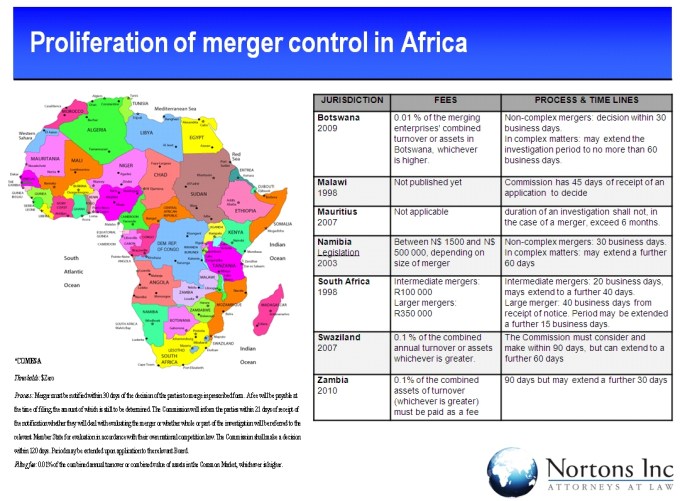
4. COMESA crossed the “missing policeman” rubicon on 14 January 2013, when the Competition Commission (“CCC”) saw the light of day. With the advent of its operation – as well as that of the supervisory body, its Board of Commissioners – also comes the enforcement of the full spectrum of competition legislation embodied in the Regulations (merger control, unilateral conduct, cartels, and so on). Its impact will be felt by economic actors across an area spanning 19 member states, 12 million km2 and a population of over 389 million [1].

5. The basics of the COMESA Regulations and the CCC’s powers are already well-documented elsewhere and do not merit repetition here. Instead, this paper is focussed on two broader policy points : (1) the law’s potential beneficial impact on the region as a whole ; and (2) the pitfalls and prospects of successful execution by the CCC. As the CCC has seemingly (and with good reason) done, we emphasise first and foremost the new merger-control regime, rather than other vertical and horizontal restrictive practices that are also, in principle, within the agency’s enforcement powers but remain entirely untested for now.

6. The new competition regime has not emerged without escaping criticism in the press and in law firms’ client alerts. Certain aspects of the feedback are particularly noteworthy, as they may have a fatal impact on the merger-control regime and indeed could render it unworkable in practice. The two key reproaches levied are (1) the “zero threshold” for mergers to be notified, and (2) that a two-party transaction must be notified even though one of the firms has no nexus to the COMESA market at all. In effect, were the COMESA merger provisions taken literally, “all” transactions falling within the ambit of a notifiable merger, regardless of how small or how removed from the common market area, would be notifiable under penalty of 10% of the merging parties’ turnover in the Common Market [2].

7. The CCC has already indicated, however, that it will address these issues in its final Guidelines and, potentially, in revisions to the Regulations themselves. Its willingness to adapt – hopefully swiftly – is commendable. It must change its initial broad-brush notification approach to accommodate the reality that the purchase of a competing road-side lemonade stand by another juice vendor in Nairobi is simply not a competitive concern justifying the legal mandate for formal notification with a multi-national antitrust authority. Compliance with ICN Recommended Practices I.A and I.B is fundamental for a pragmatic solution and, not least, to forestall the facile spread of misconceptions about the CCC’s perceived mission as well as, frankly, the danger of international ridicule [3].

8. In addition to the criticism levelled against it by third-party observers, the CCC has also sustained an early blow from within, as there has been a jurisdictional tug-of-war between the CCC and Kenya (notably a COMESA member state). The fairly little-noticed matter involves the control of acquisition of shares, interest or assets among local firms in Kenya. Uncertainty as to who the responsible regulatory authority was for such intra-country dealmakers has resulted in the Kenyan Attorney General issuing an opinion giving the Competition Authority of Kenya (CAK) authority to act as the sole agency with the mandate to clear “local” mergers and acquisitions. It shields local firms from the COMESA regime as far as purely domestic transactions are concerned. The CCC’s formal letter response to a contemporaneous blog posting by the authors on the dispute highlights the risk posed by vaguely worded filing requirements as far as “local” mergers are concerned : “[I]t is our considered view that CAK has failed to comprehend the advice by the Attorney-General which … specifically states that CAK shall continue to exercise its jurisdiction on local mergers and acquisitions. It is our understanding (…) [he] has not referred to merger transactions with regional dimension. This is the correct position” [4].

9. Regardless of the outside criticism and internal jurisdictional skirmish, at least two mergers have already been notified to the CCC as of the writing of this article, and others are underway. By comparison to another “newborn” merger authority’s performance – the Indian CCI, which was created in June 2011 – these numbers are arguably on the low end. The CCI saw a total of 51 and 62 merger filings in each of its first two years, respectively. At the CCC’s current pace, it will likely not surpass a dozen notifications in its inaugural year, although we view the first four months since its inception as non-indicative of future filings and anticipate that the rate will increase significantly.

II. Measuring COMESA’s success

10. To create a functioning, universally respected, supra-national competition authority ex nihilo is neither easy nor enviable, and to measure its success at only the half-year mark of its existence would be premature. Therefore, a perhaps more meaningful analysis of the short history of the CCC’s performance should focus on other benchmarks than the insufficient merger statistics that are available as of now. We identify some cognisable waypoints below, which may guide future evaluation of the CCC’s performance.

1. Best practices

11. The CCC’s release of formal Guidelines – dealing with, inter alia, such expected topics as merger control and market definition, as well as uniquely region-focussed topics such as the public interest criterion of the COMESA Regulations – has provided welcome and early guidance to businesses and competition practitioners alike. What’s more, the Guidelines’ pre-release in draft form, and the CCC’s concomitant request for public comment, conforms to international best practices for competition agencies and has allowed international commentators and global bodies (such as the American Bar Association) to provide valuable insight ex ante, before it is “too late” and enforcement blunders occur. It is too early to determine the extent to which the public comments will be taken into account and the Guidelines tweaked, however.

12. In addition, while simple in principle, it is hard to overstate the value inherent in clear, English-language agency documentation, made available on a professional, functioning, and well-designed web interface. The CCC offers all of the above, and fares well when compared to several of the more established competition agencies’ public profiles (including the clarity, updated nature, and accessibility of their documentation), in contrast to MOFCOM or other more senior agencies elsewhere.

13. In sum, the CCC’s pursuit of best practices from the get-go emphasises the overarching goal of “fairness” embedded in its basic charter, as well as its “ongoing efforts to clarify and publish guidance about its enforcement policies and practices” [5].

2. Organisational health

14. An enforcement agency is only as good as its enforcers, just as a law firm’s real capital is human in nature, consisting of its attorneys. That said, there does exist a benefit of having an enforcement body with a significant history and consistency of practice, regardless of present leadership, which is : institutional memory and resulting predictability for the outside practitioner of the agency’s enforcement actions and decisions. Here, this positive externality of having a long-lived authority with established practice is lacking.

15. The CCC is based in the administrative capital of Malawi, Lilongwe, and currently only fields eight staff members, which may be an issue if and when merger notifications increase. On the plus side, COMESA’s anticipated multi-national staffing portends longevity, institutional memory, and the potential for a – conceivably constructive and beneficial – “revolving door” staffing policy between NCAs and the CCC. Yet, with only two mergers notified to date and in light of its infancy, we view these criticisms as less relevant.

3. Regional enforcement and cohesion

16. One of the professed goals of COMESA’s CCC is to “achieve uniformity of interpretation and application of competition law and policy,” not only as part of its own enforcement within the CCC’s proper jurisdiction, but moreover “within the common market” as a whole [6]. In a region that has often lacked these features, such an approach is doubtless welcome. Based on the CCC’s pronouncements [7], the agency supports increased uniformity among member states’ domestic competition enforcement, in addition to its own exclusive enforcement over matters with a COMESA dimension per Article 3 of the Regulations.

17. One of the historical motivations for a pan-African competition enforcer was the realisation of member states that “with globalization, markets continued to extend beyond national boundaries and the national laws, and their enforcement institutions were no longer sufficient to deal with the new market problems of the region. To address these problems of enforcing multi-jurisdictional competition cases, a regional approach to the competition cases with regional coverage was found to be the solution.” [8]

18. Having a strong infrastructure in place has the potential to prevent pure competition policy and its application from descending into nationally politicised issues, as exemplified by anticompetitive government aid measures designed to prop up inefficient para-statal “domestic champion” enterprises.

4. Cost and time savings

19. The one-stop-shop concept which underlies the CCC’s raison d’être brings with it potential efficiencies of scope and scale, and is, in principle, a sound one. Its prime exponent is arguably one of the most successful multi-national competition enforcers, namely the EU Commission. Its current competition commissioner called it one “of the EU’s success stories making sure that consumers benefit from products and services to choose from at competitive prices whilst allowing companies to get their mergers reviewed swiftly.” [9] Today, over 70% of pre-notification referrals seek one-stop-shop review by the EU Commission in lieu of individual national filings.

20. As for the CCC, its merger mandate is similar, i.e., to enhance the efficiency of notification (one in lieu of potentially eight) and the consistency of review (obtaining one single outcome rather than potentially divergent results in different member countries). Moreover, its promise is to lower parties’ transaction costs : according to its own statement, the agency has already undertaken a “preliminary assessment” of the anticipated notification fees, concluding with the prediction that the cost of a COMESA filing will be “much lower than that of the national competition authorities and this has resulted in the cost of doing business (notifying using the COMESA route) being reduced by about 43.4%.” [10]

21. Taking this initial assessment at face value would be premature, however. The CCC admits that it “has not yet concluded any merger investigation for one to have a basis for any comparisons yet.” [11] Moreover, it is unclear from the CCC’s quoted statement whether the entire cost of notifying (including counsel fees, avoidance of duplication before multiple NCAs, and other opportunity-cost savings) is being reduced or merely the filing fees.

22. One potential procedural avenue to ensure lower average fees would be to introduce the equivalent of “short-form” notifications for transactions with little to no competitive concerns or nexi to any COMESA member state. Assuming the truth of the CCC’s assertion, however, it will be difficult for parties to squabble with expected cost savings that will slash their pre-merger legal expenditures by almost half.

23. Whether the CCC will have sufficient regulatory “bite” remains to be seen, as neither approval nor divestiture or prohibition decisions have been taken yet. It is noteworthy that the first parties to notify transactions to the CCC, however, have been highly reputable global electronics and pharmaceutical firms, respectively, represented by experienced competition counsel. Their decision to notify with the young and – at that moment still entirely untested – competition authority is, in our view, a vital sign of success for the CCC. Some observers at the EU in Brussels and at the OECD in Paris have called the high level of the pioneering notification a “stroke of luck” for the CCC, as the quality of the Philips/Funai deal will give pause to other foreign firms that may have otherwise chosen to ignore the COMESA regime. “Transaction No. 1” thus has the potential to provide the necessary initial bite to the virgin CCC’s regulatory jaw.

5. Other externalities benefitting the common market and its participants

24. A functioning antitrust regime is beneficial to economic actors at all levels, from producers and importers down to the end user [12]. With COMESA’s joinder of competition-law jurisdictions, that benefit accrues to the entire region, especially as only a minority of member states have an antitrust law at present, with varying levels of enforcement [13].

25. When considering investments in Sub-Saharan Africa, one thinks of a single jurisdiction (for example, South Africa or Botswana). A functioning CCC will result in international investors considering COMESA instead of individual member states, promoting cross-border investments and thus enhancing COMESA’s attractiveness and competitiveness within the region as a destination for foreign direct investment.

26. In this respect, the most important advantage realised by COMESA is, in principle, the elimination of multiple merger filings in various African jurisdictions in respect of a single transaction which results in a cross-border merger transaction. Accordingly, the COMESA one-stop-shop structure saves significant amounts of time and money, obviating the parties’ need to examine and comply with each individual member jurisdiction’s merger guidelines and regulations, not to speak of multiple filing fees for a single cross-border transaction.

27. The establishment of COMESA as a competition watchdog is largely welcomed in the region and appears to be on a promising international path, as well. Teething problems like thresholds, timing and jurisdictional reach are hopefully close to finalisation, which will provide greater clarity to merging parties. If the CCC and the Board manage the process of “righting the ship” well and in a timely fashion, we envisage that the COMESA competition regime will actually “enhance” the region’s economic attractiveness for both foreign and local investors, and will promote rather than stifle cross-border transactions.

III. Righting the ship : Finishing the river crossing

28. Balancing its economic and legal benefits with the CCC regime’s present shortcomings prompts the inevitable question what the implications are for future cross-border merger notifications. To realise its full potential of fostering regional growth, it is vital that the COMESA ship is righted urgently.

– Merger thresholds need to be revised, if not outright introduced, as it is plainly non-sensical to have a zero-turnover threshold. The CCC itself appears to recognize this crucial deficiency, as it claims that : “Small companies that fall below a given threshold will not need to undergo the authorisation process.” [14] Properly-scaled thresholds, i.e., thresholds that are appropriate for the region’s economy, will also permit the CCC to ensure an efficient allocation of enforcement resources, avoiding the risk of being flooded by de minimis merger-control filings that would otherwise require review.

– Article 23(3) of the Regulations implies that transactions would be notifiable to the Commission even if only one of the merging parties operates in two COMESA Member States and the other merging party does not operate in “any” COMESA Member State. This is also emphasized in the Guidelines on Merger Assessment, which suggest that a merger is notifiable even if only one of the merging parties has activities in at least two COMESA Member States and the other party has none. This would mean that a merger must be notified, or is otherwise subject to COMESA scrutiny, even if there is no nexus between one of the merging firms and the Common Market. If this interpretation is indeed maintained, we believe that it will place an undue burden on potential merger parties and undermine one of the crucial objectives of any merger regime : to gain international acceptance.

29. Absent swift rectification, these concerns may render the COMESA Competition regime unworkable. At best, they will merely deter parties from making a notification (hoping for lack of enforcement). Worse, these regulatory uncertainties may cause undertakings to abandon potential transactions entirely.

30. Addressing the issues identified above is imperative to ensuring the CCC’s viability as a recognised international competition authority. In addition, we believe that the agency faces other – perhaps less serious, yet nonetheless important – obstacles on the final leg of its proverbial river crossing :

– COMESA’s express inclusion of so-called “para-statals” (i.e., fully or partial government-owned enterprises) within the penumbra of its jurisdiction under Article 3 is commendable and indeed important, given the comparative prevalence of such enterprises in the region and the risk of abuse inherent in their transformation into privatised businesses. The CCC must be careful, however, not to be side-lined by the member states’ governments, as the Regulations’ prior-exemption exception of Article 3(2) presents a potentially appetising jurisdictional loophole for dominant para-statals being shielded from review by the CCC.

– The Guidelines’ indirect reference to EU rules poses a threat of commingling divergent standards and interpretive assessments thereof, e.g., applying guidance on the SIEC standard to an SLC regime.

– The trigger date for notification is also not clear. Article 24(1) requires notification within 30 days of a “decision to merge.” The Guidelines indicate that a decision to merge is “construed when there is established a concurrence of wills between the merging parties in the pursuit of a merger objective.” Neither the commercial nor the legal meaning of this phrase is entirely clear and will make it difficult for companies to determine when to notify a transaction, resulting in the risk of facing penalties for late filing. Clarification of all relevant “notification triggers” is therefore highly desirable from the perspective of affected undertakings.

– While the CCC’s previously identified “preliminary assessment” of the anticipated fees appears to claim otherwise, we are of the (likewise preliminary) view that COMESA’s merger filing-fee is not in accordance with other jurisdictions. These fees constitute a danger that may help to undermine COMESA’s international and legal acceptance. Especially when compared to established global regimes – such as the EU’s DG COMP or the German Bundeskartellamt (with no and relatively low filing fees, respectively) – the potential fees COMESA may charge notifying parties under its Rules pose a serious threat to the regime’s legitimacy.

– On a positive note in this regard, the CCC has taken notice of – and acted swiftly in response to – critics’ public comments relating to the initially vague arithmetic determination of the CCC’s filing fees. The alternative two-part provision contained a connecting “higher of” reference, which caused unintended confusion among competition practitioners [15]. Many a law firm’s initial assessment and subsequent public client alert therefore referred to COMESA fees being the “greater of” the two computational bases. The CCC stepped in within merely weeks and issued clarifying guidance. While it did not correct the ambiguous language in the Rule itself, it issued a public notice of Interpretive Meaning of the Notification Fee Pursuant to Rule 55(4) of the Amended COMESA Competition Rules on 26 February 2013, thereby putting an end to speculation that filing fees would indeed be calculated on the higher-of basis.

– The need for original copies to be filed with the notification goes against the global trend of leading enforcement agencies, such as the FTC or DG COMP, increasingly allowing filings to be made electronically. It hinders efficiency and increases administrative and timing burdens on the parties, which is inconsistent with the CCC’s stated objectives and, indeed, contrarian to the developments of the 21st century.

31. Several international networks and associations comprising members from various antitrust jurisdictions worldwide have provided significant contributions to the CCC, working closely with the agency to propose practical and workable solutions to the identified hurdles. Organisations that have provided input include the International Competition Network (ICN) (which currently includes 128 agency members from 111 jurisdictions and is the most extensive network of competition authorities worldwide) and the American Bar Association’s two sections of Antitrust Law and of International Law. They have offered the CCC assistance, particularly in the provision of commentary and proposed amendments to the merger assessment guidelines, suggesting workable (and tested) solutions in relation to the various teething problems it faces [16]. We note that there is a fine line between receiving offers of support and the affirmative seeking of advice – we would encourage the CCC to undertake the latter at all stages of its developmental process, as its legitimacy in the eyes of the global competition community will only be enhanced, not reduced, by its efforts to integrate itself into the global network of enforcers. As has been the mantra of many an NCA official’s speeches over the past decade, convergence of international antitrust regimes is crucial to effective enforcement on the one hand and rational decision-making by businesses on the other. For COMESA to fall in line with the global trend of convergence, the CCC must not shy away from seeking the input of other, more advanced sister agencies and organisations such as the ICN, which – in our experience – are always glad to provide their support.

32. Finally, one key inquiry faced by any nascent international legal regime is whether the unified, single decisions made under a harmonised legal system are likely to be superior to the alternative, i.e., the sum of those applying diverse national laws [17]. Even if uncoordinated domestic regimes are deemed inefficient, it does not automatically follow that a single multi-national regime will yield more pareto-optimal outcomes [18]. Historically, there have been three main criticisms levied against international antitrust regimes. They include higher monitoring costs, higher enforcement costs, and the loss of innovation [19]. Considering each of them in detail would breach the bounds of the present article. Suffice it to note that some scholarship suggests agency costs to be higher at an international level, with the concomitant effect that bureaucrats will have more ability to fashion rules in their own interest [20]. A parallel risk is that the multi-national process may appear more opaque than the more established and well-known domestic procedures, resulting inter alia in greater difficulty of monitoring those responsible for carrying out enforcement policy, as well as less innovative (because less diverse and more static) approaches to enforcement or resolution of conflicts [21]. An international regulator outside the direct control of government may pursue interests distinct from its members, which may not mirror the interests of the citizens living in the member states. Taken together, these risks may cause a global regime to appear less in the public interest than maintaining the sovereignty of individual domestic rules [22].

33. While these critiques may have valid application in developed countries with mature competition authorities where a global harmonised regime is being considered, they appear somewhat neutralised in the case of COMESA. For one, a majority of the Member States did not have pre-existing competition-law regimes, and the remainder of the NCAs were arguably inexperienced and not developed. We submit that having at least a functioning and well-funded competition enforcement regime — centralised or decentralised — is more beneficial that having none at all.

IV. Conclusion

34. As with every rubicon worthy of its proverbial name, COMESA’s crossing of the antitrust divide has advanced beyond the point of no return. And rightly so : the efficiency gains, consumer benefits, and appeal to investors derived from a stable, transparent and predictable competition-law enforcement that transcends national borders all promise a net positive return. We see this prospect holding true despite early teething problems, as the CCC appears to be in the process of rectifying most, if not all, of them in due course.

35. The CCC’s future enforcement performance being in line with international best practices will be the ultimate litmus test for increased investment in the region and COMESA’s economic growth. One gladly wishes to take the CCC by its word in describing the impetus behind the unified antitrust regime : “cooperation and transparency in procedures [are] essential for business as they would not be subjected to excessive costs arising from multiple, parallel and poorly coordinated investigations.” [23] Businesses probably could not agree more – but a mere mission statement is a far cry from actual, competent enforcement. For the time being, the CCC’s ship hasn’t made it to the other river bank and is still traversing unpredictable rapids.

36. The near future will doubtless reveal several important benchmarking metrics of the CCC’s merger review performance, for instance : how many transactions are notified ? How quickly can the authority render decisions on most routine notices ? How robust is its underlying economic and legal reasoning ? It may take additional time before a complex merger demanding in-depth analysis will challenge the CCC to show its true analytical prowess and administrative ability to deal with difficult cases.

37. The CCC has the features and multi-national support that allow it, in principle, to become a robust regional competition authority. That said, its success is not a foregone conclusion, and the agency must ensure that it has the sanctioning not only of COMESA’s regional member states and domestic NCAs, but also of the broader international antitrust community.

Footnotes:

[1] Even when compared to the worldwide GDP leader and key historical role model of multi-national competition-law jurisdictions – the European Union – these figures are impressive for a comparatively young African agglomeration of economies. (By comparison, the EU has 27 member states, a population of 501 million, and a GDP of $16 trillion.)

[2] Article 24 of COMESA Competition Regulations 2004.

[3] The “missing-nexus” and “zero-dollar” threshold problems have caused several antitrust experts – including private practitioners, EU Commission officials and US enforcement agency representatives – to scoff at even a passing mention of COMESA as a relevant jurisdiction to take into account when counselling clients on worldwide merger-notification obligations. The CCC must act with speed and determination to rectify these problems to maintain its bona fides vis-à-vis both its international sister agencies as well as private parties appearing before it.

[4] Letter from COMESA Competition Commission, dated 22 March 2013 (“CCC March letter”), at § 14, available online at https://africanantitrust.com/2013/05/14.

[5] CCC news release, COMESA Competition Commission Seeks Public Comments on its Draft Guidelines, available at : http://www.comesacompetition.org/latest.

[6] Art. 1 of COMESA Competition Regulations, December 2004, available at http://www.comesacompetition.org/im….

[7] For instance, Art. 5 of the Regulations, and the CCC’s mandate that national competition laws in the region “should increasingly come into alignment.”

[8] CCC March letter, at § 5.

[9] J. Almunia, Commission Vice President and Competition Commissioner, Mergers : competition authorities agree best practices to handle cross-border mergers that do not benefit from EU one-stop shop review, 9 November 2011. See also J.J. Parisi, A Simple Guide to the EC Merger Regulation, January 2010 (“The EC Merger Regulation (ECMR) was intended to provide a ‘level playing field’ in a ‘one-stop shop’ for the review of mergers with significant cross border effects.”).

[10] CCC March letter, at § 17.

[11] Ibid. at § 16.

[12] The European Commission’s 2012 report on competition policy showed that without an effective European competition policy, the internal market cannot deliver its full economic potential. The COMESA Regulations’ Preamble notably posits the tripartite goals of “economic growth, trade liberalisation and economic efficiency” as drivers for the regional antitrust regime.

[13] Egypt, Kenya, Malawi, Mauritius, Seychelles, Swaziland, Zambia and Zimbabwe.

[14] COMESA CCC Frequently Asked Questions.

[15] Rule 55(4) of the amended COMESA Competition Rules reads as follows : “Notification of a notifiable merger shall be accompanied by a fee calculated at 0.5% or COM$ 500 000, or whichever is lower of the combined annual turnover or combined value of assets in the Common Market, whichever is higher”.

[16] Ibid.

[17] JO McGinnis, The Political Economy of International Antitrust Harmonization, 45 Wm. & Mary L. Rev. 549 (2003), p. 555.

[18] Ibid, p. 555.

[19] Ibid, p. 560.

[20] Ibid.

[21] Ibid, at p. 560, 565.

[22] Ibid, p. 561

[23] CCC March letter, at § 5.

The “Second Coming” of COMESA’s CCC? Is the EAC foreshadowing a copy-cat maneuver?

tanzania COMESA Competition Commission logo 

Will there be a copy-cat to COMESA’s competition-law enforcer?

As the Tanzania Daily News reports (via AllAfrica, as TDN’s web site seems to be down at the moment), the Tanzanian Minister for industry and trade, Dr. Abdallah Kigoda (pictured), emphasized the importance of competition law policy across the entire East African Community (“EAC”) region during a speech yesterday.

He reportedly stated at the inaugural meeting of the “Accelerating Implementation of EAC Competition Policy and Law Project” (that’s a mouthful) that:

“[i]t is difficult for a single country to deal with the competition policy and therefore it is vital to go for a well functioning competition policy that will help curb anti-competition practices by not only domestic firms but also regional and large multinational corporation (MNGs) and international cartels.”

This sentence is somewhat incomplete, in our grammatical view — but it seems to be a thinly-veiled call for a trans-national, region-wide competition policy.   This would be notable insofar as the following two premises are considered:

  1. One need not look far in the region to find a good example: There is a very recent case of a functioning competition policy and enforcement body in the east-African region, namely: COMESA’s Competition Commission (“CCC”), which became operational in January 2013.
  2. Tanzania left COMESA in 1999 and is currently not a member.  (This withdrawal was, ironically, announced by Dr. Kigoda’s long-ago predecessor minister.)

Go figure…!  We at AfricanAntitrust.com are all for sensible competition-law enforcement.  Yet, one would hope that the EAC (and Tanzania) do not plan to emulate the COMESA example and create yet another — presumptively conflicting — regional antitrust body in eastern Africa, lest the will of corporate investors to grow their businesses in the region be completely stifled by the rampant growth of competing antitrust jurisdictions in the area, seeking to extract merger-filing fees and/or fines for contraventions from established economic actors.

Do we think this is a probable threat?  No.  But it’s worth writing about, when statements like the one quoted above are made by officials acting on behalf of national governments and, indeed, supra-national bodies.

Why don’t we think it’s a likely problem? Because all of the other EAC members** are already COMESA member states, and would have to suffer from the governmental equivalent of schizophrenia to subscribe to two separate supra-national competition regimes, in addition to their own domestic ones (to the extent they exist).

What’s an alternative interpretation?  Hmm, could Tanzania be considering re-joining COMESA?

** Burundi, Kenya, Rwanda, and Uganda (setting aside COMESA non-member Tanzania).

COMESA issues antitrust RFP for comment & review project, re-releases 5 draft Guidelines

COMESA Competition Commission logo

COMESA’s Competition Commission’s (“CCC”) has issued a Request for Proposal to conduct a comprehensive review of its previously-released five draft competition GuidelinesIn doing so, the CCC re-released the drafts for public review and comment a second time.

Yesterday (Aug. 26, 2013), the CCC published a Request for Proposal to help the agency hold workshops to aid in a comprehensive review of the key COMESA Competition Regulations and Rules / (2).  It will be interesting to see which consultancy submits the winning bid (and whether it will be one from within or outside COMESA!) and what its proposal for the review project will look like.

The topics covered by the Guidelines to be reviewed are:

  1. Mergers
  2. Art. 18 (Abuse of Dominance)
  3. Public Interest
  4. Art. 16 & 19 (horizontal and vertical practices)
  5. Market Definition

We commend the CCC for not only publishing its Guidelines in draft form prior to finalization, but for following international best practices by engaging in what promises to be a substantive and professionally-run review project, akin to the U.S. and EU enforcement agencies.

For what it’s worth, some of our observations on the Guidelines are below.

  • The CCC explicitly endorses a collective-dominance theory of harm in its Dominance Guideline.  A concept largely shunned in the United States (“shared monopoly”), collective dominance is rarely used but admittedly recognized by the EU courts and competition authorities.
  • The Merger Assessment Guideline gives the formal rationale underlying the mystifyingly low “zero-dollar threshold” problem that has plagued COMESA’s CCC since its inception: the threshold for notification has been set at zero “because different Member States are at different levels of economic development and hence a realistic threshold can only be determined after the Regulation has been tested on the market”.  Notably, the authority also predicts in this document that “the threshold shall be raised after a period of implementation of the Regulation” — a move that cannot come too soon and that should not come as any surprise to readers of this blog or to practitioners and parties, which have had to deal with outsized notification-fee demands by the agency for transactions with low to no revenues in the COMESA zone in the past.
  • Lastly, this “regional glue” of the 19-member state organization also underpins a key aspect of the CCC’s Public Interest Guideline , which emphasizes this element of unity across the COMESA region as an important factor in identifying the otherwise “amorphous” concept of public interest.  Rather commendably in this regard, the Competition Commission recognizes the presumption that competition / antitrust should be the “weightiest” of all the conceivable public interest criteria that may be raised by parties and/or member states in future proceedings.

As always, we welcome reader input in the comment section below.

“Your choice”: After Botswana and S.A., MultiChoice to be investigated by yet another antitrust authority?

kenya

MultiChoice has now appeared thrice in these blog pages… After having investigations into its alleged abuses of dominance opened in Botswana (reported here) and South Africa (here), the Naspers-controlled company MultiChoice (which owns DStv as well as SuperSport) has now been accused by Kenyan rivals Wananchi Group (Zuku TV) and StarTimes.

Their complaints reportedly focus on dominant MultiChoice locking up key football rights (U.S. readers need not worry: they mean “soccer”, of course).  As any good U.S. plaintiff would do as well, the Kenyan broadcasting competitors plan to lodge formal complaints not only with the Communication Commission of Kenya, but also with the Competition Authority of Kenya.  The focus is, therefore, on antitrust claims against giant MultiChoice.

In general, the monopolization/dominance complaints seem to mirror largely those of, for instance, the South African On Digital Media, which had previously complained to the South African Competition Commission about MultiChoice’s refusal to grant ODM’s “TopTV” subsidiary access to two of MultiChoice’s SuperSport channels.

Whether obtaining exclusive distribution rights to football gems such as the English Premier League and the “Tusker Premier League” constitutes monopolization under Kenyan law remains to be seen.

Namibian antitrust law revision will include consumer protection measures

namibia

As the Namibia Economist reports (via online journal AllAfrica), the revised Namibian Competition Act will include consumer protection legislation, in addition to the existing antitrust laws.

The current legislation dates back a decade to 2003 and is being overhauled (whether by the Namibian parliament or by the Commission is not entirely clear to us from the information provided).

The Namibian Competition Commission‘s head (their “CEO”, as the agency’s lead job title is formally called), Mihe Gaomab II, has reportedly stated in an interview with the publication of the country’s chamber of commerce that the revised law will contain new “enabling provisions on consumer rights“, e.g., regarding affordable pricing, fair promotion or advertising, contractual arrangements, and “shelving the right goods at the right place” (whatever that may mean in practice).  He is quoted as emphasizing the “enforcement of competition policy and law” not only with respect to “market failures associated with a substantial reduction of competition”, but also “addressing certain aspects … which are consumer protection related such as unfair deals and lack of information disclosures on consumers.”

We at AfricanAntitrust.com are keen to see the proposed revisions in writing, as much as we are eager to learn how “unfair deals” for consumers are going to be defined in the NCC’s enforcement practice.

COMESA criticised for inflated merger notification fees

COMESA Competition Commission logo

As BDLive’s Amanda Visser reports online, the COMESA Competition Commission (“CCC”) has come under fire for inflating its deal-notification filing fees.

The Cipla / Cipla Medpro SA deal is reported in the article to have come in at 0.5% of turnover and cost the merging firms R4.5m in filing fees.

The online journal also notes that appeals to COMESA’s appellate body in Sudan (the COMESA Court of Justice) are unlikely in the case of high filing fees.  Notably, the CCC is prepared to listen to its stakeholders, says Willard Mwemba, head of mergers at the CCC: “The commission has heard the concerns and is engaging a consultant to come up with reduced notification fees.”

South African Competition Tribunal approves merger in record time of 4 hours

south_africa

The South African Competition Tribunal received notice of, heard and approved the acquisition by construction firm, Stefanutti Stocks (Pty) Ltd, of Energotec, which is a division of First Strut (Pty) Ltd, and approved the merger within four hours of receiving the Competition Commission’s recommendation.

The Tribunal approved the deal on the basis that Energotec, and ultimately First Strut, are in a precarious financial condition (under liquidation).  The parties explained to the Commission and Tribunal that If the merger had not been approved the 667 staff employed by Energotec would have lost their jobs. The parties also relied on the failing firm jusitfication. As a condition for the approval of the merger however the Tribunal ordered that, for a period of 2 years from the date the merger is implemented, Stefanutti Stocks must limit retrenchments resulting from the merger to 16 employees.  This type of public interest condition has become common in South Africa.

It was stated by the parties that the deal will enable the acquirier to offer a more comprehensive service to its clients, making this an attractive opportunity for the construction firm.

The Competition Commission had concluded that the merger was unlikely to cause a substantial lessening of competition. The only customer affected by the transaction, Sasol, had provided support for the deal.

The matter provides useful precedent for future failing firm merger cases.

COMESA publishes explanation of first two merger approvals & receives 4th deal filing

COMESA Competition Commission logo

The COMESA Competition Commission (“CCC”) has finally shed some light on the substantive merger analysis it undertook in its first two notified (and now cleared) transactions.

The full text of the reasoning is just below…  Any light that COMESA sheds on its merger review process, which has thus far been shrouded in complete obscurity from the moment a deal is notified until the agency’s final decision, is a step in the right direction.  The CCC must strive to be transparent in its operations and review process, especially in light of the widespread criticisms of its high filing fees, opaque guidelines, and zero-dollar filing thresholds, which have plagued the CCC since it became operational in January 2013.

It is commendable that the CCC has published its reasoning behind clearing the first two notified mergers, and one should hope that the Commission will do likewise for all future matters.  That said, the CCC’s summary is not a detailed reasoned analysis that rises to the level of, for instance, a European DG COMP merger Decision, and it is thus presumably non-precedential.  In principle, we think that the CCC hits the right analytical notes in terms of defining markets, evaluating entry barriers, and estimating the competitiveness of each market.  However, the substantive market definitions as they are laid out by the Commission, such as “generic pharmaceuticals” or “home communications products,” appear unorthodox and, to say the least, rather broad.  That said, we are not privy to details of the transactions or the facts underlying them, so…

In other COMESA merger ews, the CCC published its 4th merger notification, filed by Cooper Tire (U.S.) and Apollo (India).

FULL TEXT OF CCC RELEASE:

COMESA Competition Commission approves Mergers between:

  1. 1.      Koninklijke Philips Electronics N.V. and Funai Electric Company Limited and
  2. 2.      Cipla India and Cipla Medpro South Africa Limited.

The COMESA Competition Commission (‘the Commission’) on 22nd and 23rd July approved under the COMESA Competition Regulations (‘the Regulations’) the proposed merger between Koninklijke Philips Electronics N.V. and Funai Electric Company Limited (Philips/Funai) and the merger between Cipla India and Cipla Medpro South Africa Limited (Cipla India/Cipla Medpro) respectively.

  1. 1.      Merger between Koninklijke Philips Electronics N.V. and Funai Electric Company Limited

Funai, is a limited liability company incorporated in Japan and listed on the Tokyo stock exchange with its corporate seat in Osaka and address at 7-7-1 Nakagaito, Osaka, Japan. Funai is engaged in the development, manufacture, marketing and distribution of information and communication equipment, such as DVD and Blu-ray Disc-related products, LCD-television and receiver related products. Funai furthermore has a global sales system that consists of overseas subsidiaries in the United States, Europe and Asia. Funai and its subsidiaries did not have any business interests or assets of any nature whatever in the COMESA region. They accordingly had no market share or turnover in any market in the COMESA region.

Philips is organized into three main divisions: Philips Lifestyle, Philips Healthcare and Philips Lighting. Philips Consumer Lifestyle carries on a business consisting of designing, manufacturing and selling lifestyle entertainment products in the categories audio, video and multimedia, home communication and accessories. Philips’ Lifestyle Entertainment business group (“the Business”), which was the target for purposes of the merger, is headquartered in Hong Kong and forms part of the Philips Consumer Lifestyle Division. The Business designs, develops, manufactures and sells lifestyle entertainment products including audio video multimedia products (home audio, headphone, speaker and in-car audio), video related products (like portable audio players, portable video players and home media player), home communication products (DECT phone) and accessories (like batteries, cables/connectors, storage products, portable chargers for cell phones and antennae) (“Consumer Electronics”).

The Commission delineated the relevant product market into 3 namely Audio Multi-media Products, Video Multi-media Products and Home Communications Products. The relevant geographical market was determined as the Common Market[1]. The Commission determined that the relevant markets were very fragmented due to a large number of competing brands that were being sold in the Common Market. It was further realized that the relevant market had over the recent years exhibited insignificant entry barriers. The Commission further determined that the merger would not result in the removal of any competitor from the relevant market. This is because Funai and Philips had never competed in the relevant market pre-merger. Further it was observed that the transaction shall enhance the achievement of consumer needs and choice in the Common Market.

Based on the foregoing, the Commission determined that the acquisition of Philips by Funai was not likely to substantially prevent or lessen competition and it would not be contrary to public interest in accordance with Article 26 (1) and 26(3) of the Regulations respectively. Further, the assessment of the merger revealed that it was compatible with Article 55 of the COMESA Treaty in that it did not negate the objectives of free and liberalised trade. The COMESA Treaty is premised on the attainment of full market integration. Market integration means that there should be free movement of goods and services in the Common Market and the assessment of the merger revealed that the merger shall not lead to the frustration of free movement of goods and services. The merger was therefore approved unconditionally.

  1. 2.      Merger between Cipla India and Cipla Medpro South Africa Limited

Cipla India is primarily a generic pharmaceutical manufacturing company. Cipla India’s nature of business is in key therapy areas which include cardiovascular, children’s health, dermatology and cosmetology, diabetes, HIV/AIDS, infectious disease and critical care, malaria, neurosciences, oncology, ophthalmology, osteoporosis, respiratory, urology, and women’s health. Cipla India supplies (primarily through distributors) products to the Common Market. Cipla Medpro manufactures and distributes scheduled and over the counter human pharmaceutical products, various veterinary, agricultural and nutritional products and provides healthcare solutions and support and specialised consulting and actuarial services to both open and restricted medical schemes, medical scheme administrator and managed care organisations

The Commission determined the relevant market to be the supply of generic pharmaceutical products in the Common Market. The Commission determined that the same market concentration would remain post merger as the parties did not compete in the Common Market before the merger. The Commission further observed that import competition was very rife in this market as most of the drugs sold in this market were imported. This would therefore give competitive discipline to the merging parties and restrain them from behaving in an anti-competitive manner.

The Commission observed that the transaction would not result in the removal of any competitor from the relevant market as generally the parties were not competing pre-merger. The Commission however observed that the relevant market had both structural and regulatory barriers to entry. The main structural barriers to entry were the costs of establishing a distribution network and availability of funds for research and development. The regulatory barriers to entry included the various registration processes that a firm needed to undertake before it could supply the products in the Common Market.

The Commission concluded that the acquisition of Cipla Medpro by Cipla India was not likely to substantially prevent or lessen competition and it will not be contrary to public interest in accordance with Article 26 (1) and 26(3) of the Regulations respectively. Further, the assessment of the merger revealed that it was compatible with Article 55 of the COMESA Treaty in that it did not negate the objectives of free and liberalised trade. The COMESA Treaty was premised on the attainment of full market integration. Market integration means that there should be free movement of goods and services in the Common Market and the assessment of the merger revealed that the merger shall neither lead to the frustration of free movement of goods and services nor the foreclosure of the markets in the Common Market. The merger was therefore approved unconditionally.


[1] Common Market is composed of the 19 Member States of COMESA.