Going from 44 notifications in 2014 to 15 filings last year, the Competition Commission of the COMESA common-market area has seen a dramatic decline in merger filings.
Says Andreas Stargard, a competition lawyer with Africa advisory firm Pr1merio:
“These statistics are akin to the agency’s inaugural year — a slump that can only be explained by one of two likely underlying rationales:
A. Stargard
(1) Potential filers have begun to follow widespread advice from legal counsel that effectively admonishes would-be notifying parties not to do so until COMESA establishes a more robust enforcement and notification regime; or (2) — and this is the CCC’s preferred official explanation — the increased filing thresholds as of March 2015 caused fewer transactions to be caught in the mandatory filing net of the regulator.”
Of further concern, Stargard notes, is that the supporting merger documents made available by the CCC do not reflect the purported official statistics. This fact is reflected in the MergerMania article published on AAT last August.. “For each and every one of the 15 filings identified by the Commission in its official statement, we should be able to see the underlying SOM [statement of merger] and the concomitant Decision — ideally published contemporaneously with the occurrence of each relevant event,” he says. “Unfortunately, on the CCC merger site, two merger filings are missing entirely (numbers 9 and 10), and the others are commonly published many months after the public-comment deadline for the transactions has long expired.”
To date, a parsing of the (available) 2015 statistics shows that 3 of 15 cases actually went into Phase Two review, Stargard observes. “This would generally imply a more serious concern raised by the authority in terms of the effect on competition post-merger. Here, however, it is quite unclear what the potential threat to competition in, for example, a purely private-equity deal would be. The official decision (no. 15, from November 2015) fails to even hint at a possible threat — as one would commonly expect from a PE to PE transaction, which usually raises little to no antitrust eyebrows…”
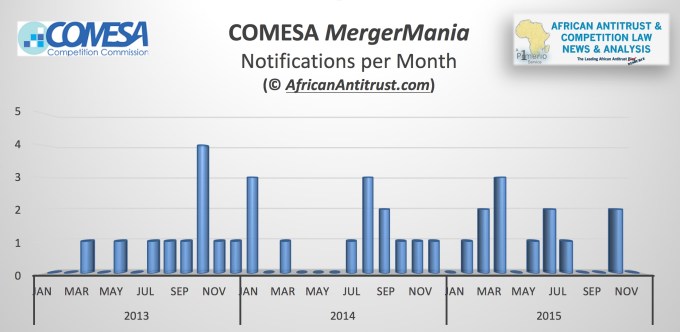
Our updated AAT COMESA MergerManiastatistics are therefore as follows (again noting the fact that AAT bases its count on only the official, published and available merger documents, instead of relying on mere press release-based summaries published by the CCC). We also note that to date, 2016 has seen one “merger inquiry notice,” namely of the Dutch Yara / Zambian Greenbeltfertiliser deal. The public-comment period for that transaction expires on January 22, 2016.
Number of merger notifications based on CCC-published notices
The full text of the COMESA release follows below:
During the year 2015, the Commission assessed and cleared 15 merger transactions. The transactions involved sectors such as insurance, food additives, water treatment, agro-chemical, banking, telecommunication, non alcohol-ic beverage, publishing, packaging and retail. The Commission handled 12 merger notifications in the year 2013 and 44 merger notifications in the year 2014. The Pie Chart below shows the number of mergers handled by the Commission from inception to date.
As shown in the pie chart the Commission dealt with more mergers in 2014 as compared to 2013 but this trend has gone down in 2015. This trend may be attributed to the supposition that in 2013, the Commission had just commenced operations and therefore some stakeholders were not immediately aware of its existence and operations. By 2014, most stake-holders had become aware of the Commission and its operations, hence the significant increase in the number of mergers notified. The significant reduction in 2015 can be attributed to the supposition that the merger notification thresholds approved by the Council of Ministers on 26 March 2015 which has resulted in smaller mergers escaping the notification. Before 26 March 2015, the merger notification thresholds were Zero hence all mergers were notifiable regardless of size.
Competition law as a tool for promoting consumer welfare & maintaining a competitive market in Kenya
By contributing author Elizabeth Sisenda, LL.M (London) LL.B (CUEA) PGD Law (KSL)
The core aim of enforcing competition law revolves around balancing between beneficial market power and market power that is detrimental to consumer welfare. Market power can be defined as the ability of a firm to raise and maintain price above the level that would prevail under competitive market conditions, without being destabilised by consumers switching to other products/services or new competitors entering the same market. Often the actual price is above cost leading to high profits for the firm with market power. In practice, the pursuit of market dominance can be a great incentive for investment, cost efficiency and innovation. Therefore, the acquisition of a dominant position through superior product or customer services, better pricing, innovation, efficiency and investment is not illegal. Only the abuse of dominance is prohibited. Where a firm exercises market power, competition law functions to protect the openness of the market by ensuring that the dominant firm does not impose unfair trading conditions for actual or potential competitors, or abuse its intellectual property rights. It also intervenes to prevent direct harm to consumer welfare through conduct or transactions that limit output or production artificially in order to price-fix.
Merger control is another important function of competition law and policy, that is designed to prevent positions of market power from being established through acquisition, unless there is a strong economic efficiency rationale that will mitigate for the loss of competition between the merging firms. A company should therefore earn market power and not simply buy out competitors.
Thus, an important ideal of competition policy is to promote a contestable market for as long as it promotes consumer welfare, and a feasible market structure for a particular sector of the economy. In a contestable market, the sunken costs required to join the sector are negligible and other entry barriers are so low that the threat of new entrants is sufficient to check the conduct of the incumbent firm with market power. The costs of exiting the market are also negligible.
In relation to competitors, competition law cannot intervene on behalf of a particular firm in the market, without taking into account the broader effects of the conduct in question on competition in the relevant market. A firm would have to show, on the face of it, that its competitors in that market are engaged in concerted or collusive practices. For instance, competitors can tacitly seek to exercise market power through anti-competitive agreements that enable them to concentrate the market. This often results in one or more firms becoming large enough to be in a position to affect the market’s outcomes in a manner that causes consumer welfare or public interest to be compromised.
Under these circumstances, competition law intervenes and investigates to ensure that there is no unwarranted concentration of economic power in a particular market through collusive agreements between competitors. Unwarranted concentrations of economic power exist where there is cross-directorship or sharing of a senior employee or executive between two distinct firms providing substantially similar goods or services, and whose combined market share is more than 40%. Competition legislation regulates this conduct because it often results in board decisions being made that could lead to collusion among the firms involved, such as price fixing and dividing markets, thereby lessening competition.
For instance, in Kenya, the cement sector has been under investigation for unwarranted concentrations of economic power. Although there are a number of cement-producing companies in the market, the dominant multinational firm – Lafarge Limited, has a 58.6% stake in the leading producer, Bamburi Cement Limited and a 42% shareholding in another leading company, East African Portland Cement Limited. Market concentration concerns have arisen because Bamburi Cement Limited, which has a market share of 39%, has had cross-directorship with the 3rd largest producer in the market – East African Portland Cement Limited to an extent that may dampen competition. Kenya’s cement prices have been the second highest out of six eastern and southern African countries including South Africa, Zambia and Tanzania between 2000-2014 according to a sector report. In 2014, the Kenyan government recommended that Lafarge dilute its shareholding in East African Portland Cement Limited. However, it was not conclusive whether price fixing was going on.
On the other hand, Kenya’s cement sector may experience increased competition from imports as a result of the East African Community (EAC) reducing the common external tariff (CET) on cement from 35% to 25% through an EAC gazette notice of February 2015. Cement has also been removed from the list of sensitive products that require protection until domestic industries can compete according to the same gazette notice. Although local cement producers are protesting the move, consumers stand to gain, as the liberalized market will lead to lower prices of the commodity, and possibly have a positive impact on the construction industry.
Numerous in personnel, yet still displaying a dearth of actual case-law development even in merely the one area in which the COMESA Competition Commission has been active — mergers — the agency recently appointed two new (indeed, additional, as the number grew from 9 to 11) Commissioners for the standard term of three years.
Competition practitioner John Oxenham, a director at Africa consultancy Pr1merio, identified them as Trudon Nzembela Kalala from the Democratic Republic of the Congo, and Kowlessur Deshmuk, Executive Director of the Competition Commission of Mauritius. Oxenham notes that neither country enjoyed representation between the April announcement of 4 new commissioners and December 8 (see also April 15 AAT story on the agency’s prior appointments).
Flying somewhat under the radar during the Christmas and year-end holiday season (but not under AAT’s radar), the South African Petroleum Industry Association (made up of BP, Shell, Chevron and other oil heavyweights) have sought a five-year renewal of their currently temporary holdover exemption from certain competition laws, which will expire in June 2016. The application was made on Christmas Eve 2015 under section 10(6)(a) of the Competition Act. SAPIA has not posted any news item or press release about its application on its web site to date.
SAPIA is seeking permission to allow its members to “cooperate and co-ordinate” on common industry logistics issues, as Andreas Stargard, a director with African competition-law and anti-corruption advisors Pr1merio notes.
“These include areas such as Single Buoy Mooring, port facilities, shipping, mooring, and interestingly also distribution as well as less well-defined ‘production and manufacturing plant shutdowns.'”
As Stargard observes, from an antitrust perspective, this could be of significant interest: production limitations would necessarily decrease available supply and thereby have the potential to drive up price, he notes. Under the terms of SAPIA’s application, the plant shutdowns are both scheduled and unscheduled and supposedly relate to upgrades and safety measures only, according to the application. In practice, however, such an exemption could give possibly provide the oil industry with carte blanche on competition issues and market manipulation.
In order to assuage concerns, the SAPIA members agree, in return for the exemption, that:
Competing participants in exempt agreements and practices may not share competitively sensitive information, except for the purposes described in the exemption application.
SAPIA and its members may not share information relating to setting of margins, imposition of levies and or approval of tariffs, unless required to do so by the DOE or NERSA.
The employees of any operating party who receive such information shall ensure that the information is held, maintained and used separately, confidentially and on need- to-know basis only.
The full text of the request for exemption is located here. Interested parties and the public have 20 business days to comment on the application.
A number of African jurisdictions have recently published guidelines relating to merger control (which we have reported here on Africanantitrust). During 2015, Malawi’sCompetition and Fair Trading Commission (“CFTC”, whose web site appears to be down at the time of publication (http://www.cftc.mw), followed suit and published Merger Assessment Guidelines in 2015 (“Guidelines”) in order to provide some guidance as to how the CFTC will evaluate mergers in terms of the Competition and Fair Trading Act (“Act”).
Most significantly, the Guidelines have not catered for mandatorily notifiable merger thresholds which is unfortunate as most competition agencies as well as advocacy groups have recognised that financial thresholds is an important requirement to ensure that merger control regimes are not overly burdensome on merging parties.
Furthermore, the COMESA Competition Commission, to which Malawi is a member, published merger notification thresholds in 2015 in line with international best practice. It would be encouraged that the CFTC considers likewise publishing thresholds.
Other than the absence of any thresholds, the Guidelines contain substantively similar content to most merger control guidelines insofar as they set out the broad and general approach that the CFTC will take when evaluating a merger. We have, however, identified the following interesting aspects which emerge from the Guidelines which our readers may want to take note of:
The CFTC is entitled to issue a “letter of comfort” to merging parties. A letter of comfort is not formal approval, but allows the merging parties to engage conduct their activities as if approval has been obtained. Therefore, once a letter of comfort has been obtained, the parties may implement the merger. In terms of the Guidelines, a letter of comfort will only be issued once the CTFC is satisfied that any should their investigation reveal any potential competition law concerns, that those concerns will be able to be sufficiently addressed by merger related conditions. It is not clear whether a letter of comfort will be issued before the merger has been made public and therefore it is also unclear what the role of an intervening third party will be once a letter of comfort has been issued.
The merger filing fee is 0.05% of the combined turnover or assets of the enterprises’ turnover. The Guidelines do not specify that the turnover must be derived from, in, or into Malawi, although it is likely that this is indeed what was intended.
The Act and Guidelines make provision for what is becoming a common feature of developing countries competition laws, namely the introduction of so-called “public interest” provisions in merger control. The Guidelines, however, indicate that the CFTC does not consider these public interest provisions in quite as robust manner as the authorities do other countries including, inter alia, South Africa, Namibia, Zambia and Swaziland. In terms of the Guidelines, any public interest advantages or disadvantages is just one of the factors that the CFTC will consider, together with the traditional merger control factors. It is thus unlikely that a pro-competitive merger would be blocked purely on public interest grounds although this is notionally possible.
The Guidelines set out the following factors, combined with figures that are likely to be utilised when evaluating market concentration, which if exceeded, may increase the likelihood of the merger leading to a substantial lessening of competition:
Market Shares: 40% for horizontal mergers and 30% for non-horizontal mergers;
Number of firms in the market;
Concentration Ratios: CR3- 65%; or
The Herfindahl-Hirschman Index (“HHI”): HHI between 1000-2000 with delta 259; or HHI above 200 with delta 150. For non-horizontal mergers a merger is unlikely to raise competition concerns if the HHI is below 2000 post-merger.
We have previously, on African Antitrust, reported on South Africa’s first predatory pricing case in the Media 24 matter. In light, however, of the recent cases on exclusionary conduct — particularly predatory pricing, which has received significant attention from competition law agencies across a number of jurisdictions of late (see, for instance, the Paris Court of Appeals’ dismissal of the predatory pricing and exclusionary conduct allegations made against Google by an online maps rival. The Indian Competition Commission has also launched an investigation into alleged predatory pricing in the taxi industry, and the European Commission has launched investigations into predatory pricing in the potato-chips / crisps industry) — a more substantive evaluation of predatory pricing in South Africa is called for. The following article on predatory pricing, in light of the Media 24 case, neatly sets out and evaluates the landscape of predatory pricing in South Africa.
Predatory Pricing & the South African Competition Act: a False-Positive?
By Michael J. Currie
Intro & Summary
“From an antitrust perspective, predatory pricing is a particularly difficult problem with which to deal. If we are to prevent anticompetitive monopolization, it is a strategy that must not be permitted. The paradox, however, is that such a pricing strategy is virtually indistinguishable from the very sort of aggressive competitive pricing we wish to encourage.”
D L Kaserman and J W Mayo, ‘Government and Business: The Economics of Antitrust and Regulation’ (1995) Fort Worth, TX: Dryden Press at 128
In September 2015, the Competition Tribunal (“Tribunal”), for the first time in South Africa’s sixteen-year history of competition-law enforcement found, in the Media 24 case that the respondent had engaged in predatory pricing in contravention of the South African Competition Act, 89 of 1998 (“Act”).
The Media 24 case, despite being dragged out for nearly six years, was set to be the leading jurisprudence on the laws pertain to predatory pricing, and in particular, how Section 8(d)(iv) of the Act would be interpreted and applied by the Tribunal. The finding by the Tribunal was, however, based on Section 8(c) of the Act, which is a broader ‘catch-all’ provision, and left some important questions as to the interpretation of Section 8(d)(iv) unanswered. Most notably, whether or not Section 8(d)(iv) permits complainants to utilise cost measurement standards other than Average Variable Costs (“AVC”) or Marginal Costs (“MC”) to prove that a dominant firm has engaged in predatory pricing in contravention of the provision.
Having said that, however, the Media 24 case provides some insight as to the precise relationship between Sections 8(d)(iv) and 8(c) of the Act as they relate to predatory pricing, and may have offered, by way of certain obiter remarks, an indication as to how the Tribunal may interpret and apply Section 8(d)(iv) of the Act in the future.
Continue reading the full article, an AAT exclusive, in PDF format:
The Public Protector, in theory, was designed and created to strengthen the constitutional democracy within South Africa along with the other Constitutional Institutions established under Chapter 9 of the Constitution of the Republic of South Africa.[1] In order to strengthen this constitutional democracy, it is imperative that the Public Protector be independent from any governmental branch or agency, as making it accountable to the exact organs it seeks to protect society from renders it ineffective and voiceless. What follows is an elaboration on the role of the Public Protector within a constitutionally democratic South Africa and whether its purpose and effectiveness has in essence fallen into redundancy by making it accountable to Parliament.
Thula Madonsela
Establishing a constitutionally democratic Public Protector
The unfailing oppressiveness and secretiveness of the Apartheid government lead to a distrust of such a government and one which was consequently not open and accountable.[2] State organs could and often did act ultra vires, doing whatever they wished regardless of whether such powers were given to them, and would not need to be accountable for any such actions.[3]
However with the dawning of a constitutional democracy in 1994, the need to divide the once monopolised parliamentary power among all branches of government and the implementation of checks and balances ensuring that all branches of government became accountable towards one another became imperative in securing the ideal of a democratic nation once founded upon racial oppression and impunity.[4] With the implementation of the 1993 Interim Constitution, in terms of principle 29, the office of the Public Protector was first established and by including it the Constitutional Principles, secured its existence within the final Constitution.[5]
The Public Protector was designed to assist in the transformation of an oppressive society into an open and democratic society, creating an accountable and credible government through the re-establishment and respect of the rule of law. No longer was government above the law nor could they do a they wished, rather the government was in theory, accountable to the people of the nation, echoing the entire theory of the social contract.[6] Consequently the office of the Public Protector was ideally to act as a check between the Executive and Legislative branches of government and to provide a link between the citizens and such branches.[7]
The powers, functions and duties of the office of the Public Protector
The Public Protector is an institution established to investigate purported or supposed indecorous behavior of state affairs, whereby upon the decision to investigate such, which is at the discretion of the Public Protector, the Public Protector must report on such conduct and if applicable the taking of appropriate remedial action must occur.[8]
The Public Protector may not investigate judicial decisions, as this is the function of the Judicial Services Commission as well as owing to the fact that the Public Protector acts as a check between the Executive and Legislature.[9] The Public Protector may also not investigate human rights issues as such issues fall within the jurisdiction of the South African Human Rights Commission.[10] Once the Public Protector has an affirmative finding of misconduct, such a finding is then referred to the Director of Public Prosecutions.[11]
What follows is a determination of the ability of the Public Protector to accurately fulfill the role of its office. Such capability is determined by means of the independence which is afforded to it.
How independent is the Public Protector?
In order to hold the Executive and Legislative branches of government accountable, the Public Protector requires a “sufficient” amount of independence. This leads to predominant issues of what constitutes sufficient independence and the issue of over independence of such institutions which would then lead to an abuse of such independence.
Independence is a characteristic, which is established objectively in terms of whether a reasonable person would perceive such an institution as being independent.[12] Thus the impact that the Public Protectors perceived independence upon the reasonable person would in hindsight affect the Public Protector to fulfill the role of its office.
In order to accurately understand the independence which the Public Protector is afforded, its independence needs to be divided amongst five aspects namely a prima facie contradiction that exists between sections 181(2) and 181(5) of the Constitution, financial independence, administrative independence and finally, the independence of appointments and dismissals of the Public Protector.
Amid section 181(2) and 181(5) of the Constitution, there exists a prima facie conflict of these two provisions in the sense that section 181(2) holds Chapter 9 institutions to be independent and only subject to the Constitution whereas 181(5) holds such institutions accountable to the National Assembly.[13] This inconsistency was settled in Independent Electoral Commission v Langeberg Municipality [14] whereby the court held in accordance with section 239 such institutions are not governmental departments which the Cabinet may have stimulus over, rather they are independent from government.[15] Thus by holding such, the court made it clear that although the Public Protector is accountable to the National Assembly, it is not accountable to government nor is it afforded the same independence as the judiciary.[16]
Two reasons exist at the outset for such accountability.[17] Firstly the Public Protector is said to be accountable to the National Assembly, as through representative democracy, the National Assembly represents the population of South Africa, their opinions and ideologies, and thus by making the Public Protector accountable to the National Assembly, it is in essence making the Public Protector accountable to the public.[18]
Financial independence of the Public Protector was too dealt with in Independent Electoral Commission v Langeberg Municipality whereby the Constitutional Court affirmed such Chapter 9 institutions need a degree of financial independence but it is not to say that such institutions may set their own budget.[19] Rather Parliament as opposed to the Executive has the obligation to provide sufficiently reasonable funding in order for the Public Protector to fulfill its functions.
Appointments of the Public Protector are made by the President through a shortlisting of candidates, by the National Assembly, whom the Public nominated.[20] Therefore there exists a grave deficit in terms of public participation, as the public does not participate beyond the nominations stage.
It is too the National Assembly who may dismiss the Public Protector with a two-thirds majority vote. Such a majority is to ensure a simple majority does not unjustly dismiss the Public Protector.[21]
In theory, affording the Public Protector this amount of Constitutional independence at first glance, seems to allow it the ability to perform its functions. However, over the past couple of years, grave injustices have been committed towards this Chapter 9 institution that raises doubts as to whether the Public Protector can effectively fulfil its office, and whether the continued lack of the required independence renders the office of the Public Protector redundant.
The Constitution can be said to afford the Public Protector “sufficient” independence. However I posit that sufficient independence does not mean effective independence, and it is evident that the Public Protector as a chapter 9 institution is fundamental in the supporting of a democratic South Africa, representing a mechanism of holding the Executive and Legislature accountable, but such an office is not effective for as long as those whom the Public Protector seeks to hold accountable are the exact persons who have the power and ability to dismiss the Public Protector and furthermore have the ability to dictate the funding it therefore receives. With the recent cries for funding by the Public Protector, and the closing of its Mpumalanga office with others following suit, the question arises of whether the Public Protector has been reduced to a mere symbol of a ideology of democracy, unable to protect the public. Furthermore the manner in which the Nkandla Report was received in Parliament shows its inability to effectively exercise its powers and functions. Not being able to protect the public renders the Public Protector a useless feat.
I therefore posit that the theoretical independence afforded to the Public Protector is not enough to allow it to effectively fulfil its powers and duties. Therefore all efforts must be made to afford the Public Protector such effective independence in order to fulfil its role and allow it to effectively protect the public.
………………………………………………………………………………………..
Footnotes
………………………………………………………………………………………..
[1] Constitution of the Republic of South Africa, 1996 section 181(1)(a).
[2] Pierre de Vos ‘Balancing Independence and Accountability: The Role of the Chapter 9 Institutions in South Africa’s Constitutional Democracy’ in M Danwood, M. Chirwa and Lia Nijzink ‘Accountable Government in Africa Chapter 10’ (2012) 160 at 160.
[3] Ibid; Iain Currie and Johan de Waal The New Constitutional & Administrative Law vol 1 (2013) 46 to 50.
[4]Public Protector v Mail and Guardian Ltd and Others 2011 (4) SA 422 (SCA) paras 5 & 6; C. Thornhill ‘Role of the Public Protector’ (2011) 2 Case Studies of Public Authority at 87.
[5] C, Murray ‘The Human Rights Commission et al: What is the Role of South Africa’s Chapter 9 Institutions?’ (2006) 2 PELJ 122 at 123 & 124;Ex Parte Chairperson of the Constitutional Assembly In Re: Certification of the Constitution of the Republic of South Africa, 1996 1996 (4) SA 744 (CC) certification case 1996 (4) SA 744 para 161.
By AAT Editor, John Oxenham and Senior Contributor, Michael-James Currie.
During November 2015, the Constitutional Court of South Africa dismissed an application by the South African Competition Commission to appeal the competition Appeal Court’s (CAC) decision that Sasol Chemical Industries (SCI) had not charged excessive prices in contravention of the Competition Act’s abuse of dominance provisions. The CAC reaffirmed its decision in Mittal, which has been the leading authority on excessive pricing in South Africa.
In doing so the CAC confirmed that the first step in an excessive pricing case is to determine the economic value of the product. This is an objective test and must be determined in consideration of a notionally long run competitive environment.
Once the economic value has been determined, it is then necessary to establish whether the price was reasonably related to the economic value.
While this is a subjective test, the CAC confirmed the origin of a firm’s dominance and ‘degree of dominance’ is not particularly relevant. The CAC went even further and held that it is unlikely that a price will be deemed “unreasonably related” to the economic value if the price is not greater than 20% of the economic value.
For a comprehensive examination of the SCI case and what it means for excessive pricing cases in South Africa, please see the authors’ paper on Excessive Pricing.
In light of the Constitutional Court’s dismissal of the leave to appeal and coupled with Minister of Economic Development Ebrahim Patel’s recently stated desire to use the Competition Act to promote industrial policies goals, South Africa’s antitrust legislation may be amended in order to assist the Competition Commission in prosecuting abuse of dominance cases, in particular, excessive pricing.
Continuing the original AAT series, ECONAfrica, Peter O’Brien addresses the WTO’s upcoming MC10 conference.
From 15-18 December Nairobi will host the 10th Ministerial Conference (MC10) of the World Trade Organization (WTO). This will be a meeting of many firsts. Till now, no sub-Saharan African country had hosted a Ministerial Conference organised by the WTO. Nairobi will bring into force the Trade Facilitation Agreement (TFA), the first occasion in the now 21 year history of WTO that a new agreement has been signed (all others were established at the inception of WTO). This is the first MC to take place against the backdrop of an agreement in Africa, concluded this year, to work for a continent wide area of free trade. Today more than one quarter (43 countries in total) of all WTO Members (more than 160) are African. Moreover, the Accession Package for Liberia was agreed in Geneva on 6 October, and it can be expected that it too will join in the course of 2016.
Apart from celebrating the firsts, are there any reasons for business in Africa to pay attention to events in Nairobi? The answer is an emphatic yes:
The TFA is the one WTO agreement that promises real advantages on the logistics of trade. Detailed studies have shown that, on average, the sheer movement of goods within Africa accounts for roughly one fifth of all costs. Serious steps to cut those costs, which is what TFA is about, represent a win/win for producers, traders, consumers and indeed the public authorities. Since Africa is the region of the world where intra-trade (transactions among African countries themselves) is by far the lowest, and where most national markets are small, the gains from logistics savings are potentially huge.
The TFA will commit WTO Members to help the least developed countries, a group of over 30 States of whom the majority are African. For the first time, there are straight advantages to be obtained without a condition of reciprocity. Funding, technical assistance, streamlining of trade administration, are just some of the things that can be expected. The TFA allows governments and business together to formulate their requests, so this is the chance to utilize an organized offer of support.
MC10 will seek to reinforce the whole network of disciplines concerned with non-discrimination and competition that constitute the core of WTO agreements. That progress is very positive for the growth of competitive markets on the continent.
The meeting will be attended by numerous international and regional observer organizations from the private sector, as well as by non-governmental organizations (NGOs) whose normal activities are overwhelmingly directed towards improving trade and welfare in African countries. Their presence serves to strengthen the lobby for growth and welfare improvement.
In the world of yesterday, tariffs and quantitative limitations dominated trade negotiations. In tomorrow’s world, the critical subjects are technical barriers to trade (meaning formal legal resolutions that control trade for purposes of national security, public health and so on), voluntary norms and standards (which in practice frequently acquire a market force equivalent to a legal provision), and a host of other regulatory issues that determine who will be best placed in the market.
More or less all African countries, with the partial exception of South Africa, have always been on the receiving end of these instruments. Africa has thus far played a very minor role in shaping “the rules of the international competitive game.”But with the continent now the fastest-growing region in the world economy, with the race for its natural resources continuing (despite the current lows in resource prices), with the ongoing investments (from within the continent and without), and the steady improvements in governance observable in the majority of countries, Africa is well placed to make its voice heard.
Nairobi and the MC10 offer the ideal stage on which the continent can begin its future path as one of the designers of competitive change.
In our new AAT series, ECONAfrica, Pr1merio economist Peter O’Brien discusses corporate debt issues on the continent.
Debt debates on Africa nearly always talk about sovereign debt. But in economies which are growing, even if with plenty of ups and downs, firms need to finance expansion. Banks can help, yet this is often not so easy to organize. Another option is to issue corporate bonds (‘CB’). Since rating agencies generally assess clients on a three letter basis (sometimes with a + or – at the end), we will make our 3R assessment of African CB. What’s the reality, what’s the regulatory situation, and what are the risks and rewards?
Overview
First, a thumbnail sketch (admittedly based on limited evidence) of the stylized facts:
So far, all African countries (including the Middle East) account for less than 5% of the value of all CB issued by Emerging Market Economies (EME).
Within that, South Africa, Mauritius and Egypt add up to around two thirds, with South Africa alone as one third.
Most CB in Africa have maturities no more than 10 years
Over half of the bonds are fixed interest
Roughly 30% of the CB are considered high yield (another way of saying that investors reckon the risks are substantial)
It seems as if there is more or less an even split between CB issued in local currency (hence with local currency coupon rates) and those in foreign currency (nearly all $ or euro)
The investors are in the main a group of 50-60 funds
In South Africa, as of October 2015, foreign holdings of local CB were 35% of the total
In a number of African countries, the leading corporate borrowers are parastatal firms
Corporate debt, measured as a percentage of GDP, is far lower in African countries than in most others. While many other places, especially some of the big EME, are vulnerable to macroeconomic damage stemming from corporate debt, Africa (including South Africa, where this percentage has remained remarkably stable) should be fairly safe
Corporate debt in South Africa has remained the same as percentage of GDP (Source: The Economist)
Lessons Learned?
What does this picture tell us? Its principal message is surely that this is an area certain to experience major changes, and quite possibly major expansion (not only in volume but also in the players involved).
Now to regulation, both internal and external. The country that seems to have explicitly made provision for corporate debt, and its restructuring, is South Africa. In Companies Act 71 of 2008, enacted in 2011, there are clauses that set out possibilities for Corporate Debt restructuring. Since enactment, over 400 companies have applied for these methods of handling the problems, and there are upwards of 80 entities offering specialized advice in the field. This prudent approach no doubt stems in part from the size and significance of corporate borrowing in that country. Elsewhere, legal and regulatory issues seem, on balance, to hold back greater reliance on CB. In part there are accounting and corporate governance standards which local companies may not yet meet. In part, it appears that the disclosure requirements that must be met before recourse to CB can be made may constrain the actions of companies (bank borrowing generally requires less disclosure). On the external side, the Basel 111 stipulations matter, in particular because they limit the possibilities for underpricing of CB (a practice that has been fairly frequent till now).
What is missing in the regulatory environment, however, is any overall examination of what might be done to stimulate the prudent use of CB. If this were to be done, such regulation would need to assess financial, economic and anti-trust issues.
The risks and rewards of the CB approach to corporate funding, and indeed the opportunities to use it, are very different across Africa. From economies such as Kenya and Botswana, where the phenomenon is on the rise, to those of the Maghreb, where political uncertainties in very recent years seem to have stunted what was a promising growth, to many parts of West Africa, where to date there is seemingly little activity in this area, each country has its own environment. However, the ever greater integration in the various regions means that there may well be prospects for making better use of private regional funds and of sovereign funds. Either way, African companies should look forward with optimism to utilizing more local capital. It is the job of regulators to ensure this is done in a sound way financially, and that these markets operate competitively.





 Strategic Timing of Exemption Application?





 From 15-18 December Nairobi will host the 10th Ministerial Conference (MC10) of the World Trade Organization (WTO). This will be a meeting of many firsts. Till now, no sub-Saharan African country had hosted a Ministerial Conference organised by the WTO. Nairobi will bring into force the Trade Facilitation Agreement (TFA), the first occasion in the now 21 year history of WTO that a new agreement has been signed (all others were established at the inception of WTO). This is the first MC to take place against the backdrop of an agreement in Africa, concluded this year, to work for a continent wide area of free trade. Today more than one quarter (43 countries in total) of all WTO Members (more than 160) are African. Moreover, the Accession Package for Liberia was agreed in Geneva on 6 October, and it can be expected that it too will join in the course of 2016.
 African Antitrust & Competition Law