Costly COMESA courthouse, ZA investigates Visa provider & holds ground on Sasol fine

south_africa

Lots AAT news this Monday, from Sudan/COMESA to South Africa

Visa facilitator backed by one branch of government & investigated by another

In substantive antitrust news, the South African Competition Commission is reported to be investigating alleged abuses of market dominance by VFS Global in the visa support services market to foreign embassies.

VFS is a worldwide outsourcing and technology services specialist for diplomatic missions and governments.

The firm has now drawn the potential ire of the Commission, as it is now apparently the only outlet for foreigners to apply for South African visas and work permits, as well as for South African citizens to obtain entry visas for multiple countries abroad.

The irony here that we at AAT perceive is that the monopoly position of VFS appears to be based on the new immigration regulations imposed by the ZA government itself (notably the Department of Home Affairs) earlier in 2014: According to a report, the company had recently opened the doors of its multiple offices across the country — “The Pretoria (Gauteng), Rustenburg (North West) and Kimberley (Northern Cape) centres were the first to open on Monday, 2 June. It is envisaged that the last office will be opened on 23 June.”

The investigation – to be confirmed by the Commission this week, as it potentially launches a full-on formal inquest – was purportedly initiated by a competitor complaint from company Visa Request, claiming damage to its competing business flowing from the governmentally-imposed dominant position of VFS’s (allegedly pricier) services…

Commission stays course on Sasol

In more ZA news, Competition Commissioner Tembinkosi Bonakele is staying the agency’s strong course on the excessive-pricing fine imposed on Sasol, which is said to be appealing its R543 fine that had been upheld by the country’s Competition Tribunal, and which Commissioner Bonakele thinks “should be bigger”…

In our prior AAT reporting on the Sasol abuse-of-dominance case we said:

The S.A. Competition Tribunal is hearing the excessive-pricing portion (which was not settled) of the Commission‘s claims against the refining & steel giant this month.  The relevant legal underpinning of the case is the provision against excessive pricing by a dominant firm.  Precedent has declared prices excessive that “bear no reasonable relation to the economic value of the good or service” at issue.  Pheeew.  Facts.  Economics.  Nice.  Looks like a coming battle of the experts to me…

By comparison, in the U.S., antitrust law of course does not forbid “excessive pricing.”  While setting and reaping apparently high prices may be indicative of monopoly power, such acts are not in themselves anti-competitive or illegal in the States.  In Verizon v. Trinko, the U.S. Supreme Court held famously that:

The mere possession of monopoly power, and the concomitant charging of monopoly prices, is not only not unlawful; it is an important element of the free-market system. The opportunity to charge monopoly prices—at least for a short period—is what attracts “business acumen” in the first place; it induces risk taking that produces innovation and economic growth.

Interestingly, there is a notable history of failures in the area of ‘excessive pricing’ complaints in South Africa, as well, despite the statutory legitimisation of the cause of action.  In the prior ArcelorMittal and Telkom cases, the Commission and/or Tribunal lost in the end, either at trial or on appeal to the Competition Appeal Court.  That Court had found, in the ArcelorMittal case, that the antitrust watchdogs could not use the ‘excessive pricing’ provision of the statute to combat perceived anti-competitiveness in the “market structure rather than price level.”

Today, Bonakele is quoted as follows:

“These are different times.  I can promise you this matter is not going to disappear. Sasol is out of touch if it believes it can win the matter on the basis of technical legal arguments. This issue has to be resolved either through competition law or through government policy.

The issue in this case is fundamental to the development of our economy. We are dealing with resources that should be available to promote that development. The government plays an important role in the country’s industrialisation, and I believe it will be very interested in the progress of this case.”

COMESA’s costly courthouse

While the COMESA organisation has had trouble in the virtual world this year, its real-world endavours appear to be prospering: Its shiny new courthouse, built to the tune of over $4 million (equivalent to only 8 merger filing fees), has opened its doors.  The country’s Minister of Justice, Mohamed Bushara Dosa, last week handed over to the COMESA Secretariat-general the Khartoum-based court premises.

The court will notably hear antitrust and merger cases that are appealed from the organisation’s Competition Commission.


 

https://i0.wp.com/news.sudanvisiondaily.com/media/images/29d17065-0634-951e.jpg
The glimmering COMESA court house in Sudan, built to the tune of $4.1 million

COMESA news of the day: web site down again; 5 “exemption” letters granted

COMESA Competition Commission logo

Site down – 5 “comfort letters in 5 months – Guidelines revision by June

In an almost farcical repetition of its information-technology woes, the COMESA Competition Commission’s web site (http://www.comesacompetition.org/) is off-line, yet again, after having been successfully hacked multiple times.  Whether the latest outage is due to a similar attack or simply (and hopefully) due to its webmaster’s shoring up the competition enforcer’s IT security measures remains to be seen.  (We have not yet heard back from the agency’s leadership on our request for information on the online data safety of parties’ submissions.)

In more substantive news, IFLR reports that the CCC has issued five so-called “Comfort Letters” since December 2013, exempting otherwise notifiable transactions from the duty to file (as well as the concomitant payment of the (high) filing fees), where the actual nexus to the COMESA region was negligible or non-existent.  This may help explain some of the lackluster filing statistics on which we reported previously.

The report also quotes the CCC’s head of mergers, Mr. Willard Mwemba, as saying that the revision of the Competition Guidelines should be finalised by the end of June 2014.

Competition authority issues sectoral warning, threatens criminal sanctions

kenya

Wake-up call to would-be cartelists and monopolists in Kenya

The Standard reports that the Competition Authority of Kenya (“CAK”) (AAT archive on CAK issues here) is threatening cartelists with prison terms of up to 5 years and fines up to 10 million Shilling ($115,000).

According to the report, CAK Director General Francis Wang’ombe Kariuki said that “investigations are already being conducted in [the] transport, insurance, shipping, milling, banking, cement, sugar, health care and tea” sectors, pursuant to purported consumer complaints.

CAK Director General Kariuki

The CAK has actively pursued antitrust matters, using novel approaches of late, as AAT recently reported on a seemingly hybrid unilateral/collusion case (“Kenya: Lafarge faces possible price-fixing penalties due to cross-shareholding“).  The CAK is also the sole COMESA member enforcement authority that has, to our knowledge, challenged the fledgling and issues-plagued COMESA Competition Authority’s jurisdiction in various merger cases.

COMESA old flag color

Malicious COMESA web site attack: Competition Commission hacked 3rd time

For the third time in a month, the fledgling pan-African antitrust enforcer’s web site has been disabled by hackers

As competition-law attorneys counseling clients on the necessity of notifying mergers in the COMESA jurisdiction, we view these developments with – put mildly – shock.  This is especially true as confidential party data and documents would appear to be at risk of involuntary and malicious disclosure to third, unauthorized parties.  As reported at AfricanAntitrust.com, the COMESA enforcement agency’s web site has previously been hacked and later simply disabled.

COMESA leadership non-responsive

On both prior occasions, AAT’s editors wrote to the COMESA Competition Commission‘s webmaster, as well as the agency’s leadership (Messrs. George Lipimile and Willard Mwemba), to seek an explanation of the attacks.  We also asked them about the safety of data and other confidential party information submitted to the CCC via its extranet & online document repository.

Not only have we not received any response to date.  What’s more, in a – perhaps unsurprising, at this stage – turn of events, the Commission has now been subjected to its third hacking attack.

Hackers boast of achieving successful attack

This latest episode also embodies the most disconcerting hack, as it appears visually and substantively more malicious than the prior attacks (one of which featured an Indonesian love poem, whilst the second rendered the CCC’s page simply blank).  A visual example of the latest attack can be found below.  The hackers (identified as “Kinal Undetected” from SerdaduPerangCrew and SPCSO) [note: prior and subsequent links open hacker-related pages] acknowledge – for the first time – that it is an intentional event and not merely an accidental outage or otherwise unintended gaffe of the CCC’s webmaster.  Moreover, the perpetrators even submitted a screenshot of the intrusion to “Zone H“, a clearing-house of hackers, as evidence of the attack on Monday.  This means that the CCC’s site has been disabled for at least two full days (through 14 May — UPDATE: the regular COMESA site is back up and running at 16:00 CET, 14th May).  On the prior occasions, the site likewise remained compromised for several days in a row.

Logo of the successful COMESA hackers displayed on CCC’s web site (May 12-13, 2014)

High risk of data security breach & next steps

We are in the process of sending yet another follow-up e-mail to the CCC’s executives to obtain further information about this unsettling and embarrassing security breach/failure, including: (1) risks to confidential corporate information, (2) the impact on the private deliberative process of the Commission, as well as (3) steps the CCC intends to take to prevent future replication of these embarrassing and dangerous attacks, including (we propose) the retention of a professional data-security firm for advice and potentially management of the web interface.

COMESA hack no3


Call for parties to CCC proceedings to take action

Especially in light of COMESA staff’s unsettling silence in response to alerts to these attacks, and as we have done before, we are notifying our readership (and particularly current or potential future parties to CCC merger reviews) regarding the deficiencies in the competition enforcer’s electronic systems. These may impact the timetable and resulting deadlines of pending merger investigations, and it is advisable that all such interested parties enquire with the Competition Commission about the procedural effect of the outage.

Investment in Africa: Changing landscape, new hurdles

Questioning African antitrust growth prospects: Slowdown in economic investment (both organic and outside investment) may affect functioning of competition law on the continent

Recent developments in Africa have many scratching their heads and wondering whether the formerly wondrous economic-growth engine of the vastly resource-rich and otherwise economically still undervalued continent will soon experience a slowdown, if not come to a halt altogether.

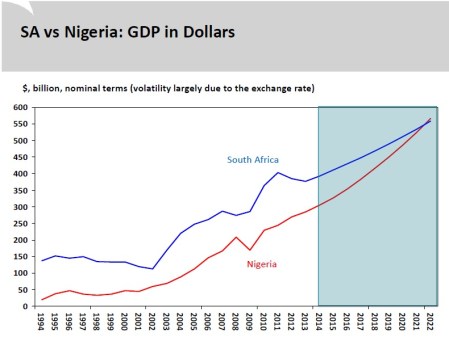
For one, in April 2014, Nigeria surpassed South Africa as the continent’s largest economy (see Economist Apr. 12, 2014: “Africa’s New Number One“).  This is a significant milestone for the former, and a setback for the latter — an economy that was 8 times the size of the Nigerian economy only 20 years ago, yet is now suffering from stagnating GDP, reeling from corruption allegations amongst its current leadership, undergoing a closely-watched presidential election process, and whose ruling ANC party is facing a heretofore unprecedented backlash and torrent of criticism.

Source: The Economist

Not only South Africa has weakened, politically and economically, however.  Events such as the Northern Nigerian wave of violence – with sectarian Boko Haram forcefully displaying the impotence of the central Nigerian government of a weakened president Goodluck Jonathan – fuel the fire of outside investors’ mistrust of African stability and their concomitant reluctance to make good on prior investment promises.  As The Economist notes in the article quoted above: “it is not a place for the faint-hearted” to invest, even though it highlights the successful Nigerian business ventures of outsiders such as Shoprite, SABMiller, and Nestlé.  Bloomberg BusinessWeek quotes Thabo Dloti, chief executive officer of South Africa’s fourth-largest insurer Liberty Holdings Ltd. (LBH), as saying: “It does slow down the plans that we have, it does put out the projections that we have by a year or two.”

http://www.stanlib.com/EconomicFocus/Pages/InterestingChart112SouthAfricaneconomyvsNigerianeconomy.aspx
Nigerian vs. RSA GDP
Source: http://www.stanlib.com

Likewise, multi-national organisations such as COMESA and its competition enforcement body, are undergoing significant changes (such as, currently, an opaque process of raising the heretofore insufficient merger-filing thresholds), shockingly successful web attacks on their data, and a resulting dearth of transactions being notified.  Elsewhere in developing economies, recent political turmoil has likewise led observes to comment on the negative spillover effect from political & social spheres into the economy (e.g., Financial Times, May 8, 2014: “Political crisis further dents prospects for Thai economy“).

Impact on antitrust practice

The upshot for competition-law practitioners and enforcers alike is rather straightforward, AAT predicts: more hesitation around African deals being done means fewer notifications, less enforcement, and overall lower billings for firms.

The flip side of the coin – as is usually the case in the economic sine curve of growth and slowdowns – is the commonly-observed inverse relationship of M&A and criminal antitrust: while we may see fewer transactions in the short term, the incidence of cartel behaviour and commercial bribery & government-contract fraud cases will likely increase.

Slow-going M&A statistics in COMESA before anticipated threshold revision

COMESA Competition Commission logo

Strong numbers from early 2014 did not hold up

After posting a record three merger notifications in January, the COMESA Competition Commission has seen its M&A filing statistics decline to zero in February and merely one in March.

As we have reported here (optimistic for 2014) and here (pessimistic on 2013 statistics), COMESA’s notified M&A deals have seen erratic ups & downs.  Not surprising, perhaps, if one considers the exquisite confusion that has reigned since the inception of the young antitrust authority about filing thresholds and fees.

The current ebb in notified deals (despite the record set in January) reflects, in our view, the impending end of the current “zero-threshold” regime in COMESA, which was foreshadowed by The CCC’s head of mergers, Willard Mwemba, back in late February 2014.  Quite understandably, parties to ongoing transactions are willing to risk “flying under the radar” if the agency has de facto admitted that the zero-dollar filing threshold is unworkable in practice.

We are curious to see what impact the vacuum of the pending revision to the COMESA merger rules will have on filing statistics going forward, until a more sensible threshold is set by the agency.  For now, with the latest notification #4/2014 (fertilizer and industrial products acquisition by Yara International ASA of OFD Holdings Inc.*) the stats look like this:

* we note that in the notice, the CCC erroneously set the deadline for public comment prior to the notice date itself, namely as “Friday, 28th February, 2014.”

competition law antitrust Africa
COMESA CCC M&A filing statistics as of March 2014

COMESA Competition Commission: first hacked, now out-of-service

COMESA out of service

The COMESA Competition Commission’s web site (http://www.comesacompetition.org/) has suffered yet another setback, only a month after AAT’s prior investigation into the apparent hacking of its online resources — it has been out of service as of 23-April-2014 (through at least the 25th), showing up as a mere white blank page.

Subordinate pages, such as the extranet page containing sensitive party information from ongoing investigations or merger reviews (http://www.comesacompetition.org/documents/private), are likewise blank.

As before, where we pointed out that the Commission’s hacking event constituted “evidence of a real risk that highly confidential party information (stemming from COMESA merger reviews or other competition investigations) may be vulnerable to accidental or intentional disclosure to unauthorized third parties,” we are alerting current or potential future parties to CCC merger reviews regarding the deficiencies in the competition enforcer’s electronic systems.  These may impact the timetable and resulting deadlines of pending merger investigations, and we advise all such interested parties to enquire with the Competition Commission about the procedural effect of the outage.

COMESA Competition Commission web site hacked?

Attack shows risk of unauthorized disclosure of confidential commercial party information

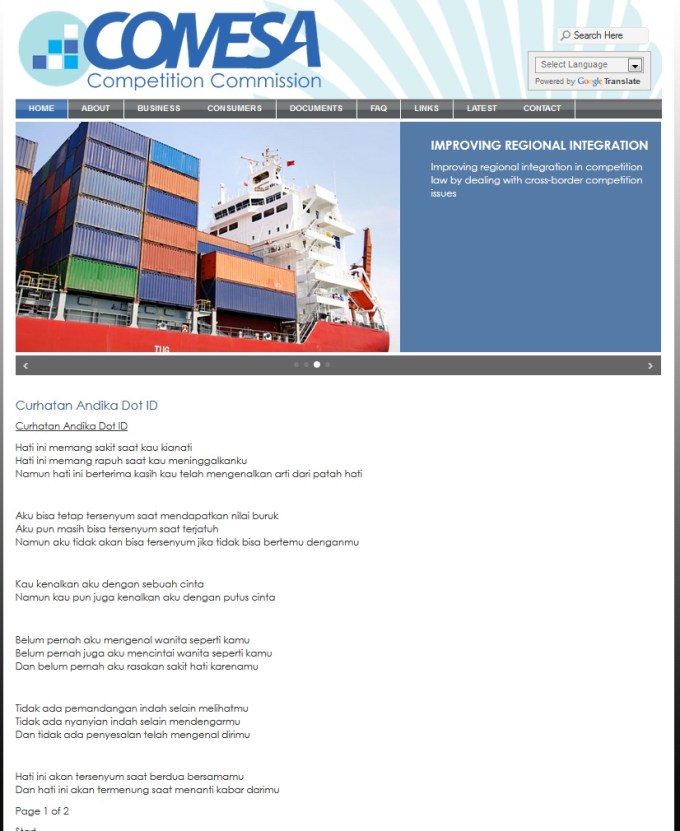
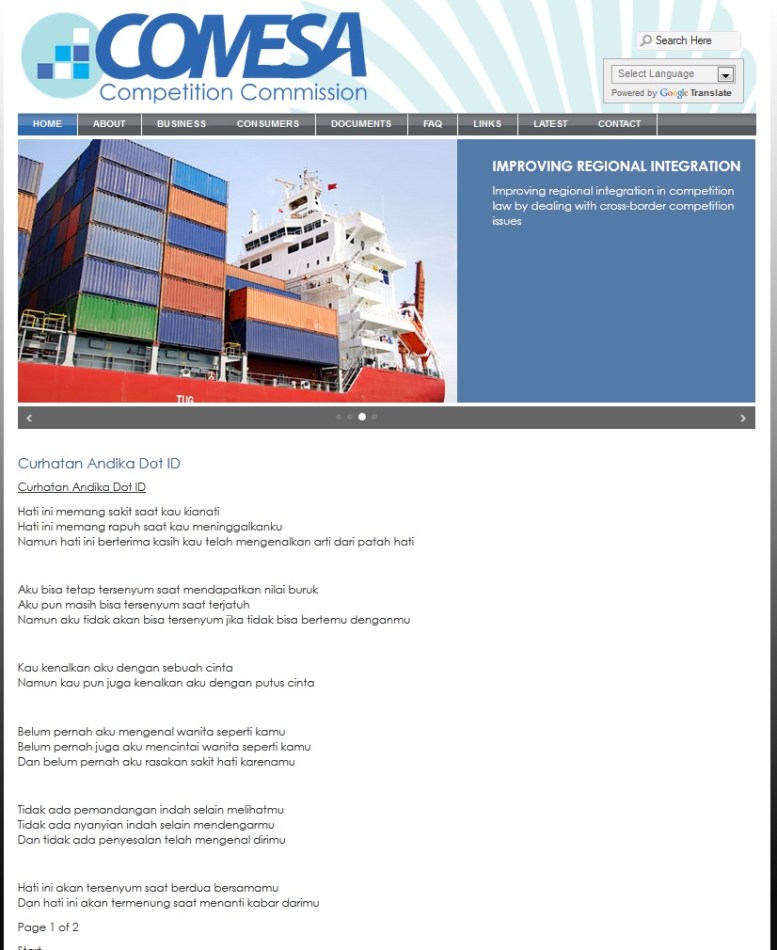
COMESA site hacked with Indonesian love poem

It would appear that the young pan-African antitrust enforcement agency’s web site has been hacked.  The headline on the COMESA Competition Commission’s (“CCC”) home page today seems to indicate a relationship with a web site bearing the Indonesian TLD (top-level domain) “.ID”, and looks like gibberish at first glance.

Then, after some digging, AAT’s editors believed that it might in fact be a tribute or memorial of sorts to the missing crew and passengers of flight MH 370, given the Indonesian language of the text and the disappearance of the jetliner in the Viet-Indo-Malaysian region’s equivalent of the Bermuda Triangle.  The relationship with COMESA escaped us, however.  Yet, upon a final review of the Google Translate result, we can confirm that this is unfortunately not the case.  Instead, it appears to be a (fairly amateurish) love poem (full text in GoogleTranslate’s English below).

With all this wind-up, here comes the real point in the story.  We perceive this hacking event as evidence of a real risk that highly confidential party information (stemming from COMESA merger reviews or other competition investigations) may be vulnerable to accidental or intentional disclosure to unauthorized third parties.  In the United States, the agencies’ unwarranted disclosure of confidential data took center stage in the 2007 aftermath of the $1/2 billion Whole Foods / Wild Oats merger, during which the FTC had accidentally submitted an insufficiently redacted PDF document to the electronic U.S. court filing system ECF, spilling the secret data guts of the case. The Washington Post reported on the story here — just as we are now alerting current or potential future parties to CCC merger reviews regarding the apparently deficient safeguards in the competition enforcer’s electronic systems.  We advise all such interested parties to enquire with the Competition Commission precisely which steps are being taken to ensure the safety of their confidential submissions to the agency.

We also note that the CCC’s site has a very publicly visible page for access to “PRIVATE” documents, protected only by (it would seem) a most simple username/password combination.  The site even allows for a cookie-based “Remember Me” function.  The privacy risks here are manifold, as any e-security expert worth her salt can attest to: Should this “private” document repository contain confidential party information, and if the main home page of the agency has already been subject to a (successful) attack, it is no stretch to imagine that access may have equally been gained to the purportedly private document storage folder on the site.

AAT has contacted the CCC’s web master and leadership, Messrs. George Lipimile and Willard Mwemba, to inquire further about the details of this apparent safety breach.  We will report on their response here once we have heard back from them.

Should readers have any other information on the goings-on at the CCC or its web site, we always appreciate hearing from you, either by way of e-mail or in the comments section to this article.

Full text of COMESA site as of 17. March 2014 (all day) – (update 18. March: the text is still up on the site at 16:40 GMT):

Andika curhatan Dot ID

This heart is sick when you kianati
This heart is fragile when you leave
But this heart grateful you have introduced the meaning of a broken heart

I can still smile while getting bad grades
I can still smile when dropped
But I would not be smiling if it can not meet you

You introduced me to a love
But you were also introduced me to breakup

I’ve never know a woman like you
I also have never loved a woman like you
And I’ve never felt hurt because of you

None other than the beautiful scenery seen
None other than the beautiful singing heard
And no one has to know you regret

This heart will smile with you when both
And this will be a pensive moment waiting to hear from you

The end of the zero-threshold contagion?

COMESA Competition Commission logo

COMESA Competition Commission‘s head of mergers foreshadows end of zero-threshold regime

Will the Commission soon find a cure to the contagion that has made the agency’s merger control the subject of heavy criticism by antitrust practitioners and and even ridicule by fellow enforcers? Willard Mwemba claims the agency has – after over a year of operating under the zero-threshold rule – “set the wheels in motion for the threshold to be raised.”  The Commission is reportedly working with the World Bank’s International Finance Corporation to determine what the proper notification thresholds should be.

We previously had this to say in November of last year:

[T]he dual dilemma of the “zero-threshold contagion” and the inordinately high filing fees currently affecting the CCC’s merger-control regime (and resulting in rather low merger-notification statistics of less than one per month) will continue to hamper the young agency and its customers for the foreseeable near-term future.

Depending on how swiftly the agency and its advisors at the IFC get things done – and the amendments actually get approved – it appears that our timing forecast was fairly accurate  (“COMESA merger rules to change in April 2014 at the earliest“).

Official closure schedule of COMESA – unique time table

COMESA Competition Commission logo

Note to practitioners: filings due on these unique closure dates, set by the COMESA Competition Commission‘s registrar’s office for 2014, will be due on the subsequent working day:

1. 1st January 2014- New Years’s Day
2. 15th January 2014- John Chilembwe day
3. 3rd March 2014- Martyrs Day
4. 18th April 2014- Good Friday
5. 21st April 2014- Easter Monday
6. 1st May 2014- Labour Day
7. 14th May 2014- Kamuzu Day
8. 20th May, 2014- General Elections
9. 7th July 2014- Independence Day
10. 15th October 2014- Mothers Day
11. 25th December 2014- Christmas