Philips & innovation in Africa: Driving worldwide growth

Philips’ CEO Frans van Houten recognizes untapped potential, invests in Africa

new multi-part series

In February, AAT launched its multi-part series on innovation & antitrust as a thematic collection focusing on the concept of innovation markets and how competition and IP laws are able to address the, by definition, novel issues that arise.  Recently, and timely so, Philips has joined this debate.

Philips & the future of African innovation: From “things” to “ideas”

For one, Frans van Houten, its President and CEO, has been quoted as saying: “Innovation is our lifeblood and will be the main driver of profitable growth going forward. … I intend to drive innovation with more intensity to help us win new customers.”

Notably, Philips changed its official company slogan from “We make things better” to “We create better ideas.

Mr. van Houten (source: Philips)

Even more pertinent, Mr. van Houten not only recognizes the crucial forward-looking importance of innovation.  Unlike many Western corporate leaders, he positively links it with the economic growth prospects of Africa.  In an insightful piece entitled “How Africa’s innovation will change the world” (published on the Davos World Economic Forum blog), Mr. van Houten discusses the promises, challenges, and realities of African innovation and resulting economic growth.

The article highlights the intuitive, yet elusive, insight that challenges become opportunities when looked at with an inventive spirit.  It also addresses the importance of multi-disciplinary approaches (such as the one at the foundation of our #AntitrustInnovation series, combining law, economics, and business innovation) and that of partnerships:

Seven years ago, millions of Kenyans were struggling to access basic financial services such as a bank account; they were unable to transfer money or receive microcredit. Then, a locally developed mobile payment system called M-Pesa [see AAT coverage here; — Ed.] radically changed everything. Today, more than two-thirds of Kenya’s population uses M-Pesa to make and receive payments and an estimated 43% of the country’s GDP flows through the system. This is transforming life in the country, increasing income in rural households and spawning a range of start-ups.

This speedy adoption of mobile payments captures the enterprising spirit of African innovation. It reflects the resourcefulness with which people in Africa find local solutions to local issues. It also shows how Africa’s challenges are opportunities in disguise and how the continent can bypass development stages without paying for their replacement. Mobile phones, for example, were rapidly adopted in Africa because of the lack of fixed telecom infrastructure. And solar panels are being adopted faster than in other parts of the world, because kerosene is so expensive that the payback time for investments in solar power is months rather than years.

Healthcare is another exciting area. According to a report from the World Economic Forum, Africa faces 28% of the global disease burden with only 3% of the world’s healthcare workforce. In response, Africa is adopting new operating models and technologies. By training health extension workers to focus on education, family planning and sanitation, Ethiopia achieved a 32% drop in child mortality and 38% drop in maternal mortality. In Kenya, e-learning has taught 12,000 nurses how to treat major diseases such as HIV and malaria, compared to the 100 nurses a year that can be taught in a classroom.

Africa is also embracing new business models that tap into the vitality of the country’s communities. Philips, for example, teamed up with Inyenyeri, a Rwandan NGO, to give families access to an innovative cookstove. Crucially, the cookstove is given away for free and families pay for the stove by harvesting twigs, leaves and grass. This biomass is compressed into fuel pellets, half of which are returned to the family for personal use and half of which are sold by the NGO. The cookstove is produced in Africa, highly energy efficient and, because it is smoke free, significantly healthier.

This example also shows the power of partnerships, without which many African innovations would not come to fruition. Solar-powered light centres, for example, increase the social activity and productivity of communities by generating light after sundown. These communities, however, are often unable to invest in a light centre, so this technology is rolled out through NGOs and governments. Sometimes these light centres are used to power medical equipment such as an ultrasound, or refrigerators that store vaccines. This type of cooperation ensures that innovation generates both financial and social value.

The complexity of Africa’s challenges also requires a multidisciplinary approach to innovation. Kenya, for example, is investing in systems that encourage open innovation. This sees local universities and small and medium enterprises join forces with NGOs, governmental organizations and foreign multinationals such as IBM and Philips, which have set up regional research and innovation centres in Nairobi. Nairobi is also home to iHub, a booming community of local entrepreneurs, investors and some of the world’s leading technology firms.

For innovation to really succeed in Africa, other factors need to be addressed, too. There is a lack of prototyping equipment and workshops, so local innovators depend on Europe or China, making the process costly and cumbersome. And while there are good patent laws in place, there are still too many counterfeit versions of successful products. Also, international firms should source locally and work with local distributors, whenever possible. And governments should focus their development money on stimulating entrepreneurship and innovation.

While in Africa millions of people still live on less than $2.50 a day, the continent looks set to have a brighter future thanks to local solutions for finance, healthcare and energy that could become globally relevant. M-Pesa, for example, has already been rolled out in other African countries, India, Afghanistan and Eastern Europe. Perhaps sooner than we think, African innovations will help the rest of the world create lasting social and economic value.

[Frans van Houten, President and CEO, Royal Philips, emphasis and links added, How Africa’s innovation will change the world” published on Davos World Economic Forum blog.]

Investment: done

More than just writing op-ed pieces, Philips’ leadership has put its money where it matters: On March 20, 2014, the company (with 23-plus billion Euros in annual revenue) announced that it was establishing a “Research & Innovation Hub” in Nairobi, Kenya.  The full Philips statement says:

  • The Philips Africa Innovation Hub in Kenya will be the center for developing innovations “in Africa-for Africa” in the areas of healthcare, lighting and healthy living

  • Hub underlines Philips’ commitment to invest in Africa and provide Africa-relevant innovations to address key challenges facing the continent

 Nairobi, KenyaRoyal Philips (NYSE: PHG, AEX: PHIA) today announced the establishment of its Africa Innovation Hub in Nairobi, Kenya, which underlines the company’s commitment to invest in Africa. The Philips Africa Innovation Hub will work both on the creation of new inventions, as well as bringing these inventions to the market.

The Philips Africa Innovation Hub will do application-focused scientific and user studies to address key challenges like improving access to lighting and affordable healthcare as well as developing innovations to meet the aspirational needs of the rising middle class in Africa.

The Philips Africa Innovation Hub will be located at the Philips East African Headquarters in Nairobi, where African talents and international researchers will operate on the concept of “open innovation” and will work in close collaboration with the R&D ecosystem of Kenya and Africa. Philips is in discussions with local organizations and Universities on R&D collaborations to co-create meaningful solutions for Africa.

“We welcome the establishment of Philips’ Innovation Hub in Kenya; Philips is a globally recognized innovation powerhouse and their selection of Nairobi as the site to establish their African Innovation hub is a testament to the Kenyan government’s commitment to nurture the drive for research and innovation in the region”, says, Hon’ble Adan Mohammed, Cabinet Secretary for Industrialization. “We lend our full support to the investment being made by Philips and look forward to the outcomes of their Africa-specific research and projects that can contribute to transforming society, business and government across the continent”.

JJ van Dongen, Senior Vice President & CEO Philips Africa states: “Philips is passionate to invent, apply technology and partner to help people succeed. Our ambition is to create impactful innovations that matter to people and address the key challenges that confront society. With Kenya as a leader in the continent in science and entrepreneurship as well as a hub of collaboration on technology and innovation, Nairobi, is the ideal location to establish Philips’ African research presence. We want to tap into the city’s vibrant R&D eco-system and contribute to the process of co-creating new solutions, new business models and meaningful partnerships to provide innovations that make an impact.”
Enhancing people’s lives in Africa though meaningful innovations
Some innovations that Philips was already working on have now become part of the Innovation Hub, hence, the Philips Africa Innovation Hub will kick-off with ventures that are under development as well as in the pilot phase; these include:

Respiratory rate Monitor to support pneumonia diagnosis: Pneumonia is the leading cause of death among children under the age of five, resulting in 1.1 million deaths worldwide annually¹. Of these, 99% of deaths occur in developing countries in low-resource settings, which typically entail rural areas with very limited or poor healthcare facilities or with low-skilled health workers. The current diagnostic tools in such settings are not easy to use, can easily distract the workers from an accurate conclusion, and thus lead to a poor diagnosis.

The Innovation hub is working on the development and clinical testing of a robust and affordable Automated Respiratory Rate Monitor that aims to support the diagnosis of pneumonia among infants and children, using smart sensing technology on the body which is intended to be more accurate and reliable compared to manual processes being currently observed. This device will be specially designed for use by community health workers and nurses in rural areas. In Kenya, discussions are on with the Kenya Medical Research Institute (KEMRI) to further develop this project and co-create an effective solution tailored to circumstances in rural Africa.

Community care services: The development and testing of a work-flow innovation designed to reduce the number of avoidable maternal and child deaths. The purpose of the workflow is to enable remote area health centers to diagnose, triage, treat, stabilize and (prepare for) transport expectant mothers that come in for a check-up and treatment.

Smokeless cook stove: Philips has designed and is manufacturing this innovative stove to improve the lives of those who rely on wood or biomass for their daily cooking. These specially designed stoves are extremely efficient and significantly reduce the use of wood as fuel. The cook stove can reduce smoke and carbon monoxide emissions by more than 90% compared to an open fire² thus reducing the health risks of indoor cooking. The contribution of the innovation hub is to create new go-to-market models for these stoves.

Consumer solar solutions: Today an estimated 560 million Africans live without electricity; Philips is committed to improving access to lighting in Africa, for the majority of the population that lives in off-grid communities. The Innovation hub is designing and developing new consumer products using the combination of solar power and energy efficient LED technology. New go-to-market models are also being established to ensure these solutions become accessible to people that would not be able to afford them otherwise.

The Philips Africa Innovation Hub while headquartered in Kenya, will be responsible for pan-African research and projects and will have operations across Africa, linked to the Philips regional offices across the continent; the hub will be headed by Dr. Maarten van Herpen and will work in close collaboration with the Philips research labs in Bangalore, Shanghai and Eindhoven.

¹ Source : Unicef  www.unicef.org/media/media_70890.html
² Reference source:  Water boiling test version 4.2.2 done at accredited stove laboratory, Aprovecho Research Center, Oregon, USA.


Criminalisation of antitrust offences: not on short-term horizon

south_africa

Competition Commission not ready to pursue antitrust cases criminally – plus: AAT‘s recommendations

The newly (permanently) appointed Competition Commissioner, Tembinkosi Bonakele, has referred to a “phased” implementation of the 2009 Competition Amendment Act.  The legislation technically criminalised hard-core antitrust offences such as bid-rigging or price-fixing cartels.  However, it has not yet been implemented or effectively signed into law.

According to a MoneyWeb/ZA report, both he and his boss, Economic Development Minister Ebrahim Patel, had discussions on how and when to implement “to ensure that the necessary institutional capacity is available to apply the amendments.”  The initially effective provisions (relating to the SACC’s market-inquiry powers) went into effect last year, while the criminalisation provisions remain unimplemented.

In a somewhat remarkable and prudent self-assessment, the minister and SACC have now admitted that the Commission currently lacks “the institutional capacity needed to comply with the higher burden of proof in criminal cases,” according to the report.

One notable aspect of potential discord lies in not only in the different standard of proof in civil vs. criminal matters (“more probable than not” vs. “beyond a reasonable doubt”), but perhaps more importantly can be found on the procedural side, preventing rapid implementation of the law: There has been historic friction between various elements of the RSA’s police forces and (special) prosecutorial services, and the power to prosecute crimes notably remains within the hands of the National Prosecuting Authority, supported in its investigations by the South African Police Service.

Historical and Legislative Background – and a bit of Advice

Starting in the spring and summer of 2008, the rumoured legislative clamp-down on corrupt & anti-competitive business practices by the government made the RSA business papers’ headlines.

During a presentation I gave at a Johannesburg conference in September that year (“Criminalising Competition Law: A New Era of ‘Antitrust with Teeth’ in South Africa? Lessons Learned from the U.S. Perspective“), I quoted a few highlights among them, asking somewhat rhetorically whether these were the words of fearmongers or oracles?

  • “Competition Bill to Pave Way for Criminal Liability”
  • “Tough on directors”
  • “Criminalisation of directors by far most controversial”
  • “Bosses Must Pay Fines Themselves”
  • “New leniency regime to turn up heat on cartels”
  • “New era in the application of competition policy in SA”
  • “Likely to give rise to constitutional challenges”
  • “New Bill On Cartels is a Step Too Far”
  • “Fork out huge sums or face jail time if found guilty”
  • “Disqualification from directorships … very career limiting”

I also quoted international precedent-setting institutions and enforcers’ recommendations, all of which tended towards the positive effect of criminal antitrust penalties:

OECD, 3rd Hard-Core Cartel Report (2005):

  • Recommends that governments consider the introduction and imposition of criminal antitrust sanctions against individuals to enhance deterrence and incentives to cooperate through leniency programmes.

U.S. Department of Justice, Tom Barnett (2008):

  • “Jail time creates the most effective, necessary deterrent.”
  • “[N]othing in our enforcement arsenal has as great a deterrent as the threat of substantial jail time in a United States prison, either as a result of a criminal trial or a guilty plea.”

While the presentation contained a lot more detail, the key recommendations that I summarised would seem to continue to hold true today, and may serve as guide-posts for Commissioner Bonakele and the EDD ministry:

Cornerstones of a successful criminal antitrust regime
  • Crystal-clear demarcation of criminal vs. civil conduct
  • Highly effective leniency policy also applies to individuals
  • Standard of proof must be met beyond a reasonable doubt
  • No blanket liability for negligent directors – only actors liable
  • Plea bargaining to be used as an effective tool to reduce sentence
  • Clear pronouncements by enforcement agency to help counsel predict outcomes
Demarcation of criminal vs civil antitrust conduct in U.S.

Investment in Africa: Changing landscape, new hurdles

Questioning African antitrust growth prospects: Slowdown in economic investment (both organic and outside investment) may affect functioning of competition law on the continent

Recent developments in Africa have many scratching their heads and wondering whether the formerly wondrous economic-growth engine of the vastly resource-rich and otherwise economically still undervalued continent will soon experience a slowdown, if not come to a halt altogether.

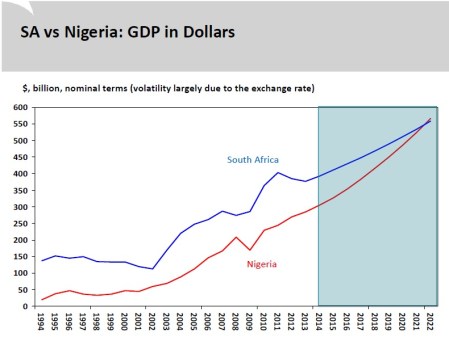
For one, in April 2014, Nigeria surpassed South Africa as the continent’s largest economy (see Economist Apr. 12, 2014: “Africa’s New Number One“).  This is a significant milestone for the former, and a setback for the latter — an economy that was 8 times the size of the Nigerian economy only 20 years ago, yet is now suffering from stagnating GDP, reeling from corruption allegations amongst its current leadership, undergoing a closely-watched presidential election process, and whose ruling ANC party is facing a heretofore unprecedented backlash and torrent of criticism.

Source: The Economist

Not only South Africa has weakened, politically and economically, however.  Events such as the Northern Nigerian wave of violence – with sectarian Boko Haram forcefully displaying the impotence of the central Nigerian government of a weakened president Goodluck Jonathan – fuel the fire of outside investors’ mistrust of African stability and their concomitant reluctance to make good on prior investment promises.  As The Economist notes in the article quoted above: “it is not a place for the faint-hearted” to invest, even though it highlights the successful Nigerian business ventures of outsiders such as Shoprite, SABMiller, and Nestlé.  Bloomberg BusinessWeek quotes Thabo Dloti, chief executive officer of South Africa’s fourth-largest insurer Liberty Holdings Ltd. (LBH), as saying: “It does slow down the plans that we have, it does put out the projections that we have by a year or two.”

http://www.stanlib.com/EconomicFocus/Pages/InterestingChart112SouthAfricaneconomyvsNigerianeconomy.aspx
Nigerian vs. RSA GDP
Source: http://www.stanlib.com

Likewise, multi-national organisations such as COMESA and its competition enforcement body, are undergoing significant changes (such as, currently, an opaque process of raising the heretofore insufficient merger-filing thresholds), shockingly successful web attacks on their data, and a resulting dearth of transactions being notified.  Elsewhere in developing economies, recent political turmoil has likewise led observes to comment on the negative spillover effect from political & social spheres into the economy (e.g., Financial Times, May 8, 2014: “Political crisis further dents prospects for Thai economy“).

Impact on antitrust practice

The upshot for competition-law practitioners and enforcers alike is rather straightforward, AAT predicts: more hesitation around African deals being done means fewer notifications, less enforcement, and overall lower billings for firms.

The flip side of the coin – as is usually the case in the economic sine curve of growth and slowdowns – is the commonly-observed inverse relationship of M&A and criminal antitrust: while we may see fewer transactions in the short term, the incidence of cartel behaviour and commercial bribery & government-contract fraud cases will likely increase.

Kenya: Lafarge faces possible price-fixing penalties due to cross shareholding

kenya

East Africa back on antitrust enforcer’s mat in hybrid unilateral / collusion case

The Competition Authority of Kenya (“CAK”) has alleged that Lafarge has engaged in price-fixing due to the company’s cross-shareholding in cement producer Eastern African Portland Company and Bamburi Cement. (Interestingly, http://www.lafarge.co.ke links to Bamburi Cement’s site).

The CAK is investigating whether Lafarge is responsible for an unwarranted concentration of economic power, given that Lafarge has a 41.7% interest in Eastern African Portland Company and a 58.9% interest in Bamburi Cement. A ruling as to whether Lafarge has “unwarranted concentration of economic power” is expected in June 2014.  In the event that Lafarge is found guilty of the charge against it, the Kenyan Competition Authority could direct the Lafarge to sell assets in one of the two businesses.  Furthermore, the directors could also be forced to pay up to USD115,000 in penalties or serve five years in prison if found guilty of price-fixing.

The CAK report comes four months after the Kenyan government, which together with the Kenyan National Social Security Fund, has a controlling stake of 52.3% in Eastern African Portland Company alleged that Lafarge tried to destabilise Eastern African Portland Company to protect Lafarge’s interests in Bamburi, the report noted. The CAK indicated that “cross-directorship could lead to price-fixing since this creates a position where a competitor is privy to the strategic decisions of another competitor. However, it is not conclusive that there is price-fixing going on.”  Lafarge has stated its minority interest in Eastern African Portland Company is insufficient to enable Lafarge to exert control over it.

This allegation comes at an interesting time given the spotlight on Lafarge due to its proposed merger with cement producer Holcim, which has already triggered insider-trading investigations elsewhere.  The proposed transaction will likely require notification in the European Union, United States, Russia, China, India, Morocco, South Africa and multi-national enforcer COMESA (which includes Kenya and would presumptively take priority over the CAK’s domestic review authority, although a jurisdictional fight between the two agencies would not be unheard of).


AAT’s LinkedIn presence

AAT header

AfricanAntitrust, the preeminent competition-law resource in Africa, now has a corporate presence on LinkedIn.

If you are a LinkedIn member, please follow our new AfricanAntitrust.com page on LinkedIn here, also to receive unique updates and information.

AAT launches multi-part “@innovation & #antitrust” series

Philips changed its company slogan from “We make things better” to “We create better ideas”

new multi-part series

Philips is but one of the companies – albeit a pioneer – that recognizes the crucial forward-looking importance of innovation.  Its CEO, Frans van Houten, has been quoted as saying: “Innovation is our lifeblood and will be the main driver of profitable growth going forward. … I intend to drive innovation with more intensity to help us win new customers.”

The U.S. Department of Commerce published a 2010 report claiming that 75% of U.S. economic growth since the end of World War II is attributable to innovation in technology.

Antitrust law is likewise cognizant of the uniqueness of ideas — the result of innovation — rather than old-fashioned brick-and-mortar “products & services”.  For instance, how do you define the relevant market for a merger of ideas-based companies?  The agencies have come to accept the existence of innovation markets almost two decades ago, in the mid-1990s (based on the original “R&D markets” concept of the 1980s, and driven in no insignificant part by the advent and meteoric rise of biotechnology patents).  The 2010 U.S. Horizontal Merger Guidelines now expressly incorporate the concept of innovating as a relevant metric of competitiveness into their language, notably at section 1 of the HMG: A transaction may have anti-competitive effects if it strengthens a firm’s market power by encouraging market participant(s) “to raise price, reduce output, diminish innovation, or otherwise harm customers as a result of diminished competitive constraints or incentives.”

We at AAT are now previewing a series of posts on innovation & antitrust to be published during the spring and summer of 2014. They will be hash-tagged #AntitrustInnovation on Twitter.

You can read our first installment of the thematic collection here (last post on innovation, competition and IP in developing countries), written by contributing author and Tilburg University scholar Sofia Ranchordás.

We expect the series to engender active discussions with, and within, our readership, either via comments on this site or on Twitter.

Cartel regulation in S.A. – 2014 Oxenham

south_africa

In addition to his highlights of the latest developments in the ZA cartel sphere, AfricanAntitrust.com editor John Oxenham recently published an excellent overview of Cartel Regulation in South Africa.

A must-read.

We are making the full PDF available to our blog readers.  The piece was originally published by Global Competition Review.

John Oxenham, editor
John Oxenham, AAT editor


Cartels: Developments in South Africa

south_africa

AfricanAntitrust.com editor John Oxenham recently published a terrific summary of the latest developments in the ZA cartel sphere.

A teaser introduction is below.  His detailed article can be found here (PDF).
John Oxenham, editor
John Oxenham, AAT editor

The past 18 months have witnessed significant developments in the investigation and prosecution of cartel conduct in South African competition law.  In summary, these developments are the following:

• The Supreme Court of Appeal recognised the availability of ‘opt
out’ class actions for private damages and set out a procedure
through which plaintiffs can seek certification of a class.
• The Constitutional Court extended the availability of class actions
for private damages by recognising ‘opt-in’ class actions
where the interests of justice permit such a procedure.
• The Competition Commission (the Commission) for the first
time utilised a fast-track settlement process in relation to the
prosecution of a widespread cartel in the construction industry.
• An amendment to the Competition Act, 89 of 1998 (the Act)
was promulgated giving the Commission the power to institute
market enquiries. The Commission has indicated that it wishes
to conduct a market inquiry into the private health-care sector.
• The Supreme Court of Appeal broadened the scope for the
Competition Tribunal (the Tribunal) to adjudicate complaints
prosecuted by the Commission.
• The Supreme Court of Appeal confirmed that leniency applications
submitted to the Commission by a leniency applicant are
subject to legal privilege unless the Commission makes reference
to the application in a complaint referral to the Tribunal
– in which case it will be taken to have waived privilege.
• The North Gauteng High Court found that a leniency applicant
is not protected from private damages claims – even where it
is not cited by the Commission as a respondent in complaint
proceedings brought before the Tribunal.

The article originally appeared in The African and Middle Eastern Antitrust Review 2014, which is published by Global Competition Review and is available online at: http://globalcompetitionreview.com/reviews/59/the-african-middle-eastern-antitrust-review-2014

NB: AfricanAntitrust.com author and economist Patrick Smith recently also published an article in the same edition of the Review, see: Public Interest Factors in African Competition Policy.

Public Interest Factors in African Competition Policy

Author and economist Patrick Smith recently publishedPublic Interest Factors in African Competition Policy in The African and Middle Eastern Antitrust Review 2014.  The consideration of public interest factors in competition law inquiries has generated much debate over the past few years. Several high profile cases have illustrated the potential for competition decisions,
and in particular merger inquiries, to be significantly affected by non-competition public interest issues.

Our readers have free access to the full PDF.

The Review is published by Global Competition Review and is available online at: http://globalcompetitionreview.com/reviews/59/the-african-middle-eastern-antitrust-review-2014

This year’s issue of the Review also features two other AfricanAntitrust.com writers: contributing author, Chabo Peo, whose piece on competition law in Botswana is available at the GCR web site, as well as editor John Oxenham‘s piece on cartels in South Africa, available here.

A full list of contributors to our site can be found at: https://africanantitrust.com/about/

In-house competition counsel joins leading African antitrust blog

We are pleased to present the latest addition to the ranks of AAT authorship: Mark Griffiths.

Mark Griffiths is Competition Counsel for Barclays Africa Group and is accountable for competition risk management across the African continent for Barclays.  Mark is heavily involved in antitrust and merger matters across twelve African jurisdictions with active competition authorities.  He has been involved in a number of pivotal developments across the region.

Prior to his appointment with the Barclays Group in 2007, he was a senior associate (admitted as a solicitor of the Senior Courts of England and Wales) in the EU and Competition practice of Clifford Chance (London).  He also previously worked for DG Competition at the European Commission as well as being specialist legal advisor to the House of Lords EU Select Committee on the EU Financial Services Action Plan.

Mark is a regular contributor to a range of legal journals as well as a regular speaker on African competition law at local and international conferences. Mark has attended meetings of the International Competition Network as a NGA. He has an LLB (University of Southampton, UK) and an LLM in European Law (College of Europe, Bruges, Belgium).

A full list of contributors to our site is available here: https://africanantitrust.com/about/