South Africa- Competition Commission conducts third dawn raid this year

south_africa

Ending off a year of numerous dawn raids, the Commission announced yesterday in a press statement that it had conducted a search and seizure / dawn raid operation at the offices of InvestChem (Pty) Ltd (“InvestChem”) and Akulu Marchon (Pty) Ltd (“Akulu Marchon”) in Kempton Park, Johannesburg. The firms manufacture and supply a range of surfactant products. Surfactants may act as detergents, wetting agents, emulsifiers, foaming agents, dishwashing liquids, soaps, car cleaning products and dispersants.
InvestChem is the South African subsidiary of Inchem Holdings Ltd, which is a Bermuda-based company which has other subsidiaries based in the USA and Portugal. InvestChem develops, manufactures and supplies a range of surfactant products which are used in the detergent and toiletry industries.
Akulu Marchon, which is one of the businesses of AECI Chemicals, supplies chemical raw materials for cosmetics, toiletry and detergent products in Southern Africa. These products include petroleum jelly and white mineral oils for the South African ethnic skin and hair care markets, locally produced and imported specialty surfactants for household, personal care products and chemical specialties for the personal care and cosmetic industries.
The Commission indicated that the dawn raid formed part of the Commission’s ongoing investigation into collusive conduct in the market for the production and supply of a range of surfactants products used as input materials in the manufacture of blended household detergents, cosmetics and toiletry products.
According to the Commission, from 2003, the parties held meetings and agreed to fix the prices for surfactants and allocated customers between each other which is prohibited by the South African Competition Act and the Commission understands the alleged conduct is currently ongoing.
The Commissioner, Tembinkosi Bonakele stated the following in relation to the dawn raid, “I believe that the information that will be obtained from today’s operation will enable the Commission to determine whether or not the parties have indeed engaged in collusive conduct. However, as part of any investigation, we also wish to urge anyone, be it business or individuals with further information to come forward and assist the Commission in concluding this investigation”.
Following a four year dawn raid “drought”, the Commission had conducted a dawn raid in July 2014 at the offices of Precision and Sons (“Precision”), Eldan Auto Body (“Eldan”) in Pretoria West, as well as the Vehicle Accident Assessment Centre (“VAAC”) in Centurion. Precision and Eldan’s business activities include panel beating, spray painting and towing of vehicles and they are approved auto body repairers to Original Equipment Manufacturers. In April 2014, the Commission conducted a dawn raid at the offices of Unilever South Africa (Pty) Ltd and Sime Darby’s respective South African offices, in relation to the Commission’s investigation into alleged collusive conduct in the product markets for the manufacture and supply of edible oils and baking fats to both wholesale and retail customers.

(Belated?) auto-parts cartel allegations sweep S. Africa

south_africa

Following late on the heels of years-old international auto-parts collusion investigations, ZA Competition Commission issues press release

In its press release, the Commission quotes Thembinkosi Bonakele as saying that his agency’s “investigation into this pervasive collusive conduct joins similar investigations launched in other jurisdictions internationally” and states:

The information in the possession of the Commission suggests that from 2000 to
date, 82 automotive component manufacturers have colluded in respect of 121
automotive components. The 121 automotive components affected by the collusion
include, but not limited to, Inverters, Electric Power Steering ECU, Electric Power
Steering and Motors, Glow Plugs, Electric Power Steering systems, Rear
Sunshades, Pressure Regulator, Pulsation Damper, Purge Control Valves,
Accelerator Pedal Modules, Power Management Controller, Evaporative Fuel
Canister systems, Knock Sensors, Spark Plugs and Clearance Sonar systems.

Kenya competition landscape active

kenya

Zuku pay-TV launched complaint against DStv in Kenya

As we reported in “Your Choice“, MultiChoice has been an active (if unwilling) player in African antitrust news.  Zuku pay-TV has recently requested the Competition Authority of Kenya (CAK) to impose a financial penalty on DStv for refusing to re-sell some of its exclusive content like the English Premier League to its rivals.

In its letter to the CAK, Zuku pay-TV accuses MultiChoice, the owners of DStv, of abusing its dominance and curbing the growth of other, competing pay-TV operators. Furthermore, Zuku pay-TV requested the CAK to compel DStv to re-sell some of its exclusive content and impose a financial penalty, which can be up to 10 per cent of a firm’s annual sales, on the South Africa firm. According to Zuku pay-TV, DStv has a market share of 95% in Kenya.

The CAK has not indicated whether it is investigating the complaint yet.

Mr Wang’ombe Kariuki, director of the CAK
Kenya to get leniency policy

In addition to the ongoing pay-TV antitrust dispute, the CAK has drafted a law (the Finance Bill of 2014) which will create a Kenyan cartel leniency programme in order for whistleblower companies and their directors to get off with lighter punishment, for volunteering information that helps to break up cartels, as AAT reported here.

To recap the leniency programme will either grant full immunity for applicants or reduce the applicant’s fines, depending on the circumstances. The Finance Act 2014 is awaiting its third reading in Parliament.

The introduction of a leniency programme in Kenya is a pleasing sight due to leniency programmes’ proving to be an integral and vital tool for uncovering cartels in every jurisdiction in which it has been deployed.

Antitrust amnesty: new regime to go online soon

kenya

Kenya to become latest competition jurisdiction with cartel leniency scheme

As Mugambi Mutegi of the Business Daily reports, Kenya is the latest antitrust jurisdiction to embrace a self-reporting leniency programme.
Mr Wang’ombe Kariuki, director of the CAK

Self-reporting of “hard-core” competition-law offences (such as price-fixing cartel conduct, market division, bid rigging, or group boycotts among horizontal competitors) has long been a staple of antitrust enforcement in the most developed jurisdictions, including the United States and the European Union.  In South Africa, cartel-whistleblowing leniency has just passed its 10th anniversary, and in the EU, the European Commission’s “Notice” on the non-imposition of fines in certain cartel cases (i.e., the EU’s leniency regime) recently celebrated its 18th birthday — nowadays, more than 75% of the EC’s cartel matters are uncovered thanks to one or many cartel members “snitching” on their counterparts, in exchange for full or partial amnesty from antitrust prosecution and attendant fines.

The Competition Authority of Kenya (CAK) has recently upped its rhetoric, threatening criminal sanctions against various business sectors’ potential cartel members and disputing jurisdiction of the multi-national, but still feeble, COMESA competition authority in merger cases.

In Africa, Kenya (AAT archive on CAK issues here) is now becoming a new member of the “Leniency Club”, rewarding whistleblowers with eased penalties for volunteering relevant tips and information on the workings of the cartel.  The CAK is acting to implement the provision of the Kenyan Finance Bill 2014, which allows it to terminate cartel investigations with lighter punishment for whistleblowers, all the way to a full pardon.

“The Authority (CAK) may operate a leniency programme where an undertaking that voluntarily discloses the existence of an agreement or practice that is prohibited by the Competition Act and co-operates…in the investigation of the agreement may not be subject to all or part of a fine…”

The agency’s web site — which otherwise (unusually) refers to the Business Daily article quoted here, instead of issuing its own press release — tersely provides as follows:

Cartel firms get amnesty in new CAK regulation

The competition regulator has drafted a law that will see whistleblower companies and their directors get off with lighter punishment for volunteering information that helps to break up cartels.

The Competition Authority of Kenya (CAK) says introduction of this law, which is already in the Finance Bill 2014, will attract informers that can help to bust unlawful business agreements between cartels and other secretive pacts that facilitate anti-competitive behaviour.

Whistleblowers whose evidence leads to the successful termination of such agreements and punishment (fines and jail sentences) of the participants will either get reduced fines or full pardon.

The CAK’s Director General, Francis Wang’ombe Kariuki, is quoted as saying that the authority’s is merely awaiting Parliament’s amendment of the law, and that “[t]he settlement policy we have drafted includes offering leniency to the directors of companies who come forward individually or as a group to report on cartels or unlawful business pacts“.

Dawn raids, early in the morning

south_africa

Auto-body repair centres raided by SACC

Earlier this morning, the South African Competition Commission (“Commission”) has conducted dawn raids at the offices of Precision and Sons (“Precision”), Eldan Auto Body (“Eldan”) in Pretoria West, as well as the Vehicle Accident Assessment Centre (“VAAC”) in Centurion.

Precision and Eldan’s business activities include panel beating, spray painting and towing of vehicles. Precision is an approved auto body repairer to Original Equipment Manufacturers (“OEMs”) such as Cadillac, Dodge, Chrysler, Fiat, Kia, Chevrolet, Toyota and Honda, while Eldan is an approved auto body repairer to OEMs such as Jeep, Fiat, Mitsubishi, Toyota, Honda and Nissan.

The VAAC is an assessment centre which renders vehicle assessment services to customers of both Precision and Eldan.

The Commission has indicated that the dawn raid operation forms part of its ongoing investigation into collusive conduct in the market for auto body repairs. The Commission has also indicated that it has reasonable grounds to believe that information relevant to this investigation is located on the premises of the two companies.

Sections 46 to 49A of the South African Competition Act of 1998 (“Competition Act”) empowers the Commission to conduct surprise search and seizure visits and to carry out so-called “dawn raids” to a firm’s business premises in order to inspect documents and interview staff where an infringement of competition law is suspected.

The Commission is empowered to enter any such premises when a judge or a magistrate has issued a warrant. Although a warrant is usually an essential requirement to ensure that a dawn raid is conducted in accordance with the law, the Competition Commission does have the power to enter and search a premises without a warrant, in exceptional circumstances. The Commission has confirmed that it has duly obtained the warrants which authorise it to search the offices of Precision, Eldan and VAAC from the North Gauteng High Court.

If the Commission has reason to believe that a firm is in contravention of provisions of the Competition Act, or is in possession of information relating to a matter that is under investigation, the Commission’s investigators have the authority to enter into the firm’s premises in order to inspect and request copies of documents, ask for information in relation to any documents, take notes and interrogate employees, search and examine computer data and remove evidence from the premises. In particular, officials may examine files, reports and emails. The Competition Commission is entitled to confiscate computer hard drives. They may also take copies of documents.

Following a four-year dawn raid “drought”, the immediately-previous dawn raid initiated by the Commission had been conducted in April 2014 at the offices of Unilever South Africa (Pty Ltd) and Sime Darby’s respective South African offices, in relation to the Commission’s investigation into alleged collusive conduct in the product markets for the manufacture and supply of edible oils and baking fats to both wholesale and retail customers.

Beer cartels: First fine sought in Mauritius leniency matter

mauritius

madagascar

Precedential leniency case yields initial fine

The Competition Commission of Mauritius (“the Commission”) has recommended fines of approximately €487,000 and €158,000 be imposed on Phoenix Beverages Ltd (PLB) and Stag Beverages, respectively, for their involvement in a cartel.

This is the country’s first cartel investigation to be made public, and the first time a party has used its leniency programme.

Phoenix and Stag have been accused by the Commission of colluding to divide the Mauritian and Madagascan beer markets between the two manufactures. The alleged agreement between the parties involved Stag leaving the Mauritian market, allowing Phoenix to dominate the country’s beer market.

Phoenix applied for leniency prior to the 24 May 2014 deadline and consequently received reduced fine.  Both companies assisted the Commission with its investigation.

The Executive Director of the CCM, Mrs. Kiran Meetarbhan, said:

“Many jurisdictions have developed programs that offer leniency because of the many benefits that flow from having them. In line with international best practices, the CCM has not lagged behind in developing a leniency program that has been reinforced so as to grant full amnesty to the first reporting firm in addition to offering judicial security to informants.

This investigation triggered our first leniency application since the CCM’s inception. This is also the first cartel investigation which I have launched in my capacity as Executive Director for which I have recommended financial penalties in addition to other measures to address competition concerns.

I wish to commend the main parties’ approach in this investigation which has revealed a true spirit of cooperation.  Leniency programs create powerful incentives to enterprises to race to self-report at an early stage. Evidence can thus be obtained more quickly, and at a lower direct cost, compared to other methods of investigation, leading to prompt and efficient resolution of cases. This case provides a perfect example of the manner in which a leniency application coupled with the active cooperation of the main parties have led to the successful completion of the investigation within a remarkable three months’ timeline.

The fine[] recommended on Phoenix Beverages Ltd takes into account its leniency application, absent which, the fines would have been higher. Phoenix Beverages Ltd took advantage of the amnesty provisions, which lapsed on 24th May 2014. We cannot stress enough the importance of the leniency programme with regards to collusive agreements.

Several factors help to free an economy from the malicious effects of a collusive agreement including a strong political support towards fighting cartels and a resilient commitment to equip the competition agency with the appropriate legislative framework and adequate financial resources. The Government has signified its intention to further empower the Competition Commission in order to better fight cartels. This was announced by the Prime Minister in his address to the Nation this year.”

Appellate competition body questions authority’s lenient fine

south_africa

Tribunal expresses doubts as to lenient fining level of Premier Fishing

The chairman of the South African Competition Tribunal, Takalani Madima, has asked the South African Competition Commission and Premier Fishing for ‘detailed substantial submissions’ on the settlement agreement reached between them, which lets the fishing company “off the hook” for an administrative penalty of a mere R2.1m (or 2% of its revenues).

2% fine not sufficient deterrent to anti-competitive conduct

According to a BDlive report, Mr. Madima is quoted as saying: ‘I am personally not too happy (with the agreement). I am still to be persuaded.’

The underlying conduct involves a cartel between Premier Fishing and others, in which the competitors shared information and pricing regarding the pelagic fish industry.  The Commission’s July 2008 investigation included the following companies as targets: Oceana, Foodcorp (note: the two former cartelists recently decided to merge and the competition authorities imposed conditions on the planned transaction), Premier Fishing, Gansbaai Marine, the SA Pelagic Fish Processors Association, Pioneer Fishing, Saldanha Bay Canning and others.

As the leniency applicant, Pioneer Fishing obtained full immunity from prosecution.  Others, such as Oceana, settled for approximately 5% of their fishing turnover.

Competition authority issues sectoral warning, threatens criminal sanctions

kenya

Wake-up call to would-be cartelists and monopolists in Kenya

The Standard reports that the Competition Authority of Kenya (“CAK”) (AAT archive on CAK issues here) is threatening cartelists with prison terms of up to 5 years and fines up to 10 million Shilling ($115,000).

According to the report, CAK Director General Francis Wang’ombe Kariuki said that “investigations are already being conducted in [the] transport, insurance, shipping, milling, banking, cement, sugar, health care and tea” sectors, pursuant to purported consumer complaints.

CAK Director General Kariuki

The CAK has actively pursued antitrust matters, using novel approaches of late, as AAT recently reported on a seemingly hybrid unilateral/collusion case (“Kenya: Lafarge faces possible price-fixing penalties due to cross-shareholding“).  The CAK is also the sole COMESA member enforcement authority that has, to our knowledge, challenged the fledgling and issues-plagued COMESA Competition Authority’s jurisdiction in various merger cases.

COMESA old flag color

Investment in Africa: Changing landscape, new hurdles

Questioning African antitrust growth prospects: Slowdown in economic investment (both organic and outside investment) may affect functioning of competition law on the continent

Recent developments in Africa have many scratching their heads and wondering whether the formerly wondrous economic-growth engine of the vastly resource-rich and otherwise economically still undervalued continent will soon experience a slowdown, if not come to a halt altogether.

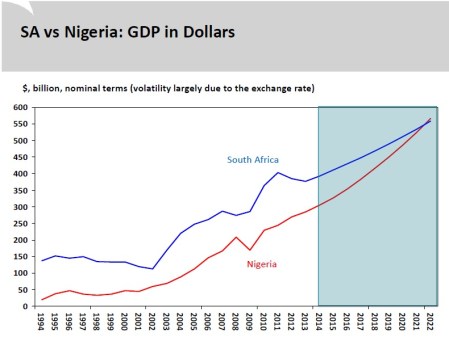
For one, in April 2014, Nigeria surpassed South Africa as the continent’s largest economy (see Economist Apr. 12, 2014: “Africa’s New Number One“).  This is a significant milestone for the former, and a setback for the latter — an economy that was 8 times the size of the Nigerian economy only 20 years ago, yet is now suffering from stagnating GDP, reeling from corruption allegations amongst its current leadership, undergoing a closely-watched presidential election process, and whose ruling ANC party is facing a heretofore unprecedented backlash and torrent of criticism.

Source: The Economist

Not only South Africa has weakened, politically and economically, however.  Events such as the Northern Nigerian wave of violence – with sectarian Boko Haram forcefully displaying the impotence of the central Nigerian government of a weakened president Goodluck Jonathan – fuel the fire of outside investors’ mistrust of African stability and their concomitant reluctance to make good on prior investment promises.  As The Economist notes in the article quoted above: “it is not a place for the faint-hearted” to invest, even though it highlights the successful Nigerian business ventures of outsiders such as Shoprite, SABMiller, and Nestlé.  Bloomberg BusinessWeek quotes Thabo Dloti, chief executive officer of South Africa’s fourth-largest insurer Liberty Holdings Ltd. (LBH), as saying: “It does slow down the plans that we have, it does put out the projections that we have by a year or two.”

http://www.stanlib.com/EconomicFocus/Pages/InterestingChart112SouthAfricaneconomyvsNigerianeconomy.aspx
Nigerian vs. RSA GDP
Source: http://www.stanlib.com

Likewise, multi-national organisations such as COMESA and its competition enforcement body, are undergoing significant changes (such as, currently, an opaque process of raising the heretofore insufficient merger-filing thresholds), shockingly successful web attacks on their data, and a resulting dearth of transactions being notified.  Elsewhere in developing economies, recent political turmoil has likewise led observes to comment on the negative spillover effect from political & social spheres into the economy (e.g., Financial Times, May 8, 2014: “Political crisis further dents prospects for Thai economy“).

Impact on antitrust practice

The upshot for competition-law practitioners and enforcers alike is rather straightforward, AAT predicts: more hesitation around African deals being done means fewer notifications, less enforcement, and overall lower billings for firms.

The flip side of the coin – as is usually the case in the economic sine curve of growth and slowdowns – is the commonly-observed inverse relationship of M&A and criminal antitrust: while we may see fewer transactions in the short term, the incidence of cartel behaviour and commercial bribery & government-contract fraud cases will likely increase.

Kenya: Lafarge faces possible price-fixing penalties due to cross shareholding

kenya

East Africa back on antitrust enforcer’s mat in hybrid unilateral / collusion case

The Competition Authority of Kenya (“CAK”) has alleged that Lafarge has engaged in price-fixing due to the company’s cross-shareholding in cement producer Eastern African Portland Company and Bamburi Cement. (Interestingly, http://www.lafarge.co.ke links to Bamburi Cement’s site).

The CAK is investigating whether Lafarge is responsible for an unwarranted concentration of economic power, given that Lafarge has a 41.7% interest in Eastern African Portland Company and a 58.9% interest in Bamburi Cement. A ruling as to whether Lafarge has “unwarranted concentration of economic power” is expected in June 2014.  In the event that Lafarge is found guilty of the charge against it, the Kenyan Competition Authority could direct the Lafarge to sell assets in one of the two businesses.  Furthermore, the directors could also be forced to pay up to USD115,000 in penalties or serve five years in prison if found guilty of price-fixing.

The CAK report comes four months after the Kenyan government, which together with the Kenyan National Social Security Fund, has a controlling stake of 52.3% in Eastern African Portland Company alleged that Lafarge tried to destabilise Eastern African Portland Company to protect Lafarge’s interests in Bamburi, the report noted. The CAK indicated that “cross-directorship could lead to price-fixing since this creates a position where a competitor is privy to the strategic decisions of another competitor. However, it is not conclusive that there is price-fixing going on.”  Lafarge has stated its minority interest in Eastern African Portland Company is insufficient to enable Lafarge to exert control over it.

This allegation comes at an interesting time given the spotlight on Lafarge due to its proposed merger with cement producer Holcim, which has already triggered insider-trading investigations elsewhere.  The proposed transaction will likely require notification in the European Union, United States, Russia, China, India, Morocco, South Africa and multi-national enforcer COMESA (which includes Kenya and would presumptively take priority over the CAK’s domestic review authority, although a jurisdictional fight between the two agencies would not be unheard of).