Insight into COMESA thinking: CCC executives speak

COMESA old flag color

COMESA officials’ pronouncements: merger enforcement #1, cartel ‘follow-on enforcement’, jurisdictional swamp

As other attendees of the 17 July 2015 regional sensitisation workshop have done, the Zimbabwean daily NewsDay has reported on the Livingstone, Zambia event — a session that has yielded a plethora of rather interesting pronouncements from COMESA Competition Commission (“CCC”) officials, including on non-merger enforcement by the CCC, as we have noted elsewhere.

In light of the additional comments made by CCC officials — in particular George Lipimile, the agency’s CEO, and Willard Mwemba, its head of mergers — we decided to select a few and publish the  “AAT Highlights: COMESA Officials’ Statements” that should be of interest to competition-law practitioners active in the region (in no particular order):

M&A: CCC claims approval of 72 deals since 2014

Non-Merger Enforcement by COMESA

As we noted in yesterday’s post, the CCC’s head, executive director George Lipimile, foreshadowed non-merger enforcement by the agency, including an inquiry into the “shopping mall sector,” as well as cartel enforcement.  On the latter topic, Mr. Lipimile highlighted cartels in the fertiliser, bread and construction industries as potential targets for the CCC — all of which, of course, would constitute a type of “follow-on enforcement” by the CCC, versus an actual uncovering by the agency itself of novel, collusive conduct within its jurisdictional borders, as John Oxenham, a director at Africa consultancy Pr1merio, notes.
“Here, in particular, the three examples given by Mr. Lipimile merely constitute existing cartel investigations that we know well from the South African experience — indeed, the SA Competition Commission has already launched, and in large part completed, its prosecutions of the three alleged cartels,” says Oxenham.
As AAT has reported since the 2013 inception of the CCC, antitrust practitioners have been of two minds when it comes to the CCC: on the one hand, they have criticised the COMESA merger notification regime, its unclear thresholds and exorbitant fees, in the past.  On the other hand, while perhaps belittling the CCC’s merger experience, the competition community has been anxious to see what non-merger enforcement within COMESA would look like, as this (especially cartel investigations and concomitant fines under the COMESA Regulations) has a potentially significantly larger impact on doing business within the 19-member COMESA jurisdiction than merely making a mandatory, but simple, filing with an otherwise “paper tiger” agency.  Says Andreas Stargard, also with Pr1merio:
“If the CCC steps up its enforcement game in the non-transactional arena, it could become a true force to reckon with in the West.  I can envision a scenario where the CCC becomes capable of launching its own cartel matters and oversees a full-on leniency regime, not having to rely on the ‘follow-on enforcement’ experience from other agencies abroad.  The CCC has great potential, but it must ensure that it fulfills it by showing principled deliberation and full transparency in all of its actions — otherwise it risks continued doubt from outsiders.”

COMESA Judge Proposes Judicial Enhancements

Justice Samuel Rugege, the former principal judge of the COMESA Court of Justice, is quoted as arguing against the COMESA Treaty’s requirement for exhaustion of local remedies prior to bringing a matter before the Court of Justice:
“I think that the rule ought to be removed and members should have access to the courts like the Ecowas Court of Justice. The matter has been raised by the president of the Court and the matter needs to be pursued. It is an obstacle to those who want to come and cannot especially on matters that are likely to be matters of trade and commercial interest. Commercial matters must be resolved in the shortest possible time as economies depend on trade,” Rugege said.
Justice Rugege also highlighted the potential for jurisdictional infighting in the COMESA region (see our prior reporting on this topic here), observing that said COMESA currently lacks any framework for coordinating matters involving countries that are part of both SADC and the COMESA bloc.

COMESA foreshadows first substantive sector study, potential cartel enforcement

Retail antitrust: “mushrooming” shopping malls vs. SMEs, and possible cartel follow-on enforcement on the horizon for CCC

As reported in the Swazi Observer and other news outlets, the COMESA Competition Commission (“CCC”) recently expressed an interest in investigating the effect that larger shopping malls have had on competition in the common market’s retail sector.

This is one of the first non-M&A investigations undertaken by the CCC, according to a review of public sources.  While observers in the competition-law community have witnessed several merger notifications (and clearances) under COMESA jurisdiction, there has been no conduct enforcement by the young CCC to speak of.  Indeed, CCC executive director George Lipimile stated at a conference in November 2014: “Since we commenced operations in January, 2013 the most active provisions of the Regulations has been the merger control provisions.”  Andreas Stargard, an attorney with the boutique Africa consultancy Pr1merio, notes:

“Looking at the relative absence of enforcement against non-merger conduct (such as monopolisation, unilateral exclusionary practices, cartels, information exchanges among competitors or other conduct investigations), this new ‘shopping mall sectoral inquiry‘ may thus mark the first time the CCC has become active in the non-merger arena — a development worth following closely.  Moreover, the head of the CCC also announced future enforcement action against cartels, albeit only those previously uncovered in other jurisdictions such as South Africa, it appears from his prepared remarks.”

The CCC’s interest in the mall sector was revealed during one of the agency’s “regional sensitisation workshops” for business journalists (AAT previously reported on one of them here).  At the event, Lipimile is quoted as follows:

“The little shops in the locations seem to be slowly disappearing because everybody is going into shopping malls. And these shopping malls and the shops in them are mostly owned by foreigners.”

The investigation will take a sampling from the economies of several of the 19 COMESA member states and attempt to determine whether the “mushrooming” growth of shopping malls negatively affects local small and medium enterprises in the whole common market.

Rajeev Hasnah, a Pr1merio consultant, former Commissioner of the CCC and previously Chief Economist & Deputy Executive Director of the Competition Commission of Mauritius, commented that,

“Conducting market studies is one of the functions of the CCC and it is indeed commendable that the institution would contemplate on conducting such a study in the development of shopping malls across the COMESA region.  I believe that this will then enable the institution to correctly identify and appreciate the competition dynamics in the operations of shopping malls and the impact they have on the economy in general.  The study should also identify whether there are areas of concerns where the CCC could initiate investigations to enable competition to flourish to the benefit of businesses, consumers and the economy in general.  We look forward to the undertaking of such a study and its findings.”

AAT agrees with this view and welcomes the notion of the CCC commencing substantive non-merger investigations.  We observe, however, that the initial reported statements on the part of the CCC tend to show that there is the potential for dangerous local protectionist motives to enter into the legal competition analysis.  As Mr. Lipimile stated at the conference:

“Though [the building of malls] might be seen as a good thing, it may negatively impact on our local entrepreneurship and might lead to poverty. Before shopping malls were built, local entrepreneurs realised sales from their products.  Now malls are taking over. … [A] strong competition policy can be an effective tool to promote social inclusion and reduce inequalities as it tends to open up more affordable options for consumers, acting as an automatic stabiliser for prices”

That said, Mr. Lipimile also stated at the same event, quite astutely, that a “solid competition framework provides a catalyst to increase productivity as it generates the right incentives to attract the most efficient firms.”  In the rational view of antitrust law & economics, if — after an objective review such as the study announced by the CCC — the “most efficient” firm happens to be a larger shopping mall that does not otherwise foreclose equally effective competition, then the Darwinian survival of the fittest in a market economy must not be impeded by regulatory intervention.

George Lipimile, CEO, COMESA Competition Commission

Mr. Lipimile himself seemed to agree in November 2014, when he said that the 19-member COMESA jurisdiction must have regard to “its trading partners [which] go beyond the Common Market hence, it requires consensus building and a balancing act.”  At this time, “when regional integration is occupying the centre stage as one of the key economic strategies and a rallying point for the development of the African continent,” domestic protectionist strategies have no place in antitrust & competition law.  Said Mr. Lipimile: “[R]egional integration can only be realized by supporting a strong competition culture in the Common Market,” which would not support a more reactionary, closed tactic of a regulatory propping-up of “domestic champions” versus more efficient foreign competition.  As the CCC head recognised, “[t]he purpose of competition law is to facilitate competitive markets, so as to promote economic efficiency, thereby generate lower prices, increase choice and economic growth and thus enhance the welfare of the general community.”

Second domino falls in SA liner-shipping cartel investigation

The M/V Thalatta, a WWL High Efficiency RoRo vessel
The M/V Thalatta, a WWL High Efficiency RoRo vessel (image (c) WWL)

WWL settles collusion allegations in South Africa for US $7,500,000

As we reported on 2 July 2015 (see “Shipping Cartel Update: NYK settles in South Africa“), the South African competition-law enforcers have had success in bringing members of the acknowledged international liner-shipping cartel to the settlement table, extracting R104 million (approximately $8,600,000) from NYK.

Now, Wallenius Wilhelmsen Logistics (“WWL”) has become the second investigated party to enter into a settlement agreement with the South African Competition Commission (“SACC”) — presumptively for a decent discount off the maximum possible fine, as outlined in greater detail below.

south_africa

On 30 July 2015, it was announced that WWL settled the SACC’s charges stemming from the investigation into the seven shipping companies for fixing prices, allocating markets and collusive tendering.

SACC found that WWL colluded on 11 tenders with its competitors in the transportation of motor vehicles by sea issued by several automotive manufacturers to and from South Africa.

WWL — a 50/50 Swedish/Norwegian liner-shipping conglomerate, which has had a representative office in South Africa since 2013 and previously had “a major Turn Key Project for a copper mine in Zambia, … creating a sub-Saharan hub for moving Breakbulk into and out of Africa” — settled for an amount of R95 million.  As Andreas Stargard, an attorney with the Africa advisory boutique Pr1merio, notes:

“This amount — in today’s dollar terms only about $7,500,000 — is a mere 0.25% of WWL’s global turnover of about $2.9 billion.  In other words, the company got away with only a tiny fraction [namely 2.5%] of the potential maximum fine, which under South African law would have been capped at $290 million or 10% of total group revenue.”

The SACC found that NYK colluded on 14 tenders with its competitors for the transportation of motor vehicles by sea issued by several automotive manufacturers to and from South Africa, including BMW, Toyota Motor Corporation, Nissan, and Honda among others.

The agency filed the WWL settlement agreement with the South African Competition Tribunal on 30 July 2015 for confirmation as an order of the Tribunal.

WWL’s Africa Ties

What is of particular note in the WWL matter is the company’s business commitment to the African continent.  As Mr. Stargard points out, WWL recently published a document entitled, “West Africa – The frontier of opportunity?” in which it states:

The outlook for Africa has long been seen as one of great promise, but with major challenges attached. It certainly is a place of great dimensions and great opportunities, but with immense development needs and complexities to be tackled. According to African Economic Outlook, a recent report published jointly by the OECD, the African Development Bank and the UN Development Program, Africa’s economic growth will gain momentum and reach 4.5 per cent in 2015 and 5 per cent in 2016.  

The world’s attention to Africa has largely been directed towards West Africa in the last few years, as some of the fastest growing economies were to be found there, as well as some of the world’s richest resource bases from oil to rare earth minerals. As of late, the shine has come off a little bit, with West African economies struggling with lower oil income, weakening currencies as well as a lack of economical and societal reform. The Ebola epidemic on top of this effectively served to slow the West African growth somewhat. The region is nevertheless expected to stage a recovery from the Ebola epidemic with 5 per cent growth in 2015.

West African growth is largely driven by the development in Nigeria, Africa’s most populous country and largest economy. Despite the large oil revenue dependency (which naturally is hurting from the recent decline in oil prices), the country has started diversifying its economic base. In the automotive industry, several OEMs have opened assembly plants for complete knock-downs, boosted by the increased import tax for finished vehicles. The slow process towards building more advanced manufacturing capabilities continues, but still remains some way off. 

Other economies in the region are smaller and even more dependent on resource exports. A few have been seeing quite positive development, like Ghana, but we still find some of Africa’s poorest countries in this region, highlighting the large contrasts to be found there. 

Trade patterns for vehicles and heavy equipment are, not surprisingly, dominated by imports, with Europe and Asia being the largest regional trade partners. 

In 2014, the single largest country exporting vehicles and heavy equipment to West Africa was the US followed by China, Japan and Germany. This illustrates the diverse geographical trade interests in the region. Trade has been developing strongly after the crisis, but has weakened over the past couple of years.

Long term, given its population and resource base, West Africa remains sure to be on everyone’s target list when it comes to capturing African opportunities.

THE SWAZILAND COMPETITION COMMISSION POWER TO IMPOSE ADMINISTRATIVE FINES UNDER SPOTLIGHT

swaziland

By Julie Tirtiaux

On Tuesday 14 July 2015, the Swaziland Competition Commission (the “SCC”) Board heard the substantive issues related to the anticompetitive behavior of Eagles Nest and Usuthu Poultry Farm (the “Parties”). The hearing followed the decisions of the Swaziland High Court and Supreme Court respectively regarding the procedure. The hearing deserves attention as it triggered questions about the SCC’s power to impose administrative fines.

The penalties that were imposed on the Parties

In November 2010, the Parties entered into a supply agreement whereby they agreed to restrict output and allocate customers. Following a complaint raised by the Minister for Commerce, Industry and Trade, the SCC Secretariat, which is the investigative and administrative arm of the Commission, initiated an investigation into this alleged anticompetitive conduct.

In 2013, the SCC Secretariat required the imposition of a fine on the Parties. The SCC Secretariat recommended a fine fixed at 10 percent of Eagles Nest’s affected turnover, while Usuthu Poultry Farm would be fined five percent of its affected turnover. The affected turnover for each company would amount to the total turnover of the companies for the three years that the Parties had allegedly contravened the Swaziland Competition Act, 8 of 2007 (the “Competition Act”).

On 15 July 2013, an appeal was launched by the Parties before the High Court based on procedural grounds as they were denied access to the full record of the SCC Secretariat’s investigations and the hearing suffered from procedural fairness problems.[1] This dispute carried on before the Supreme Court which confirmed the High Court decision by dismissing the appeal. The Supreme Court held that the SCC Board “had not taken real decision on the substantive matter of anticompetitive conduct”.[2]

Consequently, during the hearing on 14 July 2015 the substantive matters were before the SCC Board for determination. Surprisingly, however, the SCC Secretariat, chaired by Nkonzo Hlatjwayo, introduced new issues which were not raised in the first place by requesting the imposition of one of two proposed sanctions;

  1. either both of the egg producers would be required to pay 10 percent of their annual turnover for the period whereby the anti-competitive behavior was occurring; or
  2. alternatively they would be liable to a fine of E250 000 or to five years imprisonment.

In addition, the SCC referred the matter to the director of public prosecution.

What does the Swaziland Competition Act state?

The SCC is empowered to impose the fine of E250 000 or five years imprisonment since Section 42(1)(a) of the Competition Act states that “Any person who contravenes or fails to comply with any provision of this Act (…) commits an offence and shall, on conviction, be liable to a fine not exceeding two hundred and fifty thousand Emalangeni or to imprisonment to a term not exceeding 5 years or to both”.

The first option imposing a fine of 10 percent of the Parties turnover, however, is problematic since in terms of Sections 11(2)(a) and 40 of the Competition Act, the SCC has the power “to issue orders or directives it deems necessary to secure compliance with this Act” (our emphasis). There is therefore no specific provision which empowers the SCC to impose administrative fines or to refer the matter for prosecution.

How should the Swaziland Competition Act be interpreted?

Different interpretations are given to these public enforcement provisions of the Competition Act.

From the SCC’s perspective, Section 11(2)(a) read with Section 40 of the Competition Act provides the SCC with a wide range of powers in so far as the enforcement of the provisions of the Competition Act was concerned. Thus, the Secretariat of the SCC deduces from a teleological approach, based on the effective enforcement of the Competition Act, that the Board has the power to impose administrative fines.

As far as the Parties are concerned, if regard has had to the text of the Competition Act, none of the provisions confer the SCC with the authority to impose administrative penalties.

Why can’t the SCC grant itself a power which was not given by the legislator?

Imposing administrative fines without having the power triggers two main concerns.

Firstly, it leads to unpredictability as to how the factors which determine how the penalties are calculated are to be considered. Accordingly, the silence of the Competition Act and the lack of guidelines in that respect undermine the rights of companies who cannot accurately contest a fine. You cannot contest a fine if you don’t know how it was determined. The lack of clarity would make it challenging for companies to contest the imposition of a fine, if there is no guarantee as to how the fine was calculated.

Secondly, allowing the SCC the power to impose administrative penalties while the Competition Act only empowers the SCC to issue orders or directives to ensure compliance leaves the door open to the SCC to assume other powers, which they would not be entitled to do so without overstepping its bounds defined by the legislature.

We will continue to monitor this matter and eagerly await the decision of the SCC Board expected for the first week of September.

[1] Eagles Nest (Pty) and 5 others v Swaziland Competition Commission & Another (1/2014) [2014] SZSC 39 (30 May 2014, see pages 15-16.

[2] Ibid, see page 60 paragraph 8.

The Big Picture: Public-Interest Factors in Antitrust

AAT the big picture

Public-Interest Considerations in Competition Policy Take Center Stage… Once Again

By Michael Currie

An increasing trend in South Africa’s competition regulatory environment is the emphasis that the competition authorities and policy makers are placing on what is known as public-interest provisions. While we have authored a number of articles that have been published on African Antitrust highlighting our concern and disapproval of an overly-zealous reliance on public interest provisions, especially in the framework of merger control, the Competition Authorities have become increasingly bold in shaping there policies around public interest and industrial policy agendas.

In this article, we discuss the Vodacom/Neotel merger as well as COSATU’s response to the announcement that market inquiry will be conducted in the grocery retail sector, as these two developments personify the influence that Minister Patel has over the SACC’s policy and the very clear industrial policy agenda’s that Patel is using the SACC to promote.

In the past number of years in South Africa, public interest considerations have been no more prevalent than in merger control. While, to date, there has not been a merger prohibited based purely on public interest grounds, there have been a number of mergers which, despite no finding having been made that such a merger will lessen competition, have been approved subject to significantly onerous conditions, based on public-interest grounds.

south_africaThe Law

The South African Competition Act, 89 of 1998 (“Competition Act”) requires that the competition authorities consider the impact of a merger on certain public interest grounds, which are expressly listed in Section 12A of the Competition Act.

We have, on African Antitrust,[1] consistently stressed the inappropriateness of imposing burdensome conditions on mergers relating to public interest considerations, and raised the legitimate concerns that the South African Competition Authorities are increasingly being utilised as a mechanism by which to promote the government’s industrial policies.

Furthermore, conditions have been imposed on mergers without any substantial assessment done on balancing potential short term losses with long term gains.

Be that as it may, the conditions that have most commonly been imposed on mergers, based on public interest grounds, relates to employment. The impact of a merger on employment is one of the express public interest considerations that is contained in Section 12A.

What is deeply concerning, however, that as we will discuss below, the SACC has recently broadened the scope of public interest considerations to extend well past those grounds listed in Section 12A, effectively ensuring that when it comes to evaluating a merger on public interest grounds, the SACC is effectively, unrestricted.

Vodacom

Vodacom is South Africa’s largest mobile service provider and merging with Neotel would allow Vodacom to fast-track its rollout of a fixed line network.  The merger still needs to be approved by the South African Competition Tribunal (“SACT”).

On 30 June 2015, the SACC made recommendations to the SACT to approve the merger between Vodacom and Neotel, subject to stringent conditions.

The conditions recommended to be imposed on this merger will certainly ring alarm bells for all entities (especially large businesses which have a BEE shareholding) who are considering undertaking a merger in South Africa.

The SACC, who is of the view that the merger will substantially lessen competition in the market, has recommended that the following conditions to be imposed on the merger:

  • There be no retrenchments of Neotel employees;
  • That Vodacom invest R10 billion (approximately $1 billion) into data, connectivity and fixed line infrastructure; and
  • That Vodacom’s Black Economic Empowerment (“BEE”) shareholding is increased by R1.9 billion (the value of Neotel) multiplied by 19%.

The SACC’s recommendation that Vodacom’s BEE shareholding has to increase to a certain value is considerably worrisome, as it is very difficult, in our view, to justify the imposition of such a condition, in terms of the law or in terms of any social policy objective.

As noted above, the competition authorities are obliged, in terms of the Competition Act, to consider the impact that a merger may have on a number of public interest grounds. In terms of the Competition Act, the SACC and SACT, when evaluating a merger, must consider the impact that the merger will have on:

  • “A particular industry sector or region;
  • Employment;
  • The ability of small businesses, or firms controlled or owned by historically disadvantaged persons, to become competitive; and
  • The ability of national industries to compete in international markets.”[2]

Simply put, there is in our view, no justifiable legal basis, upon which to impose a condition relating to the BEE shareholding as proposed by the SACC in this merger.

A Disconcerting Trend Away from Law & Economics

Regardless of whether the merging parties accept the SACC’s recommended conditions, the competition authorities are increasingly using conditions imposed in previous mergers, as precedent to justify and become increasingly ambitious when considering conditions to be imposed on any prospective transaction. Thus, even if the conditions imposed in this particular merger are not overly-burdensome on the parties themselves, it is most likely that the conditions, should they be approved by the SACT, will set new precedent for any future transactions.

The competition authorities are inadvertently creating a ‘threshold’ of conditions. This is evident by the way in which the Commission seems to default to a recommendation of a two-to-three year moratorium on retrenchments, whenever there is a concern arising or pressure placed on the SACC relating to retrenchments.

It is well noted that timing is of critical importance when it comes to the success of a implementing a merger. The fact that the SACC has quite brazenly taken upon itself, the duty to foster and advance the government’s socio-economic and industrial policies no doubt leads to greater uncertainty as to the nature of the conditions that may be imposed on a proposed merger.

In this regard it is worth noting that the SACC has published draft guidelines (currently for public comment) on the Assessment of Public Interest Provisions on Mergers (the “Guidelines”). While the Guidelines are still in draft form, like most of the SACC’s guidelines published to date, it allow for a significant degree of discretion on the part of the SACC.

The Guidelines were an attempt to provide greater clarity and certainty when it comes to assessing the impact that a merger may have on the public interest grounds listed in Section 12A of the Competition Act, however, the Guidelines do not provide guidance with respect to assessing the impact that a merger may have on grounds not listed in Section 12A.

Hence, despite the Guidelines seeking to add clarity and certainty to the issue, the SACC’s expansion of public-interest grounds has for all practical purposes brought us back to square one.

Another Market Inquiry: Grocery/Retail

As mentioned above, public-interest considerations have now been used as the catalyst to drive other competition objectives; most notably, the recently announced market inquiry into the grocery retail sector.

It has been our suspicion from the outset that the market inquiry into the retail sector is driven by an underlying desire to promote Patel’s industrial policies, rather than address any or understand the structure of the market to ensure more competitive market is advanced.

The response by one of South Africa’s largest trade unions, COSATU, has publicly proclaimed its support for the market inquiry, and the reasons advanced in support of the inquiry, very much confirms our suspicions.

In an article published on their website, COSATU has expressed a number of reasons why they support the inquiry. Unsurprisingly, few of the reasons put forward relate to a desire to better understand the functioning of the market from a competition perspective. Much like Mr Patel, the Minister of Economic Development, COSATU has viewed the market inquiry from a socio-economic paradigm as opposed to a competition one.

While the grocery retail market share is largely attributed to the four biggest retailers in the South Africa, the broad ambit of the inquiry coupled with Patel’s comments made in Parliament in which he stated that the retail sector was a great entry point for black South Africans should leave little doubt in any objective observer’s mind that the market inquiry into the grocery sector is steeped in promoting governments industrial policies through the channels of competition regulation.

It should also come as no surprise that Patel was previously a labour activist and previously headed the Southern African Clothing and Textile Workers Union (SACTWU).

COSATU has expressed its support for the market inquiry, largely because COSATU is of the view that the market inquiry will address a number of socio-economic concerns. The following statement made by COSATU clearly illustrates as much:

“It should also be noted that the grocery retail sector is characterized by precarious and atypical employment. Most workers in the sector do not enjoy their basic labour-related socio-economic rights. Negative practices such as labour broking, outsourcing, casualisation and low-pay are prevalent in the sector. COSATU strongly believes that this inquiry is essential for addressing the above-mentioned socio-economic trends.”[3]

The preamble to the Competition Act recognises that Apartheid created a certain concentration of market shares and that South Africa needs a greater spread of ownership. In no way, however, can competition law be used as policy to address, replace and undermine legislation and institutions designed specifically to address identified concerns. In other words, the claim made by COSATU that the market inquiry will address negative labour practices, shows a fundamental flaw in understanding the purpose and nature of competition law and policy.

South Africa has extensive labour legislation and a number of institutions that have been established to deal with negative labour practices.

Placing the responsibility of protecting our labour workforce beyond the scope of the Competition Act, would undermine the efforts of the legislature as well as the institutions entrusted in promoting and enforcing fair labour practices.

Furthermore, even if the market inquiry does in one way or another lead to a greater number of smaller independent retailers, it is difficult to foresee how this will benefit labour conditions. Large retailers’ employees generally belong to trade unions who can act as a voice on their behalf. Employees of small retailers have far less bargaining power.

While it may be that COSATU, as a trade union, need not be too concerned with competition issues as such, trade unions in general have played have had an increasingly significant influence on competition law policy.

It is imperative that an institution such as the SACC remain independent and impartial, yet the SACC’s willingness to align itself with the policies Patel is championing for undoubtedly risks the independence, proper functioning and impartiality of the SACC — a risk the SACC must ensure it protects itself against.


[1] See here, here, and here.

[2] Section 12A(3) of the Competition Act, 89 of 1998.

[3] http://www.cosatu.org.za/show.php?ID=10618#sthash.XLWeNExH.dpuf
AfricanAntitrust remembers Nelson Mandela

nelson-mandela-day

Without fanfare, the editors at AAT wish to remind our readers of the legacy of Nelson Mandela on the occasion of what would have been his birthday, a day which has become a day of service in the Republic of South Africa (see and on Twitter).

Without the graciousness and leadership of Mr. Mandela, the rule of law governing the country and the open discussions engendered on AAT & AAF would not be possible today.

As one journalist observed in 2013 upon the former President’s and civil-rights icon’s death:

Few world leaders can claim among their devotees a cast as diverse as the English monarch, the president of the Palestinian Authority, and Chinese human rights activists. In Beijing and Tel Aviv, Lagos and Havana, London and Washington, DC, many around the world awoke Friday morning with their leaders momentarily united by the loss of one of the 20th century’s most revered statesmen.

CEO Calls for Introduction of Nigerian Competition Law


“Too huge to be monopolised”? — Orkeh cites business need for Nigerian competition law

The Managing Director and Chief Executive Officer of African Cable Television, Mr. Godfrey Orkeh, was interviewed recently in Lagos, Nigeria, and discussed a topic we at AAT have previously addressed: The need for Africa’s largest economy to enact antitrust laws.  ACTV (pronounced “active”) began its service in December 2014 and has faced an uphill battle in entering the pay-TV marketplace.

As John Oxenham, a founding director of Pr1merio, the Africa-focussed legal advisory firm and business consultancy, points out: “In April of 2014, Nigeria surpassed South Africa as the continent’s largest economy, yet it still lacks any enforceable antitrust provision in its statutes.” (See Economist Apr. 12, 2014: “Africa’s New Number One“).

nigeria

Even prior to Nigeria’s rise to become the continent’s premier economy in terms of GDP, we published several calls for a Nigerian competition law. For example, in our article “Another call for Competition Law in Nigeria: Privatization of Electricity,” AAT contributor Chinwe Chiwete wrote:

The way forward still remains for Nigeria to have a Competition Law as the basic legal framework upon which other sector regulations can build upon.

Chilufya Sampa, a former COMESA Competition Commissioner and currently the Executive Director of the Zambian Competition & Consumer Protection Commission, said that antitrust law in Africa’s largest economy “would be great indeed,” noting the “many benefits in having a competition law.”

Pr1merio director Andreas Stargard likewise promoted the idea of establishing an antitrust regime in West Africa’s dominant economy. He wrote in an article aptly entitled “Nigerian antitrust?“:

Today, AfricanAntitrust adds its voice to the steady, though infrequent, discussion surrounding the possibility of a Nigerian competition-law regime.  In our opinion, it is not a question of “if” but “when”, and perhaps more importantly, “how“?

“If”: it is a virtual certainty that sooner or later, the drivers of growth in the Nigerian economy (innovators, IPR owners and applicants, upstarts, and foreign investment) will succeed in their demands for an antitrust law to be enacted.

“When”: it’s been debated in Nigeria since at least 1988; there was another push in the right direction in 2002; and, since then, at least a steady trickle of intermittent calls for a central antitrust regulator, often coming loudest from the outside (as does this post). This general time line coincides with that of other developing or now emerging competition-law jurisdictions, and we believe it is now a question of years, not decades, until a Nigerian Sherman Act will see the legislative light of day. Our (admittedly unscientific) prediction is that Nigeria will have a competition-law regime prior to 2020. (Note: the latest of up to six bills introduced to date, the Competition and Consumer Protection Bill, has been languishing in the Nigerian Senate since 2009).

“How”: this is the kicker — the most interesting bit of the Groundhog Day story this would otherwise be and remain. The intriguing part about reigniting the discussion surrounding Nigerian antitrust law is that we now live in the age of COMESA and more importantly here, the COMESA CCC (Competition Commission).

This opens up new opportunities that may not have been envisaged by others in the 1990s or 2000s. For example: will the economies of West Africa band together and create a similar organisation, notably with “legal teeth”, which might include provisions for a centralised enforcement of antitrust? Will it be under the auspices of ECOWAS or UEMOA? A monetary union has been known to be an effective driver of ever-increasing competition-law enforcement elsewhere in the world (hint: Brussels)…

If the answer to these crucial questions is “no”, what are the consequences to the Nigerian economy? Will Nigeria continue on its path to outsider status when it comes to healthy economic regulation — despite its powerhouse status in sub-Saharan Africa? Will this add to the disincentive against increased foreign investment, akin to the prevalent oil and diesel-stealing that occurs ’round-the-clock and in the open? Will businesses — other than former state monopolies, now privatised and firmly in the hands of oligarchs, or cartelists — continue to accept being deprived of the economic fruit of their labour, without protection from certifiably anti-competitive behaviour? Will other state agencies continue to step in and act as quasi-enforcers of antitrust, as they have done in the past (the Air Cargo cartel is an example), filling the void of a central competition commission?

Godfrey-Orkeh
Chief Executive Officer of African Cable Television, Mr. Godfrey Orkeh

Below, we excerpt a few of Mr. Orkeh’s pertinent comments on the issue, in which he discusses the lack of any monopolisation offence under Nigerian law and the high barriers of entry in the television and media sector he and his company have faced while challenging the incumbent domestic TV provider.

The number one challenge in the industry is that there is no regulation, NBC is doing its best but there is no act of law that backs the activities up. Before the last government handed over, there was a bill that was being pushed, [competition-law] bill like what we find in Europe that nobody can own 100 per cent of an industry, if you grow beyond a particular size, for instance when Microsoft, Google among others grew beyond a certain size, they were stopped to allow room for other players. There is no such law right now in Nigeria so it is a big barrier; it is only legislature that can change that. … This is good for the economy and the customers.

We knew there is a monopolistic tendency in the market, the existing structure in the legislature of Nigeria allows a dominant player to take advantage of the environment, before we came to the market. There was no pay TV offering PVR for the middle class and for you to get decoder with PVR you have to cough out about N70, 000 but we are saying with N15, 000 you can have a PVR. And content-wise there was a lot of exclusivity which is going to be difficult for one person to break. Beyond this, we will develop the market for our self, develop a niche for our self because right now the tendency is also thriving in the industry, Nigeria with a population of about 170 million, 26 million households with television, but the market is so huge. There is still a huge market that is not being addressed, we are here to capture that niche market and grow it. … [] Nigerians are the only ones that can take a stand as far as monopoly is concerned, and we have started seeing that in recent social media reactions about what is happening in the industry.  If we don’t have a choice there will always be a monopoly even if it is only a player that is that market, but you’ve created an avenue for two to three players to play in the market, there would be options like what we see in the telecoms sector, where I can port my number, which I believe has  taken efficiency to another level. So we are getting to a point where with digitisation every Nigerian would be exposed to as many channels as possible.  But the fact remains that the market is a huge segment. It is too huge to be monopolised.

Outside of AAT’s own resources on the prospect of a future Nigerian antitrust law, we refer our readers to the following resources for further reading on this topic:

  1. http://www.globalcompetitionforum.org/regions/africa/Nigeria/antitrust%20article.pdf
  2. http://afro-ip.blogspot.be/2011/11/iprs-and-competition-law-nigerian.html
  3. http://www.cuts-ccier.org/7up4/NTW-Nigeria_media.htm

MergerMania: Are CCC notifications picking up pace unnoticed?

COMESA Competition Commission logo

COMESA Merger Mania

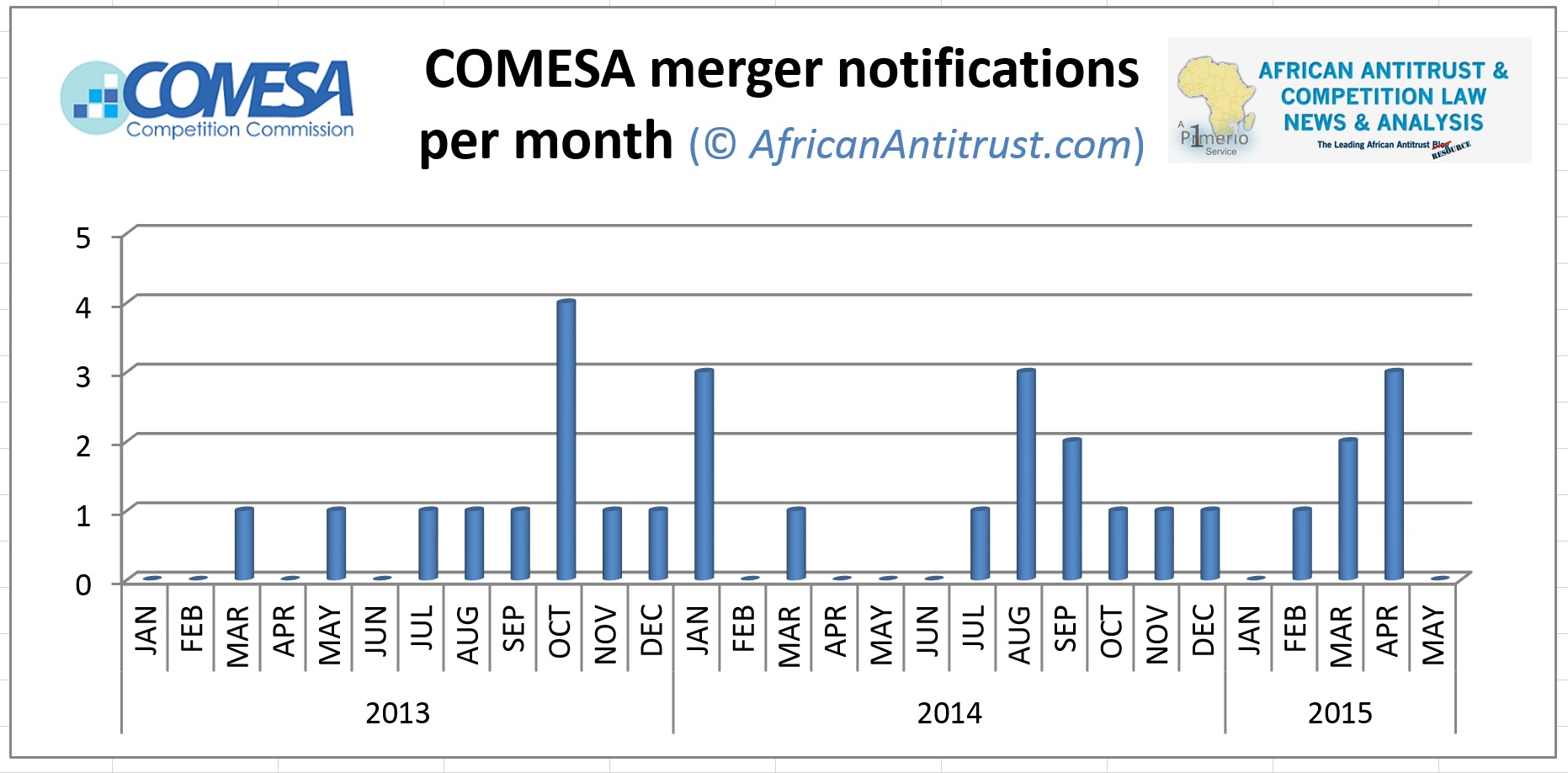
To answer our rhetorical question in the title above: We don’t believe so.  For the merger junkies among our readership, here is AAT’s latest instalment of “COMESA MergerMania” — AfricanAntitrust’s occasional look at merger matters reviewed by the young multi-jurisdictional competition enforcers in south/eastern Africa.  (To see our last post on COMESA merger statistics, click here).

COMESA publishes new Merger Filings, still fails to identify dates thereof

As nobody else seems to be doing this, let us compile the latest news in merger notifications to the COMESA Competition Commission.  Prior to doing so, however, we observe one item of utility and basic house-keeping etiquette, which we hope will be heeded in future official releases by the agency: Please note the dates of (and on the) documents being issued.  Using the date as a ‘case ID’ is insufficient in our view — the CCC’s current PDF pronouncements invariably remain un-dated, a practice which AAT deplores and which simply does not conform to international business (or government) standards.  So: please date your press releases, opinions, decisions, and notifications on the documents themselves.

We observe that the matters below have not yet been assigned final “case numbers” (at least not publicly) in the style typical of the CCC decisions in the past, namely sequential numbers per year, as they are currently under investigation and have not yet been decided.

We also note that one notification in particular appears to have been retroactively made in 2014, even though it is identified as merger no. 3 of 2015 (Gateway), a peculiarity we cannot currently explain.  Likewise, AAT wonders what the “44” stands for in its case ID (“12/44/2014”), we surmise it’s a typo and should be “14” instead.

Internal Case ID Statement of Merger
Holtzbrinck PG/ Springer Science MER/04/06/2015 SOM/6/2015
Eaton Towers/ Kenya, Malawi, Uganda Towers MER/04/05/2015 SOM/5/2015
Coca-Cola BAL/ Coca-Cola SABCO MER/04/07/2015 SOM/4/2015
Gateway/Pan Africa MER/12/44/2014 SOM/3/2015
Old Mutual/UAP MER/03/04/2015 SOM/2/2015
Zamanita /Cargill MER/03/03/2015 SOM/1//2015

Which brings us to the bi-monthly…

AAT COMESA Merger Statistics Roundup

COMESA Merger Statistics as of July 2015
COMESA Merger Statistics as of July 2015 (source: AAT)

CCOs say that with more investigations also comes (slightly) more money

deloittecompliance

In sync with greater enforcement: Firms’ compliance budgets grow

According to a recent survey, the budgets allocated to compliance have grown over the last year, including those of African participants in the study.  Consulting giant Deloitte has released its 2015 Compliance Trends report, the result of its survey in which 20 large corporations across Africa (out of 364 total qualified respondents) participated.

Below, we summarise some its key conclusions on…

The Role of the Chief Compliance Officer

Taken together, these statistics … suggest that most CCOs, especially those at larger corporations, now have an opportunity to participate in high-level discussions about corporate strategy, values, and culture.

The key items under the CCO’s responsibility were:

  1. compliance training,
  2. code of conduct, and
  3. whistleblower hotline.

Primerio director John Oxenham observes that, “unfortunately, the assessment of culture was perceived as the least important among the CCOs’ responsibilities.  This is a serious problem, as pointed out in prior articles emphasising the importance of a culture of compliance, rather than sterile top-down pronouncements that often go unheeded by mid-level management.”

African Companies

While firms from the continent have increased their compliance budgets (about 16% by 10 to 19%, and many more by 1 to 9% over the past year) along with their U.S. and European counterparts, they are perceived to be dilatory in their evaluation of their own compliance efforts and results, and lacking in their ability to make full use of their compliance efforts.  In short, many still (wrongly) view dollars spent compliance as a “grudge cost.”

Significant enforcement in Africa (both in the anti-corruption and competition-law domains) across various sectors of the economy (food, technology, construction, to name a few) have awakened many corporate boardrooms across Africa to the reality of effective home-grown government enforcement.

Information Technology and Compliance

IT Systems have not fared well in the latest report:

One possible disconnect emerges when asking CCOs about the IT systems they use to fulfill their missions: Most are not terribly confident in their IT systems’ ability to do the job. Only 32 percent of respondents were confident or very confident in their IT systems, down from 41 percent in 2014

Interestingly, smaller organisations with less than $5 billion in annual revenues showed higher levels of confidence in their IT systems when juxtaposed to their larger peers.

Infrastructure projects, competition & regulation: Tafotie on regional oversight

Africa-infrastructure

The necessity of strong regional regulatory oversight on infrastructure projects in Africa

RogerBy Roger Tafotie

Dr. Tafotie is a Pr1merio advisor with a legal & business focus on both African and European markets.  A member of the Luxembourg Bar, he is also a lecturer in law at the University of Luxembourg. His focus areas include project finance/public private partnerships, banking & finance, and corporate law.

In his latest paper on essential infrastructure development on the African continent, Roger not only embarks on a mission to clarify the valuable role of public-private partnerships (“PPPs”) — he also reminds us that, beyond “well-drafted projects contracts,” there must also be an “effective and efficient African regional regulatory oversight system, with clear roles and lines of command, that is able to protect against ills such as self-dealings and anti-competitive alliances or monopolies,” including “the monitoring of the tendering process against corruption.”

Enhanced competition and an effective oversight system to weed out corruption in the bidding (and execution) process not only protects the local, national or regional governmental issuer of the infrastructure PPP.  In order to keep all stakeholders, including global financing institutions or other private lenders, in a position of “acceptable risk,” a well-supervised competitive process is essential to tender selection and project execution.

You can find the full paper here, exclusively on AAT and on AAF.