New Competition Commissioner not so new: Bonakele retains top job

south_africa

Interim South African Acting Competition Commissioner Tembinkosi Bonakele confirmed in permanent post by minister who unceremoniously fired predecessor Ramburuth

Plus ça change, plus c’est la même chose…

This morning, economic-development minister Ebrahim Patel announced the retention of the 38 year-old Mr. Bonakele as the top antitrust enforcer in the South African republic, making permanent for a five-year term the interim appointment of the man who said the following in an interview regarding the independence of the competition authorities in South Africa:

While competition authorities should not be beholden to the government neither can they be loose cannons who claim independence without accountability.”

In prolonging Mr. Bonakele’s interim appointment for another five years, Minister Patel thus assured that the important position of Competition Commissioner did not go to a “loose cannon”…

Legislative basis

The appointment is made pursuant to Part A, Art. 22 of the South African Competition Act of 1999, as amended, which also provides (in sub section 4) for the flexible salary and benefits determination to be made by the minister himself: “The Minister must, in consultation with the Minister of Finance, determine the Commissioner’s remuneration, allowances, benefits, and other terms and conditions of employment

Minister Patel
Commissioner Bonakele
Public announcement and emphasis on enforcement

In the duo’s official tweets announcing the decision (see graphic extract below), Patel congratulated Mr. Bonakele, reaffirming his and the SA cabinet’s support of the “eminently suitable” candidate, and emphasizing the importance of (1) the Competition Commission‘s ongoing and hotly debated private health-care inquiry as well as (2) the “social-justice” elements of merger conditions imposed by the SACC on mergers in the past 5 years, purportedly “protecting” 4,900 jobs.

The agency had come under considerable flak in the past year due to its high staff and executive-level turnover and a work environment that has been described as “toxic” by insiders.

The official release by the Ministry of Economic Development quotes Patel as follows:

“I am pleased to have someone of Bonakele’s calibre at the helm of the Competition Commission. He is taking leadership of the Commission at a time when the South African economy needs to become more competitive and create many more decent work opportunities by combatting market abuse such as cartels and pervasive monopolies and ensure competitive pricing of products. In particular, the key jobs drivers identified in our policy frameworks require coordinated and concerted efforts improve economic performance and development outcomes.
“The Competition Commission has been one of a number of successful economic agencies and regulators that are together beginning to transform the South African economy. Mr Bonakele possesses the skills and experience to build on the successes of the Competition Commission.”

The agency’s official “Structure” page had not yet been updated as of the day of the announcement, listing Mr. Bonakele as “Acting” head and still showing the long-departed Ms. Makhaya as a Commission official.

Official S.A. government tweets announcing SACC personnel decision of permanent Bonakele appointment

Language barrier persists in Tribunal proceedings

south_africa

A report by the South African Citizen discusses the language barriers still present in the Republic today.

The piece, entitled “Tribunal struggles with Afrikaans” by Antoinette Slabbert, notes that the RSA Competition Tribunal has decided to have testimony given in Afrikaans transcribed, together with its English translation, “to ensure the court properly captures what a witness was trying to say.”

The underlying case is the Competition Commission’s case against Media24, alleging an abuse of dominance by squeezing its competitor, Gold-Net News, out of the market for advertising in community newspapers in the Free State Gold Fields between 2004 and 2009.

The Citizen reports:

Tribunal chairperson Norman Manoim asked whether Van Eck would mind testifying in English, since he was concerned about the quality of the translation of her responses the previous day. Media24′s legal team objected, saying Van Eck was already assisting the tribunal by taking questions in English.

The legal representative of the commission pointed out that Van Eck’s English was good. Both legal teams shared Manoim’s concern about the English interpretations. Van Eck said she prefered testifying in her home language to better express herself.

Earlier, Wian Bonthuyzen, Van Eck’s former manager and a key witness, switched from Afrikaans to broken English during his testimony, after another interpreter failed to properly convey his responses to the tribunal.

Investment in Africa: Changing landscape, new hurdles

Questioning African antitrust growth prospects: Slowdown in economic investment (both organic and outside investment) may affect functioning of competition law on the continent

Recent developments in Africa have many scratching their heads and wondering whether the formerly wondrous economic-growth engine of the vastly resource-rich and otherwise economically still undervalued continent will soon experience a slowdown, if not come to a halt altogether.

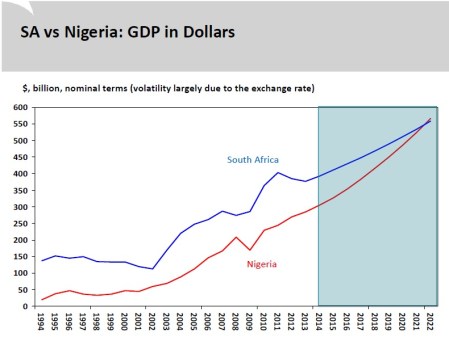
For one, in April 2014, Nigeria surpassed South Africa as the continent’s largest economy (see Economist Apr. 12, 2014: “Africa’s New Number One“).  This is a significant milestone for the former, and a setback for the latter — an economy that was 8 times the size of the Nigerian economy only 20 years ago, yet is now suffering from stagnating GDP, reeling from corruption allegations amongst its current leadership, undergoing a closely-watched presidential election process, and whose ruling ANC party is facing a heretofore unprecedented backlash and torrent of criticism.

Source: The Economist

Not only South Africa has weakened, politically and economically, however.  Events such as the Northern Nigerian wave of violence – with sectarian Boko Haram forcefully displaying the impotence of the central Nigerian government of a weakened president Goodluck Jonathan – fuel the fire of outside investors’ mistrust of African stability and their concomitant reluctance to make good on prior investment promises.  As The Economist notes in the article quoted above: “it is not a place for the faint-hearted” to invest, even though it highlights the successful Nigerian business ventures of outsiders such as Shoprite, SABMiller, and Nestlé.  Bloomberg BusinessWeek quotes Thabo Dloti, chief executive officer of South Africa’s fourth-largest insurer Liberty Holdings Ltd. (LBH), as saying: “It does slow down the plans that we have, it does put out the projections that we have by a year or two.”

http://www.stanlib.com/EconomicFocus/Pages/InterestingChart112SouthAfricaneconomyvsNigerianeconomy.aspx
Nigerian vs. RSA GDP
Source: http://www.stanlib.com

Likewise, multi-national organisations such as COMESA and its competition enforcement body, are undergoing significant changes (such as, currently, an opaque process of raising the heretofore insufficient merger-filing thresholds), shockingly successful web attacks on their data, and a resulting dearth of transactions being notified.  Elsewhere in developing economies, recent political turmoil has likewise led observes to comment on the negative spillover effect from political & social spheres into the economy (e.g., Financial Times, May 8, 2014: “Political crisis further dents prospects for Thai economy“).

Impact on antitrust practice

The upshot for competition-law practitioners and enforcers alike is rather straightforward, AAT predicts: more hesitation around African deals being done means fewer notifications, less enforcement, and overall lower billings for firms.

The flip side of the coin – as is usually the case in the economic sine curve of growth and slowdowns – is the commonly-observed inverse relationship of M&A and criminal antitrust: while we may see fewer transactions in the short term, the incidence of cartel behaviour and commercial bribery & government-contract fraud cases will likely increase.

Commission’s fisheries merger conditions upheld on review by Tribunal

south_africa

Competition Tribunal confirms Commission’s ruling on Oceana and Foodcorp merger

Johannesburg-listed Ocean Group Limited is the largest fishing company in South Africa, whose fishing activities include inter alia the catching, processing, marketing and distribution of canned fish, fishmeal and fish oil and mid-water and deep-sea fishing.

Foodcorp Limited is a food producer and manufacturer with eight production divisions, one of which is a fishing division. Foodcorp’s fishing business comprises a pelagic division, a hake division and a lobster division.

The Competition Commission said its investigation into the proposed transaction showed that the proposed transaction would substantially affect competition in the market for canned pilchards to the detriment of competition and customers. Following implementation of the transaction, Oceana will hold 80% of the market, while its closest competitor would hold less than 10%. Furthermore, the Commission was concerned that the transaction, without the conditions, would remove an efficient competitor to Oceana’s Lucky Star brand from the market, as Glenryck would not be able to provide competition to Lucky Star without its own fishing quota.

Both Oceana and Foodcorp contended that the Department of Agriculture, Forestry and Fisheries had approved the transfer of Foodcorp’s small pelagic fishing rights to Oceana, which includes the consideration of public interest issues regarding black economic empowerment.

The merging parties had taken the conditional approval of the intermediate merger on review before the Competition Tribunal. The conditions which the Competition Commission had imposed entailed that the merging parties are to sell the Glenryck canned-pilchards brand to an independent third party, as well as the small pelagic fish quota allocated to it by the Department of Agriculture, Forestry and Fisheries. The condition was imposed as a means that would deprive Oceana of Foodcorp’s fishing quota, thereby preventing market dominance.

The Competition Tribunal approved the transaction on the same conditions initially imposed by the Competition Commission. The Tribunal will issue its reasons for the decision in due course.

Tsogo Merger Unconditionally Approved

south_africa

Unconditional approval of SA hotel deal

The Competition Tribunal of South Africa (“Tribunal”) has unconditionally approved the merger of Southern Sun Hotel Interests (Pty) Ltd (“Southern Sun Hotel Interests”), which is a subsidiary of Tsogo Sun Holdings Limited, and The Cullinan Hotel (Pty) Ltd (“The Cullinan Hotel”).

The merger related to the provision of short-term hotel accommodation. Pre-merger, Southern Sun Hotel Interests held a 50% shareholding in The Cullinan Hotel and exercised joint control with Liberty Holdings Limited (“Liberty”) over The Cullinan Hotel. Southern Sun Hotel Interests acquired an additional 10% shareholding in the Cullinan Hotel from Liberty, thus increasing its shareholding in the joint venture to a majority interest of 60% and thereby acquiring sole control of The Cullinan Hotel.

The Tribunal approved the merger without any conditions.  Nortons Inc. represented Southern Sun Hotel Interests in this transaction.

Slow-going M&A statistics in COMESA before anticipated threshold revision

COMESA Competition Commission logo

Strong numbers from early 2014 did not hold up

After posting a record three merger notifications in January, the COMESA Competition Commission has seen its M&A filing statistics decline to zero in February and merely one in March.

As we have reported here (optimistic for 2014) and here (pessimistic on 2013 statistics), COMESA’s notified M&A deals have seen erratic ups & downs.  Not surprising, perhaps, if one considers the exquisite confusion that has reigned since the inception of the young antitrust authority about filing thresholds and fees.

The current ebb in notified deals (despite the record set in January) reflects, in our view, the impending end of the current “zero-threshold” regime in COMESA, which was foreshadowed by The CCC’s head of mergers, Willard Mwemba, back in late February 2014.  Quite understandably, parties to ongoing transactions are willing to risk “flying under the radar” if the agency has de facto admitted that the zero-dollar filing threshold is unworkable in practice.

We are curious to see what impact the vacuum of the pending revision to the COMESA merger rules will have on filing statistics going forward, until a more sensible threshold is set by the agency.  For now, with the latest notification #4/2014 (fertilizer and industrial products acquisition by Yara International ASA of OFD Holdings Inc.*) the stats look like this:

* we note that in the notice, the CCC erroneously set the deadline for public comment prior to the notice date itself, namely as “Friday, 28th February, 2014.”

competition law antitrust Africa
COMESA CCC M&A filing statistics as of March 2014

Antitrust sectoral healthcare inquiry

south_africa

Clarification of scope and timetable of sector investigation

According to official statements by the South African Competition Commission (“Commission”), the agency has clarified the administrative guidelines, administrative timetable, and statement of issues.  AAT has reported previously on the sectoral healthcare inquiry by the Commission, critically noting the apparent exclusion of the public healthcare segment, to the detriment of the private care providers.

Theories of harm – “just” theories

The Commission’s main document on the “stakeholder engagement meeting last week states as follows regarding its theories of harm:

[I]n order for the market inquiry to make determinations, it has developed a set of ideas or hypothesis about how harmful competitive effects might arise in the relevant markets under consideration. These ideas are generally referred to as “theories of harm”.
‘It is important to emphasise that these theories of harm are simply hypotheses, or tools, that will enable us to identify whether there are features or a combination of features that may prevent, distort, or restrict competition in the private healthcare markets. Theories of harm are not findings of harm; but are simply analytical tools to guide our analysis. They will be deepened and revised as the inquiry’s thinking develops,’ adds former Chief Judge Ngcobo.

Public comments, and timetable

The agency is “inviting stakeholders to make further comments” on its theories of harm, noting that:

The inquiry is set to follow a very precise and tight administrative timetable which is mindful of the timelines for gathering information including an invitation for written submissions, public hearings, site visits, seminars, and workshops and conducting surveys. Broadly, key milestones will include the issuing of information requests no later than 01 August 2014. The first round of public hearings will take place between 01 March 2015 to 30 April 2015 then from May 2015, the inquiry will analyse and review the information gathered. Presently, the panel aims to make provisional findings and recommendations available for public comment in October 2015.

healthcareinquirytimetabl

Commissioner calls agency’s work “reactive”, will appeal SABMiller case, counters “toothless dog” moniker

South Africa Flag

Revelations from Bonakele’s interview with CNBC Africa

South African interim Competition Commissioner Tembinkosi Bonakele called his agency, the Competition Commission (“Commission”), a “kind of reactive” enforcement body, aiming primarily to uncover cartel conduct.  In an interview with CNBC Africa‘s “Beyond Markets” segment, journalist Nozipho Mbanjwa asked the acting Commissioner tough questions on the Commission’s enforcement tactics, legislative mandate, fines imposed, the adequacy of the Commission’s capitalization, and whether the South African antitrust watchdog was, in fact, a “toothless dog.”

Bonakele held his ground, referring multiple times to the Commission’s recent successes, including the construction cartel, the bread case, cooking oils, and other “basic products” matters on which he said his agency would place the largest focus going forward.

The Acting Commissioner

The Acting Commissioner

Some of the highlights from the interview:

  • Bonakele is “quite satisfied” with the agency’s funding and performance of its 180 staff, but may ask for “more funding” specifically for the Commission’s sectoral health-care inquiry.
  • The Commission will focus its cartel-busting efforts on sectors in the basic products category such as foods and health-care.
  • The Commission will “definitely appeal” its loss of the SABMiller abuse-of-dominance matter, a “very tricky kind of offence in terms of competition law” according to Bonakele.  He said he did “not like” the 7-year long duration of the SABMiller saga, but felt compelled to extend the matter by bringing the case before the Competition Appeal Court.
  • “No comment” on the “classic” Unilever investigation.
  • On the much-maligned MultiChoice broadcaster, Bonakele called the company a “monopoly created by legislation” in a regulated market, and deferred to parliament to rectify the situation.
  • The Commission receives approximately 30% of its funds from revenues that are the result of merger filing fees.

South Africa: Surprise search and seizure visit at Unilever and Sime Darby

south_africa
Dawn Raids Rattle South African Consumer-Goods Brands

The South African Competition Commission (“Commission”) has confirmed that it has conducted such a dawn raid operation at Unilever South Africa (Pty Ltd) (“Unilever”) and Sime Darby’s respective South African offices during the morning of 03 April 2014.

Unilever is one of the largest fast-moving consumer goods companies in South Africa. Unilever’s business activities include laundry, skincare and cleansing, margarine, deodorants, household care, tea, hair care and ice cream. Household names which form part of the Unilever group include Sunlight, Knorr, Lipton, Ola and Omo.

Sime Darby is a Malaysia-based multinational company involved in sectors such as plantation, industrial equipment, motors, property and energy & utilities, with operations in more than twenty countries. It is the world’s top palm oil planter. Its South African operation, namely Sime Darby Hudson & Knight (Pty) Ltd, is located in Boksburg and it produces and sells premium fats and oils to bakery, food service industry and food manufacturers predominantly in South Africa.

“The Commission believes that the information that will be obtained from today’s operation will enable the Commission to determine whether or not Unilever SA and Sime Darby have indeed engaged in collusive conduct,” Acting Commissioner Tembinkosi Bonakele said.

The Commission has indicated that this raid forms part of an ongoing investigation into collusive conduct in the product markets for the manufacture and supply of edible oils and baking fats to both wholesale and retail customers. The Commission has further indicated that it has reasonable grounds to believe that employees of Unilever and Sime Darby have information which is relevant to the investigation.

The last dawn raid was conducted on 06 May 2010 at the premises of four electrical cables manufacturers and suppliers based in Gauteng province, South Africa. The various premises were searched by the Commission on suspicions of price fixing, market allocation and collusive tendering. This was done subsequent to a complaint initiated by the Commissioner on 16 March 2010 against Aberdare Cables (Pty) Ltd, Alvern Cables (Pty) Ltd, South Ocean Electric Wire Company (Pty) Ltd and Tulisa Cables (Pty) Ltd.

Sections 46 to 49A of the South African Competition Act of 1998 (“Competition Act”) empowers the Commission to conduct surprise search and seizure visits and to carry out so-called “dawn raids” to a firm’s business premises in order to inspect documents and interview staff where an infringement of competition law is suspected.

The Commission is empowered to enter any such premises when a judge or a magistrate has issued a warrant. Although a warrant is usually an essential requirement to ensure that a dawn raid is conducted in accordance with the law, the Competition Commission does have the power to enter and search a premises without a warrant, in exceptional circumstances.

If the Commission has reason to believe that a firm is in contravention of provisions of the Competition Act, or is in possession of information relating to a matter that is under investigation, the Commission’s investigators have the authority to enter into the firm’s premises in order to inspect and request copies of documents, ask for information in relation to any documents, take notes and interrogate employees, search and examine computer data and remove evidence from the premises. In particular, officials may examine files, reports and emails. The Competition Commission is entitled to confiscate computer hard drives. They may also take copies of documents.

UPDATE: 23-April-2014:

Based on reporting in a BDLive story, the Commission has said that it “is too early for the commission to say what data or documents were seized. Information and data are being analysed,” noting that it “believes that information that will be obtained from (the) operation will enable (it) to determine whether or not Unilever SA and Sime Darby have indeed engaged in collusive conduct,” acting commissioner Tembinkosi Bonakele said. “However, as part of any investigation, we also wish to urge anyone, be it business or individuals, with further information to come forward and assist the commission in concluding this investigation.”

Acting competition commissioner Tembinkosi Bonakele. Picture: FINANCIAL MAIL

SA competition enforcer’s distribution monopoly case dismissed by Tribunal

south_africa
South African Breweries distribution case dismissed

The Competition Tribunal of South Africa has dismissed a monopolization case brought by the Competition Commission against South African Breweries (“SAB”). The Tribunal held that the Commission brought insufficient evidence to find that SAB acted in violation of the Competition Act.  Particularly in light of the significant resources which the Commission expended on the matter, it is a disappointing loss for the agency.

The Commission had alleged that SAB’s distribution system prevented competition between firms that distributed SAB-branded beers, but the Commission made no case against 90 per cent of SAB’s distribution and focused its case on the system of appointed distributors. This would account for only 10 per cent of SAB’s method of beer distribution. The Commission claimed that SAB has a market share of about 90% of ‘clear beer’ in South Africa. It went on to claim that SAB restricted competition between its distributors as SAB would appoint distributors and allocate exclusive territories.

The Tribunal held that the distributors appointed by SAB were not adequately independent to be in competition with each other and therefore their conduct could not be seen as being restricted. The Tribunal held that SAB’s conduct did not amount to unjustified discrimination.

The decision marks the first occasion that the Tribunal has dealt with the treatment of non-compete restraints in dual distribution arrangements in South African competition law. In deciding the matter, the Tribunal also introduced the novel concept of a “separate basic economic unit.  This concept operates as a measure used to assess the level of independence distributors have from their suppliers, which means that there must be a certain level of independence between a supplier and a distributor in order to contravene the Act.

There has been no indication that the Commission intends to appeal the Tribunal’s dismissal.