On 28 September 2016, the South African Competition Commission (SACC) conducted a further set of dawn raids. This time, on various cargo shipping liners based in the provinces of Kwa-Zulu Natal and the Western Cape.
The SACC indicated that “Hamburg Sud South Africa (Pty) Ltd, Maersk South Africa (Pty) Ltd, Safmarine (Pty) Ltd, Mediterranean Shipping Company (Pty) Ltd, Pacific International Line South Africa (Pty) Ltd and CMA CGM Shipping Agencies South Africa (Pty) Ltd have engaged in collusive practices to, inter alia, fix the incremental rates for the shipment of cargo from Asia to South Africa in contravention of the Competition Act”.
The investigation is allegedly a result of a complaint received from a member of public.
The SACC has not provided an indication of the period over which conduct took place and whether this investigation relates to historical or on-going conduct. This is an important consideration in light of the introduction of criminalisation of cartel conduct, which came into effect as of 1 May 2016. In terms of the Section 73A of the Competition Amendment Act, any director or person with management authority may be held criminally liable for ‘causing’ or ‘knowingly acquiescing’ in cartel conduct.
Since the notion of criminal liability was put raised as far back as 2008, there have been substantial concerns raised about the effectiveness of the SACC’s corporate leniency policy which in effect, offers immunity to a company who whistle blows, from an administrative penalty only. The CLP does not offer immunity to any individual from criminal prosecution, as the discretion to prosecute an individual under Section 73A, rests solely with the National Prosecuting Authority.
The interplay between the introduction of criminal liability and dawn raids will, in our view, be quite significant as there have been a number of respondents who have thought to approach the SACC for leniency, off the back of a dawn raid. A decision which a company may think twice about if its directors may potentially be held criminally liable.
Regardless of the impact which the criminalisation of cartel conduct may have on the whistleblowing regime, the SACC remains committed to utilising dawn raids as one of its most powerful investigative tools.
The SACC has been strong proponent of dawn raids and despite having conducted its first dawn raids in the early 2000’s, the past 18 months has seen a marked spike in the number of dawn raids conducted across a broad range of sectors.
The shipping industry in particular has been the subject of significant attention from the South African Competition Authorities and last year saw substantial administrative penalties, of over R95 million, levied by way of a settlement agreement on WWL and NYK Shipping Liners respectively for having engaged cartel conduct in relation to certain shipping routes. This investigation, however, remains on-going.
The Competition Commission and South African steel producer, ArcelorMittal South Africa Limited (ArcelorMittal), have agreed to settle six complaints against ArcelorMittal for R1.5 billion (approximately US$ 112 million), in what is the largest (agreed) administrative penalty imposed in South Africa.
The penalty (by consent order) represents just under 5% of ArcelorMittal total turnover (including chemicals) for 2015.
The allegations which were brought against ArcelorMittal included allegations of price fixing and market allocation in what was termed by the Competition Commission the “steel cartel”.
In terms of the settlement agreement, ArcelorMittal admitted to contravening section 4(1)(b) of the Competition Act and will pay not less than R300 million per annum for five years from 2017. Furthermore, ArcelorMittal has undertaken to invest approximately R4.6 million into the South African economy for the next 5 years (provided the prevailing economic conditions render such investment feasible). Interest will be charged on the outstanding amount, interest starting to run 17 months after the finalisation of the settlement agreement.
In addition to the cartel conduct, the Commission had also instituted a complaint alleging the dominant steel manufacturer had engaged in excessive pricing. Although ArcelorMittal did not admit to wrongdoing in relation to the abuse of dominance allegation, the parties nevertheless agree that ArcelorMittal would not generate earnings before interest and tax of over 10% for the next 5 years (subject to certain exceptions).
The Competition Commission’s press release states the following:
ArcelorMittal admits that it engaged in collusion with CISCO, Scaw and Cape Gate by fixing prices and discounts, allocating customers and sharing commercially sensitive information in the market for the manufacture of long steel products, in contravention of the Competition Act. ArcelorMittal also admits that it fixed the purchased price of scrap metal with Columbus Steel, Cape Gate and Scaw. In respect of the flat steel complaint and the Barnes Fencing complaints, ArcelorMittal admits the conduct as alleged by the Commission but does not admit that this conduct constituted a contravention of the Competition Act. In relation to the pricing complaint, ArcelorMittal does not admit that it acted in contravention of the Competition Act.
The investigation and settlement agreement follows a leniency application brought by another respondent, Scaw Metals. There is little doubt that the Competition Commission’s corporate leniency policy has permitted the Commission to uncover and successfully prosecute a number of cartels. As previously reported on AAT, the risk remains that the recent introduction of criminal liability (on directors or persons having management authority) for engaging in cartel conduct, may dampen the use of the whistle-blower regime (absent any formal immunity from criminal prosecutions).
The settlement agreement does, however, bring finality to all six cases against ArcelorMittal.
In light of the very recent civil damages awarded in favour of Nationwide Airlines against South African Airways for abuse of dominance which led to loss of profits, it will be interesting to see whether any civil party elects to prosecute ArcelorMittal for the excessive pricing complaint. In terms of the South African Competition Act and a recent judgment by the Supreme Court of Appeal, it appears as if the door is closed on a civil litigant brining a civil damages claim against a respondent, based on a breach of the competition Act, if there has been no adverse finding made against such a respondent by the Competition Tribunal (or Competition Appeal Court) as per section 65 of the Competition Act.
The admission to having engaged in cartel conduct, may, however, expose ArcelorMittal to civil liability over and above the settlement agreement.
The Kenyan antitrust authority, CAK, recently closed its investigation into a classic price-fixing cartel involving the Outdoor Advertisers Association, resulting in a fine of Sh11.64 million (approx. $120,000) imposed on domestic advertising firms for fixing minimum prices of billboard space, reports the Kenya Gazette. The affected companies include Magnate Ventures Limited (Sh5 million), A1 Outdoor Limited (Sh114,000), Live Ad Limited (Sh2.5 million) and Adsite Limited (Sh2.39 million), while four others had already settled with CAK previously (Consumer Link (Sh1.2 million), Look Media (Sh136,000), Firm Bridge Limited (Sh246,400) and Spellman Walkers Limited (Sh45,180)). The remaining four trade association members will be fined forthwith.
Notes Andreas Stargard, a competition practitioner with Primerio Ltd., “[i]n this case — which really represents a classic minimum-price fixing arrangement among trade association members — the billboard owners agreed during a period of less than one year to set a minimum monthly price of Sh160,000 in large Kenyan markets, such as Nairobi. Interestingly, they price-discriminated geographically within their cartel arrangement and fixed the corresponding fees in smaller markets at a slightly lower amount.”
The head of the CAK, Director-GeneralWang’ombe Kariuki, lamented that a trade group was being used to manipulate an otherwise competitive process of market forces yielding market prices, which he believed are approximately 20 to 25% lower than the fixed rates, based on post-investigation pricing. Says Stargard:
“It is interesting to see that the CAK has already followed up on this matter and has noticed an arguably direct empirical result, yielding a beneficial effect of a not insignificant price reduction in advertising costs in Nairobi.”
South African Antitrust Developments: a WRAP from the Comp-Corner
Issue 1 – May 2016
The editors and authors at AAT welcome you to our new semi-serial publication: “The WRAP.” In this first WRAP edition, we look back over recent months and provide an overview of the key recent developments which antitrust practitioners and businesses alike should take note of in respect of merger control and competition law enforcement.
As always, thank you for reading the WRAP, and remember to visit AAT for up-to-date competition-law news from the African continent.
–Ed. (we wish to thank our contributors, especially Michael Currie, for their support)
By AAT guest author, Osayomwanbor Bob Enofe, Sutherland School of Law Doctoral Scholar, UCD.
We recently wrote about the landmark enactment of the new South African competition legislation that makes hard-core price-fixing a criminal offence, subjecting cartelists to up to 10 years imprisonment. Nigeria is usually not on the radar of antitrust practitioners, however, and certainly not in the criminal sense, either. As regular readers of AAT know, the Republic of Nigeria has featured occasionally in our posts despite not having a functioning antitrust regime, yet. As editor and Pr1merio director Andreas Stargard wrote in an article entitled “Nigerian antitrust?“, scholars and political activists alike have promoted the idea of establishing an antitrust regime in West Africa’s dominant economy: ‘Today, AfricanAntitrust adds its voice to the steady, though infrequent, discussion surrounding the possibility of a Nigerian competition-law regime. In our opinion, it is not a question of “if” but “when”, and perhaps more importantly, “how“?’
Today, contributing author Bob Enofe adds his voice to the mix, and we are publishing one of his articles that originally appeared on Robert Connolly’s cartel capers blog.
Criminal Antitrust in Nigeria?
The Federal Republic of Nigeria is currently in the process of enacting a competition law, including to criminalise cartel activity amongst competitors. While such is in line with moves made by various other jurisdictions and theories of ‘rational actor’, sanction and deterrence, on ground realities suggest that criminalisation where transplanted might be seriously flawed.
From the late 1990s, and particularly in the year 2000, the Federal Government of Nigeria commenced moves to enact a Competition Law. Under such law, business cartel activity defined as agreements between competitors, aimed at distorting the process of competition and generating monopolistic rents, would be criminalised. The ‘Federal Competition Bill, 2002’, an executive bill drafted by the Nigerian Bureau of Public Enterprises (BPE), was titled: “a Bill for an Act to provide necessary conditions for market competition and to stimulate creative business activities, protect consumers, and promote the balanced development of the natural economy, by prohibiting restrictive contracts and business practices that substantially lessened competition”. It was also to be a Bill to regulate “possible abuses of dominant positions by businesses, and anti-competitive combines, and to establish the Federal Competition Commission, for effective implementation and enforcement of all the provisions of the bill”. According to relevant sections of the bill, cartel agreements amongst competitors, including price fixing, bid rigging and market division, were also to be expressly criminalised. Clearly a robust and comprehensive bill, 16 years after introduction to the Nigerian National Assembly, the bill remains to be passed into law. Several amendments have since been presented, together with other bills presented by lawmakers. In every case, such bills have either stalled at first reading stage, or in certain cases disappeared from the legislative process. In one of such instances, an amendment of the above bill (The Federal Trade and Competition Commission Bill, 2006) was “vehemently” objected to by distinguished Senators, prompting governmental withdrawal. Amongst reasons advanced for the reception accorded the bill included that there was no need for a distinct ‘competition commission’, in the face of an already existent consumer protection council in Nigeria; other legislators simply complained about a proliferation of “too many commissions” in the country. Commentators have alluded to overt ignorance and lack of particular inclination for the subject, on the part of Nigerian Senators, as in reality underlining the reception accorded the bill.
In a paper recently presented at the #SLSA2016, ‘Developing Countries, Nigeria, and Cartel Criminalisation: of Transplantation and Desirability’ I had outlined how Nigeria’s attempt to introduce a competition law, and in particular criminalise cartel activity, reveals a (marked) lack of societal inclination towards competition law and prior poor advocacy on the part of government. Social norms are crucial to the effectiveness of law reform. Desirable social norms ensures amongst other things that prohibited conduct will be reported and discovered, even without direct enforcement or investigative intervention, thereby complementing stretched law enforcement efforts.[1] Such also imply that prosecutors will be willing to enforce and vigorously police provisions of the law where passed, and in the case of the judiciary, stringent sentences will also be applied—or at least not deliberately avoided—so as to facilitate the deterrence potential of the applicable law. Perhaps most crucially for Nigeria, existence of such norms also mean that law makers are incentivised to support reform efforts, while the chances of ‘hijack’ by private interests will be slim. Absent such norms the chances of Nigeria’s competition and cartel criminalisation law, even when passed, could be (remarkably) marginal.
Heightened advocacy, together with a careful selection of test cases once the law is enacted is advanced as capable of remedying the above situation. In the face of sub-par institutions characteristic of the Nigerian context however (including severe limitations in the operation of the rule of law), abilities to so ‘guide’ social norms will be in reality seriously limited. An online petition regarding corruption amongst Nigerian senators, for example, reflect in part difficulties that could frustrate transplantation of cartel criminalisation, absent independent, effective, anti-corruption reforms in the country.
Neoliberal theories of rational actors, sanction and deterrence, imply to large extents a similar existence of contexts as have underlined effectiveness in western societies. In many cases, on the ground realities suggest that theories where transplanted, could be seriously flawed.
As I have argued in another paper currently under review (details to be communicated soon, hopefully!), one size cannot fit all- with developing countries and cartel criminalisation, the point gains extra force. To the extent that fines and other administrative means of enforcement are limited in ability to effectively curtail cartel practices, suggests a need for continuation of relevant research. Criminalisation hardly represents the ‘Golden Fleece’.
Footnote:
[1] See Stephan, Andreas, ‘Cartel laws undermined: Corruption, social norms, and collectivist business cultures’ (2010) Journal of Law and Society 345-367, See Maher, Imelda, The Institutional Structure of Competition Law, in Dowdle, Gillespie and Maher (eds) Asian Capitalism and the Regulation of Competition: Towards a Regulatory Geography of Global Competition Law (Cambridge University Press, 2013) 55, See Gal, Michal ‘The Ecology of Antitrust: Preconditions for Competition Law Enforcement in Developing Countries.’ (2004) Competition, Competitiveness and Development 20-38.
Price-fixing in Kenya is prohibited under the Competition Act No. 12 of 2010 under Section 21 (3) (a) which provides that any agreements, decisions or concerted practices which directly or indirectly fix purchase or selling prices or any other trading condition is prohibited under the Act, unless they are exempt in accordance with the provisions of Section D of Part III.
Part III B further prohibits price-fixing by trade associations under Section 22 (b) (i) which provides that the making, indirectly or directly, of a recommendation by a trade association to its members or to any class of its members which relates to the prices charged, or to be charged by such members, or to any class of members, or to the margins included in the prices, or to the pricing formula used in the calculation of those prices, constitutes a restrictive trade practice under the Act.
Section 29 (1) of the Act further outlines the rules for exemptions in respect of professional associations. It provides that a professional association whose rules contain a restriction that has the effect of preventing, distorting or lessening competition in a market must apply in writing or in the prescribed manner to the Competition Authority for an exemption. Sub-section (2) goes on to explain what factors the Authority considers in order to grant an exemption for a specified period. These include:
Maintenance of professional standards
Maintenance of the ordinary functioning of the profession
Internationally applied norms
Section 29 (5) further gives discretion to the Authority to revoke an exemption in respect of such rules or the relevant part of the rules, at any time, if the Authority considers that any rules, either wholly or in part, should no longer be exempt under this section. For instance, if they no longer promote consumer welfare or do not enhance standards in the profession.
Price setting concerns by Law Society of Kenya, LSK
Professional fees for advocates in Kenya are set by the Chief Justice under the Advocates Act Chapter 16 of the Laws of Kenya. Part IX Section 44 provides that the Chief Justice may by order prescribe and regulate in such manner as he/she thinks fit the remuneration of advocates in respect of all professional business, whether contentious or non-contentious. Sub-section (2) also provides that the Chief Justice may prescribe a scale of rates of commission or percentage in respect of non-contentious business.
However, Section 45 provides that agreements in respect of remuneration may be made between the advocate and the client subject to permissible professional rules under section 46 of the Act. Therefore, as much as the Chief Justice may set professional fees under the Act, there is an opportunity for the advocate and the client to agree on professional fees subject to the Act. Moreover, a client has redress to apply to the courts under Section 45 (2) to set aside or vary such an agreement on grounds that it is harsh, unconscionable, exorbitant or unreasonable according to professional practice. The decision of the court on this matter is final.
The Chief Justice periodically revises the Advocates Remuneration Order which sets out the scale of professional legal fees. In doing so the Chief Justice considers factors such as inflation and the costs of providing legal fees. The Kenyan Advocates Remuneration Order was last revised upwards in 2014, increasing professional fees by 50%. The Order was last revised in 1997. Advocates had petitioned the Chief Justice to do so in order to enable them cope with tough economic conditions. Recently there was a public discourse on whether advocates should have set fees. Stakeholders argue that the Chief Justice’s decision to adjust fees may not be entirely objective because since he or she has qualifications in law, and could revert to the profession upon retirement from office.
LSK on the other had contends that the minimum fees help protect consumers from poor services, and it reduces the price wars that would occur without the scale of fees. Under the Advocates Act, charging below the set scale of fees amounts to undercutting. This is a professional offense that could result in the concerned advocate being suspended or struck off the roll. Moreover, any agreements or instruments prepared by the concerned advocate are liable to be invalidated by the courts.
The question arose among legal stakeholders as to whether the Authority could intervene in relation to the scale of professional fees under the provisions on price-fixing. The LSK chairperson recently commented that it is beyond the jurisdiction of the Authority, as the Remuneration Order seeks to set minimum fees and not a fixed rate. However, it is clear from the provisions of Section 29 that any professional body whose rules, having regard to internationally applied standards, contain any restrictions which have the effect of preventing or substantially lessening competition in a market, must apply to the Competition Authority for an exemption of the said rules.
Price Setting Concerns by Association of Kenya Reinsurers, AKR
The Association of Kenya Reinsurers is regulated by the Kenya Reinsurance Corporation Limited Act, Cap 487A of the Laws of Kenya. The Association consists of the following companies: Kenya Reinsurance Corporation Limited, Africa Reinsurance Corporation Limited, East Africa Reinsurance Company, Zep – Re and Continental Reinsurance Limited. The Authority recently investigated this association for price fixing following a complaint lodged from the National Intelligence Service (NIS). The association, through a circular dated 2, October 2013, had advised its members on the minimum applicable premiums upon renewal of NIS Group Life Scheme for 2013/2014. Insurance companies are required by their regulator Insurance Regulatory Authority (IRA) to use an independent actuary to come up with their own individual premium rates, which they file with the IRA for approval.
The association is required under the Competition Act Section 29 (1) to apply in the prescribed manner to the Authority for an exemption in relation to any anti-competitive rules. Section 22 (2) (b) also prohibits the making, directly or indirectly, of a recommendation by a trade association to its members, or to any class of its members which relates to the prices charged, or to be charged by such members, or any such class of members, or to the margins included in the prices, or to the prices, or to the pricing formula used in the calculation of those prices. Therefore, the Association is legally bound to seek the approval of the Authority in order to set a minimum fee for any particular group of consumers. Moreover, the association may be in violation of Section 21 (f) of the Competition Act which prohibits any decisions by associations of undertakings which applies dissimilar conditions to equivalent transactions with other trading parties, thereby placing them at a competitive disadvantage, unless they are exempt in accordance with the provisions of Section D of Part III.
Conclusion
In conclusion, professional associations in Kenya should take advantage of the provisions of Section 29 of the Competition Act which allow professional associations to apply rules whose effect is the lessening of competition in the market, provided they are applied to enhance professional standards, the ordinary functioning of the profession or internationally applied norms for the benefit of consumers.
Price-fixers face up to 10 years prison time, starting May 1st
Prison time for executives is now firmly on the not-so-distant horizon in South Africa: As reported in some media outlets, the criminalisation of certain hard-core (and possibly lesser) antitrust offences is finally being implemented in the Republic — notably after more than 8 years of the relevant legislation technically being on the books.
We are referring to the “phased” implementation of the 2009 Competition Amendment Act. The legislation technically criminalised hard-core antitrust offences such as bid-rigging or price-fixing cartels. However, President Zuma has, until now, not yet implemented or effectively signed the criminal provision of the Act (section 73A) into law.
Enter his Economic Development Minister,Ebrahim Patel:
According to news reports, Mr. Patel announced today (Thursday), that the criminalisation of the price-fixing cartel offence would henceforth be enforced. Section 73A will be gazetted tomorrow, 22 April 2016, and hold the force of law from 1 May 2016. BDLive also reports that even the lesser “abuse of dominance” (or more commonly “monopolisation”) offence would be subject to the criminal penalties, but AAT is awaiting independent confirmation on this subject. As Andreas Stargard, a U.S.-based Pr1merioantitrust practitioner with a focus on Africa and experience counseling clients in criminal competition matters, explains:
“If Mr. Patel indeed made this statement, and I doubt this, it would signal a departure from the rest of the world’s antitrust regimes: It is highly uncommon to have the monopolisation offence constitute a criminal act — indeed I am aware of no jurisdiction where this is the case.
In the United States, the only conduct constituting a Sherman Act offence pursued by the DOJ as a potential felony involve so-called ‘hard-core’ violations. This would include horizontal price-fixing among competitors; territorial allocations; output allocations; and bid-rigging. The same holds true in the UK. That said, monopolisation or abuse of dominance is simply not among the criminalised antitrust violations elsewhere, and I’d be surprised if South Africa took this unusual path.“
We have since been able to confirm that the BDLive report incorrectly refers to abuse of dominance as being criminalised. AAT has obtained a copy of Mr Patel’s speech which provides clearly only for cartel conduct to be subjected to imprisonment:
“We are confident that because our work on cartels over the past five years has given clarity in the market on what collusion entails and what kind of acts falls within prohibited practices, we can now step up our efforts to the next level in our endeavor to combat corruption, cartels and anti-competitive conduct that raise prices and keep businesses and new entrants out of local markets.
Accordingly, government will tomorrow gazette a Presidential Proclamation that brings into effect certain sections of the Competition Amendment Act, with effect from 1 May 2016, which make it a criminal offence for directors or managers of a firm to collude with their competitors to fix prices, divide markets among themselves or collude in tenders or to acquiesce in collusion and they expose themselves to time in jail if convicted.”
The Patel announcements come ahead of his upcoming budget vote speech, and as he has shown in recent months, Mr. Patel is a proud advocate for tougher competition enforcement in the country. “We want to make sure that it just does not make sense to collude,” he is reported as saying today. This follows the Minister’s speech during the Parliament debate in February, where he announced that, “we will now introduce measures shortly to make it a criminal offence in any industry to collude and fix-prices. It will send a message to everyone that we mean business on stamping out corruption and collusion. We must build competitive strengths through innovation, not through sitting in rooms somewhere fixing tenders, prices and contracts.”
White-collar crime: it pays, but is getting riskier
We live in the era of the PanamaPapers, where the notion of white-collar business people going to jail is not an entirely unlikely outcome for some. Antitrust offences, however, have historically not been enforced worldwide as stringently as public corruption or tax-evasion matters, for instance. Key jurisdictions with criminalisation of competition offences remain few, notably the U.S. and the UK.
In South Africa, since at least 2014, both Competition Commissioner Tembinkosi Bonakele and Minister Patel have been engaging in discussions on how and when to implement the Act “to ensure that the necessary institutional capacity is available to apply the [criminal] amendments.” While some provisions (relating to the agency’s market-inquiry powers) went into effect in 2013, the criminalisation provisions remain unimplemented to date — but this is about to change.
During these negotiations, as reported on AAT, the minister and SACC admitted in a remarkable self-assessment that the Commission then lacked “the institutional capacity needed to comply with the higher burden of proof in criminal cases.” One notable aspect of potential discord lies in not only in the different standard of proof in civil vs. criminal matters (“more probable than not” vs. “beyond a reasonable doubt”), but perhaps more importantly can be found on the procedural side, preventing rapid implementation of the law: There has been historic friction between various elements of the RSA’s police forces and (special) prosecutorial services, and the power to prosecute crimes notably remains within the hands of the National Prosecuting Authority, supported in its investigations by the South African Police Service.
History & Legislative Background – and a bit of Advice from the U.S.
Starting in the spring and summer of 2008, the rumoured legislative clamp-down on corrupt & anti-competitive business practices by the government made the RSA business papers’ headlines.
During a presentation Mr. Stargard gave at a Johannesburg conference in September that year (“Criminalising Competition Law: A New Era of ‘Antitrust with Teeth’ in South Africa? Lessons Learned from the U.S. Perspective“), he quoted a few highlights among them, such as “Competition Bill to Pave Way for Criminal Liability”, “Tough on directors”, “Criminalisation of directors by far most controversial”, “Bosses Must Pay Fines Themselves”, “Likely to give rise to constitutional challenges”, and “Disqualification from directorships … very career limiting”.
Stargard, whose practice includes criminal and civil antitrust work, having represented South African Airways in the global “Air Cargo Cartel” investigations, also notes that international best-practice recommendations all highlight the positive effect of criminal antitrust penalties. For example, the OECD’s Hard-Core Cartel Report recommended that governments consider the introduction and imposition of criminal antitrust sanctions against individuals to enhance deterrence and incentives to cooperate through leniency programmes. Then-DOJ antitrust chief Tom Barnett said in 2008, the year South Africa introduced its legislation: “Jail time creates the most effective, necessary deterrent. … [N]othing in our enforcement arsenal has as great a deterrent as the threat of substantial jail time in a United States prison, either as a result of a criminal trial or a guilty plea.”
Mr. Stargard points out the following recommendations to serve as guide-posts for the Commission going forward in its “new era” of criminal enforcement:
Cornerstones of a successful criminal antitrust regime
Crystal-clear demarcation of criminal vs. civil conduct
Highly effective leniency policy also applies to individuals
Standard of proof must be met beyond a reasonable doubt
No blanket liability for negligent directors – only actors liable
Plea bargaining to be used as an effective tool to reduce sentence
Clear pronouncements by enforcement agency to help counsel predict outcomes
What lies ahead?
After 1 May, the penalties for violating Section 73A of the Competition Amendment Act will range from a period of up to 10 years in prison and/or a fine of up to R500 000.00. It appears that the introduction of criminal provisions will not have a retrospective effect, but will only apply prospectively from 1 May 2016 onward.
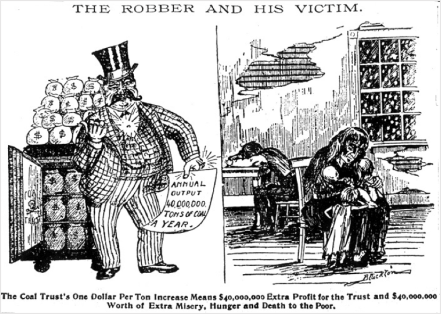
Robber barons…
The introduction of criminal sanctions for cartel conduct raise several constitutional concerns. It is likely that, in the event of the imposition of criminal sanctions, the constitutional validity of the relevant Competition Amendment Act provisions will be challenged. In particular, section 73A(5) of the Amendment Act, introduces a reverse onus on the accused, in that the onus for rebutting the Competition Tribunal of Competition Appeal Court’s conclusion rests with the accused in criminal proceedings. The reverse onus’ constitutional validity is questionable given the constitutional right to a fair trial and the right to be presumed innocent.
John Oxenham, also with Pr1merio, notes that the “criminalisation of cartel conduct is a development which needs to be carefully considered and well planned before its official introduction due to the imminent effects it will have on current South African competition law.” The successful prosecution of cartel conduct rests heavily on the efficiency of corporate leniency policies. The introduction of criminal sanctions and in turn the National Prosecuting Authority will undoubtedly have an effect on the current corporate leniency policies. It is important to consider granting the staff of a company applying for corporate leniency in relation to cartel activity ‘full immunity’ from criminal prosecution in order to encourage companies to come forward and not debilitate the very purpose of corporate leniency policies. The careful integration of criminal sanctions is therefore vital in ensuring that the very purpose of its introduction, namely to deter corruption and anti-competitive conduct, is achieved.
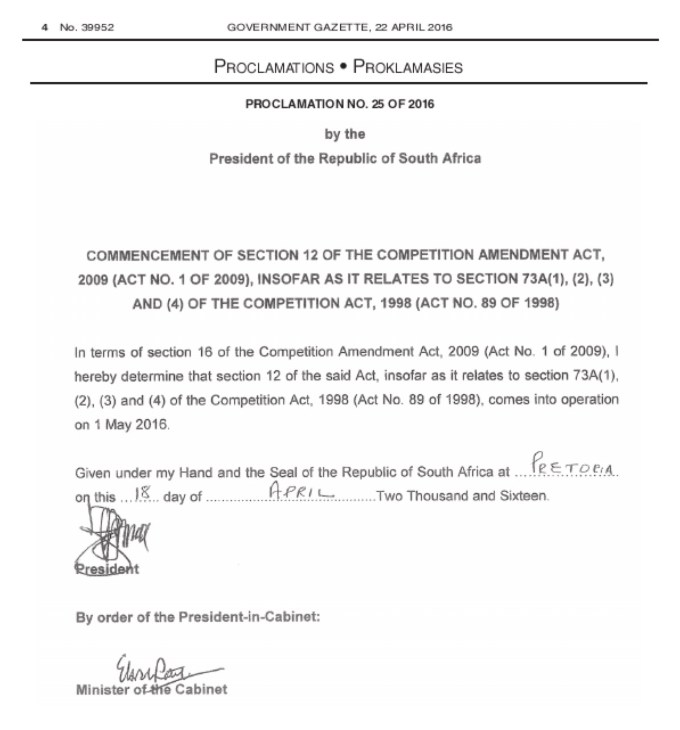
Update [22 April 2016]: As anticipated, the South African government gazetted [published] the official document starting the era of criminal antitrust enforcement under section 73A as of today, signed 18 April 2016:
March 2016 has been a busy month for the competition agencies of South Africa and Kenya respectively. Both agencies carried out search and seizure operations as a result of alleged collusion within various sectors of the economy. While the March dawn raids are not connected, the South African Competition Authority, as part of its advocacy outreach, provided training to the Competition Authority of Kenya relating to inter alia, search and seizure operations.
South Africa
On 23 March 2016, the South African Competition Commission carried out search and seizure operations in the automotive glass fitment industry, as part of its continued investigation into alleged collusion within this sector.
Accordingy to the SACC, the raid was carried out “at the Gauteng premises of PG Glass, Glasfit, Shatterprufe and Digicall as part of its investigation of alleged collusion. PG Glass and Glasfit are automotive glass fitment and repair service providers; Shatterprufe supplies PG Glass and Glasfit with automotive glass while Digicall processes and administers automotive glass related insurance claims on behalf of PG Glass and Glasfit.”
John Oxenham, founding director of Pr1merio, notes that “[t]his most recent dawn raid follows on from those carried out towards the latter part of 2014 and 2015 and confirms that the SACC has adopted a more robust approach to investigating alleged anti-competitive practices.” In this regard, Commissioner, Tembinkosi Bonakele, confirmed at the 9th Annual Competition, Law, Economics and Policy Conference in November last year that the Competition Commission has in the past two years, “conducted more dawn raids than those conducted in preceding years since the Competition Commission came into existence” (nearly 16 years ago).
For an overview of dawn raids and cartel investigations in South Africa, please see the following GCR Article.
Kenya
This month the Competition Authority of Kenya (“CAK”) conducted its first dawn raid. The search and seizure operations were carried out in respect of two fertiliser firms, Mea Limited and the Yara East Africa, based on the CAK’s suspicion of price fixing occurring between these two firms, who together control approximately 60% of the fertiliser market. The CAK conducted the raid in accordance with Section 32 of the Competition Act, 2011 which provides for the Authority to enter any premises in which persons are believed to be in possession of relevant information and documents and inspect the premises and any goods, documents and records situated thereon. This follows an inquiry which was launched last year by Kenyan competition authorities into what the CAK termed “powerful trade associations exhibiting cartel-like behaviour specifically targeting banks, microfinance institutions, forex bureaus, capital markets as well as the agricultural and insurance lobbies”. The fact that the CAK has carried out its first dawn raid demonstrates its growing stature.
The fertiliser industry appears to be a priority sector for a number of African jurisdictions as the CAK’s investigation into this sector follows the South African Competition Commission’s investigation into the fertiliser industry (which resulted in a referral before to the South African Competition Tribunal for adjudication some years back). In this regard,the South African Competition Commission’s spokesperson stated that the “fertiliser sector is viewed as a priority sector, due to the its importance as an input in the agricultural sector” (as reported here on African antitrust)
Zambia
Interestingly, the Zambian Competition and Consumer Protection Commission (“CCPC”) had, in 2012, conducted dawn raids at the premises of two fertiliser companies, as a result of alleged collusion within the industry.
On a Path to Harmonisation?
While there are a number of practical and legislative hurdles to effectively carrying out cross border search and seizure operations, it appears that cross border investigations may not be too far off. This is particularly so as the various agencies within the Southern African Region have identified similar priority sectors (as evidenced by both the investigations into the fertiliser sectors as well as the various market inquiries into the grocery retail sector).
South Africa is in the midst of one of the worst droughts in decades. The droughts impact stretches far broader than simply grass roots levels. Maize prices have recently reached a record high due to shortage of supply over the past 12 months, which, being a staple food source for the majority of the population..
It comes as no surprise that the drought has sparked interest of the competition authorities or those wanting to use competition law as a means to promote and protect socio-economic goals.
The recent matter involving alleged price-fixing and collusion between a number of fertiliser companies (including the H Pistorius and Co. company which has strong family ties to convicted former Para-Olympian champion, Oscar Pistorius – previously reported by AAT) will be heard before the Tribunal in a month’s time. Despite the matter laying dormant for some time, the Commission appears intent on prosecuting the respondents. The Commission’s spokesperson stated that the fertiliser sector is viewed as a priority sector, due to the its importance as an input in the agricultural sector. The case will undoubtedly receive additional media attention due to the heightened focus on the agricultural industry brought about by the drought, as well of course from an atmospheric perspective given the Oscar Pistorius link.
Unrelated to the fertiliser case, the Congress of South African Trade Unions (COSATU) has recently called on the Commission to investigate the maize sector for collusion. This call follows an investigation which was already carried out during 2006-2007 which saw a number of maize milling companies referred to the Tribunal for adjudication. A date for these complaint hearings has not yet been set. The complaint brought by COSATU, which must be investigated by the Commission, relates to traders who are allegedly “buying and selling maize unlawfully and manipulating the price of maize taking advantage of the shortage of supply of maize as a result of the drought”. The allegations have, however, been denied by AgriSA who insists that the price of maize has consistently being increasing from 2015 to over 50%.
As the South African Competition Commission announced today, it raided the offices of Liquefied Petroleum Gas suppliers today, 14 October 2015, seizing documents and other evidence from African Oxygen Limited, Oryx Oil South Africa (Pty) Ltd, EasiGas (Pty) Ltd and the Liquefied Petroleum Gas Safety Association of Southern Africa (LPG Association) in Gauteng and KayaGas (Pty) Ltd as well as Totalgaz Southern Africa (Pty) Ltd in the Western Cape.
According to the Commission’s press release, “[t]he five firms are competitors in the market for the supply of Liquefied Petroleum Gas (LPG) and gas cylinders. The LPG Association is an association of firms which are active at various levels of the LPG sector. The Commission has an ongoing market inquiry into the broad LPG sector. This dawn raid operation forms part of the Commission’s investigation into alleged fixing of the price or deposit fee for gas cylinders, and is unrelated to the ongoing market inquiry. The Commission is conducting the dawn raid operation with due regard to the rights of the firms and all affected persons. During the search the Commission will seize documents and electronic data, which will be analysed together with other information gathered to determine whether a contravention of the Competition Act has taken place. In terms of section 48 of the Competition Act, the Commission is authorised to enter and search premises and seize documents which have a bearing on an investigation. The Commission duly obtained warrants authorising it to search the offices of the firms at the High Courts of South Africa, namely: Gauteng Division in Pretoria and Western Cape Division in Cape Town. Commissioner Tembinkosi Bonakele said, “The Commission believes that the information that will be obtained from today’s operation will enable the Commission to determine whether or not the firms have indeed engaged in collusive conduct. However, as part of any investigation, we also wish to urge anyone, be it business or individuals with further information to come forward and assist the Commission in concluding this investigation.”
 The SACC has not provided an indication of the period over which conduct took place and whether this investigation relates to historical or on-going conduct. This is an important consideration in light of the introduction of criminalisation of cartel conduct, which came into effect as of 1 May 2016. In terms of the Section 73A of the Competition Amendment Act, any director or person with management authority may be held criminally liable for ‘causing’ or ‘knowingly acquiescing’ in cartel conduct.
 Notes Andreas Stargard, a competition practitioner with
  The Federal Republic of Nigeria is currently in the process of enacting a competition law, including to criminalise cartel activity amongst competitors. While such is in line with moves made by various other jurisdictions and theories of ‘rational actor’, sanction and deterrence, on ground realities suggest that criminalisation where transplanted might be seriously flawed.
 intervention, thereby complementing stretched law enforcement efforts.
 Professional fees for advocates in Kenya are set by the Chief Justice under the Advocates Act Chapter 16 of the Laws of Kenya. Part IX Section 44 provides that the Chief Justice may by order prescribe and regulate in such manner as he/she thinks fit the remuneration of advocates in respect of all professional business, whether contentious or non-contentious. Sub-section (2) also provides that the Chief Justice may prescribe a scale of rates of commission or percentage in respect of non-contentious business.
 We are referring to the “phased” implementation of the 2009
  According to news reports, Mr. Patel announced today (Thursday), that the criminalisation of the price-fixing cartel offence would henceforth be enforced. Section 73A will be gazetted tomorrow, 22 April 2016, and hold the force of law from 1 May 2016. BDLive also
  We live in the era of the


 African Antitrust & Competition Law