Mauritius competition watchdog places mobile operators under scrutiny

Mauritius competition watchdog places mobile operators under scrutiny

Julie Tirtiaux writes about an investigation by the CCM into allegedly discriminatory mobile pricing policies by the two main mobile operators in the island nation of about 1.2 million.

On 27 August 2015, the Competition Commission of Mauritius (“CCM”) announced an investigation against two major mobile operators, Emtel and Orange. The CCM has identified similar concerns to those examined in other jurisdictions such as France and South Africa, related to the exclusionary effects of discriminatory pricing policy for calling services.

Price discrimination triggered the investigation

The CCM is concerned that the two major mobile telephony operators may be discriminating between tariffs for calls made between subscribers within the same network (“on-net calls”) and calls to subscribers from other competing networks (“off-net calls”). This raises the question as to why off-net calls are charged at higher rates when compared to on-net calls.

The table below sets out the respective call tariffs charged by Emtel, one of the respondents in the current CCM investigation.[1]

Call direction Per second tariff (Rs) Per Minute (Rs)
Emtel to Emtel Voice call 0.02 1.2
Emtel to Emtel Video call 0.02 1.2
Emtel to other mobile operators 0.06 3.6
Emtel to Fixed land line 0.0575 3.45
Emtel to Emtel Favourite Num 0.016 0.96

The CCM suspects that the higher prices for off-net calls may not be objectively justified by cost differentials. This potential discrimination could thus be “preventing, restricting or distorting competition in the local mobile telephony sector, which ultimately could deter or slow investment, innovation and growth in the sector”.[2] It is argued that such conduct raises a strategic barrier for new and small mobile operators to enter and expand within the mobile market, as rational consumers would likely be inclined to choose the operator which already has a large user base.

mauritius

In other words, this allegedly discriminatory pricing policy for calling services could lead to exclusionary conduct by the duopoly of Emtel and Orange and consequently to the infringement of Section 46(2) of the Mauritius Competition Act of 2007.[3] However, such an infringement will have to be proved by the CCM, as the presence of on-net/off-net price differentiation does not automatically raise competition concerns in and of itself. It has been argued that the existence of two equally large competitors is enough to observe a competitive outcome and thus the maximization of and consumer welfare.[4]  Put differently, it is not the number of players in a market which determines the competitive outcome but rather the intensity of competition between the existing players.

The analysis of the foreclosure effects of on-net/off-net price differentiation by the Autorité de la concurrence[5]

In December 2012, the Autorité de la concurrence fined the three main French mobile operators, i.e. France Télécom, Orange France and SFR a total of €183.1 million for supplying their subscribers with unlimited on-net offerings.[6]

According to the Autorité de la concurrence, “these offerings first of all artificially accentuated the “club” effect, that is, the propensity for close relatives to regroup under the same operator, by encouraging consumers to switch operators and join that of their relatives (…). Once the clubs were formed, these offerings “locked” consumers in durably with their operator by significantly raising the exit costs incurred by the subscribers of on net unlimited offerings as well as by their relatives who wish to subscribe to a new offering with a competing operator”.[7]

In addition, these offerings automatically favoured large operators over small operators (“network effect”). In other words, these offerings induced users to subscribe to the dominant incumbents at the expense of smaller independent operators who would undoubtedly have been faced with higher cost structures directly related to the higher off-net calls rates.

The regulation of the mobile sector in South Africa

Unlike the Mauritian telecom market which allows operators to freely set their prices, South Africa regulates call termination rates, which correspond to fees that mobile operators charge each other to carry calls between their networks, via the Independent Communications Authority of South Africa (“ICASA”). ICASA justified new regulations by saying that the rates had driven up the cost to communicate for consumers, making South Africa one of the most expensive places to use a mobile phone.[8]


On 29 September 2014, ICASA modified the asymmetric rates, first introduced in February 2014,[9] in order to ensure a level playing field between the mobile operators. The intended effect of these asymmetric rates is to ensure low off-net call rates for operators with low market power.[10]


In addition to the regulatory aspects in the hands of ICASA, in October 2013 Cell C lodged a complaint with the South African Competition Commission against MTN and Vodacom in relation to alleged differentiation between on-net/off-net prices. [11]

Conclusion

In conclusion, the efficient functioning of the crucial mobile sector is a delicate task for both regulating bodies and enforcement agencies. It will thus be interesting to see how this investigation progresses and what learnings the CCM is able to draw through the assessment of the on-net/off-net price differentiation by the two main mobile operators in Mauritius.

[1] See Emtel’s price plans presented on their website on 7 September 2015: https://www.emtel.com/price-plans

[2] See the media release of the CCM of 27 August 2015 opening of investigation on monopoly situation in relation to mobile telephony sector.

[3] Section 46(2) of the Mauritius Competition Act prohibits a monopoly situation held by one or several firms which “(a) has the object or effect of preventing, restricting or distorting competition; or (b) in any other way constitutes exploitation of the monopoly situation”.

[4] Frontier Economics “On-net/off-net differentials the potential for large networks to use on-net/off-net differentials or high M2M call, termination charges as a means of foreclosure” March 2004.

[5] That is to say the French Competition Authority.

[6] Decision of the Autorité de la concurrence of 13 December 2012, France Télécom, Orange France and SFR, case no 12-D-24. This decision has been appealed and is currently pending before the Paris Court of Appeal.

[7] Press release of the Autorité de la concurrence: http://www.autoritedelaconcurrence.fr/user/standard.php?id_rub=418&id_article=2014

[8] ICASA, 16 October 2012 Media Release https://www.icasa.org.za/AboutUs/ICASANews/tabid/630/post/consumers-benefitfrom-a-drop-in-the-actual-cost-of-prepaid-mobile-voice-call/Default.aspx INCASA said that “mobile prices are cheaper in over 30 African countries than they are in South Africa

[9] The asymmetric rates adopted by INCASA in February 2014 were declared unlawful and invalid by the High Court on 31 March 2014 as they were objectively irrational and unreasonable.

[10] It must be noted that these new asymmetric rates have been challenged and that the case is still pending. See the following article on ENSafrica: https://www.ensafrica.com/news/the-reformulation-of-call-termination-rates-in-South-Africa?Id=1414&STitle=TMT%20ENSight.

[11] This complaint is still being investigated by the Competition Commission.

COMESA foreshadows first substantive sector study, potential cartel enforcement

Retail antitrust: “mushrooming” shopping malls vs. SMEs, and possible cartel follow-on enforcement on the horizon for CCC

As reported in the Swazi Observer and other news outlets, the COMESA Competition Commission (“CCC”) recently expressed an interest in investigating the effect that larger shopping malls have had on competition in the common market’s retail sector.

This is one of the first non-M&A investigations undertaken by the CCC, according to a review of public sources.  While observers in the competition-law community have witnessed several merger notifications (and clearances) under COMESA jurisdiction, there has been no conduct enforcement by the young CCC to speak of.  Indeed, CCC executive director George Lipimile stated at a conference in November 2014: “Since we commenced operations in January, 2013 the most active provisions of the Regulations has been the merger control provisions.”  Andreas Stargard, an attorney with the boutique Africa consultancy Pr1merio, notes:

“Looking at the relative absence of enforcement against non-merger conduct (such as monopolisation, unilateral exclusionary practices, cartels, information exchanges among competitors or other conduct investigations), this new ‘shopping mall sectoral inquiry‘ may thus mark the first time the CCC has become active in the non-merger arena — a development worth following closely.  Moreover, the head of the CCC also announced future enforcement action against cartels, albeit only those previously uncovered in other jurisdictions such as South Africa, it appears from his prepared remarks.”

The CCC’s interest in the mall sector was revealed during one of the agency’s “regional sensitisation workshops” for business journalists (AAT previously reported on one of them here).  At the event, Lipimile is quoted as follows:

“The little shops in the locations seem to be slowly disappearing because everybody is going into shopping malls. And these shopping malls and the shops in them are mostly owned by foreigners.”

The investigation will take a sampling from the economies of several of the 19 COMESA member states and attempt to determine whether the “mushrooming” growth of shopping malls negatively affects local small and medium enterprises in the whole common market.

Rajeev Hasnah, a Pr1merio consultant, former Commissioner of the CCC and previously Chief Economist & Deputy Executive Director of the Competition Commission of Mauritius, commented that,

“Conducting market studies is one of the functions of the CCC and it is indeed commendable that the institution would contemplate on conducting such a study in the development of shopping malls across the COMESA region.  I believe that this will then enable the institution to correctly identify and appreciate the competition dynamics in the operations of shopping malls and the impact they have on the economy in general.  The study should also identify whether there are areas of concerns where the CCC could initiate investigations to enable competition to flourish to the benefit of businesses, consumers and the economy in general.  We look forward to the undertaking of such a study and its findings.”

AAT agrees with this view and welcomes the notion of the CCC commencing substantive non-merger investigations.  We observe, however, that the initial reported statements on the part of the CCC tend to show that there is the potential for dangerous local protectionist motives to enter into the legal competition analysis.  As Mr. Lipimile stated at the conference:

“Though [the building of malls] might be seen as a good thing, it may negatively impact on our local entrepreneurship and might lead to poverty. Before shopping malls were built, local entrepreneurs realised sales from their products.  Now malls are taking over. … [A] strong competition policy can be an effective tool to promote social inclusion and reduce inequalities as it tends to open up more affordable options for consumers, acting as an automatic stabiliser for prices”

That said, Mr. Lipimile also stated at the same event, quite astutely, that a “solid competition framework provides a catalyst to increase productivity as it generates the right incentives to attract the most efficient firms.”  In the rational view of antitrust law & economics, if — after an objective review such as the study announced by the CCC — the “most efficient” firm happens to be a larger shopping mall that does not otherwise foreclose equally effective competition, then the Darwinian survival of the fittest in a market economy must not be impeded by regulatory intervention.

George Lipimile, CEO, COMESA Competition Commission

Mr. Lipimile himself seemed to agree in November 2014, when he said that the 19-member COMESA jurisdiction must have regard to “its trading partners [which] go beyond the Common Market hence, it requires consensus building and a balancing act.”  At this time, “when regional integration is occupying the centre stage as one of the key economic strategies and a rallying point for the development of the African continent,” domestic protectionist strategies have no place in antitrust & competition law.  Said Mr. Lipimile: “[R]egional integration can only be realized by supporting a strong competition culture in the Common Market,” which would not support a more reactionary, closed tactic of a regulatory propping-up of “domestic champions” versus more efficient foreign competition.  As the CCC head recognised, “[t]he purpose of competition law is to facilitate competitive markets, so as to promote economic efficiency, thereby generate lower prices, increase choice and economic growth and thus enhance the welfare of the general community.”

MergerMania: Are CCC notifications picking up pace unnoticed?

COMESA Competition Commission logo

COMESA Merger Mania

To answer our rhetorical question in the title above: We don’t believe so.  For the merger junkies among our readership, here is AAT’s latest instalment of “COMESA MergerMania” — AfricanAntitrust’s occasional look at merger matters reviewed by the young multi-jurisdictional competition enforcers in south/eastern Africa.  (To see our last post on COMESA merger statistics, click here).

COMESA publishes new Merger Filings, still fails to identify dates thereof

As nobody else seems to be doing this, let us compile the latest news in merger notifications to the COMESA Competition Commission.  Prior to doing so, however, we observe one item of utility and basic house-keeping etiquette, which we hope will be heeded in future official releases by the agency: Please note the dates of (and on the) documents being issued.  Using the date as a ‘case ID’ is insufficient in our view — the CCC’s current PDF pronouncements invariably remain un-dated, a practice which AAT deplores and which simply does not conform to international business (or government) standards.  So: please date your press releases, opinions, decisions, and notifications on the documents themselves.

We observe that the matters below have not yet been assigned final “case numbers” (at least not publicly) in the style typical of the CCC decisions in the past, namely sequential numbers per year, as they are currently under investigation and have not yet been decided.

We also note that one notification in particular appears to have been retroactively made in 2014, even though it is identified as merger no. 3 of 2015 (Gateway), a peculiarity we cannot currently explain.  Likewise, AAT wonders what the “44” stands for in its case ID (“12/44/2014”), we surmise it’s a typo and should be “14” instead.

Internal Case ID Statement of Merger
Holtzbrinck PG/ Springer Science MER/04/06/2015 SOM/6/2015
Eaton Towers/ Kenya, Malawi, Uganda Towers MER/04/05/2015 SOM/5/2015
Coca-Cola BAL/ Coca-Cola SABCO MER/04/07/2015 SOM/4/2015
Gateway/Pan Africa MER/12/44/2014 SOM/3/2015
Old Mutual/UAP MER/03/04/2015 SOM/2/2015
Zamanita /Cargill MER/03/03/2015 SOM/1//2015

Which brings us to the bi-monthly…

AAT COMESA Merger Statistics Roundup

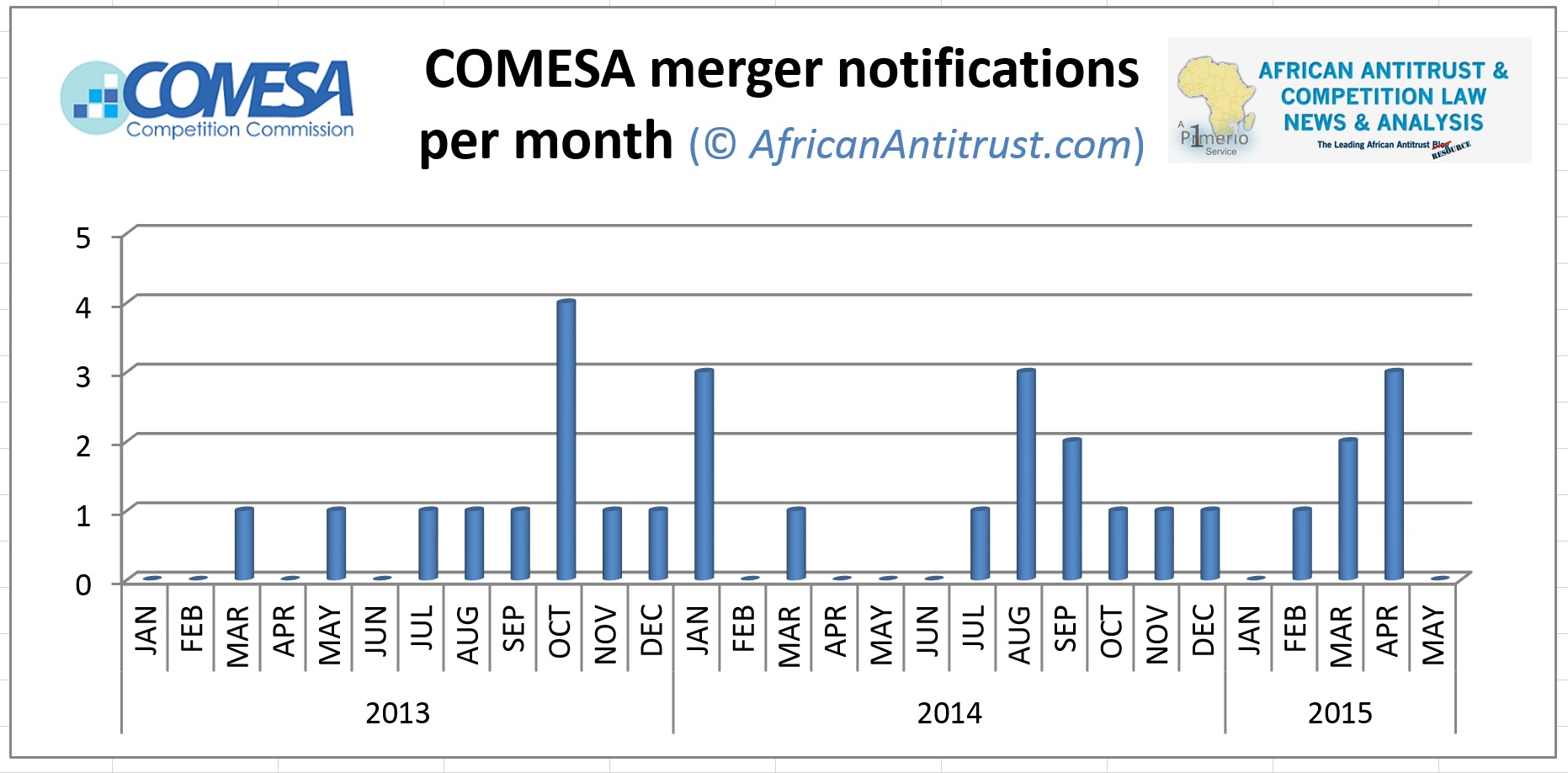
COMESA Merger Statistics as of July 2015
COMESA Merger Statistics as of July 2015 (source: AAT)

Put your drink down: Fair Competition Commission threatens to un-do Diageo beer deal

Bloomberg’s reports in an article published today that Tanzania’s Fair Competition Commission is threatening to undo the previously-approved merger between Nairobi-based East African Breweries Ltd.’s and Serengeti Breweries Ltd., alleging that the conditions laid out in the 2010 approval of the deal had not been honoured by the parties.

Apparently, notice was given to EABL in late April: “The commission has issued a notice of an intention to revoke its own decision with respect to the merger against EABL.”

EABL is majority-owned by Diageo Plc and is the largest regional brewer, whereas Serengeti was the #2 player pre-merger.  The FCC conditioned its approval on

(1) Diageo’s sale of a 20% stake in rival Tanzania Breweries Ltd., (2) compliance with a requirement that Serengeti achieve “potential growth that is well beyond the level it was able to achieve previously,” (3) the obligation to continue promoting Seregenti’s corporate identity for five years post-merger, (4) an agreement not to shutter any of Seregenti’s existing plants without prior FCC approval, and (5) the submission of annual progress reports of compliance with the investment strategy plan submitted during the application of the merger.

At issue in the current challenge by the Commission is condition no. 2, i.e., the growth-target requirement imposed on the parties.  Competition-law experts are puzzled by the FCC’s imposition of said condition, said John Oxenham of the Africa-focused Primerio consulting firm:

“Forcing a company to divest itself of a rival unit prior to acquiring a target entity is commonplace, and so is the requirement that certain brands must be maintained post-acquisition.  But it is highly unusual in my view to see a revenue growth-target imposed on merging parties by a government antitrust enforcer.”

While noting that he had not seen the precise wording of the “potential growth” condition imposed by the FCC in 2010, “[h]ow does the regulator account for outside macro-economic factors, increased competition from other players, and similar third-party effects that are outside the control of the merging entities?“, said Oxenham.

We wish to observe that the FCC’s web site itself has no update on the topic.  Its most recent press release is from 2014 and the last newsletter that is available online dates from 2013.

Proliferation of active multi-nation competition regimes continues

6-member East African Community (EAC) to finalise competition law amendments

The EAC, a regional intergovernmental organisation comprising Burundi, Kenya, Rwanda, Tanzania, Uganda and South Sudan, is said to be drafting amendments to its thus-far essentially dormant regional fair Competition Act (dating back to 2006, EAC Competition Act 2006, 49 sections) to address antitrust concerns in the region.  The EAC’s legislative body is in the final stages of completing its work on the East African Community Competition (Amendment) Bill (2015).

In a 2010 paper, Alloys Mutabingwa (then Deputy Secretary General of the EAC Community Secretariat) writes:

As the EAC begins the implementation of the Common Market, one is pushed to wonder, which kind of competition do we currently have in the East African Community? Is it the kind of competition that constantly pushes companies to innovate and reduce prices? Does it increase the choice of products and services available to EAC consumers? Or, is it the type of competition that is defined by companies colluding to highjack the market? The answer lies somewhere in the middle but one thing is certain, with the intensification of competition in the EAC there will be frictions between companies across the region as they seek to gain advantage over their competitors.

In this short and worthwhile read, he stresses the importance of having a multi-national competition framework vs. a purely domestic network of independent enforcers.  Mr. Mutabingwa uses the example of the merger case of East African Breweries and South African Breweries, in which the Kenyan and Tanzanian competition authorities were “allowed by law to handle national practices only.”

According to an October 2014 article, “statistics show that the EAC’s total intra-regional trade soared from $2 billion in 2005 to $5.8 billion in 2012, while the total intra-regional exports grew from $500 million to $3.2 billion in the period under review.”  The  piece quotes an EAC competition official as saying that the enforcement agency would be online by December 2014.

In addition to the EAC efforts, a report also states that the head of economic affairs of the Tanzanian Fair Competition Tribunal (FCT), Nzinyangwa Mchany, recently emphasised the importance of member-state level enforcement, such as that of the country’s FCT and FCC, “to increase efficiency in the production, distribution and supply of goods and services to Tanzanians,” especially in economies that were centrally planned until only a few decades ago, and which have had to struggle with the ill after-effects of unregulated trade liberalisation and privatisation of state-owned enterprises.

Which economy is growing 2-3% above global average…?

… Africa’s

AAT the big picture

According to a recent article in Polity, “Africa’s economy is projected to continue growing at between 2% and 3% above the global average over the next five years, helping it retain its position as one of the key emerging markets for 2015.

It quotes a GIBS (Gordon Institute of Business Science) study showing that sub-Saharan Africa’s growth “outstripped global growth for the past 15 years,” which has “slowed down somewhat, owing to a number of challenges, including the drop in commodity prices.”  The GIBS study is the result of an assessment of countries’ institutional evolution, measuring how countries were performing in terms of developing competitive business and living environments across political, social and economic spheres.

Kenya was highlighted, with the authors noting that “Kenya, in terms of perceptions, is a very important country on the continent; it has, since 2007, put in place a number of reforms to build competitiveness. However, it doesn’t come out very well when you look at the data behind industry and comes out poorly in [the DMI], but what you find on the ground is that there is [an entirely] different sentiment.”

EU gives Kenya until October 1 to sign Partnership Agreement

kenya

Kenya is currently at risk of losing preferential access to European markets

As of next year, this risk will expose the country’s exporters of flowers, fish, fruits and vegetables to high tariffs and logistical problems.

Lodewijk Briët, the European Union Ambassador has indicated that the bloc would remove Kenya from the preferential list again, if the East African Community fails to ratify the new Economic Partnership Agreements by October 2015. The removal of Kenya from the list would result in Kenya accessing the European Union market under the Generalised System of Preferences which results in tariffs of up to 15 per cent.  The deadline is apparently not a “must-beat” time limit, according to a quote from the Daily Nation article on the topic:

Negotiations between EU and EAC started in 2002, culminating in the two trading blocs signing an interim EPA in 2007 that ensured duty-free, quota-free access for its products under the Market Access Regulation that will end in October.

Kenya exports flowers to the European Union worth Ksh46.3 billion and vegetables worth Ksh26.5 billion annually resulting in the horticulture sector being one of the most important contributors of foreign exchange. The European Union takes about 40 per cent of Kenya’s fresh produce exports. The horticulture industry has also created job opportunities for about 90 000 Kenyans.

In October 2014, the European Union removed Kenya from its list of duty-free exporters after the East African Community failed to meet the Economic Partnership Agreements deadline which subjected fresh produce to levies of Ksh100 million per week.

Tech antitrust news: disrupting M-Pesa mobile payment monopoly? cashless NFC mandatory?

Disruption & entry — mandatory cashlessness — and alleged collective dominance

Perhaps they don’t realise it themselves, but the journalists at ITWeb Africa have written antitrust/competition law strories in three of their recent reports, covering the rapidly growing and lucrative tech world in Africa: their stories range (in antitrust terms) from collective dominance in Africa’s tech sphere, to a challenger’s new entry in mobile payments, to a mandatory government-backed mobile NFC system for Kenyan transit commuters that allegedly causes more consumer harm than benefit by going cashless and giving the spoils all to one monopolist.

We take each in turn.

Disruption to M-Pesa’s mobile payment crown?

It looks as though the M-Pesa crown may be taken through the competitive process (and without active intervention by the competition authority) after all:

Equity Bank is about to join Airtel’s challenge to the leading position of Safaricom Limited’s M-Pesa service (on which AAT has written extensively before).  The magazine reports that an ultra-thin SIM card technology and the Kenyan bank have reached a pact that will allow them to compete with M-Pesa’s service, on top of existing user SIM cards.

Equity Bank is “determined to challenge” Safaricom’s M-Pesa mobile money service with the help of Taiwanese headquartered Taisys, which claims that the Communications Authority of Kenya “last month tentatively gave Equity Bank the go-ahead to use thin SIMs for one year.”  Equity is reported to be the “largest bank in East Africa with almost 9 million bank accounts.”

The new technology of a “stick-on” slim-SIM card allows the user “to execute mobile banking transactions, releasing the bank from the limitations of a telco-issued banking SIM.”  Safaricom had previously complained to the authority, arguing that PIN theft and denial of service are real risks that counsel against use of new SIMs.

In other related news, second M-Pesa challenger Airtel has secured a contract with the Kenyan Revenue Service that allows Kenyan citizens to pay their taxes using Airtel’s mobile money service.
The cashless economy: is the imminent Kenyan My1963 NFC payment system anti-competitive?

In this story about Nairobi’s public transport system’s much-derided effort to go entirely cashless – dubbed “My1963” -, the magazine reports that the Consumer Federation of Kenya (Cofek) claims that the digital payment system benefits “all except the consumer”.  In Cofek’s statement (“7 reasons why Cofek will fight to stop the #My1963 PSV’s cashless payment fraud“), the federation makes seven distinct arguments against the legality of the scheme.  Two relevant criticisms from the competition-law perspective are the following:

  1. no competitive bidding process: the body alleges that, due to politicians’ ties to banking and other interests, the correct process for entertaining competitive bids was not followed in accordance with proper public procurement rules.
  2. supra-competitive (monopolistic) pricing: an “exorbitant” 3% commission is being charged by the service provider of the system, as agreed between the Kenyan National Transport Safety Authority and the banks.

Cofek also urges the Competition Authority of Kenya (CAK) to “investigate the #My1963 and entire cashless payment system with a view to finding it uncompetitive, predatory and anti-consumer and market interest” [sic].

Viber, WhatsApp, YouTube: dominant in Africa?

In its report on alleged dominance by three tech companies, the paper begins by pointing out the (some more and some less) startling statistics:

WhatsApp is the leading third-party messaging application, Viber has overtaken Skype as the leading VoIP service on several networks and YouTube is the top video streaming app. … on Africa’s mobile networks WhatsApp accounts for 7% of total traffic, while Viber has overtaken Skype as a VoIP service. Streaming video accounts for just over 6% of downstream traffic – significantly lower than North America and Europe where it accounts for more than 30%.

WAP Browsing has seen a significant decline in traffic share thanks to increased adoption of smartphones throughout the region [–Ed.: on the latter point, the journal also has an interesting separate piece, discussing the new era of WiFi connectivity in Africa].

Being called “dominant” may be a badge of honor to the sales staff, but it is a dangerous moniker when viewed by the competition-law enforcers through their monopolisation lens.  WhatsApp, Viber and YouTube (whose parent is, of course, the already dominant Google) may therefore have to begin thinking about treading more lightly in terms of their dealings with competitors on the African continent, lest they wish to prompt governmental scrutiny from the likes of the South African Competition Commission, the Kenyan Competition Authority, or COMESA’s CCC.

Kenya competition landscape active

kenya

Zuku pay-TV launched complaint against DStv in Kenya

As we reported in “Your Choice“, MultiChoice has been an active (if unwilling) player in African antitrust news.  Zuku pay-TV has recently requested the Competition Authority of Kenya (CAK) to impose a financial penalty on DStv for refusing to re-sell some of its exclusive content like the English Premier League to its rivals.

In its letter to the CAK, Zuku pay-TV accuses MultiChoice, the owners of DStv, of abusing its dominance and curbing the growth of other, competing pay-TV operators. Furthermore, Zuku pay-TV requested the CAK to compel DStv to re-sell some of its exclusive content and impose a financial penalty, which can be up to 10 per cent of a firm’s annual sales, on the South Africa firm. According to Zuku pay-TV, DStv has a market share of 95% in Kenya.

The CAK has not indicated whether it is investigating the complaint yet.

Mr Wang’ombe Kariuki, director of the CAK
Kenya to get leniency policy

In addition to the ongoing pay-TV antitrust dispute, the CAK has drafted a law (the Finance Bill of 2014) which will create a Kenyan cartel leniency programme in order for whistleblower companies and their directors to get off with lighter punishment, for volunteering information that helps to break up cartels, as AAT reported here.

To recap the leniency programme will either grant full immunity for applicants or reduce the applicant’s fines, depending on the circumstances. The Finance Act 2014 is awaiting its third reading in Parliament.

The introduction of a leniency programme in Kenya is a pleasing sight due to leniency programmes’ proving to be an integral and vital tool for uncovering cartels in every jurisdiction in which it has been deployed.