On Friday, subsequent to outlining the time table of the project, the South African Competition Commission Competition Commission released important frameworks for its sectoral inquiry into the competitiveness of the private healthcare sector in the RSA. The key documents are a draft “statement of issues” (which the Commission warned may further “evolve” during the course of the inquiry) and “guidelines for participation” for the market inquiry into the private healthcare sector, which is headed by retired Chief Justice Sandile Ngcobo. The public and affected stakeholders are invited to make written submissions on these before Monday, 30 June 2014 (South African Competition Commission direct e-mail address: health@compcom.co.za).
Notably, the statement of issues includes the role of the public sector in competition in the market for healthcare. This was a key sticking point for observers and stakeholders, as the initial framing of the inquiry appeared solely focused on the private players, failing to take into account the competitive restraints imposed by the strong public insurance schemes and other state-related participants in the healthcare arena. (AAT published on this and related issues here and here.)
Other topics include, predictably from an antitrust point of view, regulation, market power and dominance, barriers to entry, as well as consumer-protection aspects. Taken together, the areas of concern have been grouped by the Commission’s inquiry panel into six possible theories of harm, which the Commission defines as follows: “A theory of harm refers simply to ahypothesis about how harm to competition might arise in a market to the detriment of consumers and to the detriment of efficient and innovative outcomes in that market.” (Statement of Issues at para. 9 and 53, as follows):
Theory of harm 1: Market power and distortions in healthcare
financing.
Theory of harm 2: Market power and distortions in relation to
healthcare facilities.
Theory of harm 3: Market power and distortions in relation to
healthcare practitioners.
Theory of harm 4: Barriers to entry and expansion at various levels
of the healthcare value chain.
This morning, economic-development minister Ebrahim Patel announced the retention of the 38 year-old Mr. Bonakele as the top antitrust enforcer in the South African republic, making permanent for a five-year term the interim appointment of the man who said the following in an interview regarding the independence of the competition authorities in South Africa:
“While competition authorities should not be beholden to the government neither can they be loose cannons who claim independence without accountability.”
In prolonging Mr. Bonakele’s interim appointment for another five years, Minister Patel thus assured that the important position of Competition Commissioner did not go to a “loose cannon”…
Legislative basis
The appointment is made pursuant to Part A, Art. 22 of the South African Competition Act of 1999, as amended, which also provides (in sub section 4) for the flexible salary and benefits determination to be made by the minister himself: “The Minister must, in consultation with the Minister of Finance, determine the Commissioner’s remuneration, allowances, benefits, and other terms and conditions of employment”
Minister PatelCommissioner Bonakele
Public announcement and emphasis on enforcement
In the duo’s official tweets announcing the decision (see graphic extract below), Patel congratulated Mr. Bonakele, reaffirming his and the SA cabinet’s support of the “eminently suitable” candidate, and emphasizing the importance of (1) the Competition Commission‘s ongoing and hotly debated private health-care inquiry as well as (2) the “social-justice” elements of merger conditions imposed by the SACC on mergers in the past 5 years, purportedly “protecting” 4,900 jobs.
The agency had come under considerable flak in the past year due to its high staff and executive-level turnover and a work environment that has been described as “toxic” by insiders.
The official release by the Ministry of Economic Development quotes Patel as follows:
“I am pleased to have someone of Bonakele’s calibre at the helm of the Competition Commission. He is taking leadership of the Commission at a time when the South African economy needs to become more competitive and create many more decent work opportunities by combatting market abuse such as cartels and pervasive monopolies and ensure competitive pricing of products. In particular, the key jobs drivers identified in our policy frameworks require coordinated and concerted efforts improve economic performance and development outcomes.
“The Competition Commission has been one of a number of successful economic agencies and regulators that are together beginning to transform the South African economy. Mr Bonakele possesses the skills and experience to build on the successes of the Competition Commission.”
The agency’s official “Structure” page had not yet been updated as of the day of the announcement, listing Mr. Bonakele as “Acting” head and still showing the long-departed Ms. Makhaya as a Commission official.
Official S.A. government tweets announcing SACC personnel decision of permanent Bonakele appointment
Questioning African antitrust growth prospects: Slowdown in economic investment (both organic and outside investment) may affect functioning of competition law on the continent
Recent developments in Africa have many scratching their heads and wondering whether the formerly wondrous economic-growth engine of the vastly resource-rich and otherwise economically still undervalued continent will soon experience a slowdown, if not come to a halt altogether.
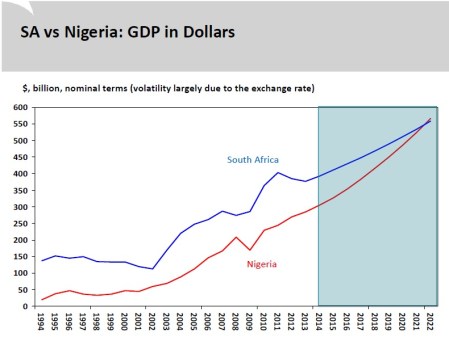
For one, in April 2014, Nigeria surpassed South Africa as the continent’s largest economy (see Economist Apr. 12, 2014: “Africa’s New Number One“). This is a significant milestone for the former, and a setback for the latter — an economy that was 8 times the size of the Nigerian economy only 20 years ago, yet is now suffering from stagnating GDP, reeling from corruption allegations amongst its current leadership, undergoing a closely-watched presidential election process, and whose ruling ANC party is facing a heretofore unprecedented backlash and torrent of criticism.
Source: The Economist
Not only South Africa has weakened, politically and economically, however. Events such as the Northern Nigerian wave of violence – with sectarian Boko Haram forcefully displaying the impotence of the central Nigerian government of a weakened president Goodluck Jonathan – fuel the fire of outside investors’ mistrust of African stability and their concomitant reluctance to make good on prior investment promises. As The Economist notes in the article quoted above: “it is not a place for the faint-hearted” to invest, even though it highlights the successful Nigerian business ventures of outsiders such as Shoprite, SABMiller, and Nestlé. Bloomberg BusinessWeek quotes Thabo Dloti, chief executive officer of South Africa’s fourth-largest insurer Liberty Holdings Ltd. (LBH), as saying: “It does slow down the plans that we have, it does put out the projections that we have by a year or two.”
The upshot for competition-law practitioners and enforcers alike is rather straightforward, AAT predicts: more hesitation around African deals being done means fewer notifications, less enforcement, and overall lower billings for firms.
The flip side of the coin – as is usually the case in the economic sine curve of growth and slowdowns – is the commonly-observed inverse relationship of M&A and criminal antitrust: while we may see fewer transactions in the short term, the incidence of cartel behaviour and commercial bribery & government-contract fraud cases will likely increase.
Revelations from Bonakele’s interview with CNBC Africa
South African interim Competition Commissioner Tembinkosi Bonakele called his agency, the Competition Commission (“Commission”), a “kind of reactive” enforcement body, aiming primarily to uncover cartel conduct. In an interview with CNBC Africa‘s “Beyond Markets” segment, journalist Nozipho Mbanjwa asked the acting Commissioner tough questions on the Commission’s enforcement tactics, legislative mandate, fines imposed, the adequacy of the Commission’s capitalization, and whether the South African antitrust watchdog was, in fact, a “toothless dog.”
Bonakele held his ground, referring multiple times to the Commission’s recent successes, including the construction cartel, the bread case, cooking oils, and other “basic products” matters on which he said his agency would place the largest focus going forward.
The Acting Commissioner
Some of the highlights from the interview:
Bonakele is “quite satisfied” with the agency’s funding and performance of its 180 staff, but may ask for “more funding” specifically for the Commission’s sectoral health-care inquiry.
The Commission will focus its cartel-busting efforts on sectors in the basic products category such as foods and health-care.
The Commission will “definitely appeal” its loss of the SABMiller abuse-of-dominance matter, a “very tricky kind of offence in terms of competition law” according to Bonakele. He said he did “not like” the 7-year long duration of the SABMiller saga, but felt compelled to extend the matter by bringing the case before the Competition Appeal Court.
On the much-malignedMultiChoice broadcaster, Bonakele called the company a “monopoly created by legislation” in a regulated market, and deferred to parliament to rectify the situation.
The Commission receives approximately 30% of its funds from revenues that are the result of merger filing fees.
Following up on our initial DOJ extradition victory post last week, here is a more in-depth look at the recent developments in worldwide criminal antitrust cases, and notably their overlap with parallel corruption / fraud / FCPA investigations. Paul Hastings and Nortons Inc. – jointly covering North America, Europe, Asia, and Africa – have extensive experience handling the defense of competition-law and FCPA-based investigations into multi-national corporations and individual executives. The piece below was written by Jeremy Evans, partner in Paul Hastings’ D.C. office, and AAT editor Andreas Stargard, in Brussels.
The long-arm of the U.S. government and its increasing willingness to pursue foreign nationals for alleged violations of U.S. law was further in evidence last Friday when the Antitrust Division of the U.S. Justice Departmentannounced(press release here) that it had extradited Romano Pisciotti, an Italian national, from Germany to the U.S. on a charge filed more than 3½ years ago that he participated in a price-fixing cartel involving the sale of marine hose.
Ian Norris, then-CEO of Morgan Crucible, sentenced to serve 18 months in federal U.S. prison
Pisciotti is the first foreign national to be extradited to the U.S. purely for an antitrust charge, although he joins a large number of foreign nationals in recent years to have been charged criminally by the Division in cartel cases, many of whom have agreed to plea deals requiring them to serve time in U.S. prisons. The Antitrust Division is not alone in its pursuit of foreign nationals; the Fraud Division of the Justice Department has also pursued extraditions of foreign nationals for violations of the Foreign Corrupt Practices Act (“FCPA”) in recent years. Indeed, Pisciotti follows his countryman Flavio Ricotti, who, in 2010, also was arrested in Germany and extradited to the U.S. following his indictment on an FCPA charge. It is clear that in both antitrust cartel and FCPA investigations, the U.S. government is growing ever-confident in its power and ability to bring uncooperative foreign executives to the U.S. to face criminal charges in the U.S., even for conduct that occurred outside the U.S.
The Marine Hose Investigation
Pisciotti’s extradition is the latest chapter in the long-running marine hose cartel investigation. In May 2007, the Antitrust Division arrested eight foreign nationals traveling on business in the U.S. and charged them for their roles in an antitrust conspiracy involving the sale of marine hose used to transport oil. The Division’s investigation was part of a multi-national law enforcement effort that included the European Commission and the U.K.’s Office of Fair Trading and much of the conduct at issue was alleged to have happened overseas. In the years that followed, the Antitrust Division secured over $54 million in fines from five companies, and nine individuals served jail time arising from their alleged involvement in the cartel. Two of these dispositions are worth particular note. The first involved the separate plea agreements by Bridgestone Corporation and Misao Hioki, a Japanese executive, each of which agreed to plead guilty to both an antitrust charge for involvement in the alleged conspiracy, as well as an FCPA charge relating to corrupt payments to government officials in various Latin American countries. These appear to be the only instances in which either a company or an executive has pled to both antitrust and FCPA charges arising from the same investigation. The second involved three British executives arrested in the U.S. at the onset of the investigation. Under a unique arrangement, the three were charged and sentenced by authorities in both the U.S. and the U.K., but the U.S. plea deals permitted them to return to the U.K. where they served their prison sentences concurrently.
Prior to Pisciotti’s extradition, the last criminal disposition involving an executive in the marine hose investigation occurred in 2009. But, what was not publicly known until recently is that the Antitrust Division had secured a sealed indictment of Pisciotti in August 2010 alleging that he rigged bids, fixed prices, and allocated markets in the sale of marine hose. It was this indictment that led to Pisciotti’s arrest in Germany last June and the subsequent extradition proceedings. The Division likely followed the same procedure that it did with Ricotti in the earlier FCPA case, using Pisciotti’s sealed indictment to obtain an Interpol red notice, effectively an international arrest warrant. Under the principle of reciprocal or dual criminality, countries often will only extradite individuals to the U.S. if an extradition treaty exists between the two countries that requires a person’s conduct to be a crime in both countries. Bid rigging is a criminal offense in Germany, thus ensnaring Pisciotti transiting through Germany on business travel and leading to his arrest in a country prepared to extradite him. Pisciotti was flown to Miami on Thursday and arraigned in federal court the following day. He now faces charges that could result in a maximum of 10 years in prison and $1 million in criminal fines.
The U.S. Government and the Ever-Shrinking World
Bill Baer, the assistant attorney general of the Antitrust Division, heralded Pisciotti’s “first of its kind extradition” as a “significant step” in the Division’s cooperation efforts with foreign antitrust enforcers. And, while it marks a new frontier for the Division, it can also be viewed as merely the latest example of the aggressive approach taken by the U.S. government in recent years toward foreign executives in international cartel and bribery cases. A little over a decade ago, the Division agreed to permit foreign executives in cartel cases to plead guilty and serve prison sentences of just a few months. But the more recent plea deals announced in seemingly ever-expanding auto parts cartel cases have seen well over twenty foreign executives face up to two years in jail.
Our experience in these and other cases also teaches that the Antitrust Division will routinely seek U.S. prison terms for conduct that occurred not merely partially or largely outside the U.S., but indeed was wholly undertaken on foreign soil. The example of Pisciotti’s extradition powerfully reaffirms that executives now must worry about the possibility of being extradited to the U.S. if they refuse to cooperate with the Antitrust Division and plead guilty in a cartel investigation, even in situations where the conduct at issue occurred exclusively or mostly overseas. This is in part because an increasing number of countries have criminalized antitrust conduct, or are in the process of doing so, meaning that there are now more jurisdictions than ever willing to extradite an executive for cartel offenses, either at home or when traveling abroad, even in situations where a sealed indictment may leave the executive ignorant of any potential risk.
These same government tactics exist in bribery and FCPA cases. Flavio Ricotti and Ousama Naaman are but two examples of foreign nationals who were extradited to the U.S. in the last five years to face FCPA charges, each apprehended overseas after the U.S. government obtained an indictment in federal court, and each charged based on conduct outside of the U.S. It appears that the U.S. government will continue to take an aggressive enforcement approach toward uncooperative executives, further highlighting the concern for senior foreign executives and their companies caught up in cartel and FCPA investigations.
In what can only be described as a significant step backwards in ensuring that the more established of the emerging economies enforce the application of sound and established (e.g., ICN) best practices in relation to merger remedies, AAT has discovered that the much publicised acquisition of South Africa’s AFGRI by international private investment group AgriGroupe has recently been subjected to a private side deal between the South African Government and the merging parties, sidestepping the Commission’s jurisdiction and decision-making competence. According to its terms, Afgri is obligated to make available R90 million (US$9m, over four years) to certain South African farmers & enrol emerging farmers in development programmes and assist poultry farmers.
Minister’s side deal replaces Competition Act merger remedies
There is little doubt that these forced conditions constitute matters best handled by the relevant antitrust regulator as proper remedies in a merger-control proceeding. At the outer limit, relevant departments such as the Department of Water, Forestry and Fisheries might have input into them. Yet, it appears that these conditions are purely negotiated by the Minister of Economic Development – the same office that sacked the prior chairman of the Competition Commission, Shan Ramburuth, and which has been subjected to criticism of meddling in the independent authority’s affairs.
Minister Patel
Following the questionable intervention of various South African Government departments in Walmart’s acquisition of Massmart (which is, as we have previously noted, the origin of the non-competition merger remedies), it appears that the same departments have in effect sought to force the merging parties into agreeing to perform services on behalf of the Government in exchange for the departments’ non-intervention before the Competition Tribunal proceedings.
Following a pattern…
Heather Irvine, counsel for the merging parties, confirmed that the “merger was approved (with the agreement as a condition) after the Tribunal hearing yesterday.” She points out that “this agreement was voluntarily entered into by the merging parties in a spirit of goodwill and as a demonstration of Afgri’s commitment to growing the African food sector, not because of concerns about any public interest issues in terms of the Competition Act,” pointing to the transcript to be made available shortly. We appreciate counsel’s confirmation that the side agreement was reached entirely outside the confines of the SA Competition Act between the ministry and the parties.
It is apparent that since Minister Patel has assumed his role as Minister of Economic Development (an “activist, interventionist and micromanaging minister,” according to the former Competition Tribunal chairman David Lewis), the competition authorities’ independence has been undermined (see some of our prior articles here and here). In particular, the merger process is little more than a means by which the South African Government seeks to extract from merging parties a series of additional unwarranted (industrial policy) conditions. It is in our view a highly problematic development. In sum, the S.A. merger review process remains a highly contentious issue and while the parties in this case sought to placate Government, others may not be as willing.
New head of mergers fills final “core” position according to Bonakele; replaces Ramburuth-appointed predecessor
New head of mergers at SA Competition Commission (Source: LinkedIn)
Following the by now fairly predictable fault lines of the Ramburuth-vs.-[others] staffing game at the Competition Commission, the agency’s crucial Mergers & Acquisitions division now also has a new head. As of March 1, Hardin Ratshisusu is filling the post of Divisional Manager, after his predecessor Ibrahim Bah‘s departure in December last year created a three-month hiatus.
Bah, having worked at the Irish antitrust regulator for a while*, had been with the South African authority on-and-off since 2008, but had been Divisional Manager only for less than a year, holding the post since January 2013. His successor Ratshisusu is likewise a former M&A veteran of the agency, having begun his career at the Commission as early as 2004 and with the division since December 2007 as a Senior Merger Analyst. He also has recent private-practice experience outside government, which we view as a welcome feature on his C.V., in addition to his historical M&A expertise.
Mr. Ratshisusu’s self-description on his LinkedIn profile (with 22 endorsements from others as to M&A) is as follows:
“In the formative years, I started off as an enumerator for SA’s 2001 Census and then a research assistant at the University of Venda, whilst doing my post-graduate studies. I have since worked in the regulatory environment having held various positions at the Competition Commission of South Africa including being Senior Merger Analyst, Acting Divisional Manager of the Mergers and Acquisitions Division and Technical Consultant/Adviser to the Deputy Commissioner. I also had a stint in the economic regulatory division of Neotel (Pty) Ltd. This has given me exposure to a number of industries, including, construction, telecommunications, broadcasting, mining, chemicals, retailing and property. I now have expertise, garnered at both operation and strategic levels, in competition and regulatory economics, strategy, and governance.”
Mr. Ratshisusu’s appointment comes at a time of staffing difficulties at the authority, including most recently the departure of a senior Deputy Commissioner. In its official release, the Commission’s Acting Commissioner Tembinkosi Bonakele is quoted as emphasizing the agency’s focus on getting past its recent personnel woes:
“I am pleased that we have now completed the task of filling all vacancies for the heads of the Commission’s core divisions. This will allow us to focus on fulfilling our strategic priorities”
We take it that any remaining open seats on the Commission’s org chart are, by logical inference, to be deemed “non-core” to the functioning of the agency.
The Acting Commissioner: Focusing on “strategic priorities”, such as the healthcare inquiry and other enforcement
* Mr. Bah co-authored an amusingly-titled mergers paper while at the Irish Competition Authority: “The Curious Tale of Pigs, Papers and Peru: Media Mergers in Ireland“. It should not come as a surprise that AfricanAntitrust.com’s editors have a faible for anything that contains alliterations…
Trade union NEHAWU’s influence over agency staff cited as reason for departure
According to an excellent piece in the ZA Financial Mail – written by Andile Makholwa* and entitled “Competition Commission Bleeds Staff” – departing Acting Deputy Commissioner Trudi Makhaya has explained in detail her recent decision to leave the antitrust authority, describing a “toxic” work environment there since at least October 2013. On the staffing front, Acting Commissioner Bonakele is quoted as regretting her departure, saying that “one of his priorities is to repair the fractured relations with senior managers and contain the staff exodus.” In the article, Makhaya is cited as bemoaning the increasing influence of NEHAWU (a powerful trade union) over the agency and its staff.
Many ZA commentators have lamented the increasingly pervasive sway that trade unions have in merger-control talks with the enforcer. This is especially important in light of South Africa’s merger-control regime having express “public interest criteria” embedded in its legislation.
Two ZA antitrust lessons
The legislation’s social agenda element, combined with the now confirmed unions’ influence over agency staff, may have resulted (and will likely result in the future, if unchecked) in extensive so-called “public-interest” conditions imposed on otherwise unproblematic transactions that pose no pure antitrust issues.
The ZA Competition Commission has received extensive bad press of late. Now, even insiders speak out about the (personnel, rather than structural) problems that have befallen the agency. Specialist publications (such as Global Competition Review, which publishes a dedicated review and ranking of government antitrust enforcement agencies, in which the Commission used to fare rather well), as well as practitioners and the courts, may perceive these developments as significant steps backward for an institution that once was lauded as a shining example of developing competition-law authorities. Even Acting Commissioner Bonakele admits that the authority is “in a rebuilding phase. All I can say is that the commission is losing a key staff member. It’s a setback. When you’re rebuilding an institution you need all hands on deck,” and the minister in chage (Patel) believes the Commission too independent.
Innovation: a path to long-term economic growth,[1]hope for economic recovery,[2] and a vital opportunity for economies in developing countries.[3] Innovation is the Holy Grail we would all like drink from. Individuals dedicate their lives to its pursuit, governments invest significant amounts of money in R&D, but despite decades of research on ‘the wealth of nations’, we remain with a poor perception of innovation as a ‘complex and mysterious phenomenon’[4] that should be stimulated, although no one knows very well how.[5]
Government intervention in itself is insufficient and it might rather have costly results, if incorrectly targeted.[6] This is particularly true when it comes to the inevitable relationship between legal conditions and innovation since the lack of an effective legal framework is in the poorest countries the main obstacle to innovation and consequently to economic growth.[7] In this context, during many years, law was simply told to stay away and admire it from a distance to avoid impeding innovation. However, beyond laboratories, laborious inventions and serendipitous discoveries, law can play a greater role than a mere walk-on in the ‘innovation film’. In fact, law can act as a ‘brakeman’ or ‘a driver’ of innovation.[8] Competition and IP law have been competing for the supporting role of ‘drivers of innovation’. Here this ‘innovation film’ does not take place in the EU or in the US, but in developing countries trying to promote domestic innovation while adopting competition laws and being forced to respect IP rights that incentivize innovation in the Western world. In such context, and before the audition starts, five questions must be posed: (i) What is innovation and what type of innovation do governments aim to promote? (ii) Should and can law in general interfere in the regulation of innovation? (iii) How can competition law play a role in the promotion of innovation? (iv) Should competition law not remain in the shadow of Intellectual Property (IP’) laws that are already designed to provide innovators with incentives or should it be the other way around? (v) Last but not the least, in the context of the problematic trichotomy antitrust/IP/innovation, should a customized approach be conceived for developing countries characterized by different socioeconomic conditions or should one plea for convergence?
In this article (and subsequently, expanded paper), I reflect upon the role of law, and particularly competition laws, in the promotion of innovation in developing countries and the problematic relationship between IP, competition laws and innovation. Up until now, (competition) law’s potential to drive innovation has been either closely associated with patent law[9] or analyzed on a mere casuistic basis in the setting of specific antitrust or mergers cases.[10] However, the enforcement of competition laws against unlawful monopolizing conduct plays in general an undeniable role in the promotion of innovation.[11] Competition law promotes innovation by removing barriers to freedom of choice, trade and market access and prevents the formation of monopolies or conditions in the marketplace susceptible of stifling the development of new products. This implies however analyzing the connection between the market structure and the ability to influence undertakings to innovate:[12] while in some cases, a large number of companies on the market may slow down innovation, in others, the lack of competitive pressure may reduce the incentives to innovate (e.g. international market of derived financial products).[13]
Although the debate on the promotion of innovation has been restricted to developed countries, the promotion of innovation is equally vital for developing countries, notably in Africa.[14] These countries are looking up to the EU and US and trying to adopt similar competition laws and policies.[15] What’s more, a number of developing countries have been deriving their antitrust legal frameworks from Western countries, as a result of trade agreements. Globalization appears to push developing countries in the sense of convergence, but is this tendency beneficial for these countries quest for innovation? Absolute convergence of antitrust enforcement might not suit the current economic stage of most developing countries, particularly in Africa. A ‘Western’ design of antitrust laws and policies might not fit the socioeconomic conditions of these countries. This might be particularly problematic when governments are struggling to promote local innovation but face inevitable IP constraints.
Reconciling the difficult relationship between antitrust and patent law can be particularly complex in African countries since patent policy has a significant impact on development. Although one might at first think that developing countries should emphasize patent policy, as they are considerably behind the global technological frontier and are craving domestic innovation, they cannot afford the short-term consumer welfare loss that must be incurred to generate patentee reward.[16] Some African countries like South Africa have been developing a solid IP regulatory framework so as to incentivize innovation,[17] but many lack the technological and financial capacity to invest in R&D. In such cases, access to protected technologies on reasonable terms may be the key to more domestic innovation. What does this mean for the trichotomy innovation-IP-competition? Although developing countries urgently require innovation,[18] should their competition authorities look less up to Western models and rather question whether they should sacrifice consumer welfare by upholding patent exploitation practices?
Instead of pushing developing countries toward convergence of global competition policy, the specific socioeconomic conditions of these countries should be taken into consideration. Thomas Cheng argues, rightly so one might say, that ‘antitrust principles and doctrines need to be tailored to domestic economic circumstances. Markets and economies function differently in developing countries and antitrust laws should reflect these differences.[19] This is a particularly important lesson for African countries as they are prone to imitate the approaches of developed countries without the required customization. Different suggestions have been advanced in the literature, such as the reduction of patent protection in developing countries, allowing even the imitation of foreign technology so that domestic innovators possess a technological basis they can further develop,[20] or the expansion of compulsory licensing beyond certain drugs for developing countries.[21]
This contribution aimed to draw attention to the challenging role of law as the driver (or at least guardian) of innovation in developing countries. Competition and IP laws both wish to share a supporting role in this ‘innovation film’ taking place in developing countries. Should they be granted this part in a context of convergence of laws and policies or should IP remain in the shadow in order to ensure that the innovation film can successfully be produced and released in the theaters? You decide who gets the part at this audition; however, recalling Eleanor Fox’ words ‘antitrust should not be used to protect David from Goliath, but it may be used to empower David against Goliath’.[22]
To be continued…
[1] Richard S. Whitt, ‘Adaptive Policymaking: Evolving and Applying Emergent Solutions for U.S. Communications Policy’ (2009) 61(3) Federal Communications Law Journal 485.
[2] BERR, ‘Regulation and Innovation: evidence and policy implications’, BERR Economics Paper No.4, 2008, iv.
[4] D. Augey, ‘Les mystères de l’innovation: le regard contemporain de l’économie et de la gestion’ (2013) In J. Mestre, & L. Merland, Droit et Innovation (Aix-en-Provence: Presses Universitaires d’Aix-Marseille) 89, 91.
[5] Joshua D. Sarnoff, ‘Government choices in Innovation Funding (with Reference to Climate Change)’ (2013) 62 Emory Law Journal, 1087.
[6] B. Frischmann, ‘Innovation and Institutions: Rethinking the Economics of U.S. Science and Technology Policy’ (2000) 24 Vermont Law Review, 347.
[7] Robert Cooter, ‘Innovation, Information, and the Poverty of Nations’ (2005) 33 Florida State University Law Review 373.
[8] W. Hoffmann-Riem, ‘Zur Notwendigkeit rechtswissenschaftlicher Innovationsforschung’, in D. Sauer, Christa Lang (Eds.), Paradoxien der Innovation: Perspektiven sozialwissenschaftlicher Innovationsforschung (Campus Verlag 1999). Wolfgang Hoffmann-Riem, ‘Rechtswissenschaftliche Innovationsforschung als Reaktion auf gesellschaftlichen Innovationsbedarf’, überarbeite Fassung eines Vortrages aus Anlass der Überreichung der Universitätsmedaille am 19.12.2000 in Hamburg, available at <http://www2.jura.uni-hamburg.de/ceri/publ/download01.PDF>.
[9]Atari Games Corp. v. Nintendo of Am., Inc., 897 F.2d 1572, 1576 (Fed. Cir. 1990). See Christine A. Varney, ‘Promoting Innovation Through Patent and Antitrust Law and Policy’ (2010), Department of Justice, Remarks as Prepared for the Joint Workshop of the U.S. Patent and Trademark Office, the Federal Trade Commission, and the Department of Justice on the Intersection of Patent Policy and Competition Policy: Implications for Promoting Innovation, available at http://www.justice.gov/atr/public/speeches/260101.pdf.
[10] David Bosco, Marie Cartapanis, ‘Droit de la concurrence et innovation’ (2013) in Jacques Mestre, Laure Merland (Eds.), Droit et Innovation (Presses Universitaires d’Aix-Marseille), 69. Pierre Larouche, ‘The European Microsoft Case at the Crossroads of Competition Policy and Innovation’ (2009) 75 (3) Antitrust Law Journal 933. François Lévêque, ‘Innovation, Leveraging and Essential Facilitaties: Interoperability Licensing in the EU Microsoft Case’ (2005) 28 World Competition 71.
[12] David Bosco, Marie Cartapanis, ‘Droit de la concurrence et innovation’ (2013) in Jacques Mestre, Laure Merland (Eds.), Droit et Innovation (Presses Universitaires d’Aix-Marseille), 69.
[14] Smita Srinivas, Judith Sutz, ‘Developing countries and innovation: Searching for a new analytical approach’(2008) 30 Technology in Society 129.
[15] Thomas K. Cheng, ‘A Developmental Approach to the Patent-Antitrust Interface’ (2012) 33 Northwestern Journal of International Law and Business 1.
[16] Thomas K. Cheng, ‘A Developmental Approach to the Patent-Antitrust Interface’ (2012) 33 Northwestern Journal of International Law and Business 1, 3.
[17] Alexis Apostolidis, ‘IP Law in South Africa: Key Cases and Issues’ (2009) ASPATORE WL 2029096.
[18] There is a significant body of literature arguing that IP does not necessarily promote innovation. For an overview, see, e.g., B. Frischmann, ‘Innovation and Institutions: Rethinking the Economics of U.S. Science and Technology Policy’ (2000) 24 Vermont Law Review, 347. Julie E. Cohen, ‘Copyright, Creativity, Catalogs: Creativity and Culture in Copyright Theory’ (2007) 40 U.C. Davis L. Review 1151.
[19] Thomas K. Cheng, ‘A Developmental Approach to the Patent-Antitrust Interface’ (2012) 33 Northwestern Journal of International Law and Business 1’, 79.
[20] Thomas K. Cheng, ‘A Developmental Approach to the Patent-Antitrust Interface’ (2012) 33 Northwestern Journal of International Law and Business 1’, 4.
[21] Colleen Chien, ‘ Cheap Drugs at What Price to Innovation: Does the Compulsory Licensing of Pharmaceuticals Hurt Innovation?’ (2003) 18 Berkeley Technology Law Journal 853.
[22] Eleanor M. Fox, ‘ Economic development, Poverty and Antitrust: the Other Path’ (2007) 13 Southwestern Journal of Law and Trade in the Americas 211.
The Western Australian government has signed a Memorandum of Understanding with COMESA.
Colin Barnett signed the papers yesterday, January 31, 2014. COMESA dutifully posted a news release on its web site, albeit misspelling the W. Australian premier’s name (“Colin Barnnet“).
Setting aside the embarrassing PR SNAFU, we expect the MoU to have little to no effect on competition enforcement by the COMESA Competition Commission. The MoU appears to us to be primarily minerals-focussed (we note that this should come as no surprise, given the mineral-rich COMESA members and the fact that Western Australia is the world’s second-largest iron ore producer). The six so-called “thematic areas” of the MoU are: fiscal frameworks and mineral policy, strengthening human and institutional capacities, collection and management of geo-scientific information, research and development, environmental and social issues; and linkages, diversification and cluster development. Antitrust/competition is nowhere to be found.
That said, Western Australian companies may choose to invest more in the region and therefore somewhat increase the merger notification statistics, which have been lackluster to date.







 African Antitrust & Competition Law