Introduction of Abuse of ‘Buyer Power’ Provisions Muddies the Water

By Michael-James Currie and Ruth Mosoti

In November last year, the editors of Africanantitrust indicated that a number of amendments to the Kenya Competition Act of 2010 were being proposed by way of the Competition Amendment Bill (Amendment Bill) in the article Competition Amendment Bill to bring about Radical changes to the Act
The Amendment Bill was assented to by the President in December 2016 and the amendments are, therefore, effective.
Although most of the amendments which are particularly noteworthy were addressed in the above article, a particularly noteworthy amendment, and very much the focus of this article, is the newly introduced prohibition of an abuse of “buyer power”. In this regard, Section 24 of the Act, which deals with abuse of dominance generally, has been amended to also cater for an abuse of “buyer power.”
Section 24 of the Act was, even prior to the introduction of “buyer power” a particularly challenging provision to interpret and it has not been clear how the provisions relating to an abuse of dominance would ultimately be assessed.
By way of background, the definition of “dominance” in the Act, effectively states that a firm will be considered dominant if that firm has greater than 50% market share
The Act goes on to list, without being exhaustive, a number of practices which would typically constitute an abuse of dominance including:
- imposing unfair purchasing or selling prices;
- limiting or restricting output, market access or technological advancements;
- tying and/or bundling as part of contractual terms; or
- abusing intellectual property rights.
The Act does not provide further guidance as to what would precisely constitute an “abuse” of dominance and under what circumstances a purchasing or selling price would be deemed to be “unfair”.
The abuse of dominance provisions do not necessarily, therefore, appear to be directly linked to the promotion or maintenance of competition in the market. Once it is shown that a firm has more than 50% market share, firms are in treacherous terrain as the threshold for engaging in “abuse” of dominance is relatively low when compared to many other comparable jurisdictions which generally cater for a rule of reason defence or at least provide greater guidance as to what conduct would constitute a per se violation.
By way of an example, in terms of the South Africa Competition Act, a dominant firm is per se prohibited from charging an “excessive price”. The South African Competition Act does, however, define an “excessive price” as one which “bears no reasonable relation to the economic value thereof”. Despite this definition, further guidance has been sought but the competition authorities as to what, in turn, constitutes a “reasonable” and “economic value.”
Over and above certain identified acts of abuse of dominance, the South African Competition Act also includes for a “catch-all” abuse of dominance provision. However, the conduct will only amount to an “abuse” if there is an anti-competitive effect which cannot be justified by a rule of reason analysis.
The comparison with the South African Competition Act is useful as the Kenyan Competition Act does not provide for a similar assessment as does its South African counter-part. For instance, it is not clear how predatory pricing or excessive pricing would be evaluated under the Kenyan Act. Presumably this would fall under the preclusion of charging an “unfair” selling price, which leads one back to the question as to what constitutes an “unfair” price.
In addition to the above, the recent addition of “buyer power” to the abuse of dominance provisions has added to the complexity and risk to firms on the procurement side.
“Buyer power” is defined as the “the influence exerted by an undertaking in the position or group of undertakings in the position of a purchaser of a product or service to obtain from a supplier more favourable terms, or to impose long term opportunity costs including harm or withheld benefit which, if carried out, would be significantly disproportionate to any resulting long term cost to the undertaking or group of undertakings.”
Furthermore, in considering whether a firm has “buyer power” the following factors will be considered:
- the nature of the contractual terms;
- the payment requested for access infrastructure; and
- the price paid to suppliers.
Accordingly, the crux of the rather cumbersome definition is that an undertaking will only be considered to have “buying power” if that undertaking(s) has simultaneously actually abused its’ buying power. In other words, there is no distinction between what constitutes “buying power” and what constitutes an “abuse” of buying power. The Act’s definition of “buying power” is, therefore, all encompassing.
Although the above definition is somewhat unclear, it should be noted that the Competition Authority of Kenya, together with Parliament and other stakeholders intend developing rules which would hopefully clarify how these provisions will ultimately be evaluated.
A further important point to note is that it is not a requirement that a firm be ‘dominant’ in order to be considered to have “buying power”. Whether it was the intention of the legislator to require a firm to first be ‘dominant’ before it could be prosecuted for “abuse of buyer power” is not entirely clear. The definition of “buying power” is remarkably silent on this issue.
The fact that the preclusion of an abuse of buyer power necessitates that a firm be dominant could be inferred by the fact that provision is inserted under Section 24 (the abuse of dominance provisions).
However, the definition of “buyer power” caters for a situation where a group of undertakings, such as when a buying group, is formed, exert buyer power, the group commits an offence. Accordingly, it may have been that the legislator was contemplating a situation in which a group of undertakings, such as a buying group collectively meets the ‘dominance’ threshold (i.e. a greater than 50% market share).
Alternatively, it could have been the intention of the legislator that the abuse of buyer power has no direct link to dominance as such and that once a firm or group of firms satisfy the definition of “buyer power”, irrespective of their market shares, the provision is triggered.
In a number of developing countries such as Turkey, South Africa and Botswana have conducted market inquiries into the grocery retail sector. Although the focus of these inquiries are relatively broad, a common focus of all the market inquiries in this sector relates to the role that the large retailers play in the market. In particular, suppliers and competition agencies are often concerned with the buying power which large retailers could exert on suppliers and that the trading terms are unfair, particularly for smaller retailers who are not always in a position to pay for shelf space, access fees or offer the discounts demanded by the retailers.
In many instances, however, the large retailers are not ‘dominant’ and a complainant would need to demonstrate that the buying power exerted by the large retailer is in fact anti-competitive.
The Kenyan Competition Authority may have thought to pre-empt this challenge and therefore included the “abuse of dominance” provisions without requiring a firm to actually be dominant for the provision to be triggered. Furthermore, the definition of “buying power” and the absence of any requirement that the conduct must in fact be anti-competitive may have been an attempt by the legislator to lower the threshold in an effort to assist a complainant in cases where a purchaser, such as a large retailer, exerts “buyer power”, but is not “dominant” in the market.
The absence of any objective qualification to assess when a firm has exerted “buyer power” in an “unfair” manner may open the litigation floodgates. A further reason why it is important that the authorities publish rules to assist with the interpretation and implementation of the “abuse of buyer” power provisions.
In terms of enforcement, the Act was previously silent on the role of the Authority upon the conclusion of an abuse of dominance investigation and the only option lay on criminal prosecution of the offending undertaking. The recent amendments to the Act now allows the Authority to impose fines of up to 10% of the annual turnover of the offending undertaking(s).
 The Draft Guidelines have been published in addition to the ‘Leniency Programme’ as well as the ‘Fines Guidelines’ published earlier this year (as well as the
 The authors, Mr. Currie & Ms. Mutuna
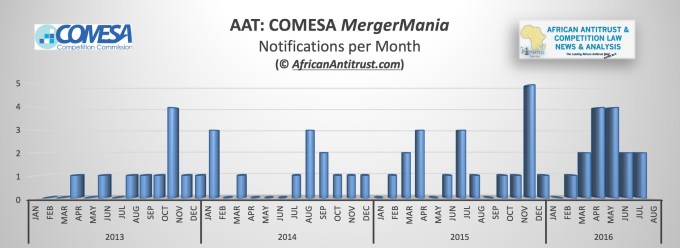
 About half of these fees (approximately $1.5 million) were allocated to the national competition authorities in various COMESA states. However, competition authorities in COMESA member states – including Kenya, Zambia and Zimbabwe – continue to insist that merging parties lodge separate merger filings in their jurisdiction. This can add significant transactional costs – the filing fee in Kenya alone for a merger in which the merging parties combined generate more than KES 50 billion (about US $ 493 million) in Kenya is KES 2 million (nearly US $ 20 000). Since Kenya is one of the Continent’s largest economies, significant numbers of global transactions as well as those involving South African firms investing in African businesses are caught in the net.
 This week, the South African Competition Commission and Minister Patel explained to the country’s National Assembly why they decided not to take any enforcement action against alleged collusion in the fisheries industry.
 At issue in the present SA case was Sekunjalo Investments Limited, Sekunjalo Marine Services Consortium, Premier Fishing SA (Pty) Ltd, and Premier Fishing Consortium. They were alleged to have entered into an agreement to collude by discussing and coordinating the preparation of their respective bids to the Department of Agriculture, Forestry and Fisheries in respect of a tender to supply marine patrol services to DAFF. In light of their nature as a single economic entity, no further investigation or enforcement is recommended.
 Le cabinet Primerio International a organisé un séminaire de sensibilisation aux enjeux du droit et de la politique de la concurrence au Cameroun et dans l’espace de la CEMAC. L’évènement lancé par le ministre du Commerce, M. Luc Magloire Mbarga Atangana s’est déroulé le 7 juillet 2016 au siège du GICAM à Douala.
 Le ministre du Commerce, qui intervient comme l’autorité publique de tutelle du secteur de la concurrence, a tenu à préciser que les rendez-vous de la concurrence ne pouvaient mieux tomber dans un contexte communautaire et camerounais situé à « la veille de l’entrée en vigueur des Accords de partenariat économique « APE », entre les pays ACP et l’UE dont le Cameroun est partie », ces accords qui impliquent une ouverture de l’économie imposent donc qu’un certain accent soit mis sur le droit et la politique de la concurrence. Au demeurant, le représentant de l’Etat du Cameroun à ce rendez-vous a tenu à réaffirmer la place reservée jusqu’ici à la concurrence, « notre conviction, a –t-il expliqué, est que le commerce a besoin d’un environnement sain et c’est la raison pour laquelle un arsenal des textes législatives ou règlementaires existe au Cameroun et cela témoigne de la volonté de l’état de réguler le secteur ». A l’appui de son affirmation, M. Luc Magloire Mbarga Atangana a soutenu que la volonté et la détermination du Cameroun à faire du droit de la concurrence un enjeu de poids, se traduit depuis des années. Pour s’en féliciter, il souligne que les premières velléités d’encadrement de la concurrence remontent aux années1990 et qu’autant les lois ont créé la Commission nationale de la concurrence (Cnc) autant des décrets en ont fixés les contours organisationnels et structurels. Le président de ladite Commission Léopold Boumsong, qui était dans la suite du Mincommerce, a été appelé à présenter les aspects nationaux de la concurrence et précisément le rôle de la Commission nationale de la concurrence. Ce rôle, comme l’a martelé le ministre, doit s’attacher à « poursuivre et sanctionner les pratiques anticoncurrentielles, en s’appuyant sur des textes datant et nouveau à l’instar de la loi cadre protection sur la consommation, de la nouvelle loi portant organisation des activités commerciales ainsi que la loi sur commerce extérieur ».
 Le président de la Cnc a précisé à l’égard des chefs d’entreprises qui emplissaient la salle du Gicam qu’il existe sommairement 3 types de pratiques qui ont « pour effet d’empêcher, de fausser ou de restreindre de manière sensible, l’exercice de la concurrence au niveau du marché intérieur » au sens de la loi n°98/013 du 14 juillet 1998 relative à la concurrence. Il s’agit des abus d’une entreprise ou d’un groupe d’entreprises en position dominante sur le marché, des fusions et acquisitions d’entreprises et aussi des accords anticoncurrentiels. L’un dans l’autre, il est apparu que les pratiques anticoncurrentielles au Cameroun sont constatées par procès-verbal dressé par les membres de la Commission suite aux enquêtes consécutives à une plainte d’une personne physique ou morale ou à celles initiées par eux-mêmes.
 Un autre moment des échanges a porté sur les aspects croisés entre le point de vue de l’économiste et celui du juriste quant à la concurrence. C’est M. Flavien Tchapga, économiste, consultant lui aussi à Primerio International et professeur associé à l’Université Senghor d’Alexandrie, qui s’y est attelé face à l’auditoire de la salle des conférences du Gicam. L’intervention de ce dernier peut se ramener à une suggestion forte faisant suite à l’interrogation suivante : « peut-on réussir la sensibilisation sur la concurrence si l’on ne tient pas compte des spécificités de l’environnement local ? ». Réponse, en effet, dans un contexte où 9 entreprises sur 10 sont individuelles, il faut se méfier des formules des juristes qui sont souvent larges et complexifiées pour les économistes plus proches du terrain.
 In terms of the AMSA settlement agreement, AMSA admitted to contravening the cartel provisions contained in the Competition Act and agreed to pay a R1.5 billion (in instalments of no less than R300 million per annum for five years) administrative penalty. In addition to the administrative penalty, AMSA also agreed to invest approximately R4,6 Million into the South African economy for the next 5 years (provided the prevailing economic conditions render such investment feasible) by way of CAPEX obligations.
 While settlement negotiations are inherently flexible, it is important that agencies ensure an objective and a transparent methodology in the manner in which they approach the quantification of a settlement agreement. This has certainty been strived for by the Competition Commission when it elected to publish Guidelines on the Determination of the Calculation of Administrative Penalties (Guidelines). The objectives of the Guidelines, may however, be undermined in light of the broader behavioural and public interest related conditions imposed in recent cases.
 x-brand chemicals. The Commission has invited “general public and stakeholders” for comments according to its formal statement.