In May 2024, two Nairobi-based small and medium-sized automobile repair centres (the “garages”) lodged separate complaints with the Competition Authority of Kenya (“CAK”) against Directline Assurance Company Limited (“Directline”). The complaints alleged persistent delays in the payment of invoices for contracted repair work that had already been completed.
The complaints were supported by authorisation letters, invoices, customer satisfaction notes, and related correspondence. On this basis, the CAK initiated an investigation into the commercial relationship between Directline and the two garages to assess:
(i) whether Directline possessed superior bargaining power; and
(ii) whether such superior bargaining power, if established, had been abused.
At the time the complaints were filed, Directline owed the garages KSh 7.6 million and KSh 5 million, respectively. After the CAK initiated its investigation, Directline made partial payments to each garage. However, it did not respond to the CAK’s formal requests concerning the remaining outstanding balances of KSh 4.7 million and KSh 1.3 million.
Directline initially attributed the delayed payments to inaccessible bank accounts. While in the commercial world late payments are often downplayed as administrative hiccups, such as cash-flow challenges or temporary constraints, for small and medium-sized enterprises (“SMEs”) these delays translate into serious financial and operational strain. CAK Director-General David Kemei stressed that the misuse of buyer power can devastate small businesses, threatening their ability to pay staff, pay suppliers, and ultimately participate fully in the economy. Such practices not only endanger individual SMEs but also undermine broader economic inclusion.
The CAK concluded that Directline had misused its superior bargaining power position to delay payments without reasonable justification. In this regard, the CAK imposed a total penalty of Ksh85 million for two counts of abuse towards the garages. The CAK additionally ordered Directline to settle the outstanding payments in full, including the remaining balances due; amend its supplier contracts to include provisions for interest on late payments and other protections for small suppliers; and cease engaging in conduct that violates the Competition Act.
While abuse of dominance cases have traditionally focused on powerful sellers, this matter highlights the growing regulatory attention on buyer power and the risks it poses to SMEs operating in highly dependent commercial relationships. Beyond the significant administrative penalty imposed, the case raises broader questions about how buyer power should be assessed, when commercial pressure crosses the line into abuse, and whether enforcement in this area adequately balances efficiency, bargaining strength, and supplier protection.
Kenya’s Competition Tribunal (the “Tribunal”) has upheld the Competition Authority of Kenya’s (the “CAK”) steelcartel decision, dismissing individual appeals brought by seven manufacturers and affirming the penalties and remedies imposed in 2023. The Tribunal rejected appeals by Tononoka Rolling Mills, Blue Nile Wire Products, Devki Steel Mills, Accurate Steel Mills, Nail & Steel Products, Corrugated Sheets and Jumbo Steel Mills, cementing the CAK’s finding of price-fixing, coordinated price adjustments and output/ import restrictions in the steel value chain.
This ruling was handed down in two tranches: on 9 July 2025 (Accurate, Blue Nile, Devki, Nail & Steel, Tononoka) and on 11 September 2025 (Corrugated Sheets, Jumbo Steel), each time siding with the Authority. In total, the Tribunal affirmed KES 287.9 million in penalties for the seven appellants. The Tribunal further held that the CAK had afforded the parties due administrative process under Article 47 of the Constitution, the Fair Administrative Action Act and the Competition Act.
The decision handed dawn on 15 October 2025 is a natural sequel to the CAK’s 23 August 2023 decision, when the CAK imposed record penalties of KES 338.8 million on nine steel producers for a cartel that, per the CAK, distorted construction-input pricing. Five firms reached settlements with the CAK, while the seven above pursued and have now lost their appeals.
Notably, during the appeal phase Doshi & Company (Hardware) Ltd and Brollo Kenya Ltd concluded out-of-court settlements with the CAK, illustrating the CAK’s willingness to resolve matters via settlement and compliance undertakings, even mid-litigation.
For context, the AfricanAntitrust 2023 coverage highlighted that the CAK’s original fines constituted the highest cartel penalties in the CAK’s history to that date, following a twoyear investigation that drew on search-and-seizure and market-intelligence evidence. With the Tribunal now endorsing the CAK’s analysis and process, the core liability findings stand, and the fine levels (for the seven appealing firms) are confirmed.
Why this matters:
i) The Tribunal’s decisions strengthen precedent on price-fixing/ output restrictions in Kenya’s construction-inputs sector and validate CAK’s investigative toolkit and evidence assessment.
ii) Appellants remain bound to cease collusion and implement internal competition-law compliance programmes.
iii) The CAK links steel-cartel conduct to higher housing and infrastructure costs, this outcome supports the CAK’sbroader enforcement narrative across the building materials market
The breakdown of the KES 287,934,697.83 penalties, as concurred by the Tribunal are as follows:
Corrugated Sheets (86,979,378.53); Tononoka Rolling Mills (62,715,074.03); Devki Steel Mills (KES 46,296,001.25); Jumbo Steel Mills (KES 33,140,459.40); Accurate Steel Mills (KES 26,826,344.31); Nail & Steel Products (KES22,816,546.01); Blue Nile Wire Products (KES9,160,894.30).
What’s next
Unless pursued further on points of law, the Tribunal’s decision bring this enforcement chapter close to closure. Penalties, compliance obligations remain, and CAK’s leniency and Informant Reward Schemes continue to beckon for future cartel detection.
In conclusion, and by quoting the CAK’s Director-General, Mr. David Kemei, “The Tribunal’s findings affirm the CAK’s unwavering commitment to protect Kenyan consumers and businesses from the damaging effects of cartel conduct, and the veracity and completeness of our evidence-gathering, analysis and decision-making processes.”
On 25 April 2025, almost a year after the Federal Competition and Consumer Protection Commission (“FCCPC”) imposed a hefty $220 million fine on WhatsApp and its parent company, Meta, the Competition and Consumer Protection Tribunal (“Tribunal”) delivered its landmark decision, upholding the fine and ordering a further – almost negligible, when compared to the substantive fine – $35,000 administrative penalty against the social media giants for fact-finding costs incurred during the 38-month long investigation. This regulatory win for Nigeria’s digital rights landscape has contributed to reinforcing Nigeria’s growing resolve to regulate big tech.
The decision stemmed from findings that the companies engaged in discriminatory data practices and violated Nigerian data protection laws, affecting more than 51 million users. As Andreas Stargard, a competition-law practitioner with Primerio, notes, “not only did the FCCPC’s investigation uncover WhatsApp’s unauthorised sharing of user data and a lack of meaningful consent mechanisms, but it also revealed discriminatory practices compared to other regions – I believe this is where the differentiation in the FCCPC’s consumer-protection jurisdiction (as opposed to that of the domestic data protection authority) comes in meaningfully. It remains to be seen what an independent, judicial review of the Tribunal decision will yield in this regard, but the FCCPC has had a comparatively strong track record so far in terms of having its novel, forceful, and ‘creative’ enforcement strategies upheld, with the B.A.T. matter perhaps being the most powerful example. The recent Dangote matter, involving the shocking fact pattern of a lack of refining capabilities in oil-rich Nigeria, is an interesting counter-point, though, as the FCCPC lost an attempt to intervene in that matter in Abuja’s Federal High Court.”
So far, the appellate-level Tribunal has sided with the Commission, dismissing an appellate request for review by WhatsApp and Meta, which challenged the fine on 22 grounds, ranging from procedural errors to allegations of vagueness and technical impossibility in respect of the timeframe given by the FCCPC. Meta’s legal team relied on the grounds that the FCCPC’s orders were unclear, unsupported by Nigerian law, and financially impractical to comply with. However, the FCCPC argued that the penalties were not financially punitive but rather corrective and aimed at rectifying the tech giant’s alleged discriminatory practices.
In its decision, the Tribunal emphasised that the FCCPC acted within its lawful mandate and that WhatsApp and Meta were afforded a fair hearing. It further upheld that the reliance on foreign legal standards, while not binding, was appropriately persuasive in determining issues of data protection and consumer rights.
The Tribunal ordered WhatsApp and Meta to inter alia, reinstate Nigerian users’ rights to control their personal data, revert to their 2016 data-sharing policy, and immediately cease unauthorised data sharing with Facebook and other third parties without obtaining the necessary consent from users. In this regard, compliance letters must be submitted by July 1, 2025, and a revised data policy must be proposed and published.
This case marks a significant moment in the Nigerian Authority’s forceful use of the regulatory tools available to it — as well as overall for Africa’s evolving digital economy, highlighting the demand for global corporations to acknowledge local presence and effects and adapt to robust local compliance expectations. While Big Tech companies such as Amazon, Google and Meta have been subject to significant penalties under the European Union’s General Data Protection Regulation, as one of Africa’s digital technology pioneers, Nigeria’s move could inspire similar enforcement actions across the African continent. This decision can be seen as a “gentle” reminder for multinational digital and tech firms that compliance with local data protection laws is no longer optional, it is imperative.
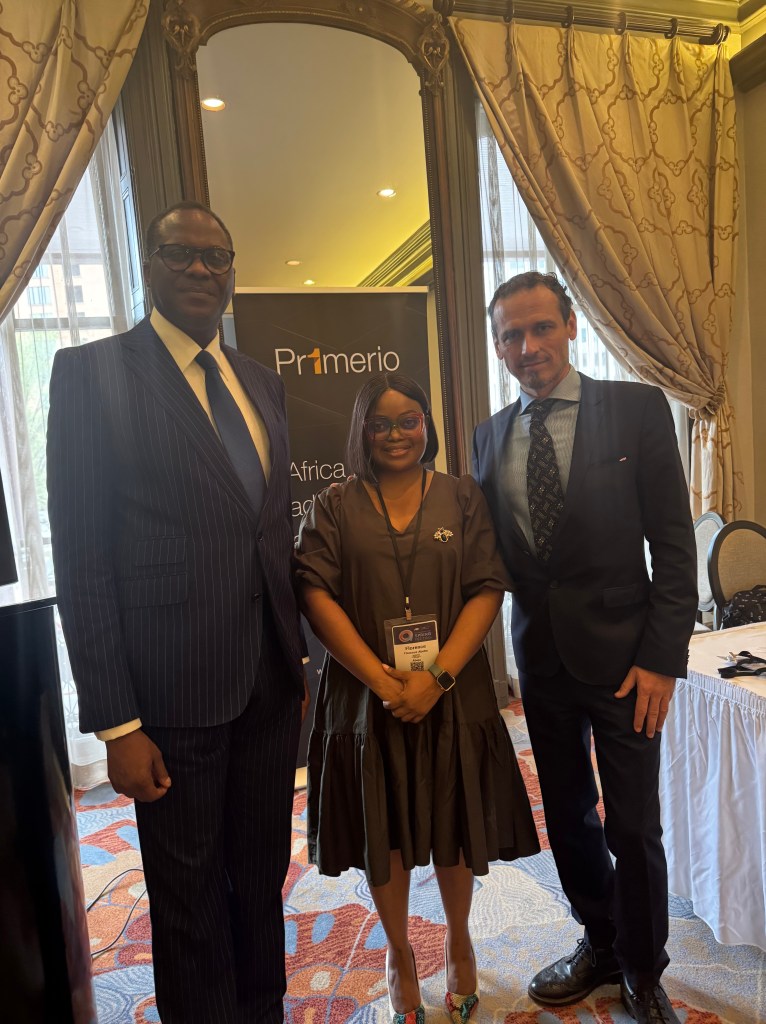
Babatunde Irukera, Florence Abebe, Andreas Stargard at the African Antitrust Salon hosted by Primerio
While more African countries are pushing back against big tech companies and are focusing on unchecked data exploitation within their borders, there is a need, however, for the continent to build towards a larger, sustainable strategy to manage the presence and power of big tech. Says Andreas Stargard, “the quarter-billion dollar Meta fine, if upheld, would firmly cement Nigeria’s antitrust global relevance in the minds of international lawyers and businesses. This comes as a surprise in some ways, as the FCCPC was first put on the map only fairly recently, by its inaugural Chief enforcer, Tunde Irukera: his vision for creative enforcement tools and encouragement of the agency’s staff to employ heretofore unused investigatory mechanisms and strategies – often seen only in U.S.-style civil litigation, and certainly not in many government agencies worldwide, much less among other African jurisdictions – show that the Commission potentially has the necessary intellectual capacity and investigatory stamina to pursue cases of equal or greater dimensions in the future. It will depend on its leadership where the FCCPC’s path is charted next…”
Of course, there needs to be a balance struck between the value of personal data and that of innovation and tech adoption, which calls for a coordinated regulation policy that will strive to balance economic and non-economic features of the continent.
As observed by Leonard Ugbajah, a competition law consultant, a balanced and pragmatic approach is essential when opting to address the regulatory landscape around big tech:
“A common approach would harness the capabilities of countries, moderate opportunism by state and non-state actors in pursuing enforcement, recognise the economic importance of big tech, properly calibrate the various pain points (economic and non-economic) and safeguard the interests of the not-so-capable African countries.”
The social media giants have 60 days, starting from 30 April 2025, to comply with the $220 million fine ordered by the Tribunal. Notably, following the decision, WhatsApp has indicated that it intends to seek a stay of the Tribunal’s decision and pursue an appeal.
Nigeria’s FCCPC has imposed a U.S. $220m fine on WhatsApp’s parent company Meta for violating data privacy laws, continuing the FCCPC’s consumer-protection streak
When it rains, it pours. And when the nascent FCCPC (on whose relatively youthful existence we have reported extensively) issues a fine on a global mega corporation like META (or BAT to the tune of $110m), then it really reaches deep into its pockets: Mr. Zuckerberg’s conglomerate will have to pay $220m to resolve an extensively-documented violation abusing its dominant position, exploiting Nigerian WhatsApp users’ personal data, which it had stored in Singapore, Europe and the U.S. The proceedings were brought approximately 3 years ago, culminating in a particularly in-depth Report issued by the FCCPC and the resulting fining decision last week, pursuant to both the Federal Competition and Consumer Protection Act, 2018 (FCCPA), and the Nigerian Data Protection Regulation, 2019 (NDPR).
At the heart of the allegations lies Meta’s undisclosed, apparent dual-use of WhatsApp user information and metadata (no pun), across virtually all of its conglomerate digital platform companies — i.e., data-sharing conduct squarely in violation of the NDPR and, so says the FCCPC, without consumer knowledge and in many cases against WhatsApp users’ wishes.
Andreas Stargard, a competition lawyer at Primerio Ltd., with a focus on African antitrust cases, comments as follows on this latest record-setting West African case:
“This latest foray by the FCCPC against Meta is notable for multiple reasons: First, it spans both the inaugural aegis of the FCCPC under internationally lauded former FCCPC chief, Babatunde Irukera, and that of his recent successor, Tunji Bello.
Secondly, it represents a new record, and quite literally a doubling of the last record fine, namely the $110m agreed-upon antitrust settlement against British American Tobacco less than 2 years ago.
Third, it shows a trend we have recently noticed in the African government enforcement world: namely, the intertwined nature of competition law and consumer-protection issues, which the detailed Report issued by Commission staff highlights in a significant way. Other agencies on the continent will surely take notice and (we hope) issue similarly-documented case reports going forward.
Fourth, and finally, setting aside the amount of the fine, this matter shows how African jurisdictions may well be ahead of some European and other peer institutions. This is a milestone development for the future regulation of digital behemoths across Africa. The detailed report and analysis provided publicly by the Nigerian agency shows that its nascent competition-law regime continues to be eager to comply with global best practices and appears well situated to keep earning the respect of its Western and other African peer authorities, akin to the journey that the COMESA Competition Commission has undertaken in its first 10 years of existence. Both agencies have gone from non-existent to generally and globally respected African antitrust and consumer-protection powerhouses.”
The Commission’s release noted that “[t]he totality of the investigation has concluded that Meta over the protracted period of time has engaged in conduct that constituted multiple and repeated, as well as continuing infringements… particularly, but not limited to abusive, and invasive practices against data subjects in Nigeria. Being satisfied with the significant evidence on the record, and that Meta has been provided every opportunity to articulate any position, representations, refutations, explanations or defences of their conduct, the Commission have now entered a final order and issued a penalty against Meta.”
A Primerio-sponsored webinar recently put the spotlight on Nigeria’s burgeoning FCCPC
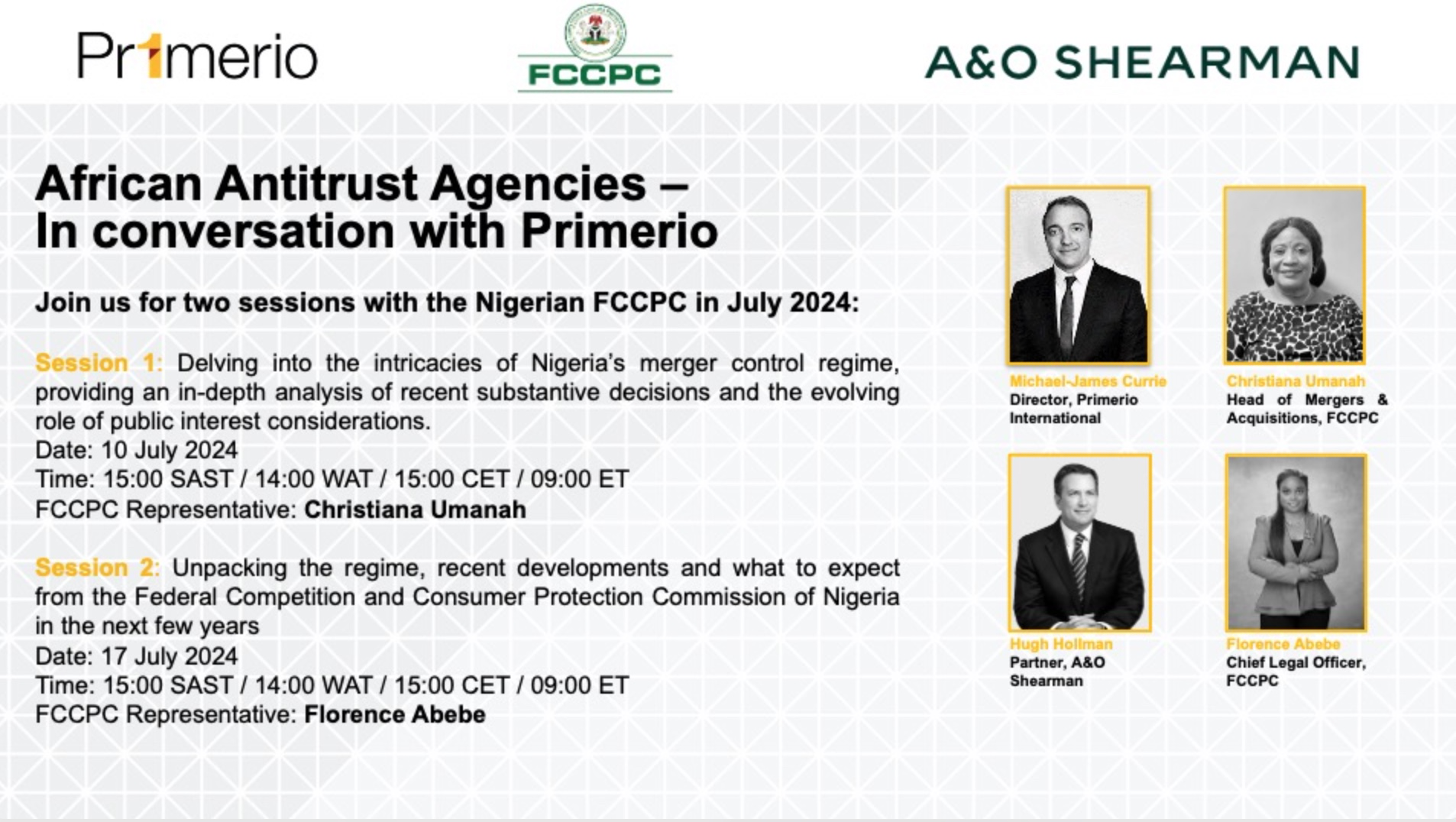
On 10 July 2024, advisors from pan-African law firm Primerio continued their “African Antitrust Agencies – in Conversation with Primerio” series with the Nigerian Federal Competition and Consumer Protection Commission (“FCCPC”) in the first of two sessions aimed at a quick snapshot of the most noteworthy enforcement, legislative, and policy developments.
This first session focused on merger control.
Primerio’s Michael-James Currie, Competition Law Partner at Primerio (Johannesburg) was joined by Hugh Hollman, Competition Law Partner at A&O Shearman (Washington & Brussels) and had the pleasure of speaking with Christiana Umanah, the Head of the FCCPC’s Merger Control Department.
This recent webinar featured insights from Hugh Hollman, an experienced international antitrust partner at A&O Shearman, and Christiana Umanah, head of FCCPC’s merger division. Christiana Umanah elaborated on the rapid development of the FCCPC since the Federal Competition and Consumer Protection Act (“FCCPA”) was enacted in 2018. She outlined the structure and growth of the FCCPC, noting its establishment in 2019 with an active team of eight in the mergers department, along with offices in all 36 states of Nigeria, and 6 regional offices. Christiana emphasized the regular training received by FCCPC staff both locally and internationally, with recent sessions in Mauritius and Barcelona. The FCCPC maintains collaborative relationships with international agencies such as the FTC, and the DOJ, especially for capacity building and training. She detailed the timelines for merger reviews in Nigeria, which usually take 60 business days, extendable to 120 business days for complex antitrust cases, while harmonizing multi-jurisdictional reviews and offering a fast-track option to reduce the timeline by 40 business days.
Addressing foreign-to-foreign mergers, Christiana explained that the FCCPC assesses these based on local turnover, focusing on the specific business presence in Nigeria. She also discussed the penalties for gun-jumping, which are commonly based on 2% turnover for the last financial year, considering factors like knowledge, cooperation, and company size. The FCCPC is open to pre-merger consultations on a no-name basis, ensuring confidentiality while guiding parties through the process. Christiana shared examples of conditions imposed on transactions, such as divestments and board member exit to prevent market concentration. Public interest considerations are also a key focus for the FCCPC, particularly regarding employment and market impact, as demonstrated in a case involving a failing firm where job preservation was prioritized. Looking ahead, the FCCPC is developing regulations for digital transactions and e-market platforms to address emerging issues in the digital market. The webinar concluded with a note on the importance of ongoing dialogues and the FCCPC’s willingness to assist with information and support.
The transcript for this session is available here, and the recording of this session is available on Primerio’s YouTube page, accessible here.
Our next session of Primerio‘s “in conversation with…” series remains focused on Nigeria, as we will discuss recent enforcement activity and legislative & policy developments. Join Hugh Hollman, the FCCPC’s senior officer, Florence Abebe and Primerio partners for another concise but very useful session as Nigeria’s FCCPC Nigeria gains prominence across the Continent.
The Guideline establishes a two-step methodology when determining a fine to be imposed on undertakings. The first step will see the Commission set a “base amount” for each undertaking or association of undertakings. The second step provides the Commission with the necessary discretion to adjust the base amount, either upwards or downwards, having consideration of any aggravating, mitigating or any other factors (Section 5(1)(a)-(b)).
The “base amount” will be set with reference to the undertaking’s turnover in the Common Market from the previous financial year and by applying the following methodology:
The base amount will be a proportion of the turnover and will depend on the nature, degree and gravity of the infringement and multiplied by the number of years of the infringement (Section 5(8)).
The Guideline deems the following as aggravating factors:
Nature and gravity of the infringement (Section 5(10)(a));
Duration of infringement(Section 5(10)(b));
Extend of consumers affected in the Member States and any action taken by the company to mitigate or remedy the damage suffered by consumers (Section 5(10)(c)).
The Guidelines propose the following base proportion of turnover to be applied:
Cartel conduct: a base of 5% of turnover;
Other horizontal conduct: a base of 4% of turnover;
Abuse of dominance: a base of 3% of turnover;
Restraints: a base of 2% of turnover;
Consumer protection violations: a base of 1% of turnover;
Mergers implemented in contravention of the Regulations: a base of 2% of turnover;
Failure to cooperate with the Commission: a base of 0.5% of turnover; and
Other infringements: a base of 0.5% of turnover.
The following aggravating circumstances may result in the increase of the base amount:
Continuation or repeat of the same or a similar infringement: basic amount will be increased by 3% of the amount of the fine for each infringement;
Refusal to cooperate with or obstruction of the Commission’s investigation: basic amount will be increased by 5% of the amount of the fine;
Where an undertaking is a leader in, or instigator of the infringement: basic amount will be increased by 4% of the amount of the fine.
The Commission may reduce the basic amount if the following mitigating factors exist:
Cooperation: decrease in the basic amount by 5% of the fine;
First offender: decrease in the basic amount by 3% of the fine;
Justifications on efficiency and consumer benefit: decrease in the basic amount by 0.5% of the fine;
Termination of the infringement: decrease in the basic amount by 0.5% of the fine;
Negligence: decrease in the basic amount by 0.1% of the fine; and
Extent of involvement in the infringement: decrease in the basic amount by 0.5% of the fine.
A reduction of a fine could be granted, upon request, solely on the basis of objective evidence that the imposition of the fine would irretrievably jeopardize the economic viability of the undertaking concerned and cause its assets to lose all their value (Section 5(21)).
The COMESA Competition Commission (“CCC”) is stepping up to the plate in 2021, and nobody can deny it. The days of ignoring the CCC’s jurisdiction over M&A deals, joint ventures, and even anti-competitive agreements in the Common Market for Eastern and Southern Africa are decidedly over, as the antitrust enforcer has significantly increased its presence and visibility in the legal and business communities over the past 6 months.
In its latest bid to be considered by the antitrust community to rank among the leading African competition-law agencies, the CCC has issued its first-ever failure-to-notify fine on mobile-phone infrastructure providers Helios Towers Limited (“Helios Towers”), Madagascar Towers S.A (“Madagascar Towers”) and Malawi Towers Limited (“Malawi Towers”) for failure to notify the transaction within the prescribed 30-day time period under Article 24(1) of the COMESA Competition Regulations of 2004. Helios Towers is a UK-based telecommunications company, listed on the LSE and a constituent of the FTSE 250 stock index; it operates in the Democratic Republic of Congo within the COMESA region.
As we previously reported in 2017 (here and here), to AAT’s knowledge the only other reported transaction that came close to being fined for a failure to be notified by the merging parties was the paints deal between Akzo Nobel and Sadolin / Crown Paints: “In that transaction, the parties boldly proclaimed that the CCC simply did not have any statutory jurisdiction at all,” says attorney Andreas Stargard, an expert in African competition law. Indeed, four years ago, Akzo’s spokespeople flatly claimed that their deal fell “outside the CCC’s purview,” as “[w]e do not have a merger going on; we are a fully independent plant, so COMESA does not come into the picture at all.”
The COMESA’s CID observed that the Parties should have filed their merger notification on 22nd April 2021 in accordance with Article 24 (1) of the Regulations, but breached it.
Interestingly, as to the comparatively low amount of the fine, the CCC took into account significant mitigating aspects pursuant to Article 26(6), including these five considerations:
The breach was unintentional;
The delay in filing did not yield any “discernible advantage” to the Parties;
The breach did not result in any loss or harm in the market;
The Parties cooperated with the Commission from the time they were engaged leading to the merger being notified on 2nd July 2021 following their initial engagement; and
The Parties have no record of contravention with the Regulations.
Therefore, the CCC merely imposed a 0.05% fine (instead of the statutory maximum under Art. 24(5) of 10% of the parties’ turnover in the preceding calendar year in the common market). AfricanAntitrust.com confirmed this 0.05% figure with a CCC executive, clarifying that this percentage amounted to a fine of U.S. $102,101. Mr. Stargard noted his understanding that the CCC’s positioning of this fine at the extremely low end of the permissible spectrum denotes not only the parties’ significant cooperation and other mitigating factors, outlined above, but also represents a nod by the Commission to the fact that this is the first-ever enforcement action of its kind, and therefore “should not set a precedent in both substance and amount.”
The Parties may appeal the decision (available to AAT readers here) to the full Board of Commissioners in accordance with Article 15(1)(d) of the Regulations as read together with Rule 24 (e) of the COMESA Competition Rules of 2004.
The Commission’s Registrar, Ms. Meti Disasa, stated that “the fine was the first of a kind for breach of the Regulations. The Commission therefore wishes to remind Undertakings in the Common Market to be cautious of the prescribed timeline for notifying mergers in under Article 24 (1) of the Regulations.” Ms. Disasa warned undertakings operating in the Common Market “to comply with all other parts of the Regulations especially with respect to anti-competitive conduct as the Commission shall henceforth not take lightly any breaches of the regional competition law,” according to the CCC’s press release, also noting that “the decision to fine has no impact on the Commission’s assessment of any competitive effects of the merger, which is still ongoing.”
In September 2019, the Competition Authority of Kenya (CAK) formally penalised two merging parties for having implemented a transaction without having obtaining the requisite prior regulatory approval.
The trigger for mandatory notification in this case was a change from joint control to sole control when Patricia Cheng acquired an additional 50% of the shareholding in Moringa School.
The maximum penalty which may be imposed for prior implementation is 10% of the parties’ combined turnover in Kenya. In this case, the CAK imposed a nominal penalty (approximately USD 5000) in light of the parties having voluntarily notified the CAK of their failure to obtain prior approval, having co-operated with the CAK’s investigatory agency and after having subsequently assessed the transaction, the CAK concluded that the merger was unlikely to have any adverse effects on competition and would have positive public interest benefits.
The public interest benefits included the fact that the school would offer coding technology to over 1000 students and employees over 100 staff members.
In light of the mitigating factors, the CAK found that the penalty was balanced taking into account principles of deterrence and proportionality of the infringement.
The case is noteworthy not only because it signals a clear message from the CAK that the prior implementation of mergers will attract penalties (which are likely to increase substantially as firms ought to have greater awareness of the merger control regime in Kenya) but also confirms that a move from sole to joint control of an entity or, as in this case, a move from joint to sole control, requires mandatory notification to the CAK.
The CAK has one of the most effective merger control regimes in Africa and is increasingly becoming a more robust competition agency from an enforcement perspective.
[Michael-James Currie is a competition lawyer practising across the majority of sub-Saharan African jurisdictions]
On 29 June 2018, the South African Competition Tribunal (Tribunal) penalised the RTO Group R75 000 for failing to comply with the Tribunal’s conditional merger approval in respect of two companies now within the RTI stable, Warehouseit and Courierit. The Tribunal approved the large merger in August 2015.
In terms of the Tribunal’s merger approval, a moratorium on merger specific retrenchments for a two year period was imposed – now a frequently imposed public interest related condition by the competition agencies in South Africa.
RTI, however, was penalised not for retrenching any employees during this window but for failure to adhere to the monitoring obligations as set out in the Tribunal’s conditional approval certificate.
In this regard, the merging parties were obliged to notify their employees (and Courierit’s subcontractors) of the conditions to the merger approval within five days of the merger approval date. The merging parties were also obliged to provide the Competition Commission with an affidavit confirming that the obligations in terms of the conditions had been complied with.
By way of a consent order, RTI admitted that it failed to comply with its monitoring obligations and agreed to pay an administrative penalty for breaching the Tribunal’s conditional merger approval.
Although there have been a limited number of cases in respect of which an administrative penalty has been imposed for a breach of the merger conditions, this case demonstrates the importance of fully complying with the terms set out by way of a conditional merger approval.
Furthermore, although notifying the employees of the relevant conditions may not have been a particularly onus obligation, merging parties should take particular cognisance of monitoring and reporting obligations when negotiating conditions with the Competition Commission. Merging parties understandably place greater emphasis on the substantive aspects of the conditions and may underestimate the reporting obligations related thereto – particularly if conditions are being negotiated at the eleventh hour (which is not uncommon).
While there are mechanism’s available to merging parties to remedy any patently unworkable aspects contained in merger approval conditions, it is advisable to ensure that the conditions are practical and capable of being adhered to in full prior to being finalised – assuming the merging parties have that luxury.
[Michael-James Currie is a South African based competition lawyer and practices across Sub-Saharan Africa]
On 28 January 2018 the Ethiopian Trade Competition and Consumer Protection Authority (“TCCPA”) filed charges against fourteen Ethiopian rebar, corrugated sheet, steel tube and pipe producers and seven rebar importers respectively for allegedly fixing prices in contravention of Article 7(1) of the Ethiopian Trade Competition and Consumer Protection Proclamation (“Article 7(1)”), which provides that “(1) An agreement between or concerted practice by, business persons or a decision by association of business persons in a horizontal relationship shall be prohibited if:…(b) it involves, directly or indirectly, fixing a purchase or selling price or any other trading condition, collusive tendering or dividing markets by allocating customers, suppliers territories or specific types of goods or services”.
It is worth mentioning that in most jurisdictions, which have an active competition law enforcement regime in place, ‘cartel conduct’ (i.e. price fixing, market allocation and/or collusion) is a per se prohibition in that the conduct is prohibited outright, without an examination of the actual effects on competition and without permitting a showing of net efficiency or other pro-competitive defensive arguments.
Where cartel conduct is prohibited per se, the relevant competition authorities require no further proof other than the existence of the agreement or concerted practice which underpins the conduct. The conduct is simply presumed to have negative effects on the relevant market.
Article 7(1) of the TCCPA, however, is not a per se prohibition and is based on the ‘rule-of-reason’ standard – effectively permitting respondents to lead evidence demonstrating that the alleged conduct can be justified by pro-competitive, technology or efficiency gain justifications which outweigh any anti-competitive effect.
From a policy perspective, Africa competition lawyer Michael-James Currie notes that the permissibility of the ‘rule of reason defence’ is largely due to the fact that a respondent who is found to have contravened Article 7(1) of the TCCPA is liable to a penalty calculated at fifteen percent of the respondent’s annual turnover. This is a prescribed penalty. For non-cartel conduct, the penalty ranges between 5-10%.
Of the aforementioned fourteen Ethiopian steel producers; three manufacture reinforcement bars, namely East Steel PLC, Habesha Steel Mills PLC and Saint Nail PLC. Six are involved in manufacturing corrugated sheets namely; Ethiopian Steel Profile, Ethiopian Steel PLC, Kombolcha Steel Products Industry PLC (KOSPI), a subsidiary of MIDROC Technology Group and Bazeto PLC and amongst the five manufacturers of steel tubes and pipes are Walia Steel Industry PLC and Mame Steel PLC.
The seven rebar importers accused of price fixing include Dag Trading PLC, Aberus PLC, Berhe Hagos PLC, Marka Trading, Beranea Yeshene and Haileselassie Amabye PLC.
Andreas Stargard, competition counsel with Primerio Ltd. notes that the trigger event for engaging in the alleged price fixing was the fifteen percent devaluation of the birr by the National Bank of Ethiopia (NBE) in October 2017 which may have influenced retailers and wholesalers to look for ways of recouping losses by raising prices for their goods and services.
It is, however, in fellow Primerio Director John Oxenham’s view, unlikely for a well-executed price-fixing cartel to be created ad hoc without any pre-existing information exchange structure. Therefore, pre-existing trade association, interest groups or other vehicles are commonly used as the enabling platform for competitors to engage in collusive conduct.
The defendants are scheduled to submit their response to the Tribunal on February 20, 2018.
The metal and related products sector is a priority sector in Ethiopia and the Ethiopian government is investigating a greater number of business entities involved in the production and importation of metal and metal related products who are also suspected of allegedly fixing prices.




 African Antitrust & Competition Law