Kipiani and Tchapga: advancing competition law & economics in Cameroon

Competition Law conference provides most in-depth look at the state of Cameroonian antitrust law

Event organised by Dr. Patricia Kipiani and Prof. Tchapga of Primerio & CEMAC, the Cameroon school of business and its competition law section

What follows is an article that appeared in French in the Le Droit journal, written by Stéphane Ngoh, reprinted here with permission.  An English translation is below.  An interview with Dr. Kipiani related to the conference can be found here.  In it, she discusses the planned creation of a “Competition Observatory” for the country.

Le cabinet Primerio International a organisé un séminaire de sensibilisation aux enjeux du droit et de la politique de la concurrence au Cameroun et dans l’espace de la CEMAC. L’évènement lancé par le ministre du Commerce, M. Luc Magloire Mbarga Atangana s’est déroulé le 7 juillet 2016 au siège du GICAM à Douala.

Présenter la concurrence comme « un bien commun » à la collectivité et « renforcer la pédagogie de la concurrence dans ses dimensions juridiques et politiques» tels peuvent être les maitres mots du premier « rendez-vous de la concurrence» au Cameroun et en CEMAC impulsé par le cabinet d’expertise Primerio International et placé sous le thème «Du droit et de la politique de la concurrence au Cameroun et dans l’espace CEMAC ».  Comme pour en souligner toute l’importance, le ministre du Commerce du Cameroun, Luc Magloire Mbarga Atangana, a fait le déplacement de la capitale économique dans l’optique d’en présider le lancement officiel. Le Docteur en droit et avocate au barreau de Bruxelles, Mme Patricia Kipiani, qui représentait le cabinet Primerio International pour l’occasion a expliqué combien cette première édition des « rendez-vous de la concurrence », se voulait sérieuse. Toute chose ayant justifié l’association aussi bien des universitaires de tous bords, du groupement inter-patronal du Cameroun (Gicam) que des autorités publiques camerounaises. Les Chercheurs de l’Université de Paris 1 Panthéon-Sorbonne en France et les spécialistes du droit de la concurrence, le Professeur des universités Martine Behar-Touchais et l’enseignant-chercheur Laurent Vidal ont fait le déplacement du Gicam.

1425573796Le ministre du Commerce, qui intervient comme l’autorité publique de tutelle du secteur de la concurrence, a tenu à préciser que les rendez-vous de la concurrence ne pouvaient mieux tomber dans un contexte communautaire et camerounais situé à « la veille de l’entrée en vigueur des Accords de partenariat économique « APE », entre les pays ACP et l’UE dont le Cameroun est partie », ces accords qui impliquent une ouverture de l’économie imposent donc qu’un certain accent soit mis sur le droit et la politique de la concurrence. Au demeurant, le représentant de l’Etat du Cameroun à ce rendez-vous a tenu à réaffirmer la place reservée jusqu’ici à la concurrence, « notre conviction, a –t-il expliqué, est que le commerce a besoin d’un environnement sain et c’est la raison pour laquelle un arsenal des textes législatives ou règlementaires existe au Cameroun et cela témoigne de la volonté de l’état de réguler le secteur ». A l’appui de son affirmation, M. Luc Magloire Mbarga Atangana a soutenu que la volonté et la détermination du Cameroun à faire du droit de la concurrence un enjeu de poids, se traduit depuis des années. Pour s’en féliciter, il souligne que les premières velléités d’encadrement de la concurrence remontent aux années1990 et qu’autant les lois ont créé la Commission nationale de la concurrence (Cnc) autant des décrets  en ont fixés les contours organisationnels et structurels. Le président de ladite Commission Léopold Boumsong, qui était dans la suite du Mincommerce, a été appelé à présenter les aspects nationaux de la concurrence et précisément le rôle de la Commission nationale de la concurrence. Ce rôle, comme l’a martelé le ministre, doit s’attacher à « poursuivre et sanctionner les pratiques anticoncurrentielles, en s’appuyant sur des textes datant et nouveau à l’instar de la loi cadre protection sur la consommation, de la nouvelle loi portant organisation des activités commerciales ainsi que la loi sur commerce extérieur ».

TROIS GRANDES PRATIQUES ANTICONCURRENTIELLES

cameroonLe président de la Cnc a précisé à l’égard des chefs d’entreprises qui emplissaient la salle du Gicam qu’il existe sommairement 3 types de pratiques qui ont « pour effet d’empêcher, de fausser ou de restreindre de manière sensible, l’exercice de la concurrence au niveau du marché intérieur » au sens de la loi n°98/013 du 14 juillet 1998 relative à la concurrence. Il s’agit des abus d’une entreprise ou d’un groupe d’entreprises en position dominante sur le marché, des fusions et acquisitions d’entreprises et aussi des accords anticoncurrentiels. L’un dans l’autre, il est apparu que les pratiques anticoncurrentielles au Cameroun sont constatées par procès-verbal dressé par les membres de la Commission suite aux enquêtes consécutives à une plainte d’une personne physique ou morale ou à celles initiées par eux-mêmes.

Par la suite, les aspects multilatéraux de la concurrence ont été évoqués au travers de la présentation du rôle de la Conférence des Nations Unies sur le Commerce et le Développement (CNUCED) en matière l’accompagnement des politiques de concurrence. L’économiste de la CNUCED, Yves Kenfack a découvert le code CNUCED de la concurrence dont il a salué la pertinence tout en regrettant que celui-ci ne soit pas contraignant pour les Etats signataires.

Un autre moment des échanges a porté sur les aspects croisés entre le point de vue de l’économiste et celui du juriste quant à la concurrence. C’est M. Flavien Tchapga, économiste, consultant lui aussi à Primerio International et professeur associé à l’Université Senghor d’Alexandrie, qui s’y est attelé face à l’auditoire de la salle des conférences du Gicam. L’intervention de ce dernier peut se ramener à une suggestion forte faisant suite à l’interrogation suivante : « peut-on réussir la sensibilisation sur la concurrence si l’on ne tient pas compte des spécificités de l’environnement local ? ». Réponse, en effet, dans un contexte où 9 entreprises sur 10 sont individuelles, il faut se méfier des formules des juristes qui sont souvent larges et complexifiées pour les économistes plus proches du terrain.

Au cours du rendez-vous de la concurrence, une table-ronde a été ouverte pour asseoir la dimension didactique de la rencontre. Les débats et les questions étaient placés sous la houlette de M. Martin Abega, administrateur de sociétés, ancien membre de la Commission nationale de la concurrence et Consul honoraire du Royaume des Pays-Bas au Cameroun.

En dernière analyse, les expériences pratiques de règlementations et de politiques de la concurrence en Europe et au Cameroun ont clairement été croisées par le biais de Martine Behar-Touchais et Laurent Vidal d’une part et de Me Abdoul Bagui d’autre part. Etant entendu qu’au Cameroun, la régulation est émiettée par secteur d’activités.

Ce sont concrètement toutes les difficultés liées au libre exercice de la concurrence qui ont été passées au crible. La contrebande, la persistance des monopoles dans certains domaines ou encore la contrefaçon relèvent de ces écueils épluchés par les soins des experts internationaux et locaux à l’instar des représentants du CNUCED, de CEMAC, de l’OHADA et surtout des entreprises camerounaises. Le Dr. Patricia Kipiani a expliqué qu’il était important que « les réflexions et les échanges reviennent sur les difficultés auxquelles se heurtent les entreprises, sur les difficultés liées à la concurrence déloyale, à leur impact sur le secteur informel et autres activités informelles des entreprises formelles. Et aussi qu’ un accent soit mis sur la réglementation et sur les politiques économiques susceptibles de promouvoir notre espace économique ».

Stéphane Ngoh


For our English readers, below is a Google Translate version in English of the article:

The international  firm Primerio organized an awareness seminar on issues of law and competition policy in Cameroon and in the CEMAC zone. The event launched by the Minister of Trade, Luc Magloire Mbarga Atangana Mr. took place July 7, 2016 at the headquarters of GICAM in Douala.

Introduce competition as a “common good” to the community and “strengthen the teaching of competition in its legal and political dimensions” — such are the watchwords of the first “meeting competition” in Cameroon and driven CEMAC by the consultancy firm Primerio International and under the theme “from the law and competition policy in Cameroon and in the CEMAC.” As if to emphasize the importance, the trade minister of Cameroon, Luc Magloire Atangana Mbarga, made the trip from the economic capital with a view to chair the official launch. The Doctor of Law and lawyer at the Brussels Bar, Patricia Kipiani, who represented the firm Primerio International for the occasion explained how this first edition of “appointments of competition”, was meant seriously. Anything that justified the association both academics of all stripes, the inter-group employers of Cameroon (Gicam) that the Cameroonian public authorities. The researchers from the University of Paris 1 Panthéon-Sorbonne in France and specialists from the competition law, the University Professor Martine Behar-Touchais and Laurent Vidal teacher-researcher made the trip from Gicam.

Minister of Commerce, which acts as a public authority supervising the sector to competition, has insisted that the appointment of the competition could not get better in a community and Cameroonian context located “on the eve of the entry into force of the economic partnership agreements ‘EPAs’, between the ACP countries and the EU which Cameroon is a party “, these agreements which involve opening up the economy therefore require that a certain emphasis on law and the competition policy. Moreover, the representative of the State of Cameroon to this appointment held to reaffirm the place reserved far in the competition, “our conviction has -t he explained, is that the trade needs a healthy environment and that is why an arsenal of legislative and regulatory texts exist in Cameroon and it demonstrates the willingness of the state to regulate the sector. “ In support of its contention, Luc Magloire Atangana Mbarga argued that the will and determination of Cameroon to the competition law of a weight issue, resulting in years. To be welcomed, he stressed that the first framework for competition ambitions date back to the 1990’s and that so many laws created the National Competition Commission (CNC) as decrees have laid the organizational and structural contours. The president said Leopold Commission Boumsong, who was later in the MINCOMMERCE, was called to present the national aspects of competition and specifically the role of the National Competition Commission. This role, as insisted the minister, must strive to “prosecute and punish anti-competitive practices, based on texts dating and new like the law under protection on consumption, the new law on the organization of business and the foreign trade Act. “

THREE MAJOR ANTI-COMPETITIVE PRACTICES

The president of the CNC said against business leaders who filled the room Gicam there summarily 3 types of practices which have “the effect of preventing, distorting or restricting significantly, the year of competition in the internal market “under law No. 98/013 of 14 July 1998 on competition. This is abuse of a company or group of companies in a dominant market position, mergers and acquisitions as well as anti-competitive agreements. One the other, it appeared that anti-competitive practices in Cameroon are recorded in minutes drawn up by the Commission of the members following the investigations following a complaint from a natural or legal person or those initiated by them -Same.

Thereafter, the multilateral aspects of competition were discussed through the presentation of the role of the United Nations Conference on Trade and Development (UNCTAD) in support for competition policy. The economist of UNCTAD, Yves Kenfack discovered the UNCTAD code of competition which he praised the relevance while regretting that it was not binding on the signatory states.

Another moment of trade covered the Crusaders aspects between the views of the economist and that of the lawyer about the competition. It was Mr. Flavien Tchapga, economist, consultant also to Primerio International and associate professor at the Senghor University of Alexandria, which it is harnessed facing the audience of the Gicam conference room. The intervention of the latter can be reduced to a strong suggestion in response to the following question: “can we succeed awareness on competition if it does not take into account the specificities of the local environment? “. Response, in fact, in a context where 9 out of 10 companies are individual, beware formulas lawyers who are often larger and more complex to the nearest economists ground.

During the appointment of the competition, a panel discussion was opened to establish the educational dimension of the encounter. The debates and issues were under the leadership of Mr. Martin Abega, corporate director, former member of the National Competition Commission and Honorary Consul of the Kingdom of the Netherlands in Cameroon.

Ultimately, the practical experiences of regulations and competition policies in Europe and Cameroon have clearly been crossed through Martine Behar-Touchais and Laurent Vidal one hand and Mr. Abdul Bagui other. It being understood that in Cameroon, regulation is broken by sector.

These are all practical difficulties related to the free exercise of competition that were screened. Smuggling, the persistence of monopolies in certain areas or counterfeiting within these pitfalls peeled for the service of international and local experts like the representatives of UNCTAD, CEMAC, OHADA and especially Cameroonian companies. Dr. Patricia Kipiani said it was important that “the reflections and exchanges back on the difficulties firms face, the difficulties related to unfair competition, their impact on the informal sector and other informal activities formal businesses. And also that an emphasis on regulation and economic policies that promote our economic space. “

CCC Begins Conduct Enforcement & Activates Its Exemption Regime for Potentially Anti-Competitive Agreements

Parties Start Discussing Business Practices with COMESA’s CCC

As AAT reported recently — see “Growing Pains: From One-Trick Pony to Full-Fledged Enforcer?” — the COMESA Competition Commission (CCC) has begun to move from being a pure merger-control administrator to becoming a full-fledged antitrust enforcer.  The CCC issued a Notice calling on firms to notify the CCC of any agreements (both historic and forward-looking) that may be anti-competitive, for the purpose of having such agreements ‘authorised’ or ‘exempted’ under Article 20 of the COMESA Competition Regulations.  (More details on that regime are in our June article, referenced above.)

Eveready products (sample)

AAT has now learned that several companies have taken the agency up on its Exemption proposal: Andreas Stargard, a competition practitioner with Primerio Ltd. observes that the CCC’s announced “leniency ‘window’ to incentivise firms to come forward and obtain an exemption” has closed at this point in time, although he expressed doubt that the relatively short one-month period was sufficient and will likely be extended.  Says Stargard: “We are seeing several parties, both global & local companies, who are beginning to take the CCC’s non-merger enforcement seriously.  These undertakings are considering to obtain advance clearance of their business practices under the Commission’s Notice procedure.”  One such example, he adds, is Kenya’s financially embattled Eveready East Africa: it has reportedly sought CCC approval of its agreements with international manufacturers for the importation and distribution within the COMESA common market of their diverse products, ranging from batteries to fountain pens to CloroCOMESA old flag colorx-brand chemicals.  The Commission has invited “general public and stakeholders” for comments according to its formal statement.
In light of these developments, Stargard advises that:
“multi-national firms operating within COMESA or jointly with a COMESA-based importer or other domestic business partner should consider engaging counsel to evaluate their practices, and if they may fall within Article 16 of the Regulations, consider approaching the CCC for an authorisation letter.”


COMESA sees slight uptick in merger notifications

Merger filings still dither, but YTD numbers now tentatively promise to exceed FY2015

Making sense of the COMESA Competition Commission’s merger notification site is no  easy undertaking.  The perplexing nature of its case-numbering system mirrors perhaps only the level of confusion surrounding the CCC’s original merger threshold and notification-fee guidelines (e.g., see here on that topic).

As we pointed out here, the merger statistics (as they had been released as of January 2016) for 2015 were disappointingly low.  In today’s post, please note that we are upgrading those numbers, however, to reflect additional material now made available on the official CCC web resource, reflecting 3 additional filings, bringing the year-end total for FY2015 to 18.  Three of those were “Phase 2” cases.  In addition, according to the CCC, there were 3 supplemental cases in which “Comfort Letters” were issued to the parties.

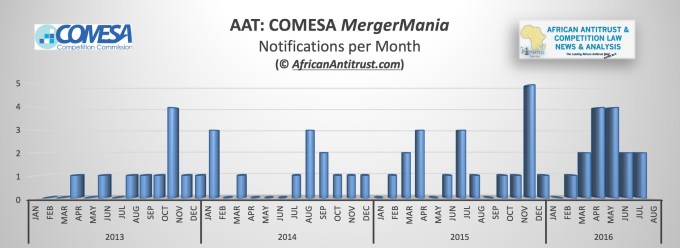
For year-to-date 2016 statistics, the numbers look analogous, albeit somewhat higher than the 2015 slump — that is to say, still diminished from the 2013-2014 height of COMESA ‘mergermania’, during which (mostly international) counsel took the confusion surrounding the CCC notification thresholds to heart and erred on the side of caution (and more fees), advising clients to notify rather than not to (65 in the 2 years), or to seek Comfort Letters, which also were issued in record numbers (19 total for the 2-year period)…   With that said, the agency is now up to 16 merger cases, with 2 Second-Phase matters on deck.

AAT 2016 September mergermania statistics
Number of merger notifications based on CCC-published notices (using educated inferences where the original CCC case numbers, dates and/or descriptions lack intelligibility; note that 2013-14 statistics only reflect actual filings made available online and not the official statistics issued by the CCC of 21 and 43, respectively)                                                                         (c) AfricanAntitrust.com

Growing Pains: From One-Trick Pony to Full-Fledged Enforcer?

COMESA Competition Commission Expands Enforcement Ambit from Merger Control to Conduct —

CCC Seeks Information on “Potentially” Anti-Competitive Agreements

By AAT Senior Contributor, Michael-James Currie.

Breaking News: The COMESA Competition Commission (CCC) has issued a notice (the “Notice”) calling on firms to notify the CCC of any agreements (both historic and forward looking) that may be anti-competitive, for the purpose of having such agreements ‘authorised’ or ‘exempted’ in terms of Article 20 of the COMESA Competition Regulations (the “Regulations”).

In terms of Article 20 of the Regulations, agreements which are anticompetitive may be exempted by the CCC if such an ‘anticompetitive agreement’ contributes positively to the ‘public interest’ to the extent that the public interest benefit outweighs the anti-competitive effect.

In terms of the CCC’s notice 1/2013, the following agreements may well be considered to be in the public interest when evaluating whether an anti-competitive agreement or concerted practice should be exempted:

  • Joint research and development ventures;
  • Specialisation agreements; and
  • Franchising agreements

As to the agreements or concerted practices which may be anti-competitive, the Notice refers specifically to the restrictive business practices listed in Article 16 of the Regulations which states that:

The following shall be prohibited as incompatible with the Common Market:

all agreements between undertakings, decisions by associations of undertakings and concerted practices which:

(a) may affect trade between Member States; and

(b) have as their object or effect the prevention, restriction or distortion of competition within the Common Market.”

It should be noted that Article 16 is deliberately drafted broadly so as to prohibit conduct which has as its “object” the prevention, restriction or distortion of competition. Certain conduct, such as price fixing, fixing of trading terms or conditions, allocating suppliers or markets or collusive tendering may be considered as having as its ‘object’ the distortion or restriction of competition in the market. Accordingly, firms who have engaged in this type of conduct may be held liable in the absence of any evidence of an anti-competitive effect (whether actual or potential).

Says Andreas Stargard, a competition practitioner with Primerio Ltd., “[t]he CCC’s notice is a clear sign that the agency is gathering momentum in its efforts to detect and prosecute anticompetitive practices within the member states — and is going beyond its ‘one-trick pony’ status as a pure merger-control gatekeeper.  We anticipate a more active role by the CCC in conduct investigations and presumptively also enforcement actions, as opposed to its previous rubber-stamping activity of approving transactions with a COMESA community dimension (and concomitant collection of vast filing fees).”

The CCC has recently signed a number of Memoranda of Understanding and Cooperation Agreements with various member states as well as a tripartite agreement with other broader regional forums such as the Southern African Development Community and the East African Community.

COMESA old flag colorThe web of MoU’s recently concluded, which have as their primary objectives the facilitation of information exchanges and cooperation between competition agencies, is certainly a significant stride made to assist the authorities, including the CCC, in detecting and prosecuting anticompetitive practices which may be taking place across the African continent.

A further indication of the CCC’s growing appetite and confidence to identify anticompetitive practices is that the CCC has announced that it is conducting a market enquiry into the grocery retail sector.  This is the first market inquiry to be conducted by the CCC.

In terms of the CCC’s Notice, firms who have not yet notified the CCC of agreements which may be anticompetitive, have approximately one month to do so. In other words, the CC has offered a leniency ‘window’ to incentivise firms to come forward and obtain an exemption in respect of agreements already implemented which may be in contravention of Article 16 of the Regulations.


More Criminal Anti-Cartel Enforcement in Africa? Some Thoughts on Nigeria

By AAT guest author, Osayomwanbor Bob Enofe, Sutherland School of Law Doctoral Scholar, UCD.

We recently wrote about the landmark enactment of the new South African competition legislation that makes hard-core price-fixing a criminal offence, subjecting cartelists to up to 10 years imprisonment.  Nigeria is usually not on the radar of antitrust practitioners, however, and certainly not in the criminal sense, either.  As regular readers of AAT know, the Republic of Nigeria has featured occasionally in our posts despite not having a functioning antitrust regime, yet.  As editor and Pr1merio director Andreas Stargard wrote in an article entitled “Nigerian antitrust?“, scholars and political activists alike have promoted the idea of establishing an antitrust regime in West Africa’s dominant economy: ‘Today, AfricanAntitrust adds its voice to the steady, though infrequent, discussion surrounding the possibility of a Nigerian competition-law regime.  In our opinion, it is not a question of “if” but “when”, and perhaps more importantly, “how“?’

Today, contributing author Bob Enofe adds his voice to the mix, and we are publishing one of his articles that originally appeared on Robert Connolly’s cartel capers blog.

Criminal Antitrust in Nigeria?

nigeriaThe Federal Republic of Nigeria is currently in the process of enacting a competition law, including to criminalise cartel activity amongst competitors. While such is in line with moves made by various other jurisdictions and theories of ‘rational actor’, sanction and deterrence, on ground realities suggest that criminalisation where transplanted might be seriously flawed.

From the late 1990s, and particularly in the year 2000, the Federal Government of Nigeria commenced moves to enact a Competition Law. Under such law, business cartel activity defined as agreements between competitors, aimed at distorting the process of competition and generating monopolistic rents, would be criminalised. The ‘Federal Competition Bill, 2002’, an executive bill drafted by the Nigerian Bureau of Public Enterprises (BPE), was titled: “a Bill for an Act to provide necessary conditions for market competition and to stimulate creative business activities, protect consumers, and promote the balanced development of the natural economy, by prohibiting restrictive contracts and business practices that substantially lessened competition”. It was also to be a Bill to regulate “possible abuses of dominant positions by businesses, and anti-competitive combines, and to establish the Federal Competition Commission, for effective implementation and enforcement of all the provisions of the bill”.  According to relevant sections of the bill, cartel agreements amongst competitors, including price fixing, bid rigging and market division, were also to be expressly criminalised. Clearly a robust and comprehensive bill, 16 years after introduction to the Nigerian National Assembly, the bill remains to be passed into law. Several amendments have since been presented, together with other bills presented by lawmakers. In every case, such bills have either stalled at first reading stage, or in certain cases disappeared from the legislative process. In one of such instances, an amendment of the above bill (The Federal Trade and Competition Commission Bill, 2006) was “vehemently” objected to by distinguished Senators, prompting governmental withdrawal. Amongst reasons advanced for the reception accorded the bill included that there was no need for a distinct ‘competition commission’, in the face of an already existent consumer protection council in Nigeria; other legislators simply complained about a proliferation of “too many commissions” in the country. Commentators have alluded to overt ignorance and lack of particular inclination for the subject, on the part of Nigerian Senators, as in reality underlining the reception accorded the bill.

In a paper recently presented at the #SLSA2016, ‘Developing Countries, Nigeria, and Cartel Criminalisation: of Transplantation and Desirability’ I had outlined how Nigeria’s attempt to introduce a competition law, and in particular criminalise cartel activity, reveals a (marked) lack of societal inclination towards competition law and prior poor advocacy on the part of government. Social norms are crucial to the effectiveness of law reform. Desirable social norms ensures amongst other things that prohibited conduct will be reported and discovered, even without direct enforcement or investigativeBob Enofe intervention, thereby complementing stretched law enforcement efforts.[1] Such also imply that prosecutors will be willing to enforce and vigorously police provisions of the law where passed, and in the case of the judiciary, stringent sentences will also be applied—or at least not deliberately avoided—so as to facilitate the deterrence potential of the applicable law. Perhaps most crucially for Nigeria, existence of such norms also mean that law makers are incentivised to support reform efforts, while the chances of ‘hijack’ by private interests will be slim. Absent such norms the chances of Nigeria’s competition and cartel criminalisation law, even when passed, could be (remarkably) marginal.

Heightened advocacy, together with a careful selection of test cases once the law is enacted is advanced as capable of remedying the above situation. In the face of sub-par institutions characteristic of the Nigerian context however (including severe limitations in the operation of the rule of law), abilities to so ‘guide’ social norms will be in reality seriously limited. An online petition regarding corruption amongst Nigerian senators, for example, reflect in part difficulties that could frustrate transplantation of cartel criminalisation, absent independent, effective, anti-corruption reforms in the country.

Neoliberal theories of rational actors, sanction and deterrence, imply to large extents a similar existence of contexts as have underlined effectiveness in western societies. In many cases, on the ground realities suggest that theories where transplanted, could be seriously flawed.

As I have argued in another paper currently under review (details to be communicated soon, hopefully!), one size cannot fit all- with developing countries and cartel criminalisation, the point gains extra force. To the extent that fines and other administrative means of enforcement are limited in ability to effectively curtail cartel practices, suggests a need for continuation of relevant research. Criminalisation hardly represents the ‘Golden Fleece’.

Footnote:

[1] See Stephan, Andreas, ‘Cartel laws undermined: Corruption, social norms, and collectivist business cultures’ (2010) Journal of Law and Society 345-367, See Maher, Imelda, The Institutional Structure of Competition Law, in Dowdle, Gillespie and Maher (eds) Asian Capitalism and the Regulation of Competition: Towards a Regulatory Geography of Global Competition Law (Cambridge University Press, 2013) 55, See Gal, Michal  ‘The Ecology of Antitrust: Preconditions for Competition Law Enforcement in Developing Countries.’ (2004) Competition, Competitiveness and Development 20-38.

EAC expands to accept 6th member in accession of S. Sudan

Landlocked and Oil-Rich South Sudan Joins Free-Trade Zone

As South Sudan was officially admitted to the East African Community (EAC) as its sixth member in Arusha (Tanzania), on Wednesday, March 2, the beleaguered nation joined a free-trade zone that will allow it to benefit from more open labour movement, less restrictions on capital flows and other increased economic integration.  The other member states are Tanzania, Kenya, Uganda, Burundi, and Rwanda.  After integration with S. Sudan — the youngest nation on Earth — the region will have a population of an estimated 163 million.

John Oxenham, of Pr1merio Africa advisors, says: “South Sudan’s former institutional weaknesses were (apparently, despite the ongoing civil strife in the country) sufficiently remedied that the EAC governing body saw fit to grant the application for admission that had been pending since 2011.  Basic governance principles must be met for EAC membership, and we are not even talking competition-law here…”

As the EAC charter provides, all members must demonstrate and strive to achieve “good governance including adherence to the principles of democracy, the rule of law, accountability, transparency, social justice, equal opportunities, gender equality, as well as the recognition, promotion and protection of human and peoples’ rights in accordance with the provisions of the African Charter on Human and Peoples’ Rights.”  (EAC Treaty, Chapter 2 Article 6 (d)).


Setting aside civil-rights concerns or worries about political instability, the integration of an oil-rich nation may ultimately benefit its neighbouring fellow EAC members, such as Kenya and Uganda.  It remains to be seen whether integrating a less-than-stable country into the EAC zone will harm the competition legislation the region enacted in 2006.  As AAT author Elizabeth Sisenda pointed out recently, the organisation “has been setting up the mechanisms for its enforcement to-date through capacity building and mobilizing resources. In 2010, the EAC subsequently enacted competition regulations to assist in implementing the Act. One of the main challenges that has been encountered in the EAC with regards to the implementation of competition law and policy has been the unique economic and market structure of the member states.  The majority of the EAC member states are economies that are transitioning from state-regulation to liberalization.”

We note that S. Sudan’s northern neighbour, the Republic of [the] Sudan, is currently a COMESA member state and thereby subject to the COMESA competition-law regulations and related merger-notification regime.  South Sudan has, since at least the 2012 talks in Uganda, likewise been in negotiations with the COMESA governing bodies to discuss accession to that free-trade zone.

Regs & Exemptions: more on the EAC

The Exemption Regime under the East African Community’s competition regulations

Continuing in our series about the burgeoning East African Community and its nascent antitrust regime, AAT contributing author Elizabeth Sisenda is highlighting the exemption regime of the populous (146 million inhabitants) and increasingly wealthy ($150 billion GDP) region.  (For more background on the EAC regime, start here.)

Elizabeth Sisenda, LL.M (London) LL.B (CUEA) PGD Law (KSL)

Emerging markets or developing economies only recently adopted competition law and policy as an exclusive legal and economic tool for regulating markets. In previous years, restrictive trade practices were mostly handled under government price control departments or monopolies commissions. Most of the competition legislation and regulations in developing economies were promulgated within the last decade.

EAC: regulations & market conditions

The EAC, in particular, enacted its competition legislation in 2006 and has been setting up the mechanisms for its enforcement to-date through capacity building and mobilizing resources. In 2010, the EAC subsequently enacted competition regulations to assist in implementing the Act. One of the main challenges that has been encountered in the EAC with regards to the implementation of competition law and policy has been the unique economic and market structure of the member states.

The majority of the EAC member states are economies that are transitioning from state-regulation to liberalization. Consequently, several key sectors of these economies are still under quasi-governmental regulation by independent agencies established by the legislature, or explicitly protected by executive policy or subsidiary legislation.

As a result of the progressive liberalization of EAC economies, private entities have been building capacity to supply sectors of the economy where the government once had a monopolistic stake. These private firms, both local and multinational, have faced several challenges in meeting market requirements in terms of capacity. Consequently, the governments of these economies have sometimes adopted a protectionist approach for key sectors of their economies in the public interest. As much as this has often contributed to the substantial lessening of competition in the affected sectors to the detriment of consumers, these regulatory measures have been upheld by the respective governments on the grounds of national interest. The EAC, however, has been very cautious in its provisions for exemptions within the common market that could contribute to the substantial lessening of competition.

The EAC exemptions

Section 6 (3) of the EAC Competition Act provides that the Competition Authority may exempt a category of concerted practices by firms or parties, provided the concerted practice is limited to objectives which lead to an improvement of production or distribution, and whose beneficial effects, in the opinion of the Authority, outweigh its negative effects on competition. However, any exemptions granted by the Authority under this sub-section shall be applicable only if the combined market share of the parties involved in the concerted practice does not exceed 20% of the relevant market, and the agreement relating to the concerted practice does not contain any restrictive trade practice expressly prohibited under the Act. Thus, it may be contended that this exemption does not contribute to the substantial lessening of competition because it only applies to small or medium firms without any hint of market power, having a maximum market share of 10% each. Furthermore, the net effect of the concerted practice is beneficial to consumer welfare by improving access to goods or services. It also gives leeway for small producers to produce more efficiently, thus improving market conditions.

Low shares = more permissible conduct

The Authority under section 6 (1) further allows competitors whose combined market share does not exceed 10% of the relevant market to apply quantitative restraints on investment or input, output or sales, and engage in concerted practices that restrict the movement of goods within the common market. However, such conduct is expressly forbidden by the Act in the case of firms with larger market share. It may be contended that this particular provision is aimed at enabling small and medium enterprises to have a strategic opportunity to operate in an otherwise large and well-exploited market. It also does not limit competition because the firms in question have very little market share. Instead this exemption aims at protecting the competitiveness of the market by ensuring that smaller firms are not driven out of the market by larger, more efficient firms.

R&D and so on

Under section 6 (2) of the Act, the Authority also exempts 3 categories of conduct, namely: joint research and development, specialization of production or distribution and standardization of products or services, by firms whose combined market share does not exceed 20% of the relevant market. This exemption requires that the agreement relating to these categories of concerted practices should not contain any of the expressly prohibited anti-competitive practices under the Act. The Authority may contend that this exemption promotes consumer welfare by enabling smaller firms to collaborate in improving the quality of products or services in the relevant market through standardization and specialization efforts. It also enables smaller firms to participate in innovation through a collaborative effort. Most firms with this extent of combined market share would lack the resources or capacity on their own to engage in these activities that promote consumer welfare and efficiency in the relevant market.

Get permission first!

According to section 7 of the Act, any firm or person must first apply to the Authority, in accordance with the Regulations, for clearance to engage in any concerted practice. The Authority shall thereafter communicate its decision to the applicant within 45 days of receipt of the application. However, if the Authority does not communicate its decision in the specified duration, then the permission for the concerted practice shall be deemed to have been granted. Under the same section, it is an offence, punishable by a fine of not more than $10 000, to omit to seek the permission of the Authority to engage in a concerted practice. The Regulations under section 16 further provide that the undertaking seeking an exemption must pay the prescribed fees, and provide a detailed statement setting out the reasons why the concerted practice should be permitted for consideration to the Authority.

Conclusion

The EAC exemptions are therefore permitted in the common market to exercise a form of economic regulation for the purpose of ensuring that small and medium enterprises can effectively compete in a liberalized market without being driven out by firms with larger market share. In this way, the public interest is promoted to ensure that national or regional interests such as employment, allocative efficiency, specialization agreements and international competitiveness of domestic firms are taken into account. Applying exemptions does not necessarily imply the weakening of competition law enforcement. National economic policy considerations such as the maintenance and promotion of exports, changing productive capacity to stop decline in a particular industry, or maintaining stability in a particular industry are some of the policy considerations that motivate the application of exemptions. However, exemptions must be applied with caution because their application in one sector can perpetuate or induce distortions that can affect economic efficiency.


The Big Picture (AAT): East Africa & Antitrust Enforcement

AAT the big picture

East-Africa & Antitrust: Enforcement of EAC Competition Act

By AAT guest author, Anne Brigot-Laperrousaz.

Introduction: Back in 2006…

The East African Community (the “EAC”) Competition Act of 2006 (the “Act”) was published in the EAC Gazette in September 2007. The Act was taken as a regulatory response to the intensification of competition resulting from the Customs Union entered into in 2005. This was the first of the four-step approach towards strengthening relations between member States, as stated in Article 5(1) of the Treaty Establishing the EAC.

Challenges facing the EAC

As John Oxenham, an Africa practitioner with advisory firm Pr1merio, notes, “10 years have passed since the adoption of the EAC Act, yet it remains unclear when (and if) the EAC will develop a fully functional competition law regime.”

The EAC Competition Authority (the “Authority”) was intended to be set up by July 2015, after confirmation of the member States’ nominees for the posts of commissioners. Unfortunately Rwanda, Uganda and Burundi failed to submit names of nominees for the positions available, and the process has become somewhat idle, leaving questions open as to future developments.

The main challenges facing the EAC identified by the EAC’s Secretariat is firstly, the implementation of national competition regulatory frameworks in all member States; and secondly, the enhancement of public awareness and political will[1].

The first undertaking was the adoption of competition laws and the establishment of competition institutions at a national level, by all member states, on which the sound functioning of the EAC competition structure largely relies.

Apart from Uganda, all EAC member States have enacted a competition act, although with important discrepancies as to their level of implementation at a national level.

The second aspect of the EAC competition project is the setting up of the regional Competition Authority, which was to be ensured and funded by all members of the EAC, under the supervision of the EAC Secretariat. Although an interim structure has been approved by member States, the final measures appear to be at a deadlock.

As mentioned, the nomination of the commissioners and finalisation of the setting up of the EAC Competition Authority came to a dead-end in July 2015, despite the $701,530 was set aside in the financial budget to ensure the viability of the institution[2]. It is widely considered, however, that this amount is still insufficient to ensure the functionality of the Competition Authority.  Andreas Stargard, also with Pr1merio, points out that “[t]he EAC has been said to be drafting amendments to its thus-far essentially dormant Competition Act to address antitrust concerns in the region.  However, this has not come to fruition and work on developing the EAC’s competition authority into a stable body has been surpassed by its de facto competitor, the COMESA Competition Commission.”

Furthermore, inconsistencies among national competition regimes within the EAC are an important impediment to the installation of a harmonised regional enforcement. Finally, international reviews as well as national doctrine and practice commentaries have highlighted the lack public sensitization and political will to conduct this project.

A further consideration, as pointed out by Wang’ombe Kariuki, Director-General of the Competition Authority of Kenya, is the challenge posed by the existence of the Common Market for Eastern and Southern Africa (“COMESA”).

Conclusion

The implementation of the EAC has not seen much progress since its enactment, despite its important potential and necessity[3]. It therefore remains to be seen how the EAC deals with the various challenges and whether it will ever become a fully functional competition agency.

A quick summation of the status of the national laws of the various EAC members can be seen below. For further and more comprehensive assessments of the various member states competition law regimes please see African Antitrust for more articles dealing with the latest developments.

EAC Member States Status

Tanzania

The Tanzanian Fair Competition Act (the “FCA”) was enacted in 2003, along with the institution of a Commission and Tribunal responsible for its enforcement. The FCA became operational in 2005. Tanzania’s competition regime was analysed within the ambit of an UNCTAD voluntary peer review in 2012[4]. The UNCTAD concluded that Tanzania had overall “put in place a sound legal and institutional framework”, containing “some of the international best practices and standards”.

This report, however, triggered discussions on major potential changes to the FCA, which would impact, in particular, institutional weaknesses and agency effectiveness[5]. One of the most radical changes announced consisted in the introduction of criminal sanctions against shareholders, directors and officers of a firm engaged in cartel conduct[6], although there is no sign that this reform will be adopted.

Kenya

Kenya, following a 2002 OECD report[7] and the European Union competition regulation model, replaced its former legislation with the 2010 Competition Act, which came into force in 2011, and established a Competition Authority and Tribunal. Under the UNCTAD framework, the 2015 assessment of the implementation of the recommendations made during a voluntary peer review conveyed in 2005[8] was generally positive. It was noted, however, that there was an important lack of co-operation between the Competition Authority and sectoral regulators, and that there was a need for clear merger control thresholds[9].

Burundi

Burundi adopted a Competition Act in 2010, which established the Competition Commission as the independent competition regulator. To date, the Act has not yet been implemented, and accordingly no competition agency is in operation[10].

A 2014 study led by the Burundian Consumers Association (Association Burundaise des Consommateurs, “Abuco”) (which was confirmed by the Ministry of Trade representative) pointed to the lack of an operating budget as one of the main obstacles to the pursuit of the project[11].

Rwanda and Uganda

Rwanda enacted its Competition and Consumer Protection Law in 2012, and established the Competition and Consumer Protection Regulatory Body.

As for Uganda, to date no specific legal regime has been put in place in Uganda as regards competition matters, although projects have been submitted to Uganda’s cabinet and Parliament, in particular a Competition Bill issued by the Uganda Law Reform Commission, so far unsuccessfully.


Footnotes:

[1] A Mutabingwa “Should EAC regulate competition?” (2010), East African Community Secretariat

[2] C Ligami, “EAC to set up authority to push for free, fair trade” (2015), The EastAfrican

[3] O Kiishweko, “Tanzania : Dar Praised for Fair Business Environment” (2015), Tanzania Daily News

[4] UNCTAD “ Voluntary Peer Review on competition policy: United Republic of Tanzania” (2012), UNCTAD/DITC/CLP/2012/1

[5] S Ndikimi, “The future of fair competition in Tanzania” (2013), East African Law Chambers

[6] O Kiishweko, “Tanzania: Fair Competition Act for Review’ (2012), Tanzania Daily News.

[7] OECD Global Forum on Competition, Contribution from Kenya, “ Kenya’s experience of and needs for capacity building/technical assistance in competition law an policy “ (2002), Paper n°CCNM/GF/COMP/WD(2002)7

[8] UNCTAD, “ Voluntary Peer Review on competition policy: Kenya” (2005), UNCTAD/DITC/CLP/2005/6

[9] MM de Fays, “ UNCTAD peer review mechanism for competition law : 10 years of existence – A comparative analysis of the implementation of the Peer Review’s recommendations across several assessed countries” (2015)

[10] Burundi Investment Promotion Authority “Burundi at a Glance – Legal and political structure”, http://www.investburundi.com/en/legal-structure

[11] Africa Time, “Loi sur la concurrence : 4 ans après, elle n’est pas encore appliquée” (Competition Law : 4 years after, it is still not implemented) (2014), http://fr.africatime.com/burundi/articles/loi-sur-la-concurrence-4-ans-apres-elle-nest-pas-encore-appliquee

COMESA acknowledges low merger filing stats

2015 figures plummet 66% year-over-year

Going from 44 notifications in 2014 to 15 filings last year, the Competition Commission of the COMESA common-market area has seen a dramatic decline in merger filings.

Says Andreas Stargard, a competition lawyer with Africa advisory firm Pr1merio:

“These statistics are akin to the agency’s inaugural year — a slump that can only be explained by one of two likely underlying rationales:

Andreas Stargard, editor
A. Stargard

(1) Potential filers have begun to follow widespread advice from legal counsel that effectively admonishes would-be notifying parties not to do so until COMESA establishes a more robust enforcement and notification regime; or (2) — and this is the CCC’s preferred official explanation — the increased filing thresholds as of March 2015 caused fewer transactions to be caught in the mandatory filing net of the regulator.”

Of further concern, Stargard notes, is that the supporting merger documents made available by the CCC do not reflect the purported official statistics.  This fact is reflected in the MergerMania article published on AAT last August..  “For each and every one of the 15 filings identified by the Commission in its official statement, we should be able to see the underlying SOM [statement of merger] and the concomitant Decision — ideally published contemporaneously with the occurrence of each relevant event,” he says.  “Unfortunately, on the CCC merger site, two merger filings are missing entirely (numbers 9 and 10), and the others are commonly published many months after the public-comment deadline for the transactions has long expired.”

To date, a parsing of the (available) 2015 statistics shows that 3 of 15 cases actually went into Phase Two review, Stargard observes.  “This would generally imply a more serious concern raised by the authority in terms of the effect on competition post-merger.  Here, however, it is quite unclear what the potential threat to competition in, for example, a purely private-equity deal would be.  The official decision (no. 15, from November 2015) fails to even hint at a possible threat — as one would commonly expect from a PE to PE transaction, which usually raises little to no antitrust eyebrows…”

Our updated AAT COMESA MergerMania statistics are therefore as follows (again noting the fact that AAT bases its count on only the official, published and available merger documents, instead of relying on mere press release-based summaries published by the CCC).  We also note that to date, 2016 has seen one “merger inquiry notice,” namely of the Dutch Yara / Zambian Greenbelt fertiliser deal.  The public-comment period for that transaction expires on January 22, 2016.

Number of merger notifications based on CCC-published notices

The full text of the COMESA release follows below:

During the year 2015, the Commission assessed and cleared 15 merger transactions. The transactions involved sectors such as insurance, food additives, water treatment, agro-chemical, banking, telecommunication, non alcohol-ic beverage, publishing, packaging and retail. The Commission handled 12 merger notifications in the year 2013 and 44 merger notifications in the year 2014. The Pie Chart below shows the number of mergers handled by the Commission from inception to date.

COMESA merger statistics (official graphic)

As shown in the pie chart the Commission dealt with more mergers in 2014 as compared to 2013 but this trend has gone down in 2015. This trend may be attributed to the supposition that in 2013, the Commission had just commenced operations and therefore some stakeholders were not immediately aware of its existence and operations. By 2014, most stake-holders had become aware of the Commission and its operations, hence the significant increase in the number of mergers notified. The significant reduction in 2015 can be attributed to the supposition that the merger notification thresholds approved by the Council of Ministers on 26 March 2015 which has resulted in smaller mergers escaping the notification. Before 26 March 2015, the merger notification thresholds were Zero hence all mergers were notifiable regardless of size.

Can antitrust law ensure a competitive Kenyan marketplace?

Competition law as a tool for promoting consumer welfare & maintaining a competitive market in Kenya 

By contributing author Elizabeth Sisenda, LL.M (London) LL.B (CUEA) PGD Law (KSL)

Elizabeth Sisenda, LL.M (London) LL.B (CUEA) PGD Law (KSL)

The core aim of enforcing competition law revolves around balancing between beneficial market power and market power that is detrimental to consumer welfare. Market power can be defined as the ability of a firm to raise and maintain price above the level that would prevail under competitive market conditions, without being destabilised by consumers switching to other products/services or new competitors entering the same market. Often the actual price is above cost leading to high profits for the firm with market power. In practice, the pursuit of market dominance can be a great incentive for investment, cost efficiency and innovation. Therefore, the acquisition of a dominant position through superior product or customer services, better pricing, innovation, efficiency and investment is not illegal. Only the abuse of dominance is prohibited. Where a firm exercises market power, competition law functions to protect the openness of the market by ensuring that the dominant firm does not impose unfair trading conditions for actual or potential competitors, or abuse its intellectual property rights. It also intervenes to prevent direct harm to consumer welfare through conduct or transactions that limit output or production artificially in order to price-fix.

Merger control is another important function of competition law and policy, that is designed to prevent positions of market power from being established through acquisition, unless there is a strong economic efficiency rationale that will mitigate for the loss of competition between the merging firms. A company should therefore earn market power and not simply buy out competitors.

Thus, an important ideal of competition policy is to promote a contestable market for as long as it promotes consumer welfare, and a feasible market structure for a particular sector of the economy. In a contestable market, the sunken costs required to join the sector are negligible and other entry barriers are so low that the threat of new entrants is sufficient to check the conduct of the incumbent firm with market power. The costs of exiting the market are also negligible.

In relation to competitors, competition law cannot intervene on behalf of a particular firm in the market, without taking into account the broader effects of the conduct in question on competition in the relevant market. A firm would have to show, on the face of it, that its competitors in that market are engaged in concerted or collusive practices. For instance, competitors can tacitly seek to exercise market power through anti-competitive agreements that enable them to concentrate the market. This often results in one or more firms becoming large enough to be in a position to affect the market’s outcomes in a manner that causes consumer welfare or public interest to be compromised.

Under these circumstances, competition law intervenes and investigates to ensure that there is no unwarranted concentration of economic power in a particular market through collusive agreements between competitors. Unwarranted concentrations of economic power exist where there is cross-directorship or sharing of a senior employee or executive between two distinct firms providing substantially similar goods or services, and whose combined market share is more than 40%. Competition legislation regulates this conduct because it often results in board decisions being made that could lead to collusion among the firms involved, such as price fixing and dividing markets, thereby lessening competition.

kenya

For instance, in Kenya, the cement sector has been under investigation for unwarranted concentrations of economic power. Although there are a number of cement-producing companies in the market, the dominant multinational firm – Lafarge Limited, has a 58.6% stake in the leading producer, Bamburi Cement Limited and a 42% shareholding in another leading company, East African Portland Cement Limited. Market concentration concerns have arisen because Bamburi Cement Limited, which has a market share of 39%, has had cross-directorship with the 3rd largest producer in the market – East African Portland Cement Limited to an extent that may dampen competition. Kenya’s cement prices have been the second highest out of six eastern and southern African countries including South Africa, Zambia and Tanzania between 2000-2014 according to a sector report. In 2014, the Kenyan government recommended that Lafarge dilute its shareholding in East African Portland Cement Limited. However, it was not conclusive whether price fixing was going on.

On the other hand, Kenya’s cement sector may experience increased competition from imports as a result of the East African Community (EAC) reducing the common external tariff (CET) on cement from 35% to 25% through an EAC gazette notice of February 2015. Cement has also been removed from the list of sensitive products that require protection until domestic industries can compete according to the same gazette notice. Although local cement producers are protesting the move, consumers stand to gain, as the liberalized market will lead to lower prices of the commodity, and possibly have a positive impact on the construction industry.