Finally: One step forward for COMESA merger enforcement? New rules, new commissioners

COMESA old flag color

Clarification or not?

Amended Rules for Merger Notification

Repealing the oft-criticised original 2012 Rules on the Determination of Merger Notification Threshold, the COMESA Board of Commissioners approved on March 26, 2015 the new set of Amended Merger Rules. These are ostensibly meant to permit parties and their legal counsel a more meaningful determination of filing fees, notification thresholds, and calculation of parties’ revenue (and asset) valuation.  Whilst many legal news outlets have reported (uncritically, as we fear) a high-level summary of these Rules, AAT undertook a critical review of them, and finds that many of the previously-identified flaws persist.

Filing Fee

The question of what parties had to pay in administrative fees to be permitted to file a merger notification with the Competition Commission was always in question (see here for AAT summaries of the issue).  We have reported on examples of fees that came dangerously close to the original $500,000 maximum limit.  Since then, the agency’s “Explanatory Note” (which still has a visible link on the Commission’s web site, but which happens to be an essentially “dead” web page, other than its amusing headline: “What is merger?“) attempted to clarify, and indeed informally change, the filing fee from a 0.5% figure to 0.01% of the parties’ annual COMESA-area turnover.
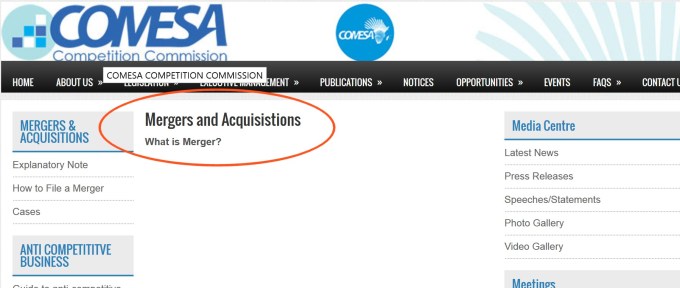
COMESA explanatory note

Where the filing fee stands now is, honestly, not clear to AAT.  While other sources have reiterated the revised fee of 0.1% with a maximum of $200,000, we fail to see any information whatsoever about the filing fee in the (partial set, containing only ANNEX 2 of) the Amended Rules made available by COMESA on its site, despite their title containing the term “fees”.  We have been able to determine, through some internet sleuthing on the COMESA site, that a document marked clearly as “DRAFT” does contain references to 0.1% and $200k maximum fees.

We note that we have now seen three different turnover percentage-based filing fees from COMESA: 0.01%, 0.1%, and 0.5%, as well as several different maxima.  Which shall govern in the end remains to be seen.  We do not envy those parties that have filed with COMESA and have paid the half-million dollar fee within the past 2 years, as we doubt they are entitled to restitution of their evident overpayment.

AAT predicts that this is where things will land, at 0.1% and $200,000, once the good folks at COMESA get around to actually editing the document and finalising their own legislation, so that practitioners and parties alike may have an original, statutory source document on which to rely

Our previous AAT advice has been very clear to companies envisaging a filing with COMESA: wait until the Commission and the Board clarify the regime in its entirety.  Do not file for fear of enforcement, because there is little if any enforcement yet, and the utter lack of clarity – apparently even within the agency itself – on the actual thresholds and other rules provides ample grounds for a legal challenge to the “constitutionality,” if you will, of the entire COMESA merger regime

Combined $50 million revenue threshold

What the 5-page document does show, however, is the new notification threshold embodied in Rule 4, which defines the threshold as follows:

Either (or both) of the acquiring and/or target firms must ‘operate’ [defined elsewhere] in at least two COMESA member states and have (1) combined annual turnover or assets of $50 million or more in the COMESA common market, AND (2) in line with the EU’s “two-thirds” merger rule, each of at least 2 parties to the merger must have at least $10 million revenue or assets within the COMESA zone, unless each of the merging parties achieves 2/3 or more of its aggregate revenue within one and the same member state.

The likewise-revised Form 12, the mandatory filing form, which is available in a scanned format (we hope this will be remedied and provided in more legible and native-electronic format soon by the secretariat) here, reflects the rules changes.  It must be submitted at a minimum within “30 days of the merging parties’ decisions [sic] to merge.”  The Competition Commission mus t make a decision within 120 days of receipt of (a complete) notification.

Interestingly, if the same two firms enter into multiple transactions within a 2-year period are to be treated “as one and the same merger arising on the date of the last transaction.” (See Rule 5, in a likely-misidentified subsection that is confusingly entitled 1.2.). Mimicking the EU Merger Regulation and Consolidated Jurisdictional Notice, the revised COMESA rules likewise contain special provisions for determining the revenues or assets of financial institutions (and their individual member-state branches’ income) as well as insurance companies.

Parents, sisters, subs: included.

Parent, sister and subsidiary entities are included in the revenue determination of the purchaser, to no surprise.  However, unlike what has been reported in the media, again we fail to see the (entirely logical) exclusion of the target parent’s turnover in calculating total revenues, other than in section 3.16 of the August 2014 Guidelines (which provides: “the annual turnover and value of assets of a target undertaking will not, for the purposes of these Guidelines, include the annual turnover or value of assets of its parents and their subsidiaries under Section 3.15)(d)where, after the merger is implemented, such parents are not parents of (i) the target undertaking if it remains after the merger, or (ii) the merged undertaking in the case of an amalgamation or combination“).

We observe the obvious: the Guidelines have no binding legal effect.

The Amended Rules do however provide that state-owned enterprises do not have to include their “parental” governmental revenues; for instance, if a state-owned airline like Air Tanzania were to acquire its counterpart, such as Air Mauritius, in a hypothetical COMESA-reportable transaction, the parties would not be required to report the full tax income or other revenues of the Tanzanian and Mauritian governments, respectively, but only those of the actual state-owned entity and its subsidiaries.

COMESA's 18th Summit in Ethiopia

18th COMESA Summit in Ethiopia

Four New Commissioners

As AAT reported previously, the Addis Ababa COMESA summit also saw the election and confirmation of four new Competition Commissioners.  We now have the full listing of the members, including the 4 new* ones (listed below in italics), whose term is for three years:

New 2015 Commissioners Origin
Ali Mohammed Afkada Djibouti
Amira Abdel Ghaffar* Egypt
Merkebu Zeleke Sime* Ethiopia
Francis Kariuki Kenya
Matthews Chikankheni Malawi
Georges Emmanuel Jude Tirant* Seychelles
Thabisile Langa Swaziland
Patrick Okilangole* Uganda
Chilufya Sampa Zambia

COMESA antitrust authority swears in 4 new commissioners

COMESA out of service

Four new Commissioners sworn in – while COMESA’s own site fails to make announcement

We do not commonly report on news from the Seychelles here on AAT, but today, the Office of the President of the Seychelles has in fact beat AAT (as well as the COMESA Competition Commission itself (!)) to it: as the Office reports, the 18th COMESA Summit, held on 30th March 2015 in Addis Ababa, (a city that I have fallen in love with, by the way), saw the swearing-in of four new COMESA Competition Commissioners.

The summit also saw the swearing in of Mr. George Tirant, Chief Executive Officer of the Seychelles Fair Trading Commission. Mr. Tirant was appointed as a commissioner on the COMESA Competition Commission, alongside representatives from Egypt, Uganda and Ethiopia.

We have not yet identified the other new members that were sworn in this week, but in admitting so we note in the same breath that it is surprising for the authority itself not to have this relevant item anywhere on its site, neither in the News category nor anywhere else.  Indeed, the reader looks in vain for even a cursory Press Release announcing that 4 new Commissioners were seated for a new term of 3 years each. COMESA’s site still shows the outdated list of its Commissioners (copied below the photo below).

Irregular?  Perhaps.  But then again, we are used to outages and unfortunately much worse from the COMESA Competition Commission web site.

AAT notes that, in addition to the four new competition commissioners, the 19-country IGO also welcomed new:

  • Judge President and Judges of the Appellate Division of the COMESA Court of Justice
  • Principal Judge and Judges of the First Instance Division of the COMESA Court of Justice
  • the COMESA Committee of Elders
COMESA's 18th Summit in Ethiopia
COMESA’s 18th Summit in Ethiopia

[Outdated] List of Commissioners from Comp Comm web site:

  1. Commissioner Alexander Juvensio Kububa : Chairperson of the Board of Commissioners and former Chief Executive Officer of the Competition and Tariff Commission of Zimbabwe.
  2. Commissioner Mathews Chikankheni: Vice Chairperson of the Board of Commissioner and President of the Malawi Confederation of Chamber of Commerce and Industry.
  3. Commissioner Ali Mohamed Afkada: Inspector General des Services Judiciarisés’ de Djibouti.
  4. Commissioner Daniel Phillip Gappy – Former Chief Executive Officer of Fair Trading Commission of Seychelles and Chief Executive Officer of Seychelles Licensing Authority.
  5. Commissioner Rajeev Hasnah: former Deputy Director of Competition Commission of Mauritius.
  6. Commissioner Francis Kariuki: Director General of Competition Authority of Kenya.Commissioner Rajeev Hasnah:  Chief Economist and Deputy Executive Director of the Competition Commission of Mauritius.
  7. Commissioner Thabisile Pearl Langa’: Chief Executive Officer of Swaziland Competition Commission.
  8.  Commissioner Rostom Omar: Former Legal Counselor of Egyptian Competition Commission.
  9. Commissioner Chilufya Sampa: Chief Executive Officer of Competition Commission of Zambia

South Africa-Dawn Raids in Gauteng in Relation to Suppliers of Fire Control and Protection Systems

south_africa

The South African Competition Commission (SACC) launched a dawn raid, in terms of Section 48 of the Competition Act, 89 of 1998, on the offices of six companies in Gauteng, who supply fire control and protection systems on 20 March 2015. The companies subjected to the dawn raid include:

  •  Belfa Fire (Pty) Ltd;
  • Cross Fire Management (Pty) Ltd;
  • Fire Control Systems (Pty) Ltd;
  • QD Air (Pty) Ltd;
  • Technological Fire Innovations (Pty) Ltd; and
  • Fireco (Pty) Ltd

According to the SACC’s spokesperson, the SACC has reasonable grounds to believe that these companies have been involved in collusion when bidding for tenders in respect to the provision of fire control and protection systems.  The dawn raid forms part of an on-going investigation into this alleged anti-competitive conduct. This is the first dawn raid conducted in 2015.  The SACC  conducted 3 dawn raids in 2014, after a substantial period of no activity signalling that the trend in 2014 may well continue in 2015.  Some of the dawn raids conducted in 2014 include:

  •  Investchem Pty Ltd (Investchem) and Akulu Marchon Pty Ltd (Akulu Marchon), in Kempton Park, Gauteng (December 2014);
  • Unilever in Durban and Sime Darby Hudson & Knight in Boksburg (April 2014);
  • Precision and Sons, Eldan Auto Body in Pretoria West and the Vehicle Accident Assessment Centre in Centurion (July 2014).

The SACC appears content to increasingly uitilise dawn raids as an investigative tool during its investigations into anti-competitive conduct. The increase in the use of dawn raids coincides with a change of senior management at the SACC.

New COMESA merger approvals: stats and details

COMESA Competition Commission logo

COMESA publishes new Merger decisions

In the past week, the COMESA Competition Commission published the following decisions in its most recent merger cases, resulting from the CCC’s 14th meeting:

  • Case 1/15: Cannon (insurance) – decision time: 176 days – 4 member states affected.
  • Case 2/15: ImproChem (water treatment) – decision time: 166 days – 12 member states affected.
  • Case 3/15: Chlor Arkali (food-grade salt) – decision time: 135 days – 3 member states affected.

…and from its 15th meeting:

  • Case 4/15: Telkom SA (information and telecom technology) – decision time: 11 days (!) – 10 member states affected
  • Case 5/15: Platform Specialty Products (fungicides, herbicides, and insecticides) – decision time: 112 days – 9 member states affected

Of note are the following:

  1. The record time11 calendar days — in which the CCC resolved the Telkom transaction in favor of the South African provider, which aquired a BBBEE entity, despite the fact that the affected geographies encompassed 10 COMESA member states.
  2. The average time it took for the CCC to clear these 5 transactions was 120 days from notification to decision.
  3. All 5 notified transactions were unconditionally approved.
  4. The voting Commission members were, in all cases, Chilufya Sampa (Zambia), Thabisile Langa (Swaziland), and Alexander Kububa (Zimbabwe).

Finally, we observe that none of these merger matters presumptively benefitted from the upward-adjusted threshold (>$5 million), as they date to a pre-Assessment Guidelines era (see also here).

AAT’s updated COMESA merger statistics are thus as follows:

 COMESA merger stats 3-2015

Which economy is growing 2-3% above global average…?

… Africa’s

AAT the big picture

According to a recent article in Polity, “Africa’s economy is projected to continue growing at between 2% and 3% above the global average over the next five years, helping it retain its position as one of the key emerging markets for 2015.

It quotes a GIBS (Gordon Institute of Business Science) study showing that sub-Saharan Africa’s growth “outstripped global growth for the past 15 years,” which has “slowed down somewhat, owing to a number of challenges, including the drop in commodity prices.”  The GIBS study is the result of an assessment of countries’ institutional evolution, measuring how countries were performing in terms of developing competitive business and living environments across political, social and economic spheres.

Kenya was highlighted, with the authors noting that “Kenya, in terms of perceptions, is a very important country on the continent; it has, since 2007, put in place a number of reforms to build competitiveness. However, it doesn’t come out very well when you look at the data behind industry and comes out poorly in [the DMI], but what you find on the ground is that there is [an entirely] different sentiment.”

Meet the Enforcers: Companies Tribunal’s Prof. Kasturi Moodaliyar

meet the enforcers

Interview with Professor Moodaliyar marks second in AAT interview series highlighting African enforcers

In the second instalment of our Meet the Enforcers series, we speak with Prof. Kasturi Moodaliyar. An Associate Professor of Competition Law, she is part-time member at the Companies Tribunal; ICASA’s Complaints and Compliance Committee; and the Film and Publication Board Appeal Tribunal. She holds a B.Proc. LLB.LLM.(Natal), M.Phil (Cambridge), and Prog. Economics and Public Finance (UNISA)

As an academic in South Africa, focussing on competition law, how do you perceive the major differences and challenges that developing or younger antitrust-law jurisdictions are faced with, compared to more established ones? Specifically with regards to the Competition Commission, what is your assessment of its strengths and weaknesses?

The Commission has established a credible reputation in the area of anti-cartel enforcement and merger regulation. However, it has been less effective in addressing abuse of dominance. This is a risk as there is increasingly an expectation that the Commission address problems of single firm dominance in concentrated markets in the South African economy. If performance continues to lag in this area it will impact negatively on the perceived effectiveness of the Commission. While under-deterence of abuse of dominance reflects some limitations in the legislation it also highlights the challenge of resource constraints faced by the Commission. Such cases demand extensive legal and economic expertise – a shift of priorities to this area may impact performance of the Commission in areas in which it has traditionally had more success (cartel busting, mergers). The use of complementary tools like market inquiries and advocacy will be important and can asset the Commission – but also places a burden on resources.

Regarding staff turnover: Do you see the personnel turnover in recent history to be of sufficient magnitude to have an impact on the performance of the enforcement agency?

It is a worrying development although there are signs that it is starting to stabilise. Although key executives were lost there are still a number of highly experienced staff at the middle management level within the institution that must be nurtured and developed. Some have moved into executive level positions. This is a positive development but also points to a level go juniority in the executive which may impact on effectiveness. Will watch this space.

On Leadership: Do you consider it a benefit or a hindrance if leadership want to introduce their own philosophy of what competition law should seek to achieve on the agency’s activities during their tenure, or do you think that the law is sufficiently clear, such that leadership should focus on efficient and effective delivery of the service, and leave the interpretation to the Tribunal/courts.

It is natural that any leader will bring their own perspective to the role – this cannot be avoided. However, it will be important for the leadership to ensure that such perspectives do not undermine their objectives in giving effect to the mandate of the Commission – which is set down in the Competition Act. Fortunately there are checks and balances in the adjudicative process (Tribunal, rights of appeal) to ensure that these objectives are not contradicted.

Prioritisation: Every agency has budgetary constraints. What are the factors that you think should be most important in how cases are prioritised, should this be based on the developmental needs to society, particular sectors, or even particular areas of the law. What do you think of the prioritisation of recent Section 8 cases, SAB (10 years on an issue that has been extensively sanitised by foreign agencies), Gold Reef News (de minimis), and Sasol Polymers (niche, with limited potential for downstream beneficiation)?

The Commission’s stated prioritisation principles seem reasonable (as they appear in annual reports). However, there is somewhat of a disjuncture between the principles and the outcomes – particularly with respect to abuse of dominance cases. In fact, the outcomes in respect of anti-cartel enforcement have been largely consistent with the application of the Commission’s prioritisation principles – so credit is deserved here. However, new thinking around prioritisation is needed for abuse of dominance cases. In this regard there needs to be a better integration between the Commissions’s policy and research activity, the use of market inquiries and its advocacy with its planning and actions around enforcement against abuse of dominance.

Do you believe that the Competition Tribunal has a role in relation to broader competition advocacy initiatives in South Africa by way of the decisions made?

Advocacy is primarily a function of the Competition Commission, not the Tribunal. The Tribunal must first and foremost safeguard the integrity of its adjudicative function by ensuring impartiality in its decision making processes. There is no harm done though if the Tribunal makes a contribution to the such initiatives as a bi-product of good decisions.

How important, in your view, is the political independence of competition enforcers?

It is very important if the integrity and effectiveness of the agency is to be upheld.

Comparing merger review in an African jurisdiction (any jurisdiction) with that of other competition enforcement agencies worldwide, where do you see the key differences?

A significant difference does appear to be the elevated status of public interest issues in merger proceedings.

What is your view about the elevation of non-competition assessments above those of pure competition tests in merger review? Is it good for the adjudication of competition matters generally?

It is not a problem in and of itself, and is to be expected given various developmental challenges. However, public interest considerations should not trump core competition concerns. In other words, agencies should strive to achieve consistency between the ‘pure’ competition policy objectives (competitive market structures, efficient outcomes etc) and public interest considerations. However, significant dangers arise when public interest objectives conflict with competition policy objectives. Where there are conflicts, alternative policy mechanisms should be considered so that agencies can focus on core non-conflicting objectives. Otherwise they may end up achieving nothing by trying to please everyone. This also means that the public interest considerations that do fall within the mandate of competition agencies should be carefully circumscribed.

What skills would you encourage regional African practitioners focus in on for purposes of developing antitrust advocacy in the region?

They should build a technocratic and professional staff with strong legal and economic skills. These core functions should also be supported by strong policy research and analysis skills – also of the technocratic professional (rather than political) variety. As an academic in this field I would also encourage ongoing training to strengthen those research, investigative and analytical skills.

Thank you, Professor Moodaliyar.

UNCTAD report evaluates antitrust efforts in Namibia

namibia


Extensive UNCTAD report highlights state of Namibian competition enforcement, comes at right time when Namibia ponders inclusion of “unfairness” standard in merger control

A.S.

Following the release of the final UNCTAD report (entitled “Voluntary Peer Review of Competition Law and Policy: Namibia“), the report’s sponsors organised a gathering of interested parties in mid-February in Windhoek, the Namibian capital, for a “dissemination event” of the report.

The event included a session on “various elements of knowledge management systems,” for which the the South African Competition Commission was selected to serve as an exemplary agency.  The Namibia Competition Commission presented a plan for implementing the Report’s recommendations.  This plan will form part of the agency’s overall strategic planning framework “Smart enforcement, smart advocacy and smart research” that is to be launched by June 2015.

In attendace was, among others, the country’s Deputy Minister of Trade and Industry, Tjekero Tweya.  Participants were invited to attend two round tables discussions on the intersection and complementarities of competition policy and consumer protection; and strengthening cooperation between different government bodies to improve competition enforcement in Namibia.

Can Report avert devolution of merger-control regime into extrajudicial “fairness” criteria?
Substantively, AAT welcomes further and deeper discussion of true antitrust/competition law issues in Namibia wholeheartedly.  We reported last year that a crucial revision of the Namibian competition law includes consumer-protection provisions that would potentially bar M&A deals not only on pure antitrust grounds but also on a more broadly defined “unfairness” basis.
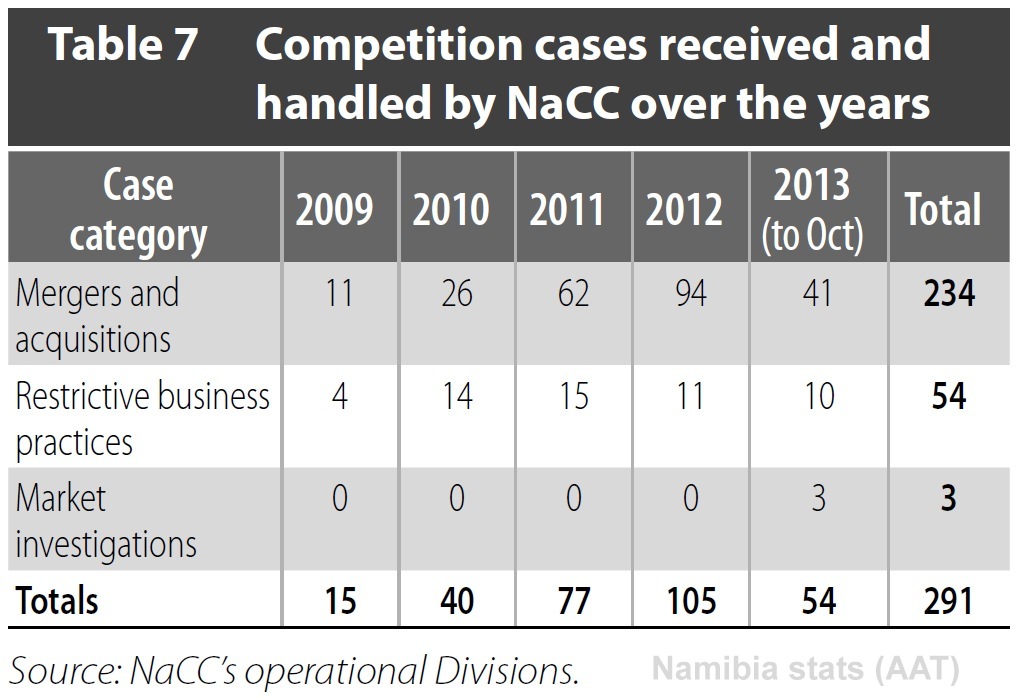
The cited Report contains two relevant statistics, showing the relatively young enforcement agency’s workload in absolute terms as well as in relative (merger vs. other enforcement work) numbers:

Namibia stats

Namibia stats comparison


Video: Oxenham on government interventionism in African antitrust

AAT the big picture

AAT’s own editor John Oxenham has been featured in a video discussion of government interventionism in African competition law.  See the talk on Competition Law Observatory (subscription required)

The topic at issue is successfully negotiating the ever-increasing rise of government interventionism in South African and regional merger control.  Not only does interventionism have the potential to undermine the independence of the agencies, but given the increasing trend of government intervention over the past decade, there are concomitant negative effects on merger control in terms of timing and costs.

John Oxenham, editor

The number of countries in Sub-Saharan Africa, and indeed Africa as a whole, which require mandatory merger notification, has increased dramatically in recent times. South Africa, which has the largest economy in Africa and has had a merger control regime in place for some time now, has made significant contributions to merger jurisprudence in Sub-Saharan Africa already. Accordingly, as many regional countries adopt competition law legislation or specific merger control regimes, they will look increasingly towards South Africa’s Competition Authorities to assist in interpreting and enforcing competition law policies.

In addition with this growth in regimes there are significant challenges for companies (and advisors on their behalf) engaging in multi-jurisdictional mergers principally due to the lack of uniformity across the respective jurisdictions. In particular, when one considers the unique merger review considerations that the South African authorities take into account, it becomes clear that navigating through the field of merger control in South Africa and indeed many African countries requires great skill and care.

Kowlessur appointed as head of Mauritian Competition Commission

New head of CCM announced

Amid some controversy over other past (and some other pending) political appointments and potential nepotism, Mr. Deshmuk Kowlessur has been appointed as new head of the Competition Commission in Mauritius.

An article in Le Mauricien states (French skills required) that the rules have “followed to a T” in Mr. Kowlessur’s case, thereby alleviating readers’ concerns that the Competition Commission’s recent appointment may have been similarly tainted:

Les nominations de proches du MSM continuent conformément à l’engagement donné par Pravind Jugnauth. Et c’est d’ailleurs un proche, Deshmuk Kowlessur, qui décroche le poste de directeur de la Competition Commission en attendant que d’autres affidés du Sun Trust soient casés.

Deshmuk Kowlessur, un professionnel de la gestion qui a occupé divers postes dans le management de quelque grandes compagnies dont Rogers ou Emtel, est le beau-frère du beau-frère du leader du MSM et il avait déjà occupé le poste de président de la SIC lorsque Pravind Jugnauth était vice-Premier ministre et ministre des Finances entre 2003 et 2005. Week-End a toutefois appris que, contrairement à l’ICAC, les procédures et les consultations d’usage ont été respectées à la lettre pour la nomination de M. Kowlessur.

EU gives Kenya until October 1 to sign Partnership Agreement

kenya

Kenya is currently at risk of losing preferential access to European markets

As of next year, this risk will expose the country’s exporters of flowers, fish, fruits and vegetables to high tariffs and logistical problems.

Lodewijk Briët, the European Union Ambassador has indicated that the bloc would remove Kenya from the preferential list again, if the East African Community fails to ratify the new Economic Partnership Agreements by October 2015. The removal of Kenya from the list would result in Kenya accessing the European Union market under the Generalised System of Preferences which results in tariffs of up to 15 per cent.  The deadline is apparently not a “must-beat” time limit, according to a quote from the Daily Nation article on the topic:

Negotiations between EU and EAC started in 2002, culminating in the two trading blocs signing an interim EPA in 2007 that ensured duty-free, quota-free access for its products under the Market Access Regulation that will end in October.

Kenya exports flowers to the European Union worth Ksh46.3 billion and vegetables worth Ksh26.5 billion annually resulting in the horticulture sector being one of the most important contributors of foreign exchange. The European Union takes about 40 per cent of Kenya’s fresh produce exports. The horticulture industry has also created job opportunities for about 90 000 Kenyans.

In October 2014, the European Union removed Kenya from its list of duty-free exporters after the East African Community failed to meet the Economic Partnership Agreements deadline which subjected fresh produce to levies of Ksh100 million per week.