Note to practitioners: filings due on these unique closure dates, set by the COMESA Competition Commission‘s registrar’s office for 2014, will be due on the subsequent working day:
1. 1st January 2014- New Years’s Day
2. 15th January 2014- John Chilembwe day
3. 3rd March 2014- Martyrs Day
4. 18th April 2014- Good Friday
5. 21st April 2014- Easter Monday
6. 1st May 2014- Labour Day
7. 14th May 2014- Kamuzu Day
8. 20th May, 2014- General Elections
9. 7th July 2014- Independence Day
10. 15th October 2014- Mothers Day
11. 25th December 2014- Christmas
After commenting on the rather lackluster statistics of the first 11 months A.D. 2013, we observed that some deal-making parties might be “flying under the radar” and asked the question:
Combine Point 4 above (low filing statistics) with the zero-threshold and low nexus requirements that trigger a COMESA merger notification, and the following question inevitably comes to mind: With such low thresholds, and the certain existence of commercial deal activity going on in the COMESA zone, why are there so few notifications?
Well, the young agency’s stats have picked up some steam in 2014, it would seem: based on a review of its online document repository, the CC has received a whopping three notifications in January alone. They are, in chronological order:
Mail & courier services: FedEx / SupaSwift– a transaction involving the acquisition of a South African courier with operations in multiple COMESA member states, Botswana, Malawi, Mozambique, Namibia, Swaziland and Zambia.
Agricultural distribution and financial services: AgriGroupe / AFGRI Ltd. – Mauritian SPV AgriGroupe seems to be taking AFGRI (listed on the JSE) private. The target has operations in multiple COMESA countries.
Generic pharmaceuticals: CFR Inversiones SPA / Adcock Ingram Holdings Ltd. – Chilean CFR is buying all of South African off-patent pharmaceuticals manufacturer Adcock’s shares. Notably, the buyer has no COMESA activities; target is active in Kenya, Malawi, Rwanda, Sudan, Swaziland, Uganda and Zimbabwe.
Merger notification stats for COMESA as of Feb. 2014
Take-aways:
Activity has increased dramatically. Is it a coincidence & a statistically irrelevant blip on the radar screen? This remains to be seen. The parties are – unlike last year’s – not “repeat parties” and therefore the increase in notifications seems to be natural/organic growth, if you will, rather than a case of the same bear falling into the same honey-trap multiple times…
The Competition Commission has listened to its critics (including this blog). Notably, the CC now clearly identifies the affected member-state jurisdictions in the published notice – a commendable practice that it did not follow in all previous instances, and which AAT welcomes.
Post-scriptum: Adding up the total 2013 tally of notifications, the Tractor & Grader Supplies Ltd / Torre Industrial Holdingstransaction (notified after our prior statistics post in November 2013) brought the sum-total of COMESA merger filings to 11 for FY2013.
Philips changed its company slogan from “We make things better” to “We create better ideas”
Philips is but one of the companies – albeit a pioneer – that recognizes the crucial forward-looking importance of innovation. Its CEO, Frans van Houten, has been quoted as saying: “Innovation is our lifeblood and will be the main driver of profitable growth going forward. … I intend to drive innovation with more intensity to help us win new customers.”
Antitrust law is likewise cognizant of the uniqueness of ideas — the result of innovation — rather than old-fashioned brick-and-mortar “products & services”. For instance, how do you define the relevant market for a merger of ideas-based companies? The agencies have come to accept the existence of innovation markets almost two decades ago, in the mid-1990s (based on the original “R&D markets” concept of the 1980s, and driven in no insignificant part by the advent and meteoric rise of biotechnology patents). The 2010 U.S. Horizontal Merger Guidelines now expressly incorporate the concept of innovating as a relevant metric of competitiveness into their language, notably at section 1 of the HMG: A transaction may have anti-competitive effects if it strengthens a firm’s market power by encouraging market participant(s) “to raise price, reduce output, diminish innovation, or otherwise harm customers as a result of diminished competitive constraints or incentives.”
We at AAT are now previewing a series of posts on innovation & antitrust to be published during the spring and summer of 2014. They will be hash-tagged #AntitrustInnovationon Twitter.
Innovation: a path to long-term economic growth,[1]hope for economic recovery,[2] and a vital opportunity for economies in developing countries.[3] Innovation is the Holy Grail we would all like drink from. Individuals dedicate their lives to its pursuit, governments invest significant amounts of money in R&D, but despite decades of research on ‘the wealth of nations’, we remain with a poor perception of innovation as a ‘complex and mysterious phenomenon’[4] that should be stimulated, although no one knows very well how.[5]
Government intervention in itself is insufficient and it might rather have costly results, if incorrectly targeted.[6] This is particularly true when it comes to the inevitable relationship between legal conditions and innovation since the lack of an effective legal framework is in the poorest countries the main obstacle to innovation and consequently to economic growth.[7] In this context, during many years, law was simply told to stay away and admire it from a distance to avoid impeding innovation. However, beyond laboratories, laborious inventions and serendipitous discoveries, law can play a greater role than a mere walk-on in the ‘innovation film’. In fact, law can act as a ‘brakeman’ or ‘a driver’ of innovation.[8] Competition and IP law have been competing for the supporting role of ‘drivers of innovation’. Here this ‘innovation film’ does not take place in the EU or in the US, but in developing countries trying to promote domestic innovation while adopting competition laws and being forced to respect IP rights that incentivize innovation in the Western world. In such context, and before the audition starts, five questions must be posed: (i) What is innovation and what type of innovation do governments aim to promote? (ii) Should and can law in general interfere in the regulation of innovation? (iii) How can competition law play a role in the promotion of innovation? (iv) Should competition law not remain in the shadow of Intellectual Property (IP’) laws that are already designed to provide innovators with incentives or should it be the other way around? (v) Last but not the least, in the context of the problematic trichotomy antitrust/IP/innovation, should a customized approach be conceived for developing countries characterized by different socioeconomic conditions or should one plea for convergence?
In this article (and subsequently, expanded paper), I reflect upon the role of law, and particularly competition laws, in the promotion of innovation in developing countries and the problematic relationship between IP, competition laws and innovation. Up until now, (competition) law’s potential to drive innovation has been either closely associated with patent law[9] or analyzed on a mere casuistic basis in the setting of specific antitrust or mergers cases.[10] However, the enforcement of competition laws against unlawful monopolizing conduct plays in general an undeniable role in the promotion of innovation.[11] Competition law promotes innovation by removing barriers to freedom of choice, trade and market access and prevents the formation of monopolies or conditions in the marketplace susceptible of stifling the development of new products. This implies however analyzing the connection between the market structure and the ability to influence undertakings to innovate:[12] while in some cases, a large number of companies on the market may slow down innovation, in others, the lack of competitive pressure may reduce the incentives to innovate (e.g. international market of derived financial products).[13]
Although the debate on the promotion of innovation has been restricted to developed countries, the promotion of innovation is equally vital for developing countries, notably in Africa.[14] These countries are looking up to the EU and US and trying to adopt similar competition laws and policies.[15] What’s more, a number of developing countries have been deriving their antitrust legal frameworks from Western countries, as a result of trade agreements. Globalization appears to push developing countries in the sense of convergence, but is this tendency beneficial for these countries quest for innovation? Absolute convergence of antitrust enforcement might not suit the current economic stage of most developing countries, particularly in Africa. A ‘Western’ design of antitrust laws and policies might not fit the socioeconomic conditions of these countries. This might be particularly problematic when governments are struggling to promote local innovation but face inevitable IP constraints.
Reconciling the difficult relationship between antitrust and patent law can be particularly complex in African countries since patent policy has a significant impact on development. Although one might at first think that developing countries should emphasize patent policy, as they are considerably behind the global technological frontier and are craving domestic innovation, they cannot afford the short-term consumer welfare loss that must be incurred to generate patentee reward.[16] Some African countries like South Africa have been developing a solid IP regulatory framework so as to incentivize innovation,[17] but many lack the technological and financial capacity to invest in R&D. In such cases, access to protected technologies on reasonable terms may be the key to more domestic innovation. What does this mean for the trichotomy innovation-IP-competition? Although developing countries urgently require innovation,[18] should their competition authorities look less up to Western models and rather question whether they should sacrifice consumer welfare by upholding patent exploitation practices?
Instead of pushing developing countries toward convergence of global competition policy, the specific socioeconomic conditions of these countries should be taken into consideration. Thomas Cheng argues, rightly so one might say, that ‘antitrust principles and doctrines need to be tailored to domestic economic circumstances. Markets and economies function differently in developing countries and antitrust laws should reflect these differences.[19] This is a particularly important lesson for African countries as they are prone to imitate the approaches of developed countries without the required customization. Different suggestions have been advanced in the literature, such as the reduction of patent protection in developing countries, allowing even the imitation of foreign technology so that domestic innovators possess a technological basis they can further develop,[20] or the expansion of compulsory licensing beyond certain drugs for developing countries.[21]
This contribution aimed to draw attention to the challenging role of law as the driver (or at least guardian) of innovation in developing countries. Competition and IP laws both wish to share a supporting role in this ‘innovation film’ taking place in developing countries. Should they be granted this part in a context of convergence of laws and policies or should IP remain in the shadow in order to ensure that the innovation film can successfully be produced and released in the theaters? You decide who gets the part at this audition; however, recalling Eleanor Fox’ words ‘antitrust should not be used to protect David from Goliath, but it may be used to empower David against Goliath’.[22]
To be continued…
[1] Richard S. Whitt, ‘Adaptive Policymaking: Evolving and Applying Emergent Solutions for U.S. Communications Policy’ (2009) 61(3) Federal Communications Law Journal 485.
[2] BERR, ‘Regulation and Innovation: evidence and policy implications’, BERR Economics Paper No.4, 2008, iv.
[4] D. Augey, ‘Les mystères de l’innovation: le regard contemporain de l’économie et de la gestion’ (2013) In J. Mestre, & L. Merland, Droit et Innovation (Aix-en-Provence: Presses Universitaires d’Aix-Marseille) 89, 91.
[5] Joshua D. Sarnoff, ‘Government choices in Innovation Funding (with Reference to Climate Change)’ (2013) 62 Emory Law Journal, 1087.
[6] B. Frischmann, ‘Innovation and Institutions: Rethinking the Economics of U.S. Science and Technology Policy’ (2000) 24 Vermont Law Review, 347.
[7] Robert Cooter, ‘Innovation, Information, and the Poverty of Nations’ (2005) 33 Florida State University Law Review 373.
[8] W. Hoffmann-Riem, ‘Zur Notwendigkeit rechtswissenschaftlicher Innovationsforschung’, in D. Sauer, Christa Lang (Eds.), Paradoxien der Innovation: Perspektiven sozialwissenschaftlicher Innovationsforschung (Campus Verlag 1999). Wolfgang Hoffmann-Riem, ‘Rechtswissenschaftliche Innovationsforschung als Reaktion auf gesellschaftlichen Innovationsbedarf’, überarbeite Fassung eines Vortrages aus Anlass der Überreichung der Universitätsmedaille am 19.12.2000 in Hamburg, available at <http://www2.jura.uni-hamburg.de/ceri/publ/download01.PDF>.
[9]Atari Games Corp. v. Nintendo of Am., Inc., 897 F.2d 1572, 1576 (Fed. Cir. 1990). See Christine A. Varney, ‘Promoting Innovation Through Patent and Antitrust Law and Policy’ (2010), Department of Justice, Remarks as Prepared for the Joint Workshop of the U.S. Patent and Trademark Office, the Federal Trade Commission, and the Department of Justice on the Intersection of Patent Policy and Competition Policy: Implications for Promoting Innovation, available at http://www.justice.gov/atr/public/speeches/260101.pdf.
[10] David Bosco, Marie Cartapanis, ‘Droit de la concurrence et innovation’ (2013) in Jacques Mestre, Laure Merland (Eds.), Droit et Innovation (Presses Universitaires d’Aix-Marseille), 69. Pierre Larouche, ‘The European Microsoft Case at the Crossroads of Competition Policy and Innovation’ (2009) 75 (3) Antitrust Law Journal 933. François Lévêque, ‘Innovation, Leveraging and Essential Facilitaties: Interoperability Licensing in the EU Microsoft Case’ (2005) 28 World Competition 71.
[12] David Bosco, Marie Cartapanis, ‘Droit de la concurrence et innovation’ (2013) in Jacques Mestre, Laure Merland (Eds.), Droit et Innovation (Presses Universitaires d’Aix-Marseille), 69.
[14] Smita Srinivas, Judith Sutz, ‘Developing countries and innovation: Searching for a new analytical approach’(2008) 30 Technology in Society 129.
[15] Thomas K. Cheng, ‘A Developmental Approach to the Patent-Antitrust Interface’ (2012) 33 Northwestern Journal of International Law and Business 1.
[16] Thomas K. Cheng, ‘A Developmental Approach to the Patent-Antitrust Interface’ (2012) 33 Northwestern Journal of International Law and Business 1, 3.
[17] Alexis Apostolidis, ‘IP Law in South Africa: Key Cases and Issues’ (2009) ASPATORE WL 2029096.
[18] There is a significant body of literature arguing that IP does not necessarily promote innovation. For an overview, see, e.g., B. Frischmann, ‘Innovation and Institutions: Rethinking the Economics of U.S. Science and Technology Policy’ (2000) 24 Vermont Law Review, 347. Julie E. Cohen, ‘Copyright, Creativity, Catalogs: Creativity and Culture in Copyright Theory’ (2007) 40 U.C. Davis L. Review 1151.
[19] Thomas K. Cheng, ‘A Developmental Approach to the Patent-Antitrust Interface’ (2012) 33 Northwestern Journal of International Law and Business 1’, 79.
[20] Thomas K. Cheng, ‘A Developmental Approach to the Patent-Antitrust Interface’ (2012) 33 Northwestern Journal of International Law and Business 1’, 4.
[21] Colleen Chien, ‘ Cheap Drugs at What Price to Innovation: Does the Compulsory Licensing of Pharmaceuticals Hurt Innovation?’ (2003) 18 Berkeley Technology Law Journal 853.
[22] Eleanor M. Fox, ‘ Economic development, Poverty and Antitrust: the Other Path’ (2007) 13 Southwestern Journal of Law and Trade in the Americas 211.
It has recently been reported that Ms Trudi Makhaya, the Deputy Competition Commissioner, has resigned. There has been no indication yet on a replacement but it signals a continuation of the worrying trend of senior experienced Commission staff departing the authority.
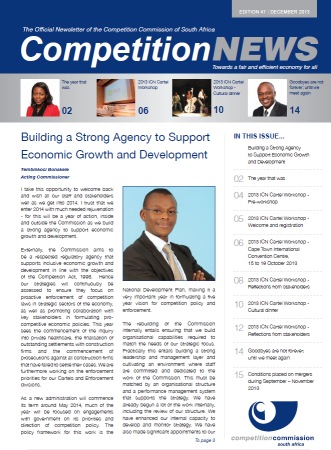
A couple of months after its official release date, the SACC’s latest newsletter, “CompetitionNEWS“ (December 2013 ed. no. 47), is finally out.
For those interested, the South African Competition Commission has published a piece largely consisting of the agency’s internal personnel news and photographs of “cultural dinners” & the like (even screenshots of related tweets?)… One of the only substantive sections appears to be the half-pager on p.15 summarising “conditions placed on mergers during September-November 2013.” Other than that, it’s picture time and a recapitulation of the ICN Cape Town event.
Readers of AfricanAntitrust.com have full access to the PDF here.
The Western Australian government has signed a Memorandum of Understanding with COMESA.
Colin Barnett signed the papers yesterday, January 31, 2014. COMESA dutifully posted a news release on its web site, albeit misspelling the W. Australian premier’s name (“Colin Barnnet“).
Setting aside the embarrassing PR SNAFU, we expect the MoU to have little to no effect on competition enforcement by the COMESA Competition Commission. The MoU appears to us to be primarily minerals-focussed (we note that this should come as no surprise, given the mineral-rich COMESA members and the fact that Western Australia is the world’s second-largest iron ore producer). The six so-called “thematic areas” of the MoU are: fiscal frameworks and mineral policy, strengthening human and institutional capacities, collection and management of geo-scientific information, research and development, environmental and social issues; and linkages, diversification and cluster development. Antitrust/competition is nowhere to be found.
That said, Western Australian companies may choose to invest more in the region and therefore somewhat increase the merger notification statistics, which have been lackluster to date.
The South African Competition Commission (“Commission”) has recently announced that it has concluded its investigation into the major retail grocery stores, namely Shoprite Holdings Ltd, Woolworths Holdings Ltd, the Spar Group Ltd and Pick ‘n Pay Stores Ltd, as well as wholesale retailers, Massmart Holding Ltd and Metcash Trading Africa (Pty) Ltd for alleged contraventions of the Competition Act in relation to exclusive lease agreements.
By way of factual background, the Commission initiated an investigation in 2009 against Shoprite, Woolworths, Spar, Massmart, Metcash and Pick ‘n Pay in which the Commission examined various competition concerns including buyer power, category management, information exchange and long-term exclusive lease agreements. The Commission’s initial investigation uncovered no evidence of competition contraventions, yet subsequently the Commission decided to focus its investigation on the long-term exclusive lease agreements, evaluating whether they could potentially give rise to contraventions of abuse of dominance and restrictive vertical practices.
The Commission’s investigation failed to find sufficient evidence to meet the tests set out in the Competition Act to proceed with the investigation. As a result, the Commission has decided not to refer the matter to the Competition Tribunal, concluding that “on the basis of the evidence before the commission, the anti-competitive effects of the conduct could not be demonstrated conclusively.“
More countries may enter the mix of players – but at the platform level, competition may have stagnated
As we reported last month, the mobile payments sector is going gangbusters on the African continent. Kenya is ahead of the game, but other countries are closing in.
Kenya itself is considered by many to be at the forefront of the African mobile-payments universe, with its M-Pesa mobile-currency system often touted as the most developed mobile-payment system in the world. The Economist asked rhetorically: “Why does Kenya lead the world in mobile money?”, pointing out that roughly 25% of Kenya’s GDP flows through the mobile service, with over 17 million users in Kenya alone. The WorldBank has commented that “Mobile payments go viral [with] M-PESA in Kenya.”
Earlier this week, South African media outlet Business Tech published an interesting comparative piece on the issue, entitled “Africa leads in mobile banking“. The article shows (also graphically, see below) how and South Africa are close rivals to the Kenyan leadership in the mobile payments industry:
Image credit: Business Tech
What triggered the article is the release of the MEF-Africa reporton mobile payments on the continent, which provides much of the content of the Business Tech piece.
One of the key developments highlighted is that M-Pesa’s platform may soon see a major upgrade in South Africa (where it is run by Vocadom and Nedbank), according to the article, linking the system directly with the brick-and-mortar banks’ platforms. This may either (1) cement the relative market dominance of M-Pesa or (2) spur further innovation and enhance the overall competitiveness of the still rather young industry.
The sector has recently been the subject of significant attention from the Commission, the South African health minister in particular, and the S.A. government in general. In spite of the perilous state of South Africa’s public health system, the government appears to have invested more time in deflecting from the obvious problems in the public branch by subjecting the private sector to a costly investigation. From a procedural-history point of view, it is interesting to note that the market inquiry provision was brought into effect by way of Section 6 of the amended South African Competition Act. Although there were other areas of the legislation to be amended, it is noteworthy that only the market inquiry provision was brought into effect.
Many have suspected that the motivation behind the private healthcare inquiry was based on aspirations from outside the ambit of the Commission, particularly since the launch of the South African government’s National Health Insurance policy scheme (designed to achieve the noble aim of universal health insurance coverage, not entirely unlike the United States’ “Obamacare” effort) may ultimately cause the demise of a robust private healthcare sector.
Independence of Commission questioned
With this in mind, what is perhaps most interesting is a recent public submission made by the newly appointed 37-year old Acting Competition CommissionerTembinkosi Bonakele in the South African media. In an article co-authored with Ms. Paremoer, the Commission principal responsible for the healthcare inquiry, entitled “Market inquiries an important advocacy tool” (also published in the Sunday Times), Bonakele attempts to deflect any suggestions of government involvement in (or other ministerial influence over the pursuit of) the market inquiry. This approach seems at odds with Mr Bonakele’s predecessor, Shan Ramburuth – who was unceremoniously let go by the same government in a public display of shaming last year – in seeking to justify the motivation behind the private healthcare inquiry. (We note that the present government has an apparent history of “letting go” unruly cabinet members in unusual and rather bombastic fashion, see here and here.)
Ramburuth’s Commission had previously stated expressly, for instance, that the inquiry was intended at least in part to review the sector for collusive behaviour, while Mr. Bonakele now disavows this rationale and claims that any such findings would merely be a side effect of the inquiry (“[o]f course, during such an inquiry, we may come across anti-competitive practices that need to be rooted out”).
In his piece, the Acting Commissioner seeks to reassure those who “remain confused about the […] intended market inquiry,” and states that the “inquiry is not a stalking horse“:
“we are simply seeking to understand how to improve efficiency and competition” in what he calls the “complicated web” of the healthcare industry.
Is this a case of Shakespearean “the [man] doth protest too much”, especially when keeping in mind that the private healthcare sector has previously been acknowledged to be competitive and efficient. Mr. Bonakele has previously emphasised his independence, despite being referred to in the press as Minister “Patel’s man”:
“I haven’t responded to the media debate out there because I don’t think one has to stand on a mountain and say ‘I’m independent’. Actions speak louder than words.” [Source: BDLive]
Acting Commissioner Bonakele
The aim of the inquiry, according to the Acting Commissioner, is to improve competition and efficiency in the sector to such a degree that the ordinary man on the street will have full access. A very noble goal indeed, but when juxtaposed with the fundamental function and intention of the NHI,it is highly contradictory: the private healthcare sector is, by definition, not in the business of providing access to everybody. The public NHI body’s own slogan, on the other hand, shows that the national insurance programme fulfills precisely that role: “NHI is premised on the ideology that all South Africans are entitled to access quality healthcare services.”
What is perhaps of greater concern (with a wider applicability than just the healthcare sector, public or private) to competition-law enforcement in South Africa as a whole, is the confluence of the government’s industrial policy ambitions with otherwise supposedly independent Commission investigations and its competition adjudication based in the pure law & economics of antitrust. As previously reported in our piece on political interventionism in South African competition law, the Commission should seek to demonstrate its complete independence from the cabinet and executive branch as a whole, and avoid falling into the trap FTC Chairwoman Edith Ramirez warned against: the “proper goals” of competition law are best solved when a competition authority is focused on competitive effects and on consumer welfare and its analysis is not “interrupted to meet social and political goals.”
In sum, one must hope that Mr. Bonakele can be taken at his word when he says that, while “[m]aybe people think the minister will use the commission as a tool, but it’s just not possible. This is a legal process we are talking about.“








 African Antitrust & Competition Law