Kipiani and Tchapga: advancing competition law & economics in Cameroon

Competition Law conference provides most in-depth look at the state of Cameroonian antitrust law

Event organised by Dr. Patricia Kipiani and Prof. Tchapga of Primerio & CEMAC, the Cameroon school of business and its competition law section

What follows is an article that appeared in French in the Le Droit journal, written by Stéphane Ngoh, reprinted here with permission.  An English translation is below.  An interview with Dr. Kipiani related to the conference can be found here.  In it, she discusses the planned creation of a “Competition Observatory” for the country.

Le cabinet Primerio International a organisé un séminaire de sensibilisation aux enjeux du droit et de la politique de la concurrence au Cameroun et dans l’espace de la CEMAC. L’évènement lancé par le ministre du Commerce, M. Luc Magloire Mbarga Atangana s’est déroulé le 7 juillet 2016 au siège du GICAM à Douala.

Présenter la concurrence comme « un bien commun » à la collectivité et « renforcer la pédagogie de la concurrence dans ses dimensions juridiques et politiques» tels peuvent être les maitres mots du premier « rendez-vous de la concurrence» au Cameroun et en CEMAC impulsé par le cabinet d’expertise Primerio International et placé sous le thème «Du droit et de la politique de la concurrence au Cameroun et dans l’espace CEMAC ».  Comme pour en souligner toute l’importance, le ministre du Commerce du Cameroun, Luc Magloire Mbarga Atangana, a fait le déplacement de la capitale économique dans l’optique d’en présider le lancement officiel. Le Docteur en droit et avocate au barreau de Bruxelles, Mme Patricia Kipiani, qui représentait le cabinet Primerio International pour l’occasion a expliqué combien cette première édition des « rendez-vous de la concurrence », se voulait sérieuse. Toute chose ayant justifié l’association aussi bien des universitaires de tous bords, du groupement inter-patronal du Cameroun (Gicam) que des autorités publiques camerounaises. Les Chercheurs de l’Université de Paris 1 Panthéon-Sorbonne en France et les spécialistes du droit de la concurrence, le Professeur des universités Martine Behar-Touchais et l’enseignant-chercheur Laurent Vidal ont fait le déplacement du Gicam.

1425573796Le ministre du Commerce, qui intervient comme l’autorité publique de tutelle du secteur de la concurrence, a tenu à préciser que les rendez-vous de la concurrence ne pouvaient mieux tomber dans un contexte communautaire et camerounais situé à « la veille de l’entrée en vigueur des Accords de partenariat économique « APE », entre les pays ACP et l’UE dont le Cameroun est partie », ces accords qui impliquent une ouverture de l’économie imposent donc qu’un certain accent soit mis sur le droit et la politique de la concurrence. Au demeurant, le représentant de l’Etat du Cameroun à ce rendez-vous a tenu à réaffirmer la place reservée jusqu’ici à la concurrence, « notre conviction, a –t-il expliqué, est que le commerce a besoin d’un environnement sain et c’est la raison pour laquelle un arsenal des textes législatives ou règlementaires existe au Cameroun et cela témoigne de la volonté de l’état de réguler le secteur ». A l’appui de son affirmation, M. Luc Magloire Mbarga Atangana a soutenu que la volonté et la détermination du Cameroun à faire du droit de la concurrence un enjeu de poids, se traduit depuis des années. Pour s’en féliciter, il souligne que les premières velléités d’encadrement de la concurrence remontent aux années1990 et qu’autant les lois ont créé la Commission nationale de la concurrence (Cnc) autant des décrets  en ont fixés les contours organisationnels et structurels. Le président de ladite Commission Léopold Boumsong, qui était dans la suite du Mincommerce, a été appelé à présenter les aspects nationaux de la concurrence et précisément le rôle de la Commission nationale de la concurrence. Ce rôle, comme l’a martelé le ministre, doit s’attacher à « poursuivre et sanctionner les pratiques anticoncurrentielles, en s’appuyant sur des textes datant et nouveau à l’instar de la loi cadre protection sur la consommation, de la nouvelle loi portant organisation des activités commerciales ainsi que la loi sur commerce extérieur ».

TROIS GRANDES PRATIQUES ANTICONCURRENTIELLES

cameroonLe président de la Cnc a précisé à l’égard des chefs d’entreprises qui emplissaient la salle du Gicam qu’il existe sommairement 3 types de pratiques qui ont « pour effet d’empêcher, de fausser ou de restreindre de manière sensible, l’exercice de la concurrence au niveau du marché intérieur » au sens de la loi n°98/013 du 14 juillet 1998 relative à la concurrence. Il s’agit des abus d’une entreprise ou d’un groupe d’entreprises en position dominante sur le marché, des fusions et acquisitions d’entreprises et aussi des accords anticoncurrentiels. L’un dans l’autre, il est apparu que les pratiques anticoncurrentielles au Cameroun sont constatées par procès-verbal dressé par les membres de la Commission suite aux enquêtes consécutives à une plainte d’une personne physique ou morale ou à celles initiées par eux-mêmes.

Par la suite, les aspects multilatéraux de la concurrence ont été évoqués au travers de la présentation du rôle de la Conférence des Nations Unies sur le Commerce et le Développement (CNUCED) en matière l’accompagnement des politiques de concurrence. L’économiste de la CNUCED, Yves Kenfack a découvert le code CNUCED de la concurrence dont il a salué la pertinence tout en regrettant que celui-ci ne soit pas contraignant pour les Etats signataires.

Un autre moment des échanges a porté sur les aspects croisés entre le point de vue de l’économiste et celui du juriste quant à la concurrence. C’est M. Flavien Tchapga, économiste, consultant lui aussi à Primerio International et professeur associé à l’Université Senghor d’Alexandrie, qui s’y est attelé face à l’auditoire de la salle des conférences du Gicam. L’intervention de ce dernier peut se ramener à une suggestion forte faisant suite à l’interrogation suivante : « peut-on réussir la sensibilisation sur la concurrence si l’on ne tient pas compte des spécificités de l’environnement local ? ». Réponse, en effet, dans un contexte où 9 entreprises sur 10 sont individuelles, il faut se méfier des formules des juristes qui sont souvent larges et complexifiées pour les économistes plus proches du terrain.

Au cours du rendez-vous de la concurrence, une table-ronde a été ouverte pour asseoir la dimension didactique de la rencontre. Les débats et les questions étaient placés sous la houlette de M. Martin Abega, administrateur de sociétés, ancien membre de la Commission nationale de la concurrence et Consul honoraire du Royaume des Pays-Bas au Cameroun.

En dernière analyse, les expériences pratiques de règlementations et de politiques de la concurrence en Europe et au Cameroun ont clairement été croisées par le biais de Martine Behar-Touchais et Laurent Vidal d’une part et de Me Abdoul Bagui d’autre part. Etant entendu qu’au Cameroun, la régulation est émiettée par secteur d’activités.

Ce sont concrètement toutes les difficultés liées au libre exercice de la concurrence qui ont été passées au crible. La contrebande, la persistance des monopoles dans certains domaines ou encore la contrefaçon relèvent de ces écueils épluchés par les soins des experts internationaux et locaux à l’instar des représentants du CNUCED, de CEMAC, de l’OHADA et surtout des entreprises camerounaises. Le Dr. Patricia Kipiani a expliqué qu’il était important que « les réflexions et les échanges reviennent sur les difficultés auxquelles se heurtent les entreprises, sur les difficultés liées à la concurrence déloyale, à leur impact sur le secteur informel et autres activités informelles des entreprises formelles. Et aussi qu’ un accent soit mis sur la réglementation et sur les politiques économiques susceptibles de promouvoir notre espace économique ».

Stéphane Ngoh


For our English readers, below is a Google Translate version in English of the article:

The international  firm Primerio organized an awareness seminar on issues of law and competition policy in Cameroon and in the CEMAC zone. The event launched by the Minister of Trade, Luc Magloire Mbarga Atangana Mr. took place July 7, 2016 at the headquarters of GICAM in Douala.

Introduce competition as a “common good” to the community and “strengthen the teaching of competition in its legal and political dimensions” — such are the watchwords of the first “meeting competition” in Cameroon and driven CEMAC by the consultancy firm Primerio International and under the theme “from the law and competition policy in Cameroon and in the CEMAC.” As if to emphasize the importance, the trade minister of Cameroon, Luc Magloire Atangana Mbarga, made the trip from the economic capital with a view to chair the official launch. The Doctor of Law and lawyer at the Brussels Bar, Patricia Kipiani, who represented the firm Primerio International for the occasion explained how this first edition of “appointments of competition”, was meant seriously. Anything that justified the association both academics of all stripes, the inter-group employers of Cameroon (Gicam) that the Cameroonian public authorities. The researchers from the University of Paris 1 Panthéon-Sorbonne in France and specialists from the competition law, the University Professor Martine Behar-Touchais and Laurent Vidal teacher-researcher made the trip from Gicam.

Minister of Commerce, which acts as a public authority supervising the sector to competition, has insisted that the appointment of the competition could not get better in a community and Cameroonian context located “on the eve of the entry into force of the economic partnership agreements ‘EPAs’, between the ACP countries and the EU which Cameroon is a party “, these agreements which involve opening up the economy therefore require that a certain emphasis on law and the competition policy. Moreover, the representative of the State of Cameroon to this appointment held to reaffirm the place reserved far in the competition, “our conviction has -t he explained, is that the trade needs a healthy environment and that is why an arsenal of legislative and regulatory texts exist in Cameroon and it demonstrates the willingness of the state to regulate the sector. “ In support of its contention, Luc Magloire Atangana Mbarga argued that the will and determination of Cameroon to the competition law of a weight issue, resulting in years. To be welcomed, he stressed that the first framework for competition ambitions date back to the 1990’s and that so many laws created the National Competition Commission (CNC) as decrees have laid the organizational and structural contours. The president said Leopold Commission Boumsong, who was later in the MINCOMMERCE, was called to present the national aspects of competition and specifically the role of the National Competition Commission. This role, as insisted the minister, must strive to “prosecute and punish anti-competitive practices, based on texts dating and new like the law under protection on consumption, the new law on the organization of business and the foreign trade Act. “

THREE MAJOR ANTI-COMPETITIVE PRACTICES

The president of the CNC said against business leaders who filled the room Gicam there summarily 3 types of practices which have “the effect of preventing, distorting or restricting significantly, the year of competition in the internal market “under law No. 98/013 of 14 July 1998 on competition. This is abuse of a company or group of companies in a dominant market position, mergers and acquisitions as well as anti-competitive agreements. One the other, it appeared that anti-competitive practices in Cameroon are recorded in minutes drawn up by the Commission of the members following the investigations following a complaint from a natural or legal person or those initiated by them -Same.

Thereafter, the multilateral aspects of competition were discussed through the presentation of the role of the United Nations Conference on Trade and Development (UNCTAD) in support for competition policy. The economist of UNCTAD, Yves Kenfack discovered the UNCTAD code of competition which he praised the relevance while regretting that it was not binding on the signatory states.

Another moment of trade covered the Crusaders aspects between the views of the economist and that of the lawyer about the competition. It was Mr. Flavien Tchapga, economist, consultant also to Primerio International and associate professor at the Senghor University of Alexandria, which it is harnessed facing the audience of the Gicam conference room. The intervention of the latter can be reduced to a strong suggestion in response to the following question: “can we succeed awareness on competition if it does not take into account the specificities of the local environment? “. Response, in fact, in a context where 9 out of 10 companies are individual, beware formulas lawyers who are often larger and more complex to the nearest economists ground.

During the appointment of the competition, a panel discussion was opened to establish the educational dimension of the encounter. The debates and issues were under the leadership of Mr. Martin Abega, corporate director, former member of the National Competition Commission and Honorary Consul of the Kingdom of the Netherlands in Cameroon.

Ultimately, the practical experiences of regulations and competition policies in Europe and Cameroon have clearly been crossed through Martine Behar-Touchais and Laurent Vidal one hand and Mr. Abdul Bagui other. It being understood that in Cameroon, regulation is broken by sector.

These are all practical difficulties related to the free exercise of competition that were screened. Smuggling, the persistence of monopolies in certain areas or counterfeiting within these pitfalls peeled for the service of international and local experts like the representatives of UNCTAD, CEMAC, OHADA and especially Cameroonian companies. Dr. Patricia Kipiani said it was important that “the reflections and exchanges back on the difficulties firms face, the difficulties related to unfair competition, their impact on the informal sector and other informal activities formal businesses. And also that an emphasis on regulation and economic policies that promote our economic space. “

Administrative Penalties & Behavioural Remedies – Two Sides of the Same Coin?

By AAT Senior Contributor, Michael-James Currie.

In the wake of the dust settling around the recent settlement agreement reached between ArcelorMittal (AMSA) and the South African Competition Commission (SACC), it may be an opportune time to consider the appropriateness of behavioural penalties levied in respect of firms engaging in cartel conduct or abuse of dominance practices.
AAT Header squareIn terms of the AMSA settlement agreement, AMSA admitted to contravening the cartel provisions contained in the Competition Act and agreed to pay a R1.5 billion (in instalments of no less than R300 million per annum for five years) administrative penalty. In addition to the administrative penalty, AMSA also agreed to invest approximately R4,6 Million into the South African economy for the next 5 years (provided the prevailing economic conditions render such investment feasible) by way of CAPEX obligations.

Furthermore, a pricing remedy was imposed on AMSA in terms of which AMSA undertook not to generate earnings before interest and tax of more than 10% for the next five years (which could be amended on good cause shown, but was capped, in any event, at 15%).

The nature of the settlement terms as agreed to by AMSA is not, however, a novel feature in settlements before the South African Competition Authorities. In 2010, the Competition Commission settled its investigation in relation to Pioneer Foods’ activities in the maize and wheat milling, baking, poultry and eggs industries (the settlement came after the Competition Tribunal had already imposed a R197 million administrative penalty against Pioneer in respect of its participation in a bread cartel).

In terms of the settlement agreement, Pioneer undertook to:

  • pay R250 million as an administrative penalty to National Revenue Fund;
  • pay R250 million to create an Agro-processing Competitiveness Fund to be administered by the Industrial Development Corporation (IDC);
  • increase its capital expenditure by R150 million over and above its currently approved capital expenditure (capex) budget; and
  • cooperate with the Competition Commission in the ongoing investigations and prosecutions of the cases that are the subject of this settlement; and stopping anti-competitive conduct and implementing a competition compliance programme.

Furthermore, and more recently, the consent agreement with edible fats producer Sime Darby Hudson Knight (“Sime Darby”), is a further example of a consent order which included financial undertakings in addition to paying an administrative penalty.

In terms of this consent agreement, Sime Darby undertook to invest and establish a warehouse for the distribution of its products into territories which it had previously not distributed its products into, due to the market allocation agreement which formed the basis of the complaint. Sime Darby also committed to contributing to funding the entry of a BEE distributor.

What is evident from the above three examples is that over and above the administrative penalty which may be imposed on a respondent, the financial impact of the additional behavioural and public interest related conditions may substantially exceed the administrative penalty itself.

It is, therefore, an important factor for respondents who find themselves in settlement negotiations with the Competition Commission to consider alternative terms of settling a matter as opposed to merely focussing on the administrative penalty itself.

From an agency’s perspective, the costs associated with behavioural conditions must be carefully weighed up as they also tend to require ongoing, and occasionally extensive oversight by the authorities. Furthermore, it is important to ensure that behavioural remedies are not abused, both by the authorities and by respondents.

south_africaWhile settlement negotiations are inherently flexible, it is important that agencies ensure an objective and a transparent methodology in the manner in which they approach the quantification of a settlement agreement. This has certainty been strived for by the Competition Commission when it elected to publish Guidelines on the Determination of the Calculation of Administrative Penalties (Guidelines). The objectives of the Guidelines, may however, be undermined in light of the broader behavioural and public interest related conditions imposed in recent cases.

A clear and objective point of departure would be favourable for both the agency itself and the relevant respondent in being able to conclude settlement negotiation expeditiously.

A further important consideration, which is particularly highlighted in the AMSA settlement agreement, is whether the remedies provide for an adequate deterrent factor and/or address the relevant harm.

Importantly, in the AMSA matter, AMSA’s R4.6 million CAPEX expenditure investment was as a result of a complaint into alleged abuse of dominance. In terms of the settlement agreement, AMSA did not admit liability for having engaged in abuse of dominance practices.

In light of the fact that the Competition Commission generally requires an admission of liability before concluding a consent order, it is not clear to us, at this stage, why the Commission elected not to demand an admission of liability in relation to the abuse of dominance complaint.

It may be that the Commission did not wish to spend the significant resources in prosecuting an abuse of dominance case, or that the Commission took the view that any abuse of dominance finding would likely only be in respect of the general prohibition against exclusionary conduct, as per Section 8(c) of the Competition Act, which carries no administrative liability for a first time offence.

Accordingly, it may have been a strategic weighing up of the ‘costs versus likely penalty’ which shaped the Commission’s strategic decision.

Whether or not such a strategic decision is justified is not a particular focus of this article. What we do wish to highlight, however, is that absent an admission of liability, a third party who seeks to pursue follow-on damages will be precluded from bringing a civil damages claim against AMSA. This was confirmed by the Supreme Court of Appeal in the Premier Foods matter in 2015.

The Media 24 Case

Shifting our train of thought to another issue, although not unrelated, is the question as to what exactly constitutes an administrative penalty?

The question was raised, although ultimately not decided by the Competition Tribunal in the recent Media 24 predatory pricing case.

After having been found guilty by the Competition Tribunal, in 2015, for contravening section 8(c) of the Competition Act (for engaging in ‘predatory pricing’), a separate hearing was held to determine the appropriate sanction. As mentioned above, an administrative penalty is not permissible for a first time offence of section 8(c) of the Act.

At the hearing the Competition Commission had proposed, as one of its remedies that Media 24 undertake to establish a R10 million development fund to fund a new entrant into the market.

Media 24 objected to the proposed remedy and raised the argument that the remedy proposed by the Commission would effectively be an administrative penalty, which is not a permissible sanction in terms of the Competition Act.

The Competition Tribunal elected to evaluate the remedy from a practical perspective, finding that the proposed remedy would not be suitable or effective, but deliberately kept open the legal question as to whether or not a remedy which requires any financial commitment from the respondent would effectively amount to an administrative penalty.

The question is rather vexing and may require clarification in due course.

Assuming that the proposed remedy in the Media 24 case would indeed amount to an administrative penalty, the question would naturally arise whether a CAPEX undertaking, as was the case in the AMSA matter discussed above, would also be considered a form of an administrative penalty. If so, then due consideration should be had as to whether the aggregation of the ‘stated administrative penalty’ (i.e. the R1.5 billion in AMSA’s case) together with the behavioural remedies imposed in AMSA (a minimum of R4.6 billion), should be calculated for purposes of determining whether the statutory cap of 10% of a firm’s turnover has been exceeded.

Alternatively, if the Competition tribunal ultimately decides that the proposed remedy in Media 24 is not an administrative penalty as contemplated in terms of the Competition Act, then effectively, we may see an entire new paradigm in the manner in which firms are sanctioned for contravening the Competition Act. For instance, those provisions of the Competition Act which do not cater for an administrative penalty for a first time offence (i.e., certain vertical, horizontal and abuse of dominance practices), may in any event result in respondents paying substantial ‘penalties’ for contravening these provisions.

Furthermore, respondents may not be afforded the protection which the statutory cap places on administrative penalties. As noted above, a firm may be subjected to an administrative penalty which does not exceed 10% of its annual turnover, but the net effect of the respondent’s financial liability may indeed exceed the cap.

While we do not pronounce our views on this issue, suffice it to say that firms engaging with the Competition Authorities with a view of concluding a settlement agreement are entering into a ‘new world’ and there are a number of options, avenues and risks associated in ultimately negotiating a settlement.

Accordingly, the issues raised above may be particularly useful in the manner in which firms embark on their settlement strategies.



CCC Begins Conduct Enforcement & Activates Its Exemption Regime for Potentially Anti-Competitive Agreements

Parties Start Discussing Business Practices with COMESA’s CCC

As AAT reported recently — see “Growing Pains: From One-Trick Pony to Full-Fledged Enforcer?” — the COMESA Competition Commission (CCC) has begun to move from being a pure merger-control administrator to becoming a full-fledged antitrust enforcer.  The CCC issued a Notice calling on firms to notify the CCC of any agreements (both historic and forward-looking) that may be anti-competitive, for the purpose of having such agreements ‘authorised’ or ‘exempted’ under Article 20 of the COMESA Competition Regulations.  (More details on that regime are in our June article, referenced above.)

Eveready products (sample)

AAT has now learned that several companies have taken the agency up on its Exemption proposal: Andreas Stargard, a competition practitioner with Primerio Ltd. observes that the CCC’s announced “leniency ‘window’ to incentivise firms to come forward and obtain an exemption” has closed at this point in time, although he expressed doubt that the relatively short one-month period was sufficient and will likely be extended.  Says Stargard: “We are seeing several parties, both global & local companies, who are beginning to take the CCC’s non-merger enforcement seriously.  These undertakings are considering to obtain advance clearance of their business practices under the Commission’s Notice procedure.”  One such example, he adds, is Kenya’s financially embattled Eveready East Africa: it has reportedly sought CCC approval of its agreements with international manufacturers for the importation and distribution within the COMESA common market of their diverse products, ranging from batteries to fountain pens to CloroCOMESA old flag colorx-brand chemicals.  The Commission has invited “general public and stakeholders” for comments according to its formal statement.
In light of these developments, Stargard advises that:
“multi-national firms operating within COMESA or jointly with a COMESA-based importer or other domestic business partner should consider engaging counsel to evaluate their practices, and if they may fall within Article 16 of the Regulations, consider approaching the CCC for an authorisation letter.”


COMESA sees slight uptick in merger notifications

Merger filings still dither, but YTD numbers now tentatively promise to exceed FY2015

Making sense of the COMESA Competition Commission’s merger notification site is no  easy undertaking.  The perplexing nature of its case-numbering system mirrors perhaps only the level of confusion surrounding the CCC’s original merger threshold and notification-fee guidelines (e.g., see here on that topic).

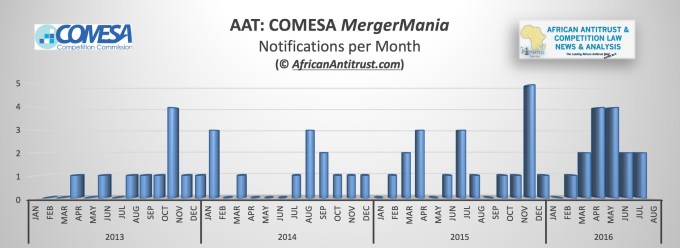
As we pointed out here, the merger statistics (as they had been released as of January 2016) for 2015 were disappointingly low.  In today’s post, please note that we are upgrading those numbers, however, to reflect additional material now made available on the official CCC web resource, reflecting 3 additional filings, bringing the year-end total for FY2015 to 18.  Three of those were “Phase 2” cases.  In addition, according to the CCC, there were 3 supplemental cases in which “Comfort Letters” were issued to the parties.

For year-to-date 2016 statistics, the numbers look analogous, albeit somewhat higher than the 2015 slump — that is to say, still diminished from the 2013-2014 height of COMESA ‘mergermania’, during which (mostly international) counsel took the confusion surrounding the CCC notification thresholds to heart and erred on the side of caution (and more fees), advising clients to notify rather than not to (65 in the 2 years), or to seek Comfort Letters, which also were issued in record numbers (19 total for the 2-year period)…   With that said, the agency is now up to 16 merger cases, with 2 Second-Phase matters on deck.

AAT 2016 September mergermania statistics
Number of merger notifications based on CCC-published notices (using educated inferences where the original CCC case numbers, dates and/or descriptions lack intelligibility; note that 2013-14 statistics only reflect actual filings made available online and not the official statistics issued by the CCC of 21 and 43, respectively)                                                                         (c) AfricanAntitrust.com

“The WRAP” — our monthly summary of antitrust developments across the continent

AAT Header square

Competition-Law Developments: a WRAP from the Comp-Corner

Issue 2 – August 2016

The editors and authors at AAT welcome you to the second edition of “The WRAP.”

We look at the most recent developments and updates in respect of competition law and enforcement which has taken place across the African continent in recent months.

As always, thank you for reading the WRAP, and remember to visit us at AAT for up-to-date competition-law news from the African continent.

         –Ed. (we wish to thank our contributors, especially Michael James Currie, for their support)

Antitrust conference hosted by Pr1merio, CEMAC & Cameroonian Ministry

This Thursday, June 7th, 2016, the Ministry of Trade & Commerce of Cameroon, the CEMAC organisation of states, and law boutique Pr1merio, will host an all-day conference on competition law & business in Africa, taking place in Douala, Cameroon.

1425573796The brochure and press communiqué are available online.  Dr. Patricia Kipiani, the host of the event, legal scholar and Pr1merio attorney, notes that the event is almost sold out and few seats remain.  “We are excited to host the first-ever antitrust conference of its kind in Cameroon,” Kipiani notes.  “Our platform allows us to work directly with both scientific, scholarly, and governmental advisors to create fora like these, where experts are able to discuss cutting-edge issues in the burgeoning field of competition law on the continent,” adds Prof. Flavien Tchapga, who will also speak at the event.


Growing Pains: From One-Trick Pony to Full-Fledged Enforcer?

COMESA Competition Commission Expands Enforcement Ambit from Merger Control to Conduct —

CCC Seeks Information on “Potentially” Anti-Competitive Agreements

By AAT Senior Contributor, Michael-James Currie.

Breaking News: The COMESA Competition Commission (CCC) has issued a notice (the “Notice”) calling on firms to notify the CCC of any agreements (both historic and forward looking) that may be anti-competitive, for the purpose of having such agreements ‘authorised’ or ‘exempted’ in terms of Article 20 of the COMESA Competition Regulations (the “Regulations”).

In terms of Article 20 of the Regulations, agreements which are anticompetitive may be exempted by the CCC if such an ‘anticompetitive agreement’ contributes positively to the ‘public interest’ to the extent that the public interest benefit outweighs the anti-competitive effect.

In terms of the CCC’s notice 1/2013, the following agreements may well be considered to be in the public interest when evaluating whether an anti-competitive agreement or concerted practice should be exempted:

  • Joint research and development ventures;
  • Specialisation agreements; and
  • Franchising agreements

As to the agreements or concerted practices which may be anti-competitive, the Notice refers specifically to the restrictive business practices listed in Article 16 of the Regulations which states that:

The following shall be prohibited as incompatible with the Common Market:

all agreements between undertakings, decisions by associations of undertakings and concerted practices which:

(a) may affect trade between Member States; and

(b) have as their object or effect the prevention, restriction or distortion of competition within the Common Market.”

It should be noted that Article 16 is deliberately drafted broadly so as to prohibit conduct which has as its “object” the prevention, restriction or distortion of competition. Certain conduct, such as price fixing, fixing of trading terms or conditions, allocating suppliers or markets or collusive tendering may be considered as having as its ‘object’ the distortion or restriction of competition in the market. Accordingly, firms who have engaged in this type of conduct may be held liable in the absence of any evidence of an anti-competitive effect (whether actual or potential).

Says Andreas Stargard, a competition practitioner with Primerio Ltd., “[t]he CCC’s notice is a clear sign that the agency is gathering momentum in its efforts to detect and prosecute anticompetitive practices within the member states — and is going beyond its ‘one-trick pony’ status as a pure merger-control gatekeeper.  We anticipate a more active role by the CCC in conduct investigations and presumptively also enforcement actions, as opposed to its previous rubber-stamping activity of approving transactions with a COMESA community dimension (and concomitant collection of vast filing fees).”

The CCC has recently signed a number of Memoranda of Understanding and Cooperation Agreements with various member states as well as a tripartite agreement with other broader regional forums such as the Southern African Development Community and the East African Community.

COMESA old flag colorThe web of MoU’s recently concluded, which have as their primary objectives the facilitation of information exchanges and cooperation between competition agencies, is certainly a significant stride made to assist the authorities, including the CCC, in detecting and prosecuting anticompetitive practices which may be taking place across the African continent.

A further indication of the CCC’s growing appetite and confidence to identify anticompetitive practices is that the CCC has announced that it is conducting a market enquiry into the grocery retail sector.  This is the first market inquiry to be conducted by the CCC.

In terms of the CCC’s Notice, firms who have not yet notified the CCC of agreements which may be anticompetitive, have approximately one month to do so. In other words, the CC has offered a leniency ‘window’ to incentivise firms to come forward and obtain an exemption in respect of agreements already implemented which may be in contravention of Article 16 of the Regulations.


“The WRAP” from last month – a new semi-serial publication

South African Antitrust Developments: a WRAP from the Comp-Corner

Issue 1 – May 2016

The editors and authors at AAT welcome you to our new semi-serial publication: “The WRAP.”  In this first WRAP edition, we look back over recent months and provide an overview of the key recent developments which antitrust practitioners and businesses alike should take note of in respect of merger control and competition law enforcement.

As always, thank you for reading the WRAP, and remember to visit AAT for up-to-date competition-law news from the African continent.

         –Ed. (we wish to thank our contributors, especially Michael Currie, for their support)

Antitrust exemption regime: Value-add or underutilized?

Professional Associations in Kenya not Making Use of Exemption Provisions a Major Concern for Competition Authority

Continuing in our series about the burgeoning East African Community and its nascent antitrust regime, AAT contributing author and Pr1merio attorney, Elizabeth Sisenda, writes a second installment covering the exemption regime of the region and its (surprising) underutilized status to date.

Elizabeth Sisenda, LL.M (London) LL.B (CUEA) PGD Law (KSL)

Price-fixing in Kenya is prohibited under the Competition Act No. 12 of 2010 under Section 21 (3) (a) which provides that any agreements, decisions or concerted practices which directly or indirectly fix purchase or selling prices or any other trading condition is prohibited under the Act, unless they are exempt in accordance with the provisions of Section D of Part III.

Part III B further prohibits price-fixing by trade associations under Section 22 (b) (i) which provides that the making, indirectly or directly, of a recommendation by a trade association to its members or to any class of its members which relates to the prices charged, or to be charged by such members, or to any class of members, or to the margins included in the prices, or to the pricing formula used in the calculation of those prices, constitutes a restrictive trade practice under the Act.

Section 29 (1) of the Act further outlines the rules for exemptions in respect of professional associations. It provides that a professional association whose rules contain a restriction that has the effect of preventing, distorting or lessening competition in a market must apply in writing or in the prescribed manner to the Competition Authority for an exemption. Sub-section (2) goes on to explain what factors the Authority considers in order to grant an exemption for a specified period. These include:

  • Maintenance of professional standards
  • Maintenance of the ordinary functioning of the profession
  • Internationally applied norms

Section 29 (5) further gives discretion to the Authority to revoke an exemption in respect of such rules or the relevant part of the rules, at any time, if the Authority considers that any rules, either wholly or in part, should no longer be exempt under this section. For instance, if they no longer promote consumer welfare or do not enhance standards in the profession.

Price setting concerns by Law Society of Kenya, LSK

kenyaProfessional fees for advocates in Kenya are set by the Chief Justice under the Advocates Act Chapter 16 of the Laws of Kenya. Part IX Section 44 provides that the Chief Justice may by order prescribe and regulate in such manner as he/she thinks fit the remuneration of advocates in respect of all professional business, whether contentious or non-contentious. Sub-section (2) also provides that the Chief Justice may prescribe a scale of rates of commission or percentage in respect of non-contentious business.

However, Section 45 provides that agreements in respect of remuneration may be made between the advocate and the client subject to permissible professional rules under section 46 of the Act. Therefore, as much as the Chief Justice may set professional fees under the Act, there is an opportunity for the advocate and the client to agree on professional fees subject to the Act. Moreover, a client has redress to apply to the courts under Section 45 (2) to set aside or vary such an agreement on grounds that it is harsh, unconscionable, exorbitant or unreasonable according to professional practice. The decision of the court on this matter is final.

The Chief Justice periodically revises the Advocates Remuneration Order which sets out the scale of professional legal fees. In doing so the Chief Justice considers factors such as inflation and the costs of providing legal fees. The Kenyan Advocates Remuneration Order was last revised upwards in 2014, increasing professional fees by 50%. The Order was last revised in 1997. Advocates had petitioned the Chief Justice to do so in order to enable them cope with tough economic conditions. Recently there was a public discourse on whether advocates should have set fees. Stakeholders argue that the Chief Justice’s decision to adjust fees may not be entirely objective because since he or she has qualifications in law, and could revert to the profession upon retirement from office.

LSK on the other had contends that the minimum fees help protect consumers from poor services, and it reduces the price wars that would occur without the scale of fees. Under the Advocates Act, charging below the set scale of fees amounts to undercutting. This is a professional offense that could result in the concerned advocate being suspended or struck off the roll. Moreover, any agreements or instruments prepared by the concerned advocate are liable to be invalidated by the courts.

The question arose among legal stakeholders as to whether the Authority could intervene in relation to the scale of professional fees under the provisions on price-fixing. The LSK chairperson recently commented that it is beyond the jurisdiction of the Authority, as the Remuneration Order seeks to set minimum fees and not a fixed rate. However, it is clear from the provisions of Section 29 that any professional body whose rules, having regard to internationally applied standards, contain any restrictions which have the effect of preventing or substantially lessening competition in a market, must apply to the Competition Authority for an exemption of the said rules.

Price Setting Concerns by Association of Kenya Reinsurers, AKR

The Association of Kenya Reinsurers is regulated by the Kenya Reinsurance Corporation Limited Act, Cap 487A of the Laws of Kenya. The Association consists of the following companies: Kenya Reinsurance Corporation Limited, Africa Reinsurance Corporation Limited, East Africa Reinsurance Company, Zep – Re and Continental Reinsurance Limited. The Authority recently investigated this association for price fixing following a complaint lodged from the National Intelligence Service (NIS). The association, through a circular dated 2, October 2013, had advised its members on the minimum applicable premiums upon renewal of NIS Group Life Scheme for 2013/2014. Insurance companies are required by their regulator Insurance Regulatory Authority (IRA) to use an independent actuary to come up with their own individual premium rates, which they file with the IRA for approval.

The association is required under the Competition Act Section 29 (1) to apply in the prescribed manner to the Authority for an exemption in relation to any anti-competitive rules. Section 22 (2) (b) also prohibits the making, directly or indirectly, of a recommendation by a trade association to its members, or to any class of its members which relates to the prices charged, or to be charged by such members, or any such class of members, or to the margins included in the prices, or to the prices, or to the pricing formula used in the calculation of those prices. Therefore, the Association is legally bound to seek the approval of the Authority in order to set a minimum fee for any particular group of consumers. Moreover, the association may be in violation of Section 21 (f) of the Competition Act which prohibits any decisions by associations of undertakings which applies dissimilar conditions to equivalent transactions with other trading parties, thereby placing them at a competitive disadvantage, unless they are exempt in accordance with the provisions of Section D of Part III.

Conclusion

In conclusion, professional associations in Kenya should take advantage of the provisions of Section 29 of the Competition Act which allow professional associations to apply rules whose effect is the lessening of competition in the market, provided they are applied to enhance professional standards, the ordinary functioning of the profession or internationally applied norms for the benefit of consumers.


Criminal Antitrust: South Africa begins to enforce felony provisions

Price-fixers face up to 10 years prison time, starting May 1st

Prison time for executives is now firmly on the not-so-distant horizon in South Africa: As reported in some media outlets, the criminalisation of certain hard-core (and possibly lesser) antitrust offences is finally being implemented in the Republic — notably after more than 8 years of the relevant legislation technically being on the books.

white collar crimeWe are referring to the “phased” implementation of the 2009 Competition Amendment Act.  The legislation technically criminalised hard-core antitrust offences such as bid-rigging or price-fixing cartels.  However, President Zuma has, until now, not yet implemented or effectively signed the criminal provision of the Act (section 73A) into law.

Enter his Economic Development Minister, Ebrahim Patel:

Patel signature on 73AAccording to news reports, Mr. Patel announced today (Thursday), that the criminalisation of the price-fixing cartel offence would henceforth be enforced.  Section 73A will be gazetted tomorrow, 22 April 2016, and hold the force of law from 1 May 2016.  BDLive also reports that even the lesser “abuse of dominance” (or more commonly “monopolisation”) offence would be subject to the criminal penalties, but AAT is awaiting independent confirmation on this subject.  As Andreas Stargard, a U.S.-based Pr1merio antitrust practitioner with a focus on Africa and experience counseling clients in criminal competition matters, explains:

“If Mr. Patel indeed made this statement, and I doubt this, it would signal a departure from the rest of the world’s antitrust regimes: It is highly uncommon to have the monopolisation offence constitute a criminal act — indeed I am aware of no jurisdiction where this is the case.

In the United States, the only conduct constituting a Sherman Act offence pursued by the DOJ as a potential felony involve so-called ‘hard-core’ violations.  This would include horizontal price-fixing among competitors; territorial allocations; output allocations; and bid-rigging.  The same holds true in the UK.  That said, monopolisation or abuse of dominance is simply not among the criminalised antitrust violations elsewhere, and I’d be surprised if South Africa took this unusual path.

We have since been able to confirm that the BDLive report incorrectly refers to abuse of dominance as being criminalised.  AAT has obtained a copy of Mr Patel’s speech which provides clearly only for cartel conduct to be subjected to imprisonment:

“We are confident that because our work on cartels over the past five years has given clarity in the market on what collusion entails and what kind of acts falls within prohibited practices, we can now step up our efforts to the next level in our endeavor to combat corruption, cartels and anti-competitive conduct that raise prices and keep businesses and new entrants out of local markets.

Accordingly, government will tomorrow gazette a Presidential Proclamation that brings into effect certain sections of the Competition Amendment Act, with effect from 1 May 2016, which make it a criminal offence for directors or managers of a firm to collude with their competitors to fix prices, divide markets among themselves or collude in tenders or to acquiesce in collusion and they expose themselves to time in jail if convicted.”

The Patel announcements come ahead of his upcoming budget vote speech, and as he has shown in recent months, Mr. Patel is a proud advocate for tougher competition enforcement in the country.  “We want to make sure that it just does not make sense to collude,” he is reported as saying today.  This follows the Minister’s speech during the Parliament debate in February, where he announced that, “we will now introduce measures shortly to make it a criminal offence in any industry to collude and fix-prices. It will send a message to everyone that we mean business on stamping out corruption and collusion. We must build competitive strengths through innovation, not through sitting in rooms somewhere fixing tenders, prices and contracts.”

White-collar crime: it pays, but is getting riskier

white collar crime 2We live in the era of the Panama Papers, where the notion of white-collar business people going to jail is not an entirely unlikely outcome for some.  Antitrust offences, however, have historically not been enforced worldwide as stringently as public corruption or tax-evasion matters, for instance.  Key jurisdictions with criminalisation of competition offences remain few, notably the U.S. and the UK.

In South Africa, since at least 2014, both Competition Commissioner Tembinkosi Bonakele and Minister Patel have been engaging in discussions on how and when to implement the Act “to ensure that the necessary institutional capacity is available to apply the [criminal] amendments.”  While some provisions (relating to the agency’s market-inquiry powers) went into effect in 2013, the criminalisation provisions remain unimplemented to date — but this is about to change.

During these negotiations, as reported on AAT, the minister and SACC admitted in a remarkable self-assessment that the Commission then lacked “the institutional capacity needed to comply with the higher burden of proof in criminal cases.”  One notable aspect of potential discord lies in not only in the different standard of proof in civil vs. criminal matters (“more probable than not” vs. “beyond a reasonable doubt”), but perhaps more importantly can be found on the procedural side, preventing rapid implementation of the law: There has been historic friction between various elements of the RSA’s police forces and (special) prosecutorial services, and the power to prosecute crimes notably remains within the hands of the National Prosecuting Authority, supported in its investigations by the South African Police Service.

History & Legislative Background – and a bit of Advice from the U.S.

Starting in the spring and summer of 2008, the rumoured legislative clamp-down on corrupt & anti-competitive business practices by the government made the RSA business papers’ headlines.

During a presentation Mr. Stargard gave at a Johannesburg conference in September that year (“Criminalising Competition Law: A New Era of ‘Antitrust with Teeth’ in South Africa? Lessons Learned from the U.S. Perspective“), he quoted a few highlights among them, such as “Competition Bill to Pave Way for Criminal Liability”, “Tough on directors”, “Criminalisation of directors by far most controversial”, “Bosses Must Pay Fines Themselves”, “Likely to give rise to constitutional challenges”, and “Disqualification from directorships … very career limiting”.

Stargard, whose practice includes criminal and civil antitrust work, having represented South African Airways in the global “Air Cargo Cartel” investigations, also notes that  international best-practice recommendations all highlight the positive effect of criminal antitrust penalties. For example, the OECD’s Hard-Core Cartel Report recommended that governments consider the introduction and imposition of criminal antitrust sanctions against individuals to enhance deterrence and incentives to cooperate through leniency programmes.  Then-DOJ antitrust chief  Tom Barnett said in 2008, the year South Africa introduced its legislation: “Jail time creates the most effective, necessary deterrent. … [N]othing in our enforcement arsenal has as great a deterrent as the threat of substantial jail time in a United States prison, either as a result of a criminal trial or a guilty plea.”

Mr. Stargard points out the following recommendations to serve as guide-posts for the Commission going forward in its “new era” of criminal enforcement:

Cornerstones of a successful criminal antitrust regime

  • Crystal-clear demarcation of criminal vs. civil conduct
  • Highly effective leniency policy also applies to individuals
  • Standard of proof must be met beyond a reasonable doubt
  • No blanket liability for negligent directors – only actors liable
  • Plea bargaining to be used as an effective tool to reduce sentence
  • Clear pronouncements by enforcement agency to help counsel predict outcomes

Demarcation of criminal vs civil antitrust conduct in U.S.

What lies ahead?

After 1 May, the penalties for violating Section 73A of the Competition Amendment Act will range from a period of up to 10 years in prison and/or a fine of up to R500 000.00.  It appears that the introduction of criminal provisions will not have a retrospective effect, but will only apply prospectively from 1 May 2016 onward.

robber barons
Robber barons…

The introduction of criminal sanctions for cartel conduct raise several constitutional concerns. It is likely that, in the event of the imposition of criminal sanctions, the constitutional validity of the relevant Competition Amendment Act provisions will be challenged. In particular, section 73A(5) of the Amendment Act, introduces a reverse onus on the accused, in that the onus for rebutting the Competition Tribunal of Competition Appeal Court’s conclusion rests with the accused in criminal proceedings. The reverse onus’ constitutional validity is questionable given the constitutional right to a fair trial and the right to be presumed innocent.

John Oxenham, also with Pr1merio, notes that the “criminalisation of cartel conduct is a development which needs to be carefully considered and well planned before its official introduction due to the imminent effects it will have on current South African competition law.” The successful prosecution of cartel conduct rests heavily on the efficiency of corporate leniency policies. The introduction of criminal sanctions and in turn the National Prosecuting Authority will undoubtedly have an effect on the current corporate leniency policies. It is important to consider granting the staff of a company applying for corporate leniency in relation to cartel activity ‘full immunity’ from criminal prosecution in order to encourage companies to come forward and not debilitate the very purpose of corporate leniency policies. The careful integration of criminal sanctions is therefore vital in ensuring that the very purpose of its introduction, namely to deter corruption and anti-competitive conduct, is achieved.

Update [22 April 2016]: As anticipated, the South African government gazetted [published] the official document starting the era of criminal antitrust enforcement under section 73A as of today, signed 18 April 2016:

gazette 73A.jpg