Namibian Competition Act to be Amended

By Michael-James Currie

The Namibian Competition Commission (“NaCC”) has recently confirmed that the NaCC has submitted proposals to the Ministry of Industrialisation, Trade and SME Development (“Ministry”) relating to possible amendments to the Namibian Competition Act.

namibiaAAT does not yet know exactly what the nature and scope of the proposed amendments are, although the NaCC has indicated that the current Act, which was promulgated in 2003, is out of date and does not sufficiently cater for Namibia’s context (relating both to Namibia’s economic and socio-economic environment).

Furthermore, the NaCC has indicated that the amendments are aimed at increasing the NaCC’s enforcement capabilities and address ‘loopholes’ in the current Act.

In this regard, Minister Calle Schlettwein under whose portfolio the NaCC falls, stated that: “I am made to understand that in the years ahead, the Commission will focus on moving forward as a highly competent and equipped market regulator, especially in addressing market distortions on monopolistic and collusive behaviour and inefficiencies on price formation processes in the country that impact on the consumer welfare and the broader structure of the economy.  To this end, its activities are to be driven by the adoption of a National Competition Policy as well as revisions to the Competition Act.

As Andreas Stargard notes, ‘[i]t would not be surprising if the proposed amendments related to “complex monopolies” and the introduction of criminal sanctions for cartel conduct,’ as this would be in line with the amendments made to the South African Competition Act (although not yet in force).  “Moreover, the Namibian commission will also likely cater for so-called ‘public interest’ elements in its enforcement strategy, as we have seen in several African jurisdictions.”  Stargard’s law partner at Pr1merio, John Oxenham, likewise emphasises “the strong ties between the two respective competition authorities” in southern Africa:

“The NaCC has often taken the lead from the South African competition authorities in respect of the interpretation and enforcement of competition law matters. The Namibian Competition Act is also largely moulded around the South African Competition Act.”

The strong links between the two respective authorities culminated in the signing of a Memorandum of Understanding under the heading, “In the field of competition law, enforcement and policy”MOU-COMPETITION-COMMISSION-SOUTH-AFRICA-and-NAMIBIAN-COMPETITION-COMMISSION

The spokesperson for the NaCC has said that “the aim of the review is to strengthen the enforcement capabilities and machinery of the commission and to close loopholes that exist within the current law.  Our Competition Act is similar, in many ways, to that of South Africa and the amendment thereof will only raise our standards to international best practices but within the context of Namibia.”

Schlettwein is on record as saying: “I am made to understand that in the years ahead, the Commission will focus on moving forward as a highly competent and equipped market regulator, especially in addressing market distortions on monopolistic and collusive behaviour and inefficiencies on price formation processes in the country that impact on the consumer welfare and the broader structure of the economy.

“To this end, its activities are to be driven by the adoption of a National Competition Policy as well as revisions to the Competition Act.”

In sum, given that the proposed introduction of a “complex monopolies” offence and criminal sanctions in South Africa has led a number of practioners in that country questioning the constitutionality or the practicality of the these amendments, it will be interesting to see whether the NaCC takes these concerns into consideration assuming we at AAT are indeed correct that these are the amendments which the NaCC is also proposing to introduce.

Coca-Cola/SAB Miller merger prompts onerous conditions

Coca-Cola/SAB Miller merger prompts onerous conditions

Written by Jenna Foley, AAT contributor

The agreement between The Coca-Cola Company, SABMiller and Gutsche Family Investments to combine their soft-drink bottling operations in Southern and East Africa has been met with the proposal of onerous merger conditions. The new bottling company, Coca-Cola Beverages Africa, will bottle 40% of Africa’s Coca-Cola beverages with operations in 12 countries. Minister of Economic Development, Ebrahim Patel has, after considering the public interest issues in mergers, expressed concern on the effect of the merger on small businesses, supplier industries, employment and investment.

Section 12A(3) of the Competition Act (89 of 1998) prescribes that, “when determining whether a merger can or cannot be justified on public interest grounds, the Competition Commission or the Competition Tribunal must consider the effect that the merger will have on –

  • a particular industrial sector or region;
  • employment;
  • the ability of small businesses, or firms controlled or owned by historically disadvantaged persons, to become competitive; and
  • the ability of national industries to compete in international markets.”

The Competition Commission (the “Commission”), on the advice of Minister Ebrahim Patel, has recommended that the merger only be approved subject to a list of onerous conditions. One of these conditions stipulate that the merging parties invest R650m to support the development of black-owned retailers, small suppliers and developing farmers. Taking into account the above-mentioned section of the Competition Act it is yet to be determined how the R650m investment was calculated or the specific justification of such an onerous condition. In addition, other recommended conditions include requirements on employment and black economic empowerment (BEE) as well as allowing retailers who are given Coca-Cola branded fridges free of charge to stock the fridges with products made by rival companies.

The Commission’s concerns have arisen despite the merging parties’ consideration for public interest issues. The proposed merger, according to the Commission, is said to have a negative impact on employment and BEE. This has been expressed even though the merging parties have undertaken not to retrench employees as a result of the merger, except for 250 identified employees. In addition the parties have made a commitment to increasing their BEE shareholding. The Commission has further expressed concern about the negative effect the merger will have on suppliers, namely the weakening of their negotiating position, despite the merging parties’ undertaking to buy certain products (tin cans, glass and plastic bottles, packaging crates and sugar) from local suppliers.

In light of the above, the Commission’s recommended conditions to the Competition Tribunal, on the advice of Patel, seem far-reaching, leaving the merging parties with a heavy burden of complying with such onerous conditions.  The recommendation to apply these burdensome conditions has caused delays and the proposed merger has not yet been finalised.

South Africa: Drought Highlights the Importance of the Basic Foods Sector to the Competition Commission


By Michael-James Currie

South Africa is in the midst of one of the worst droughts in decades.  The droughts impact stretches far broader than simply grass roots levels. Maize prices have recently reached a record high due to shortage of supply over the past 12 months, which, being a staple food source for the majority of the population..

It comes as no surprise that the drought has sparked interest of  the competition authorities or those wanting to use competition law as a means to promote and protect socio-economic goals.south_africa

The recent matter involving alleged price-fixing and collusion between a number of fertiliser companies (including the H Pistorius and Co. company which has strong family ties to convicted former Para-Olympian champion, Oscar Pistorius – previously reported by AAT) will be heard before the Tribunal in a month’s time.  Despite the matter laying dormant for some time, the Commission appears intent on prosecuting the respondents.  The Commission’s spokesperson stated that the fertiliser sector is viewed as a priority sector, due to the its importance as an input in the agricultural sector.  The case will undoubtedly receive additional media attention due to the heightened focus on the agricultural industry brought about by the drought, as well of course from an atmospheric perspective given the Oscar Pistorius link.

Unrelated to the fertiliser case, the Congress of South African Trade Unions (COSATU) has recently called on the Commission to investigate the maize sector for collusion. This call follows an investigation which was already carried out during 2006-2007 which saw a number of maize milling companies referred to the Tribunal for adjudication. A date for these complaint hearings has not yet been set.  The complaint brought by COSATU, which must be investigated by the Commission, relates to traders who are allegedly “buying and selling maize unlawfully and manipulating the price of maize taking advantage of the shortage of supply of maize as a result of the drought”.  The allegations have, however, been denied by AgriSA who insists that the price of maize has consistently being increasing from 2015 to over 50%.

Competition & the Public Interest

The public-interest saga continues: South African antitrust & inclusiveness

More on the revised Guidelines for the public-interest assessment in southern African’s largest economy… By AAT guest author Anne Brigot-Laperrousaz.

In December 2015, the South African Competition Commission (the “Commission”) issued revised guidelines for the assessment of public interest provisions in mergers (the “Guidelines”). This document is a further step in a long process aiming at ensuring better efficiency in the Commission’s evaluation of mergers. One of the main rationale is that informed parties will be able to anticipate the documentation and data to be transmitted to the Commission in view of obtaining its approval. Transparency, predictability and clarity, all of them fundamental aspects of legal certainty, shall result in reduction of delays and enhancement of legitimacy of the Commission’s decisions.

In January 2015, the Commission issued a first draft of those Guidelines, open to comment by stakeholders. Several bodies answered positively to this initiative, including law firms (Bowman Gilfilan, Baker & McKenzie, …), companies (Vodacom, Tabacks), international associations (International Bar Association) and policy research centers (UK Center for Competition Policy). The December 2015 Guidelines are the result of this broad enquiry, and the final version open to comments until the 29th January 2016.

Public-interest considerations abroad

Firstly, the international perspective on public interest considerations in the assessment of mergers might offer an interesting insight to the question.

In Europe, at Community level, the EU Merger Regulation (the “EUMR”) prevents the European Commission to assess non-competition considerations in its analysis of the proposed transaction. Indeed, Article 2 EUMR sets out a test based exclusively on the potential “significant impediment to effective competition”, and the available remedies when the merger might result in such an impediment.

Yet Article 21(4) EUMR allows interventions of Member States to protect three determined types of public interests, namely, public security, plurality of the media and prudential rules. Exceptionally, the European Commission may allow a national measure aimed at protecting a different legitimate interest, although this procedure is rarely used. In any case, the measures taken shall be compatible with the general principles and provisions of European Union law.

A major difference between EU and US competition laws is that the former was meant to serve as a tool to achieve a State union, whereas the latter intervened in an already federated region. This feature arguably plays a significant role in the importance attached to further political aims in the elaboration of the competition framework, although this feature did appear at the first stages of the US.

Two US institutions are today in charge of reviewing the competitive effects of mergers: the Antitrust Division of the US Department of Justice, and the Federal Trade Commission. Those two institutions act as competition regulators, focusing exclusively on the competition aspects of targeted operations. Other public policy interests, related to specific sectors, might be analysed and taken into account under the responsibility of other US agencies, such as the Federal Communication Commission or the Federal Reserve and the Federal Deposit Insurance Corporation. Such agencies therefore act as sector or industry regulators.

To the extent that the South African Competition Act (1998) (the “Act”) gives a particularly important role to public interest criteria in merger controls, the need for transparency and clarity in the Commission’s assessment mergers is all the more crucial.

south_africaZA: The integration of stakeholders’ comments by the Competition Commission

As for the general observations on the January 2015 guidelines, some constants remain in most of the stakeholders’ commentaries.

This is so in particular as regards evidential requirements, that is, the type and nature of information that would generally be required from the merging parties. Although the Guidelines do provide a relatively detailed and insightful perspective on the Commission’s methodology in assessing mergers, it does not appear that they answer this recurrent request, even in the form of non-exhaustive references to specific documents.

Tembinkosi Bonakele, the South African Competition Commissioner, had the following to say on the topic, when interviewed for AAT’s Meet the Enforcers:

It is important that BRICS countries weigh-in on this important debate. There is a divergence of views amongst many antitrust practitioners on the compatibility of antitrust issues with public interest issues, but everyone accepts that there are public interest issues. The conference will deepen and broaden perspectives on the matter. …


Tembinkosi-Bonakele-Profile-PicThe South African competition authorities were established as a package of reforms to transform the unequal South African economy to make it economy inclusive and ensuring that those who participate in it are competitive.

Through engagements such as the BRICS conference we’re able to discuss with our BRICS counterparts how to make our economies, which are similar, more efficient, competitive and inclusive.

A second concern regards the issue of “balancing” competition and other public policy interests. The different nature of those matters, implying various qualitative and quantitative methods of assessment, arguably makes this task “inherently arbitrary”. This is even more so in presence of the broad and general principles addressed by the Act, and that the Guidelines arguably ought to determine and circumscribe. In their revised version, although some further precisions on the process and the determining factors of the Commission’s assessment have been added, some grey areas remain. For instance, some commentators have highlighted the fact that as regards the effect of the merger on a particular industrial sector or region, the Commission “may consider any public interest argument in justification of the substantial negative effect arising as a result of the merger on an industrial sector or region” (Guidelines, §7.2.4.2). It is our view that this wording is all too broad and undetermined to provide useful guidance to practitioners, and ensure a transparent and consistent analysis by the Commission. Not to mention that, as noted by the International Bar Association, the Act limits the Commission’s jurisdiction in evaluating public interest matters in merger reviews. This reference to “any public interest” arguably overlooks the Commission’s limited jurisdiction. Unfortunately, this comment does not seem to have been taken into account in the drafting of the revised version.

The same analysis can be made of the use of such concepts as causality, for example, which is not clearly defined. Furthermore, the Guidelines often provide for the possibility to prove that the effect “results or arises from” the merger, together with the requirement of a causal link, undermining the precise and strict legal requirements that are entailed by the notion of causality (see §7.2.2.1). In other instances, the Commission will merely “consider whether the employment effects are in any way linked to the intentions […] of the acquiring group”, which broadens unreasonably the scope of analysis.

Overall, when considering the clarifications that were called for in various submissions from stakeholders, it appears that in most cases, where the comments have been echoed in the revised Guidelines, the drafting committee has hidden the difficulties rather than going further in its analysis.

For instance, several commentators have expressed their surprise at the principle stated in the January 2015 version of the Guidelines, in the section dedicated to the general approach to assessing public interest provisions, that when the Commission found that the public interest effects were neutral, it would balance the negative and positive effects (§6.6). Indeed, the concept lacked clarity, and does not appear in the revised Guidelines.

Yet, some more substantial comments, in that they pointed to more potentially noxious loopholes, have apparently been disregarded. This is the case of the consequences of the finding of negative competition and public policy effects, a situation where the Commission does not seem to consider the possibility to justify and find remedies. It appears that the result would be a forthright prohibition of the transaction, even if other ways could have existed.

More generally, the perspective on the matters at stake seems to be rather hostile. For instance, in cases where negative public interest effects have been identified, the Commission “may consider imposing remedies or prohibiting the merger depending on the substantiality of the public interest effects”. It may be considered that a more relevant criterion might have been the existence and efficiency of potential remedies, rather than the substantiality of the negative effects at stake. Indeed, although the substantial character of the adverse effects might be a suitable criterion to set the standard of analysis, it does not easily justify to disregard possible remedies, which seems to be the result of the present wording.

Similarly, the Guidelines seem to set the existence of a positive competition finding as a threshold to its analysis. It has been advocated that a more suitable logic would be that the starting point is the absence of any prevention or lessening of competition, which would be more in line with both the Act and the role it affords to public policy concerns, and international best practice.

Conclusion

As noted by the International Competition Network, “the legal framework for competition law merger review should focus exclusively on identifying and preventing or remedying anticompetitive mergers. A merger review law should not be used to pursue other goals”.

Since the introduction of public policy issues in merger control is broadly considered to require cautiousness and measure, it is questionable if the revised Guidelines abide by this general principle of predictability and transparency as regards those matters. Although clear efforts have been made, the public policies at stake do not appear to have been sufficiently identified and articulated with what should remain the fundamental purpose of merger control, that is, the competitive effects of the transaction at stake.

That is particularly so in view of the nature of the Commission, which has no particular expertise in the public policy matters that it his charged to assess. As it is the case in other jurisdictions, such as the UK, it may be useful to create the possibility for the Commission to obtain input from other specialised government agencies or department, although through a transparent and public process which would prevent any diversion of the Act and the Commission’s purposes.

COMESA acknowledges low merger filing stats

2015 figures plummet 66% year-over-year

Going from 44 notifications in 2014 to 15 filings last year, the Competition Commission of the COMESA common-market area has seen a dramatic decline in merger filings.

Says Andreas Stargard, a competition lawyer with Africa advisory firm Pr1merio:

“These statistics are akin to the agency’s inaugural year — a slump that can only be explained by one of two likely underlying rationales:

Andreas Stargard, editor
A. Stargard

(1) Potential filers have begun to follow widespread advice from legal counsel that effectively admonishes would-be notifying parties not to do so until COMESA establishes a more robust enforcement and notification regime; or (2) — and this is the CCC’s preferred official explanation — the increased filing thresholds as of March 2015 caused fewer transactions to be caught in the mandatory filing net of the regulator.”

Of further concern, Stargard notes, is that the supporting merger documents made available by the CCC do not reflect the purported official statistics.  This fact is reflected in the MergerMania article published on AAT last August..  “For each and every one of the 15 filings identified by the Commission in its official statement, we should be able to see the underlying SOM [statement of merger] and the concomitant Decision — ideally published contemporaneously with the occurrence of each relevant event,” he says.  “Unfortunately, on the CCC merger site, two merger filings are missing entirely (numbers 9 and 10), and the others are commonly published many months after the public-comment deadline for the transactions has long expired.”

To date, a parsing of the (available) 2015 statistics shows that 3 of 15 cases actually went into Phase Two review, Stargard observes.  “This would generally imply a more serious concern raised by the authority in terms of the effect on competition post-merger.  Here, however, it is quite unclear what the potential threat to competition in, for example, a purely private-equity deal would be.  The official decision (no. 15, from November 2015) fails to even hint at a possible threat — as one would commonly expect from a PE to PE transaction, which usually raises little to no antitrust eyebrows…”

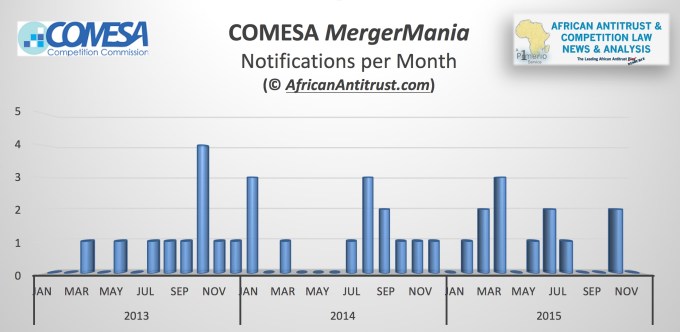
Our updated AAT COMESA MergerMania statistics are therefore as follows (again noting the fact that AAT bases its count on only the official, published and available merger documents, instead of relying on mere press release-based summaries published by the CCC).  We also note that to date, 2016 has seen one “merger inquiry notice,” namely of the Dutch Yara / Zambian Greenbelt fertiliser deal.  The public-comment period for that transaction expires on January 22, 2016.

Number of merger notifications based on CCC-published notices

The full text of the COMESA release follows below:

During the year 2015, the Commission assessed and cleared 15 merger transactions. The transactions involved sectors such as insurance, food additives, water treatment, agro-chemical, banking, telecommunication, non alcohol-ic beverage, publishing, packaging and retail. The Commission handled 12 merger notifications in the year 2013 and 44 merger notifications in the year 2014. The Pie Chart below shows the number of mergers handled by the Commission from inception to date.

COMESA merger statistics (official graphic)

As shown in the pie chart the Commission dealt with more mergers in 2014 as compared to 2013 but this trend has gone down in 2015. This trend may be attributed to the supposition that in 2013, the Commission had just commenced operations and therefore some stakeholders were not immediately aware of its existence and operations. By 2014, most stake-holders had become aware of the Commission and its operations, hence the significant increase in the number of mergers notified. The significant reduction in 2015 can be attributed to the supposition that the merger notification thresholds approved by the Council of Ministers on 26 March 2015 which has resulted in smaller mergers escaping the notification. Before 26 March 2015, the merger notification thresholds were Zero hence all mergers were notifiable regardless of size.

Christmas Eve Exemption: Petroleum industry seeks pass from antitrust provisions

south_africaStrategic Timing of Exemption Application?

Flying somewhat under the radar during the Christmas and year-end holiday season (but not under AAT’s radar), the South African Petroleum Industry Association (made up of BP, Shell, Chevron and other oil heavyweights) have sought a five-year renewal of their currently temporary holdover exemption from certain competition laws, which will expire in June 2016.  The application was made on Christmas Eve 2015 under section 10(6)(a) of the Competition Act.  SAPIA has not posted any news item or press release about its application on its web site to date.

SAPIA is seeking permission to allow its members to “cooperate and co-ordinate” on common industry logistics issues, as Andreas Stargard, a director with African competition-law and anti-corruption advisors Pr1merio notes.

“These include areas such as Single Buoy Mooring, port facilities, shipping, mooring, and interestingly also distribution as well as less well-defined ‘production and manufacturing plant shutdowns.'”

As Stargard observes, from an antitrust perspective, this could be of significant interest: production limitations would necessarily decrease available supply and thereby have the potential to drive up price, he notes.  Under the terms of SAPIA’s application, the plant shutdowns are both scheduled and unscheduled and supposedly relate to upgrades and safety measures only, according to the application.  In practice, however, such an exemption could give possibly provide the oil industry with carte blanche on competition issues and market manipulation.

In order to assuage concerns, the SAPIA members agree, in return for the exemption, that:

Competing participants in exempt agreements and practices may not share competitively sensitive information, except for the purposes described in the exemption application.

SAPIA and its members may not share information relating to setting of margins, imposition of levies and or approval of tariffs, unless required to do so by the DOE or NERSA.

The employees of any operating party who receive such information shall ensure that the information is held, maintained and used separately, confidentially and on need- to-know basis only.

The full text of the request for exemption is located here.  Interested parties and the public have 20 business days to comment on the application.

Predatory Pricing & the Competition Act: a False-Positive?

We have previously, on African Antitrust, reported on South Africa’s first predatory pricing case in the Media 24 matter. In light, however, of the recent cases on exclusionary conduct — particularly predatory pricing, which has received significant attention from competition law agencies across a number of jurisdictions of late (see, for instance, the Paris Court of Appeals’ dismissal of the predatory pricing and exclusionary conduct allegations made against Google by an online maps rival.  The Indian Competition Commission has also launched an investigation into alleged predatory pricing in the taxi industry, and the European Commission has launched investigations into predatory pricing in the potato-chips / crisps industry) — a more substantive evaluation of predatory pricing in South Africa is called for. The following article on predatory pricing, in light of the Media 24 case, neatly sets out and evaluates the landscape of predatory pricing in South Africa.


Predatory Pricing & the South African Competition Act: a False-Positive?

By Michael J. Currie

Intro & Summary

“From an antitrust perspective, predatory pricing is a particularly difficult problem with which to deal. If we are to prevent anticompetitive monopolization, it is a strategy that must not be permitted. The paradox, however, is that such a pricing strategy is virtually indistinguishable from the very sort of aggressive competitive pricing we wish to encourage.”

D L Kaserman and J W Mayo, ‘Government and Business: The Economics of Antitrust and Regulation’ (1995) Fort Worth, TX: Dryden Press at 128

In September 2015, the Competition Tribunal (“Tribunal”), for the first time in South Africa’s sixteen-year history of competition-law enforcement found, in the Media 24 case that the respondent had engaged in predatory pricing in contravention of the South African Competition Act, 89 of 1998 (“Act”).

The Media 24 case, despite being dragged out for nearly six years, was set to be the leading jurisprudence on the laws pertain to predatory pricing, and in particular, how Section 8(d)(iv) of the Act would be interpreted and applied by the Tribunal. The finding by the Tribunal was, however, based on Section 8(c) of the Act, which is a broader ‘catch-all’ provision, and left some important questions as to the interpretation of Section 8(d)(iv) unanswered. Most notably, whether or not Section 8(d)(iv) permits complainants to utilise cost measurement standards other than Average Variable Costs (“AVC”) or Marginal Costs (“MC”) to prove that a dominant firm has engaged in predatory pricing in contravention of the provision.

Having said that, however, the Media 24 case provides some insight as to the precise relationship between Sections 8(d)(iv) and 8(c) of the Act as they relate to predatory pricing, and may have offered, by way of certain obiter remarks, an indication as to how the Tribunal may interpret and apply Section 8(d)(iv) of the Act in the future.

Continue reading the full article, an AAT exclusive, in PDF format:

Predatory Pricing and the South African Competition Act: a False-Positive?

Silencing a Public Protector

The Fascinating Story of Thula Madonsela and Being Undermined

By Rui Lopes

The Public Protector, in theory, was designed and created to strengthen the constitutional democracy within South Africa along with the other Constitutional Institutions established under Chapter 9 of the Constitution of the Republic of South Africa.[1] In order to strengthen this constitutional democracy, it is imperative that the Public Protector be independent from any governmental branch or agency, as making it accountable to the exact organs it seeks to protect society from renders it ineffective and voiceless. What follows is an elaboration on the role of the Public Protector within a constitutionally democratic South Africa and whether its purpose and effectiveness has in essence fallen into redundancy by making it accountable to Parliament.

Thula Madonsela
Thula Madonsela

Establishing a constitutionally democratic Public Protector

The unfailing oppressiveness and secretiveness of the Apartheid government lead to a distrust of such a government and one which was consequently not open and accountable.[2] State organs could and often did act ultra vires, doing whatever they wished regardless of whether such powers were given to them, and would not need to be accountable for any such actions.[3]

However with the dawning of a constitutional democracy in 1994, the need to divide the once monopolised parliamentary power among all branches of government and the implementation of checks and balances ensuring that all branches of government became accountable towards one another became imperative in securing the ideal of a democratic nation once founded upon racial oppression and impunity.[4] With the implementation of the 1993 Interim Constitution, in terms of principle 29,  the office of the Public Protector was first established and by including it the Constitutional Principles, secured its existence within the final Constitution.[5]

The Public Protector was designed to assist in the transformation of an oppressive society into an open and democratic society, creating an accountable and credible government through the re-establishment and respect of the rule of law. No longer was government above the law nor could they do a they wished, rather the government was in theory, accountable to the people of the nation, echoing the entire theory of the social contract.[6] Consequently the office of the Public Protector was ideally to act as a check between the Executive and Legislative branches of government and to provide a link between the citizens and such branches.[7] 

The powers, functions and duties of the office of the Public Protector

The Public Protector is an institution established to investigate purported or supposed indecorous behavior of state affairs, whereby upon the decision to investigate such, which is at the discretion of the Public Protector, the Public Protector must report on such conduct and if applicable the taking of appropriate remedial action must occur.[8]

The Public Protector may not investigate judicial decisions, as this is the function of the Judicial Services Commission as well as owing to the fact that the Public Protector acts as a check between the Executive and Legislature.[9] The Public Protector may also not investigate human rights issues as such issues fall within the jurisdiction of the South African Human Rights Commission.[10] Once the Public Protector has an affirmative finding of misconduct, such a finding is then referred to the Director of Public Prosecutions.[11]

What follows is a determination of the ability of the Public Protector to accurately fulfill the role of its office. Such capability is determined by means of the independence which is afforded to it.

How independent is the Public Protector?

In order to hold the Executive and Legislative branches of government accountable, the Public Protector requires a “sufficient” amount of independence. This leads to predominant issues of what constitutes sufficient independence and the issue of over independence of such institutions which would then lead to an abuse of such independence.

Independence is a characteristic, which is established objectively in terms of whether a reasonable person would perceive such an institution as being independent.[12] Thus the impact that the Public Protectors perceived independence upon the reasonable person would in hindsight affect the Public Protector to fulfill the role of its office.

In order to accurately understand the independence which the Public Protector is afforded, its independence needs to be divided amongst five aspects namely a prima facie contradiction that exists between sections 181(2) and 181(5) of the Constitution, financial independence, administrative independence and finally, the independence of appointments and dismissals of the Public Protector.

Amid section 181(2) and 181(5) of the Constitution, there exists a prima facie conflict of these two provisions in the sense that section 181(2) holds Chapter 9 institutions to be independent and only subject to the Constitution whereas 181(5) holds such institutions accountable to the National Assembly.[13] This inconsistency was settled in Independent Electoral Commission v Langeberg Municipality [14] whereby the court held in accordance with section 239 such institutions are not governmental departments which the Cabinet may have stimulus over, rather they are independent from government.[15] Thus by holding such, the court made it clear that although the Public Protector is accountable to the National Assembly, it is not accountable to government nor is it afforded the same independence as the judiciary.[16] 

Two reasons exist at the outset for such accountability.[17] Firstly the Public Protector is said to be accountable to the National Assembly, as through representative democracy, the National Assembly represents the population of South Africa, their opinions and ideologies, and thus by making the Public Protector accountable to the National Assembly, it is in essence making the Public Protector accountable to the public.[18] 

Financial independence of the Public Protector was too dealt with in Independent Electoral Commission v Langeberg Municipality whereby the Constitutional Court affirmed such Chapter 9 institutions need a degree of financial independence but it is not to say that such institutions may set their own budget.[19] Rather Parliament as opposed to the Executive has the obligation to provide sufficiently reasonable funding in order for the Public Protector to fulfill its functions.

Appointments of the Public Protector are made by the President through a shortlisting of candidates, by the National Assembly, whom the Public nominated.[20] Therefore there exists a grave deficit in terms of public participation, as the public does not participate beyond the nominations stage.

It is too the National Assembly who may dismiss the Public Protector with a two-thirds majority vote. Such a majority is to ensure a simple majority does not unjustly dismiss the Public Protector.[21]

In theory, affording the Public Protector this amount of Constitutional independence at first glance, seems to allow it the ability to perform its functions. However, over the past couple of years, grave injustices have been committed towards this Chapter 9 institution that raises doubts as to whether the Public Protector can effectively fulfil its office, and whether the continued lack of the required independence renders the office of the Public Protector redundant.

The Constitution can be said to afford the Public Protector “sufficient” independence. However I posit that sufficient independence does not mean effective independence, and it is evident that the Public Protector as a chapter 9 institution is fundamental in the supporting of a democratic South Africa, representing a mechanism of holding the Executive and Legislature accountable, but such an office is not effective for as long as those whom the Public Protector seeks to hold accountable are the exact persons who have the power and ability to dismiss the Public Protector and furthermore have the ability to dictate the funding it therefore receives. With the recent cries for funding by the Public Protector, and the closing of its Mpumalanga office with others following suit, the question arises of whether the Public Protector has been reduced to a mere symbol of a ideology of democracy, unable to protect the public. Furthermore the manner in which the Nkandla Report was received in Parliament shows its inability to effectively exercise its powers and functions. Not being able to protect the public renders the Public Protector a useless feat.

I therefore posit that the theoretical independence afforded to the Public Protector is not enough to allow it to effectively fulfil its powers and duties.  Therefore all efforts must be made to afford the Public Protector such effective independence in order to fulfil its role and allow it to effectively protect the public.

………………………………………………………………………………………..

Footnotes

………………………………………………………………………………………..

[1] Constitution of the Republic of South Africa, 1996 section 181(1)(a).

[2] Pierre de Vos ‘Balancing Independence and Accountability: The Role of the Chapter 9 Institutions in South Africa’s Constitutional Democracy’ in M Danwood, M. Chirwa and Lia Nijzink ‘Accountable Government in Africa Chapter 10’ (2012) 160 at 160.

[3] Ibid; Iain Currie and Johan de Waal The New Constitutional & Administrative Law vol 1 (2013) 46 to 50.

[4] Public Protector v Mail and Guardian Ltd and Others 2011 (4) SA 422 (SCA) paras 5 & 6; C. Thornhill ‘Role of the Public Protector’ (2011) 2 Case Studies of Public Authority at 87.

[5] C, Murray ‘The Human Rights Commission et al: What is the Role of South Africa’s Chapter 9 Institutions?’ (2006) 2 PELJ 122 at 123 & 124; Ex Parte Chairperson of the Constitutional Assembly In Re: Certification of the Constitution of the Republic of South Africa, 1996 1996 (4) SA 744 (CC) certification case 1996 (4) SA 744 para 161.

[6] Op cit note 2.

[7] Op cit note 2; supra note 4 para 19.

[8] Supra note 4 para 20; Newspaper clip; Public Protector Act 23 of 1994 section 6(4).

[9] Supra note 1 section 182(3).

[10] C, Murray ‘The Human Rights Commission et al: What is the Role of South Africa’s Chapter 9 Institutions?’ (2006) 2 PELJ 122 at 130.

[11] Thus demonstrating such institutional relationships of the Public Protector with such constitutional institutions.

[12] Van Rooyen and Others v S & Others 2002 (8) BCLR 810 (CC) paras 16 to 18.

[13] Supra note 1.

[14] 2001 (9) BCLR 883 (CC) paras 28 to 29.

[15] Ibid.

[16] Op cit note 2.

[17] It is important to note these to be my own deductions.

[18] Public Protector Act 23 of 1994 section 8(2)(a) and (b).

[19] Supra note 14 para 29; Op cit note 2

[20] Supra note 14; op cit note 2 168 to 170.

[21] Supra note 1 section 193(1) to (6) and 194(1) to (3).

Exclusive AAT interview: Bonakele on antitrust conferences

meet the enforcers

In our latest instalment of our Meet the Enforcers series, we speak with South African Competition Commissioner Tembinkosi Bonakele on the topic of hosting a series of academic & practitioner platforms to discuss cases and developments in competition-law enforcement.

This week, the South African Competition Commission and the Competition Tribunal successfully organised the 9th Annual Conference on Competition Law, Economics & Policy (as part of the 4th BRICS International Competition Conference), taking place in Durban, South Africa.

Commissioner Bonakele, the head of the SACC, discussed hosting the conference with AAT’s contributing author, Njeri Mugure, Esq.  According to his biography, Mr. Bonakele has been with the Commission for the past ten years. He briefly left the Commission in March 2013 and came back in October 2013 as Acting Commissioner. He has been in this position until his appointment as the Commissioner. Bonakele has occupied various positions in the Commission’s core divisions. He was appointed Deputy Commissioner in 2008, and prior to that worked as head of mergers, head of compliance and senior legal counsel respectively.

The AAT-exclusive interview follows:

Tembinkosi-Bonakele-Profile-Pic

AfricanAntitrust.com: South Africa has been participating in the BRICS International Competition Conference (“BRICS ICC”) since 2011, a year after she officially became a member of BRICS. This November the country will host the 4th of this biennial meeting in Durban. What are your goals for this year’s conference?

Tembinkosi Bonakele:

The theme for the BRICS International Competition Conference 2015 is “Competition and Inclusive”. This theme will enable the conference to explore the relationship between competition and growth, competition and employment, competition and inequality and competition and poverty. As with the previous conferences, the aim of the conference is to strengthen cooperation amongst BRICS countries in the area of competition regulation by creating a platform for sharing experiences. We also aim to use the conference to discuss a proposed Memorandum of Understanding between BRICS competition agencies. Finally, the conference is also a platform for both developed and developing countries to discuss competition policy and enforcement issues.

AfricanAntitrust.com: Speaking of Durban, some might have expected for the 9th Annual Competition Law, Economics and Policy Conference (“Annual Competition Conference”) and/or the BRICS ICC to be held in Pretoria, the capital city of South Africa.  Could you tell us why you chose to hold the two conferences in Durban?

Tembinkosi Bonakele:

We wanted a venue that would provide world class facilities for the conference as well as enjoyment for the delegates, and Durban ticks both boxes. The Kwazulu-Natal province, where Durban is situated, is home to rich natural resources, including Africa’s Big Five game and beautiful mountainous landscapes.

Durban itself is a diverse African city providing cultural diversity as well as a natural paradise known for its beautiful coastline beaches and subtropical climate. The City is also host to the largest and busiest harbor in Africa. The Inkosi Albert Luthuli International Convention Centre (Durban ICC), where the two conferences will be held, is the largest indoor conference facility in Africa.

The Commission has previously partnered with the KwaZulu-Natal Provincial Government, eThekwini (Durban) Municipality and the University KwaZulu-Natal on various activities.

AfricanAntitrust.com: In addition to hosting the Annual and the BRICS competition conferences, the South African Competition Commission (“the Commission”) along with Cresse and the University of Kwazulu-Natal will hold a joint workshop exploring areas such as collusions and cartels, unilateral and coordinated effects in mergers, the economics of exclusionary conducts, and use of economic evidence, among others. What do you hope this workshop will achieve?

Tembinkosi Bonakele:

The economic understanding of competition policy is constantly evolving. In the last two decades economists have developed new theories of harm and traditional views have changed significantly. The workshop will bring top quality instruction on the economics of competition to agency officials in South Africa and more broadly Africa, competition practitioners, academics and policy makers. I hope that everyone attending the workshop will walk away having learned something new about the economics of competition.

AfricanAntitrust.com: Speaking of the this year’s events, planning the joint workshop, the Annual Competition Conference and the BRICS ICC was a great undertaking, could you tell us why you decided to have the three events back to back and what audience each event is tailored to suit?

Tembinkosi Bonakele:

With the BRICS conference coming into South Africa was a great opportunity as so many people were interested to come. So many opinion makers, academics and practitioners were going to be in the country, so we organized all these events to take advantage of their presence, and the response was very positive. We also thought logistically it makes sense to have our annual conference organized back to back with BRICS, so we don’t get conference fatigued. In the end, all the events flow into each other.

The Joint Workshop is a technical training and knowledge sharing platform, looking at the latest thinking on various aspects of competition enforcement.

The conference is an annual academic platform to discuss cases and developments in competition law enforcement.

AfricanAntitrust.com: Turning to the BRICS International Competition Conference, in what way has this year’s agenda been informed by the previous three conferences? What impact do you think the previous conferences have had on antitrust discourse in BRICS and non-BRICS countries?

Tembinkosi Bonakele:

The previous conferences, hosted by the Federal Antimonopoly Services of Russia in 2009, the State Administration for Industry and Commerce of the People’s Republic of China in 2011 and Competition Commission of India in 2013, created a solid platform on which we can deepen our relations in the fi­eld of competition regulation.

South Africa has focused the conference on the relationship between growth and inclusivity. Furthermore, this year’s conference aims to institutionalize BRICS cooperation on competition matters, and move it beyond conferences. There is a proposed Memorandum and Understanding, as well as a joint research initiative.

AfricanAntitrust.com: There’s been a lot of debate surrounding public interest factors in merger review. What do you hope to achieve by including the topic to this year’s conference agenda?

Tembinkosi Bonakele:

It is important that BRICS countries weigh-in on this important debate. There is a divergence of views amongst many antitrust practitioners on the compatibility of antitrust issues with public interest issues, but everyone accept that there are public interest issues. The conference will deepen and broaden perspectives on the matter.

AfricanAntitrust.com: How do these engagements such as the BRICS conference and competition law enforcement in general benefit the ordinary South African?

Tembinkosi Bonakele:

The South African competition authorities were established as a package of reforms to transform the unequal South African economy to make it economy inclusive and ensuring that those who participate in it are competitive.

Through engagements such as the BRICS conference we’re able to discuss with our BRICS counterparts how to make our economies, which are similar, more efficient, competitive and inclusive.

The Commission has, in the past 16 years investigated and dismantled cartels from different sectors including construction, bread – a staple food for many South Africans, and cement. In the cement cartel, for instance, the Commission conducted a study post the cartel and discovered that we have saved consumers about R6 billion.

AfricanAntitrust.com: Mr. Bonakele, are there other topics you would have liked to address or comments you would like to add?

Tembinkosi Bonakele:

We see BRICS as an important and strategic platform where we advance arguments about the relationships between competition and other policy instruments that are very relevant in our developing countries.

As a collective, BRICS competition authorities are able to provide leadership in the international antitrust community on what it means to create and enforce competition law and policy in developing economies which come with their own particular challenges and opportunities. These perspectives will serve to enrich the global knowledge base in competition enforcement.

AfricanAntitrust.com: Thank you for taking the time to speak with me, Commissioner!

The interview was conducted by Ms. Mugure for AfricanAntitrust.com on 8 November 2015.

south_africa

Landmark bilateral competition agreement takes effect

namibiasouth_africa

South Africa and Namibia sign landmark memorandum of understanding

On 11 November 2015, the Competition Commission of South Africa and theNamibian Competition Commission signed an historic memorandum of understanding (MoU) on cooperation on competition matters both in terms of policy and enforcement.

Andreas Stargard, a director with African competition-law and anti-corruption advisors Pr1merio, points out, that collaboration of the two relatively mature agencies is not new per se:

Having cooperated in prior years on multiple merger investigations (see, e.g., the Wal*Mart / Massmart transaction), the time had come for a formalised agreement in principle between these two key southern-African jurisdictions.  Antitrust practitioners in the region should anticipate a hopefully streamlined process across national borders, especially in terms of merger reviews & clearance, as well as quite likely conduct investigations in the cartel or dominance areas.

Says the SACC’s press release:

“We thank the Namibian Competition Commission for their cooperation. I’m grateful we’re able to formalise our relations. Our laws tend to be similar which makes cooperation easier,” said South African Competition Commissioner Tembinkosi Bonakele.

Namibian Competition Commission Chief Executive Officer, Mr Mihe Gaomab said that the signing of the MoU is a historic moment for them, and that this will improve cooperation between the authorities, especially on multi-jurisdiction projects, such as mergers.