Investment in Africa: Changing landscape, new hurdles

Questioning African antitrust growth prospects: Slowdown in economic investment (both organic and outside investment) may affect functioning of competition law on the continent

Recent developments in Africa have many scratching their heads and wondering whether the formerly wondrous economic-growth engine of the vastly resource-rich and otherwise economically still undervalued continent will soon experience a slowdown, if not come to a halt altogether.

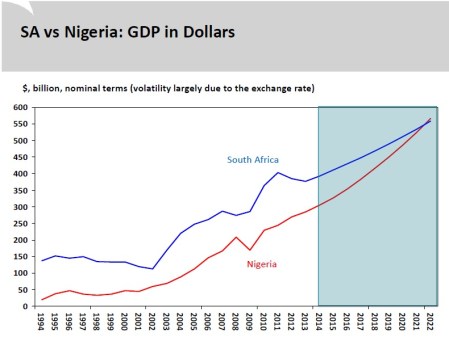
For one, in April 2014, Nigeria surpassed South Africa as the continent’s largest economy (see Economist Apr. 12, 2014: “Africa’s New Number One“).  This is a significant milestone for the former, and a setback for the latter — an economy that was 8 times the size of the Nigerian economy only 20 years ago, yet is now suffering from stagnating GDP, reeling from corruption allegations amongst its current leadership, undergoing a closely-watched presidential election process, and whose ruling ANC party is facing a heretofore unprecedented backlash and torrent of criticism.

Source: The Economist

Not only South Africa has weakened, politically and economically, however.  Events such as the Northern Nigerian wave of violence – with sectarian Boko Haram forcefully displaying the impotence of the central Nigerian government of a weakened president Goodluck Jonathan – fuel the fire of outside investors’ mistrust of African stability and their concomitant reluctance to make good on prior investment promises.  As The Economist notes in the article quoted above: “it is not a place for the faint-hearted” to invest, even though it highlights the successful Nigerian business ventures of outsiders such as Shoprite, SABMiller, and Nestlé.  Bloomberg BusinessWeek quotes Thabo Dloti, chief executive officer of South Africa’s fourth-largest insurer Liberty Holdings Ltd. (LBH), as saying: “It does slow down the plans that we have, it does put out the projections that we have by a year or two.”

http://www.stanlib.com/EconomicFocus/Pages/InterestingChart112SouthAfricaneconomyvsNigerianeconomy.aspx
Nigerian vs. RSA GDP
Source: http://www.stanlib.com

Likewise, multi-national organisations such as COMESA and its competition enforcement body, are undergoing significant changes (such as, currently, an opaque process of raising the heretofore insufficient merger-filing thresholds), shockingly successful web attacks on their data, and a resulting dearth of transactions being notified.  Elsewhere in developing economies, recent political turmoil has likewise led observes to comment on the negative spillover effect from political & social spheres into the economy (e.g., Financial Times, May 8, 2014: “Political crisis further dents prospects for Thai economy“).

Impact on antitrust practice

The upshot for competition-law practitioners and enforcers alike is rather straightforward, AAT predicts: more hesitation around African deals being done means fewer notifications, less enforcement, and overall lower billings for firms.

The flip side of the coin – as is usually the case in the economic sine curve of growth and slowdowns – is the commonly-observed inverse relationship of M&A and criminal antitrust: while we may see fewer transactions in the short term, the incidence of cartel behaviour and commercial bribery & government-contract fraud cases will likely increase.

Slow-going M&A statistics in COMESA before anticipated threshold revision

COMESA Competition Commission logo

Strong numbers from early 2014 did not hold up

After posting a record three merger notifications in January, the COMESA Competition Commission has seen its M&A filing statistics decline to zero in February and merely one in March.

As we have reported here (optimistic for 2014) and here (pessimistic on 2013 statistics), COMESA’s notified M&A deals have seen erratic ups & downs.  Not surprising, perhaps, if one considers the exquisite confusion that has reigned since the inception of the young antitrust authority about filing thresholds and fees.

The current ebb in notified deals (despite the record set in January) reflects, in our view, the impending end of the current “zero-threshold” regime in COMESA, which was foreshadowed by The CCC’s head of mergers, Willard Mwemba, back in late February 2014.  Quite understandably, parties to ongoing transactions are willing to risk “flying under the radar” if the agency has de facto admitted that the zero-dollar filing threshold is unworkable in practice.

We are curious to see what impact the vacuum of the pending revision to the COMESA merger rules will have on filing statistics going forward, until a more sensible threshold is set by the agency.  For now, with the latest notification #4/2014 (fertilizer and industrial products acquisition by Yara International ASA of OFD Holdings Inc.*) the stats look like this:

* we note that in the notice, the CCC erroneously set the deadline for public comment prior to the notice date itself, namely as “Friday, 28th February, 2014.”

competition law antitrust Africa
COMESA CCC M&A filing statistics as of March 2014

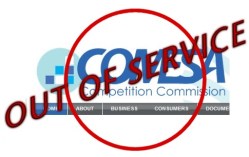
COMESA Competition Commission: first hacked, now out-of-service

COMESA out of service

The COMESA Competition Commission’s web site (http://www.comesacompetition.org/) has suffered yet another setback, only a month after AAT’s prior investigation into the apparent hacking of its online resources — it has been out of service as of 23-April-2014 (through at least the 25th), showing up as a mere white blank page.

Subordinate pages, such as the extranet page containing sensitive party information from ongoing investigations or merger reviews (http://www.comesacompetition.org/documents/private), are likewise blank.

As before, where we pointed out that the Commission’s hacking event constituted “evidence of a real risk that highly confidential party information (stemming from COMESA merger reviews or other competition investigations) may be vulnerable to accidental or intentional disclosure to unauthorized third parties,” we are alerting current or potential future parties to CCC merger reviews regarding the deficiencies in the competition enforcer’s electronic systems.  These may impact the timetable and resulting deadlines of pending merger investigations, and we advise all such interested parties to enquire with the Competition Commission about the procedural effect of the outage.

COMESA Competition Commission web site hacked?

Attack shows risk of unauthorized disclosure of confidential commercial party information

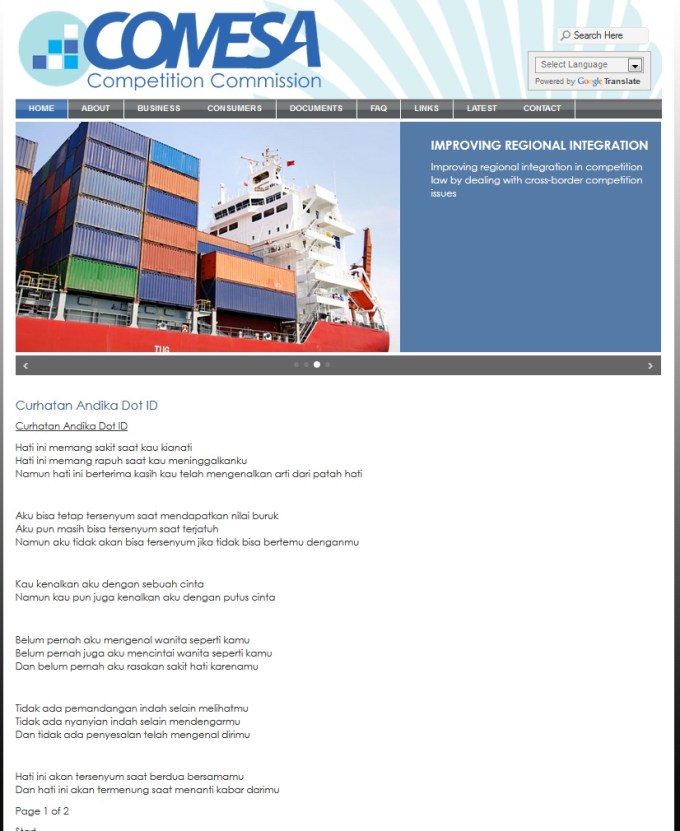
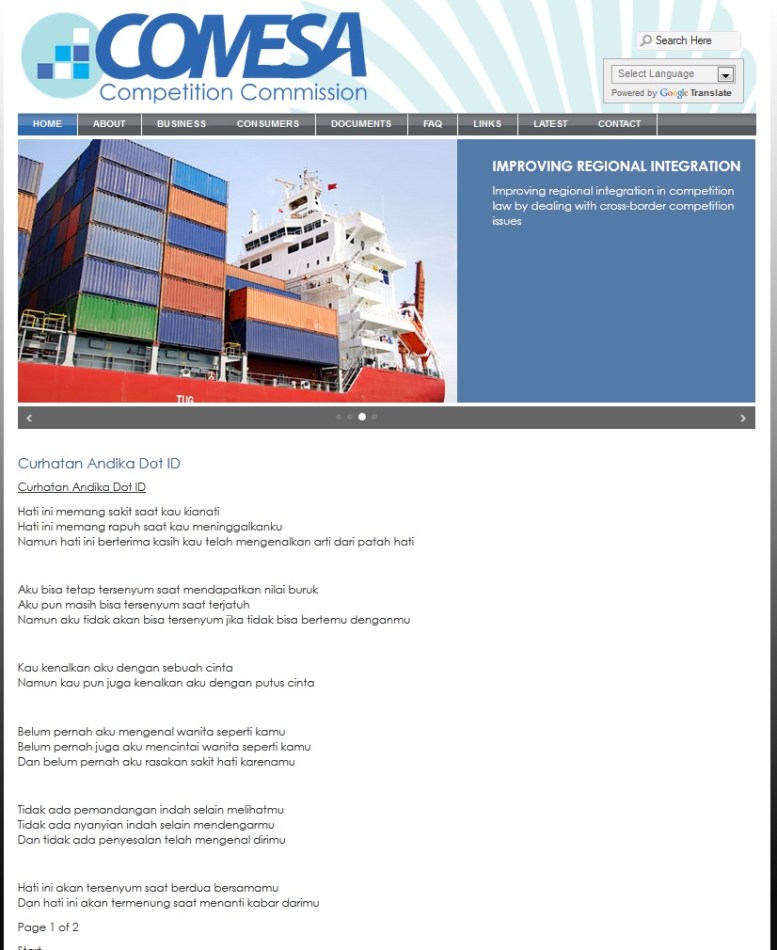
COMESA site hacked with Indonesian love poem

It would appear that the young pan-African antitrust enforcement agency’s web site has been hacked.  The headline on the COMESA Competition Commission’s (“CCC”) home page today seems to indicate a relationship with a web site bearing the Indonesian TLD (top-level domain) “.ID”, and looks like gibberish at first glance.

Then, after some digging, AAT’s editors believed that it might in fact be a tribute or memorial of sorts to the missing crew and passengers of flight MH 370, given the Indonesian language of the text and the disappearance of the jetliner in the Viet-Indo-Malaysian region’s equivalent of the Bermuda Triangle.  The relationship with COMESA escaped us, however.  Yet, upon a final review of the Google Translate result, we can confirm that this is unfortunately not the case.  Instead, it appears to be a (fairly amateurish) love poem (full text in GoogleTranslate’s English below).

With all this wind-up, here comes the real point in the story.  We perceive this hacking event as evidence of a real risk that highly confidential party information (stemming from COMESA merger reviews or other competition investigations) may be vulnerable to accidental or intentional disclosure to unauthorized third parties.  In the United States, the agencies’ unwarranted disclosure of confidential data took center stage in the 2007 aftermath of the $1/2 billion Whole Foods / Wild Oats merger, during which the FTC had accidentally submitted an insufficiently redacted PDF document to the electronic U.S. court filing system ECF, spilling the secret data guts of the case. The Washington Post reported on the story here — just as we are now alerting current or potential future parties to CCC merger reviews regarding the apparently deficient safeguards in the competition enforcer’s electronic systems.  We advise all such interested parties to enquire with the Competition Commission precisely which steps are being taken to ensure the safety of their confidential submissions to the agency.

We also note that the CCC’s site has a very publicly visible page for access to “PRIVATE” documents, protected only by (it would seem) a most simple username/password combination.  The site even allows for a cookie-based “Remember Me” function.  The privacy risks here are manifold, as any e-security expert worth her salt can attest to: Should this “private” document repository contain confidential party information, and if the main home page of the agency has already been subject to a (successful) attack, it is no stretch to imagine that access may have equally been gained to the purportedly private document storage folder on the site.

AAT has contacted the CCC’s web master and leadership, Messrs. George Lipimile and Willard Mwemba, to inquire further about the details of this apparent safety breach.  We will report on their response here once we have heard back from them.

Should readers have any other information on the goings-on at the CCC or its web site, we always appreciate hearing from you, either by way of e-mail or in the comments section to this article.

Full text of COMESA site as of 17. March 2014 (all day) – (update 18. March: the text is still up on the site at 16:40 GMT):

Andika curhatan Dot ID

This heart is sick when you kianati
This heart is fragile when you leave
But this heart grateful you have introduced the meaning of a broken heart

I can still smile while getting bad grades
I can still smile when dropped
But I would not be smiling if it can not meet you

You introduced me to a love
But you were also introduced me to breakup

I’ve never know a woman like you
I also have never loved a woman like you
And I’ve never felt hurt because of you

None other than the beautiful scenery seen
None other than the beautiful singing heard
And no one has to know you regret

This heart will smile with you when both
And this will be a pensive moment waiting to hear from you

The end of the zero-threshold contagion?

COMESA Competition Commission logo

COMESA Competition Commission‘s head of mergers foreshadows end of zero-threshold regime

Will the Commission soon find a cure to the contagion that has made the agency’s merger control the subject of heavy criticism by antitrust practitioners and and even ridicule by fellow enforcers? Willard Mwemba claims the agency has – after over a year of operating under the zero-threshold rule – “set the wheels in motion for the threshold to be raised.”  The Commission is reportedly working with the World Bank’s International Finance Corporation to determine what the proper notification thresholds should be.

We previously had this to say in November of last year:

[T]he dual dilemma of the “zero-threshold contagion” and the inordinately high filing fees currently affecting the CCC’s merger-control regime (and resulting in rather low merger-notification statistics of less than one per month) will continue to hamper the young agency and its customers for the foreseeable near-term future.

Depending on how swiftly the agency and its advisors at the IFC get things done – and the amendments actually get approved – it appears that our timing forecast was fairly accurate  (“COMESA merger rules to change in April 2014 at the earliest“).

Official closure schedule of COMESA – unique time table

COMESA Competition Commission logo

Note to practitioners: filings due on these unique closure dates, set by the COMESA Competition Commission‘s registrar’s office for 2014, will be due on the subsequent working day:

1. 1st January 2014- New Years’s Day
2. 15th January 2014- John Chilembwe day
3. 3rd March 2014- Martyrs Day
4. 18th April 2014- Good Friday
5. 21st April 2014- Easter Monday
6. 1st May 2014- Labour Day
7. 14th May 2014- Kamuzu Day
8. 20th May, 2014- General Elections
9. 7th July 2014- Independence Day
10. 15th October 2014- Mothers Day
11. 25th December 2014- Christmas

COMESA merger stats: January ’14 outperforms first 6 months of 2013

COMESA Competition Commission logo
Three merger notifications in one month set new record for COMESA Competition Commission.

After commenting on the rather lackluster statistics of the first 11 months A.D. 2013, we observed that some deal-making parties might be “flying under the radar” and asked the question:

Combine Point 4 above (low filing statistics) with the zero-threshold and low nexus requirements that trigger a COMESA merger notification, and the following question inevitably comes to mind: With such low thresholds, and the certain existence of commercial deal activity going on in the COMESA zone, why are there so few notifications?

Well, the young agency’s stats have picked up some steam in 2014, it would seem: based on a review of its online document repository, the CC has received a whopping three notifications in January alone.  They are, in chronological order:

  1. Mail & courier services: FedEx / SupaSwift – a transaction involving the acquisition of a South African courier with operations in multiple COMESA member states, Botswana, Malawi, Mozambique, Namibia, Swaziland and Zambia.
  2. Agricultural distribution and financial services: AgriGroupe / AFGRI Ltd. – Mauritian SPV AgriGroupe seems to be taking AFGRI (listed on the JSE) private.  The target has operations in multiple COMESA countries.
  3. Generic pharmaceuticals: CFR Inversiones SPA / Adcock Ingram Holdings Ltd. – Chilean CFR is buying all of South African off-patent pharmaceuticals manufacturer Adcock’s shares. Notably, the buyer has no COMESA activities; target is active in Kenya, Malawi, Rwanda, Sudan, Swaziland, Uganda and Zimbabwe.
(c) AAT
Merger notification stats for COMESA as of Feb. 2014

Take-aways:

  • Activity has increased dramatically.  Is it a coincidence & a statistically irrelevant blip on the radar screen?  This remains to be seen. The parties are – unlike last year’s – not “repeat parties” and therefore the increase in notifications seems to be natural/organic growth, if you will, rather than a case of the same bear falling into the same honey-trap multiple times…
  • The Competition Commission has listened to its critics (including this blog). Notably, the CC now clearly identifies the affected member-state jurisdictions in the published notice – a commendable practice that it did not follow in all previous instances, and which AAT welcomes.

Post-scriptum: Adding up the total 2013 tally of notifications, the Tractor & Grader Supplies Ltd / Torre Industrial Holdings transaction (notified after our prior statistics post in November 2013) brought the sum-total of COMESA merger filings to 11 for FY2013.

COMESA and W. Australia now economically linked via MoU

COMESA Competition Commission logo 

The Western Australian government has signed a Memorandum of Understanding with COMESA.

Colin Barnett signed the papers yesterday, January 31, 2014.  COMESA dutifully posted a news release on its web site, albeit misspelling the W. Australian premier’s name (“Colin Barnnet“).

Setting aside the embarrassing PR SNAFU, we expect the MoU to have little to no effect on competition enforcement by the COMESA Competition Commission.  The MoU appears to us to be primarily minerals-focussed (we note that this should come as no surprise, given the mineral-rich COMESA members and the fact that Western Australia is the world’s second-largest iron ore producer).  The six so-called “thematic areas” of the MoU are: fiscal frameworks and mineral policy, strengthening human and institutional capacities, collection and management of geo-scientific information, research and development, environmental and social issues; and linkages, diversification and cluster development.  Antitrust/competition is nowhere to be found.

That said, Western Australian companies may choose to invest more in the region and therefore somewhat increase the merger notification statistics, which have been lackluster to date.

Antitrust & “extreme economic inequality” – new OXFAM paper out

Arguably, most if not all of today’s antitrust enforcers would agree that the world’s competition regimes (African or Asian, American or European, established or recently budding) are fundamentally designed to achieve very few, but important, goals.  Among these goals are the following: (1) economically, to enhance the market’s allocative efficiency & stimulate growth of production and (2) individually, consistent with Bob Bork‘s key insight, to increase consumer welfare (even if the latter may not be a formally stated aim of some regimes).

Today’s release of the OXFAM briefing paper on “Political Capture and Economic Inequality,” tantalizingly entitled “WORKING FOR THE FEW,” brings the second of the two above-stated goals to the fore:

Is the world today better for the [working] consumer than it was 123 years ago, when Senator Sherman and the majority of the U.S. legislature decried the unjust and ill-gotten riches of that era’s robber barons and enacted the Sherman Act?

Robber Baron
Robber Baron, circa 1890

The paper is interesting but too short to be of real academic or legal value in and of itself, in our view.  The infamous photo of the super-yacht on the authors’ blog represents the easy part of what they set out to accomplish – politicizing the issue and driving popular opinion (much akin to the period newspaper cartoon above).

Robber Baron, circa 2014

That said, authors Ricardo Fuentes and Nick Galasso go somewhat beyond the, by now, usual egalitarian quotes (Brandeis’s Depression-era statement: “We may have democracy, or we may have wealth concentrated in the hands of the few, but we cannot have both“) and the well-known head-turner statistics of inequality (e.g., “almost half [of the world’s wealth is] going to the richest one percent; the other half to the remaining 99 percent“), many of which are also found on their blog.

Yet, while they do go a bit deeper than merely scratching the surface with populist platitudes and photos of jetsetter playtoys, they fail to do so on the specific issue of how antitrust fits into the question of global economic inequality.  One need not attempt to un-seat Bork from the academic and judicial pedestals he has reigned over for 4 decades, but one could try a bit harder here…  The OXFAM study simply does not provide any new insights.  To its credit, it does identify the issue – but it does not develop the overall impact of competition law any further than highlighting the one (very particularized) example of the allegedly monopolistic Mexican telecoms sector:

Anti-competition and regulatory failure: the richest man in the world
Weak regulatory environments are ideal settings for anti-competitive business practices. Without competition, firms are free to charge exorbitant prices, which cause consumers to lose out and ultimately increase economic inequality. When elites exploit weak or incompetent anti-trust authorities, price gauging follows as a form of government to big business. By not acting when dominant firms crowd out competition, government tacitly permits big business to capture unearned profits, thereby transferring income from the less well-off sections of society to the rich. Consumer goods become more expensive, and if incomes do not rise, inequality worsens.

Mexico’s privatization of its telecommunications sector 20 years ago provides a clear example of the nexus between monopolistic behavior, weak and insufficient regulatory and legal institutions, and resulting economic inequality.

Mexico’s Carlos Slim moves in and out of the world’s richest person spot, possessing a net worth estimated at $73bn. The enormity of his wealth derives from establishing an almost complete monopoly over fixed line, mobile, and broadband communications services in Mexico. Slim is the CEO and Chairman of América Móvil, which controls nearly 80 percent of fixed line services and 70 percent of mobile services in the country. A recent OECD review on telecommunications policy and regulation in Mexico concluded that the monopoly over the sector has had a significant negative effect on the economy, and a sustained welfare cost to citizens who have had to pay inflated prices for telecommunications.

As the OECD report argues, América Móvil’s ‘incessant’ monopolistic behavior is facilitated by a ‘dysfunctional legal system’, which has replaced the elected government’s right and responsibility to develop economic policy and execute regulation of markets. This system has stunted the emergence of a dynamic and competitive telecommunications market. In fact, many of the regulatory instruments present in most OECD countries are absent in Mexico.

The costs of government failure to curb such monopolistic behavior are large. Mexico has a high level of inequality and has the lowest GDP of all OECD countries. As other OECD countries demonstrate, a more efficient telecommunications (especially broadband) sector can play an important role in driving economic growth and reducing poverty, especially among a large rural population, as in Mexico’s case. The OECD calculates that the market dysfunctions stemming from the telecommunications sector have generated a welfare loss of $129.2bn between 2005 and 2009, or 1.8 percent of GDP per year.

In the end, no matter how deeply or superficially the paper treats its subject, it will likely be of great interest to several of the African competition enforcers that preside over antitrust regimes in which the “public interest” criterion is present (e.g., COMESA, South Africa, and several others).  This means in practice: We at AfricanAntitrust.com expect the paper to be cited in the near future by a competition authority near you.  So get acquainted with it before it’s too late.

COMESA merger rules to change in April 2014 at the earliest

COMESA Competition Commission logo

Breaking news: A senior source at the COMESA Competition Commission (“CCC”), has confirmed that the CCC is currently finalising proposed amendments to the Regulations.

The amendments being debated seek to change, crucially, the applicable thresholds for merger notifications to the CCC and to clarify the definition and (potentially lower?) amount of the administrative notification fees.

For the amendments to come into force, they require approval from the COMESA Council of Ministers.  The Council convenes once a year, now likely in February.  The source adds that, as the amendments will only be finalised toward the end of February, an extraordinary session of the Council of Ministers will likely need to be convened to consider the amendments to the Regulations.  Such an extraordinary session may take place in April 2014.  The amended Regulations will only become enforceable upon approval by the Council.

That is, the way things are looking today, any change to the COMESA merger rules will occur in half a year at the earliest

In practical terms, this means that the dual dilemma of the “zero-threshold contagion” and the inordinately high filing fees currently affecting the CCC’s merger-control regime (and resulting in rather low merger-notification statistics of less than one per month) will continue to hamper the young agency and its customers for the foreseeable near-term future.

We will report back once we have additional details on the precise language of the proposed amendments.