Merger filings in Africa remain costly and cumbersome
By AAT guest contributor Heather Irvine, Esq.
The Common Market for Eastern and Southern Africa Competition Commission (COMESA) recently announced that it has received over US$3 million in merger filing fees between December 2015 and October 2016.
About half of these fees (approximately $1.5 million) were allocated to the national competition authorities in various COMESA states. However, competition authorities in COMESA member states – including Kenya, Zambia and Zimbabwe – continue to insist that merging parties lodge separate merger filings in their jurisdiction. This can add significant transactional costs – the filing fee in Kenya alone for a merger in which the merging parties combined generate more than KES 50 billion (about US $ 493 million) in Kenya is KES 2 million (nearly US $ 20 000). Since Kenya is one of the Continent’s largest economies, significant numbers of global transactions as well as those involving South African firms investing in African businesses are caught in the net.
Merging parties are in effect paying African national competition authorities twice to review exactly the same proposed merger. And they are not receiving quicker approvals or an easier fling process in return. Low merger thresholds mean that even relatively small transactions, often with no impact on competition at all, may trigger multiple filings. There is no explanation for why COMESA member states have failed to amend their local competition laws despite signing the COMESA treaty over 2 years ago.
Filing fees are even higher if a proposed cross-border African merger transaction involves a business in Tanzania or Swaziland– the national authorities there have recently insisted that filing fees must be calculated based on the merging parties’ global turnover (even though the statutory basis for these demands are not clear).
The problem will be exacerbated even further if more regional African competition authorities, like the Economic Community of West African States (ECOWAS) and the proposed East African Competition authority, commence active merger regulation.
Although memoranda of understanding were recently signed between South Africa and some other relatively experienced competition regulators on the Continent, like Kenya and Namibia, there are generally few formal procedures in place to harmonise merger filing requirements, synchronise the timing of reviews or align the approach of the regulators to either competition law or public interest issues.
The result is high filing fees, lots of duplicated effort and documents on the part of merging parties and the regulators, and slow merger reviews.
If African governments are serious about attracting global investors, they should prioritise the harmonisation of national and regional competition law regimes.
Parties Start Discussing Business Practices with COMESA’s CCC
As AAT reported recently — see “Growing Pains: From One-Trick Pony to Full-Fledged Enforcer?” — the COMESA Competition Commission (CCC) has begun to move from being a pure merger-control administrator to becoming a full-fledged antitrust enforcer. The CCC issued a Notice calling on firms to notify the CCC of any agreements (both historic and forward-looking) that may be anti-competitive, for the purpose of having such agreements ‘authorised’ or ‘exempted’ under Article 20 of the COMESA Competition Regulations. (More details on that regime are in our June article, referenced above.)
Eveready products (sample)
AAT has now learned that several companies have taken the agency up on its Exemption proposal: Andreas Stargard, a competition practitioner with Primerio Ltd. observes that the CCC’s announced “leniency ‘window’ to incentivise firms to come forward and obtain an exemption” has closed at this point in time, although he expressed doubt that the relatively short one-month period was sufficient and will likely be extended. Says Stargard: “We are seeing several parties, both global & local companies, who are beginning to take the CCC’s non-merger enforcement seriously. These undertakings are considering to obtain advance clearance of their business practices under the Commission’s Notice procedure.” One such example, he adds, is Kenya’s financially embattled Eveready East Africa: it has reportedly sought CCC approval of its agreements with international manufacturers for the importation and distribution within the COMESA common market of their diverse products, ranging from batteries to fountain pens to Clorox-brand chemicals. The Commission has invited “general public and stakeholders” for comments according to its formal statement.
In light of these developments, Stargard advises that:
“multi-national firms operating within COMESA or jointly with a COMESA-based importer or other domestic business partner should consider engaging counsel to evaluate their practices, and if they may fall within Article 16 of the Regulations, consider approaching the CCC for an authorisation letter.”
Merger filings still dither, but YTD numbers now tentatively promise to exceed FY2015
Making sense of the COMESA Competition Commission’s merger notification site is no easy undertaking. The perplexing nature of its case-numbering system mirrors perhaps only the level of confusion surrounding the CCC’s original merger threshold and notification-fee guidelines (e.g., see here on that topic).
As we pointed out here, the merger statistics (as they had been released as of January 2016) for 2015 were disappointingly low. In today’s post, please note that we are upgrading those numbers, however, to reflect additional material now made available on the official CCC web resource, reflecting 3 additional filings, bringing the year-end total for FY2015 to 18. Three of those were “Phase 2” cases. In addition, according to the CCC, there were 3 supplemental cases in which “Comfort Letters” were issued to the parties.
For year-to-date 2016 statistics, the numbers look analogous, albeit somewhat higher than the 2015 slump — that is to say, still diminished from the 2013-2014 height of COMESA ‘mergermania’, during which (mostly international) counsel took the confusion surrounding the CCC notification thresholds to heart and erred on the side of caution (and more fees), advising clients to notify rather than not to (65 in the 2 years), or to seek Comfort Letters, which also were issued in record numbers (19 total for the 2-year period)… With that said, the agency is now up to 16 merger cases, with 2 Second-Phase matters on deck.
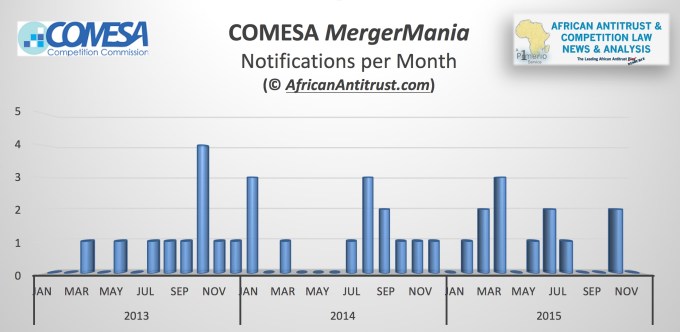
Number of merger notifications based on CCC-published notices (using educated inferences where the original CCC case numbers, dates and/or descriptions lack intelligibility; note that 2013-14 statistics only reflect actual filings made available online and not the official statistics issued by the CCC of 21 and 43, respectively) (c) AfricanAntitrust.com
We look at the most recent developments and updates in respect of competition law and enforcement which has taken place across the African continent in recent months.
As always, thank you for reading the WRAP, and remember to visit us at AAT for up-to-date competition-law news from the African continent.
–Ed. (we wish to thank our contributors, especially Michael James Currie, for their support)
COMESA Competition Commission Expands Enforcement Ambit from Merger Control to Conduct —
CCC Seeks Information on “Potentially” Anti-Competitive Agreements
By AAT Senior Contributor, Michael-James Currie.
Breaking News: The COMESA Competition Commission (CCC) has issued a notice (the “Notice”) calling on firms to notify the CCC of any agreements (both historic and forward looking) that may be anti-competitive, for the purpose of having such agreements ‘authorised’ or ‘exempted’ in terms of Article 20 of the COMESA Competition Regulations (the “Regulations”).
In terms of Article 20 of the Regulations, agreements which are anticompetitive may be exempted by the CCC if such an ‘anticompetitive agreement’ contributes positively to the ‘public interest’ to the extent that the public interest benefit outweighs the anti-competitive effect.
In terms of the CCC’s notice 1/2013, the following agreements may well be considered to be in the public interest when evaluating whether an anti-competitive agreement or concerted practice should be exempted:
Joint research and development ventures;
Specialisation agreements; and
Franchising agreements
As to the agreements or concerted practices which may be anti-competitive, the Notice refers specifically to the restrictive business practices listed in Article 16 of the Regulations which states that:
“The following shall be prohibited as incompatible with the Common Market:
all agreements between undertakings, decisions by associations of undertakings and concerted practices which:
(a) may affect trade between Member States; and
(b) have as their object or effect the prevention, restriction or distortion of competition within the Common Market.”
It should be noted that Article 16 is deliberately drafted broadly so as to prohibit conduct which has as its “object” the prevention, restriction or distortion of competition. Certain conduct, such as price fixing, fixing of trading terms or conditions, allocating suppliers or markets or collusive tendering may be considered as having as its ‘object’ the distortion or restriction of competition in the market. Accordingly, firms who have engaged in this type of conduct may be held liable in the absence of any evidence of an anti-competitive effect (whether actual or potential).
Says Andreas Stargard, a competition practitioner with Primerio Ltd., “[t]he CCC’s notice is a clear sign that the agency is gathering momentum in its efforts to detect and prosecute anticompetitive practices within the member states — and is going beyond its ‘one-trick pony’ status as a pure merger-control gatekeeper. We anticipate a more active role by the CCC in conduct investigations and presumptively also enforcement actions, as opposed to its previous rubber-stamping activity of approving transactions with a COMESA community dimension (and concomitant collection of vast filing fees).”
The web of MoU’s recently concluded, which have as their primary objectives the facilitation of information exchanges and cooperation between competition agencies, is certainly a significant stride made to assist the authorities, including the CCC, in detecting and prosecuting anticompetitive practices which may be taking place across the African continent.
A further indication of the CCC’s growing appetite and confidence to identify anticompetitive practices is that the CCC has announced that it is conducting a market enquiry into the grocery retail sector. This is the first market inquiry to be conducted by the CCC.
In terms of the CCC’s Notice, firms who have not yet notified the CCC of agreements which may be anticompetitive, have approximately one month to do so. In other words, the CC has offered a leniency ‘window’ to incentivise firms to come forward and obtain an exemption in respect of agreements already implemented which may be in contravention of Article 16 of the Regulations.
Significant Strides made to Promote Harmonisation across African Competition Agencies
By AAT Senior Contributor, Michael-James Currie.
In the past 12 months there has been a steady drive by competition law agencies in Africa to promote harmonisation between the respective jurisdictions.
The African regional competition authority, the COMESA Competition Commission (CCC), has entered into memorandum of understandings with a number of its nineteen member states. On 5 June 2016, it was announced that the CCC has further concluded MoU’s with the Swaziland Competition Commission as well as the Fair Trade Commission of the Seychelles.
On 7 May 2016, it was announced that nine members of the Southern African Development Community (SADC) have also entered into and MoU. These member states include South Africa, Malawi, Botswana, Swaziland, Seychelles, Mozambique, Namibia, Tanzania and Zambia.
The SADC MoU was based on the 2009 SADC Declaration on Regional Cooperation and Consumer Policies.
According to the South African Competition Commissioner, Mr Tembinkosi Bonakele, the MoU creates a framework for cooperation enforcement within the SADC region. “The MoU provides a framework for cooperation in competition enforcement within the SADC region and we are delighted to be part of this historic initiative,” said Bonakele.
Interestingly, although a number of the signatories to SADC MoU are not member states of COMESA (that is, South Africa and Namibia, who in turn, have a MoU between their respective competition authorities), Swaziland, Malawi and the Seychelles have existing MoU’s with the COMESA Competition Commission. Says Andreas Stargard, a competition practitioner with Primerio Ltd., “it will be interesting to see, first, whether there may be conflicts that arise out of the divergent patchwork of cooperation MoUs, and second, to what extent the South African Competition Authorities, for example, could indirectly benefit from the broader cooperation amongst the various jurisdiction and regional authorities.”
Part of the objectives of the MoUs to date has largely been to facilitate an advocacy role. However, from a practical perspective, the SADC MoU envisages broader information exchanges and coordination of investigations.
While the MoU’s are a positive stride in achieving cross-border harmonisation, it remains to be seen to what extent the collaboration will assist the respective antitrust agencies in detecting and prosecuting cross border anticompetitive conduct.
There may be a number of practical and legal hurdles which may provide challenges to the effective collaboration envisaged. The introduction of criminal liability for cartel conduct in South Africa, for example, may provide challenges as to how various agencies obtain and share evidence.
Information-sharing, investigative assistance, and capacity-building at forefront of MoU
As reported by the Swaziland Observer, the Seychelles Competition Commission and COMESA’s Competition Commission have entered, on 20 April 2016, into a Memorandum of Understanding that aims to deepen the cooperation and coordination between the two agencies (as well as the Seychelles Fair Trading Commission). Republic of Seychelles has been a member of COMESA since its accession to the common market in 1997.
The MoU creates positions of “desk officers” in each agency to ensure that the institutions will cooperate on investigations and share relevant information to ensure enforcement. It also foresees policy coordination, technical assistance and capacity-building programs.
FTC Seychelles CEO Georges Tirant pointed out that the MoU merely formalises what has already been a day-to-day reality, with the aim of legislative harmonisation and ultimately regional integration. “I have a dream that all African member states should work together for a better Africa,” he said. COMESA Competition Commission Board Chairman Mattews Chikankheni said that it would “improve efficiency in day to day processes, remove entry barriers create an enabling ground for small businesses and medium enterprises which will enable economic growth, job creation and reduce poverty.”
CCC Chief Executive Officer George Lipimile emphasised the need to create jobs and “link industries,” as well as explain the agency’s mission: “We are going to work hard so that competition laws make sense to the people, because a law that does not benefit people is useless.”
Key competition-law conference features dedicated panel discussion on African antitrust developments
By Michael-James Currie
The 54th annual American Bar Association Antitrust Spring Meeting was held in Washington, D.C., during the second week of April 2016 and the AAT editors were there to ensure that we provide our readers with an update on the latest developments in relation to African antitrust issues, discussed during a panel held last Friday.
ABA Africa Panelists
Given that mergers hit a global all-time high last year with the total value of transactions amounting to over USD 4.6 trillion, merger control is certainly at the forefront of many antitrust practitioners. The interest in mergers and acquisitions has perhaps gained even further attention in light of the announcement this week that the USD160 billion Pfizer/Allergan global mega-deal has been officially abandoned, despite the transaction having already been filed before all the relevant competition agencies around the world. While the Pfizer/Allergan deal was called off as a result of new tax laws and therefore not as a result of antitrust issues directly, the deal did put multinational mega-deals firmly in the spotlight.
The Pfizer/Allergan deal is not the only mega-deal that faced significant government opposition. It was announced this week that Halliburton’s takeover of Baker Hughes, in a deal valued at USD 25 billion, is going to be strongly opposed by the U.S. DOJ.
It is, however, not only the U.S. Government that is having a significant impact on multinational deals, as evidenced by the Anbang Insurance and Starwood Hotels & Resorts deal, valued at USD 14 billion, which has also been abandoned after mounting pressure by the Chinese government.
From an African perspective, the South African Competition Commission just last week extended its investigation in the USD 104 billion SABMiller and Anheuser-Busch InBev merger. It is widely suspected that the request for the extension is due to intervention by the Minister of Economic Development, in relation to public interest grounds. Although there is no suggestion at this stage that Minister Patel is opposing the deal, the proposed intervention does highlight bring into sharp focus the fact that multinational mega-deals face a number of hurdles in getting the deal done.
‘Getting multinational deals through’ is a hot topic at the moment amongst antitrust practitioners and is and the ABA thought it beneficial to have a panel discussion dedicated purely to merger control issues across African jurisdictions. In particular, the panel addressed some of the key issues which merging parties need to consider, including inter alia issues relating to harmonisation across agencies, the role of public interest considerations, prior implementation and the need for upfront substantive economic assessments.
The panel consisted of a varied mix of panellists from both private practice and government, and included Pr1merio director John Oxenham (he is also a founding partner at South African based law firm Nortons Inc.), economist and former Commissioner of the COMESA Competition Commission (COMESA CC) Rajeev Hasnah (Rajeev was also a former commissioner of the Mauritius Competition Commission and is an economist for Pr1merio), manager of the South African Competition Commission office, Wendy Ndlovu, and Kenyan based external counsel Anne Kiunuhe (Anne practices at the law firm Anjarwalla & Khanna).
The panellists were tasked with addressing a variety of topics: we summarise below some of the key issues which the panellists highlighted, which merging parties, practitioners and antitrust agencies themselves (amongst whom Tembikosi Bonakele, the South African Competition Commissioner was present in the panel audience) should be cognisant of in relation to merger control in Africa.
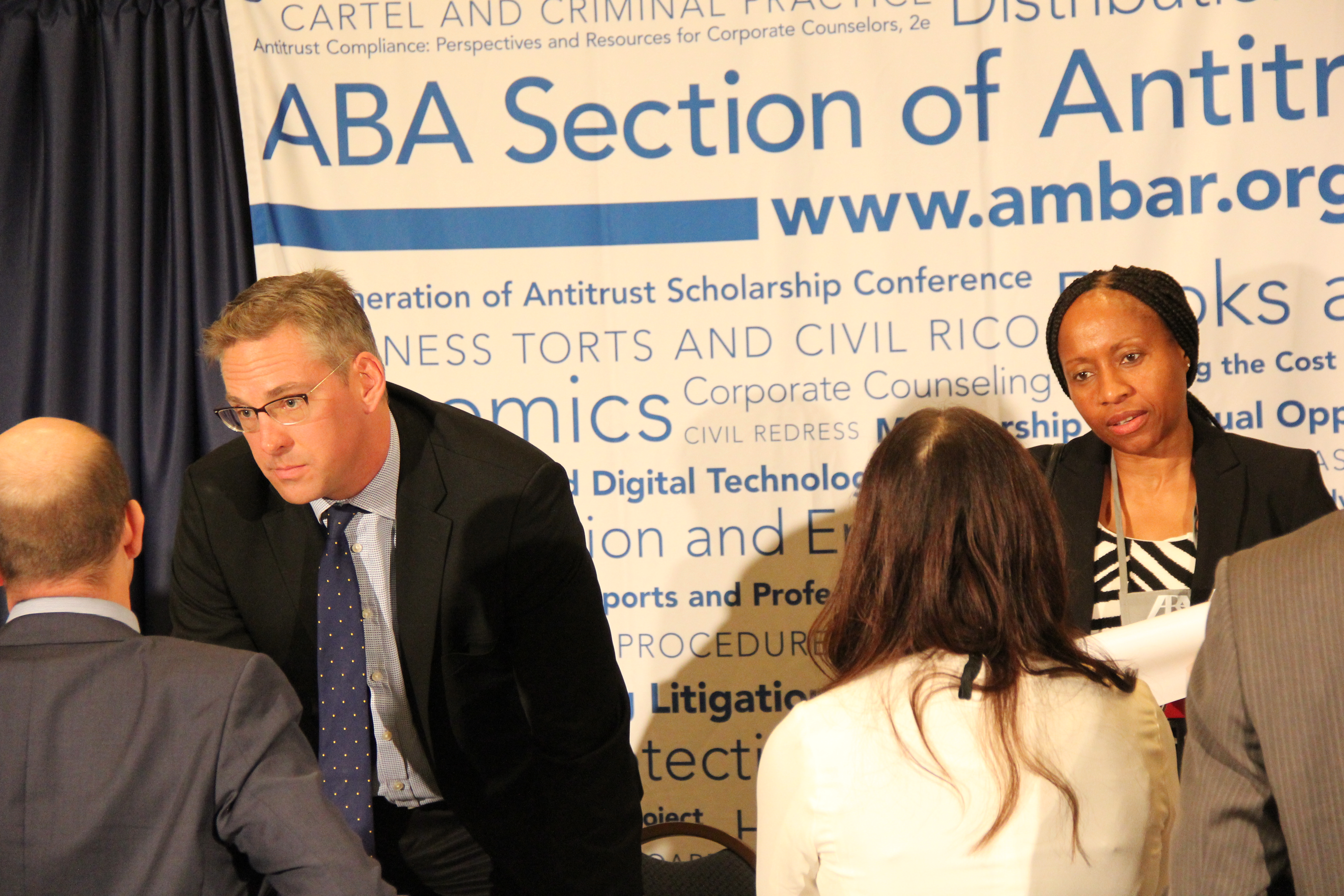
John Oxenham and Wendy Ndlovu at ABA Spring Meeting 2016 in Washington, D.C.
John Oxenham
John pointed out that from a South African perspective, mergers undergo a robust evaluation by the Competition Authorities and that although the investigation of most large mergers is completed within 60-70 days, the fact that the Commission may request the Competition Tribunal for an extension of up to 15 business days at a time, may result in the investigation of certain mergers taking considerably longer. The risk of a merger being delayed is increased significantly due to the level of third party interventionism, particularly ministerial intervention on public interest grounds.
John advised that merging parties should consider the impact that a particular merger will have on the public-interest grounds upfront to avoid delays in the investigation period as a result of further requests for information from the Commission, or may even amount to an incomplete filing.
In respect of substantive economic assessments, John pointed out that a number of jurisdictions, including South Africa, Namibia, Zambia and to a lesser extent Botswana, requires a substantive upfront economic assessment. In this regard the South African Competition Commission is perhaps the most robust in its economic evaluation of a merger in light of the resources dedicated to its own in-house economic department as well as utilising external experts when necessary. John also highlighted the fact that the South African Competition Authorities rely on oral testimony and expert witnesses are often subjected to substantial and lengthy examination and cross examination before the Competition Tribunal.
On the topic of gun-jumping or prior implementation, John mentioned that the following jurisdictions are examples of countries which do not require notification prior to implementing the transaction – in other words, they are not suspensory:
Malawi
Senegal
Mauritius
Whereas the following countries do require notification prior to implementation (suspensory merger control jurisdictions):
South Africa
Swaziland
Zambia
Botswana
On harmonisation, John confirmed that in relation to public interest considerations in merger control, the South African competition authorities play a leading role on the African continent and pointed out that in addition to Kenya and Tanzania, Namibia also considers public interest considerations and that there is a substantial amount of collaboration and information sharing between the South African and Namibian competition authorities, as was the case in the Walmart/Massmart deal.
Despite the information sharing between agencies, John confirmed that there are rules in place to protect confidential and legally privileged information and that the South African competition authorities are cognisant and respectful of these provisions.
Rajeev Hasnah
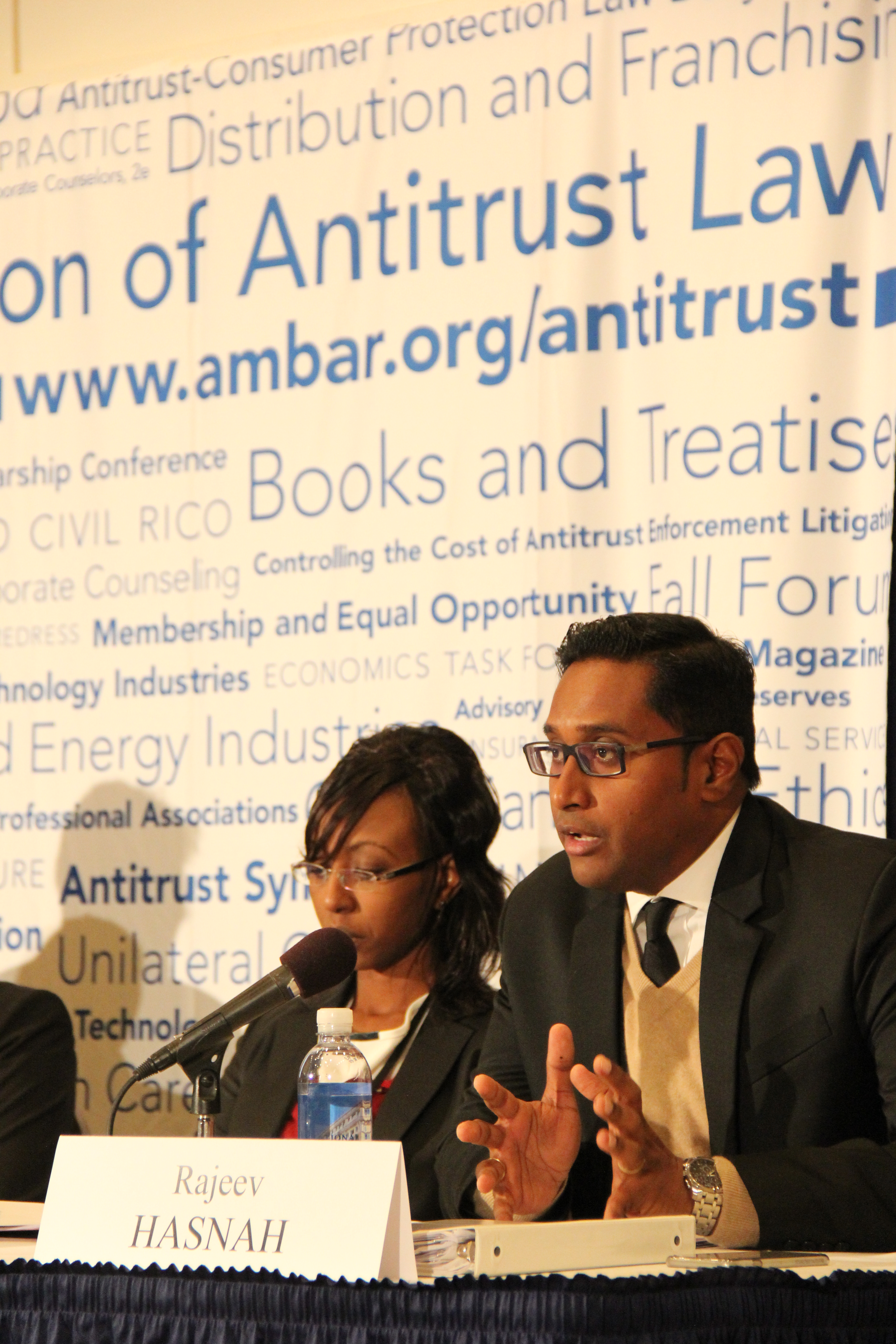
Rajeev Hasnah, Pr1merio economist and former COMESA Competition Commissioner, and Anne Kiunuhe from Kenya
Rajeev noted the significant progress which the COMESA CC has made in relation to merger control by publishing financial thresholds for mandatorily notifiable transactions and specified filing fees, as well as publishing guidelines which clarify when a merger will have a sufficient regional dimension to fall within the COMESA CC’s jurisdiction.
On the topic of harmonisation, Rajeev discussed the challenges due to a lack of harmonisation between COMESA and its member states and noted that COMESA does not have exclusive jurisdiction in the cases which do fall within its jurisdiction. Parties, therefore, may find themselves being required to file a merger both before the COMESA CC as well as before the respective national authorities. A further challenge facing the COMESA CC is that there are 19 member states and consequently, the relevant geographic market is significant. Accordingly, often the national authorities are best placed to evaluate a merger and will therefore defer the evaluation of the merger to the relevant national authority.
On the role of economic assessments, Rajeev stated that an economic assessment underlies any merger evaluation and that both the Mauritius Competition Commission and the COMESA Competition Commission conducts a comprehensive economic assessment of a merger.
Wendy Ndlovu
When asked on what role public interest considerations play in merger control in terms of the South African competition regime, Wendy indicated that the framework of the Competition Act specifically requires the competition authorities to consider the impact that a merger may have on the four specified public interest provisions contained in the Act. Wendy confirmed that an evaluation of public interest considerations may both justify a merger despite the merger likely being likely to cause a substantial lessening or prevention of competition in the market, alternatively, public interest considerations may lead to a prohibition or the imposition of conditions on a merger which raises no competition law concerns and may in fact be pro-competitive.
Wendy recognised that there is a need, however, for greater certainty in respect to the manner in which the South African authorities evaluate public interest considerations and pointed out that the Competition Commission is likely to finalise and publish its guidelines on the public interest assessment in an effort to promote greater certainty.
On prior the issue of prior implementation, Wendy pointed out that merging parties need to be mindful of the consequences of gun-jumping and noted that the South African Competition Tribunal has imposed administrative penalties, as in the Netcare case, on parties for failing to notify a mandatorily notifiable transaction.
Anne Kiunuhe
Anne discussed the Competition Authority of Kenya’s (CAK) willingness to focus not only on merger control but has also identified the CAK’s increasing tendency to investigate and prosecute firms engaged in restrictive practices (as demonstrated by the recent dawn raids conducted by the CAK in the fertiliser industry). Despite the CAK’s growing confidence, Anne pointed out that in respect of merger control, the CAK is open to and in fact often relies on precedent from foreign jurisdictions when evaluating a merger. In particular, Anne noted that public interest grounds are specifically considered during the merger review procedure and that in this respect, the CAK largely takes the lead from the South African competition authorities.
From a practical perspective, Anne mentioned that the CAK usually requests a meeting with the merging parties soon after a transaction has been notified, and that usually representatives from the merging parties, along with local external legal counsel, should be present. The CAK prefers that the representatives present should be the best placed to answer or address the CAK’s queries. This often necessitates representatives from the parent company being present as opposed to representatives from the subsidiary entities only.
The direct contact between the CAK and the merging parties is quite different from the manner in which the COMESA CC evaluates mergers where the consideration of a merger is done solely on the papers and any communication between the COMESA CC and the merging parties is done through the merging parties’ local external counsel.
As to legislative developments, Anne pointed out that the merger regulations in Kenya now provide that for purposes of establishing a “change of control”, it is sufficient if the acquiring firm is able to materially influence the commercial decisions of the target firm. Accordingly, the acquisition of a minority shareholding for instance may constitute a change of control if the holders of such shares may for instance exercise veto rights.
On COMESA, Anne mentioned that the COMESA CC permits merging parties to seek a comfort letter when unsure as to whether a merger requires filing and that the use of comfort letters has been rather prevalent.
Conclusion
The role of public interest considerations in merger control was a dominant focus point throughout the panel discussion due to this unique aspect in a growing number of African jurisdictions merger control provisions.
Please click on the following link to access a an article on the role of public interest considerations in merger control in South Africa, which addresses in particular, the impact of ministerial intervention in merger proceedings and the concomitant impact which such intervention has on the costs, timing and certainty of merger proceedings.
Most African jurisdictions with competition laws have included provisions in their respective legislations that allow the competition authorities to conduct market inquiries.
Market inquiries have proved to be useful tools for competition agencies in numerous jurisdictions, particularly in Europe, and is becoming a common and increasingly popular tool amongst an number of African agencies as well.
Despite the benefits that may flow from a market inquiry, it is important that competition agencies appreciate and have due regard to the costs associated with such inquiries. Market inquiries are very time consuming and onerous for market participants and should be used sparingly. Having said that, the focus of market inquiries in most African jurisdictions tend to be on markets which the relevant authorities have identified as having a large impact on consumers.
In other words, socio-economic considerations appear to be a significant factor during the screening process used in deciding whether to institute a market inquiry. Sectors such as food, healthcare and banking (at an individual consumer level) are some of the common industries which have been ‘prioritised’ or identified as important sectors.
While the number of market inquiries which have been concluded on the African continent is limited, as competition agencies gain more expertise and confidence in their mandates, there is likely to be a significant increase in the number of market inquiries instituted and firms conducting business in Africa, particularly within ‘priority’ sectors, should be cognisant of this.
We set out below a brief overview of the market inquiries which are currently being conducted in the various African jurisdictions.
South Africa
There are currently three market inquiries which are underway, one into the private healthcare sector and the other into the grocery retail market. The third market inquiry is in the liquefied petroleum gas sector.
The private healthcare inquiry was launched on the basis that cost of private health carein South Africa is a concern to the competition authorities. A revised statement of Issues for public comment was announced on 11 February 2016 and comments are to be submitted by 11 March 2016.
The grocery retail inquiry is focussed largely on the stricture of the market and the ability of smaller or informal retailers to compete, but will also address issues such as “long term lease” clauses (which has already been adjudicated upon by the Competition Tribunal).
The third market inquiry is into the LPG which was launched in August 2014 is expected to conclude in March 2016.
The only previous market inquiry concluded in South Africa was into the banking sector. This inquiry was conducted on an informal basis as there were no formal legislative powers bestowed on the competition authorities to conduct market inquiries.
Swaziland
The Swaziland Competition Commission (SCC) announced in January 2016 that a market inquiry has been launched into the retail banking sector. The SCC stated that retail banking service offered to consumers, micro and medium enterprises remained the most important sub-sector of banking. It is, however, the ‘current account’ which is the central product to be used as the starting point for the inquiry.
Zambia
On 1 February 2016, the Zambian Competition Authority (CCPC) announced that it will be conducting a market inquiry into the vehicle towing industry. While the CCPC indicated that it wishes to understand the “conditions of competition in the market”, although the inquiry came about as the CCPC had received numerous complaints from consumers that emergency towing operators were charging high prices. It remains to be seen whether this inquiry is focused predominantly on competition-law issues, or rather consumer-protection laws.
Botswana
The Competition Authority in Botswana (CA) is currently underway with a market inquiry into the grocery retail sector, focusing on shopping malls and in particular, the impact of long term exclusivity leases on competition in the market.
COMESA
Consistent with the competition authorities of South Africa and Botswana, the COMESA Competition Commission (“CCC”) has also launched an investigation into the impact that shopping malls have on competition. The CCC announced that it will carry out their inquiry by taking samples from the member states.
Going from 44 notifications in 2014 to 15 filings last year, the Competition Commission of the COMESA common-market area has seen a dramatic decline in merger filings.
Says Andreas Stargard, a competition lawyer with Africa advisory firm Pr1merio:
“These statistics are akin to the agency’s inaugural year — a slump that can only be explained by one of two likely underlying rationales:
A. Stargard
(1) Potential filers have begun to follow widespread advice from legal counsel that effectively admonishes would-be notifying parties not to do so until COMESA establishes a more robust enforcement and notification regime; or (2) — and this is the CCC’s preferred official explanation — the increased filing thresholds as of March 2015 caused fewer transactions to be caught in the mandatory filing net of the regulator.”
Of further concern, Stargard notes, is that the supporting merger documents made available by the CCC do not reflect the purported official statistics. This fact is reflected in the MergerMania article published on AAT last August.. “For each and every one of the 15 filings identified by the Commission in its official statement, we should be able to see the underlying SOM [statement of merger] and the concomitant Decision — ideally published contemporaneously with the occurrence of each relevant event,” he says. “Unfortunately, on the CCC merger site, two merger filings are missing entirely (numbers 9 and 10), and the others are commonly published many months after the public-comment deadline for the transactions has long expired.”
To date, a parsing of the (available) 2015 statistics shows that 3 of 15 cases actually went into Phase Two review, Stargard observes. “This would generally imply a more serious concern raised by the authority in terms of the effect on competition post-merger. Here, however, it is quite unclear what the potential threat to competition in, for example, a purely private-equity deal would be. The official decision (no. 15, from November 2015) fails to even hint at a possible threat — as one would commonly expect from a PE to PE transaction, which usually raises little to no antitrust eyebrows…”
Our updated AAT COMESA MergerManiastatistics are therefore as follows (again noting the fact that AAT bases its count on only the official, published and available merger documents, instead of relying on mere press release-based summaries published by the CCC). We also note that to date, 2016 has seen one “merger inquiry notice,” namely of the Dutch Yara / Zambian Greenbeltfertiliser deal. The public-comment period for that transaction expires on January 22, 2016.
Number of merger notifications based on CCC-published notices
The full text of the COMESA release follows below:
During the year 2015, the Commission assessed and cleared 15 merger transactions. The transactions involved sectors such as insurance, food additives, water treatment, agro-chemical, banking, telecommunication, non alcohol-ic beverage, publishing, packaging and retail. The Commission handled 12 merger notifications in the year 2013 and 44 merger notifications in the year 2014. The Pie Chart below shows the number of mergers handled by the Commission from inception to date.
As shown in the pie chart the Commission dealt with more mergers in 2014 as compared to 2013 but this trend has gone down in 2015. This trend may be attributed to the supposition that in 2013, the Commission had just commenced operations and therefore some stakeholders were not immediately aware of its existence and operations. By 2014, most stake-holders had become aware of the Commission and its operations, hence the significant increase in the number of mergers notified. The significant reduction in 2015 can be attributed to the supposition that the merger notification thresholds approved by the Council of Ministers on 26 March 2015 which has resulted in smaller mergers escaping the notification. Before 26 March 2015, the merger notification thresholds were Zero hence all mergers were notifiable regardless of size.
 About half of these fees (approximately $1.5 million) were allocated to the national competition authorities in various COMESA states. However, competition authorities in COMESA member states – including Kenya, Zambia and Zimbabwe – continue to insist that merging parties lodge separate merger filings in their jurisdiction. This can add significant transactional costs – the filing fee in Kenya alone for a merger in which the merging parties combined generate more than KES 50 billion (about US $ 493 million) in Kenya is KES 2 million (nearly US $ 20 000). Since Kenya is one of the Continent’s largest economies, significant numbers of global transactions as well as those involving South African firms investing in African businesses are caught in the net.
 x-brand chemicals. The Commission has invited “general public and stakeholders” for comments according to its formal statement.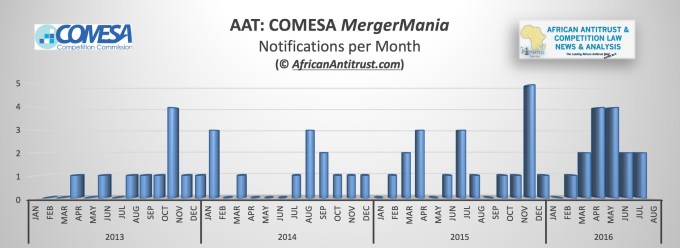
 The web of MoU’s recently concluded, which have as their primary objectives the facilitation of information exchanges and cooperation between competition agencies, is certainly a significant stride made to assist the authorities, including the CCC, in detecting and prosecuting anticompetitive practices which may be taking place across the African continent.
 According to the South African Competition Commissioner, Mr Tembinkosi
  The MoU creates positions of “desk officers” in each agency to ensure that the institutions will cooperate on investigations and share relevant information to ensure enforcement. It also foresees policy coordination, technical assistance and capacity-building programs.
 CCC Chief Executive Officer George Lipimile emphasised the need to create jobs and “link industries,” as well as explain the agency’s mission: “We are going to work hard so that competition laws make sense to the people, because a law that does not benefit people is useless.”



 African Antitrust & Competition Law