A new era of antitrust in Zimbabwe: National Competition Policy moves ahead

Having recently hosted a national sensitisation workshop on COMESA competition policy in Harare, as we reported here, Zimbabwe is expected to enact a revised competition law.  The country’s Cabinet has reportedly approved the National Competition Policy.  One element of the NCP is to reduce the time it takes the Zimbabwean Competition and Tariff Commission (CTC) to review mergers and acquisitions from 90 to 60 days, thereby encouraging “brownfield” investments, according to a minister.

Zimbabwean Industry and Commerce Minister Dr. Mike Bimha spoke at the mentioned workshop, emphasising the need for “a level playing field”: “We are now working to ensure that we have a new Competition Law in place which will assist the CTC in dealing more effectively with matters related to abuse of dominant positions and cartels,” he said.

The NCP is part of a larger project to encourage investment and is closely linked with the country’s industrial and trade policies, known as Zimbabwe Agenda for Sustainable Socio-Economic Transformation (a.k.a. “Zim-ASSET”).

The Zimbabwean NCP is not merely domestically focussed, however.  Andreas Stargard, a competition-law practitioner, highlights the more international aspects that also form part of the revised competition bill awaiting enactment by the President:

Not only does the NCP contain the usual  focus of levelling the playing field among domestic competitors under its so-called Zim-ASSET programme.  It also undergirds the so-called ‘domestication’ of the broader regional COMESA competition rules, as well as the Ministry’s bilateral agreements.  For example, Zimbabwe recently entered into a Memorandum of Understanding with the Chinese government, designed to enhance cooperation on competition and consumer protection issues between Zimbabwe’s CTC and the PRC’s MOFCOM.

Pan-African Antitrust Round-Up: Mauritius to Egypt & Tunisia (in)to COMESA

A spring smorgasbord of African competition-law developments

As AAT reported in late February, it is not only the COMESA Competition Commission (CCC), but also the the Egyptian antitrust authorities, which now have referred the heads of the Confederation of African Football (CAF) to the Egyptian Economic Court for competition-law violations relating to certain exclusive marketing & broadcasting rights.  In addition, it has been reported that the Egyptian Competition Authority (ECA) has also initiated prosecution of seven companies engaged in alleged government-contract bid rigging in the medical supply field, relating to hospital supplies.

Nigeria remains, for now, one of the few powerhouse African economies without any antitrust legislation (as AAT has reported on here, here, here and here).

But, notes Andreas Stargard, an antitrust attorney with Primerio Ltd., “this status quo is possibly about to change: still waiting for the country’s Senate approval and presidential sign-off, the so-called Federal Competition and Consumer Protection Bill of 2016 recently made it past the initial hurdle of receiving sufficient votes in the lower House of Representatives.  Especially in light of the Nigerian economy’s importance to trade in the West African sphere, swift enactment of the bill would be a welcome step in the right direction.”

The global trend in competition law towards granting immunity to cartel whistleblowers has now been embraced by the Competition Commission of Mauritius (CCM), but with a twist: in a departure from U.S. and EU models, which usually do not afford amnesty to the lead perpetrators of hard-core antitrust violations, the CCM will also grant temporary immunity (during the half-year period from March 1 until the end of August 2017) not only to repentant participants but also to lead initiators of cartels, under the country’s Leniency Programme.

The Executive Director of the CCM, Deshmuk Kowlessur, is quoted in the official agency statement as follows:

‘The policy worldwide including Mauritius, regarding leniency for cartel is that the initiators of cartel cannot benefit from leniency programmes and get immunity from or reduction in fines. The amnesty for cartel initiatorsis a one-off opportunity for cartel initiators to benefit from immunity or up to 100% reduction in fines as provided for under the CCM’s leniency programme. The amnesty is a real incentive for any enterprise to end its participation in a cartel. In many cases it is not clear for the cartel participant itself as to which participant is the initiator. The participants being unsure whether they are an initiator finds it too risky to disclose the cartel and apply for leniency. The amnesty provides this unique window of 6 months where such a cartel participant can apply and benefit from leniency without the risk of seeing its application rejected on ground of it being an initiator.’


COMESA Competition Commission logoFinally, COMESA will grow from 19 to 20 member states, welcoming Tunisia at the upcoming October 2017 summit: the official statement notes that “Tunisia first applied for observer status in COMESA in 2005 but the matter was not concluded. In February, 2016 the country formally wrote to the Secretary General making inquiries on joining COMESA. This set in motion the current process towards its admission. once successfully concluded, Tunisia will become the 20[th] member of COMESA.”

This means that within 6 months of accession to the Common Market, Tunisia’s business community will be bound by the competition regulations (including merger control) enforced by the CCC.  Speaking of the CCC, the agency also recently entered into a Memorandum of Understanding with the Mauritian CCM on March 24, facilitating inter-agency coordination.  In addition, the Zimbabwean Competition and Tariff Commission (CTC) will host a national sensitisation workshop on COMESA competition policy on May 16, 2017 in Harare, purportedly as a result of “over 50 transactions involving cross-border mergers notified” to the CCC involving the Zimbabwean market.  “The main objective of the national workshop is to raise awareness among the key stakeholders and business community in Zimbabwe with regards to the provisions and implementation of COMEA competition law,” the CTC noted in a statement.


Kenya: Competition Amendment Bill to bring about Radical changes to the Act

kenyaThe Competition Authority of Kenya (CAK) has recently announced that a number of proposed amendments to the Competition Act are currently pending before the National Assembly for consideration and approval.

The proposed amendments are generally aimed at increasing sanctions and CAK’s authority to detect and prosecute anti-competitive behaviour as well as to ensure that parties provide the CAK with adequate and correct information to properly assess merger notifications.

  • Anti-competitive conduct

Importantly, the amendments seek to introduce a financial threshold for respondents who are found to have engaged in abuse of dominance practices. Currently, there is no administrative penalty for a abuse of dominance.

The amendments further include an administrative cap of 10% for engaging in cartel conduct.

Interestingly, the amendments also seek to introduce measures to protect suppliers from buying groups. Unlike the South African Competition Act which specifically precludes competitors from entering into an agreement or concerted practice which amounts to the fixing of a purchase price or trading condition, Kenya’s Competition Act does not have a similar express prohibition.

It is also not clear, at this stage, what the anti competitive effect of buying groups is having in Kenya. The CAK has, however, indicated that suppliers are often left short-changed as a result of buying groups not paying the suppliers. Whether this has or may have a foreclosure effect on suppliers is noy yet apparent.

In any event, the proposed solution is likely to be resolved through the development of guidelines rather than an amendment to the Act.

  • Mergers

A clear indication that the CAK is increasing its efforts to ensure that they are not merely a regulatory body which rubber stamps merger approvals is the proposed introduction of penalties for merging parties who submit incorrect information to the CAK during a merger filing.

In addition, in terms of Section 47 of the Competition Act, the CAK may revoke their decision to approve or conditionally approve a merger if the merger approval was granted based on materially incorrect or false information provided during the notification and/or the merger is implemented in contravention of any merger approval related conditions.  In terms of the amendments, the CAK is proposing the introduction of criminal liability for merging parties who implement a merger despite the CAK having revoked the merger.

Merging parties will, therefore, need to ensure that they adequately prepare and submit comprehensive merger filings.

As to the definition of what constitutes a “merger” for purposes of the Competition Act, the proposed amendments seek to clarify that a change of control can take place by the acquisition of assets.

  • Market inquiries

Section 18 of the Act is also to be amended to place an obligation on parties to provide the CAK with information during market inquiries.

We have not yet seen the CAK conduct a full blown market inquiry as has been the case in South Africa. In light, however, of the CAK and the South African Competition Commission’s (SACC) advocacy initiatives (readers wlll recall that the CAK and the SACC recently concluded a Memorandum of Understanding), the CAK may soon launch a market inquiry into priority sectors such as grocery retail and agro-processing.


Notifying African M&A – balancing burdens & costs

Merger filings in Africa remain costly and cumbersome

By AAT guest contributor Heather Irvine, Esq.

The Common Market for Eastern and Southern Africa Competition Commission (COMESA) recently announced that it has received over US$3 million in merger filing fees between December 2015 and October 2016.

heatherirvineAbout half of these fees (approximately $1.5 million) were allocated to the national competition authorities in various COMESA states. However, competition authorities in COMESA member states – including Kenya, Zambia and Zimbabwe – continue to insist that merging parties lodge separate merger filings in their jurisdiction. This can add significant transactional costs – the filing fee in Kenya alone for a merger in which the merging parties combined generate more than KES 50 billion (about US $ 493 million) in Kenya is KES 2 million (nearly US $ 20 000). Since Kenya is one of the Continent’s largest economies, significant numbers of global transactions as well as those involving South African firms investing in African businesses are caught in the net.

Merging parties are in effect paying African national competition authorities twice to review exactly the same proposed merger. And they are not receiving quicker approvals or an easier fling process in return. Low merger thresholds mean that even relatively small transactions, often with no impact on competition at all, may trigger multiple filings. There is no explanation for why COMESA member states have failed to amend their local competition laws despite signing the COMESA treaty over 2 years ago.

Filing fees are even higher if a proposed cross-border African merger transaction involves a business in Tanzania or Swaziland– the national authorities there have recently insisted that filing fees must be calculated based on the merging parties’ global turnover (even though the statutory basis for these demands are not clear).

The problem will be exacerbated even further if more regional African competition authorities, like the Economic Community of West African States (ECOWAS) and the proposed East African Competition authority, commence active merger regulation.

Although memoranda of understanding were recently signed between South Africa and some other relatively experienced competition regulators on the Continent, like Kenya and Namibia, there are generally few formal procedures in place to harmonise merger filing requirements, synchronise the timing of reviews or align the approach of the regulators to either competition law or public interest issues.

The result is high filing fees, lots of duplicated effort and documents on the part of merging parties and the regulators, and slow merger reviews.

If African governments are serious about attracting global investors, they should prioritise the harmonisation of national and regional competition law regimes.

COMESA sees slight uptick in merger notifications

Merger filings still dither, but YTD numbers now tentatively promise to exceed FY2015

Making sense of the COMESA Competition Commission’s merger notification site is no  easy undertaking.  The perplexing nature of its case-numbering system mirrors perhaps only the level of confusion surrounding the CCC’s original merger threshold and notification-fee guidelines (e.g., see here on that topic).

As we pointed out here, the merger statistics (as they had been released as of January 2016) for 2015 were disappointingly low.  In today’s post, please note that we are upgrading those numbers, however, to reflect additional material now made available on the official CCC web resource, reflecting 3 additional filings, bringing the year-end total for FY2015 to 18.  Three of those were “Phase 2” cases.  In addition, according to the CCC, there were 3 supplemental cases in which “Comfort Letters” were issued to the parties.

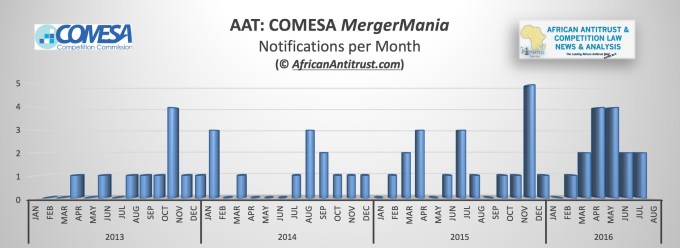
For year-to-date 2016 statistics, the numbers look analogous, albeit somewhat higher than the 2015 slump — that is to say, still diminished from the 2013-2014 height of COMESA ‘mergermania’, during which (mostly international) counsel took the confusion surrounding the CCC notification thresholds to heart and erred on the side of caution (and more fees), advising clients to notify rather than not to (65 in the 2 years), or to seek Comfort Letters, which also were issued in record numbers (19 total for the 2-year period)…   With that said, the agency is now up to 16 merger cases, with 2 Second-Phase matters on deck.

AAT 2016 September mergermania statistics
Number of merger notifications based on CCC-published notices (using educated inferences where the original CCC case numbers, dates and/or descriptions lack intelligibility; note that 2013-14 statistics only reflect actual filings made available online and not the official statistics issued by the CCC of 21 and 43, respectively)                                                                         (c) AfricanAntitrust.com

AB InBev/SABMiller: SA conditional approval

South African Competition Commission Concludes Investigation into the AB In-Bev/SABMiller deal and Recommends that the Merger be Approved Subject to Conditions

On 31 May 2016, the South African Competition Commission (SACC) recommended that that the Anheuser-Busch Inbev/ SABMiller merger be approved subject to various conditions relating to both competition and public interest concerns.

south_africaFrom a procedural aspect, the SACC’s recommendations are made to the South African Competition Tribunal, the adjudicative body ultimately responsible for approving a merger.

The SACC’s recommendations are not binding on the merging parties or the Tribunal. To the extent that the merging parties, or third parties, are concerned about the merger or the SACC’s recommendations, they may elect to participate in the hearing before the Tribunal.

In cases where neither the merging parties nor any third parties contest the SACC’s recommendations, the Tribunal usually rubber stamps the SACC’s recommendations.

We note that in terms of the SACC’s proposed recommendations, that the merging parties have made numerous undertakings to address the SACC’s concerns.

The following concerns and recommendations were proposed by the SACC:

  • A divestiture of SABMiller’s shareholding in the Distell Limited Group (a competitor of SAB in the cider market) within three years of the closing date of the transaction;
  • That no employees of the merged entity will be involved on the bottling operations of both Coca-Cola and PepsiCo and that no commercially sensitive information would be exchanged between employees in relation to these two soft drink entities;
  • AB Inbev will continue supplying third parties with ‘tin metal crowns’ in South Africa as AB Inbev will own the only ‘tin metal supplier’ in South Africa post merger for a period of 5 years;
  • AB Inbev should make at least 10% of its fridge space available, in small retail outlets or taverns, to competitors’ products to protect small beer producers;
  • The development of a R1 billion fund which will be used, inter alia, to develop barley, hops and maize output in South Africa;
  • No merger related retrenchments are to take place in South Africa, in perpetuity;
  • AB Inbev will continue to supply certain products to small beer producers;
  • AB Inbev will continue to ensure that it follows the same ratio of local production and will, itself, remain committed to sourcing products locally;
  • Undertakings to ensure that the merging parties will, within two years after closing the merger, propose to the Commission and Government its plan on how to maintain black participation in the company and preserve equity;
  • AB Inbev will continue to comply with the existing terms and conditions of the current agreements which exist between SABMiller and ‘owner-drivers’.

The merging parties have agreed to the majority of the conditions imposed on the merger. We note, however, that the SACC’s media statement does not make it clear that the merging parties have agreed to the divestiture recommendation. The merging parties have also not agreed to the proposed condition relating to a commitment to continue to supply small beer producers with hops and malt.

Accordingly, even in the absence of any third party intervention, this merger may still be contested before the Tribunal.

While the SACC’s official recommendations have not yet been published, it appears to us that a number of the concerns raised by the SACC relate to pre-existing concerns which are not merger specific. Furthermore, important aspect of the proposed recommendations, even those which have been agreed to between the parties, will be in perpetuity.

Furthermore, although what may appear to be a relatively innocuous proposed conditions which the merging parties shave agreed to, is that AB Inbev will respect the current existing contractual arrangements as between SABMiller and ‘owner drivers’.  Approving a merger subject to such a condition poses an interesting conundrum. What happens in the event that there is contractual dispute between Ab-Inbev and owner drivers in the future? Will the Tribunal have jurisdiction to hear such disputes and could the merged entity be subject to penalties for breaching a condition of the merger, despite a contractual dispute which may have little if anything to do with the merger itself?

We have previously, here on Africanantitrust raised our concerns regarding the merger specificity of the R1 billion development fund. To access our previous article on this topic, please click here.

In our view, the Competition Tribunal should satisfy itself that the proposed conditions, even if agreed to between the merging parties, should address merger specific concerns and nothing more. A decision by the Tribunal is precedent setting and has an impact on the transparency and certainty of the merger control process in South Africa. When mergers are approved subject to conditions which go beyond merger specificity, uncertainty is created.
“The WRAP” from last month – a new semi-serial publication

South African Antitrust Developments: a WRAP from the Comp-Corner

Issue 1 – May 2016

The editors and authors at AAT welcome you to our new semi-serial publication: “The WRAP.”  In this first WRAP edition, we look back over recent months and provide an overview of the key recent developments which antitrust practitioners and businesses alike should take note of in respect of merger control and competition law enforcement.

As always, thank you for reading the WRAP, and remember to visit AAT for up-to-date competition-law news from the African continent.

         –Ed. (we wish to thank our contributors, especially Michael Currie, for their support)

Developments in South African Merger Control: Ministerial Interventionism and the Impact on Timing & Certainty

Partisanship can degrade the brand of the antitrust agencies, reduce their influence aboard, and discourage longer term investments that strengthen agency performance. Though difficult to quantify, these constitute a potentially serious, unnecessary drag on agency effectiveness”

(William Kovacic, “Policies and Partisanship in U.S. Federal Antitrust Enforcement” (2014) Antitrust Law Journal, Vol. 79 at 704).

In their article entitled “Developments in South African Merger Control – Ministerial Interventionism and the Impact on Timing & Certainty,” John Oxenham, Andreas Stargard, and Michael Currie argue that, while the existence of ‘public-interest’ provisions in merger control is an express feature in certain jurisdictions’ antitrust regimes, the manner and regularity with which they are applied remains a significant challenge both for antitrust practitioners and for their clients gauging certainty of their foreign investments.

A consideration of the developments in the South African context indicates the substantial risks associated with the manner in which antitrust agencies and governmental departments approach public interest considerations in merger proceedings.

Merging firms, particularly multinationals, need to be acutely aware of the challenges and risks associated with the use of public-interest considerations throughout merger-control proceedings in South Africa. Recent interventionist strategies have had a significant impact on two key features: the timing and cost of concluding mergers in the region.

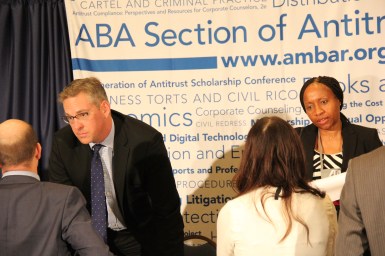
The paper was presented at this year’s ABA Antitrust Spring Meeting, the largest competition-law focussed conference in the world, taking place annually in Washington, D.C.  AAT’s readers have exclusive free access to the PDF here.

John Oxenham and Wendy
John Oxenham

Ministerial meddling in mergers

Intervention by economic ministry outside proper competition channels yields R1 billion employment fund

As reported yesterday, AB InBev has agreed to a R1bn ($69m) fund to buoy the South African beer industry and to “protect” domestic jobs.  It is widely seen as a direct payment in exchange for the blessing of the U.S. $105 billion takeover of SABMiller by InBev — notably occurring outside the usual channels of the Competition Authorities, instead taking place as behind-closed-door meetings held between the parties and the Minister for Economic Development, Ibrahim Patel, and his staff.

Patel talks.jpgAs we reported earlier this week, the previously granted extension of the competition authorities’ review was “widely suspected that the request for the extension is due to intervention by the Minister of Economic Development, in relation to public interest grounds. Although there is no suggestion at this stage that Minister Patel is opposing the deal, the proposed intervention does highlight bring into sharp focus the fact that multinational mega-deals face a number of hurdles in getting the deal done.”
AAT has reported previously on “extra-judicial factors,” as well as the interventionism by the current ministry.  This latest deal struck by Mr. Patel and the parent of famed Budweiser beer includes a promise by the parties to preserve full-time employment levels in the country for five years after closing, according to AB InBev.  Moreover, the companies pledged to provide financial help for new farms to increase raw materials production of beer inputs like hops and barley.
The minister is quoted as saying: “This transaction is by far the largest yet to be considered by the competition authorities and it’s important that South Africans know that the takeover of a local iconic company will bring tangible benefits.  Jobs and inclusive growth are the central concerns in our economy.”
ABInbev
The holy trinity of InBev’s beers
Our editors and contributing authors have reported (and warned) on multiple occasions that the extra-procedural behaviour of the economic minister effectively side-lines the competition agencies, thereby eroding the perceived or real authority of the Competition Commission and the Tribunal.  Says Andreas Stargard, a competition law practitioner with a focus on Africa:
“This ‘unscripted’ process risks future merger parties not taking the Authorities seriously and side-stepping them ex ante by a short visit to the Minister instead, cutting a deal that may be in the interest of South Africans according to his ministry’s current political view, but certainly not according to well-founded and legislatively prescribed antitrust principles.  The Commission and the Tribunal take the latter into account, whereas the Minister is not bound by them, by principled legal analysis, nor by competition economics.”
This is especially true as the current deal involves the takeover of SABMiller, an entity that controls 90% of South Africa’s beer market.  From a pure antitrust perspective, this transaction would certainly raise an agency’s interest in an in-depth investigation on the competition merits — not merely on the basis of job maintenance and other protectionist goals that may serve a political purpose but do not protect or assure future competition in an otherwise concentrated market.
Says one African antitrust attorney familiar with the matter, “What may be a short-term populist achievement, racking up political points for Mr. Patel and the ANC, may well turn out to be a less-than-optimal antitrust outcome in the long run.”

Gun jumping: Record antitrust fine for failure to notify merger

S.A. Competition Tribunal imposes record fine for missed merger filing in healthcare

By AAT guest author Meghan Eurelle

On 7 April 2016, the South African Competition Tribunal (“Tribunal”) confirmed that merger parties Life Healthcasouth_africare Group Proprietary Limited and Joint Medical Holdings Limited had entered into a consent agreement with record-breaking consequences.  The two hospital groups admitted to not complying with the Competition Act, 1998 (“the Act”) by failing to notify the competition authorities of their merger and to obtain the required approval prior to the merger being implemented; and subsequently agreed to jointly pay an administrative penalty of 10 million Rand, or approximately U.S. $690,000.  (Interestingly, the parties also conceded that they were guilty of fixing the price of services back in 2004 but the Tribunal dropped these charges.)

gunjumpingThe R10-million administrative penalty is a record amount for gun-jumping, or the failure to notify the competition authorities of a merger.  Previously, the highest penalty for a failure to notify was just over R1-million. The new record penalty follows numerous warnings by the Competition Commission (“Commission”) that it intended to materially increase penalties for failure to notify mergers — says Andreas Stargard, an antitrust practitioner with Pr1merio advisors, “South Africa has a suspensory merger-notification system, like most international antitrust regimes do.  And unlike other African countries, such as Senegal or Mauritius, the domestic S.A. competition legislation prohibits transacting parties from effecting the transfer of control or beneficial ownership prior to obtaining clearance from the authorities.”

In terms of the Act, transactions that are defined as “intermediate mergers” and “large mergers” must be notified to the Commission and may only be lawfully implemented if it has been approved, with or without conditions, by the relevant competition authorities. Small mergers do not have to be notified in the ordinary course and may be implemented without approval unless required by the Commission.

Merger notification thresholds in South Africa remain as follows:

Acquiring and Target firm (merger group) Target firm
Large Merger Combined assets and/or turnover of at least R6.6-billion. AND Assets and/or turnover of at least R190-million.
Intermediate Merger Combined assets and/or turnover equals or exceeds R560-million but is less than R6.6-billion. AND Assets and/or turnover equals or exceeds R80-million but is less than R190-million.
Small Merger Combined assets and/or turnover of less than R560-million. OR Assets and/or turnover of less than R80-million.

In light of the above, it serves as an important reminder to parties that they ensure compliance with the competition authorities and the Act so as to avoid costly consequences.