Private Health-Care Sector Inquiry: Time Table & Details

south_africa

Inquiry panel’s head details logistics

On 16 April 2014, the South African Competition Commission held a media briefing, in which the administrative guidelines, the administrative timetable and statement of issues for the inquiry were announced.  AAT previously reported on the health-care sector investigation here.

Addressing the media and other stakeholders at the briefing, the chairperson of the inquiry, former Chief Justice Sandile Ngcobo, provided a brief explanation of what a market inquiry is, provided an overview of its possible outcomes, the Competition Commission and panel’s approach, the use of information during the inquiry and the management of confidential information.

Furthermore, the former Chief Justice elaborated on the important dates and timelines of the inquiry, the statement of issues, theories of harm and that stakeholders ought to provide accurate information in order to assist the panel.

The important dates are:

Date Event
31 May Statement of Issues and Administrative Guidelines issues for public comment
30 June Deadline for submission of public comment on Statement of Issues and Administrative Guidelines
1 July – 31 July Incorporation of comments on Statement of Issues and Administrative Guidelines
01 August Publication of final Statement of Issues and Administrative Guidelines
01 August Call for submissions on subject matter of the inquiry
March and April 2015 Public hearings
November 2015 Forecasted completion of the inquiry

Criminalisation of antitrust offences: not on short-term horizon

south_africa

Competition Commission not ready to pursue antitrust cases criminally – plus: AAT‘s recommendations

The newly (permanently) appointed Competition Commissioner, Tembinkosi Bonakele, has referred to a “phased” implementation of the 2009 Competition Amendment Act.  The legislation technically criminalised hard-core antitrust offences such as bid-rigging or price-fixing cartels.  However, it has not yet been implemented or effectively signed into law.

According to a MoneyWeb/ZA report, both he and his boss, Economic Development Minister Ebrahim Patel, had discussions on how and when to implement “to ensure that the necessary institutional capacity is available to apply the amendments.”  The initially effective provisions (relating to the SACC’s market-inquiry powers) went into effect last year, while the criminalisation provisions remain unimplemented.

In a somewhat remarkable and prudent self-assessment, the minister and SACC have now admitted that the Commission currently lacks “the institutional capacity needed to comply with the higher burden of proof in criminal cases,” according to the report.

One notable aspect of potential discord lies in not only in the different standard of proof in civil vs. criminal matters (“more probable than not” vs. “beyond a reasonable doubt”), but perhaps more importantly can be found on the procedural side, preventing rapid implementation of the law: There has been historic friction between various elements of the RSA’s police forces and (special) prosecutorial services, and the power to prosecute crimes notably remains within the hands of the National Prosecuting Authority, supported in its investigations by the South African Police Service.

Historical and Legislative Background – and a bit of Advice

Starting in the spring and summer of 2008, the rumoured legislative clamp-down on corrupt & anti-competitive business practices by the government made the RSA business papers’ headlines.

During a presentation I gave at a Johannesburg conference in September that year (“Criminalising Competition Law: A New Era of ‘Antitrust with Teeth’ in South Africa? Lessons Learned from the U.S. Perspective“), I quoted a few highlights among them, asking somewhat rhetorically whether these were the words of fearmongers or oracles?

  • “Competition Bill to Pave Way for Criminal Liability”
  • “Tough on directors”
  • “Criminalisation of directors by far most controversial”
  • “Bosses Must Pay Fines Themselves”
  • “New leniency regime to turn up heat on cartels”
  • “New era in the application of competition policy in SA”
  • “Likely to give rise to constitutional challenges”
  • “New Bill On Cartels is a Step Too Far”
  • “Fork out huge sums or face jail time if found guilty”
  • “Disqualification from directorships … very career limiting”

I also quoted international precedent-setting institutions and enforcers’ recommendations, all of which tended towards the positive effect of criminal antitrust penalties:

OECD, 3rd Hard-Core Cartel Report (2005):

  • Recommends that governments consider the introduction and imposition of criminal antitrust sanctions against individuals to enhance deterrence and incentives to cooperate through leniency programmes.

U.S. Department of Justice, Tom Barnett (2008):

  • “Jail time creates the most effective, necessary deterrent.”
  • “[N]othing in our enforcement arsenal has as great a deterrent as the threat of substantial jail time in a United States prison, either as a result of a criminal trial or a guilty plea.”

While the presentation contained a lot more detail, the key recommendations that I summarised would seem to continue to hold true today, and may serve as guide-posts for Commissioner Bonakele and the EDD ministry:

Cornerstones of a successful criminal antitrust regime
  • Crystal-clear demarcation of criminal vs. civil conduct
  • Highly effective leniency policy also applies to individuals
  • Standard of proof must be met beyond a reasonable doubt
  • No blanket liability for negligent directors – only actors liable
  • Plea bargaining to be used as an effective tool to reduce sentence
  • Clear pronouncements by enforcement agency to help counsel predict outcomes
Demarcation of criminal vs civil antitrust conduct in U.S.

Internet & mobile operators at war: merge, acquire, complain

Deals and accusations rock ZA’s Vodacom

The South African mobile operator landscape can be described as a microcosmic reflection of the larger African experience: Mobile technology is exponentially more developed than what an outside observer would otherwise predict, based on distinct economic predictors.  One of the key reasons for this highly-developed sub-Saharan mobile world is the concomitant lack of hard-wired infrastructure, necessitating that mobile make up for the copper-wire slack.  Other reasons include the hot topic of mobile banking (again: lack of brick-and-mortar banks necessitates mobile banking alternatives, such as M-Pesa’s services, on which AAT has reported extensively).

South Africa, as the continent’s largest (or second-largest, depending on whether you trust the revised Nigerian GDP numbers) economy, is of course at the forefront of the African mobile/internet frontier.

Now, the large South African operator Vodacom has rejoined the antitrust headlines simultaneously in two ways:

First, Vodacom ZA plans to acquire Neotel, a large S.A. internet provider, for 7 billion Rand (circa $650m).  This transaction will, of course, be subject to merger review by the South African Competition Commission (“SACC”).

Second, Vodacom has confirmed the prior reports of its competitor Cell-C’s October 2013 complaint, accusing Vodacom of discriminatory pricing, which is now being taken rather seriously by the SACC, according to TechCentral’s reporting.  On that front, Vodacom’s spokesman Richard Boorman is quoted as using classic competition-law argumentation as a clever shield:

“Cell C is apparently arguing for an increase in the price that Vodacom customers pay to call other Vodacom customers. It’s hard to argue that increasing prices would be a benefit to consumers.”

Vodacom’s official press statement on the Neotel deal follows below:

Vodacom reaches agreement to acquire Neotel

Monday, 19 May 2014

Further to the SENS announcement on 30 September 2013, Vodacom has reached an agreement with the shareholders of Neotel Proprietary Limited (“Neotel” or the “Company”) to acquire 100% of the issued share capital in, and shareholder loans against, Neotel for a total cash consideration equivalent to an enterprise value of R7.0bn.

Principal benefits of the transaction

Leading fixed telecommunications network

Neotel, which started operations in 2007, is the second largest provider of fixed telecommunications services for both businesses (commonly referred to as enterprise services) and consumers in South Africa. The company has access to over 15,000 km of fibre-optic cable, including 8,000 km of metro fibre in Johannesburg, Cape Town and Durban. Neotel also has access to 2 x 12 MHz of 1800 MHz spectrum, 2 x 5 MHz of 800 MHz spectrum and 2 x 28 MHz of 3.5 GHz spectrum.

Acceleration of Vodacom’s unified communications strategy

Neotel will become a subsidiary of Vodacom South Africa and the combination with Vodacom’s South African fixed enterprise business will create a national service provider with annual revenues of more than R5bn.

Vodacom sees a significant opportunity to accelerate growth in unified communications products and services by integrating its extensive distribution and marketing capabilities with Neotel’s fixed network and product capabilities. The combined entity will be able to offer an expanded and enhanced range of converged services (e.g. hosted PBX, OneNet) to enterprise customers. Vodacom estimates revenue synergies with a total net present value of approximately R0.9bn after integration costs.

Enhancement of next generation network capabilities in South Africa

The combination of Neotel’s and Vodacom’s networks will improve overall network availability and reduce the cost to serve customers. The combined business will also be ideally positioned to accelerate broadband connectivity in line with the South African Government’s broadband targets, enabling Vodacom to take a leading position in the fibre to the home and fibre to the enterprise segments of the market.

The combined entity will also be able to use the radio spectrum currently assigned to Neotel more effectively. This spectrum will enable Vodacom to accelerate the roll-out of LTE (commonly referred to as 4G) services, providing high speed, high quality wireless connectivity to a greater proportion of the South African population.

In-market consolidation with substantial cost and capex savings

Vodacom expects to achieve substantial cost and capex synergies with an annual run-rate of approximately R300m before integration costs in the full fifth year post completion, equivalent to a net present value of approximately R1.5bn after integration costs. These savings will primarily be derived from the joint utilisation of Neotel’s extensive fibre network and the elimination of overlapping elements, joint procurement and the combination of overlapping administrative functions. The transaction values Neotel at a multiple of 8.8x annualised 1H2014 OpFCF, adjusted for cost and capex synergies.

Neotel management and employees

Vodacom looks forward to welcoming Neotel’s employees. Their fixed and enterprise skills will enable the combined entity to deliver enhanced and extended service offers.

Additional information on the transaction

Vodacom will fund the acquisition through available cash resources and existing credit facilities.

The transaction remains subject to the fulfilment of a number of conditions precedent including applicable regulatory approvals and is expected to close before the end of the financial year.

Speaking about the transaction, Vodacom Group CEO Shameel Joosub said:

“Through the combination of these two businesses, the provision of a wider range of business services and much needed consumer services like fibre-to-the-business and fibre-to-the-home becomes a concrete reality – it will be good for the consumer, good for business and good for the country.  And for our investors, the transaction fits perfectly within the priorities of Vodacom’s growth strategy focused on continuing our investment in data and our Enterprise business.”
 

New Competition Commissioner not so new: Bonakele retains top job

south_africa

Interim South African Acting Competition Commissioner Tembinkosi Bonakele confirmed in permanent post by minister who unceremoniously fired predecessor Ramburuth

Plus ça change, plus c’est la même chose…

This morning, economic-development minister Ebrahim Patel announced the retention of the 38 year-old Mr. Bonakele as the top antitrust enforcer in the South African republic, making permanent for a five-year term the interim appointment of the man who said the following in an interview regarding the independence of the competition authorities in South Africa:

While competition authorities should not be beholden to the government neither can they be loose cannons who claim independence without accountability.”

In prolonging Mr. Bonakele’s interim appointment for another five years, Minister Patel thus assured that the important position of Competition Commissioner did not go to a “loose cannon”…

Legislative basis

The appointment is made pursuant to Part A, Art. 22 of the South African Competition Act of 1999, as amended, which also provides (in sub section 4) for the flexible salary and benefits determination to be made by the minister himself: “The Minister must, in consultation with the Minister of Finance, determine the Commissioner’s remuneration, allowances, benefits, and other terms and conditions of employment

Minister Patel
Commissioner Bonakele
Public announcement and emphasis on enforcement

In the duo’s official tweets announcing the decision (see graphic extract below), Patel congratulated Mr. Bonakele, reaffirming his and the SA cabinet’s support of the “eminently suitable” candidate, and emphasizing the importance of (1) the Competition Commission‘s ongoing and hotly debated private health-care inquiry as well as (2) the “social-justice” elements of merger conditions imposed by the SACC on mergers in the past 5 years, purportedly “protecting” 4,900 jobs.

The agency had come under considerable flak in the past year due to its high staff and executive-level turnover and a work environment that has been described as “toxic” by insiders.

The official release by the Ministry of Economic Development quotes Patel as follows:

“I am pleased to have someone of Bonakele’s calibre at the helm of the Competition Commission. He is taking leadership of the Commission at a time when the South African economy needs to become more competitive and create many more decent work opportunities by combatting market abuse such as cartels and pervasive monopolies and ensure competitive pricing of products. In particular, the key jobs drivers identified in our policy frameworks require coordinated and concerted efforts improve economic performance and development outcomes.
“The Competition Commission has been one of a number of successful economic agencies and regulators that are together beginning to transform the South African economy. Mr Bonakele possesses the skills and experience to build on the successes of the Competition Commission.”

The agency’s official “Structure” page had not yet been updated as of the day of the announcement, listing Mr. Bonakele as “Acting” head and still showing the long-departed Ms. Makhaya as a Commission official.

Official S.A. government tweets announcing SACC personnel decision of permanent Bonakele appointment

Language barrier persists in Tribunal proceedings

south_africa

A report by the South African Citizen discusses the language barriers still present in the Republic today.

The piece, entitled “Tribunal struggles with Afrikaans” by Antoinette Slabbert, notes that the RSA Competition Tribunal has decided to have testimony given in Afrikaans transcribed, together with its English translation, “to ensure the court properly captures what a witness was trying to say.”

The underlying case is the Competition Commission’s case against Media24, alleging an abuse of dominance by squeezing its competitor, Gold-Net News, out of the market for advertising in community newspapers in the Free State Gold Fields between 2004 and 2009.

The Citizen reports:

Tribunal chairperson Norman Manoim asked whether Van Eck would mind testifying in English, since he was concerned about the quality of the translation of her responses the previous day. Media24′s legal team objected, saying Van Eck was already assisting the tribunal by taking questions in English.

The legal representative of the commission pointed out that Van Eck’s English was good. Both legal teams shared Manoim’s concern about the English interpretations. Van Eck said she prefered testifying in her home language to better express herself.

Earlier, Wian Bonthuyzen, Van Eck’s former manager and a key witness, switched from Afrikaans to broken English during his testimony, after another interpreter failed to properly convey his responses to the tribunal.

Investment in Africa: Changing landscape, new hurdles

Questioning African antitrust growth prospects: Slowdown in economic investment (both organic and outside investment) may affect functioning of competition law on the continent

Recent developments in Africa have many scratching their heads and wondering whether the formerly wondrous economic-growth engine of the vastly resource-rich and otherwise economically still undervalued continent will soon experience a slowdown, if not come to a halt altogether.

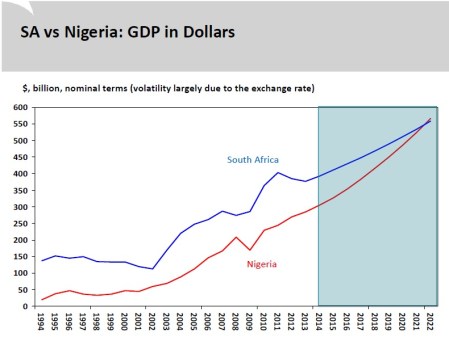
For one, in April 2014, Nigeria surpassed South Africa as the continent’s largest economy (see Economist Apr. 12, 2014: “Africa’s New Number One“).  This is a significant milestone for the former, and a setback for the latter — an economy that was 8 times the size of the Nigerian economy only 20 years ago, yet is now suffering from stagnating GDP, reeling from corruption allegations amongst its current leadership, undergoing a closely-watched presidential election process, and whose ruling ANC party is facing a heretofore unprecedented backlash and torrent of criticism.

Source: The Economist

Not only South Africa has weakened, politically and economically, however.  Events such as the Northern Nigerian wave of violence – with sectarian Boko Haram forcefully displaying the impotence of the central Nigerian government of a weakened president Goodluck Jonathan – fuel the fire of outside investors’ mistrust of African stability and their concomitant reluctance to make good on prior investment promises.  As The Economist notes in the article quoted above: “it is not a place for the faint-hearted” to invest, even though it highlights the successful Nigerian business ventures of outsiders such as Shoprite, SABMiller, and Nestlé.  Bloomberg BusinessWeek quotes Thabo Dloti, chief executive officer of South Africa’s fourth-largest insurer Liberty Holdings Ltd. (LBH), as saying: “It does slow down the plans that we have, it does put out the projections that we have by a year or two.”

http://www.stanlib.com/EconomicFocus/Pages/InterestingChart112SouthAfricaneconomyvsNigerianeconomy.aspx
Nigerian vs. RSA GDP
Source: http://www.stanlib.com

Likewise, multi-national organisations such as COMESA and its competition enforcement body, are undergoing significant changes (such as, currently, an opaque process of raising the heretofore insufficient merger-filing thresholds), shockingly successful web attacks on their data, and a resulting dearth of transactions being notified.  Elsewhere in developing economies, recent political turmoil has likewise led observes to comment on the negative spillover effect from political & social spheres into the economy (e.g., Financial Times, May 8, 2014: “Political crisis further dents prospects for Thai economy“).

Impact on antitrust practice

The upshot for competition-law practitioners and enforcers alike is rather straightforward, AAT predicts: more hesitation around African deals being done means fewer notifications, less enforcement, and overall lower billings for firms.

The flip side of the coin – as is usually the case in the economic sine curve of growth and slowdowns – is the commonly-observed inverse relationship of M&A and criminal antitrust: while we may see fewer transactions in the short term, the incidence of cartel behaviour and commercial bribery & government-contract fraud cases will likely increase.

Commission’s fisheries merger conditions upheld on review by Tribunal

south_africa

Competition Tribunal confirms Commission’s ruling on Oceana and Foodcorp merger

Johannesburg-listed Ocean Group Limited is the largest fishing company in South Africa, whose fishing activities include inter alia the catching, processing, marketing and distribution of canned fish, fishmeal and fish oil and mid-water and deep-sea fishing.

Foodcorp Limited is a food producer and manufacturer with eight production divisions, one of which is a fishing division. Foodcorp’s fishing business comprises a pelagic division, a hake division and a lobster division.

The Competition Commission said its investigation into the proposed transaction showed that the proposed transaction would substantially affect competition in the market for canned pilchards to the detriment of competition and customers. Following implementation of the transaction, Oceana will hold 80% of the market, while its closest competitor would hold less than 10%. Furthermore, the Commission was concerned that the transaction, without the conditions, would remove an efficient competitor to Oceana’s Lucky Star brand from the market, as Glenryck would not be able to provide competition to Lucky Star without its own fishing quota.

Both Oceana and Foodcorp contended that the Department of Agriculture, Forestry and Fisheries had approved the transfer of Foodcorp’s small pelagic fishing rights to Oceana, which includes the consideration of public interest issues regarding black economic empowerment.

The merging parties had taken the conditional approval of the intermediate merger on review before the Competition Tribunal. The conditions which the Competition Commission had imposed entailed that the merging parties are to sell the Glenryck canned-pilchards brand to an independent third party, as well as the small pelagic fish quota allocated to it by the Department of Agriculture, Forestry and Fisheries. The condition was imposed as a means that would deprive Oceana of Foodcorp’s fishing quota, thereby preventing market dominance.

The Competition Tribunal approved the transaction on the same conditions initially imposed by the Competition Commission. The Tribunal will issue its reasons for the decision in due course.

Tsogo Merger Unconditionally Approved

south_africa

Unconditional approval of SA hotel deal

The Competition Tribunal of South Africa (“Tribunal”) has unconditionally approved the merger of Southern Sun Hotel Interests (Pty) Ltd (“Southern Sun Hotel Interests”), which is a subsidiary of Tsogo Sun Holdings Limited, and The Cullinan Hotel (Pty) Ltd (“The Cullinan Hotel”).

The merger related to the provision of short-term hotel accommodation. Pre-merger, Southern Sun Hotel Interests held a 50% shareholding in The Cullinan Hotel and exercised joint control with Liberty Holdings Limited (“Liberty”) over The Cullinan Hotel. Southern Sun Hotel Interests acquired an additional 10% shareholding in the Cullinan Hotel from Liberty, thus increasing its shareholding in the joint venture to a majority interest of 60% and thereby acquiring sole control of The Cullinan Hotel.

The Tribunal approved the merger without any conditions.  Nortons Inc. represented Southern Sun Hotel Interests in this transaction.

Antitrust sectoral healthcare inquiry

south_africa

Clarification of scope and timetable of sector investigation

According to official statements by the South African Competition Commission (“Commission”), the agency has clarified the administrative guidelines, administrative timetable, and statement of issues.  AAT has reported previously on the sectoral healthcare inquiry by the Commission, critically noting the apparent exclusion of the public healthcare segment, to the detriment of the private care providers.

Theories of harm – “just” theories

The Commission’s main document on the “stakeholder engagement meeting last week states as follows regarding its theories of harm:

[I]n order for the market inquiry to make determinations, it has developed a set of ideas or hypothesis about how harmful competitive effects might arise in the relevant markets under consideration. These ideas are generally referred to as “theories of harm”.
‘It is important to emphasise that these theories of harm are simply hypotheses, or tools, that will enable us to identify whether there are features or a combination of features that may prevent, distort, or restrict competition in the private healthcare markets. Theories of harm are not findings of harm; but are simply analytical tools to guide our analysis. They will be deepened and revised as the inquiry’s thinking develops,’ adds former Chief Judge Ngcobo.

Public comments, and timetable

The agency is “inviting stakeholders to make further comments” on its theories of harm, noting that:

The inquiry is set to follow a very precise and tight administrative timetable which is mindful of the timelines for gathering information including an invitation for written submissions, public hearings, site visits, seminars, and workshops and conducting surveys. Broadly, key milestones will include the issuing of information requests no later than 01 August 2014. The first round of public hearings will take place between 01 March 2015 to 30 April 2015 then from May 2015, the inquiry will analyse and review the information gathered. Presently, the panel aims to make provisional findings and recommendations available for public comment in October 2015.

healthcareinquirytimetabl

Commissioner calls agency’s work “reactive”, will appeal SABMiller case, counters “toothless dog” moniker

South Africa Flag

Revelations from Bonakele’s interview with CNBC Africa

South African interim Competition Commissioner Tembinkosi Bonakele called his agency, the Competition Commission (“Commission”), a “kind of reactive” enforcement body, aiming primarily to uncover cartel conduct.  In an interview with CNBC Africa‘s “Beyond Markets” segment, journalist Nozipho Mbanjwa asked the acting Commissioner tough questions on the Commission’s enforcement tactics, legislative mandate, fines imposed, the adequacy of the Commission’s capitalization, and whether the South African antitrust watchdog was, in fact, a “toothless dog.”

Bonakele held his ground, referring multiple times to the Commission’s recent successes, including the construction cartel, the bread case, cooking oils, and other “basic products” matters on which he said his agency would place the largest focus going forward.

The Acting Commissioner

The Acting Commissioner

Some of the highlights from the interview:

  • Bonakele is “quite satisfied” with the agency’s funding and performance of its 180 staff, but may ask for “more funding” specifically for the Commission’s sectoral health-care inquiry.
  • The Commission will focus its cartel-busting efforts on sectors in the basic products category such as foods and health-care.
  • The Commission will “definitely appeal” its loss of the SABMiller abuse-of-dominance matter, a “very tricky kind of offence in terms of competition law” according to Bonakele.  He said he did “not like” the 7-year long duration of the SABMiller saga, but felt compelled to extend the matter by bringing the case before the Competition Appeal Court.
  • “No comment” on the “classic” Unilever investigation.
  • On the much-maligned MultiChoice broadcaster, Bonakele called the company a “monopoly created by legislation” in a regulated market, and deferred to parliament to rectify the situation.
  • The Commission receives approximately 30% of its funds from revenues that are the result of merger filing fees.