 The COMESA Competition Commission (CCC) recently announced that it will be investigating allegations of exclusionary conduct in relation to the Confederate of African Football’s (CAF) decision to extend an exclusive marketing of broadcasting rights and sponsorship agreement with Lagardère Sports in relation CAF tournaments.
It is not yet clear whether the CCC is investigating this matter as an ‘abuse of dominance’ case or rather, in terms of Article 16 of the CCC’s Rules, general restrictive practices.
COMESA Article 16 essentially precludes firms from implementing an agreement in the Common Market which has as its object or effect the distortion or prevention of competition in the Common Market, to the extent that it may restrict trade between member states.
The Registrar of the CCC, Meti Demissie Disasa, is quoted as saying: “The aim of the Commission’s investigation is to ensure that competition in the commercialisation and award of media and marketing rights for African Football tournaments is not undermined as a result of anti-competitive practices from market operators and that football fans can benefit from better and more coverage of the games and affordable viewing options.”
“Any agreement which contravenes Article 16 is automatically void. In light of the fact that the CAF agreement in question here is valuable and moreover only set to expire in 2028, a voiding of the contract by the CCC would likely be contested by the parties,” says competition practitioner Andreas Stargard.
 The CCC, which has to date largely focused on merger control, has certainly made clear strides to moving towards a greater enforcement role, as AAT first reported here. While there is still some ways to go, the current investigation follows the CCC’s announcement that it intends to conduct a market inquiry into the grocery retail sector and has also issued an announcement calling on all firms who may have exclusive agreements being implemented in the Common Market to disclose these agreements to the CCC in an effort to obtain authorisation (i.e., an exemption) from the CCC. In 2016, Eveready applied to the CCC to have a number of distribution agreements “authorised” by the CCC.
The ECA and the CCC signed a Memorandum of Understanding in August 2016 which envisages increased cooperation between the two agencies including information exchanges.
In relation to the CAF complaint, the CCC received the complaint by the Egyptian Competition Authority (ECA) who is in turn also investigating this matter. This raises an interesting question as to whether or not the CCC has exclusive jurisdiction over this matter which, in terms of the CCC’s Rules, the CCC should have but other COMESA member-state competition authorities have challenged in the past.
UPDATE: the official CCC statement seeking stakeholder input includes the following passage regarding the agreements at issue:
It is alleged that on 12th June 2015, CAF entered into an agreement with Lagardère Sports S.A.S. for the exclusive commercialization of marketing and media rights of main regional football competitions in Africa, including the Africa Cup of Nations, African Nations Championship and African Champions League, for the period 2017 to 2028. CAF and Lagardère Sports S.A.S. are alleged to have previously entered into a similar commercialization agreement for marketing and media rights of CAF tournaments for the period 2009 to 2016. Consecutively and cumulatively, the length of the alleged exclusive agreement is twenty years. It should be noted that the commencement of investigations neither presupposes that the conduct being investigated is anti-competitive nor that any of the parties to the agreement has violated the Regulations. The Commission will, in accordance with the provisions of Part 3 of the Regulations, conduct an inquiry into the agreements concluded between CAF and Lagardère Sports S.A.S. to determine whether the alleged conduct has as its object or effect the prevention, restriction or distortion of competition in the Common Market or in a substantial part of it. In view of the foregoing, the Commission hereby gives notice to all interested stakeholders and the general public to submit their representations to the Commission … no later than 21st April 2017.


 About half of these fees (approximately $1.5 million) were allocated to the national competition authorities in various COMESA states. However, competition authorities in COMESA member states – including Kenya, Zambia and Zimbabwe – continue to insist that merging parties lodge separate merger filings in their jurisdiction. This can add significant transactional costs – the filing fee in Kenya alone for a merger in which the merging parties combined generate more than KES 50 billion (about US $ 493 million) in Kenya is KES 2 million (nearly US $ 20 000). Since Kenya is one of the Continent’s largest economies, significant numbers of global transactions as well as those involving South African firms investing in African businesses are caught in the net.
 x-brand chemicals. The Commission has invited “general public and stakeholders” for comments according to its formal statement.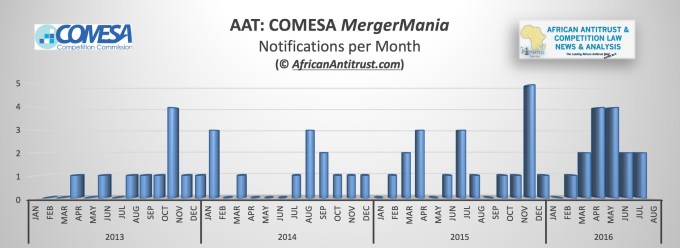
 The web of MoU’s recently concluded, which have as their primary objectives the facilitation of information exchanges and cooperation between competition agencies, is certainly a significant stride made to assist the authorities, including the CCC, in detecting and prosecuting anticompetitive practices which may be taking place across the African continent.
 According to the South African Competition Commissioner, Mr Tembinkosi
  The MoU creates positions of “desk officers” in each agency to ensure that the institutions will cooperate on investigations and share relevant information to ensure enforcement. It also foresees policy coordination, technical assistance and capacity-building programs.
 CCC Chief Executive Officer George Lipimile emphasised the need to create jobs and “link industries,” as well as explain the agency’s mission: “We are going to work hard so that competition laws make sense to the people, because a law that does not benefit people is useless.”
