New COMESA merger approvals: stats and details

COMESA Competition Commission logo

COMESA publishes new Merger decisions

In the past week, the COMESA Competition Commission published the following decisions in its most recent merger cases, resulting from the CCC’s 14th meeting:

  • Case 1/15: Cannon (insurance) – decision time: 176 days – 4 member states affected.
  • Case 2/15: ImproChem (water treatment) – decision time: 166 days – 12 member states affected.
  • Case 3/15: Chlor Arkali (food-grade salt) – decision time: 135 days – 3 member states affected.

…and from its 15th meeting:

  • Case 4/15: Telkom SA (information and telecom technology) – decision time: 11 days (!) – 10 member states affected
  • Case 5/15: Platform Specialty Products (fungicides, herbicides, and insecticides) – decision time: 112 days – 9 member states affected

Of note are the following:

  1. The record time11 calendar days — in which the CCC resolved the Telkom transaction in favor of the South African provider, which aquired a BBBEE entity, despite the fact that the affected geographies encompassed 10 COMESA member states.
  2. The average time it took for the CCC to clear these 5 transactions was 120 days from notification to decision.
  3. All 5 notified transactions were unconditionally approved.
  4. The voting Commission members were, in all cases, Chilufya Sampa (Zambia), Thabisile Langa (Swaziland), and Alexander Kububa (Zimbabwe).

Finally, we observe that none of these merger matters presumptively benefitted from the upward-adjusted threshold (>$5 million), as they date to a pre-Assessment Guidelines era (see also here).

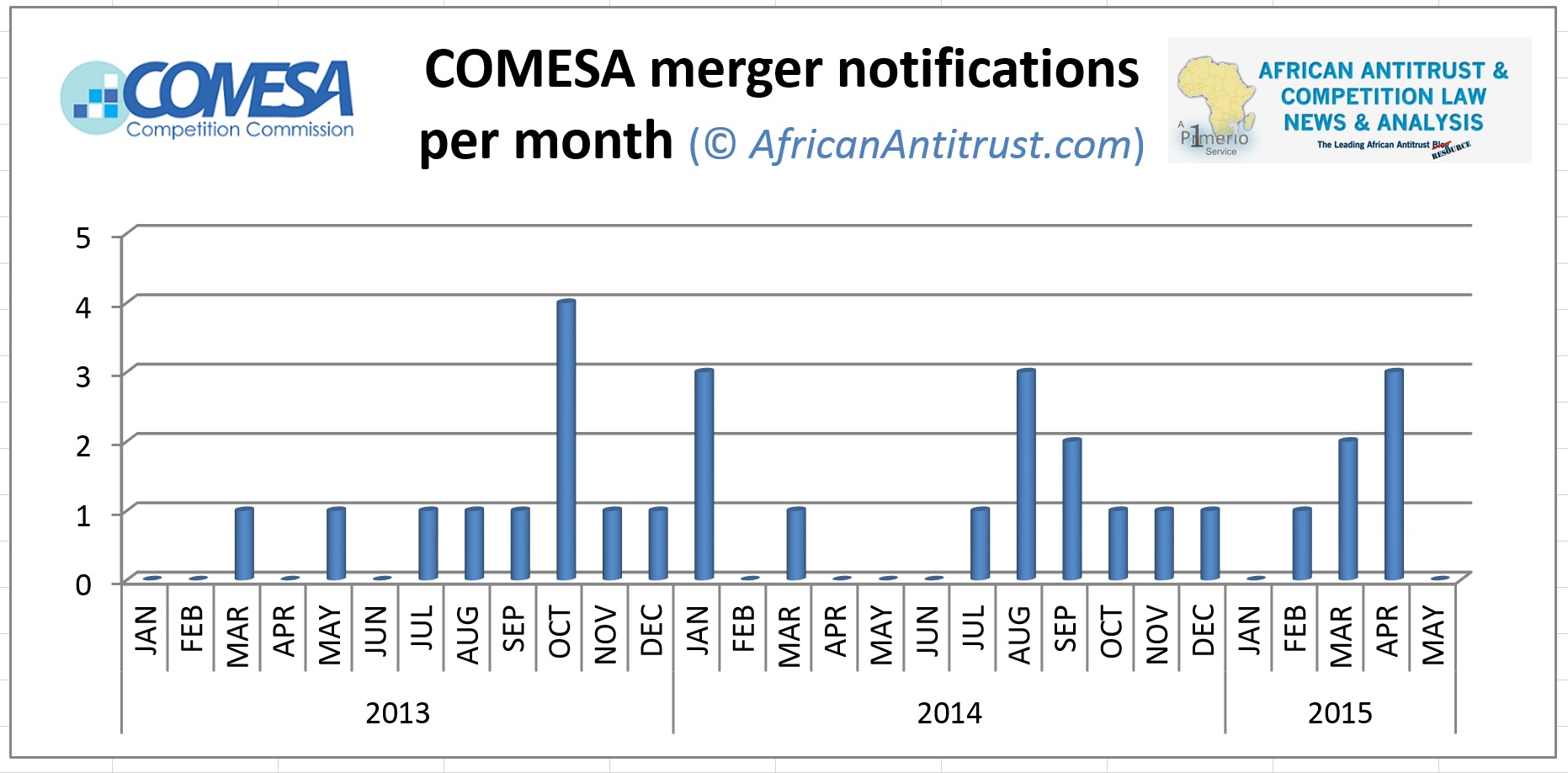
AAT’s updated COMESA merger statistics are thus as follows:

 COMESA merger stats 3-2015

Meet the Enforcers: Companies Tribunal’s Prof. Kasturi Moodaliyar

meet the enforcers

Interview with Professor Moodaliyar marks second in AAT interview series highlighting African enforcers

In the second instalment of our Meet the Enforcers series, we speak with Prof. Kasturi Moodaliyar. An Associate Professor of Competition Law, she is part-time member at the Companies Tribunal; ICASA’s Complaints and Compliance Committee; and the Film and Publication Board Appeal Tribunal. She holds a B.Proc. LLB.LLM.(Natal), M.Phil (Cambridge), and Prog. Economics and Public Finance (UNISA)

As an academic in South Africa, focussing on competition law, how do you perceive the major differences and challenges that developing or younger antitrust-law jurisdictions are faced with, compared to more established ones? Specifically with regards to the Competition Commission, what is your assessment of its strengths and weaknesses?

The Commission has established a credible reputation in the area of anti-cartel enforcement and merger regulation. However, it has been less effective in addressing abuse of dominance. This is a risk as there is increasingly an expectation that the Commission address problems of single firm dominance in concentrated markets in the South African economy. If performance continues to lag in this area it will impact negatively on the perceived effectiveness of the Commission. While under-deterence of abuse of dominance reflects some limitations in the legislation it also highlights the challenge of resource constraints faced by the Commission. Such cases demand extensive legal and economic expertise – a shift of priorities to this area may impact performance of the Commission in areas in which it has traditionally had more success (cartel busting, mergers). The use of complementary tools like market inquiries and advocacy will be important and can asset the Commission – but also places a burden on resources.

Regarding staff turnover: Do you see the personnel turnover in recent history to be of sufficient magnitude to have an impact on the performance of the enforcement agency?

It is a worrying development although there are signs that it is starting to stabilise. Although key executives were lost there are still a number of highly experienced staff at the middle management level within the institution that must be nurtured and developed. Some have moved into executive level positions. This is a positive development but also points to a level go juniority in the executive which may impact on effectiveness. Will watch this space.

On Leadership: Do you consider it a benefit or a hindrance if leadership want to introduce their own philosophy of what competition law should seek to achieve on the agency’s activities during their tenure, or do you think that the law is sufficiently clear, such that leadership should focus on efficient and effective delivery of the service, and leave the interpretation to the Tribunal/courts.

It is natural that any leader will bring their own perspective to the role – this cannot be avoided. However, it will be important for the leadership to ensure that such perspectives do not undermine their objectives in giving effect to the mandate of the Commission – which is set down in the Competition Act. Fortunately there are checks and balances in the adjudicative process (Tribunal, rights of appeal) to ensure that these objectives are not contradicted.

Prioritisation: Every agency has budgetary constraints. What are the factors that you think should be most important in how cases are prioritised, should this be based on the developmental needs to society, particular sectors, or even particular areas of the law. What do you think of the prioritisation of recent Section 8 cases, SAB (10 years on an issue that has been extensively sanitised by foreign agencies), Gold Reef News (de minimis), and Sasol Polymers (niche, with limited potential for downstream beneficiation)?

The Commission’s stated prioritisation principles seem reasonable (as they appear in annual reports). However, there is somewhat of a disjuncture between the principles and the outcomes – particularly with respect to abuse of dominance cases. In fact, the outcomes in respect of anti-cartel enforcement have been largely consistent with the application of the Commission’s prioritisation principles – so credit is deserved here. However, new thinking around prioritisation is needed for abuse of dominance cases. In this regard there needs to be a better integration between the Commissions’s policy and research activity, the use of market inquiries and its advocacy with its planning and actions around enforcement against abuse of dominance.

Do you believe that the Competition Tribunal has a role in relation to broader competition advocacy initiatives in South Africa by way of the decisions made?

Advocacy is primarily a function of the Competition Commission, not the Tribunal. The Tribunal must first and foremost safeguard the integrity of its adjudicative function by ensuring impartiality in its decision making processes. There is no harm done though if the Tribunal makes a contribution to the such initiatives as a bi-product of good decisions.

How important, in your view, is the political independence of competition enforcers?

It is very important if the integrity and effectiveness of the agency is to be upheld.

Comparing merger review in an African jurisdiction (any jurisdiction) with that of other competition enforcement agencies worldwide, where do you see the key differences?

A significant difference does appear to be the elevated status of public interest issues in merger proceedings.

What is your view about the elevation of non-competition assessments above those of pure competition tests in merger review? Is it good for the adjudication of competition matters generally?

It is not a problem in and of itself, and is to be expected given various developmental challenges. However, public interest considerations should not trump core competition concerns. In other words, agencies should strive to achieve consistency between the ‘pure’ competition policy objectives (competitive market structures, efficient outcomes etc) and public interest considerations. However, significant dangers arise when public interest objectives conflict with competition policy objectives. Where there are conflicts, alternative policy mechanisms should be considered so that agencies can focus on core non-conflicting objectives. Otherwise they may end up achieving nothing by trying to please everyone. This also means that the public interest considerations that do fall within the mandate of competition agencies should be carefully circumscribed.

What skills would you encourage regional African practitioners focus in on for purposes of developing antitrust advocacy in the region?

They should build a technocratic and professional staff with strong legal and economic skills. These core functions should also be supported by strong policy research and analysis skills – also of the technocratic professional (rather than political) variety. As an academic in this field I would also encourage ongoing training to strengthen those research, investigative and analytical skills.

Thank you, Professor Moodaliyar.

Meet the Enforcers: COMESA’s Rajeev Hasnah, 1st in exclusive AAT interview series

meet the enforcers

New AAT interview series highlights individual African competition enforcers

In the first instalment of our new Meet the Enforcers series, we speak with Rajeev Hasnah, CFA, who is a sitting Commissioner of the COMESA Competition Commission.  In our exclusive interview, we discuss the CCC’s merger review practice, its revised Guidelines, young history and achievements, and seek practitioner guidance.


Rajeev Hasnah, CFA
You are an economist by training and currently a sitting COMESA Competition Commissioner.  As the young agency is about to celebrate its 2nd anniversary, what do you consider to be the CCC’s biggest achievement to date?
According to me, it is the fact that the CCC is effectively enforcing the COMESA Competition Regulations since it started operating in January 2013.  It is indeed a commendable achievement given that the current Board of Commissioners sworn-in in October 2011.  In 2012, the CCC worked on the drafting of the guidelines, in consultation with various stakeholders, and under the advice of other competition experts.
The institution also established a good working relationship with national authorities across COMESA and beyond, and proved its credibility and effectiveness as a regional competition authority within the business and legal communities globally.  The rather high number of merger notifications with a COMESA dimension already adjudicated to-date (around 50) is testimony to the success of the CCC being an effective competition law enforcer in its still early days.
Comparing the CCC merger review in practice with that of other competition enforcement agencies worldwide, where do you see the key differences?
Nowadays it is getting harder to talk about differences in any field of economic activity in this increasingly globalised world.  In my view, the key principles and the application of the Competition Law in the COMESA region do not differ significantly either from that of the national authorities or other major jurisdictions across the globe.  The assessment of “substantial lessening of competition” as the underlying fundamental test in merger reviews is at the core of the evaluation conducted by the CCC as well.
Does the multi-national nature of the CCC (akin to the European Commission) make the substantive work more difficult?
It is definitely not an easy feat to enforce the COMESA Competition Regulations across 19 different countries, each with its own economic, legal and cultural environments.  Yet, under the leadership of the current Chairman, Alex Kububa and Director/CEO of the CCC, George Lipimile, a good working relationship and collaboration has been established with the different national authorities across the COMESA region, which facilitates an effective enforcement of the Competition Regulations.   This also ensures that the CCC has a good perspective of the individual local realities, which is no doubt a key element to assess the impact on competition at the regional level.
What prompted the re-drafting of the CCC Merger Guidelines, and why was the indirect path of an administrative guidelines interpretation of the verb “to operate” chosen to elevate the review thresholds, as opposed to increasing the thresholds in the underlying Rules themselves?
It is not uncommon that an authority reviews its guidelines as it gains experience in enforcing the law.  Any changes or further clarifications are geared toward ensuring that the business and legal communities as well as competition economics experts have a good understanding of how the Regulations are enforced by the CCC.  This indeed shows that the CCC stands ready to ensure an improved clarity of its enforcement of the Competition Regulations among its key stakeholders.
The relevant paragraphs defining the verb “to operate” in the Merger Guidelines, should not be construed as a review of the merger notification thresholds per se.  The latter has its own procedures regarding any likely review.  The definition in the Merger Guidelines is rather to ascertain whether the said undertaking is construed to be effectively operating in a Member State or not.
Do you have advice for African practitioners counselling their clients on whether or not to notify a merger to the CCC?
Taking into consideration the rise in the enactment and enforcement of a competition policy regime across various jurisdictions and at the level of regional trading blocs as well, one can safely say that a competition authority is here to stay and to enforce the law as prescribed.
One of the key considerations in doing business is a proper assessment of the risks the undertaking faces or could potentially face and the implementation of a suitable actionplan to deal with these risks.  I believe that non-notification of a notifiable COMESA dimension merger to the CCC should not be construed as carrying a low probability of being detected by the CCC and certainly not a low impact one for the undertaking.
What is your view about the elevation of non-competition assessments above those of pure competition tests in merger review?  Is it good for the adjudication of competition matters generally?
Some jurisdictions consider public interests as important, while some don’t.  This is normally provided for or not in the respective laws, and whichever is the case, as adjudicators, we need to follow what is prescribed in the Regulations.
It is also important to note that in practice, the enforcement of competition law can be defined as being the conduct of economic analysis within a legal framework.  Both the economic analysis and legal framework evolve accordingly in line with the development of the jurisdiction’s economy.  We can take the examples of more mature competition policy regimes which started with the consideration of non-competition issues in merger review, to then afterwards moving to assessing only competition matters.  As such, each jurisdiction has its own specificities that it needs to take into consideration, though these are bound to evolve with time.
By way of background, how did you get into antitrust/competition law & economics?
I am an economist and a Chartered Financial Analyst (CFA) by training, and prior to joining the antitrust world I was an investment professional.  Four years ago I had the choice between acquiring experience in private equity or joining the nascent competition law enforcement team of the Competition Commission of Mauritius as its Chief Economist/Deputy Executive Director, working with the then Executive Director, John Davies.  I chose the latter for its excellent combination of applied microeconomics and law.
What was the path that took you to working for competition enforcement agencies?
I started as a macroeconomist working in London for an economic consultancy firm in the city, where I was advising traders and asset managers.  I then moved on to financial investing in an investment management firm and to corporate finance in one of the largest conglomerates in Mauritius.  So I came to the antitrust world as a business/investment practitioner with a strong background and experience in applied economic and financial analysis.
Having seen the world from the private sector side, I acquired an edge in the application of competition economics in my previous role as a Chief Economist/Deputy Executive Director and as a current Commissioner at the COMESA Competition Commission.
What skills would you encourage regional African practitioners focus on for purposes of developing antitrust advocacy in the COMESA region?
Having previously led the Competition Culture project for the International Competition Network (ICN) Advocacy Working Group (AWG), I am now one of the strong proponents of the importance of advocacy to develop and maintain a strong competition culture within society.
Ensuring that advocacy activities are properly designed and tailored to meet the requirements of the target group is crucial.  Equally important is to ability to communicate in a very simple and easy to understand language, adapted to meeting the target audience’s expectations.
Thank you, Mr. Hasnah.

ACF in the spotlight: African Competition Forum promotes policy enhancements

Putting African antitrust enforcement in the spotlight: the work of the African Competition Forum

AAT is often right and sometimes wrong — and we acknowledge the latter whenever that happens.  Today is one such occasion, as we have been entirely remiss in our coverage of the African Competition Forum (“ACF”).

The ACF (FAQ here) is a 3+ year-old organisation comprising several anglophone and francophone countries with and without competition enforcement agencies across the African continent (with apparently ongoing efforts to recruit Portuguese-language entities as well, e.g., Mozambique, Angola).  It undertakes various research, capacity-building, and advocacy/integration projects, all related to competition policy and enforcement.

The ACF notably spans across the entire continent, having a self-reported 41 countries as members, and its membership scope is larger than that of regional bodies, such as COMESA or SADC.

We look forward to providing more in-depth coverage of the ACF in the future, including interviews with the group’s senior leaders.  For the time being, in the organisation’s own words, its history and mission are as follows:

The African Competition Forum (ACF) was formally launched in March 2011 as a network of competition authorities in African countries. The network is comprised of 41 out of 54 African countries. It was tasked with enhancing the adoption of competition laws, building the capacity of new authorities and assisting in advocating for the implementation of competition reforms that benefit African economies. In countries where there is no authority, the network would assist in paving the way for the development of a competition law. An Interim Steering Group (ISG) was initially tasked with overseeing the setting up of the ACF.

A major task the ISG and then SC had to perform, foremost, was the development of a needs assessment which would be used to develop the ACF’s plan of action and would also help prioritise the key issues for which countries who are members of the network would require assistance. In coming up with the needs assessment a broad questionnaire was administered and sent to the four regional competition authorities of Southern African Development Community (SADC), West African Economic Monetary Union (WAEMU), Common Market for East and Southern Africa (COMESA) and Economic Community of West African States (ECOWAS) and to forty-one countries, twenty-seven of which responded.

Overall, the key elements that were identified as priorities for African authorities within the questionnaire fell into three main categories:

1. Capacity building on strategic planning and management, practical aspects of competition law enforcement such as investigative and litigation skills and techniques; and foundational training on the basics of competition law and economics;
2. Technical assistance in drafting and revising competition policy, laws and regulations and in designing agency procedures, guidelines, and operational manuals; and,
3. Support with advocacy and engaging other relevant stakeholders.

The questionnaire incorporated the above elements in five sections, namely:

1. The status of competition policy and law in the responding country
2. The responsible agency’s powers, jurisdiction and functions (if one exists)
3. The resources and workload of the competition agency
4. The capacity building and technical support required by the responding country
5. The nature of relationships with regional and multinational and other competition bodies.

Respondents’ contact details were drawn from the International Development Research Centre (IDRC) databases on competition authorities worldwide; information supplied by Department for International Development (DFID); SADC; United Nations Conference on Trade and Development (UNCTAD); personal contact between the ACF Co-ordinating Team; and, regional and national authorities. A meeting about the needs assessment questionnaire with African countries attending an UNCTAD conference in Geneva in November 2010 also served to provide contacts details of key competition personnel.

The ACF was recently spotlighted in an article in the Tanzanian Daily News, which reported on the ACF’s workshop entitled “Agency Effectiveness.”  The article is worth a read, we believe, as it explains the history of the ACF’s founding as well as some background to African economies’ slower and later adoption of competition regulation, due to previously centrally-planned economics and broadly government-sanctioned monopolies operating lawfully:

Dr Kigoda noted that African economies have co-existed with a number of well-known cartels and anti-competitive conducts such as price fixing, bid-ridding, restrictions of output, allocation of markets and other unwarranted agreements.

Due to that African competition agencies must be vigilant to investigate and prosecute all these in order to ease the burden on their taxpayers.

Deputy Chairman of Fair Competition Commission (FCC) Col. (Rtd) Abihudi Nalingigwa said competition authorities seek to ensure that there are no anti-competitive agreements, abuse of market power and unjustified monopolistic market concentrations are put on check.

“We thought it would be worthwhile this time around concentrating on ‘Agency Effectiveness” because we believed the topic falls directly within the expectations of our stakeholders including the consumer, business community and the government who should see value for financing agency operations.

This can best be realized through translation into more effective competition and regulatory authorities which are capable of quick dispensation of justice that provide relief to their lives. On other hand, investor-confidence through better market regulation will increase investment inflow as investors will be assured that no anti-competitive will go unchecked or unaddressed.

Many African countries introduced their competition law in the mid 1990s prompted by a process of privatization and liberalization of their respective economies that started in late 1980s….


Confusion reigns in COMESA: filing fees misstated, “operation” vs. “threshold”, and new web site

COMESA Competition Commission logo

COMESA Competition Commission makes changes, but observers deplore lack of clarity and persisting mistakes

Visiting the CCC web site will yield a surprise to COMESA followers, as the Commission’s online presence has an updated look.  (Importantly, we express hope that it’s not all cosmetic but also substantive, and that the CCC’s webmaster has improved online security, in light of the numerous hacking attacks to which the agency was subjected in 2014.)

What’s more, the new web site has some new merger-related information, most notably of course the new finalized Merger Assessment Guidelines and an “Explanatory Note” on mergers.

Guidelines subvert Rules threshold under guise of companies’ “operation” within region

The former attempt to infuse some sense into the previous zero-dollar notification threshold regime (by re-defining in the Guidelines what it means to “operate” in COMESA countries as having turnover of >$5 million per annum).  They do so without actually amending or otherwise revoking the underlying Rules, which still do specify to this day that the turnover threshold for notification is “$0” COMESA dollars (which are the fictitious FX equivalent currency of U.S. dollars, so there is effectively no currency conversion required from USD figures).  CNBC/Africa has an 8-minute interview on the topic with a World Bank Group staffer who was part of the working group making the revisions here.

We at AAT respectfully question both the validity and the sensibility of keeping the flawed legislation of the Rules in place, while making agency ex parte interpretive changes via CCC “Guidelines” that notably do not have the force of law in COMESA countries.

“Explanatory Note” and the question of filing fees: 0.01% or 0.5%? Errors continue to persist.

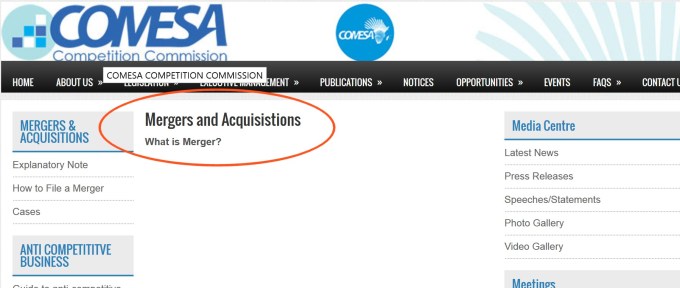
The latter document (reproduced below in full) tries to do the same in a more simplistic fashion — asking, curiously, “What is merger?” [sic!]  However, the Explanatory Note appears fundamentally flawed as it incorrectly includes a reference to the filing fee as being set at 0.01% of the parties’ combined annual revenues.

AAT analysed this statement and believes that the CCC improperly refers to the old Rules (which provided for a 0.01% fee in Rule 55) until they were revised and then subsequently interpreted by CCC guidance in February of 2013: since then, filing a CCC notification incurs a fee of 0.5% of turnover, as we extensively discussed here(Update: The CCC has apparently read our post and, as of 5 Nov. 2014, changed this incorrect statement, deleting all references to filing fees in their entirety.)

Continuing lack of clarity emanates from COMESA’s official statements and publications

AAT deplores the ongoing confusion that reigns with respect to the CCC’s pronouncements on crucially important issues such as thresholds, filing fees, and the like.  It takes more than a new web site design to instill parties’ and attorneys’ trust in the young antitrust regime’s competency, and with it, new filings (which have notably stalled at zero for the past half year).

Mergers and Acquisistions

What is Merger?

Most mergers pose little or no serious threat to competition, and may actually be pro-competitive.  Such benevolent mergers have a number of economic advantages such as resultant economies of scale, reduction in the cost of production and sale, and gains of horizontal integration.  There could also be more convenient and reliable supply of input materials and reduction of overheads.  These advantages could, and should, lead to lower prices to the consumer.

Other mergers, however, may harm competition by increasing the probability of exercise of market power and abuse of dominance.  Mergers can also sometimes produce market structures that are anti-competitive in the sense of making it easier for a group of firms to cartelise a market, or enabling the merged entity to act more like a monopolist.

An increasing number of business firms in the COMESA region are merging, or entering into other forms of strategic alliances, in order to take advantage of the many economic benefits that arise from such transactions.  Undertakings in the COMESA region are relatively small compared with those in other parts of the world.  Mergers in the region, however, would create ‘regional champions’ capable of competing with other international companies on an equal footing.

Companies however need to notify the Commission their proposed mergers to enable the mergers to be thoroughly examined for any anti-competitive features that might reduce or eliminate the transaction’s economic benefits.  Not all mergers are notified to the Commission.  Only those large mergers that exceed a certain prescribed threshold have to be notified.  The fee for notifying mergers is not punitive, but is only meant to defray the costs to the Commission for examining the transactions.  The COMESA Competition Rules provide for a relatively small merger notification fee calculated at 0.01% of the combined annual turnover or combined value of assets in the COMESA region of the merging parties.  (NOTE by editor: The CCC has, as of 5 Nov. 2014, changed this incorrect statement and deleted all references to filing fees entirely.) Failure to notify mergers can however be very costly to the merging parties.  The Regulations provide for a high penalty of up to 1% of the merging parties’ annual turnover in the COMESA region for not notifying eligible mergers

Merger in COMESA Competition Regulations

The word merger in this COMESA Competition Regulation is construed in the context of its definition under Article 23(1) of the Regulations.

Control is used in the context of controlling interest as defined under Article 23(2) of the Regulations. Without prejudice to Article 23(2), control shall be constituted by rights, contracts or any other means which, either separately or in combination with and having regard to the considerations of fact or law involved, confer the possibility of exercising decisive influence on an undertaking. The COMESA Competition Commission (‘the Commission’) shall deem a person or undertaking to exercise control within the meaning of Article 23(2) of the Regulations if the person or undertaking;

  • Beneficially owns more than one half of the issued share capital of the undertaking;
  • Is entitled to cast a majority of the votes that may be cast at a general meeting of the undertaking, or has the ability to control the voting of a majority of those votes that may be cast at a general meeting of the undertaking, or has the ability to control the voting of a majority of those votes, either directly or through a controlled entity of the undertaking;
  • Is able to appoint, or to veto the appointment, of a majority of the directors of the undertakings;
  • Is a holding company, and the undertaking is a subsidiary of that holding company;
  • In the case of the undertaking being a trust, has the ability to control the majority of the votes of the trustees or to appoint or change the majority of the beneficiaries of the trust;
  • In the case of an undertaking being a close corporation, owns the majority of the members’ interest or controls directly, or has the right to control, the majority of the members’ votes in the close corporation; or
  • Has the ability to materially influence the policy of the undertaking in a manner comparable to a person who, in ordinary commercial practice, can exercise an element of control referred to in paragraphs (a) to (f).

The Commission shall assess material influence on a case by case basis, having regard to the overall relationship between the acquiring firm and the target firm in light of the commercial context.

In its assessment of material influence, the Commission shall focus on the acquiring undertaking(s). Minority and other interests shall be examined by the Commission to the extent that they are able to influence the policy of the undertaking(s) concerned.

The Commission shall consider an acquiring firm’s ability to influence policy relevant to the behaviour of the target firm in the market place. This includes the management of the business, in particular in relation to its competitive conduct, and thus includes the strategic direction of a firm and its ability to define and achieve its commercial objectives.

The Commission shall consider an acquiring firm’s ability to block special resolutions by virtue of share ownership or other factors, including:

  • The distribution and holders of the remaining shares, in particular whether the acquiring entity’s shareholding makes it the largest shareholder;
  • Patterns of attendance and voting at recent shareholders’ meetings based on recent shareholder returns, and, in particular, whether voter attendance is such that in practice a minority holder is able to block a special resolution;
  • Any special voting or veto rights attached to the shareholding under consideration; and
  • Any other special provisions in the constitution of the target firm which confer the ability to exercise influence.

Where an acquiring firm is not able to block special resolutions of the target firm, the Commission shall have regard to the status and expertise of the acquiring firm, and its corresponding influence with other shareholders, and shall consider whether, given the identity and corporate policy of the target company, the acquiring firm may be able to exert material influence on policy formulation at an earlier stage.

The Commission shall review the proportion of Board of Directors appointed by the acquiring firm and the corporate/industry expertise of members of the Board appointed by the acquiring firm. The Commission may also assess the identities, relevant expertise and incentives of other Board Members.

Interpretation of Article 23(3) of the COMESA Competition Regulations
Article 23(3) of the COMESA Competition Regulations (‘the Regulations’) provides that:

                        “This Article shall apply where:

  • both the acquiring firm and target firm or either the acquiring firm or target firm operate in two or more Member States; and

  • the threshold of combined annual turnover or assets provided for in paragraph 4 is exceeded”.

The interpretation shall focus on Article 23(3)(a) since Article 23(3)(b) is superfluous due to the non-existent of thresholds currently. Article 23(3)(a) is divided into two parts as follows:

  • both the acquiring firm and the target firm operate in two or more Member States;
  • either the acquiring firm or target firm operate in two or more Member States.

The meaning of the first part above is that for a merger to fall within the dominion of Part IV of the Regulations is that both the acquiring firm and the target firm should operate in two or more Member States. For example if Company A is the acquiring firm and it operates in Zambia and Malawi and Company B is the target company and it equally operates in Zambia and Malawi, then the requirements of the first limb are satisfied and the merger falls within the ambit of Part IV of the Regulations.

Another scenario where the first part is satisfied is where Company A the acquiring firm operates in Zambia and Malawi and Company B the target firm operates in Zambia and Ethiopia. In this example, both Company A and Company B operate in two or more Member States.

The third scenario where the first part is satisfied is where Company A the acquiring firm operates in Zambia and Malawi and Company B the target firm operates in Djibouti and Madagascar. In this example, both Company A and Company B operate in two or more Member States.

As regards the second part, a merger falls within the province of Part IV of the Regulations where for example Company A the acquiring firm operates in Kenya and Seychelles and acquires Company B the target which has no operations in the COMESA Member States.

Another scenario where the second part is satisfied is where Company A the acquiring firm has no operations in any of the COMESA Member States but acquires Company B the target which operates in Rwanda and Burundi.

The foregoing are pursuant to the second limb which uses the words “either or” and therefore presupposes that both the acquiring firm and the target firm do not have to operate in two or more Member States as is the case for the first limb but that where either the target or acquiring is operates in two or more Member States, the merger is captured under Part IV of the Regulations.

It is important to note that where the acquiring firm operates in only one Member State and the target firm operates in another Member State and only that Member State, then such a merger does not satisfy the jurisdictional requirements of Part IV of the Regulations. This is however on the premise that such firms do not control any other firm whether directly or indirectly in a third Member State. Such firms should also not be controlled whether directly or indirectly by any other firm in a third Member State. For example, where Company A the acquiring firm operates in Swaziland only and Company B the target operates in Rwanda only, such a merger does not meet the jurisdictional requirements of Part IV of the Regulations. The situation may be different where Company A has a stake in Company C which operates in Mauritius or Company B has a stake in Company D which operates in the Democratic Republic of Congo.

The word operate is taken to mean that a firm(s) in issue derives turnover in two or more Member States. Therefore does not need to be directly domiciled in a Member State but it can have operations through exports, imports, subsidiaries etc. in a Member State.

New Merger Guidelines fail to revise Rules flaw, but adjust notification threshold upwards

COMESA Competition Commission logo

COMESA publishes new Merger Assessment Guidelines, uses back-door defintion to adjust threshold to >$5 million

On Friday, the COMESA Competition Commission published its 2014 Merger Assessment Guidelines, available here in PDF.  They finally replace the prior Draft Guidelines, which the agency’s Willard Mwemba had predicted would be finalised no later than June 2014.  The new final version fails to put a formal end to the technical zero-dollar notification threshold, but — through a back-door definition of what it means to “operate” in the COMESA region — does achieve the practical effect of terminating what AAT has dubbed the “zero-threshold contagion” – i.e., any transaction between parties with any turnover/revenue whatsoever within the common market of COMESA used to be notifiable.

We invite our readers to take a look at the entire document.  Rather than having the COMESA Board meet and re-draft the actual Rule, the CCC appears to have taken the short-cut solution of ex parte “Commission consider[ation]” of what it means for a company to “operate” in the organisation’s jurisdiction.  Section 3.9 re-defines “operat[ion]” of a COMESA company as follows:

3.9 The Commission considers that an undertaking only “operates” in a Member State for purposes of Article 23(3)(a) of the Regulations if its operations in that Member State are substantial enough that a merger involving it can contribute to an appreciable effect on trade between Member States and restriction on competition in the Common Market. For these purposes, the Commission considers that an undertaking “operates” in a Member State if its annual turnover or value of assets in that Member State exceeds US $5 million.

However, it notably maintains all references to the “Rules on Notification Threshold,” which continue to specify a “U.S. $ zero” threshold:

3.4 The Commission’s Board prescribed such threshold with Council approval in the Rules on Notification Threshold, the scope of which is also limited to mergers having a “regional dimension”(Rule 3). According to the Rules on Notification Threshold currently in force, the threshold of combined annual turnover or assets for the purposes of Article 23(4) is exceeded if:
(a) the combined worldwide aggregate annual turnover or the combined worldwide aggregate value of assets, whichever is higher, of all undertakings to the merger in the Common Market equals or exceeds US $ zero; and
(b) the aggregate annual turnover or the aggregate value of assets, whichever is higher, of each or at least two undertakings to the merger in the Common Market equals or exceeds US $ zero.

It is not as though the CCC’s staff were unaware of the critiques levied against their zero-threshold regime.  Mr. Mwemba stated back in February 2014 that the agency had been setting “the wheels in motion for the threshold to be raised.”  The Commission has been eportedly working with the World Bank’s International Finance Corporation to determine what the proper notification thresholds should be.  AAT also understands that other antitrust advisors — including former FTC Commissioner, Chairman, law professor and competition-law conference mainstay Bill Kovacic — were helping the young enforcement agency to design a more workable and internationally respected merger-review regime.

COMESA to media reps: “Dr. Livingstone, I presume?”

COMESA Competition Commission logo

Zambia hosts COMESA Competition Commission workshop to sensitize journalists to antitrust

As many African news outlets are reporting, their journalists were recently invited to take part in a competition-law “sensitization workshop” hosted by high-ranking CCC personnel in Livingstone, Zambia.

In light of COMESA’s currently lackluster merger enforcement and virtually non-existing merger notifications (none since 19 March 2014), this “media sensitization” public relations effort on the part of the CCC leadership comes as no surprise.

Here, we quote from the Seychelles Nation:


The Common Market for Eastern and Southern Africa (Comesa) competition commission recently organised a regional sensitisation workshop for business reporters.

The aim of the workshop, held in Livingstone, Zambia, was to enhance the role of the media in exposing anti-competitive business practices and promoting a competition culture in markets. 

The media was explained the role of good reporting on the competition policy within the Comesa, whose prime objective is to promote consumer welfare through encouraging competition among businesses. This objective is achieved by instituting a legal framework aimed at preventing restrictive business practices and other restrictions that deter the efficient operation of the market, thereby enhancing the welfare of consumers in the common market. 

Comesa is a regional economic grouping composed of 19 member states namely; Republic of Burundi, Union of Comoros, Democratic Republic of Congo, Republic of Djibouti, Arab Republic of Egypt, State of Eritrea, Federal Democratic Republic of Ethiopia, Republic of Kenya, Libya, Republic of Madagascar, Republic of Malawi, Republic of Mauritius, Republic of Rwanda, Republic of Seychelles, Republic of Sudan, Kingdom of Swaziland, Republic of Uganda, Republic of Zambia and Republic of Zimbabwe.  The grouping’s objective is for a full free trade area guaranteeing the free movement of goods and services produced within Comesa and the removal of all tariffs and non-tariff barriers.

But only journalists from Kenya, Malawi, Mauritius, Seychelles, Rwanda, Swaziland, Uganda, Zambia and Zimbabwe were present at the workshop. Seychelles was represented by journalist Marylene Julie from the Seychelles NATION newspaper.

The Comesa competition law is, in this regard, a legal framework enforced with the sole aim of enabling the common market attain the full benefits of the regional economic integration agenda by affording a legal platform for promoting fair competition among businesses involved in trade in the common market and protecting consumers from the adverse effects of monopolisation and related business malpractices.

Among the topics discussed at the meeting were the definition and scope of competitive policy;  the relevance of competition policy in ensuring market efficiency and the protection of consumer welfare; overview of the Comesa competition regulations, its legal basis and implementation modalities.

Mergers and acquisitions were also explained and why competition authorities regulate them. 

The media representatives also learned about their role in ensuring businesses notify transactions with competition authorities to avoid the dangers of anti-competitive business.

Hosting the workshop were the director and chief executive of the Comesa competition commission, George K. Lipimile; the manager for enforcement and exemptions Vincent Nkhoma and Willard Mwemba, manager (mergers & acquisitions).

In a message from the secretary general of Comesa Sindiso Ngwenya which was read by Mr Lipimile, Mr Ngwenya welcomed all media guests in Livingstone for the sensitisation workshop.

He said the gathering means that Comesa is reaching out to one of the most important key stakeholders in the region – the media. 

He also said the media plays a great role in advancing the group’s advocacies in the regions and through it Comesa is creating awareness surrounding the current regional trade order and the need for a competition policy for the region.

“Today our specific governments as well as other economic operators and the general public are appreciating that competition policy has a key role to play in creating conditions of governance for the national, regional and global market place,” read the message.

Explaining why the competition policy is an important instrument, Mr Lipimile said it forces companies to run themselves efficiently, ensures a level playing field, forces economic operators to adjust changes and encourages innovation. Competitions lead to lower prices, greater dynamism in industry and most important of all greater job creation.

He added that competitive markets are needed to provide strong incentives for achieving economic efficiency and goods that consumers want in the quantities they want.

Regarding mergers and acquisitions and why competition authorities should regulate mergers, Mr Mwemba said the regulation of mergers is one of the most important components of any competition legislation and policy. 

He explained that sometimes mergers are effected to eliminate competition. 
“Therefore mergers need to be regulated so as not to injure the process of competition and harm consumers,” said Mr Mwemba.

He highlighted that firms merging just to eliminate competition is detrimental to consumers as it results in poor quality goods, high prices, and fewer choices to them.

He also stressed the media’s role in ensuring firms notify their mergers so that they do not merge for ulterior motives. 

The media can also avoid situations where firms  keep the merger a secret as they are mindful competition authority may reject their application. 
“The media should act as watchdog by reporting mergers that have happened in the country,” said Mr Mwemba.

As for Mr Nkhoma, he said there are several ways in which anti-competitive business practices can harm consumer welfare and derail the gains of intra regional trade. 

He said this during his presentation on anti-competitive business practices and the role of the media in enhancing the competition culture. 

He gave examples of two well established firms in a country or region which are engaged in fierce competition with each other. Such competition leads them to independently introduce innovations aimed at outwitting each other on the market such as offering lower prices, discounts, rebates, etc.  The consumer benefits from this rivalry in terms of low prices, high quality, etc. 

He explained the scenario where two firms decide that rather than compete, they agree on what quantities to supply on the market and at what price and quality.  The two firms will end up maximising profits at the expense of consumer welfare. 

“This is what is described as a cartel, a situation where businesses rather than compete, seek to collude to exploit high prices from the market. Markets dominated by cartels will ultimately become complacent in their business decisions and as a result, consumers lose out by way of poor quality products, high prices, etc.,” said Mr Nkhoma.

He also said consumers may also have experienced scenarios where a firm or a collection of firms become so dominant in the market to the extent of behaving without effective constraints from existing competitors or potential competitors. Such dominant firms have an incentive to charge excessive prices knowing that consumers have no alternative of getting similar goods or services anywhere feasible. 

In Seychelles the competition regulator is the Fair Trading Commission (FTC). In a recent press release, FTC said it is setting up a National Competition Policy which comes at a time when Comesa is seeking to harmonise the Comesa competition regulations with domestic competition law. 

The National Competition Policy aims at guiding governments on applying laws, regulations, rules of policies that will allow businesses to compete fairly with one another in order to foster entrepreneurship activity and innovation. 

The policy will also guide the commission in the enforcement of the Fair Competition Act 2009 and will provide a platform upon which national policies can be harmonised with the existing competition law.

Antitrust amnesty: new regime to go online soon

kenya

Kenya to become latest competition jurisdiction with cartel leniency scheme

As Mugambi Mutegi of the Business Daily reports, Kenya is the latest antitrust jurisdiction to embrace a self-reporting leniency programme.
Mr Wang’ombe Kariuki, director of the CAK

Self-reporting of “hard-core” competition-law offences (such as price-fixing cartel conduct, market division, bid rigging, or group boycotts among horizontal competitors) has long been a staple of antitrust enforcement in the most developed jurisdictions, including the United States and the European Union.  In South Africa, cartel-whistleblowing leniency has just passed its 10th anniversary, and in the EU, the European Commission’s “Notice” on the non-imposition of fines in certain cartel cases (i.e., the EU’s leniency regime) recently celebrated its 18th birthday — nowadays, more than 75% of the EC’s cartel matters are uncovered thanks to one or many cartel members “snitching” on their counterparts, in exchange for full or partial amnesty from antitrust prosecution and attendant fines.

The Competition Authority of Kenya (CAK) has recently upped its rhetoric, threatening criminal sanctions against various business sectors’ potential cartel members and disputing jurisdiction of the multi-national, but still feeble, COMESA competition authority in merger cases.

In Africa, Kenya (AAT archive on CAK issues here) is now becoming a new member of the “Leniency Club”, rewarding whistleblowers with eased penalties for volunteering relevant tips and information on the workings of the cartel.  The CAK is acting to implement the provision of the Kenyan Finance Bill 2014, which allows it to terminate cartel investigations with lighter punishment for whistleblowers, all the way to a full pardon.

“The Authority (CAK) may operate a leniency programme where an undertaking that voluntarily discloses the existence of an agreement or practice that is prohibited by the Competition Act and co-operates…in the investigation of the agreement may not be subject to all or part of a fine…”

The agency’s web site — which otherwise (unusually) refers to the Business Daily article quoted here, instead of issuing its own press release — tersely provides as follows:

Cartel firms get amnesty in new CAK regulation

The competition regulator has drafted a law that will see whistleblower companies and their directors get off with lighter punishment for volunteering information that helps to break up cartels.

The Competition Authority of Kenya (CAK) says introduction of this law, which is already in the Finance Bill 2014, will attract informers that can help to bust unlawful business agreements between cartels and other secretive pacts that facilitate anti-competitive behaviour.

Whistleblowers whose evidence leads to the successful termination of such agreements and punishment (fines and jail sentences) of the participants will either get reduced fines or full pardon.

The CAK’s Director General, Francis Wang’ombe Kariuki, is quoted as saying that the authority’s is merely awaiting Parliament’s amendment of the law, and that “[t]he settlement policy we have drafted includes offering leniency to the directors of companies who come forward individually or as a group to report on cartels or unlawful business pacts“.

Competition agencies to split up, abandon dual roles

Dual role of Commission prompts constitutionality questions

As Portia Nkani reports in the Botswana Gazette, the country’s two competition-law authorities are slated to be separated in the near future.  Botswana – a COMESA member state – has both a Competition Commission and Competition Authority.  Concerns over the dual roles of the Competition Commission (it is, since January 2011, both the strategy-setting administrative entity supervising the Authority and a quasi-judicial agency) have reportedly led to the structural change in organization.

The Chairman of the Competition Commission, Dr Zein Kebonang purportedly has voiced support for the decision to separate the two functions and agencies, saying “that regular contact between Commission and CA officials could give raise to reasonable appreciation of bias. ‘The independence and impartiality of Commissioners cannot be guaranteed when it doubles up as a board and as a tribunal. Besides relational bias, the likelihood of informational bias is also far too great. Sitting as a Board, the Commission acquires prior knowledge of disputes that are to be adjudicated before it as a tribunal. Undoubtedly, prior knowledge of a dispute may operate in the minds of the Commissioners and thus deprive the parties that appear before them a proper hearing,'” he has written in a position paper.

Procedural fairness demands that investigative and adjudicative functions must be kept separate. This is desirable because competition law and policy must be implemented in an objective, impartial and transparent manner. Unless the Competition Commission and the Competition Authority are afforded independence from each other, they are unlikely to objectively decide matters presented before them and the risk of bias will forever be present,’” he said, adding that public confidence and trust can only be enhanced if the adjudicative and administrative function were separated.

The initial call for the split of the authorities was made by lawyers for panel-beating companies under investigation last year (see article here):

Sadique Kebonang, counsel for one of the parties, had argued that the relationship between the agencies was “too intimate”: “The main test here is what the ordinary man out there perceives the two entities to be.”

Costly COMESA courthouse, ZA investigates Visa provider & holds ground on Sasol fine

south_africa

Lots AAT news this Monday, from Sudan/COMESA to South Africa

Visa facilitator backed by one branch of government & investigated by another

In substantive antitrust news, the South African Competition Commission is reported to be investigating alleged abuses of market dominance by VFS Global in the visa support services market to foreign embassies.

VFS is a worldwide outsourcing and technology services specialist for diplomatic missions and governments.

The firm has now drawn the potential ire of the Commission, as it is now apparently the only outlet for foreigners to apply for South African visas and work permits, as well as for South African citizens to obtain entry visas for multiple countries abroad.

The irony here that we at AAT perceive is that the monopoly position of VFS appears to be based on the new immigration regulations imposed by the ZA government itself (notably the Department of Home Affairs) earlier in 2014: According to a report, the company had recently opened the doors of its multiple offices across the country — “The Pretoria (Gauteng), Rustenburg (North West) and Kimberley (Northern Cape) centres were the first to open on Monday, 2 June. It is envisaged that the last office will be opened on 23 June.”

The investigation – to be confirmed by the Commission this week, as it potentially launches a full-on formal inquest – was purportedly initiated by a competitor complaint from company Visa Request, claiming damage to its competing business flowing from the governmentally-imposed dominant position of VFS’s (allegedly pricier) services…

Commission stays course on Sasol

In more ZA news, Competition Commissioner Tembinkosi Bonakele is staying the agency’s strong course on the excessive-pricing fine imposed on Sasol, which is said to be appealing its R543 fine that had been upheld by the country’s Competition Tribunal, and which Commissioner Bonakele thinks “should be bigger”…

In our prior AAT reporting on the Sasol abuse-of-dominance case we said:

The S.A. Competition Tribunal is hearing the excessive-pricing portion (which was not settled) of the Commission‘s claims against the refining & steel giant this month.  The relevant legal underpinning of the case is the provision against excessive pricing by a dominant firm.  Precedent has declared prices excessive that “bear no reasonable relation to the economic value of the good or service” at issue.  Pheeew.  Facts.  Economics.  Nice.  Looks like a coming battle of the experts to me…

By comparison, in the U.S., antitrust law of course does not forbid “excessive pricing.”  While setting and reaping apparently high prices may be indicative of monopoly power, such acts are not in themselves anti-competitive or illegal in the States.  In Verizon v. Trinko, the U.S. Supreme Court held famously that:

The mere possession of monopoly power, and the concomitant charging of monopoly prices, is not only not unlawful; it is an important element of the free-market system. The opportunity to charge monopoly prices—at least for a short period—is what attracts “business acumen” in the first place; it induces risk taking that produces innovation and economic growth.

Interestingly, there is a notable history of failures in the area of ‘excessive pricing’ complaints in South Africa, as well, despite the statutory legitimisation of the cause of action.  In the prior ArcelorMittal and Telkom cases, the Commission and/or Tribunal lost in the end, either at trial or on appeal to the Competition Appeal Court.  That Court had found, in the ArcelorMittal case, that the antitrust watchdogs could not use the ‘excessive pricing’ provision of the statute to combat perceived anti-competitiveness in the “market structure rather than price level.”

Today, Bonakele is quoted as follows:

“These are different times.  I can promise you this matter is not going to disappear. Sasol is out of touch if it believes it can win the matter on the basis of technical legal arguments. This issue has to be resolved either through competition law or through government policy.

The issue in this case is fundamental to the development of our economy. We are dealing with resources that should be available to promote that development. The government plays an important role in the country’s industrialisation, and I believe it will be very interested in the progress of this case.”

COMESA’s costly courthouse

While the COMESA organisation has had trouble in the virtual world this year, its real-world endavours appear to be prospering: Its shiny new courthouse, built to the tune of over $4 million (equivalent to only 8 merger filing fees), has opened its doors.  The country’s Minister of Justice, Mohamed Bushara Dosa, last week handed over to the COMESA Secretariat-general the Khartoum-based court premises.

The court will notably hear antitrust and merger cases that are appealed from the organisation’s Competition Commission.


https://i0.wp.com/news.sudanvisiondaily.com/media/images/29d17065-0634-951e.jpg
The glimmering COMESA court house in Sudan, built to the tune of $4.1 million