Competition Regulation & the ‘spaghetti bowl’ of regional African integration

AAT the big picture

Professor Tchapga on competition legislation in a future regionally integrated Africa

AAT’s own contributing author and Primerio consultant, Professor Flavien TCHAPGA has drafted a paper for the African Economic Conference in Johannesburg.  The conference is organized each year by AfdB, UNECA & UNDP.

We are proud to present his paper here (written in French), which is entitled “Perspective de la régulation concurrentielle des marchés dans la future zone de libre échange continentale en Afrique : Enjeux et défis“.

The concise and eminently readable expose deals with the current and proposed competition regulation in the growing African free-trade area.  It provides a comprehensive overview of, and new insights into, the ‘spaghetti bowl’ of African regional integration and the necessary (yet little developed) competition regulation that must go along with it.

We invite our readership, especially the francophone and francophile contingent, to download and peruse Professor Tchapga’s work.  His prior related work, also published here, has been on developing effective competition policies in Africa and on the inherent tension this effort faces, focused on the member countries of CEMAC and WAEMU.

Legislative action threatens to enlarge public-interest scope of merger review

south_africa

The Potential Impact on Public Interest Considerations of the Labour Relations Amendment Act

The recently enacted Labour Relations Amendment Act, 6 of 2014 (the “LRAA”) has potentially increased the scope and role employment, as a specified public interest ground listed in Section 12A of the Competition Act, 89 of 1998 (the “Act”), could have on merger reviews in South Africa.

Section 12A of the Act places an obligation on the South African Competition Authorities to (the “Authorities”), when evaluating a merger, to consider the impact that a proposed merger will have on a number of public interest grounds which are listed in the Act.

The Authorities have become increasingly proactive in imposing conditions on approved mergers, which aims to alleviate their concerns in relation to the potential impact that a proposed merger may have on any of the public interest grounds.

The most often relied upon public-interest ground is employment. In 2015 alone there have been five large mergers that have been approved, subject to conditions in relation to employment. [1]

When assessing the impact that a proposed merger will have on employment, the most crucial factor is the potential immediate retrenchments that may result from the merger.

Previously, the impact that a merger may have on employees who were on ‘fixed term’ employment contracts would not be a significant factor as the employment contract, it could be argued, was in any event to come to an end. However, the LRAA has now changed the position somewhat in this regard, as an employer may no longer conclude fixed term contracts with employees for a period of 3 months, unless the nature of the work to be performed is for a definite or limited duration, or there is another justifiable reason for concluding a fixed term contract.

Should the requirements for concluding a fixed term contract for a period of longer than three months not be met, such an employee will be deemed to be employed for an indefinite term.

Thus, for companies who make use of fixed term employment contracts (that are concluded for a period longer than three months), the scope and the potential negative impact (in the eyes of the Authorities) that a proposed merger will have on employment, could be significantly broader than previously the case.

[1] Delatrade 83 (Pty) Ltd and The JHI Retail Division of JHI Properties (Pty) Ltd and LP Manco, The Property Management Business of Liberty Holdings Ltd; Sasfin Bank Limited and Fintech (Pty) Ltd; Bytes People Solutions a Division of Bytes Technology Group South Africa (Pty) Ltd and Inter-Active Technologies (Pty) Ltd; Dimension Data (Pty) Ltd and The Following Three Business Divisions of Mweb Connet (Pty) Ltd: Mweb Business, Optinet Networks and Optinet Services; Shoprite Checkers (Pty) Ltd and The Assignment of Certain Leases and the Employment of Employees of Final Selected Stores OR Ellerines Furnitures (Pty) Ltd

South African Competition Commission’s Guidelines for the Determination of Administrative Penalties for Prohibited Practices (the “Guidelines”)

On 17 April 2015, the new Guidelines were published in the Government Gazette (No. 38693). The Guidelines will come into effect on 1 May 2015.

The Guidelines have been adopted in response to criticism that there is a lack of transparency, certainty and consistency when imposing administrative penalties on firms for prohibited conduct.

Notably the Guidelines are virtually identical  to the guidelines which were published in November 2014 for comment (“draft guidelines”). Despite a number of individuals and entities submitting proactive and substantive comments to the South African Competition Commission (“SACC”) in relation to the draft guidelines, it is somewhat remarkable that the only material change effected by the SACC is to be found in the Guidelines is in 5.19.4., which deals with repeated conduct in terms of Section 59(3)(g) of the Competition Act, 89 of 1998 (the “Act”). The Guidelines now requires that a firm must have engaged in conduct which is substantially a repeat, of conduct previously found by the Competition Tribunal to be a prohibited practice. Previously, the word “substantially” was omitted from the draft guidelines. Beyond this the Guidelines mirror the draft guidelines of 2014.

The Guidelines set out a six step process to be used by the SACC  to calculate administrative penalties. The six steps are summarised below:

  1. An affected turnover in the base year is calculated;
  2. the base amount is a proportion of the affected turnover ranging from 0-30% depending on the type of infringement (the higher end of the scale being reserved for the more serious types of prohibited conduct such as collusion or price fixing);
  3. the amount obtained in step 2 is then multiplied by the number of years that the contravention took place;
  4. the amount in step 3 is then rounded off in terms of Section 59(20 of the Act which is limited to 10% of the firms turnover derived from or within South Africa;
  5. the amount in step 4 can be adjusted upwards or downwards depending on mitigating or aggravating circumstances; and
  6. the amount should again be rounded down in accordance with Section 59(2) of the Act if the sum exceeds the statutory limit.

It is important to note in the case of bid-rigging or collusive tendering, the affected turnover will be determined by calculating the value of the tender awarded. Thus, even where a firm deliberately ‘loses’ a tender, the firm will be subjected to an administrative penalty which calculates the value of the tender in the hands of the firm who ‘won’ the tender.

The Guidelines are not, however, clear as to how the affected turnover will be calculated when the value of the tender is not readily ascertainable.

Part of the objectives of the Guidelines is to encourage settlement proposals and outcomes. The SACC may at its sole discretion, offer a discount of between 10-50% of a potential administrative penalty as calculated in terms of the six steps identified. There are a number of factors that will determine what discount percentage will apply, including the timing, pro activeness and co-operation of the firm, during the settlement discussions.

Importantly, in terms of the Guidelines, a holding company (parent company) may be held liable for an administrative penalty imposed on one of the holding company’s subsidiaries (the proviso is that the holding company must directly control the subsidiary company). This is a noteworthy development and certainly raises constitutional concerns. The disregard of separate juristic personality, which is a well established principle in South African law, is problematic. These concerns, which were initially addressed by various parties with the SACC, have seemingly been ignored.

While the Guidelines are binding on the SACC, the Guidelines also afford the SACC the use of its discretion to impose administrative penalties on a case-by-case basis. Furthermore, the Guidelines are not binding on the Competition Tribunal or the Competition Appeal Court, who may also use their discretion to impose administrative penalties on a case-by-case basis.

SA guidelines for administrative penalties

Finally: One step forward for COMESA merger enforcement? New rules, new commissioners

COMESA old flag color

Clarification or not?

Amended Rules for Merger Notification

Repealing the oft-criticised original 2012 Rules on the Determination of Merger Notification Threshold, the COMESA Board of Commissioners approved on March 26, 2015 the new set of Amended Merger Rules. These are ostensibly meant to permit parties and their legal counsel a more meaningful determination of filing fees, notification thresholds, and calculation of parties’ revenue (and asset) valuation.  Whilst many legal news outlets have reported (uncritically, as we fear) a high-level summary of these Rules, AAT undertook a critical review of them, and finds that many of the previously-identified flaws persist.

Filing Fee

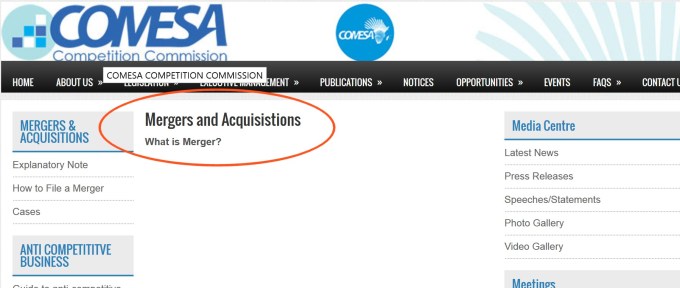
The question of what parties had to pay in administrative fees to be permitted to file a merger notification with the Competition Commission was always in question (see here for AAT summaries of the issue).  We have reported on examples of fees that came dangerously close to the original $500,000 maximum limit.  Since then, the agency’s “Explanatory Note” (which still has a visible link on the Commission’s web site, but which happens to be an essentially “dead” web page, other than its amusing headline: “What is merger?“) attempted to clarify, and indeed informally change, the filing fee from a 0.5% figure to 0.01% of the parties’ annual COMESA-area turnover.

COMESA explanatory note

Where the filing fee stands now is, honestly, not clear to AAT.  While other sources have reiterated the revised fee of 0.1% with a maximum of $200,000, we fail to see any information whatsoever about the filing fee in the (partial set, containing only ANNEX 2 of) the Amended Rules made available by COMESA on its site, despite their title containing the term “fees”.  We have been able to determine, through some internet sleuthing on the COMESA site, that a document marked clearly as “DRAFT” does contain references to 0.1% and $200k maximum fees.

We note that we have now seen three different turnover percentage-based filing fees from COMESA: 0.01%, 0.1%, and 0.5%, as well as several different maxima.  Which shall govern in the end remains to be seen.  We do not envy those parties that have filed with COMESA and have paid the half-million dollar fee within the past 2 years, as we doubt they are entitled to restitution of their evident overpayment.

AAT predicts that this is where things will land, at 0.1% and $200,000, once the good folks at COMESA get around to actually editing the document and finalising their own legislation, so that practitioners and parties alike may have an original, statutory source document on which to rely

Our previous AAT advice has been very clear to companies envisaging a filing with COMESA: wait until the Commission and the Board clarify the regime in its entirety.  Do not file for fear of enforcement, because there is little if any enforcement yet, and the utter lack of clarity – apparently even within the agency itself – on the actual thresholds and other rules provides ample grounds for a legal challenge to the “constitutionality,” if you will, of the entire COMESA merger regime

Combined $50 million revenue threshold

What the 5-page document does show, however, is the new notification threshold embodied in Rule 4, which defines the threshold as follows:

Either (or both) of the acquiring and/or target firms must ‘operate’ [defined elsewhere] in at least two COMESA member states and have (1) combined annual turnover or assets of $50 million or more in the COMESA common market, AND (2) in line with the EU’s “two-thirds” merger rule, each of at least 2 parties to the merger must have at least $10 million revenue or assets within the COMESA zone, unless each of the merging parties achieves 2/3 or more of its aggregate revenue within one and the same member state.

The likewise-revised Form 12, the mandatory filing form, which is available in a scanned format (we hope this will be remedied and provided in more legible and native-electronic format soon by the secretariat) here, reflects the rules changes.  It must be submitted at a minimum within “30 days of the merging parties’ decisions [sic] to merge.”  The Competition Commission mus t make a decision within 120 days of receipt of (a complete) notification.

Interestingly, if the same two firms enter into multiple transactions within a 2-year period are to be treated “as one and the same merger arising on the date of the last transaction.” (See Rule 5, in a likely-misidentified subsection that is confusingly entitled 1.2.). Mimicking the EU Merger Regulation and Consolidated Jurisdictional Notice, the revised COMESA rules likewise contain special provisions for determining the revenues or assets of financial institutions (and their individual member-state branches’ income) as well as insurance companies.

Parents, sisters, subs: included.

Parent, sister and subsidiary entities are included in the revenue determination of the purchaser, to no surprise.  However, unlike what has been reported in the media, again we fail to see the (entirely logical) exclusion of the target parent’s turnover in calculating total revenues, other than in section 3.16 of the August 2014 Guidelines (which provides: “the annual turnover and value of assets of a target undertaking will not, for the purposes of these Guidelines, include the annual turnover or value of assets of its parents and their subsidiaries under Section 3.15)(d)where, after the merger is implemented, such parents are not parents of (i) the target undertaking if it remains after the merger, or (ii) the merged undertaking in the case of an amalgamation or combination“).

We observe the obvious: the Guidelines have no binding legal effect.

The Amended Rules do however provide that state-owned enterprises do not have to include their “parental” governmental revenues; for instance, if a state-owned airline like Air Tanzania were to acquire its counterpart, such as Air Mauritius, in a hypothetical COMESA-reportable transaction, the parties would not be required to report the full tax income or other revenues of the Tanzanian and Mauritian governments, respectively, but only those of the actual state-owned entity and its subsidiaries.

COMESA's 18th Summit in Ethiopia

18th COMESA Summit in Ethiopia

Four New Commissioners

As AAT reported previously, the Addis Ababa COMESA summit also saw the election and confirmation of four new Competition Commissioners.  We now have the full listing of the members, including the 4 new* ones (listed below in italics), whose term is for three years:

New 2015 Commissioners Origin
Ali Mohammed Afkada Djibouti
Amira Abdel Ghaffar* Egypt
Merkebu Zeleke Sime* Ethiopia
Francis Kariuki Kenya
Matthews Chikankheni Malawi
Georges Emmanuel Jude Tirant* Seychelles
Thabisile Langa Swaziland
Patrick Okilangole* Uganda
Chilufya Sampa Zambia

Government-mandated sharing of trade secrets: anticompetitive interference

south_africa

Ms. Zulu proposes foreign competitors share trade secrets with SA counterparts

Perhaps it is time for increased advocacy initiatives within the South African government, or at a minimum a basic educational program in competition law for all its sitting ministers.
In what can only be described as startling (and likely positively anticompetitive), Lindiwe Zulu, the S.A. Minister of Small Business, has demanded foreign business owners to reveal their trade secrets to their smaller rivals.
The South African Competition Commission, and perhaps one of the Minister’s own fellow Cabinet members, minister Ebrahim Patel, who is de facto in charge of the competition authorities, can see fit to remind Ms. Zulu that fundamental antitrust law principles (and in particular section 4 of the South African Competition Act), preclude firms in a horizontal relationship from sharing trade secrets that are competitively sensitive – i.e., precisely those types of information Ms. Zulu now proposes to be shared mandatorily amongst competitors.
While SACC has utilized this provision with much success against big business in South Africa, it would be remiss not enforce the provisions of the Act without fear or favor should the traders act out on the instruction of the Minister.  It is also time that the Cabinet seeks to enforce business practices which comply with South African legislation.
BDLive‘s Khulekani Magubane reports in today’s edition (“Reveal trade secrets, minister tells foreigners“) that “foreign business owners in SA’s townships cannot expect to co-exist peacefully with local business owners unless they share their trade secrets, says Small Business Development Minister Lindiwe Zulu.”

Lindiwe Zulu. Picture: PUXLEY MAKGATHO

Lindiwe Zulu. Picture: PUXLEY MAKGATHO

“In an interview on Monday she said foreign business owners had an advantage over South African business owners in townships. This was because local business owners had been marginalised and been offered poor education and a lack of opportunities under apartheid.

“Foreigners need to understand that they are here as a courtesy and our priority is to the people of this country first and foremost. A platform is needed for business owners to communicate and share ideas. They cannot barricade themselves in and not share their practices with local business owners,” Ms Zulu said.”

Research fellow at the SA Institute for International Affairs Peter Draper said Ms Zulu’s remarks, underscored government’s mistrust of foreign investors which was also reflected in business regulations. “If you connect this to the broader picture, essentially this is part of a thrust to single out foreign business, which is contrary to the political message President Jacob Zuma went to portray in Davos. We are at a tipping point and we are going beyond it. You can only push foreign business so far before they disengage,” he said.Mr Draper agreed with Ms Zulu’s remarks on the effect of apartheid on local business owners in townships but said foreign business owners had to confront their own challenges with little state support.

“Apartheid did disadvantage black people and over generations it inhibited social capital. Many foreigners have trading entrenched in their blood. Wherever they go they bring social capital, networks and extended family. Is that unfair? I don’t think so. That’s life,” he said.

Ms Zulu’s comments show the about-turn in the African National Congress’ (ANC’s) ideology of Pan Africanism and in line with remarks by party leaders.

After a week of looting in Soweto last week, ANC secretary-general Gwede Mantashe told residents in Doornkop that immigration laws needed to be strengthened to protect the country from terror.

Confusion reigns in COMESA: filing fees misstated, “operation” vs. “threshold”, and new web site

COMESA Competition Commission logo

COMESA Competition Commission makes changes, but observers deplore lack of clarity and persisting mistakes

Visiting the CCC web site will yield a surprise to COMESA followers, as the Commission’s online presence has an updated look.  (Importantly, we express hope that it’s not all cosmetic but also substantive, and that the CCC’s webmaster has improved online security, in light of the numerous hacking attacks to which the agency was subjected in 2014.)

What’s more, the new web site has some new merger-related information, most notably of course the new finalized Merger Assessment Guidelines and an “Explanatory Note” on mergers.

Guidelines subvert Rules threshold under guise of companies’ “operation” within region

The former attempt to infuse some sense into the previous zero-dollar notification threshold regime (by re-defining in the Guidelines what it means to “operate” in COMESA countries as having turnover of >$5 million per annum).  They do so without actually amending or otherwise revoking the underlying Rules, which still do specify to this day that the turnover threshold for notification is “$0” COMESA dollars (which are the fictitious FX equivalent currency of U.S. dollars, so there is effectively no currency conversion required from USD figures).  CNBC/Africa has an 8-minute interview on the topic with a World Bank Group staffer who was part of the working group making the revisions here.

We at AAT respectfully question both the validity and the sensibility of keeping the flawed legislation of the Rules in place, while making agency ex parte interpretive changes via CCC “Guidelines” that notably do not have the force of law in COMESA countries.

“Explanatory Note” and the question of filing fees: 0.01% or 0.5%? Errors continue to persist.

The latter document (reproduced below in full) tries to do the same in a more simplistic fashion — asking, curiously, “What is merger?” [sic!]  However, the Explanatory Note appears fundamentally flawed as it incorrectly includes a reference to the filing fee as being set at 0.01% of the parties’ combined annual revenues.

AAT analysed this statement and believes that the CCC improperly refers to the old Rules (which provided for a 0.01% fee in Rule 55) until they were revised and then subsequently interpreted by CCC guidance in February of 2013: since then, filing a CCC notification incurs a fee of 0.5% of turnover, as we extensively discussed here(Update: The CCC has apparently read our post and, as of 5 Nov. 2014, changed this incorrect statement, deleting all references to filing fees in their entirety.)

Continuing lack of clarity emanates from COMESA’s official statements and publications

AAT deplores the ongoing confusion that reigns with respect to the CCC’s pronouncements on crucially important issues such as thresholds, filing fees, and the like.  It takes more than a new web site design to instill parties’ and attorneys’ trust in the young antitrust regime’s competency, and with it, new filings (which have notably stalled at zero for the past half year).

Mergers and Acquisistions

What is Merger?

Most mergers pose little or no serious threat to competition, and may actually be pro-competitive.  Such benevolent mergers have a number of economic advantages such as resultant economies of scale, reduction in the cost of production and sale, and gains of horizontal integration.  There could also be more convenient and reliable supply of input materials and reduction of overheads.  These advantages could, and should, lead to lower prices to the consumer.

Other mergers, however, may harm competition by increasing the probability of exercise of market power and abuse of dominance.  Mergers can also sometimes produce market structures that are anti-competitive in the sense of making it easier for a group of firms to cartelise a market, or enabling the merged entity to act more like a monopolist.

An increasing number of business firms in the COMESA region are merging, or entering into other forms of strategic alliances, in order to take advantage of the many economic benefits that arise from such transactions.  Undertakings in the COMESA region are relatively small compared with those in other parts of the world.  Mergers in the region, however, would create ‘regional champions’ capable of competing with other international companies on an equal footing.

Companies however need to notify the Commission their proposed mergers to enable the mergers to be thoroughly examined for any anti-competitive features that might reduce or eliminate the transaction’s economic benefits.  Not all mergers are notified to the Commission.  Only those large mergers that exceed a certain prescribed threshold have to be notified.  The fee for notifying mergers is not punitive, but is only meant to defray the costs to the Commission for examining the transactions.  The COMESA Competition Rules provide for a relatively small merger notification fee calculated at 0.01% of the combined annual turnover or combined value of assets in the COMESA region of the merging parties.  (NOTE by editor: The CCC has, as of 5 Nov. 2014, changed this incorrect statement and deleted all references to filing fees entirely.) Failure to notify mergers can however be very costly to the merging parties.  The Regulations provide for a high penalty of up to 1% of the merging parties’ annual turnover in the COMESA region for not notifying eligible mergers

Merger in COMESA Competition Regulations

The word merger in this COMESA Competition Regulation is construed in the context of its definition under Article 23(1) of the Regulations.

Control is used in the context of controlling interest as defined under Article 23(2) of the Regulations. Without prejudice to Article 23(2), control shall be constituted by rights, contracts or any other means which, either separately or in combination with and having regard to the considerations of fact or law involved, confer the possibility of exercising decisive influence on an undertaking. The COMESA Competition Commission (‘the Commission’) shall deem a person or undertaking to exercise control within the meaning of Article 23(2) of the Regulations if the person or undertaking;

  • Beneficially owns more than one half of the issued share capital of the undertaking;
  • Is entitled to cast a majority of the votes that may be cast at a general meeting of the undertaking, or has the ability to control the voting of a majority of those votes that may be cast at a general meeting of the undertaking, or has the ability to control the voting of a majority of those votes, either directly or through a controlled entity of the undertaking;
  • Is able to appoint, or to veto the appointment, of a majority of the directors of the undertakings;
  • Is a holding company, and the undertaking is a subsidiary of that holding company;
  • In the case of the undertaking being a trust, has the ability to control the majority of the votes of the trustees or to appoint or change the majority of the beneficiaries of the trust;
  • In the case of an undertaking being a close corporation, owns the majority of the members’ interest or controls directly, or has the right to control, the majority of the members’ votes in the close corporation; or
  • Has the ability to materially influence the policy of the undertaking in a manner comparable to a person who, in ordinary commercial practice, can exercise an element of control referred to in paragraphs (a) to (f).

The Commission shall assess material influence on a case by case basis, having regard to the overall relationship between the acquiring firm and the target firm in light of the commercial context.

In its assessment of material influence, the Commission shall focus on the acquiring undertaking(s). Minority and other interests shall be examined by the Commission to the extent that they are able to influence the policy of the undertaking(s) concerned.

The Commission shall consider an acquiring firm’s ability to influence policy relevant to the behaviour of the target firm in the market place. This includes the management of the business, in particular in relation to its competitive conduct, and thus includes the strategic direction of a firm and its ability to define and achieve its commercial objectives.

The Commission shall consider an acquiring firm’s ability to block special resolutions by virtue of share ownership or other factors, including:

  • The distribution and holders of the remaining shares, in particular whether the acquiring entity’s shareholding makes it the largest shareholder;
  • Patterns of attendance and voting at recent shareholders’ meetings based on recent shareholder returns, and, in particular, whether voter attendance is such that in practice a minority holder is able to block a special resolution;
  • Any special voting or veto rights attached to the shareholding under consideration; and
  • Any other special provisions in the constitution of the target firm which confer the ability to exercise influence.

Where an acquiring firm is not able to block special resolutions of the target firm, the Commission shall have regard to the status and expertise of the acquiring firm, and its corresponding influence with other shareholders, and shall consider whether, given the identity and corporate policy of the target company, the acquiring firm may be able to exert material influence on policy formulation at an earlier stage.

The Commission shall review the proportion of Board of Directors appointed by the acquiring firm and the corporate/industry expertise of members of the Board appointed by the acquiring firm. The Commission may also assess the identities, relevant expertise and incentives of other Board Members.

Interpretation of Article 23(3) of the COMESA Competition Regulations
Article 23(3) of the COMESA Competition Regulations (‘the Regulations’) provides that:

                        “This Article shall apply where:

  • both the acquiring firm and target firm or either the acquiring firm or target firm operate in two or more Member States; and

  • the threshold of combined annual turnover or assets provided for in paragraph 4 is exceeded”.

The interpretation shall focus on Article 23(3)(a) since Article 23(3)(b) is superfluous due to the non-existent of thresholds currently. Article 23(3)(a) is divided into two parts as follows:

  • both the acquiring firm and the target firm operate in two or more Member States;
  • either the acquiring firm or target firm operate in two or more Member States.

The meaning of the first part above is that for a merger to fall within the dominion of Part IV of the Regulations is that both the acquiring firm and the target firm should operate in two or more Member States. For example if Company A is the acquiring firm and it operates in Zambia and Malawi and Company B is the target company and it equally operates in Zambia and Malawi, then the requirements of the first limb are satisfied and the merger falls within the ambit of Part IV of the Regulations.

Another scenario where the first part is satisfied is where Company A the acquiring firm operates in Zambia and Malawi and Company B the target firm operates in Zambia and Ethiopia. In this example, both Company A and Company B operate in two or more Member States.

The third scenario where the first part is satisfied is where Company A the acquiring firm operates in Zambia and Malawi and Company B the target firm operates in Djibouti and Madagascar. In this example, both Company A and Company B operate in two or more Member States.

As regards the second part, a merger falls within the province of Part IV of the Regulations where for example Company A the acquiring firm operates in Kenya and Seychelles and acquires Company B the target which has no operations in the COMESA Member States.

Another scenario where the second part is satisfied is where Company A the acquiring firm has no operations in any of the COMESA Member States but acquires Company B the target which operates in Rwanda and Burundi.

The foregoing are pursuant to the second limb which uses the words “either or” and therefore presupposes that both the acquiring firm and the target firm do not have to operate in two or more Member States as is the case for the first limb but that where either the target or acquiring is operates in two or more Member States, the merger is captured under Part IV of the Regulations.

It is important to note that where the acquiring firm operates in only one Member State and the target firm operates in another Member State and only that Member State, then such a merger does not satisfy the jurisdictional requirements of Part IV of the Regulations. This is however on the premise that such firms do not control any other firm whether directly or indirectly in a third Member State. Such firms should also not be controlled whether directly or indirectly by any other firm in a third Member State. For example, where Company A the acquiring firm operates in Swaziland only and Company B the target operates in Rwanda only, such a merger does not meet the jurisdictional requirements of Part IV of the Regulations. The situation may be different where Company A has a stake in Company C which operates in Mauritius or Company B has a stake in Company D which operates in the Democratic Republic of Congo.

The word operate is taken to mean that a firm(s) in issue derives turnover in two or more Member States. Therefore does not need to be directly domiciled in a Member State but it can have operations through exports, imports, subsidiaries etc. in a Member State.
Kenya competition landscape active

kenya

Zuku pay-TV launched complaint against DStv in Kenya

As we reported in “Your Choice“, MultiChoice has been an active (if unwilling) player in African antitrust news.  Zuku pay-TV has recently requested the Competition Authority of Kenya (CAK) to impose a financial penalty on DStv for refusing to re-sell some of its exclusive content like the English Premier League to its rivals.

In its letter to the CAK, Zuku pay-TV accuses MultiChoice, the owners of DStv, of abusing its dominance and curbing the growth of other, competing pay-TV operators. Furthermore, Zuku pay-TV requested the CAK to compel DStv to re-sell some of its exclusive content and impose a financial penalty, which can be up to 10 per cent of a firm’s annual sales, on the South Africa firm. According to Zuku pay-TV, DStv has a market share of 95% in Kenya.

The CAK has not indicated whether it is investigating the complaint yet.

Mr Wang’ombe Kariuki, director of the CAK
Kenya to get leniency policy

In addition to the ongoing pay-TV antitrust dispute, the CAK has drafted a law (the Finance Bill of 2014) which will create a Kenyan cartel leniency programme in order for whistleblower companies and their directors to get off with lighter punishment, for volunteering information that helps to break up cartels, as AAT reported here.

To recap the leniency programme will either grant full immunity for applicants or reduce the applicant’s fines, depending on the circumstances. The Finance Act 2014 is awaiting its third reading in Parliament.

The introduction of a leniency programme in Kenya is a pleasing sight due to leniency programmes’ proving to be an integral and vital tool for uncovering cartels in every jurisdiction in which it has been deployed.

The creeping public-interest factor in antitrust: Still creeping or racing yet?

south_africa

Race to bottom: dilution of competition-law factors in South Africa?

As we have reported numerous times, both on the global policy front as well as in individual case reports, the South African competition regulators and their superiors in the economic development ministry have had their sights on placing a stronger emphasis on the “public interest” element inherent in the SA competition legislation — thereby diluting pure competition-law/antitrust analysis, as some might argue.

Recently, Minister Patel commended his “independent” team at the Competition Commission for not only doing a good job overall, but also in particular on the public-interest front, encouraging the systematic consideration of public interest by the Commission and the Tribunal.

His prepared remarks from the 8th Annual Competition, Law, Economics and Policy Conference in Johannesburg are now uploaded here.  In them, he emphasizes that competition policy is “rightly”…:

“… a subset of broader competitive policies, which in turn are part of our industrial policy framework. … Our law provides an opportunity, and indeed an obligation, to align corporate strategy (by which I refer to mergers or takeovers) with public interest considerations. … The increasing use of the public-interest requirements in evaluating mergers has been critical in ensuring that competition policy has a growing developmental impact, saving thousands of jobs and providing millions of rands to support small and emerging enterprises.”

On the independence of the enforcers, Mr. Patel had this to say:

This kind of alignment must in future, as in the past, respect the independence of the regulator. But all our agencies, however independent, work within the framework of national policies.

These remarks are fairly strong, indeed!  We leave it to our AAT readership to infer the consequences of these observations on future merger enforcement and on the true degree of independence of the Commission — you can read between the lines.

In a companion paper, entitled “What is competition good for – weighing the wider benefits of competition and the costs of pursuing non-competition objectives”, AAT’s own John Oxenham (Nortons) and Patrick Smith (RBB Economics) argue as follows:

Over the past five years, the South African competition authorities have increasingly struggled to balance a competition test with defined public interest criteria (Metropolitan, Kansai, Walmart). Other agencies (ICASA, NERSA), and government ministries more generally, have also wrestled with how competition policy might fit into wider government policies and even broader concepts of the “public interest”, including notions of equality, fairness and access. In this paper we discuss some of key events in this ongoing debate, and we anticipate some of the battles that are likely to come. Furthermore, we set out a rigorous framework and provide a review of the available research and literature to discuss the effects of competition (both positive and negative) in multiple dimensions, in order to assess how far a “pure competition” test might go in achieving a broad range of efficiency, growth, and employment objectives. Such a comprehensive and evidence based approach is essential in understanding the costs and benefits of the existing pursuit of multiple (and often apparently conflicting) objectives, and will allow decision makers to more logically assess the trade-offs that they will continue to be confronted with.

Bonakele advocates regulation in lieu of antitrust enforcement

south_africa

South African Competition Commissioner quoted as preferring legislative action rather than Commission action

In a BD Live article from today (“Competition policy ‘not best way to plug industrial loopholes’”), Linda Ensor reports on a presentation Tembinkosi Bonakele made to Parliament’s trade and industry portfolio committee.  In it, the head of the Competition Commission (“Commission”) remarked, according to the article, that “the application of competition law by the competition authorities was a slow process that should not be used to address loopholes in the implementation of industrial policy.”  Mr. Bonakele is quoted as noting that the “litigious nature of using competition policy as a mechanism to reduce prices was a ‘delayed remedy to the market’.”

The Acting Commissioner

At issue, in part, are the price levels of South Africa’s natural-resource sector, including a reference by Mr. Bonakele to “a loophole” in industrial policy and regulation, i.e., the Commission’s long-running investigation of alleged excessive pricing by Sasol Chemical Industries, which lasted about seven years prior to a ruling by the Competition Tribunal, in which Sasol was found guilty of excessive pricing of propylene and polypropylene products, fining it R534m.

Mr. Bonakele’s key suggestion was that there are alternative means for the government to intervene, e.g., through regulation.


Minister’s grip over antitrust authorities further strengthened

South Africa takes on more price regulation in planned amendment to Competition Act

BDLive’s Carol Paton reports that Economic Development Minister Ebrahim Patel – with whose involvement in competition policy AAT readers are well aware from reading our site – has further strengthened his grip on the country’s competition authorities.  He is said to be drafting amendments to the Competition Act in relation to dominant firms’ “excessive pricing” practices.  The amendments are to be introduced to Parliament in 2015.
The article quotes Mr. Patel’s Sunday interview, in which he said:

“The past five years indicated that we are serious about dealing with cartels. But the challenge that we have had is that the economy still has many formal monopolies or upstream producers who are able to impose high prices on downstream manufacturers. We have got to move with greater urgency to tackle the structural challenges.  Giving a dominant player the right to set its own price results is an unfairness. In the Sasol example, part of the remedy is for the firm to work with the competition authorities to develop a soft version of price regulation.”

Price regulation is an absolute taboo in U.S. antitrust law, and even under more interventionist and public-policy influenced EU standards, explicit price regulation is not practiced in the bloc’s 28 member states.
Sasol, the giant South African oil company, is said to be aware of the government’s plans, saying: “setting prices, in particular of traded goods, invariably leads to unsatisfactory outcomes.  South Africa’s joining the World Trade Organisation in 1995 took us forward to opening the economy to compete internationally, with prices being brought in line with international prices. Regulating prices to below gate price, is unlikely to lead to building long-term competitive industries.”