Cooperation, handshakes & MoUs: all the rage in African antitrust?

AAT the big picture

Significant Strides made to Promote Harmonisation across African Competition Agencies

By AAT Senior Contributor, Michael-James Currie.

In the past 12 months there has been a steady drive by competition law agencies in Africa to promote harmonisation between the respective jurisdictions.

The African regional competition authority, the COMESA Competition Commission (CCC), has entered into memorandum of understandings with a number of its nineteen member states. On 5 June 2016, it was announced that the CCC has further concluded MoU’s with the Swaziland Competition Commission as well as the Fair Trade Commission of the Seychelles.

On 7 May 2016, it was announced that nine members of the Southern African Development Community (SADC) have also entered into and MoU. These member states include South Africa, Malawi, Botswana, Swaziland, Seychelles, Mozambique, Namibia, Tanzania and Zambia.

The SADC MoU was based on the 2009 SADC Declaration on Regional Cooperation and Consumer Policies.

SADC MoUAccording to the South African Competition Commissioner, Mr Tembinkosi Bonakele, the MoU creates a framework for cooperation enforcement within the SADC region.  “The MoU provides a framework for cooperation in competition enforcement within the SADC region and we are delighted to be part of this historic initiative,” said Bonakele.

Interestingly, although a number of the signatories to SADC MoU are not member states of COMESA (that is, South Africa and Namibia, who in turn, have a MoU between their respective competition authorities), Swaziland, Malawi and the Seychelles have existing MoU’s with the COMESA Competition Commission. Says Andreas Stargard, a competition practitioner with Primerio Ltd., “it will be interesting to see, first, whether there may be conflicts that arise out of the divergent patchwork of cooperation MoUs, and second, to what extent the South African Competition Authorities, for example, could indirectly benefit from the broader cooperation amongst the various jurisdiction and regional authorities.”

Part of the objectives of the MoUs to date has largely been to facilitate an advocacy role. However, from a practical perspective, the SADC MoU envisages broader information exchanges and coordination of investigations.

While the MoU’s are a positive stride in achieving cross-border harmonisation, it remains to be seen to what extent the collaboration will assist the respective antitrust agencies in detecting and prosecuting cross border anticompetitive conduct.

There may be a number of practical and legal hurdles which may provide challenges to the effective collaboration envisaged. The introduction of criminal liability for cartel conduct in South Africa, for example, may provide challenges as to how various agencies obtain and share evidence.

AB InBev/SABMiller: SA conditional approval

South African Competition Commission Concludes Investigation into the AB In-Bev/SABMiller deal and Recommends that the Merger be Approved Subject to Conditions

On 31 May 2016, the South African Competition Commission (SACC) recommended that that the Anheuser-Busch Inbev/ SABMiller merger be approved subject to various conditions relating to both competition and public interest concerns.

south_africaFrom a procedural aspect, the SACC’s recommendations are made to the South African Competition Tribunal, the adjudicative body ultimately responsible for approving a merger.

The SACC’s recommendations are not binding on the merging parties or the Tribunal. To the extent that the merging parties, or third parties, are concerned about the merger or the SACC’s recommendations, they may elect to participate in the hearing before the Tribunal.

In cases where neither the merging parties nor any third parties contest the SACC’s recommendations, the Tribunal usually rubber stamps the SACC’s recommendations.

We note that in terms of the SACC’s proposed recommendations, that the merging parties have made numerous undertakings to address the SACC’s concerns.

The following concerns and recommendations were proposed by the SACC:

  • A divestiture of SABMiller’s shareholding in the Distell Limited Group (a competitor of SAB in the cider market) within three years of the closing date of the transaction;
  • That no employees of the merged entity will be involved on the bottling operations of both Coca-Cola and PepsiCo and that no commercially sensitive information would be exchanged between employees in relation to these two soft drink entities;
  • AB Inbev will continue supplying third parties with ‘tin metal crowns’ in South Africa as AB Inbev will own the only ‘tin metal supplier’ in South Africa post merger for a period of 5 years;
  • AB Inbev should make at least 10% of its fridge space available, in small retail outlets or taverns, to competitors’ products to protect small beer producers;
  • The development of a R1 billion fund which will be used, inter alia, to develop barley, hops and maize output in South Africa;
  • No merger related retrenchments are to take place in South Africa, in perpetuity;
  • AB Inbev will continue to supply certain products to small beer producers;
  • AB Inbev will continue to ensure that it follows the same ratio of local production and will, itself, remain committed to sourcing products locally;
  • Undertakings to ensure that the merging parties will, within two years after closing the merger, propose to the Commission and Government its plan on how to maintain black participation in the company and preserve equity;
  • AB Inbev will continue to comply with the existing terms and conditions of the current agreements which exist between SABMiller and ‘owner-drivers’.

The merging parties have agreed to the majority of the conditions imposed on the merger. We note, however, that the SACC’s media statement does not make it clear that the merging parties have agreed to the divestiture recommendation. The merging parties have also not agreed to the proposed condition relating to a commitment to continue to supply small beer producers with hops and malt.

Accordingly, even in the absence of any third party intervention, this merger may still be contested before the Tribunal.

While the SACC’s official recommendations have not yet been published, it appears to us that a number of the concerns raised by the SACC relate to pre-existing concerns which are not merger specific. Furthermore, important aspect of the proposed recommendations, even those which have been agreed to between the parties, will be in perpetuity.

Furthermore, although what may appear to be a relatively innocuous proposed conditions which the merging parties shave agreed to, is that AB Inbev will respect the current existing contractual arrangements as between SABMiller and ‘owner drivers’.  Approving a merger subject to such a condition poses an interesting conundrum. What happens in the event that there is contractual dispute between Ab-Inbev and owner drivers in the future? Will the Tribunal have jurisdiction to hear such disputes and could the merged entity be subject to penalties for breaching a condition of the merger, despite a contractual dispute which may have little if anything to do with the merger itself?

We have previously, here on Africanantitrust raised our concerns regarding the merger specificity of the R1 billion development fund. To access our previous article on this topic, please click here.

In our view, the Competition Tribunal should satisfy itself that the proposed conditions, even if agreed to between the merging parties, should address merger specific concerns and nothing more. A decision by the Tribunal is precedent setting and has an impact on the transparency and certainty of the merger control process in South Africa. When mergers are approved subject to conditions which go beyond merger specificity, uncertainty is created.

Antitrust in the Digital Economy: Fighting Inequality?

AAT the big picture

HOW CAN COMPETITION LAW ENFORCEMENT IN THE DIGITAL ECONOMY HELP IN THE FIGHT AGAINST POVERTY?

By DWA co-founder and visiting AAT author, Amine Mansour* (re-published courtesy of Developing World Antitrust’s editors)

When talking about competition law and poverty alleviation, we may intuitively think about markets involving essential needs. The rise of new sectors may however prompt competition authorities to turn their attention away from these markets. One of those emerging sectors is the digital economy sector. This triggers the question of whether the latter should be a top priority in competition authorities’ agenda. The answer remains unclear and depends mainly on the potential value added to consumers in general and the poor in particular[1].

Should competition authorities in developing countries focus on digital markets?

Obviously, access to computer and technology is not a source of poverty stricto sensu. In the absence of basic needs, strategies focusing on digital sectors may prove meaningless. In practice, the last thing people living in extreme poverty will think about is gaining digital skills. Their immediate needs are embodied in markets offering goods and services which are basic necessities. The approach put forward by several Competition authorities in developing countries corroborates this view. For instance, in South Africa, digital markets are not seen as a top priority. Instead, the South African competition authority focuses on food and agro-processing, infrastructure and construction, banking and intermediate industrial products.

There are however compelling arguments to be made against such position. Most importantly, although access to technology and computers is not a source of poverty, such an access can be a solution to the poverty problem. In fact, closing the digital gap by providing digital skills and making access to technology and Internet easier can help the low income population when acting either as entrepreneurs or consumers. In both cases competition law can play a decisive role.

The low income population acting as consumers

First, when acting as consumers, people with low income can enjoy the benefits of new technology-based entrant. Thanks to lower costs of operation, lower barriers to entry and (almost) infinite buyers, these new operators have changed the competitive landscape by aggressively competing against traditional companies. These features have helped them not only extending existing products and services to low-income consumers but also making new ones available for them. Better yet, in some cases increased competition coming from technology-based companies motivates traditional business forms to adapt their offer to low-income consumers so as to face this new competition and remedy shrinking revenues. Perhaps, the most noteworthy aspect of all these evolutions, is that these new entrants have, in some instances, been able to challenge incumbents’ position by driving prices downward to levels unattainable by traditional companies without scarifying their profitability.

A shining example of all this dynamic is the possibility for low-income consumers to engage, thanks to some mobile companies, in financial transaction without the need to pass through the traditional stationary banking infrastructure. For instance, in Kenya, M-PESA a mobile money transfer service that has over 22 million subscribers[2] and around 40,000 agents (around 2600 Commercial bank branches)[3] changed the life of million of citizens. The service enables clients to deposit cash into their M-PESA accounts, send or transfer money to any other mobile phone user, withdraw cash and complete other financial transactions. A farmer in a remote area in Kenya can send or receive money by simply using his mobile phone. In this way, M-PESA can act as a substitute to personal bank accounts. This experience shows how the digital economy helps overcoming the prohibitive costs of reaching low-income customers and thus raising living standards.

On that basis, we can easily imagine the counter-argument incumbent companies might put forward. In this regard, unfair competition and the need for regulation to preserve policy objectives are often in the forefront. However, there is a great risk that these arguments are simply used to restrict market entry and impede competition from those new players.

In fact, this kind of arguments do not always reflect market reality. For example, in some remote geographic areas, traditional companies and the new ones based on the digital/internet space do not even compete directly against each other. Accordingly, regulation intended to protect policy goals has no role to play given that the affected consumers are out of the reach of the traditional business. In the M-PESA example, it may be possible to argue that any operator engaging in financial transactions should observe the regulatory restrictions that apply to the banking sector in order to ensure that policy objectives such as the stability of the banking system or the protection of consumer savings are preserved. However, applying such a reasoning will leave a large part of consumers with no alternative given the absence of a banking infrastructure in remote areas. The unfair competition and regulation arguments may only hold in cases where consumers are offered alternatives capable of providing an equivalent service.

This shows the need to proceed cautiously by favoring an evidence-based approach to the ex-post use of the regulation argument by incumbent operators. This is however only one of different facets of the interaction between the competitive impact of companies based on the internet-space, the regulatory framework and the repercussions for people with low income[4].

The low income population acting as entrepreneurs

Second, the focus on digital markets as way to alleviate poverty is further justified when low-income people act as entrepreneurs. In fact, digital markets are distinguished from basic good markets in that they may act as an empowering instrument that encourages entrepreneurship.

More precisely, the digitalization of the economy results in an improved access to market information which in turn may benefit entrepreneurs especially the poor whether they intervene in the same market or in a different one. Practice is replete with cases where, for instance, a downstream firm heavily relies for its production/operation on services or products offered by an upstream company operating in a digital market. Similarly, in a traditional and somewhat caricatural way, a small-scale farmer may use VOIP calls to obtain market information or directly contact buyers suppressing the need for a middleman.

However, we can well imagine the disastrous consequences for these small-scale farmers or the downstream firm if mobile operators decide to block access to internet telephony services such as Skype or WhatsApp based on cheap phone calls using VOIP (this is what actually happened in Morocco). In such a case, the digitalization of the economy has clearly contributed to greatly lowering the costs of communication and distribution. However, low income entrepreneurs are prevented from benefiting of these low costs, which are a key input to be able to compete in the market.

The major difficulty here lies in the fact that, when low income people act as entrepreneurs, it is likely that they organize their activities in small structures. This result in relationships and structures favorable to the emergence of exploitative abuses. Keeping digital markets clear from obstructing anticompetitive practices is thus indispensable to ensure that small existing or potential competitors are not prevented from competing. This might not be easily achieved given that competition authorities’ focus is sometimes more on high profile cases.

*Co-editor, Developing World Antitrust

[1] Intervention may also be justified by the institutional significance argument. This significance lies in the fact that those markets are growing ones and challenging the common ways of both doing business and applying competition rules which in turn make it crucial for authorities to intervene by drawing the lines that ensure the right conditions for those market to grow and develop.

[2] http://www.safaricom.co.ke/about-us/about-safaricom

[3] http://www.safaricom.co.ke/personal/m-pesa/get-started-with-m-pesa/m-pesa-agents

[4] For instance, it possible to think of the same problem from an ex-ante point of view highlighting incumbent firms’ efforts to block any re-examination of the regulatory standards that apply to the concerned sector (no relaxation of the quantitative and qualitative restrictions). This aspect has more to do with the advocacy function of competition authorities.
Namibia: NaCC issues Guidelines on Restrictive Practices

By Michael-James Currie

In April 2016, the Namibian Competition Commission (NaCC) finalised its guidelines on restrictive practices (Guidelines) in terms of chapter three of the Namibian Competition Act. The Guidelines focus in particular on the investigatory powers and procedures to be utilised by the NaCC during its investigations into restrictive practices.

The Namibian Competition Act contains most of the traditional antitrust prohibitions in relation to restrictive conduct. These include ‘agreements’ or ‘concerted practices’ between firms in a horizontal or vertical relationship which have the “object” or “effect” of substantially lessening competition in the market.

The Competition Act does not, from a plain reading of the language, impose a per se prohibition for ‘hardcore’ cartel conduct. The Guidelines, however, confirm that certain practices such as ‘hardcore cartel conduct’ and ‘minimum resale price maintenance’ will be considered per se to be anticompetitive. It is unclear, however, whether this per se contravention should rather serve as a presumption that the conduct is anti-competitive which may affect the onus of proof, rather, as in the South African context where the Act makes it clear that the effect of hardcore cartel conduct is irrelevant.

Furthermore, there is no express provision which deals with ‘rule of reason’ defences, however, the Guidelines confirm that efficiency or pro-competitive features of the alleged anti-competitive conduct, may outweigh any anti-competitive effect. It should be noted, however, that even if there was no anti-competitive effect, if the objective of the conduct was to engage in an anti-competitive agreement or concerted practice, a respondent may still be liable. Accordingly, conduct must not only be shown not to have an anti-competitive effect, but must also be properly ‘characterised’ as not being anti-competitive, in order to avoid liability.

The Namibian Competition Act also prohibits abuse of dominance conduct. The Act does not contain thresholds or criteria for deterring when a firm would be considered ‘dominant’, however, in term of the Competition Commission’s Rules, a firm:

  • will be considered dominant if it has above a 45% market share;
  • will be presumed dominant if it has between 35-45% market share (unless it can show it does not have market power); or
  • has a market share of less than 35%, but has market power.

Although the abuse of dominant provision is intended to prohibit a broad range of potential anti-competitive conduct, the Act in particular, notes the following conduct which, if a firm is dominant, is restricted:

  • directly or indirectly imposing unfair purchase or selling prices or other unfair trading conditions;
  • limiting or restricting production, market outlets or market access, investment, technical development or technological progress;
  • applying dissimilar conditions to equivalent transactions with other trading parties; and
  • making the conclusion of contracts subject to acceptance by other parties of supplementary conditions which by their nature or according to commercial usage have no connection with the subject-matter of the contracts.”

Importantly, the Namibian Competition Act does not state that the conduct identified above must lead to a substantial-lessening of competition in the market. Furthermore, in terms of the Guidelines, the NaCC not only considers the conduct of and individual firm, but also considers the conduct of a “number of connected undertakings acting collectively” for purposes of considering whether there has been an “abuse of dominance”.

It should be noted that the Namibian Competition Act does cater for exemptions from the application of Chapter 3 (i.e. restrictive practices) and sets out in some detail the requirements and terms upon which an exemption may be granted.

As noted above, however, the most elements contained in the Guidelines relate to the NaCC’s investigatory powers.

In terms of the Namibian Competition Act, the NaCC may initiate a complaint or may elect to investigate a third party complaint.

The NaCC‘s investigatory powers include the power to conduct search and seizure operations. Importantly, the NaCC may take into possession any evidence which, in its opinion, will assist in the investigation. This is so even if such evidence would not be admissible as evidence in a court of law. For purposes of obtaining witness statements, however, a witness has the same rights and privileges as a witness before a court of law.

The Guidelines also confirm that the NaCC is not entitled to peruse or seize “legally privileged” documents unless privilege is waived. Interestingly, the Guidelines do not appear to protect communication between in-house legal and the firm and refers to legally privileged communication as that between “lawyer and client” only.

Search and seizure operations must be conducted in terms of a valid search warrant.

The Guidelines also contains further guidance on various topics and caters for a number of procedural aspects which must be adhered to (as well as the prescribed forms which should be utilised in certain circumstances) in relation to, inter alia the following:

  • initiating complaint;
  • applying for an exemption;
  • requesting an advisory opinion;
  • handling and the use of ‘confidential information’;

The Guidelines is no doubt a stern indication that the NaCC is preparing to heighten its intensity in terms of investigating and prosecuting restrictive practices. Since inception, the NaCC has dealt with over 450 merger cases, but has only handled approximately 40 restrictive practice complaints.

Furthermore, and in line with the NaCC’s newly adopted 5 year ‘Strategic Plan (2015-2020), the NaCC is growing in confidence and competence and firms should be aware that the NaCC will look to utilise the dawn raids provisions when necessary.

“The WRAP” from last month – a new semi-serial publication

South African Antitrust Developments: a WRAP from the Comp-Corner

Issue 1 – May 2016

The editors and authors at AAT welcome you to our new semi-serial publication: “The WRAP.”  In this first WRAP edition, we look back over recent months and provide an overview of the key recent developments which antitrust practitioners and businesses alike should take note of in respect of merger control and competition law enforcement.

As always, thank you for reading the WRAP, and remember to visit AAT for up-to-date competition-law news from the African continent.

         –Ed. (we wish to thank our contributors, especially Michael Currie, for their support)

The Coca Cola bottlers merger & the costs of placating third parties in merger control

Tax Man Patel Strikes Again: Merger Conditions Going Beyond Antitrust

By Michael-James Currie

On 4 May 2016, it was announced that the merging parties to the SABMiller/Coca-Cola merger have agreed to establish a R850 million development fund in order to address public interest concerns raised by the Minister of Economic Development, Minister Patel.

south_africaThe latest deal struck with Patel follows the R1 billion commitment from the merging parties in the SABMiller/AB-Inbev merger less than a month ago.

Collectively, these two commitments, which equate to R1.85 billion (or approximately U.S. $132 million), exceed the total administrative penalties which were paid by over 13 firms in the “construction cartel” (in 2013, the total penalties amounted to approximately R1.4 billion) which is regarded as the most significant and highly publicised cartel to be investigated and prosecuted by the Competition Commission to date.

A South African competition practitioner with knowledge of the recent cases observed that “[c]onsidering that there have been, in our view, no substantial arguments raised that either of the two mergers pose any substantial anti-competitive concerns, it appears absurd that to date, not a single administrative penalty imposed on a firm for hardcore cartel conduct matches the quantum which the respective merging parties have agreed to pay to get their deals done.” It further appears evident that the conditions imposed, although broadly described by the Minister as being necessary to address public interest concerns, are in fact at all merger specific.

In a clear move to placate Minister Patel and preclude further intervention by the Minister which may have the effect of delaying the merger, the merging parties in both mergers respectively, have agreed to these conditions. The timing of the two commitments are, however, illuminating.

Patel talks.jpgThe commitment made by the merging parties to the SAB/Coca-Cola merger, which was filed at the Competition Commission in March 2015, comes after the Competition Commission itself recommended that the merger be approved subject to an agreed R150 million development fund to help train and support historically disadvantaged farmers and suppliers. Despite the agreement reached with the Competition Commission and a confirmed hearing in May 2016 (effectively 14 months after the proposed transaction was filed) the merging parties have recognised the risk of further delays should Minster Patel intervene during the hearing proceedings.

In contrast, the in the SAB/AB In-Bev deal, the top executives met with Minster Patel soon after the deal was notified (albeit behind closed door discussions outside of the SACC’s merger-control process) in an attempt to pre-empt Minster Patel’s intervention. It is expected that the Competition Commission would, today, conclude its investigation and make its recommendations to the Competition Tribunal some four months after the this deal was filed at the competition authorities.

Patel signature on 73AMinister Patel has expressed his satisfaction with the two ‘agreements’ as  it is in line with his express commitment to target multinational deals, in particular, in order to promote government’s industrial policies and socio-economic objectives.

In the world of commercial negotiations and deal-making, the parties are, however, hardly in an equally bargaining position when before the competition authorities – a bargaining chip in Minister Patel’s favour which is no doubt aware of.

Whether the strategies adopted by the merging parties in respect of both the SABMiller/Ab-Inbev or the SAB/Coca-Cola merger will pave the way for the expeditious conclusion of the review process remains to be seen (although we would tend to think it certainly will in Patel’s absence from the hearings). The agreements will, however, certainly influence the Landscape of merger control in South Africa.

The precedent set by these two proposed mergers will no doubt result in greater uncertainty in South Africa’s merger control process as the message seems clear. If merging parties want to get a multinational deal concluded in South Africa and you are in Minister Patel’s sights, pay-up – irrespective of the merger specific effects of the deal.

As Andreas Stargard, a U.S.-based Pr1merio antitrust practitioner with a focus on Africa notes: “It will be interesting to see whether the Competition Tribunal, which is tasked with ultimately approving or prohibiting a large merger, will consider whether the interventionist conditions imposed by the current ministry and agreed to by the merging parties are in fact merger-specific.”  Although the Tribunal is often reluctant to get involved in conditions which have been agreed to by the respective parties, the Tribunal should be cognisant of the fact that orders of the Tribunal are precedent setting and that imposing conditions to a merger which go beyond what is necessary in terms of the Competition Act as far as merger specificity is concerned, may be undesirable.

Both parties to both recent mergers have agreed to further public interest-related conditions pertaining to employment. In the SAB/Coca-Cola deal, the parties have further agreed to “maintaining employment at current levels for three years and not reduce jobs by natural attrition”, however, may retrench up to 250 “non-unionised” head office employees. Despite the intervention by Minister Patel (who formerly headed the Southern African Clothing and Textile Workers Union) and the Food and Allied Workers Union, it would appear completely outside the realm of competition policy if the Competition Tribunal imposes this condition, as effectively the competition authorities would be providing greater protection to trade union members as opposed to non-trade union members. A clearer indication of a complete lack of merger specificity may be hard to come by.


More Criminal Anti-Cartel Enforcement in Africa? Some Thoughts on Nigeria

By AAT guest author, Osayomwanbor Bob Enofe, Sutherland School of Law Doctoral Scholar, UCD.

We recently wrote about the landmark enactment of the new South African competition legislation that makes hard-core price-fixing a criminal offence, subjecting cartelists to up to 10 years imprisonment.  Nigeria is usually not on the radar of antitrust practitioners, however, and certainly not in the criminal sense, either.  As regular readers of AAT know, the Republic of Nigeria has featured occasionally in our posts despite not having a functioning antitrust regime, yet.  As editor and Pr1merio director Andreas Stargard wrote in an article entitled “Nigerian antitrust?“, scholars and political activists alike have promoted the idea of establishing an antitrust regime in West Africa’s dominant economy: ‘Today, AfricanAntitrust adds its voice to the steady, though infrequent, discussion surrounding the possibility of a Nigerian competition-law regime.  In our opinion, it is not a question of “if” but “when”, and perhaps more importantly, “how“?’

Today, contributing author Bob Enofe adds his voice to the mix, and we are publishing one of his articles that originally appeared on Robert Connolly’s cartel capers blog.

Criminal Antitrust in Nigeria?

nigeriaThe Federal Republic of Nigeria is currently in the process of enacting a competition law, including to criminalise cartel activity amongst competitors. While such is in line with moves made by various other jurisdictions and theories of ‘rational actor’, sanction and deterrence, on ground realities suggest that criminalisation where transplanted might be seriously flawed.

From the late 1990s, and particularly in the year 2000, the Federal Government of Nigeria commenced moves to enact a Competition Law. Under such law, business cartel activity defined as agreements between competitors, aimed at distorting the process of competition and generating monopolistic rents, would be criminalised. The ‘Federal Competition Bill, 2002’, an executive bill drafted by the Nigerian Bureau of Public Enterprises (BPE), was titled: “a Bill for an Act to provide necessary conditions for market competition and to stimulate creative business activities, protect consumers, and promote the balanced development of the natural economy, by prohibiting restrictive contracts and business practices that substantially lessened competition”. It was also to be a Bill to regulate “possible abuses of dominant positions by businesses, and anti-competitive combines, and to establish the Federal Competition Commission, for effective implementation and enforcement of all the provisions of the bill”.  According to relevant sections of the bill, cartel agreements amongst competitors, including price fixing, bid rigging and market division, were also to be expressly criminalised. Clearly a robust and comprehensive bill, 16 years after introduction to the Nigerian National Assembly, the bill remains to be passed into law. Several amendments have since been presented, together with other bills presented by lawmakers. In every case, such bills have either stalled at first reading stage, or in certain cases disappeared from the legislative process. In one of such instances, an amendment of the above bill (The Federal Trade and Competition Commission Bill, 2006) was “vehemently” objected to by distinguished Senators, prompting governmental withdrawal. Amongst reasons advanced for the reception accorded the bill included that there was no need for a distinct ‘competition commission’, in the face of an already existent consumer protection council in Nigeria; other legislators simply complained about a proliferation of “too many commissions” in the country. Commentators have alluded to overt ignorance and lack of particular inclination for the subject, on the part of Nigerian Senators, as in reality underlining the reception accorded the bill.

In a paper recently presented at the #SLSA2016, ‘Developing Countries, Nigeria, and Cartel Criminalisation: of Transplantation and Desirability’ I had outlined how Nigeria’s attempt to introduce a competition law, and in particular criminalise cartel activity, reveals a (marked) lack of societal inclination towards competition law and prior poor advocacy on the part of government. Social norms are crucial to the effectiveness of law reform. Desirable social norms ensures amongst other things that prohibited conduct will be reported and discovered, even without direct enforcement or investigativeBob Enofe intervention, thereby complementing stretched law enforcement efforts.[1] Such also imply that prosecutors will be willing to enforce and vigorously police provisions of the law where passed, and in the case of the judiciary, stringent sentences will also be applied—or at least not deliberately avoided—so as to facilitate the deterrence potential of the applicable law. Perhaps most crucially for Nigeria, existence of such norms also mean that law makers are incentivised to support reform efforts, while the chances of ‘hijack’ by private interests will be slim. Absent such norms the chances of Nigeria’s competition and cartel criminalisation law, even when passed, could be (remarkably) marginal.

Heightened advocacy, together with a careful selection of test cases once the law is enacted is advanced as capable of remedying the above situation. In the face of sub-par institutions characteristic of the Nigerian context however (including severe limitations in the operation of the rule of law), abilities to so ‘guide’ social norms will be in reality seriously limited. An online petition regarding corruption amongst Nigerian senators, for example, reflect in part difficulties that could frustrate transplantation of cartel criminalisation, absent independent, effective, anti-corruption reforms in the country.

Neoliberal theories of rational actors, sanction and deterrence, imply to large extents a similar existence of contexts as have underlined effectiveness in western societies. In many cases, on the ground realities suggest that theories where transplanted, could be seriously flawed.

As I have argued in another paper currently under review (details to be communicated soon, hopefully!), one size cannot fit all- with developing countries and cartel criminalisation, the point gains extra force. To the extent that fines and other administrative means of enforcement are limited in ability to effectively curtail cartel practices, suggests a need for continuation of relevant research. Criminalisation hardly represents the ‘Golden Fleece’.

Footnote:

[1] See Stephan, Andreas, ‘Cartel laws undermined: Corruption, social norms, and collectivist business cultures’ (2010) Journal of Law and Society 345-367, See Maher, Imelda, The Institutional Structure of Competition Law, in Dowdle, Gillespie and Maher (eds) Asian Capitalism and the Regulation of Competition: Towards a Regulatory Geography of Global Competition Law (Cambridge University Press, 2013) 55, See Gal, Michal  ‘The Ecology of Antitrust: Preconditions for Competition Law Enforcement in Developing Countries.’ (2004) Competition, Competitiveness and Development 20-38.

COMESA enters into agreement with Seychelles antitrust regulator

Information-sharing, investigative assistance, and capacity-building at forefront of MoU

As reported by the Swaziland Observer, the Seychelles Competition Commission and COMESA’s Competition Commission have entered, on 20 April 2016, into a Memorandum of Understanding that aims to deepen the cooperation and coordination between the two agencies (as well as the Seychelles Fair Trading Commission).  Republic of Seychelles has been a member of COMESA since its accession to the common market in 1997.


image The MoU creates positions of “desk officers” in each agency to ensure that the institutions will cooperate on investigations and share relevant information to ensure enforcement.  It also foresees policy coordination, technical assistance and capacity-building programs.

FTC Seychelles CEO Georges Tirant pointed out that the MoU merely formalises what has already been a day-to-day reality, with the aim of legislative harmonisation and ultimately regional integration.  “I have a dream that all African member states should work together for a better Africa,” he said.  COMESA Competition Commission Board Chairman Mattews Chikankheni said that it would “improve efficiency in day to day processes, remove entry barriers create an enabling ground for small businesses and medium enterprises which will enable economic growth, job creation and reduce poverty.”

COMESA old flag colorseychellesCCC Chief Executive Officer George Lipimile emphasised the need to create jobs and “link industries,” as well as explain the agency’s mission: “We are going to work hard so that competition laws make sense to the people, because a law that does not benefit people is useless.”

Antitrust exemption regime: Value-add or underutilized?

Professional Associations in Kenya not Making Use of Exemption Provisions a Major Concern for Competition Authority

Continuing in our series about the burgeoning East African Community and its nascent antitrust regime, AAT contributing author and Pr1merio attorney, Elizabeth Sisenda, writes a second installment covering the exemption regime of the region and its (surprising) underutilized status to date.

Elizabeth Sisenda, LL.M (London) LL.B (CUEA) PGD Law (KSL)

Price-fixing in Kenya is prohibited under the Competition Act No. 12 of 2010 under Section 21 (3) (a) which provides that any agreements, decisions or concerted practices which directly or indirectly fix purchase or selling prices or any other trading condition is prohibited under the Act, unless they are exempt in accordance with the provisions of Section D of Part III.

Part III B further prohibits price-fixing by trade associations under Section 22 (b) (i) which provides that the making, indirectly or directly, of a recommendation by a trade association to its members or to any class of its members which relates to the prices charged, or to be charged by such members, or to any class of members, or to the margins included in the prices, or to the pricing formula used in the calculation of those prices, constitutes a restrictive trade practice under the Act.

Section 29 (1) of the Act further outlines the rules for exemptions in respect of professional associations. It provides that a professional association whose rules contain a restriction that has the effect of preventing, distorting or lessening competition in a market must apply in writing or in the prescribed manner to the Competition Authority for an exemption. Sub-section (2) goes on to explain what factors the Authority considers in order to grant an exemption for a specified period. These include:

  • Maintenance of professional standards
  • Maintenance of the ordinary functioning of the profession
  • Internationally applied norms

Section 29 (5) further gives discretion to the Authority to revoke an exemption in respect of such rules or the relevant part of the rules, at any time, if the Authority considers that any rules, either wholly or in part, should no longer be exempt under this section. For instance, if they no longer promote consumer welfare or do not enhance standards in the profession.

Price setting concerns by Law Society of Kenya, LSK

kenyaProfessional fees for advocates in Kenya are set by the Chief Justice under the Advocates Act Chapter 16 of the Laws of Kenya. Part IX Section 44 provides that the Chief Justice may by order prescribe and regulate in such manner as he/she thinks fit the remuneration of advocates in respect of all professional business, whether contentious or non-contentious. Sub-section (2) also provides that the Chief Justice may prescribe a scale of rates of commission or percentage in respect of non-contentious business.

However, Section 45 provides that agreements in respect of remuneration may be made between the advocate and the client subject to permissible professional rules under section 46 of the Act. Therefore, as much as the Chief Justice may set professional fees under the Act, there is an opportunity for the advocate and the client to agree on professional fees subject to the Act. Moreover, a client has redress to apply to the courts under Section 45 (2) to set aside or vary such an agreement on grounds that it is harsh, unconscionable, exorbitant or unreasonable according to professional practice. The decision of the court on this matter is final.

The Chief Justice periodically revises the Advocates Remuneration Order which sets out the scale of professional legal fees. In doing so the Chief Justice considers factors such as inflation and the costs of providing legal fees. The Kenyan Advocates Remuneration Order was last revised upwards in 2014, increasing professional fees by 50%. The Order was last revised in 1997. Advocates had petitioned the Chief Justice to do so in order to enable them cope with tough economic conditions. Recently there was a public discourse on whether advocates should have set fees. Stakeholders argue that the Chief Justice’s decision to adjust fees may not be entirely objective because since he or she has qualifications in law, and could revert to the profession upon retirement from office.

LSK on the other had contends that the minimum fees help protect consumers from poor services, and it reduces the price wars that would occur without the scale of fees. Under the Advocates Act, charging below the set scale of fees amounts to undercutting. This is a professional offense that could result in the concerned advocate being suspended or struck off the roll. Moreover, any agreements or instruments prepared by the concerned advocate are liable to be invalidated by the courts.

The question arose among legal stakeholders as to whether the Authority could intervene in relation to the scale of professional fees under the provisions on price-fixing. The LSK chairperson recently commented that it is beyond the jurisdiction of the Authority, as the Remuneration Order seeks to set minimum fees and not a fixed rate. However, it is clear from the provisions of Section 29 that any professional body whose rules, having regard to internationally applied standards, contain any restrictions which have the effect of preventing or substantially lessening competition in a market, must apply to the Competition Authority for an exemption of the said rules.

Price Setting Concerns by Association of Kenya Reinsurers, AKR

The Association of Kenya Reinsurers is regulated by the Kenya Reinsurance Corporation Limited Act, Cap 487A of the Laws of Kenya. The Association consists of the following companies: Kenya Reinsurance Corporation Limited, Africa Reinsurance Corporation Limited, East Africa Reinsurance Company, Zep – Re and Continental Reinsurance Limited. The Authority recently investigated this association for price fixing following a complaint lodged from the National Intelligence Service (NIS). The association, through a circular dated 2, October 2013, had advised its members on the minimum applicable premiums upon renewal of NIS Group Life Scheme for 2013/2014. Insurance companies are required by their regulator Insurance Regulatory Authority (IRA) to use an independent actuary to come up with their own individual premium rates, which they file with the IRA for approval.

The association is required under the Competition Act Section 29 (1) to apply in the prescribed manner to the Authority for an exemption in relation to any anti-competitive rules. Section 22 (2) (b) also prohibits the making, directly or indirectly, of a recommendation by a trade association to its members, or to any class of its members which relates to the prices charged, or to be charged by such members, or any such class of members, or to the margins included in the prices, or to the prices, or to the pricing formula used in the calculation of those prices. Therefore, the Association is legally bound to seek the approval of the Authority in order to set a minimum fee for any particular group of consumers. Moreover, the association may be in violation of Section 21 (f) of the Competition Act which prohibits any decisions by associations of undertakings which applies dissimilar conditions to equivalent transactions with other trading parties, thereby placing them at a competitive disadvantage, unless they are exempt in accordance with the provisions of Section D of Part III.

Conclusion

In conclusion, professional associations in Kenya should take advantage of the provisions of Section 29 of the Competition Act which allow professional associations to apply rules whose effect is the lessening of competition in the market, provided they are applied to enhance professional standards, the ordinary functioning of the profession or internationally applied norms for the benefit of consumers.


Criminal Antitrust: South Africa begins to enforce felony provisions

Price-fixers face up to 10 years prison time, starting May 1st

Prison time for executives is now firmly on the not-so-distant horizon in South Africa: As reported in some media outlets, the criminalisation of certain hard-core (and possibly lesser) antitrust offences is finally being implemented in the Republic — notably after more than 8 years of the relevant legislation technically being on the books.

white collar crimeWe are referring to the “phased” implementation of the 2009 Competition Amendment Act.  The legislation technically criminalised hard-core antitrust offences such as bid-rigging or price-fixing cartels.  However, President Zuma has, until now, not yet implemented or effectively signed the criminal provision of the Act (section 73A) into law.

Enter his Economic Development Minister, Ebrahim Patel:

Patel signature on 73AAccording to news reports, Mr. Patel announced today (Thursday), that the criminalisation of the price-fixing cartel offence would henceforth be enforced.  Section 73A will be gazetted tomorrow, 22 April 2016, and hold the force of law from 1 May 2016.  BDLive also reports that even the lesser “abuse of dominance” (or more commonly “monopolisation”) offence would be subject to the criminal penalties, but AAT is awaiting independent confirmation on this subject.  As Andreas Stargard, a U.S.-based Pr1merio antitrust practitioner with a focus on Africa and experience counseling clients in criminal competition matters, explains:

“If Mr. Patel indeed made this statement, and I doubt this, it would signal a departure from the rest of the world’s antitrust regimes: It is highly uncommon to have the monopolisation offence constitute a criminal act — indeed I am aware of no jurisdiction where this is the case.

In the United States, the only conduct constituting a Sherman Act offence pursued by the DOJ as a potential felony involve so-called ‘hard-core’ violations.  This would include horizontal price-fixing among competitors; territorial allocations; output allocations; and bid-rigging.  The same holds true in the UK.  That said, monopolisation or abuse of dominance is simply not among the criminalised antitrust violations elsewhere, and I’d be surprised if South Africa took this unusual path.

We have since been able to confirm that the BDLive report incorrectly refers to abuse of dominance as being criminalised.  AAT has obtained a copy of Mr Patel’s speech which provides clearly only for cartel conduct to be subjected to imprisonment:

“We are confident that because our work on cartels over the past five years has given clarity in the market on what collusion entails and what kind of acts falls within prohibited practices, we can now step up our efforts to the next level in our endeavor to combat corruption, cartels and anti-competitive conduct that raise prices and keep businesses and new entrants out of local markets.

Accordingly, government will tomorrow gazette a Presidential Proclamation that brings into effect certain sections of the Competition Amendment Act, with effect from 1 May 2016, which make it a criminal offence for directors or managers of a firm to collude with their competitors to fix prices, divide markets among themselves or collude in tenders or to acquiesce in collusion and they expose themselves to time in jail if convicted.”

The Patel announcements come ahead of his upcoming budget vote speech, and as he has shown in recent months, Mr. Patel is a proud advocate for tougher competition enforcement in the country.  “We want to make sure that it just does not make sense to collude,” he is reported as saying today.  This follows the Minister’s speech during the Parliament debate in February, where he announced that, “we will now introduce measures shortly to make it a criminal offence in any industry to collude and fix-prices. It will send a message to everyone that we mean business on stamping out corruption and collusion. We must build competitive strengths through innovation, not through sitting in rooms somewhere fixing tenders, prices and contracts.”

White-collar crime: it pays, but is getting riskier

white collar crime 2We live in the era of the Panama Papers, where the notion of white-collar business people going to jail is not an entirely unlikely outcome for some.  Antitrust offences, however, have historically not been enforced worldwide as stringently as public corruption or tax-evasion matters, for instance.  Key jurisdictions with criminalisation of competition offences remain few, notably the U.S. and the UK.

In South Africa, since at least 2014, both Competition Commissioner Tembinkosi Bonakele and Minister Patel have been engaging in discussions on how and when to implement the Act “to ensure that the necessary institutional capacity is available to apply the [criminal] amendments.”  While some provisions (relating to the agency’s market-inquiry powers) went into effect in 2013, the criminalisation provisions remain unimplemented to date — but this is about to change.

During these negotiations, as reported on AAT, the minister and SACC admitted in a remarkable self-assessment that the Commission then lacked “the institutional capacity needed to comply with the higher burden of proof in criminal cases.”  One notable aspect of potential discord lies in not only in the different standard of proof in civil vs. criminal matters (“more probable than not” vs. “beyond a reasonable doubt”), but perhaps more importantly can be found on the procedural side, preventing rapid implementation of the law: There has been historic friction between various elements of the RSA’s police forces and (special) prosecutorial services, and the power to prosecute crimes notably remains within the hands of the National Prosecuting Authority, supported in its investigations by the South African Police Service.

History & Legislative Background – and a bit of Advice from the U.S.

Starting in the spring and summer of 2008, the rumoured legislative clamp-down on corrupt & anti-competitive business practices by the government made the RSA business papers’ headlines.

During a presentation Mr. Stargard gave at a Johannesburg conference in September that year (“Criminalising Competition Law: A New Era of ‘Antitrust with Teeth’ in South Africa? Lessons Learned from the U.S. Perspective“), he quoted a few highlights among them, such as “Competition Bill to Pave Way for Criminal Liability”, “Tough on directors”, “Criminalisation of directors by far most controversial”, “Bosses Must Pay Fines Themselves”, “Likely to give rise to constitutional challenges”, and “Disqualification from directorships … very career limiting”.

Stargard, whose practice includes criminal and civil antitrust work, having represented South African Airways in the global “Air Cargo Cartel” investigations, also notes that  international best-practice recommendations all highlight the positive effect of criminal antitrust penalties. For example, the OECD’s Hard-Core Cartel Report recommended that governments consider the introduction and imposition of criminal antitrust sanctions against individuals to enhance deterrence and incentives to cooperate through leniency programmes.  Then-DOJ antitrust chief  Tom Barnett said in 2008, the year South Africa introduced its legislation: “Jail time creates the most effective, necessary deterrent. … [N]othing in our enforcement arsenal has as great a deterrent as the threat of substantial jail time in a United States prison, either as a result of a criminal trial or a guilty plea.”

Mr. Stargard points out the following recommendations to serve as guide-posts for the Commission going forward in its “new era” of criminal enforcement:

Cornerstones of a successful criminal antitrust regime

  • Crystal-clear demarcation of criminal vs. civil conduct
  • Highly effective leniency policy also applies to individuals
  • Standard of proof must be met beyond a reasonable doubt
  • No blanket liability for negligent directors – only actors liable
  • Plea bargaining to be used as an effective tool to reduce sentence
  • Clear pronouncements by enforcement agency to help counsel predict outcomes

Demarcation of criminal vs civil antitrust conduct in U.S.

What lies ahead?

After 1 May, the penalties for violating Section 73A of the Competition Amendment Act will range from a period of up to 10 years in prison and/or a fine of up to R500 000.00.  It appears that the introduction of criminal provisions will not have a retrospective effect, but will only apply prospectively from 1 May 2016 onward.

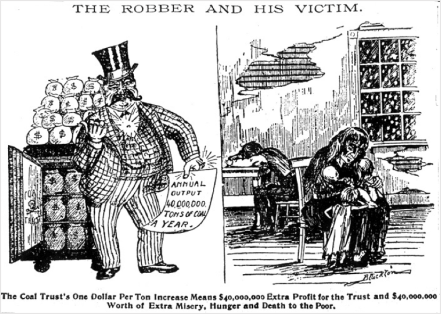
robber barons
Robber barons…

The introduction of criminal sanctions for cartel conduct raise several constitutional concerns. It is likely that, in the event of the imposition of criminal sanctions, the constitutional validity of the relevant Competition Amendment Act provisions will be challenged. In particular, section 73A(5) of the Amendment Act, introduces a reverse onus on the accused, in that the onus for rebutting the Competition Tribunal of Competition Appeal Court’s conclusion rests with the accused in criminal proceedings. The reverse onus’ constitutional validity is questionable given the constitutional right to a fair trial and the right to be presumed innocent.

John Oxenham, also with Pr1merio, notes that the “criminalisation of cartel conduct is a development which needs to be carefully considered and well planned before its official introduction due to the imminent effects it will have on current South African competition law.” The successful prosecution of cartel conduct rests heavily on the efficiency of corporate leniency policies. The introduction of criminal sanctions and in turn the National Prosecuting Authority will undoubtedly have an effect on the current corporate leniency policies. It is important to consider granting the staff of a company applying for corporate leniency in relation to cartel activity ‘full immunity’ from criminal prosecution in order to encourage companies to come forward and not debilitate the very purpose of corporate leniency policies. The careful integration of criminal sanctions is therefore vital in ensuring that the very purpose of its introduction, namely to deter corruption and anti-competitive conduct, is achieved.

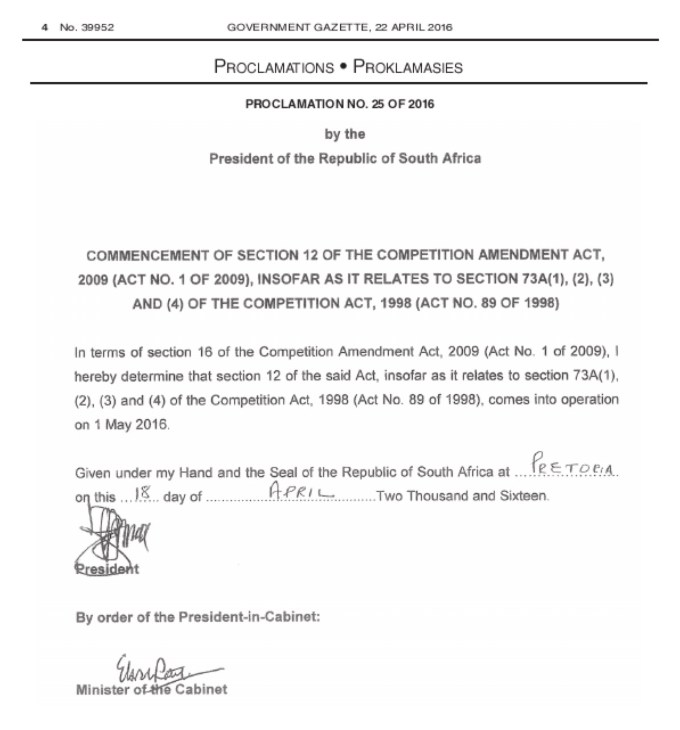
Update [22 April 2016]: As anticipated, the South African government gazetted [published] the official document starting the era of criminal antitrust enforcement under section 73A as of today, signed 18 April 2016:

gazette 73A.jpg